What Is Multithreading in Sales? The Complete, Data-Backed Guide
Your champion just went dark. No reply to the follow-up. No Slack response. You check their profile - they left the company two weeks ago and didn't tell anyone on your side. Forty hours of discovery, a custom demo, and a proposal that took your SE an entire weekend to build. Gone.
This isn't a freak accident. If you're wondering what multithreading in sales actually means and why everyone keeps talking about it, the answer starts here: 40% of deals stall because the primary contact leaves or changes roles. Average B2B buyer tenure has dropped to 18 months. Becc Holland, CEO of Flip the Script, lost two CROs in succession while single-threading a deal - hours of prospecting evaporated each time. If your deal depends on one person, you're not running a sales process. You're holding a lottery ticket.
Sales multithreading is how you stop gambling. And the data behind it is staggering.
What You Need to Know (Quick Version)
Multi-threading means building relationships with multiple stakeholders inside a single account - not just your champion. Here's the cheat sheet:
- The headline stat: Multithreading boosts win rates by 130% in deals over $50K. That's from Gong's analysis of 1.8 million new business deals.
- The risk you're ignoring: Single-threaded deals have a 5% win rate. Five percent.
- The target: Engage 3+ stakeholders per deal, across 2+ roles per meeting.
- The timeline: Expect measurable cycle-time improvement within 30-45 days of adopting a multithreading motion.
- The prerequisite most guides skip: You need verified contact data for every stakeholder you've mapped - not just the one person who filled out your demo form.
Now let's get into the details.
Multithreading in Sales, Defined
Multithreading in sales is the deliberate practice of engaging multiple stakeholders within a target account simultaneously. Instead of relying on a single champion to shepherd your deal through their organization, you build direct relationships with the economic buyer, end users, technical evaluators, and anyone else who can influence - or kill - the purchase.

The term borrows from software engineering, where multithreading means running multiple processes in parallel. Same idea: you're running parallel conversations across the buying committee so that if one thread breaks, the deal doesn't die.
78% of sales reps are single-threaded in most of their deals.
That's the norm. It's also why so many deals stall. And here's the thing: most reps think they're multithreading because they CC'd someone on an email. That's not a multi-threaded approach. That's single-threading with a witness. Real multithreading means each stakeholder has received value from you directly - not just a forwarded deck.
| Single-Threaded | Multi-Threaded | |
|---|---|---|
| Contacts | 1-2 | 5-17 |
| Risk level | High | Low |
| Cycle length | Longer | 53-78 days shorter |
| Win rate | ~5% | 25-35%+ |
The gap isn't subtle. It's the difference between a pipeline that converts and one that evaporates.
Why Multi-Threading Matters More Than Ever in 2026
The data here isn't ambiguous. It's overwhelming.

Gong's analysis of 1.8 million new business deals found that closed-won deals have twice as many buyer contacts as lost deals. In enterprise, won deals average 17 contacts. Multithreading boosts win rates by 130% in deals over $50K. And 77% of deals are already multi-threaded - meaning if you're not doing it, you're behind the majority of your competition.
Aviso's data tells a similar story from the velocity angle. Deals above $50K close 78 days faster with multithreading. Even smaller deals shed 53 days from the cycle. The overall win rate increase? 42%.
UserGems ran their own analysis across 500 opportunities. A single-threaded deal had a 5% chance of closing. With five people engaged, that jumped to 30% - a 6x improvement.
But here's why this matters more now than it did five years ago: buying committees have exploded. Gartner tracked the average B2B buying committee at 6 people in 2015. By 2023, it was 11. Intentsify's research now puts it at roughly 13 people involved in a typical B2B purchase. Some enterprise deals involve 20+. Meanwhile, 94% of buyers now use LLMs during their buying process - they're doing deep research before you ever get a meeting. Buyers spend [only 17% of their total buying time](https://www.gartner.com/en/newsroom/press-releases/2020-09-15-gartner-says-80 - of-b2b-sales-interactions-between-su) with potential suppliers. The rest is internal research, peer conversations, and consensus-building you'll never see.
86% of purchases stall during the buying process. 74% of buying teams experience unhealthy internal conflict - yet teams that reach consensus are 2.5x more likely to consider the outcome a high-quality decision. A multithreaded approach helps build that consensus.
Your champion isn't just your advocate. They're fighting a war inside their own organization. And they're doing it with 17% of their attention on you. If you're not directly engaging the other people in that room, you're hoping your champion wins an argument you can't even hear.
We've seen teams with great products and strong champions lose deals simply because the CFO never heard from anyone on the selling side. The champion tried to "sell internally," got pushback, and went quiet. Threading into multiple stakeholders doesn't just improve your odds - it gives you visibility into what's actually happening inside the account.
And consider this: 81% of buyers end up dissatisfied with their chosen provider. That means even the deals you win single-threaded are fragile - because you never built the multi-stakeholder buy-in that survives implementation friction and renewal conversations.

You can't multithread a deal if you only have one contact's email. Prospeo gives you verified contact data for every stakeholder on the buying committee - 300M+ profiles, 125M+ direct dials, 98% email accuracy. Map the full org chart, not just your champion.
Stop single-threading because you're missing contact data.
Three Types of Multithreading
Most people think of multithreading as "talk to more people." That's relationship multithreading - and it's the most important type. But there are two others that compound the effect.

Relationship Multithreading
This is the core: engaging multiple stakeholders across the buying committee. Not just your champion and their boss, but the end users who'll live in the product daily, the IT team who'll evaluate security, the procurement team who'll negotiate terms, and the executive who signs the check.
The goal isn't just coverage - it's creating multiple advocates. When three people inside an account are excited about your solution, the deal develops its own momentum. One enthusiastic champion is a spark. Three is a fire that's hard to put out.
Channel Multithreading
Different stakeholders prefer different communication channels. Your champion lives in email. The VP responds to a quick video message. The CTO only engages on a phone call.
Channel multithreading means meeting each person where they actually communicate - email, phone, video, events, even direct mail for high-value accounts. A CFO who ignores your email sequence might respond to a 90-second Loom video from your CEO.
Content Multythreading
This is where most teams fall short. You can't send the same pitch deck to every stakeholder and expect it to land. Content multithreading means tailoring materials by role:
- CFO / Economic Buyer: ROI models, cost avoidance analysis, risk reduction frameworks
- Champion: Competitive advantage, speed to value, internal visibility
- IT / Technical: Integration specs, security documentation, scalability benchmarks
- End Users: Workflow demos, ease-of-use comparisons, training timelines
When each stakeholder receives content that speaks to their priorities, you're not just multithreading - you're multi-selling.
Which Stakeholders to Engage (and in What Combination)
Not all stakeholder combinations are created equal. Trumpet analyzed thousands of their Digital Sales Rooms and found specific role combinations that dramatically impact win rates. This is the data that changes how you prioritize your threads.
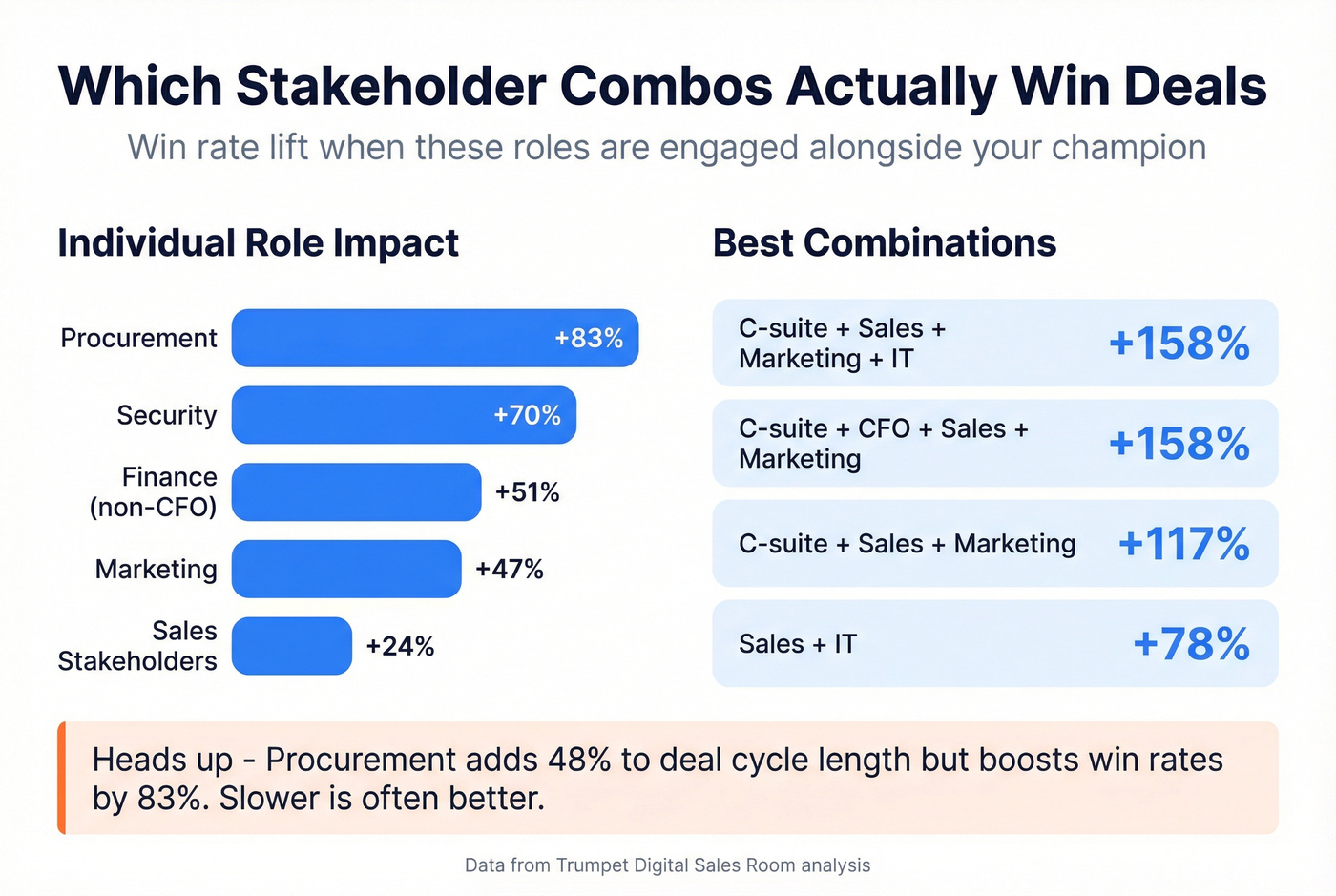
Individual role impact when added alongside a champion:
| Role Added | Win Rate Lift |
|---|---|
| Procurement | +83% |
| Security | +70% |
| Finance (non-CFO) | +51% |
| Marketing | +47% |
| Sales stakeholders | +24% |
The combination data is even more revealing:
| Stakeholder Combo | Win Rate Lift |
|---|---|
| C-suite + Sales + Mktg + IT | +158% |
| C-suite + CFO + Sales + Mktg | +158% |
| C-suite + Sales + Mktg | +117% |
| Sales + IT | +78% |
Here's the counter-intuitive part. Procurement extends deal cycles by 48% but boosts win rates by 83%. Legal extends timelines by 24%. These roles slow you down - and that's a good thing. Deals that survive procurement and legal scrutiny are deals that actually close. The ones that skip those steps are the ones that "stall at legal" in month four.
CFOs hold final decision power in 79% of purchases. 72% of buying teams hire outside advisors who influence the decision. Best-performing deals had 4+ roles working together.
Here are the six roles you should map for every deal worth multithreading:
- Champion - your internal advocate with motivation to push
- Decision-maker - the person who says yes
- Economic buyer - the person who controls budget
- End user - the people who'll use your product daily
- Technical stakeholder - IT, security, integrations
- Legal / Procurement - the gatekeepers who finalize terms
I've watched teams skip the end-user thread because "the VP already bought in." Then the implementation fails because the actual users weren't consulted, and the renewal dies twelve months later. Running a multi-threaded process isn't just about winning the deal - it's about winning a deal that sticks.
How to Multithread - Step by Step
Knowing why to multithread is easy. Execution is the hard part. Here's the framework that actually works, broken into five steps.
Map Your Stakeholders Before the First Call
Before you even schedule discovery, build a stakeholder map. Start with these questions:

- "Who else will be involved in evaluating this solution?"
- "Who else is impacted if we roll this out?"
- "Who signs off on this type of initiative?"
Then reverse-engineer your past wins. Look at your last 5-10 closed-won deals and identify which roles were involved. You'll find patterns - maybe every won deal had IT engaged by week three, or every lost deal was missing the CFO.
Thread to power within your first three touches. Don't wait until the deal is stalling to expand - by then, it's often too late.
Find Verified Contact Data for Every Stakeholder
Here's where every multithreading guide falls apart. They tell you to "engage 5-17 stakeholders" but never address the prerequisite: actually finding accurate contact data for all of them.
Your champion gave you one name. Maybe two. You need direct emails and phone numbers for the CFO, the VP of Engineering, the procurement lead, and three end users. Your CRM has the company name and a generic info@ address.
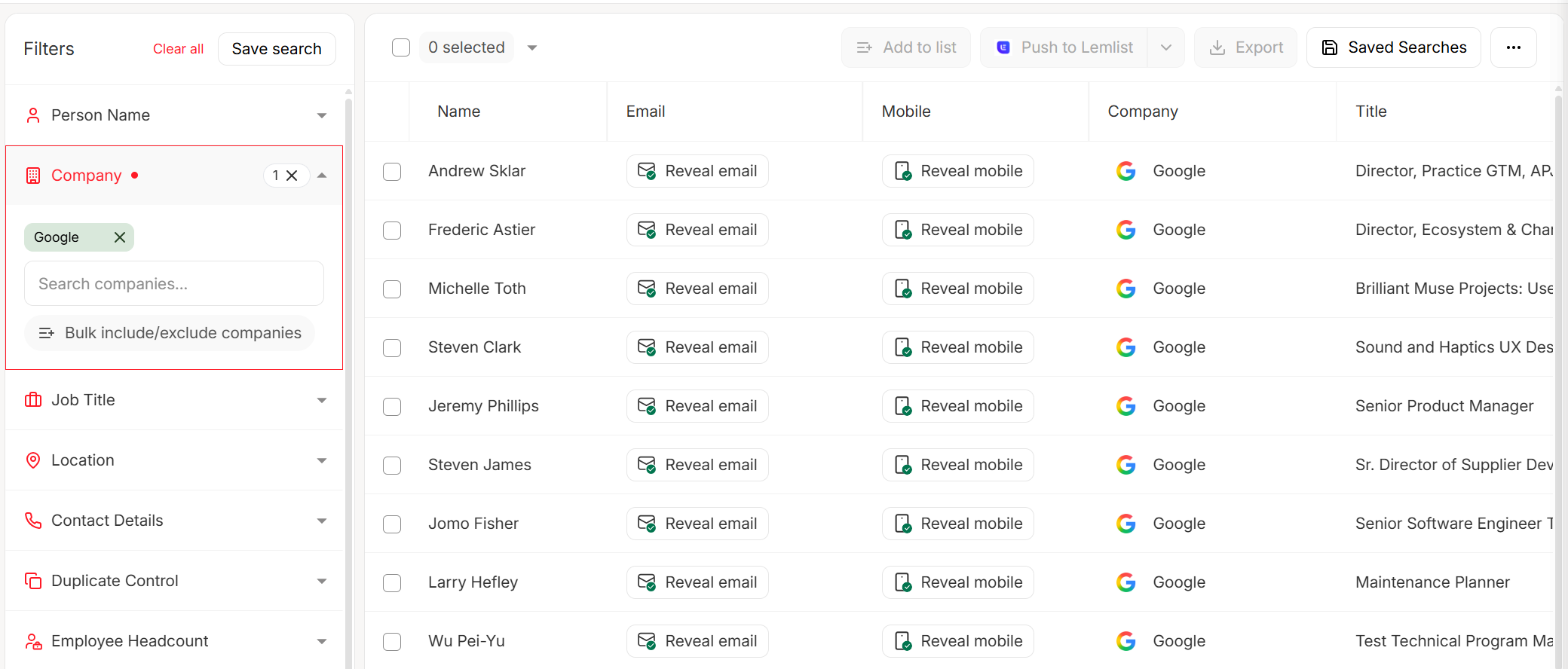
Tools like Prospeo let you search by company, filter by department and seniority, and pull verified emails and direct dials for every stakeholder on your map. A weekly data refresh means you're not reaching out to someone who left the company last quarter - which is exactly the problem multithreading is supposed to solve.

The time investment for quality multi-threading runs 3-5 hours per week per account. Don't waste half of that guessing email formats - use an email lookup workflow and a proper B2B phone number source.
Tailor Your Outreach by Role and Channel
Once you've got contacts, resist the urge to blast the same message to everyone. Persona-based messaging is what separates effective multithreaded outreach from spam (and it’s much easier with clear buyer persona examples):
- CFO / Economic Buyer: Lead with cost avoidance, ROI benchmarking, and risk reduction. "Your team is evaluating [category] - here's what the cost of inaction looks like over 12 months."
- Champion: Competitive advantage, speed to value, internal visibility. "Here's how [similar company] rolled this out in 6 weeks and what their team said after 90 days."
- IT / Technical: Reliability, scalability, integration. "Here's our SOC 2 report, our API docs, and a sandbox environment."
One play that works well for large inbound leads: cold-sequence at least one C-Suite contact letting them know someone on their team is interested. Later in the deal cycle, use exec-to-exec outreach - your CRO reaches out to their CRO as an "executive sponsor" with a value prop tailored to their level (see more on email outreach to executives).
Use Your Champion as a Guide, Not a Gatekeeper
Your champion knows the internal politics. Use that knowledge - but don't make them do all the work.
The "deposits before withdrawals" principle: make three value-add touches to each new stakeholder before asking for anything. Share a relevant case study. Send a benchmark report. Forward an industry insight. Then ask for 15 minutes.
And always - always - tell your champion before you reach out to anyone new. More on this in the mistakes section, but the short version: surprises kill trust, and trust is the only thing holding your deal together.
Bring in Your Own Team (Exec-to-Exec Alignment)
Multithreading isn't just about engaging more of their people. It's about matching seniority.
The same Gong dataset shows selling teams for closed-won deals are 67% larger than those for lost deals. Enterprise reps who bring in a sales engineer for demos increase win rates by up to 30%. Bring your CRO to meet their CRO. Have your CTO join a technical deep-dive with their VP of Engineering. This isn't just relationship-building - it signals organizational commitment. When a prospect sees your leadership investing time, they take the deal more seriously (this is a core lever in enterprise sales).
Multithreading Mistakes That Kill Deals
Kyle Asay opened a LinkedIn post with a DM he received: "I just lost a deal because I multi-threaded to a CEO and went above my champion. He said I betrayed his trust and had a hidden agenda."
That's the fear. And it's valid - but avoidable.
Going Above Your Champion Without Warning
The most common mistake is reaching out to your champion's boss without telling them first. It makes your champion feel like you don't trust their judgment. Worse, it makes them look bad internally - like they couldn't handle the evaluation themselves.
The fix is simple: ask permission. "I'd love to connect with [VP Name] to share some ROI data that's specific to their priorities. Would you be comfortable making an intro, or would you prefer I reach out directly and CC you?"
Kyle Asay's caveat is worth repeating: "The risk of multi-threading is usually overstated. I've seen way more deals lost from NOT multi-threading." The mistake isn't engaging more people. The mistake is doing it behind your champion's back.
Surprising Your Champion with New Contacts
Imagine your champion gets a Slack message from a colleague: "Uh... do you know Kyle from LaunchDarkly? He just emailed me out of nowhere." That's a bad moment. Your champion didn't know you were reaching out, and now they look uninformed.
The fix: loop in your champion before every new outreach. Even a quick heads-up - "I'm going to send [Name] our integration docs since they'll likely be involved in the technical review" - preserves trust and often gets you a warm intro instead of a cold email.
Neglecting Your Original Contacts
Here's one that's less obvious: as you thread upward to executives, don't abandon the people who got you in the door.
Junior employees often have real influence. Many executives won't greenlight a purchase their team isn't excited about. The LaunchDarkly example from Kyle Asay includes a specific talk track for engaging a VP of Product when you're already working with the VP of Engineering - acknowledging the existing relationship while adding value for the new contact's specific priorities. It's threading across, not just up.
When NOT to Multithread
Not every deal needs five threads. Nate Nasralla, founder of Fluint, coined the concept of the "minimum viable buying committee" - the smallest group who can validate, fund, and implement the deal. Sometimes that's one person.
If your average deal size is under $10K, you probably don't need a multithreaded strategy at all. The 3-5 hours per week per account that quality multithreading demands simply doesn't pencil out for transactional volume. Save it for your top 20% of opportunities.
Skip multithreading when:
- Low-ACV transactional sales - the buyer has a credit card and authority, don't overcomplicate it
- Single-user tools - one person buys it, one person uses it, done
- Truly centralized buying - some orgs genuinely have one decision-maker with full authority
- Early discovery - before you've identified a clear problem and champion, expanding contacts is premature
Measuring Multithreading Success
You can't improve what you don't measure. Here are the benchmarks that matter:
| Metric | Target |
|---|---|
| Threads per account | 3+ |
| Roles per meeting | 2+ |
| Active thread definition | Responded in last 14 days |
| Time to improvement | 30-45 days |
An "active thread" means a contact who's responded to outreach in the last 14 days. If your champion replied three months ago and you haven't heard since, that's not a thread - that's a ghost.
67% of stalled pipeline comes from the main point of contact going dark or leaving. Track your thread count per deal in your CRM. Create a custom field for "Active Thread Count." Flag any deal over $50K with fewer than three active threads. Make it a mandatory field in your deal review template (tie this into your broader B2B sales pipeline management).
Gartner predicts that by 2026, organizations using multi-threaded commercial engagements will realize revenue growth that outperforms competition by 50%. The teams that build this muscle now will compound the advantage.
Tools That Make Multithreading Work
Your CRM tracks the deal. Your engagement platform sequences the outreach. Neither helps if you don't have accurate contact data for every stakeholder. Here's the stack that makes multithreading operational:
Contact Data - Prospeo (the foundation layer)
Prospeo covers 300M+ profiles with 143M+ verified emails and 125M+ verified mobile numbers. The Chrome extension lets you pull contact data from any company website in one click. Pricing runs about $0.01 per email with a free tier (75 emails + 100 Chrome extension credits/month). No contracts, self-serve, GDPR compliant (more on GDPR for Sales and Marketing).
CRM - Salesforce, HubSpot
You need somewhere to track thread count per deal and flag single-threaded opportunities. HubSpot has a free tier; paid plans run $20-150/user/month. Salesforce starts around $25/user/month.
Sales Engagement - Salesloft, Outreach
Multi-channel sequences tailored by persona. Expect roughly $100-150/user/month. These platforms let you run parallel sequences to different stakeholders without losing track of who's heard what (see sales sequence best practices).
Revenue Intelligence - Gong
Conversation intelligence shows you which stakeholders are engaged, what they care about, and where deals are at risk. Enterprise pricing, typically $30-100K+/year. Worth it if you're running complex enterprise deals.
Job Change Tracking - UserGems
When your champion leaves, UserGems alerts you so you can re-thread immediately - and follow your champion to their new company. Custom pricing, typically around $1-3K/month (pair this with an automated champion tracking workflow).
Here's what matters most: the best multithreading playbook in the world fails if your contact data is stale. We've seen teams map 12 stakeholders, build beautiful account plans, and then bounce 40% of their emails because the data was six months old. Start with accurate data. Everything else follows.
Won deals average 17 contacts. That means you need 17 verified emails and direct dials - not guesses. Prospeo's 30+ filters let you find economic buyers, technical evaluators, and end users at any account, with data refreshed every 7 days so you're never reaching someone who left two weeks ago.
Your champion just left. Your other 16 threads didn't.
FAQ
How many stakeholders should I engage per deal?
Target 3+ for mid-market and 5-17 for enterprise. Gong's data shows closed-won enterprise deals average 17 contacts. Start with the minimum viable buying committee and scale up as the deal progresses.
How is multithreading different from going over someone's head?
Multithreading means engaging multiple stakeholders with your champion's knowledge and consent. Going over someone's head means bypassing them without warning. The difference is transparency - always loop in your champion before reaching out to anyone new in their org.
How do I find contact information for multiple stakeholders at one company?
Use a B2B data platform that lets you search by company, filter by department and seniority, and pull verified emails and direct dials in one search. This replaces guessing email formats or relying on your champion for every introduction - and a weekly data refresh keeps contacts current.
When should I start multithreading in a deal?
Start before the first meeting if possible - thread to power within the first three touches. Waiting until late-stage to expand contacts is one of the most common mistakes. By the time a deal stalls, it's too late to build new relationships from scratch.
Does multithreading work for SMB or transactional sales?
Not always. For deals under $15K with a single decision-maker, single-threading is fine. Multithreading adds the most value in deals over $50K with multiple departments involved. The 3-5 hours per week it requires doesn't pencil out for high-velocity, low-touch sales motions.