

How to Build Cold Email Automation That Actually Nurtures Leads
A RevOps lead we know launched a 500-email sequence from a brand-new domain last quarter. No warm-up, no verification, no ramp plan. By day three, Gmail flagged the domain. By day five, every email - including internal ones - landed in spam. The domain was toast, and so was the pipeline it was supposed to build.
That's the scenario nobody warns you about when they sell you on cold email automation for lead nurturing. The tools make it easy to send. They don't make it easy to send well - or to turn cold touches into a nurturing engine that moves deals forward over months.
What You Need Before Anything Else
This workflow only works when you nail three things in order:
- Clean data. Verified emails, accurate firmographics, no stale records. Aim for 98% accuracy with weekly refreshes - bad data kills everything downstream. (If you’re fighting decay, start with CRM hygiene.)
- Deliverability infrastructure. SPF, DKIM, DMARC, domain warm-up, sending caps. Skip this and you're burning domains. Use an email deliverability checklist before you send anything.
- A sequence-to-nurture workflow. A data provider, a sequencer, and a CRM. That's the stack. Not eight tools. Three. If you’re rebuilding your stack, use a B2B sales stack blueprint.
Follow-Ups vs. Nurturing
These aren't the same thing, and conflating them is how teams waste sequences.
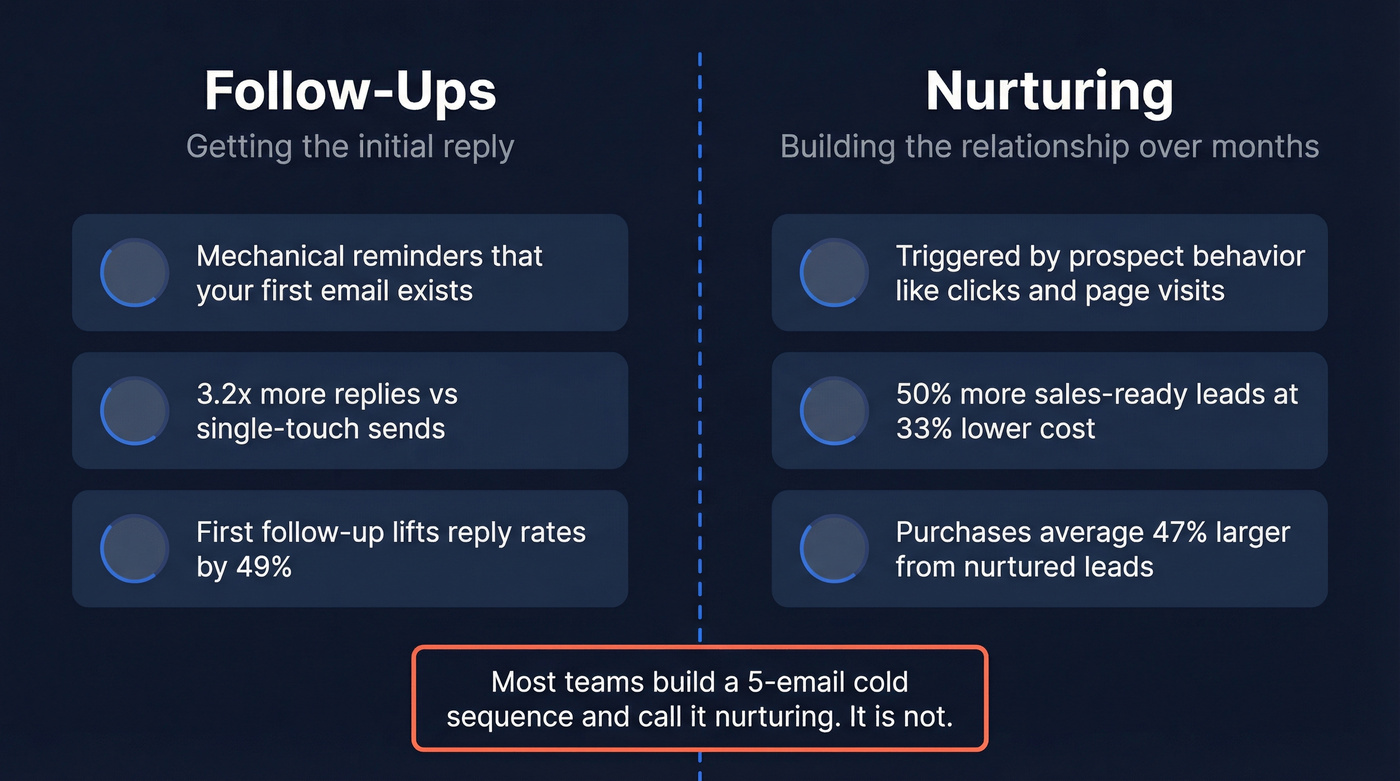
Follow-ups get the initial reply. Campaigns with follow-ups generate 3.2x more replies than single-touch sends, and your first follow-up alone lifts reply rates by 49%. Follow-ups are mechanical - reminders that your first email exists. If you need better copy patterns, pull from these outreach email templates.
Nurturing starts after someone engages. It's the case study you send when a prospect clicks your pricing link. It's the industry insight that lands two months after the initial sequence paused. Most teams build a 5-email cold sequence and call it "nurturing." It's not. You got 47 replies from your last campaign - what happens next? If the answer is "the rep follows up manually whenever they remember," you don't have a nurture system. You have a hope system. (For a deeper framework, see lead nurturing strategy.)
What the Data Says
Belkins analyzed 16.5 million cold emails across 93 business domains. The benchmarks are sobering:
| Metric | Number | Context |
|---|---|---|
| Avg reply rate | 5.8% | Down from 6.8% the prior year |
| Single-email reply rate | 8.4% | No follow-up dilution |
| Reply drop by email 3 | -20% | Diminishing returns hit fast |
| First follow-up lift | +49% | The biggest single lever |
| Spam rate, email 1 | 0.5% | Manageable |
| Spam rate, email 4 | 1.6% | Danger zone |
Keep the cold phase short - one to three emails. By email four, spam complaints rise sharply and response rates drop hard. If you’re pushing volume, follow cold email volume best practices.
For target-setting, 5-10% reply rates are good for B2B cold email, 10-15% is excellent, and above 15% means your targeting and copy are elite.
Here's why the nurture track matters more than the cold sequence: 40.4% of B2B buyers take 6-12 months to make a purchase decision, and another 15.4% take over a year. During that window, 45.8% consume seven or more content pieces. If you're not feeding them value after the cold sequence ends, someone else is.
Technical Setup Before You Send
None of your sequence design matters if emails don't reach the inbox.
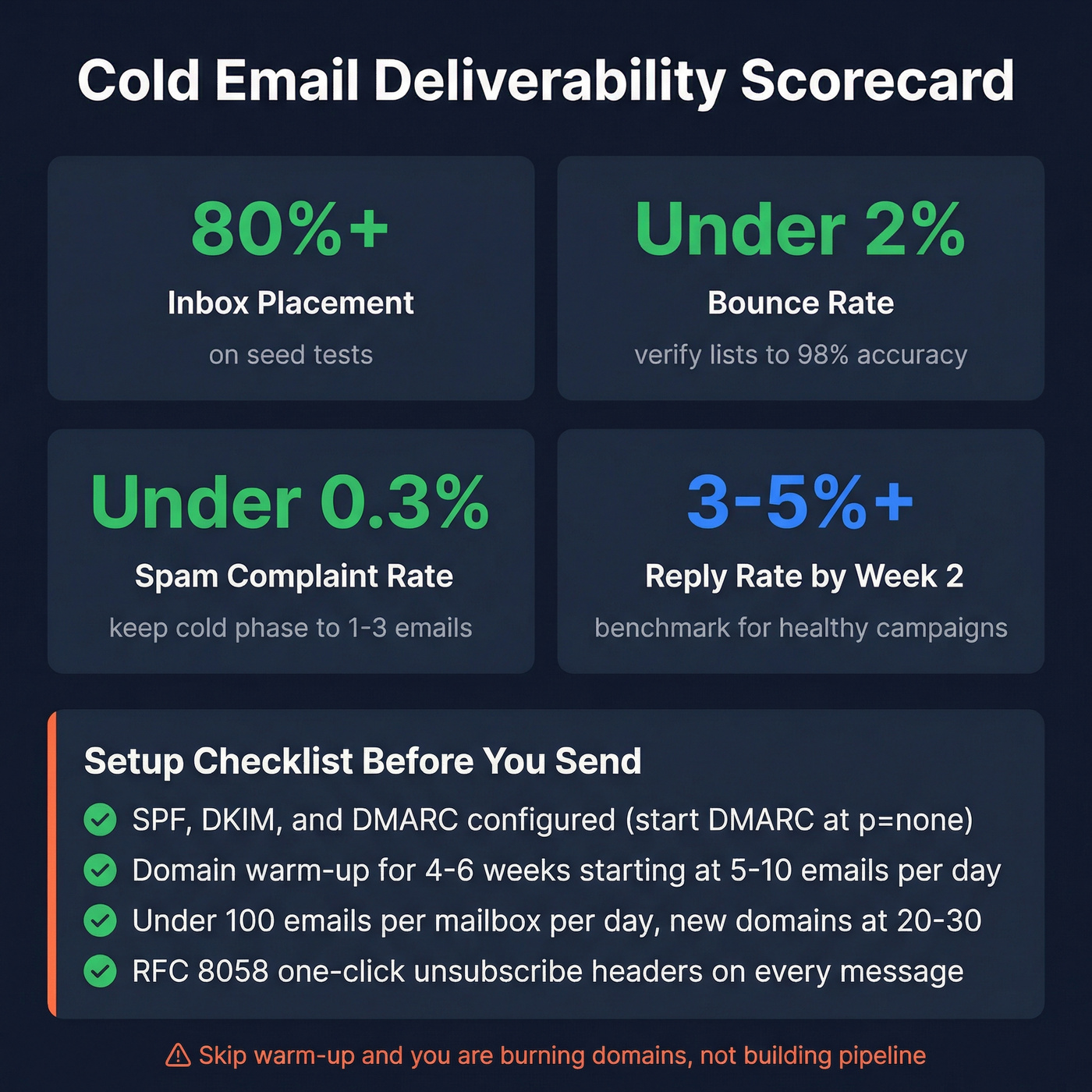
Authentication (do this first):
- SPF, DKIM, DMARC configured for your sending domain (start DMARC at p=none, move to quarantine)
- Custom tracking subdomain to isolate reputation
Domain warm-up: Start at 5-10 emails per day. Increase gradually over 4-6 weeks. Don't touch production sends until warm-up is complete. The bulk sender enforcement rules from Google and Yahoo aren't optional - you need RFC 8058 one-click unsubscribe headers on every message. Microsoft is following suit with similar requirements. For a full warm-up plan, use this automated email warmup guide.
Here's the thing: the most common mistake we see in cold email communities is teams skipping warm-up entirely, then blaming the tool when deliverability tanks. Don't be that team.
Sending caps: Under 100 emails per mailbox per day. New domains stay at 20-30/day during ramp. Custom SMTP setups stay under 50/day - they lack the trust signals of Gmail and Outlook infrastructure.
Scorecard targets:
| Metric | Target |
|---|---|
| Inbox placement | 80%+ on seed tests |
| Bounce rate | Under 2% |
| Spam complaint rate | Under 0.3% |
| Reply rate by week 2 | 3-5%+ |
Run your list through a verification tool before loading it into any sequencer. 98% verified-email accuracy helps keep bounces under the 2% threshold that protects your sender reputation. If you’re comparing vendors, start with the best email checker tool options.

You just read it: bounce rates above 2% destroy sender reputation and kill your nurture pipeline before it starts. Prospeo's 5-step email verification delivers 98% accuracy with a 7-day refresh cycle - so the contacts entering your cold sequences are real, current, and reachable.
Stop burning domains on stale data. Verify before you send.
Building Your Cold-to-Nurture Sequence
Three emails in the cold phase, then a branching handoff into nurture tracks.
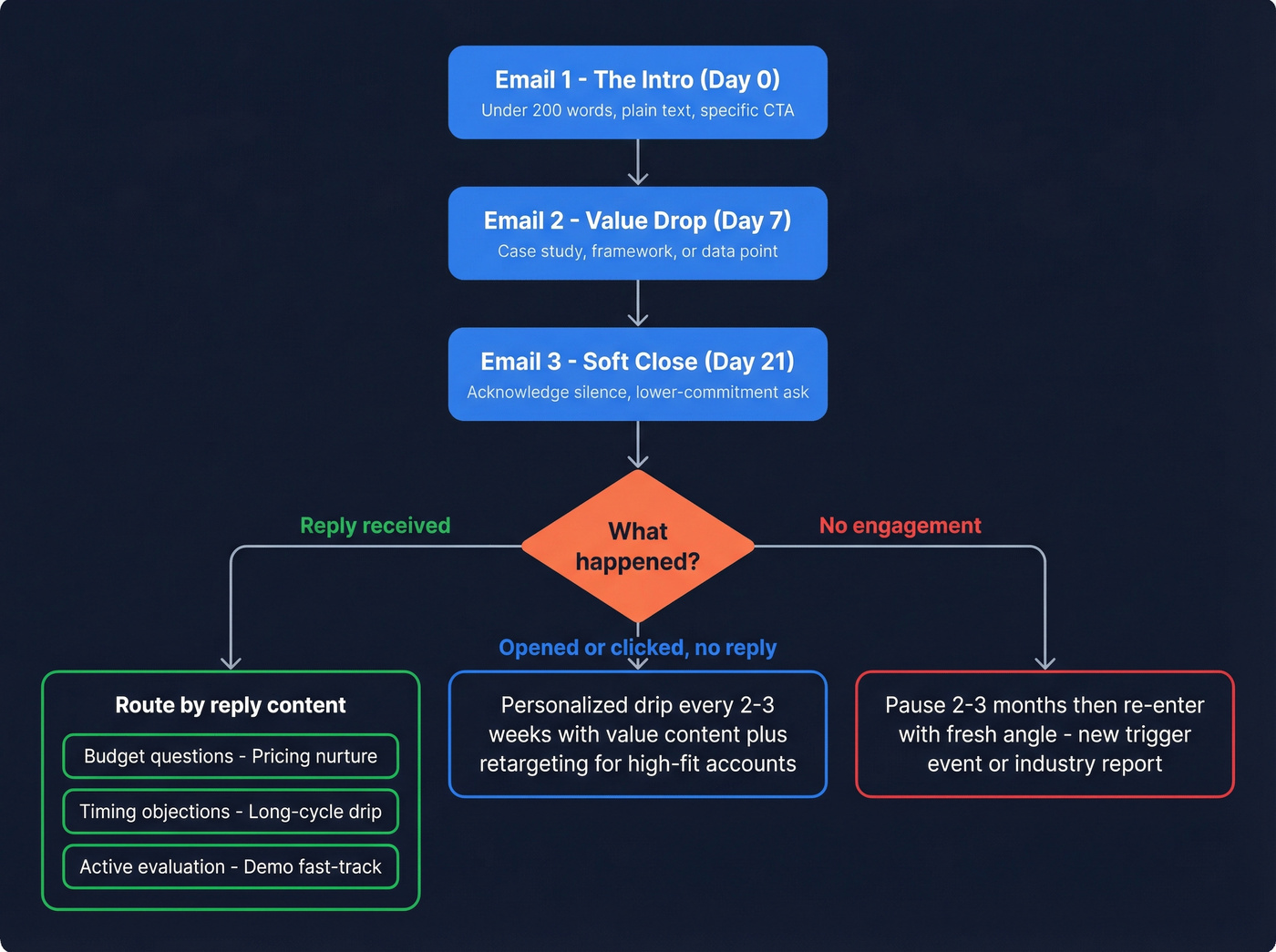
Email 1 - The Intro (Day 0)
Short. Under 200 words. One specific observation about their company, one clear value proposition, one concrete CTA. "15-minute call next Thursday" beats "let me know if you're interested" every time. Send plain text - no HTML templates, no images. It reads like a real email because it is one. If you want to tighten structure, use this sales email structure.
Email 2 - The Value Drop (Day 7)
Don't follow up on your first email. Send something new: a case study from their industry, a framework they can use immediately, a data point relevant to their role. This is where you start earning the right to nurture. A/B test subject lines here - the value-add framing ("Your Q3 pipeline math" vs. "Quick follow-up") makes a measurable difference.
Email 3 - The Soft Close (Day 21)
Acknowledge the silence. Offer a different angle or a lower-commitment ask. "Would a 2-minute video walkthrough be more useful than a call?" Keep it light. This is your last cold touch. When you need a clean re-entry later, use re-engagement email subject lines.
After Email 3 - The Branch
Reply received: Route to a nurture track based on reply content. Budget questions go to a pricing nurture, timing objections go to a long-cycle drip, active evaluation goes to a demo fast-track.
Opened/clicked, no reply: They're interested but not ready. Build a personalized drip that sends value content every 2-3 weeks, layering in a call or retargeting touch for high-fit accounts.
No engagement: Pause for 2-3 months. Re-enter with a completely fresh angle - a new trigger event at their company, a relevant industry report, or a "saw this and thought of your team" share. Never rehash the original sequence.
Let's be honest about where most teams get this wrong: they over-invest in cold sequence optimization and under-invest in what happens after. Your cold sequence is a filter. The nurture tracks are where 50% more sales-ready leads come from - at 33% lower cost, with purchases averaging 47% larger.
Lead Scoring for Cold-to-Warm Handoff
Without scoring, your reps are guessing which replies to prioritize.
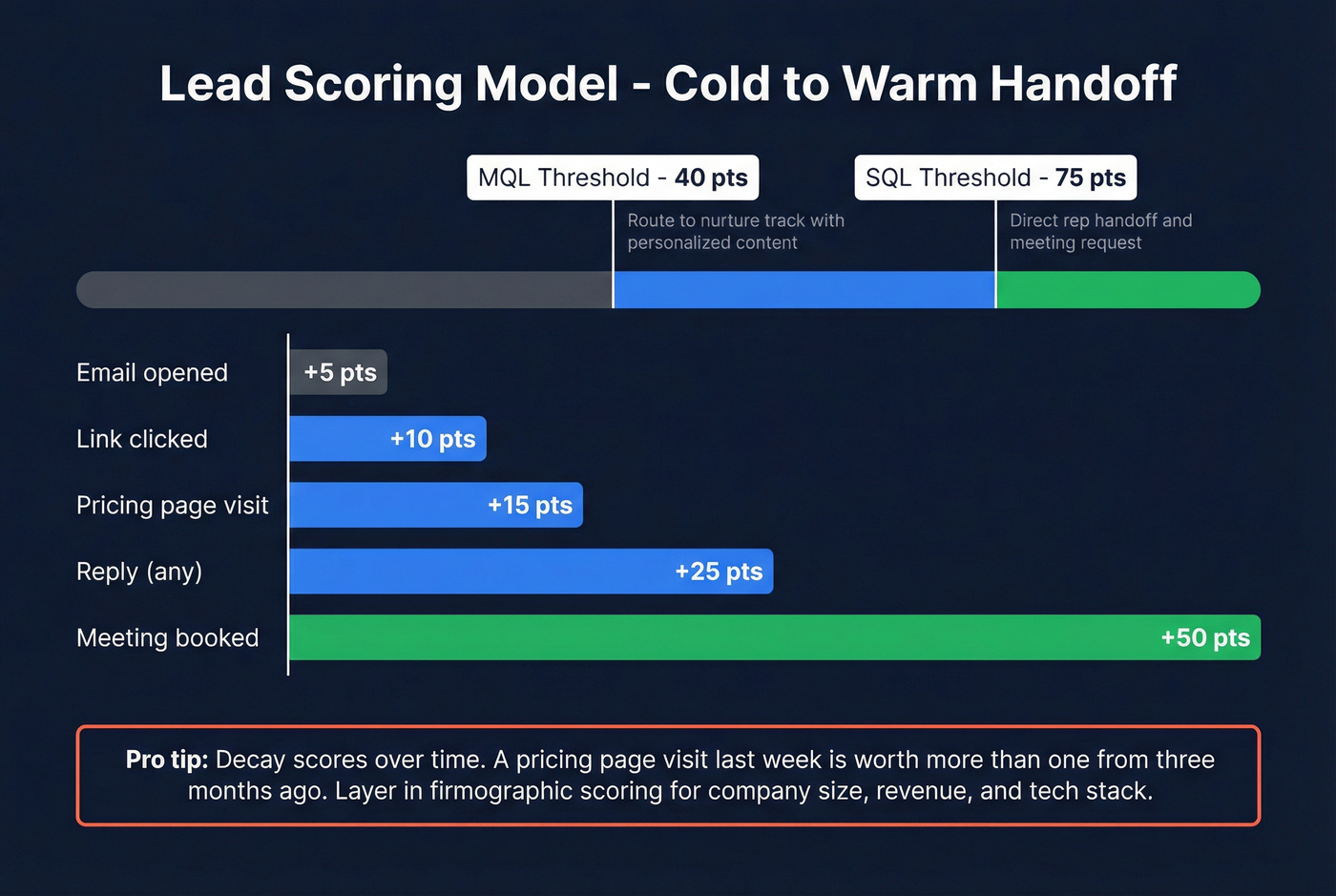
| Action | Points |
|---|---|
| Email opened | +5 |
| Link clicked | +10 |
| Pricing page visit | +15 |
| Reply (any) | +25 |
| Meeting booked | +50 |
MQL threshold: 40 points. This prospect gets routed to a nurture track with more frequent, personalized content. SQL threshold: 75 points. Direct rep handoff and a meeting request.
Decay scores over time - a pricing page visit last week is worth more than one three months ago. And layer in firmographic scoring so you're not just measuring behavior but fit: company size, revenue, tech stack, and funding stage all matter. If you want a full build, use this guide on how to build a lead scoring system.
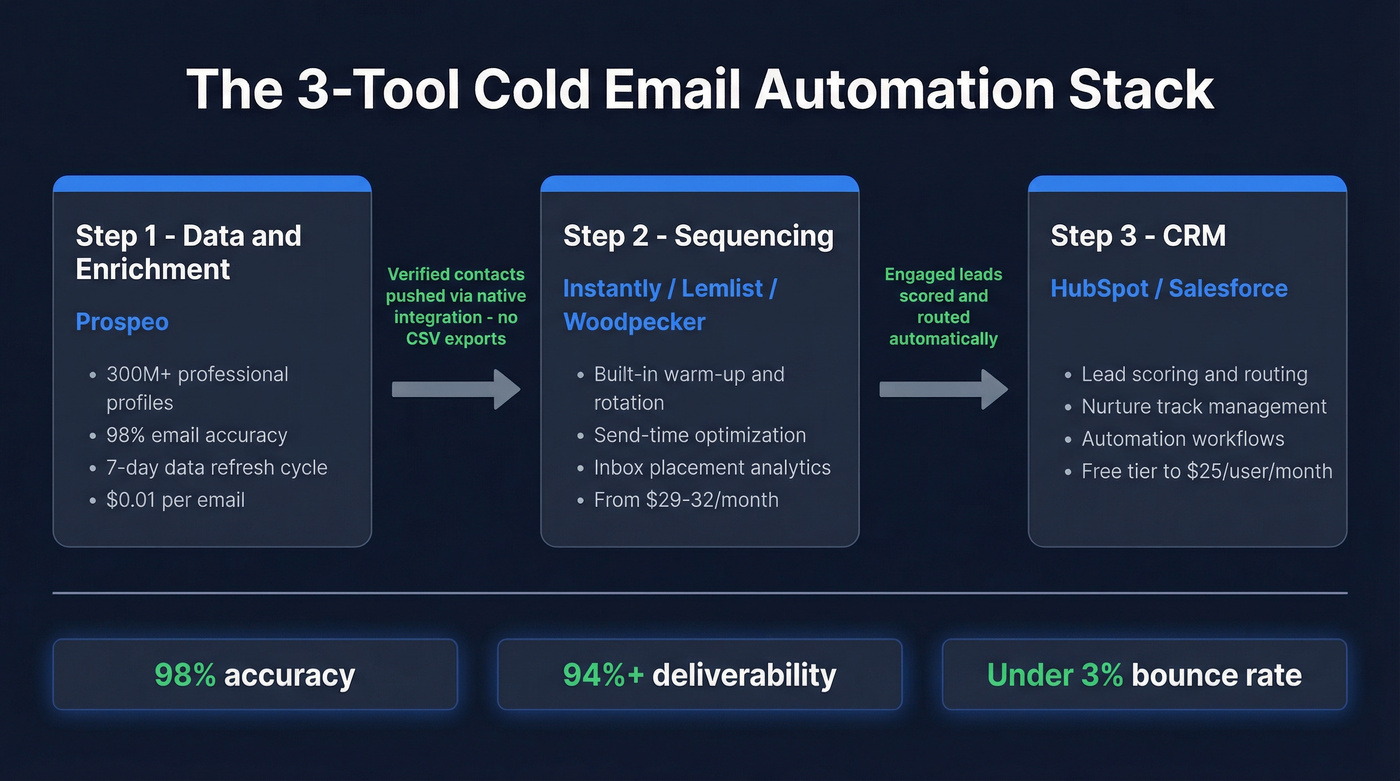
The Three-Tool Automation Stack
You need a data provider, a sequencer, and a CRM. That's it.
Data & Enrichment - Prospeo
Your sequencer is only as good as the data feeding it. Prospeo covers 300M+ professional profiles with 143M+ verified emails at 98% accuracy, verified through a proprietary 5-step process that includes catch-all handling, spam-trap removal, and honeypot filtering. The 7-day data refresh cycle means you're not emailing people who changed jobs six weeks ago - a problem that plagues providers on the typical 4-6 week refresh schedule. (If you want the underlying ops, see data enrichment for cold email.)
Native integrations with Instantly, Lemlist, and Smartlead push verified contacts straight into your sequencer with no CSV exports or manual imports. Stack Optimize built from $0 to $1M ARR using this workflow, maintaining 94%+ deliverability and under 3% bounce rates across all clients.
Pricing runs about $0.01 per email, with a free tier of 75 emails and 100 Chrome extension credits per month.

Sequencing & Deliverability
Instantly is the go-to for deliverability-first teams. Built-in warm-up, mailbox rotation, and send-time optimization keep you out of spam, with inbox placement analytics. Plans start around $30/month.
If you want prospecting and sending in one tool, Lemlist bundles a 450M+ lead database with its sequencer plus multi-channel sequences from $32/user/month. If you’re evaluating options, compare more cold email marketing tools.
Woodpecker is the no-frills option: solid sequencing, good deliverability defaults, $29/month for up to 500 contacted prospects and 6,000 emails/month. Skip this one if you need multi-channel - it's email-only and doesn't pretend otherwise.
CRM
HubSpot is the SMB default - free CRM, automation workflows starting around $20-$30/month on Starter. Good enough for scoring and nurture track management until you outgrow it.
Salesforce is the enterprise standard, starting around $25/user/month for entry tiers. If you're already on it, build your scoring and routing there rather than adding another tool.
The 3-tool stack this article recommends - data provider, sequencer, CRM - starts with data you can trust. Prospeo gives you 300M+ profiles with 30+ filters including buyer intent and job changes, so your cold-to-nurture sequences reach the right people at the right time. At $0.01 per email, scaling from hundreds to thousands of nurtured leads doesn't break the budget.
Build nurture lists that actually convert - starting at a penny per lead.
Staying Legal
Cold email isn't illegal, but doing it wrong gets expensive fast.
United States (CAN-SPAM): Accurate headers, no deceptive subject lines, identify the message as commercial with a valid physical address, and honor unsubscribe requests within 10 business days with a working opt-out mechanism in every email.
EU (GDPR + ePrivacy): Requires explicit consent or documented legitimate interest for B2B outreach. Disclose your identity, how you obtained their data, and provide a clear opt-out. Penalties reach EUR 20M or 4% of global annual turnover. For the practical outbound version, use GDPR for sales and marketing.
Canada (CASL): Consent-centric with a narrower implied-consent window than CAN-SPAM.
Australia: AU$14M+ in spam-related penalties collected between 2023 and 2025.
Real talk: 44% of recipients unsubscribe due to high email frequency. The compliance risk isn't just legal - it's reputational. Keep sequences short, unsubscribe links visible, and sending frequency respectful.
FAQ
How many cold emails should I send per day?
Cap at 100 per mailbox per day. New domains start at 20-30/day and ramp over 4-6 weeks. Custom SMTP setups stay under 50/day. Going higher risks burning your sender reputation before your nurture engine ever gets a chance to work.
What's a good reply rate for B2B cold email?
5-10% is solid, 10-15% is excellent, and above 15% means your targeting is elite. The industry average across 16.5 million emails was 5.8% - hitting 8%+ puts you ahead of most outbound teams.
What tools do I need for automated lead nurturing via cold email?
Three: a data provider like Prospeo for verified contacts, a sequencer with deliverability features like Instantly or Lemlist, and a CRM for scoring and handoff like HubSpot or Salesforce. Tool sprawl creates paralysis - every additional integration is another point of failure.
How long should a nurture sequence last?
The cold phase should be three emails over about three weeks. The nurture phase has no fixed end date - it runs as long as the prospect fits your ICP and hasn't opted out. Since 40%+ of B2B buyers take 6-12 months to decide, plan for at least that window with value touches every 2-3 weeks.
What's the difference between follow-ups and lead nurturing?
Follow-ups are mechanical reminders designed to get a first reply - they reference your original email and ask for a response. Nurturing delivers new value based on the prospect's behavior and stage. A follow-up says "bumping this." A nurture email says "here's the ROI framework your CFO will want" - triggered by what the prospect did, not just a timer.