The Sales Email Structure That Actually Gets Replies
The average cold email pulls a 3.43% reply rate. That means 96 out of 100 prospects ignore you. The gap between that average and the top quartile (5.5%+) isn't better copy or a fancier tool - it's structure. A repeatable framework that tells the reader what you want, why it matters to them, and what to do next, in under 80 words.
The Cheat Sheet
Short on time? Start with PAS (Problem → Agitate → Solution) - it works across most industries and deal sizes. Keep emails under 80 words, use a single CTA, plan 4-7 touchpoints where each follow-up adds new value, and write subject lines in the 61-70 character range. Skip emojis. The frameworks section below breaks down your five best options.
Core Elements of Every Sales Email
Every effective outbound email has five elements, whether you're conscious of them or not.
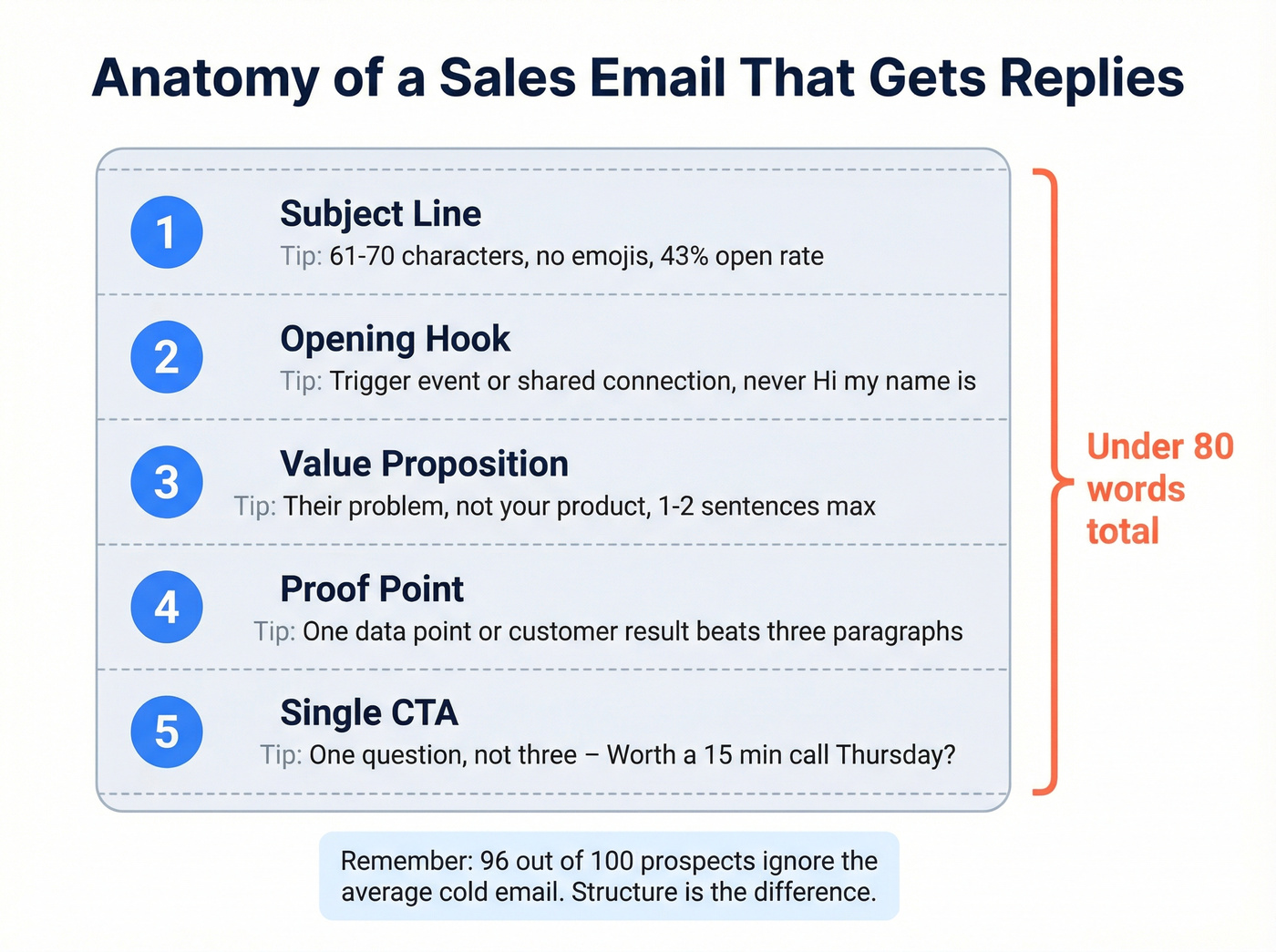
Subject line. This is your gatekeeper. 69% of recipients mark emails as spam based on the subject line alone. Subject lines in the 61-70 character range hit a 43.38% open rate - the sweet spot. No-emoji subjects outperform emoji subjects 42.23% to 37.5% on opens. For more deliverability-safe phrasing, see words to avoid and email subject line spam.
Opening hook. Your first sentence earns the second. Reference a trigger event, a shared connection, or a company milestone. Never open with "Hi, my name is..." If you need examples, borrow a few patterns from how to start an email or test a lighter tone with funny email openers.
Value. Why should this person care? Connect their world to your solution in one or two sentences. This is about their problem, not your product.
Proof. A single data point, a customer name, a result. "We helped [similar company] cut X by 30%" does more than three paragraphs of feature descriptions.
CTA. One clear ask. A question works best - "Worth a 15-minute call Thursday?" beats "Let me know if you'd like to learn more." Limiting yourself to one question per email keeps the ask focused. Prospects who face multiple questions tend to answer none. If you want more options, use these open-ended sales questions or follow the structure in how to ask for a meeting via email.
5 Proven Frameworks
Pick one, adapt it to your voice, and run it for two weeks before switching. These frameworks are for cold outbound - renewal, nurture, and post-sale emails follow different rules.
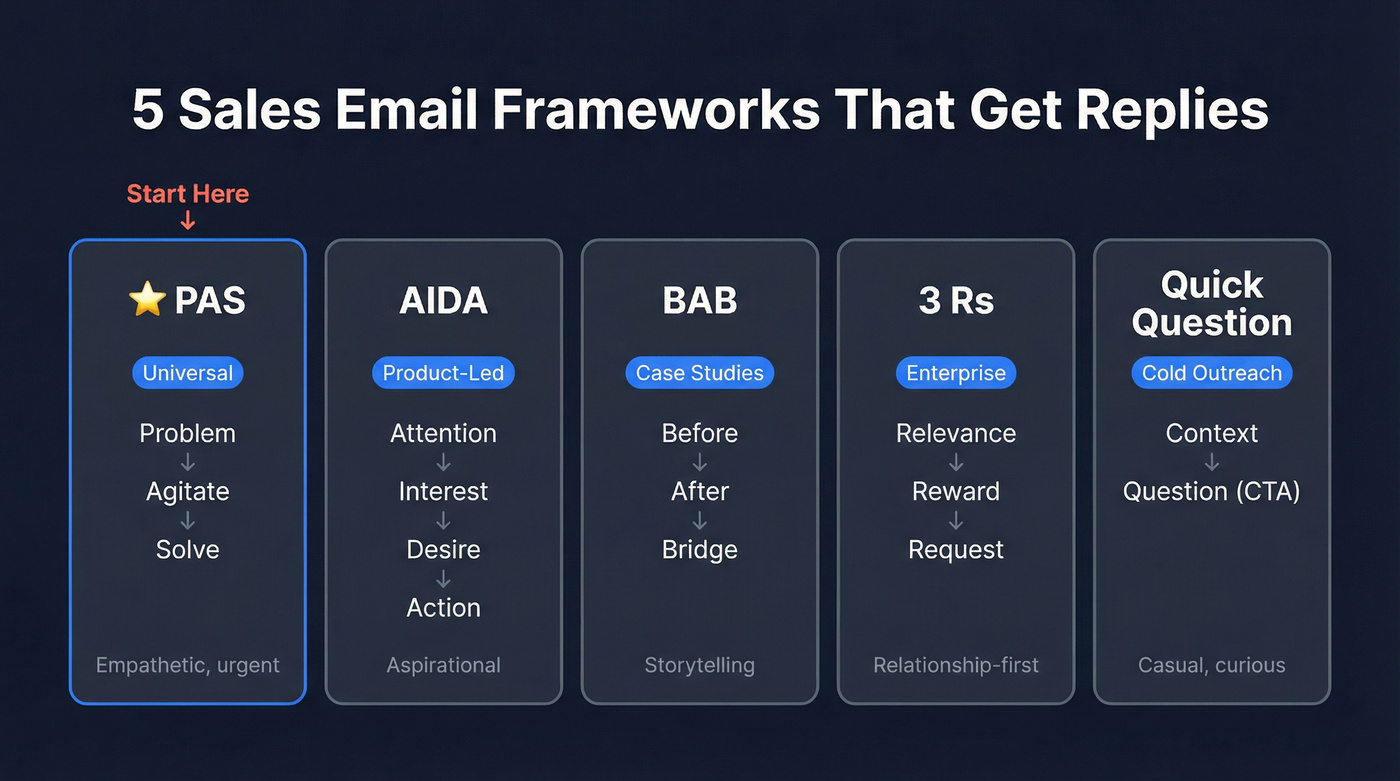
PAS (Problem → Agitate → Solution) ★ Recommended
PAS is the default for a reason. It works for any industry, deal size, or seniority level. You name the prospect's problem, twist the knife on why it's costing them, then offer the way out.
Here's what it looks like in practice:
"Scaling outbound without verified data means your reps burn 2-3 hours a day on bounced emails and wrong numbers. That's $40K+ in wasted SDR salary per year. We built Acme to fix that - want to see how Initech cut their bounce rate to under 3%?"
Fifty words. Problem, agitation, solution, CTA. Done.
We've tested PAS against every other framework on this list across dozens of campaigns, and it consistently pulls the highest reply rates when you don't have a strong product demo moment or a killer case study to lead with. It's the framework most SDR communities on Reddit default to, and for good reason - it forces you to lead with the prospect's pain instead of your pitch.
AIDA (Attention → Interest → Desire → Action)
Best for product-led pitches with a clear wow factor. Grab attention with a bold hook, build interest with a relevant insight, create desire with a specific outcome, then drive action with a low-friction ask. If your product has a demo moment that sells itself, AIDA is your framework. Skip it if you're selling services or anything that requires a consultative conversation to land.
BAB (Before → After → Bridge)
Best for case-study-driven outreach. Paint the "before" (their current pain), show the "after" (the result you've delivered), then bridge the gap with your offer. This one shines when you have a concrete, numbers-backed transformation story to tell.
The 3 R's (Relevance → Reward → Request)
Winning by Design's framework is built on a core truth: you can't sell over email. Email earns the meeting. Show relevance, offer a reward like an insight or resource, then make a request. Especially useful for enterprise and consultative sales where the ask is a conversation, not a click.
Quick Question
Best for ultra-cold outreach with minimal context. One sentence of context, one question as the CTA. "Noticed [company] is hiring 3 AEs - are you also scaling your outbound data stack?" The brevity itself signals respect for the prospect's time, and concise emails consistently outperform longer pitches in reply rate benchmarks.
| Framework | Structure | Best For | Tone |
|---|---|---|---|
| ★ PAS | Problem → Agitate → Solve | Universal | Empathetic, urgent |
| AIDA | Attention → Interest → Desire → Action | Product-led pitches | Aspirational |
| BAB | Before → After → Bridge | Case-study outreach | Storytelling |
| 3 R's | Relevance → Reward → Request | Enterprise / consultative | Relationship-first |
| Quick Question | Context → Question (CTA) | Cold, low context | Casual, curious |
What the Data Says About Length
Reply rates dropped 15% year-over-year, from 6.8% to 5.8% across 16.5M cold emails studied by Belkins. Every structural advantage counts now. Here's what the numbers reward:
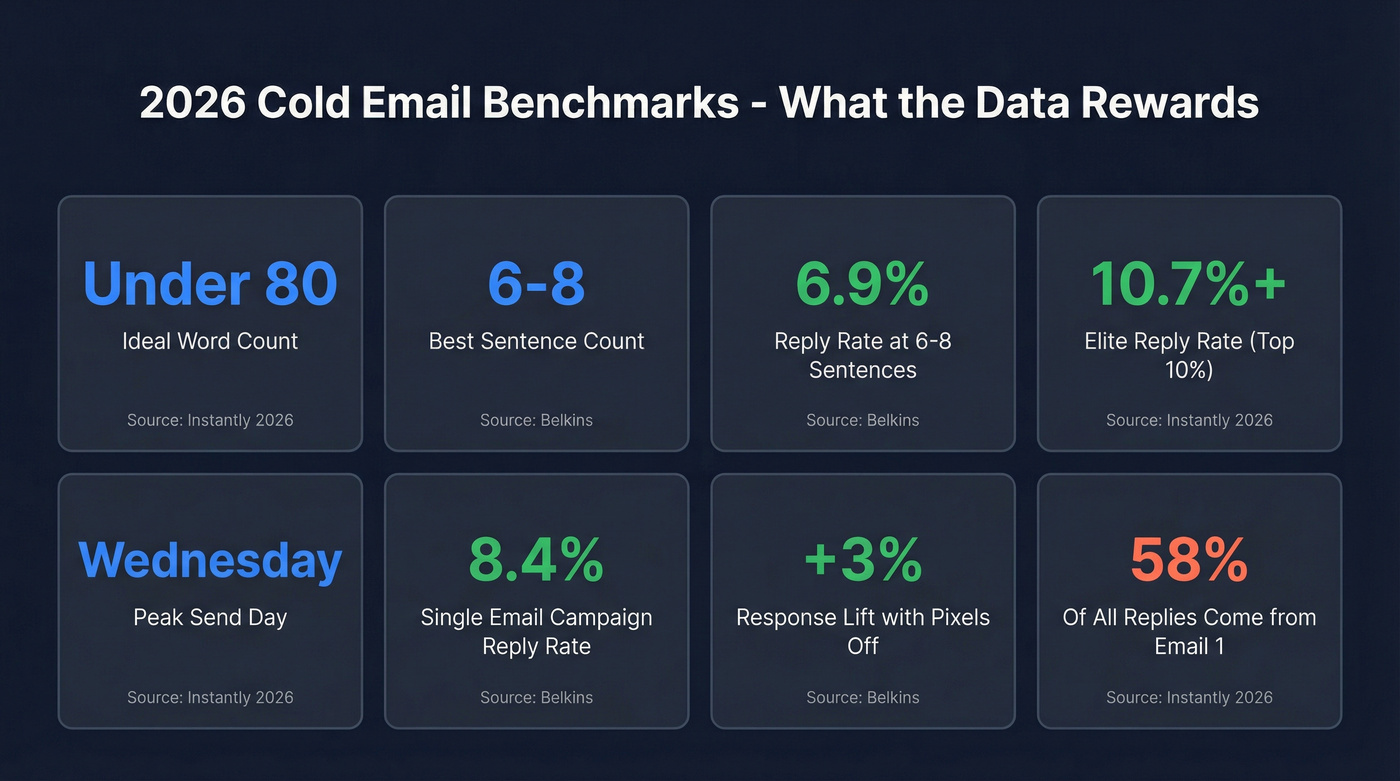
| Metric | Benchmark | Source |
|---|---|---|
| Ideal word count | Under 80 words | Instantly 2026 |
| Best sentence count | 6-8 sentences | Belkins |
| Reply rate at 6-8 sentences | 6.9% | Belkins |
| Elite reply rate (top 10%) | 10.7%+ | Instantly 2026 |
| Peak send day | Wednesday | Instantly 2026 |
| Single-email campaign reply rate | 8.4% | Belkins |
| Tracking pixels off vs. on | +3% response lift | Belkins |
The tracking pixel stat deserves attention. Turning off open tracking lifted response rates by 3%. We've seen the same pattern across our own campaigns - pixels add deliverability risk with minimal upside once you're measuring replies instead of opens. If you want the deeper deliverability angle, read does open tracking hurt cold email and email deliverability tracking.
Now for the contrarian finding: one-email campaigns pulled an 8.4% reply rate, higher than the 5.8% average across all campaign types. That doesn't mean you should only send one email. It means your first email needs to stand alone, because 58% of all replies come from step one.

The best sales email structure in the world won't save you if 35% of your emails bounce. Prospeo delivers 98% verified email accuracy with a 7-day refresh cycle - so every PAS, AIDA, or BAB email you craft actually lands in a real inbox.
Stop perfecting emails that bounce. Start sending to verified addresses.
How to Optimize for Replies
Beyond choosing the right framework, a few tactical adjustments can meaningfully lift performance.
Trim ruthlessly. Word count under 80 is the benchmark. Every sentence above that threshold costs you replies. Read your draft on a phone screen - if it requires scrolling, cut something.
Limit hyperlinks to one or two. Each additional link increases spam risk and dilutes your CTA. One link to a case study or calendar page is plenty. (If you're building a full outbound motion, use an outbound email campaign checklist to keep the basics tight.)
Ask one question, not three. A single, specific ask outperforms multi-question emails because it lowers cognitive load on the reader. "Open to a 15-minute call next week?" is better than three bullet points of options.
Send on Wednesday. It's the peak reply day across the Instantly 2026 dataset. If you're testing send windows, see best time to send prospecting emails.
Turn off tracking pixels. The 3% response lift from disabling open tracking is free performance you're leaving on the table.
Follow-Up Structure
The first follow-up can lift reply rates by up to 49%. That's nearly half your total replies sitting in the follow-up sequence. But there's a ceiling.
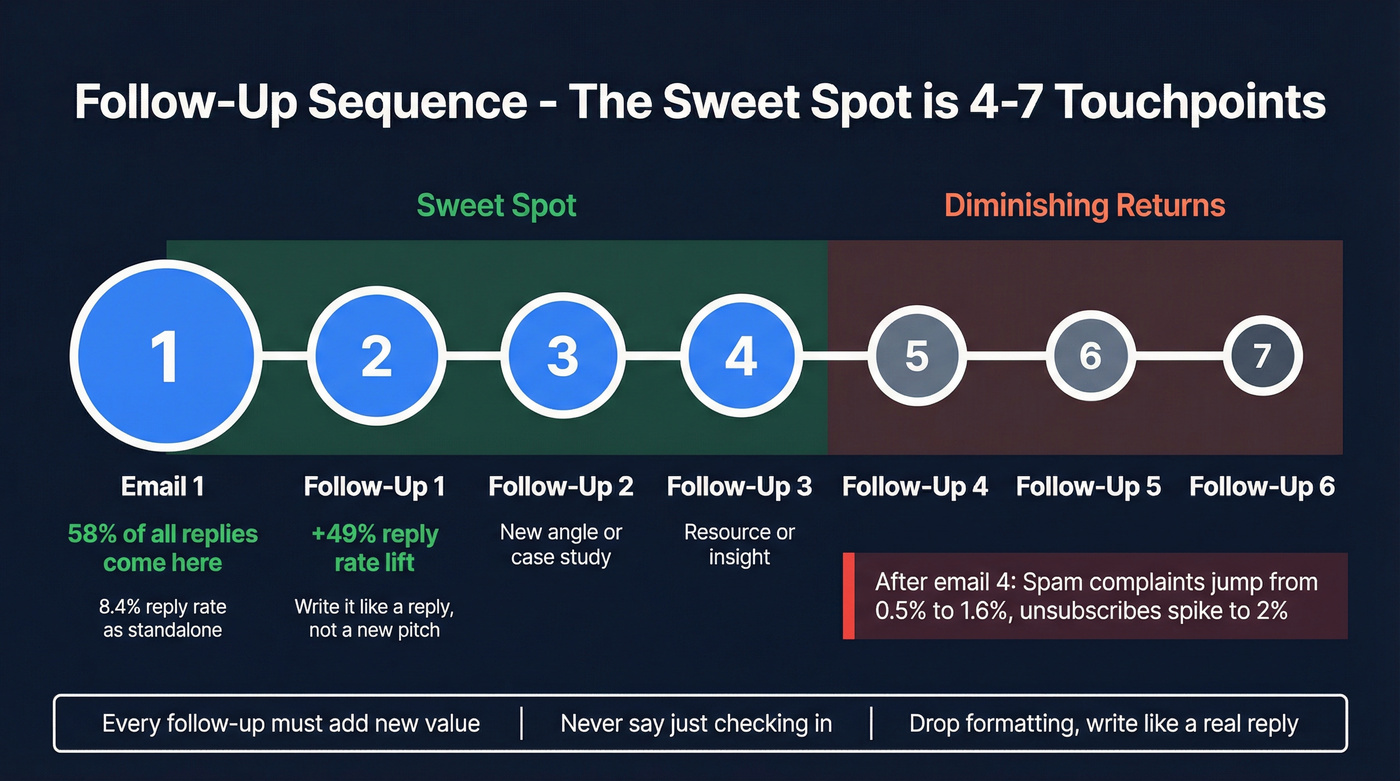
By the fourth email, spam complaint rates climb from 0.5% to 1.6% and unsubscribes spike to 2%. The sweet spot is 4-7 touchpoints, each adding genuinely new value - a different angle, a relevant case study, a resource link. For more cadence benchmarks, use follow-up email reply rate and when should you follow up on an email.
Your second email should feel like a reply, not a new pitch. In our experience, the reply-style follow-up is the single highest-leverage change most teams can make. Drop the formatting, skip the signature block, and write it like you're responding to a thread: "Forgot to mention - Initech just published results from this approach. Thought you'd find it useful: [link]."
Let's be honest about what kills follow-up sequences: "just checking in" emails. Ask any SDR community what follow-up they hate most and that phrase wins unanimously. Every follow-up that doesn't add value is a step closer to the spam folder.
Mistakes That Kill Reply Rates
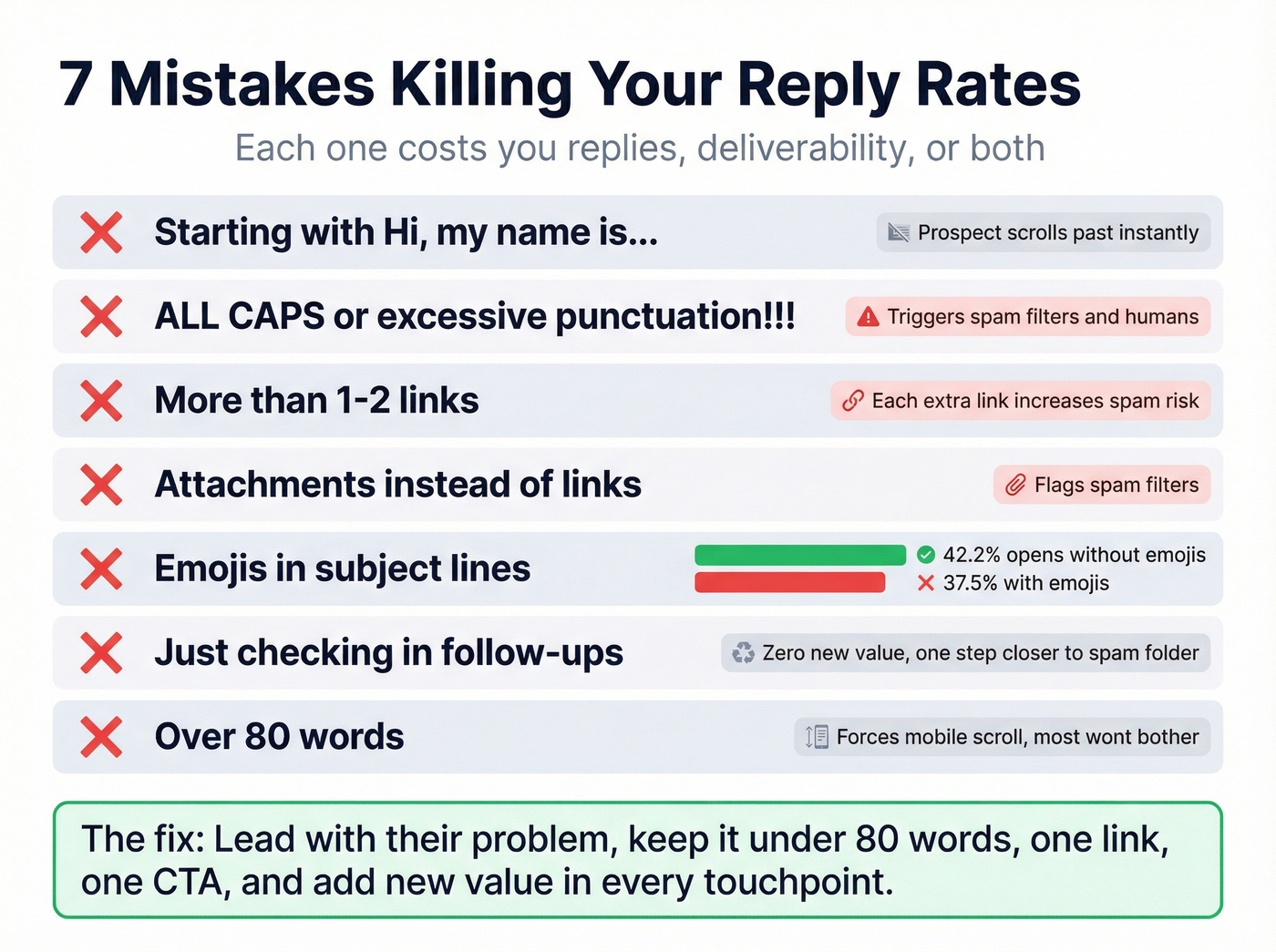
- Starting with "Hi, my name is..." - the prospect doesn't care who you are yet. Lead with their problem.
- ALL CAPS or excessive punctuation - instant spam trigger for both filters and humans.
- More than 1-2 links - each additional link increases spam risk and dilutes your CTA.
- Attachments instead of links - attachments flag spam filters. Link to a hosted resource instead.
- Emojis in subject lines - 42.23% open rate without them vs. 37.5% with. The data is clear.
- Generic follow-ups - "Just wanted to circle back" tells the prospect you have nothing new to say.
- Ignoring word count - anything over 80 words forces a scroll on mobile, and most people won't bother.
Structure Won't Save Bad Data
Look, most teams obsess over email copy when their real problem is a double-digit bounce rate. You can nail every framework on this page and still watch your campaign crater if your list is garbage.
Bulk sender rules now require bounces under 2%, spam complaints under 0.3%, one-click unsubscribe headers per RFC 8058, and SPF/DKIM/DMARC authentication. These aren't optional - they're table stakes. If you need the setup details, start with SPF, DKIM, DMARC and the full email deliverability checklist.
Stack Optimize built from $0 to $1M ARR running cold outbound with 94%+ deliverability and under 3% bounce rates. The difference wasn't their email copy. It was verified data going in. Before you send a single email using the frameworks above, run your list through Prospeo's email verification - catch-all handling, spam-trap removal, honeypot filtering, 98% accuracy across 143M+ verified addresses, refreshed every 7 days. A perfectly structured PAS email that bounces doesn't just waste a send. It damages your domain reputation for every email that follows.

You just learned that 58% of replies come from email one. Make it count by sending to the right person at the right address. Prospeo gives you 300M+ profiles with 30+ filters - buyer intent, job changes, tech stack - so your structured outreach hits decision-makers, not dead ends.
Find the prospects worth writing to. Emails start at $0.01.
FAQ
How long should a sales email be?
Under 80 words - four to six sentences with one clear CTA. The Instantly 2026 dataset confirms that emails in this range hit the highest reply rates. If your message forces a scroll on mobile, cut it.
What's the best cold email framework?
PAS (Problem → Agitate → Solution) works across industries because it leads with the prospect's pain, not your product. Start there and test AIDA or BAB once you have baseline reply data.
How many follow-ups should I send?
Four to seven touchpoints. The first follow-up lifts replies by up to 49%, but by the fourth email spam complaints hit 1.6%. Make sure your data is clean before you start - follow-ups only work when they reach real inboxes.
Does sales email structure matter more than personalization?
Structure is the foundation; personalization is the multiplier. A well-structured PAS email with a generic hook still outperforms a rambling, personalized essay. Nail the framework first, then layer in trigger events and company-specific details for maximum impact.