Types of Sales: 3 Dimensions, Not 25 Random Categories
Every "types of sales" article lists 15-25 categories in a flat list - B2B, B2C, inside, outside, consultative, transactional, SaaS, enterprise - as if they're all the same kind of thing. They're not. That's like listing "SUV, automatic, highway driving" as three types of cars. You're mixing up what you drive, how you drive it, and where you drive it.
Ask ten sales leaders what "type" of selling they run and you'll get a different taxonomy every time. That's exactly why a structured framework matters.
Sales categories break into three dimensions. Once you see it, the confusion disappears - and you can make real decisions about how to build your sales org.
The Three-Dimension Framework
Stop thinking in flat lists. Types of sales break into three dimensions:
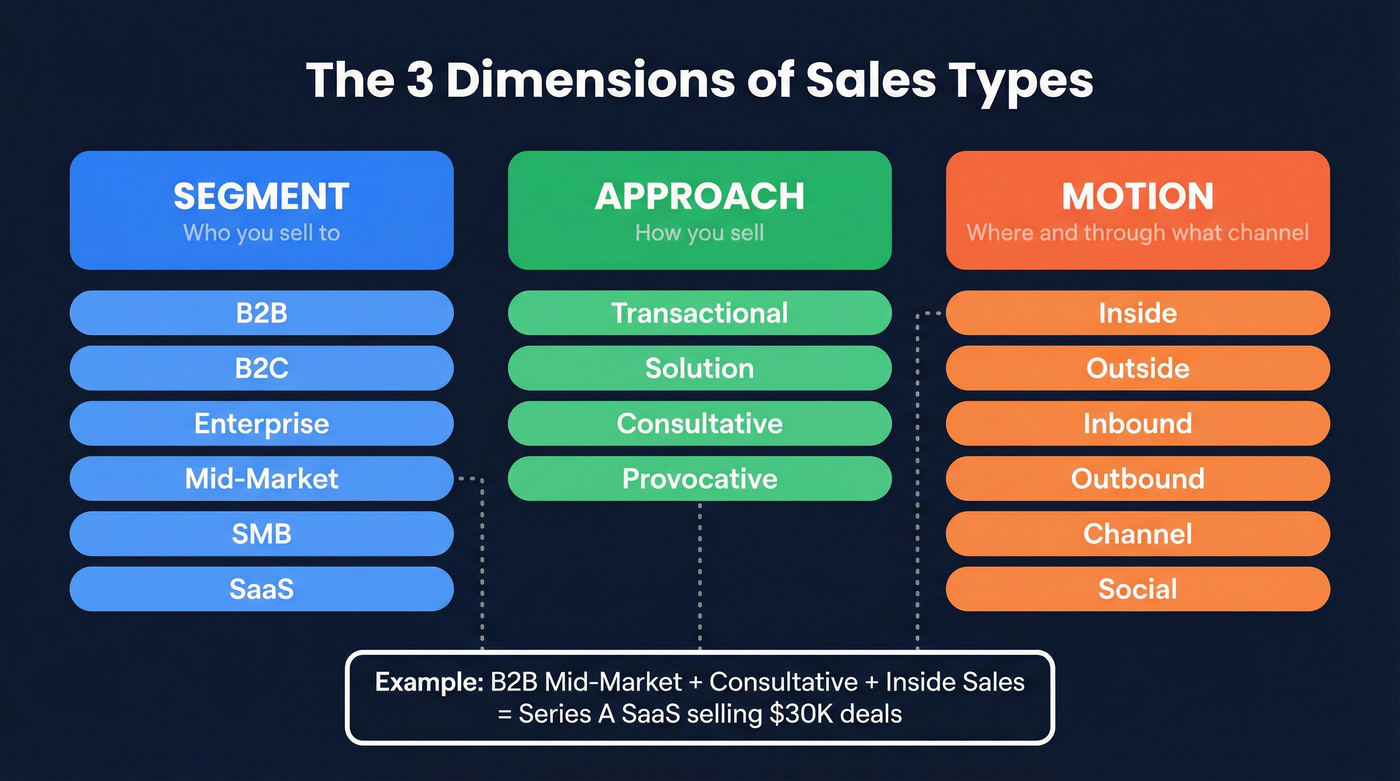
- Segment - who you sell to: B2B, B2C, enterprise, SaaS, SMB
- Approach - how you sell: transactional, solution, consultative, provocative
- Motion - where and through what channel you sell: inside, outside, inbound, outbound, channel, social
Pick one from each column based on your deal size and buyer complexity. A Series A SaaS company selling $30K contracts to mid-market might run inside sales (motion) with a consultative approach, targeting B2B mid-market (segment). Three deliberate choices, not one label.
Sales Types by Market Segment
The first dimension is the simplest: who's buying?
B2B Sales
The global B2B eCommerce market hit $32.11T in 2025, and it's still growing. B2B is where the complexity lives. Buyers spend only about 17% of their total purchase time actually engaging with vendors - the rest goes to internal research, committee discussions, and consensus-building. In 87% of B2B purchases, four or more stakeholders are involved.
Within B2B, you've got sub-types that matter for how you staff and structure deals. Supply sales covers raw materials and components with thin margins. Distribution sales handles reselling and logistics. Service sales - consulting, SaaS, managed services - commands higher margins but demands longer cycles. They all share the multi-stakeholder complexity that defines B2B, but the day-to-day selling motions look completely different from each other.
B2C Sales
B2C is the mirror image. Cycles are shorter - minutes for ecommerce, days to weeks for considered purchases like furniture or insurance. Decision-makers are usually one person, maybe two for household purchases. Volume is higher, and the selling motion leans heavily on marketing, brand, and frictionless checkout rather than rep-driven conversations.
The key distinction: B2C optimizes for conversion rate at scale. B2B optimizes for deal value through relationship depth.
Enterprise Sales
Enterprise is where B2B gets serious. Here's how the segments compare:
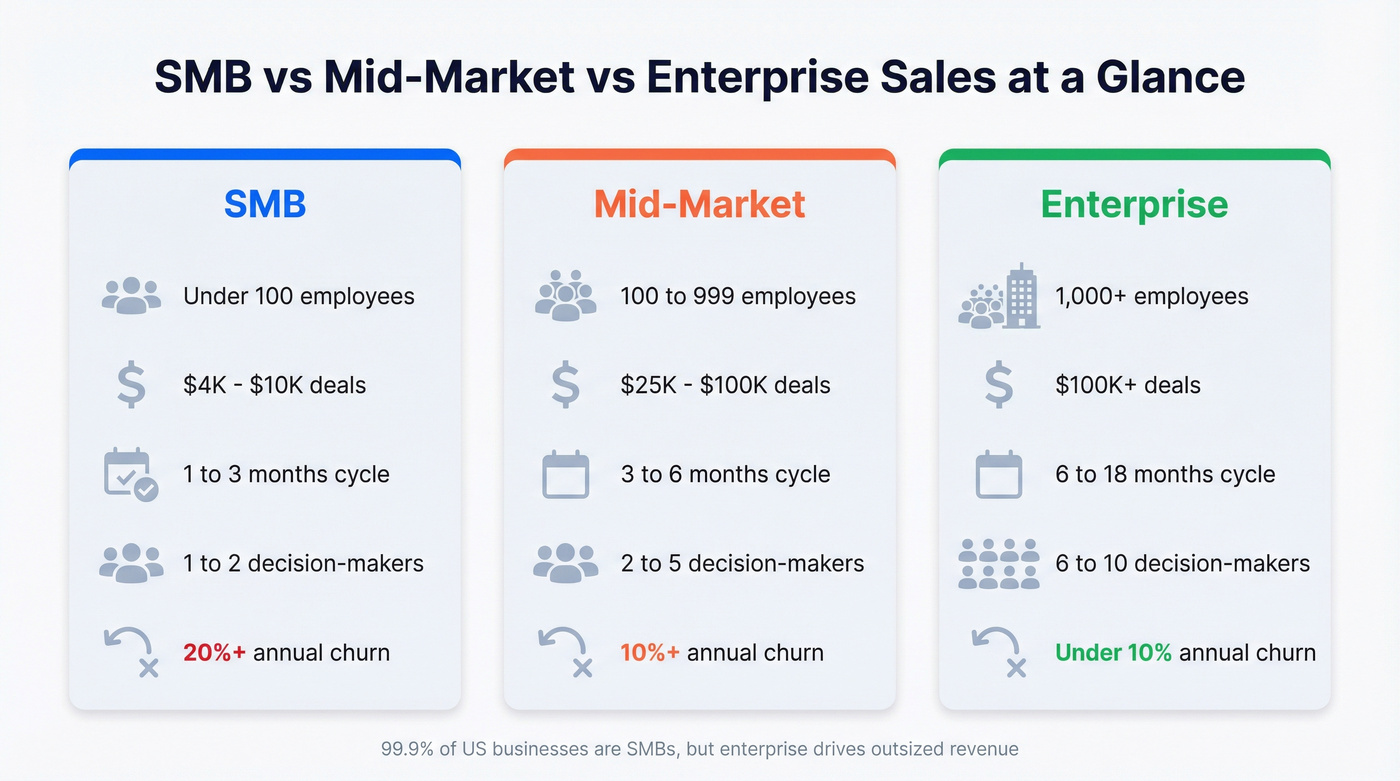
| Metric | SMB | Mid-Market | Enterprise |
|---|---|---|---|
| Employees | <100 | 100-999 | 1,000+ |
| Typical deal size | $4K-$10K | $25K-$100K | $100K+ |
| Sales cycle | 1-3 months | 3-6 months | 6-18 months |
| Decision-makers | 1-2 | 2-5 | 6-10 |
| Annual churn | ~20%+ | ~10%+ | <10% |
Enterprise deals involve 6-10 decision-makers, cycles that stretch to 18 months, and contracts above $100K. The upside is lower churn and higher lifetime value. The downside is that every deal is a project - dedicated AEs, solution engineers, and often executive sponsors. 99.9% of US businesses are SMBs, so the enterprise market is small by count but massive by revenue.
SaaS Sales
SaaS deserves its own category because the pricing model changes the selling motion entirely. The global SaaS market is projected to reach $307B by 2026, and most SaaS companies operate across three sub-models defined by ACV:
- Self-serve / PLG ($5-$50/mo per user): No reps. Product does the selling. Think Slack, Notion, Calendly.
- Transactional ($50-$500/mo per user): Inside sales assists the process. Demos, trials, light negotiation.
- Enterprise ($500+/mo per user or $100K+ contracts): Full-cycle AEs, multi-month deals, procurement involvement.
Most scaling SaaS companies run a hybrid - PLG for small accounts, sales-assisted for mid-market, enterprise team for the big logos. The motion shifts as deal size grows.
Selling Approaches Explained
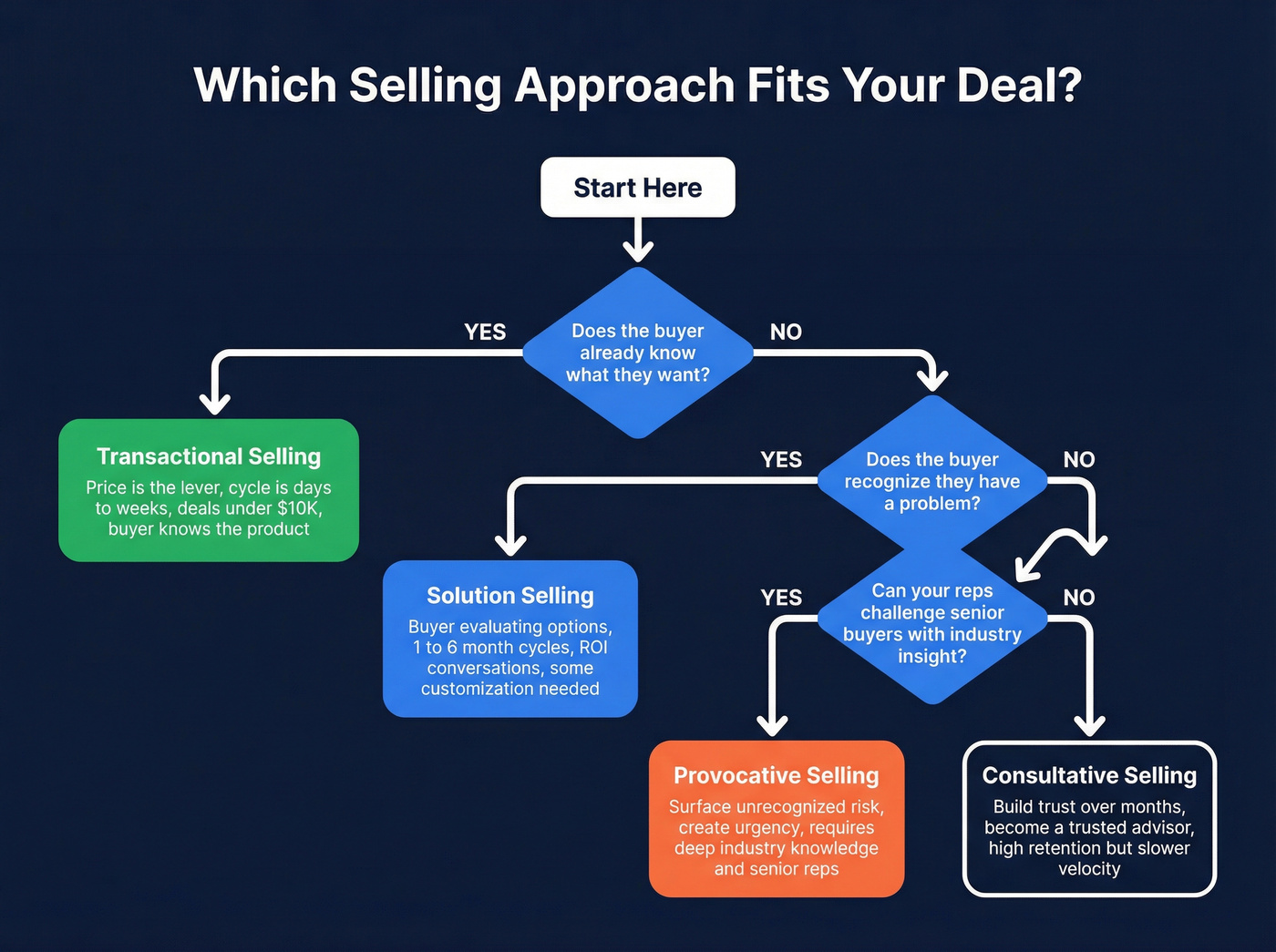
The second dimension is how you actually sell once you're in a conversation. The EO Network's taxonomy breaks this into four approaches, and it's the cleanest framework we've found.
Transactional Selling
The simplest approach. The buyer knows what they want, price is the primary lever, and the cycle is days to weeks. Retail, real estate, basic software subscriptions - anywhere the product is well-understood and the deal is under $10K.
If you're trying to run transactional selling in a complex deal with multiple stakeholders, you're just leaving money on the table.
Solution Selling
Use this if: The buyer has a recognized problem and is evaluating options. Your product requires some customization or integration. Cycles run 1-6 months and deals justify ROI conversations.
Skip this if: The buyer doesn't know they have a problem yet (that's provocative territory) or the deal is too small to warrant discovery calls.
Consultative Selling
Consultative selling is the long game. You're not a vendor - you're a trusted advisor. Think management consulting, complex enterprise software, financial services. This approach demands experienced reps who can build genuine trust over months, not weeks. The payoff is deep relationships and high retention, but the cost is speed: if your model depends on closing 30+ deals per rep per month, consultative selling will break it.
Provocative Selling
Picture this: a VP of Operations is perfectly happy with their current workflow. It's inefficient, it's costing them $200K a year in hidden waste, but they don't see it. Your job isn't to pitch your product - it's to surface that unrecognized risk and make the status quo feel unsafe.
That's provocative selling. It requires deep industry knowledge and the confidence to challenge a senior buyer's assumptions. Done well, it creates urgency where none existed. Done poorly by junior reps, it just feels aggressive. Some frameworks call this "insight selling" - same principle, different label.

Enterprise, mid-market, or SMB - every segment demands accurate contact data. Prospeo's 300M+ profiles with 30+ filters let you target by deal size, buyer intent, technographics, and headcount growth. Build lists that match your exact sales segment in minutes, not hours.
Stop guessing which buyers fit your segment. Filter and find them instantly.
Sales Types by Motion
The third dimension is where and through what channel the selling happens. This is the operational layer - it determines your tech stack, your hiring profile, and your cost structure.
Inside and Outside Sales
The most fundamental motion split. Inside sales is remote-first, driven by phone, email, and video. It's the default for many B2B SaaS companies. An inside rep works from a central location or their home office, running sequences, booking demos, and closing deals without ever meeting the buyer in person. It scales efficiently and pairs well with transactional or solution selling approaches.
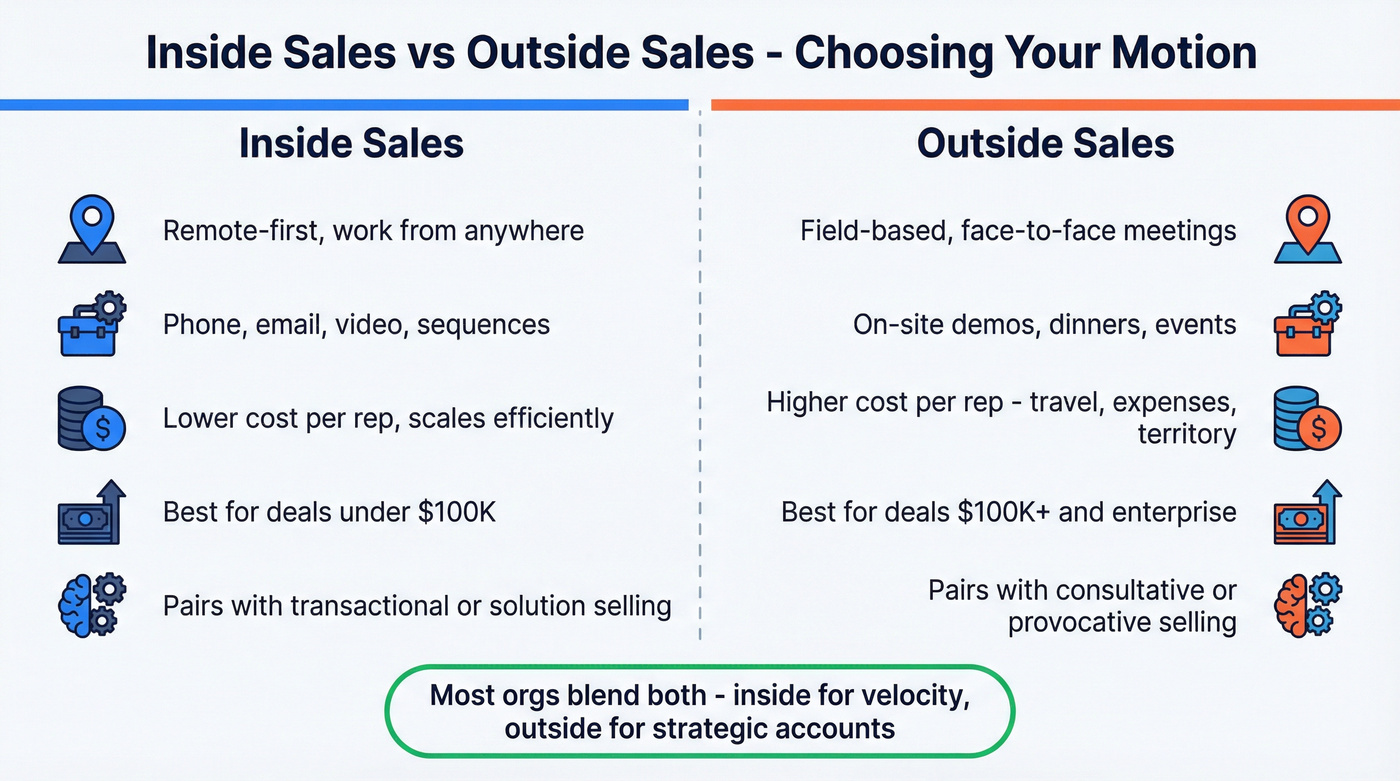
Outside sales is field sales: face-to-face meetings, travel, dinners, on-site demos. Still critical for enterprise deals above $100K where relationships and trust are the differentiator. The cost per rep is significantly higher - travel, expenses, territory management - but the deal sizes justify it. If you're selling $500K infrastructure contracts to Fortune 500 companies, you're sending someone on a plane.
Inbound vs. Outbound
Let's be honest - inbound and outbound aren't really "types" of sales. They're motions describing how leads enter your pipeline. Inbound means the buyer comes to you through content, SEO, paid ads, or referrals. Outbound means you go to them via cold email, cold calls, and social outreach. Most healthy sales orgs run both. The mix depends on your market maturity and deal size.
For outbound, data quality is the bottleneck. You can write the perfect cold email, but if 30% of your list bounces, your domain reputation tanks and the whole motion breaks before your messaging even gets a chance.
Direct vs. Channel Sales
Direct sales means your team owns the full cycle. Channel sales means partners own much of the motion - resellers, affiliates, service providers, or marketplace platforms. Per Iconiq Capital's State of GTM research, B2B SaaS companies often derive 20%+ of revenue from channel sales, and that share is growing as CAC rises.
Channel makes sense when you need geographic reach without hiring, when partners have existing buyer relationships, or when your product is part of a larger solution stack. The tradeoff is margin and control - you don't fully own the customer relationship.
Social Selling
With 600M+ monthly active users on professional networks, social selling has moved from "nice to have" to measurable pipeline contributor. Reps with high Social Selling Index scores generate 45% more opportunities and are 51% more likely to hit quota. Visual and video content drives 2-5x higher engagement than text alone.
Consistency matters more than brilliance here. Posting 1-2 times per week yields roughly 2x engagement and 7x faster follower growth compared to sporadic activity. Social selling isn't a replacement for outbound - it's an amplifier.
Account-Based Sales
ABS is the enterprise segment's natural motion. Instead of casting a wide net, you identify target accounts, multi-thread into the buying committee, and coordinate marketing and sales around a small number of high-value opportunities. If you're running deals above $100K with 6+ stakeholders, you're probably doing some version of ABS whether you call it that or not.
Methodologies vs. Types
This is the distinction most guides miss entirely. Sales types describe the structure: who you sell to, how you approach them, and through what channel. Sales methodologies are repeatable frameworks for executing within that structure. Cross-selling and upselling, for instance, are techniques that apply across any segment, approach, or motion - not types in themselves.
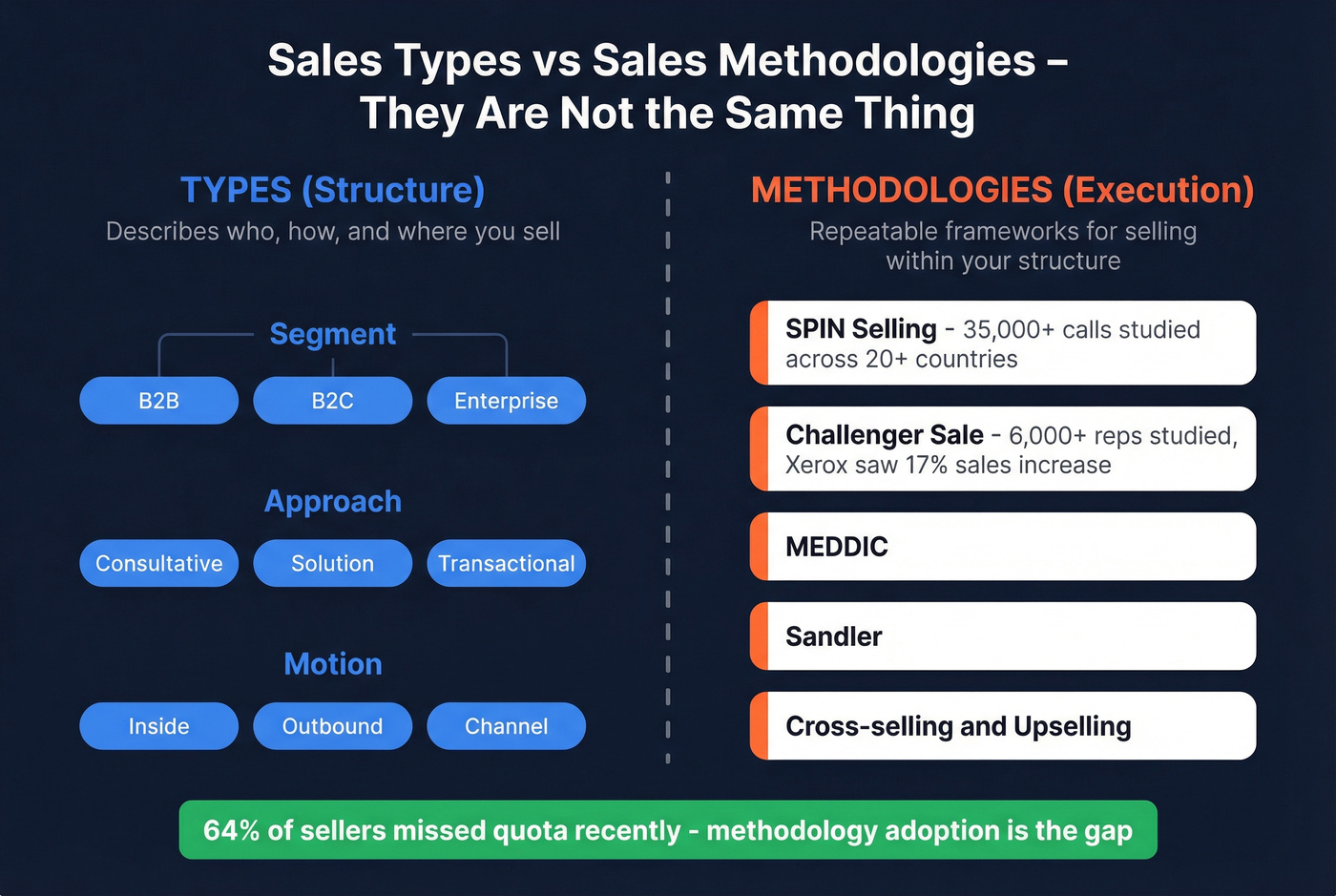
SPIN Selling came from research analyzing 35,000+ sales calls across 20+ countries over 12 years. The Challenger Sale is based on CEB's study of 6,000+ reps, and Xerox saw a 17% increase in sales and $65M in contract value after implementing it. These aren't theoretical - they're battle-tested systems.
Here's the frustrating part: 64% of sellers missed their most recent quota, 61% say admin tasks and inefficient processes slow them down most, and only 38% have formal guidelines for how reps should use their tools and workflows. Methodology adoption stays low even when the evidence is overwhelming.
Deal size maps to methodology fit like this:
| Deal Size | Typical Cycle | Best Methodology |
|---|---|---|
| <$25K | 1-3 months | BANT |
| $25K-$100K | 3-6 months | SPIN / Challenger |
| $100K+ | 6-18 months | MEDDIC / MEDDPICC |
Don't force Challenger on junior reps selling $15K deals. BANT gets them qualifying fast. Save the sophisticated frameworks for deals that justify the complexity.
How to Choose the Right Combination
Your ACV drives most of the decision. Here's the hot take most sales consultants won't give you: if your average contract value is below $10K, you probably don't need a sales team at all. Build a better product, invest in PLG, and add reps only when self-serve conversion plateaus.
For everyone else:
Under $25K ACV: Inside sales + transactional or solution approach + BANT qualification. Keep it lean. Two to three touches, fast qualification, high volume. For SaaS products under $50/mo per user, prioritize PLG before hiring reps - let the product sell itself and add sales-assist when you hit conversion ceilings.
$25K-$100K ACV: Inside sales, maybe hybrid with some field visits, plus a consultative approach and SPIN or Challenger methodology. You need reps who can run discovery, build business cases, and navigate 3-5 stakeholders. Cycles run 3-6 months, and each rep should own the full cycle from first touch to close.
$100K+ ACV: Dedicated AEs + solution or provocative approach + MEDDIC/MEDDPICC. Add field sales for key accounts. Expect 6-18 month cycles, 6-10 stakeholders, and procurement involvement. Layer in account-based motions and executive sponsorship. This is where your senior reps earn their keep - they're navigating complex buying committees, running multi-threaded outreach, and coordinating with solution engineers to close seven-figure deals.
The scaling path for most startups follows a predictable arc: founder-led sales, then first inside hires, then a structured team with methodology, then enterprise expansion with field reps. Don't skip stages. We've seen teams hire enterprise AEs before they've figured out their ICP, and it's an expensive mistake every time.
The Data Layer Every Motion Needs
Every combination above - whether you're running PLG self-serve or 18-month enterprise cycles - depends on accurate contact data. Bad emails tank your deliverability. Dead phone numbers waste rep time. Stale data means you're pitching someone who changed jobs three months ago.
When Snyk rolled out Prospeo to 50 AEs, their bounce rate dropped from 35-40% to under 5%, and AE-sourced pipeline jumped 180% with 200+ new opportunities per month. That's what happens when your data refreshes every 7 days instead of the 6-week industry average.

Whether you're building outbound lists, enriching inbound leads, or multi-threading into enterprise accounts, the data layer is the foundation. Get it wrong and nothing else matters. If you want the operational benchmarks behind this, start with data quality and B2B contact data decay.
Running inside sales sequences? Outbound campaigns? Consultative plays with enterprise buyers? None of it works if your emails bounce. Prospeo delivers 98% email accuracy on a 7-day refresh cycle - so your reps connect with real decision-makers regardless of motion.
Your sales motion is only as good as the data powering it.
FAQ
What are the 4 main types of selling?
Transactional, solution, consultative, and provocative. Each fits a different combination of deal complexity and buyer awareness. Transactional works for simple, price-driven purchases under $10K. Provocative works when the buyer doesn't yet realize they have a problem - common in enterprise deals above $100K.
What's the difference between a sales type and a methodology?
Sales types describe structural dimensions - who you sell to, how you approach buyers, and through what channel. Methodologies like SPIN, Challenger, and MEDDIC are repeatable execution frameworks that operate within those structural choices. Match methodology to deal size: BANT under $25K, SPIN/Challenger for mid-market, MEDDIC for enterprise.
What sales type works best for startups?
Most startups with deals under $25K should start with inside sales, a transactional or solution approach, and BANT qualification. SaaS products under $50/mo per user should prioritize product-led growth before hiring reps - add sales-assist only when self-serve conversion plateaus.
How does data quality affect different sales motions?
Bad data breaks every motion equally - bounced emails destroy domain reputation in outbound, stale contacts waste rep time in account-based selling, and unverified numbers kill cold-calling efficiency. A 7-day data refresh cycle and 98% email accuracy are the benchmarks we've seen make the biggest difference, which is why teams running high-volume outbound treat data quality as infrastructure, not an afterthought.
Is inside sales replacing outside sales?
Inside sales dominates for deals under $100K, but outside sales remains critical for enterprise contracts where face-to-face trust is the differentiator. Most mid-market and enterprise orgs run a hybrid - inside reps handle early-stage qualification and smaller accounts, while field reps focus on six- and seven-figure opportunities.