How to Create a Sales Pitch People Actually Want to Hear
You sent 200 cold emails last quarter. Thirty-eight bounced. Another sixty landed in inboxes belonging to people who'd never buy your product. The pitch wasn't the problem - the foundation was.
Here's the thing about learning how to create a sales pitch that actually converts: 96% of prospects research your company before engaging with a rep, and 61% of B2B buyers prefer a rep-free experience entirely. Your pitch isn't competing with other pitches. It's competing with your prospect's desire to never hear one.
Most sales pitch advice is backwards. It starts with storytelling frameworks and ignores the boring prerequisite - clean data, right person, working email. A perfect pitch that bounces is worth exactly zero. Data first, narrative second. That's the thesis of everything that follows.
What Makes a Sales Pitch Work in 2026
71% of buyers expect personalization, and 76% get frustrated when they don't get it. Meanwhile, the average B2B deal involves 6-10 stakeholders. You're pitching a committee, and each member cares about something different.
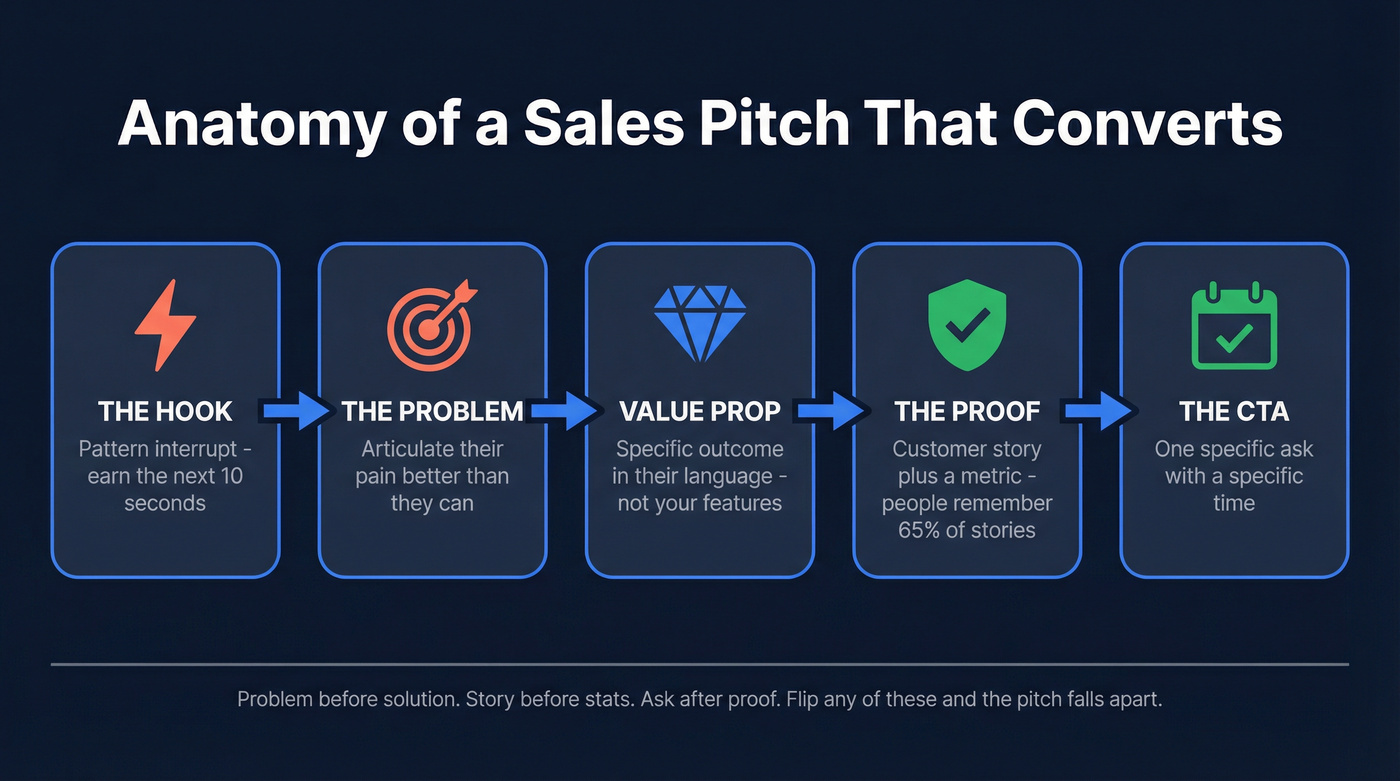
A pitch that works in this environment has five components:
- The hook - a pattern interrupt that earns the next 10 seconds. (If you want examples, start with pattern interrupt openers that earn attention.)
- The problem - articulate their pain better than they can. If the prospect doesn't feel understood in 30 seconds, they're gone.
- The value proposition - the specific outcome they'll get, in their language. Not your feature list.
- The proof - a customer story backed by a metric. People retain 65-70% of stories versus 5-10% of raw statistics. Decks with a single clear next step convert 27% higher.
- The CTA - one specific ask with a specific time. Not "let me know your thoughts."
Problem before solution. Story before stats. Ask after proof. Flip any of these and the pitch falls apart.
6 Steps to Build a Pitch That Converts
Step 1 - Get Your Data Right
82% of B2B decision-makers say salespeople are unprepared for calls. "Unprepared" doesn't just mean they skipped the prospect's profile - it means they're pitching the wrong person at a dead email address with a title that changed six months ago.
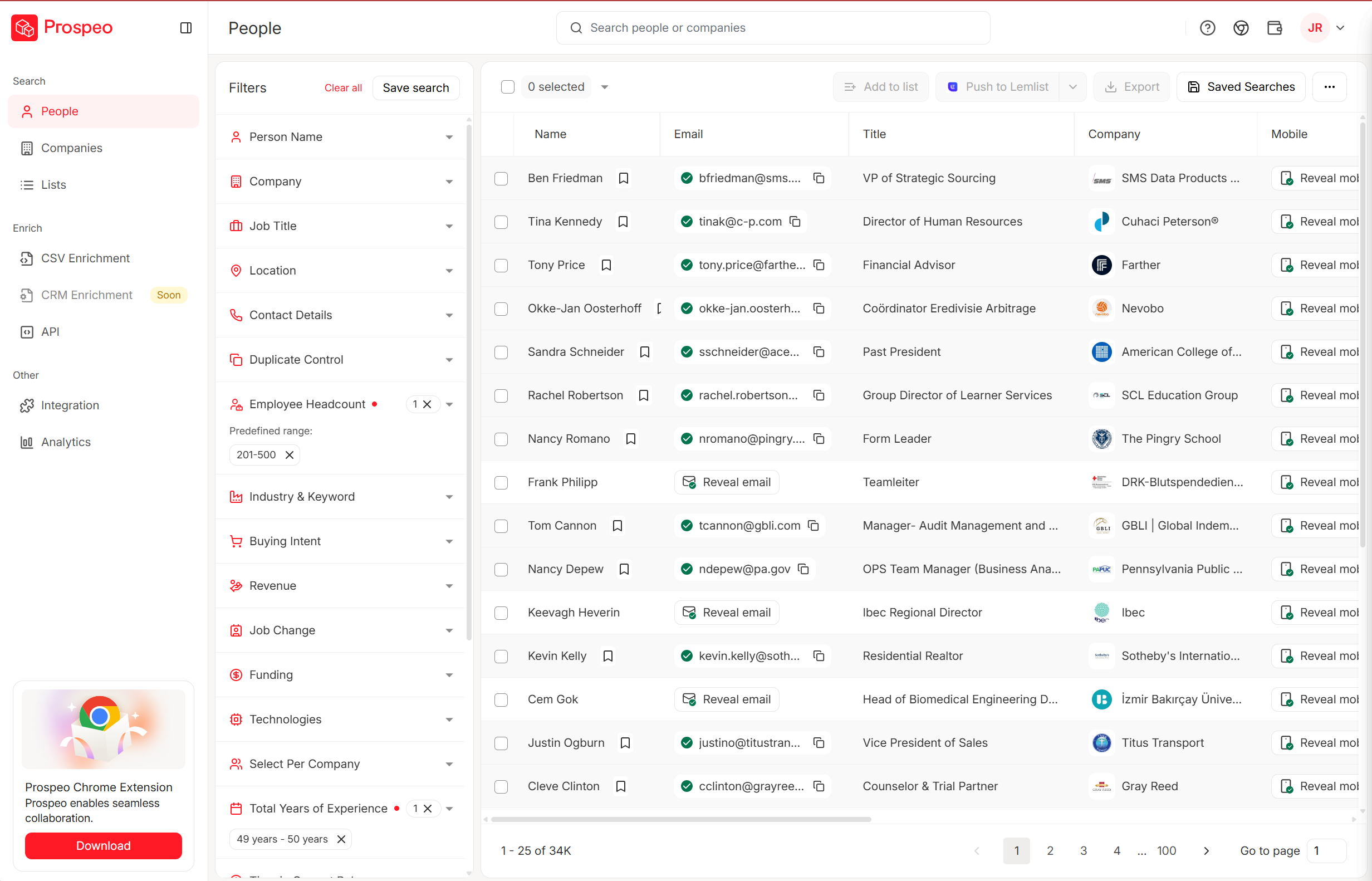
B2B contact data decays fast. People change jobs, companies restructure, email domains shift. We've seen teams lose entire campaigns to bounce rates above 30% simply because they trusted a stale list. Prospeo verifies emails in real time with 98% accuracy across 300M+ profiles and refreshes data every 7 days, so your pitch reaches the right person at a working address. You can start with 75 free verified emails per month to see the difference clean data makes. (If you’re auditing your list, use an email verification workflow and track B2B contact data decay as a KPI.)
Step 2 - Identify the Real Problem
Nearly 70% of the buyer's journey is complete before a prospect talks to a rep. They've already Googled solutions and formed opinions. Your job isn't category education - it's showing you understand their specific situation better than the alternatives.
The consensus across sales communities like r/sales boils down to this: shut up and listen. Check their recent earnings calls, job postings that signal a gap you can fill, tech stack changes. The pitch writes itself when you've done the homework. This research phase is the most overlooked part of the process, but it's what separates generic outreach from conversations that actually go somewhere. (Use a simple pre-call research checklist and focus on prospect pain points.)
Step 3 - Build Your Narrative Arc
Every strong pitch follows the same arc: problem, change, solution, proof, ask. Start with the world as your prospect experiences it. Introduce the shift that makes the old way unsustainable. Present your solution as the natural response. Back it with a story - not a feature dump. Then make the ask.
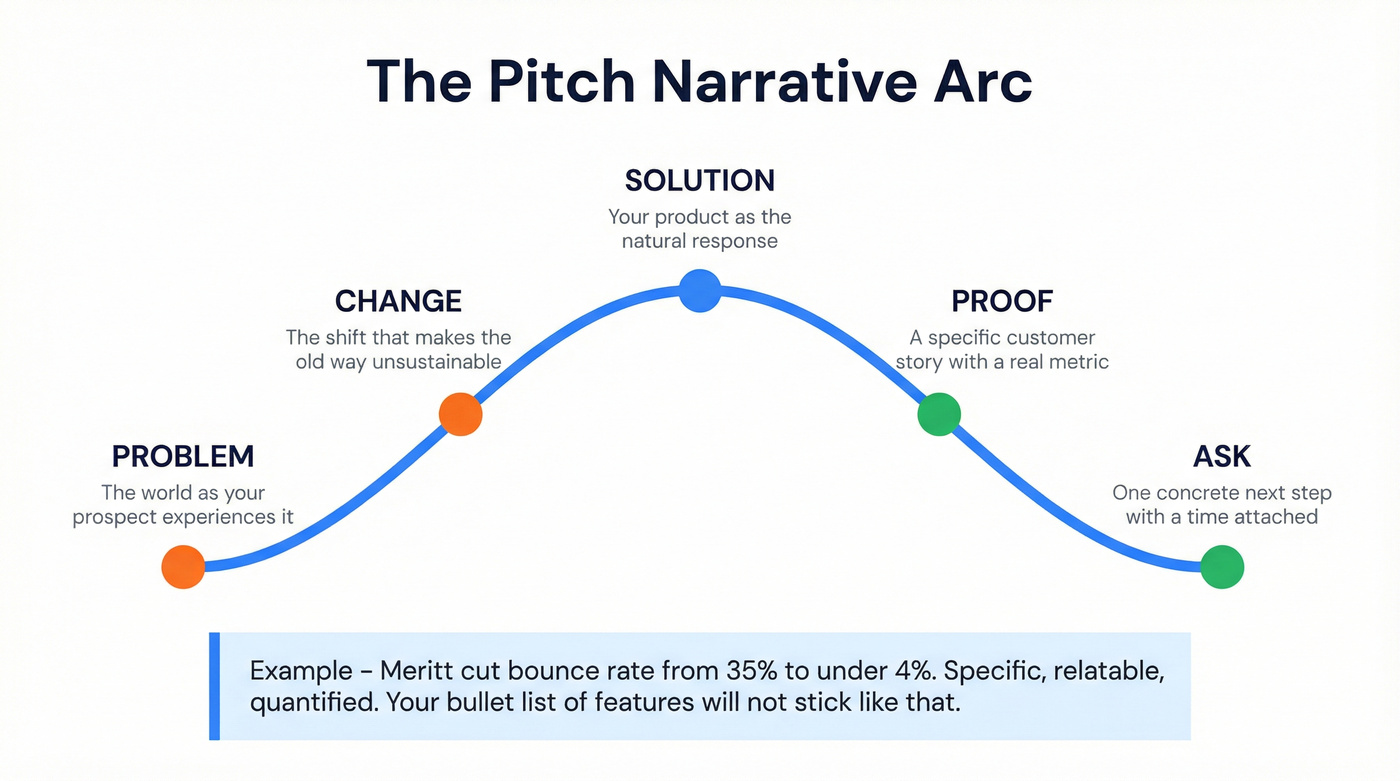
Let's break this down with a real example. A case study like Meritt cutting bounce rate from 35% to under 4% will stick with a prospect because it's specific, relatable, and quantified. Your bullet list of product features won't, because nobody lies awake at night thinking about your feature roadmap.
Step 4 - Write Channel-Specific Versions
Don't write one pitch and paste it everywhere. Email forces brevity - drafting your email version first is the best discipline. If you can nail your value prop in under 75 words, expanding it into a 90-second call script or a 9-minute deck becomes straightforward.
Personalized pitch decks get 68% more complete reads and are shared 2.3x more often. Each channel has different rules, but the core arc stays the same. (For more copy/paste options, keep a set of outreach email templates and a repeatable sales email structure.)
Step 5 - Nail the Length
Shorter pitches outperform longer ones across every channel. The average successful cold call runs 93 seconds - aim for under 90.
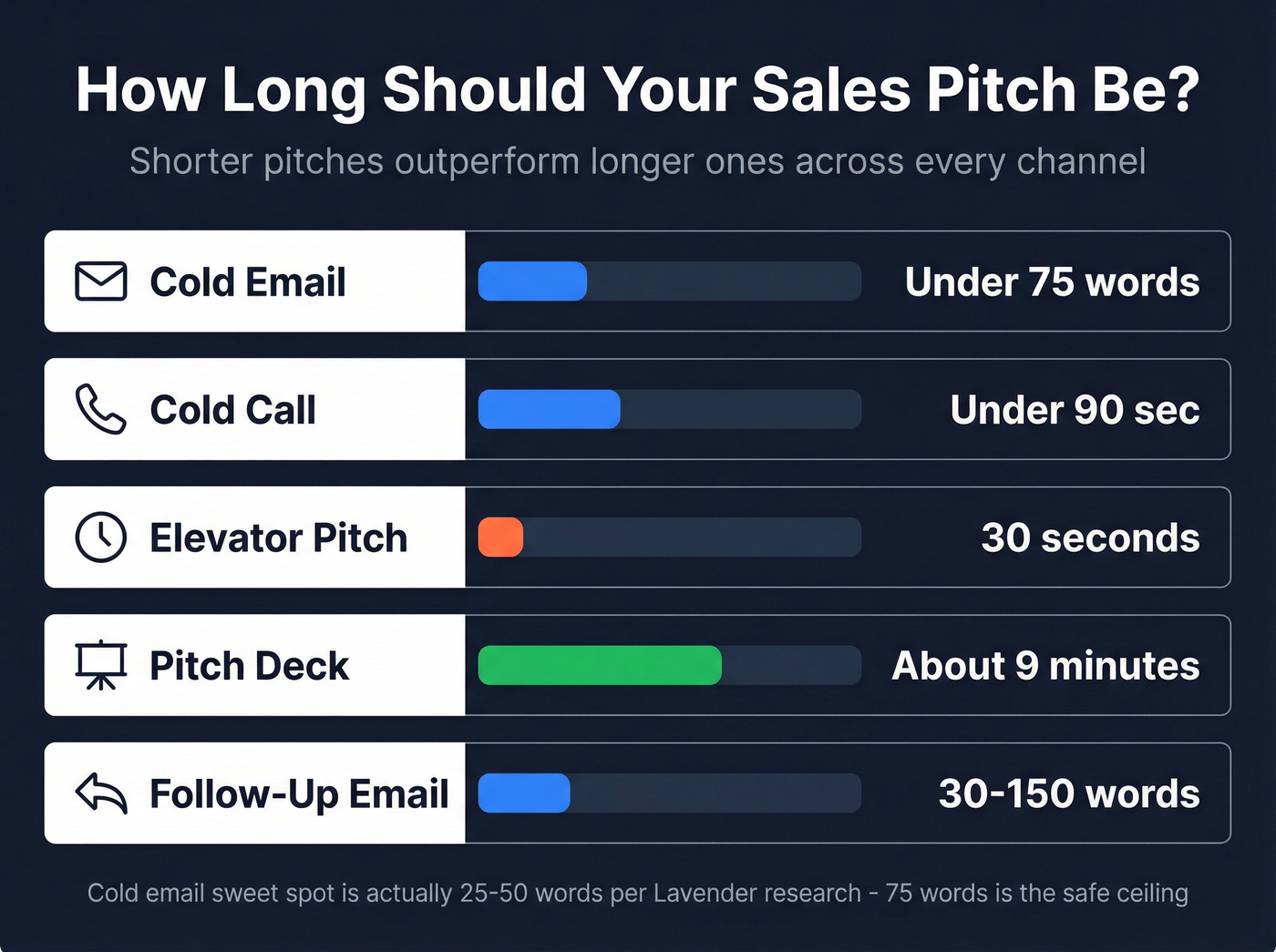
| Channel | Target Length |
|---|---|
| Cold email | Under 75 words |
| Cold call | Under 90 sec |
| Elevator pitch | 30 seconds |
| Pitch deck | ~9 minutes |
| Follow-up email | 30-150 words |
The cold email number surprises people. The old Boomerang benchmark of 50-125 words gets cited everywhere, but that study included warm and internal emails. Lavender's cold-email-specific research puts the sweet spot at 25-50 words. For initial cold outreach, under 75 words is the safe ceiling. (If you’re optimizing send strategy too, test the best time to send prospecting emails.)
Step 6 - Build the Follow-Up Sequence
80% of successful sales require five or more follow-up touches. Yet 48% of reps never follow up once.
That's half the sales force abandoning deals before they start. Your first follow-up alone boosts reply rates by 49%. Space them 2-4 days apart and vary the angle each time - a relevant case study on day 3, a short video on day 7, a direct question on day 10. (If you need a system, use a proven prospect follow up cadence.)

You just learned that 82% of reps are called unprepared - and most of that comes down to bad data, wrong contacts, and stale emails. Prospeo gives you 300M+ profiles with 98% email accuracy, refreshed every 7 days, so your pitch lands in the right inbox every time. Start with 75 free verified emails.
Stop crafting perfect pitches for people who'll never see them.
Sales Pitch Templates by Channel
Cold Email Template
Subject: [Specific metric] at [Company Name]
Hi [First Name],
[Company Name]'s [specific observation - e.g., "3 new SDR job postings"] suggests you're scaling outbound. Most teams at that stage see bounce rates spike.
We helped [similar company] cut bounces from 35% to under 4% while tripling pipeline. Worth a 15-minute call Thursday?
Subject line is specific, not clever. First sentence proves research. Second names a recognizable problem. Third offers proof. CTA is concrete. That's all five components in under 60 words.
Cold Call Script
0-15 sec (hook): "Hi [Name], this is [You] from [Company]. I noticed [specific trigger]. Quick question - are you handling [relevant problem] internally or looking at tools?"
15-45 sec (problem + value): "Teams scaling from [X] to [Y] typically see [specific pain]. We helped [similar company] solve that by [one-sentence solution]."
45-90 sec (proof + ask): "They went from [before metric] to [after metric] in [timeframe]. Do you have 15 minutes this week?"
One stat worth knowing: 69% of B2B buyers are open to cold calls from new providers. Calling between 4-5 PM yields 71% better results than other time slots. The 16.6% connect rate means you won't reach most people - when you do, delivering a pitch that respects their time is everything.
Elevator Pitch
"We help [target audience] solve [specific problem]. Most teams deal with [common pain], which costs them [quantified impact]. [Company Name] saw [specific result] in [timeframe]."
Thirty seconds. Problem, solution, proof. That's it.
Follow-Up Sequence (3-Touch)
60% of customers reject an offer four times before buying. Your follow-up sequence is where deals actually happen.
Day 1: "Wanted to make sure this didn't get buried. The [specific metric] I mentioned is something we're seeing across [industry]. Worth a quick look?"
Day 3: "Thought this might be relevant - [link to case study]. [One sentence connecting it to their situation]."
Day 7: "If [problem] isn't a priority right now, no worries - just let me know. If it is, [specific CTA]."
The day 7 email gives them an easy out, which paradoxically makes people more likely to respond. We've tested this across dozens of campaigns and the "permission to say no" line consistently outperforms harder closes.
Pitch Mistakes That Kill Deals
Talking more than listening. The reps who close most consistently are the ones who ask one more question before launching into their pitch. On discovery calls, your mouth should be closed more than it's open.
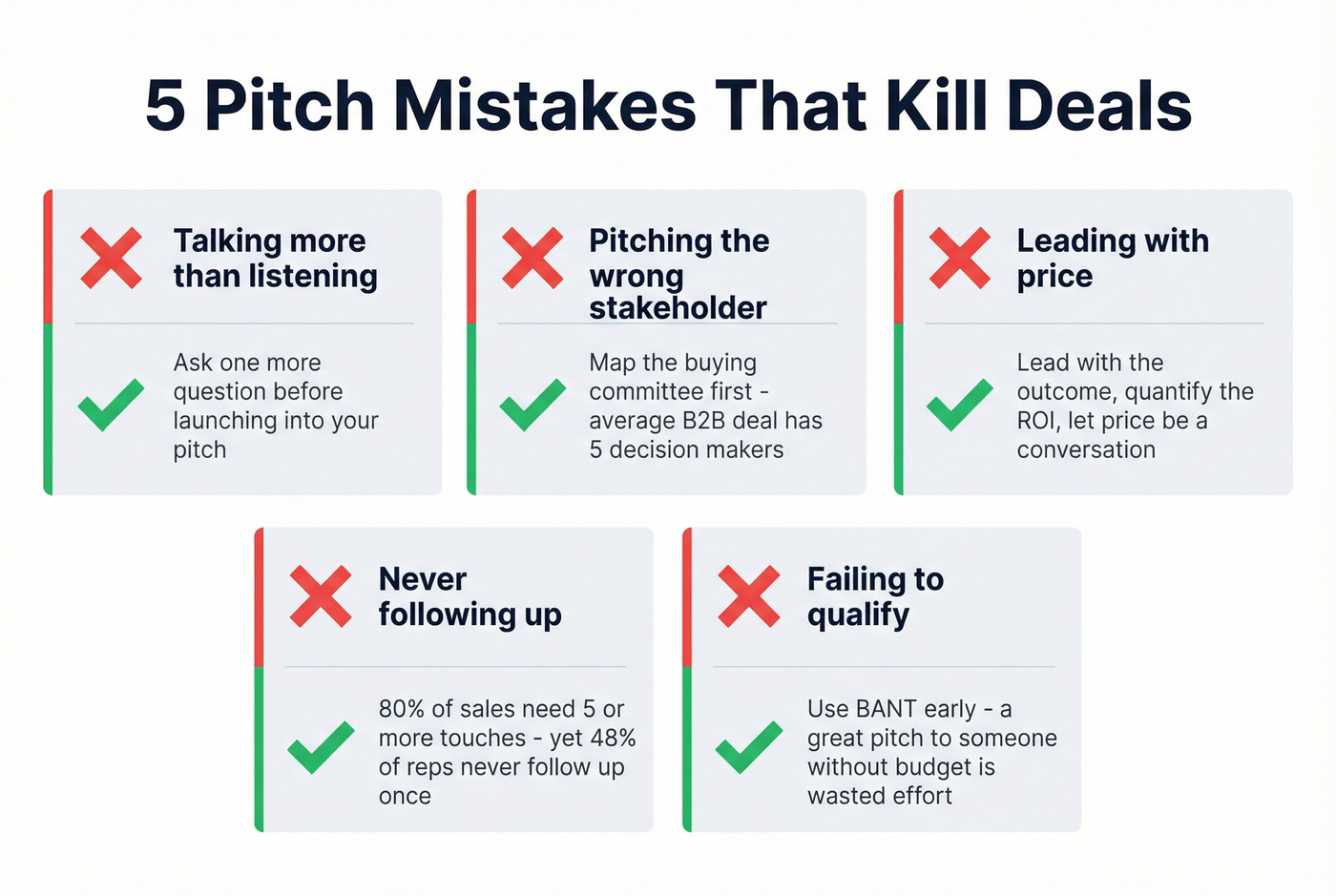
Pitching the wrong stakeholder. Map the buying committee first. The average B2B deal involves five decision-makers. Same product, different story for each. Skip this step and you'll deliver a beautiful pitch to someone who can't sign anything. (This is where multithreading in sales matters.)
Leading with price. Lead with the outcome, quantify the ROI, and let price be a conversation - not the conversation.
Never following up. If your bounce rate is above 5%, treat it as a data-quality problem before you touch your messaging. Fix the data, then build the sequence. (If you’re diagnosing bounces, start with hard bounce basics.)
Failing to qualify. Use BANT early. A beautiful pitch delivered to someone without budget authority is wasted effort - and it's frustrating for both sides. (If you want a modern alternative, use a lead qualification framework.)

Using AI to Craft Your Pitch
Sales reps spend 31% of their working hours searching for or creating content. That's nearly a third of your week not selling. Productivity lifts of up to 30% are realistic with AI tools, and 92% of companies are increasing their AI investment over the next three years.
The balanced take: AI writes the first draft in 30 seconds. You make it human in five minutes. Don't send raw AI output - it reads generic, and generic gets ignored.
In our experience, the best results come from using AI for prospect research - scanning earnings calls, job postings, and tech stack changes in seconds - then writing the actual pitch yourself. That combination turns cold outreach into warm conversations. If you're using AI to write the whole email and hitting send without editing, skip that approach entirely. Your prospects can tell. (If you’re building a workflow, start with AI for B2B outreach.)
Following up 5+ times only works if your emails actually arrive. Teams using Prospeo cut bounce rates from 35% to under 4% and tripled pipeline - because every touchpoint in their sequence reached a real person at a verified address. At $0.01 per email, bad data is no longer an excuse.
Build your follow-up sequence on data that doesn't bounce.
FAQ
What's the ideal length for a cold pitch email?
Under 75 words for cold outreach. Lavender's cold-email-specific data shows shorter emails dramatically outperform the older 50-125 word benchmark. Your first email's only job is to earn a response - not close the deal.
How many follow-ups should I send?
At least five. 80% of successful sales require five or more touches, yet 48% of reps never follow up once. Vary the angle each time - case study, video, direct question.
Should I use AI to write my pitch?
Use AI for first drafts and prospect research, then personalize with specific details. Generic AI copy gets ignored faster than no email at all. The best reps use AI for speed and add human insight for relevance.
How do I pitch multiple decision-makers?
Map the buying committee first - typically 6-10 people in B2B. The CFO cares about ROI, the end user cares about daily friction. Same product, different narrative for each stakeholder.
How do I make sure my pitch reaches the right person?
Verify contact data before sending. Bad data is the silent killer of otherwise great outreach - fix your list before you fix your messaging. Tools like Prospeo's real-time verification and 7-day refresh cycle keep bounce rates under control so your pitch actually lands.