The Sales Pitch Opening Guide: What 300M+ Calls Reveal About Your First 10 Seconds
Cold call success rates dropped from 4.82% to 2.3% in a single year. The average cold call lasts 93 seconds. Your sales pitch opening isn't just important - it's the entire game now.
Why Your Opening Pitch Matters More in 2026 Than Ever Before
Here's a number that should make every sales leader uncomfortable: 96% of B2B buyers research companies before they ever engage with a sales rep. By the time your rep dials, the prospect already has opinions. They've read your G2 reviews. They've compared your pricing page to three competitors. They don't need your pitch - they need a reason not to hang up.
And the window to deliver that reason is shrinking fast.
Cognism's benchmarks show cold call success rates cratered from 4.82% to 2.3% in a single year. The average cold call now lasts 93 seconds. Jason Bay frames it well: the first 60 seconds of a cold call determine whether you earn the next five minutes or get sent to voicemail purgatory.
Yet cold calling isn't dying - it's consolidating around the reps who actually know what they're doing. HubSpot's State of Cold Calling report found that 24% of sales organizations still use cold calling as their primary channel, with another 25% using it as a secondary one. That's nearly half the market. The channel works. Most openers don't.
The gap between top performers and everyone else keeps widening because buyers expect more. 84% of B2B buyers expect salespeople to act as trusted advisors, yet 59% say reps never bother learning their specific challenges. That disconnect starts in the first sentence. A generic "just checking in" opener confirms the buyer's worst suspicion: you don't know them, you don't care, and this call is about your quota, not their problem.
The reps who win aren't the ones with the smoothest lines. They're the ones who open with enough context to prove they've done the work - and enough humanity to earn 30 more seconds.
What You Need (Quick Version)
If you're short on time, here's the cheat sheet:

Cold calls: The highest-performing opener is "Heard the name tossed around?" at 11.24% success rate across 300M+ analyzed calls. The runner-up is the Tailored Permission Opener at 11.18%. Both crush "How's your day going?" (7.6%) and absolutely destroy "Did I catch you at a bad time?" (2.15%). If you want more scripts and benchmarks, see our B2B cold calling guide.
Emails: Keep subject lines to 1-4 words, all lowercase. Salesy language tanks open rates by up to 17.9%. Top reps achieve 58%+ open rates - 2.1x what average reps get. For more examples, use these cold email subject lines.
Presentations and demos: Your audience decides in the first 10 seconds whether to engage or mentally check out. Lead with a problem they already feel, a startling contrast, or a question they can't ignore. Never open with "Let me introduce myself." If you’re building decks, this B2B sales presentation playbook helps.
The invisible prerequisite: None of this matters if you're calling dead numbers or emailing invalid addresses. Verify your data first. Use a verify an email address workflow before you hit send.
Now, the deep dive.
The Data: Which Opening Lines Actually Work
The Best Lines From 300M+ Calls
Armand Farrokh, author of Cold Calling Sucks (And That's Why It Works), partnered with Gong to analyze which openers actually move the needle. Here's what they found:

| Opener | Success Rate | Verdict |
|---|---|---|
| "Did I catch you at a bad time?" | 2.15% | Worst performer |
| "How's your day going?" | 7.6% | Better, still mediocre |
| Tailored Permission Opener | 11.18% | Strong - honesty disarms |
| "Heard the name tossed around?" | 11.24% | Top performer |
The gap between worst and best is a 5x difference.
The pattern is clear: openers that establish context and familiarity win. Openers that give the prospect an easy exit lose.
"Did I catch you at a bad time?" is basically handing the prospect a loaded gun. You're lowering your status and giving them permission to hang up. The 2.15% success rate is barely above random chance. "How's your day going?" performs better, but prospects see through it. Nobody believes you care about their Tuesday. It's a social nicety that signals "I'm about to pitch you."
The Winner: "Heard the Name Tossed Around?"
Here's the full script structure:

Step 1: Lead with context. Mention you work with their peer companies - this makes the call feel like a warm referral, not a cold dial. (If you need a repeatable process, use a pre call research checklist.)
Step 2: Introduce yourself after establishing familiarity. Not before.
Step 3: Ask: "Have you heard the name tossed around?"
If they say yes: Don't pitch. Just ask, "What'd you hear?" Let them talk. You've already won the opening - now you're in a conversation.
If they say no: "Ha! Guess I'm not as popular as I thought. Well, the reason for my call is I work with a few other [peer companies], and typically they're dealing with [problem you solve]..."
The genius here is the recovery line. It's self-deprecating, human, and immediately pivots to value. The prospect laughs, their guard drops, and you're in.
The underlying principle: leading with context is the single most important element. It transforms a cold call into something that feels like a referral.
The Runner-Up: The Tailored Permission Opener
Katy Mason-Jones, an Enterprise AE at Cognism, uses this script and gets consistent results - and occasional laughs:
"Hi [name], this is Katy calling from Cognism. For full transparency at the very beginning, this is a well-researched B2B sales call. I appreciate that I've called completely out of the blue. Is now a bad time for a two-minute chat?"
At 11.18%, it's statistically neck-and-neck with the top performer. Radical honesty is disarming. When everyone else is pretending they're not making a cold call, owning it earns instant respect. The prospect thinks, "At least this person isn't wasting my time with fake pleasantries." If you want more variations, see this permission based opener cold call guide.
My hot take: the Permission Opener is actually better than "Heard the name tossed around?" for enterprise sales. Enterprise buyers respect directness over social engineering. If your average deal size is north of $50K, lead with honesty - save the familiarity play for mid-market.

The best sales pitch opening in the world won't save you if you're calling wrong numbers or emailing invalid addresses. Prospeo gives you 125M+ verified mobiles with a 30% pickup rate and 98% email accuracy - so every opener you craft actually reaches a real person.
Stop perfecting your pitch for voicemail boxes that never check back.
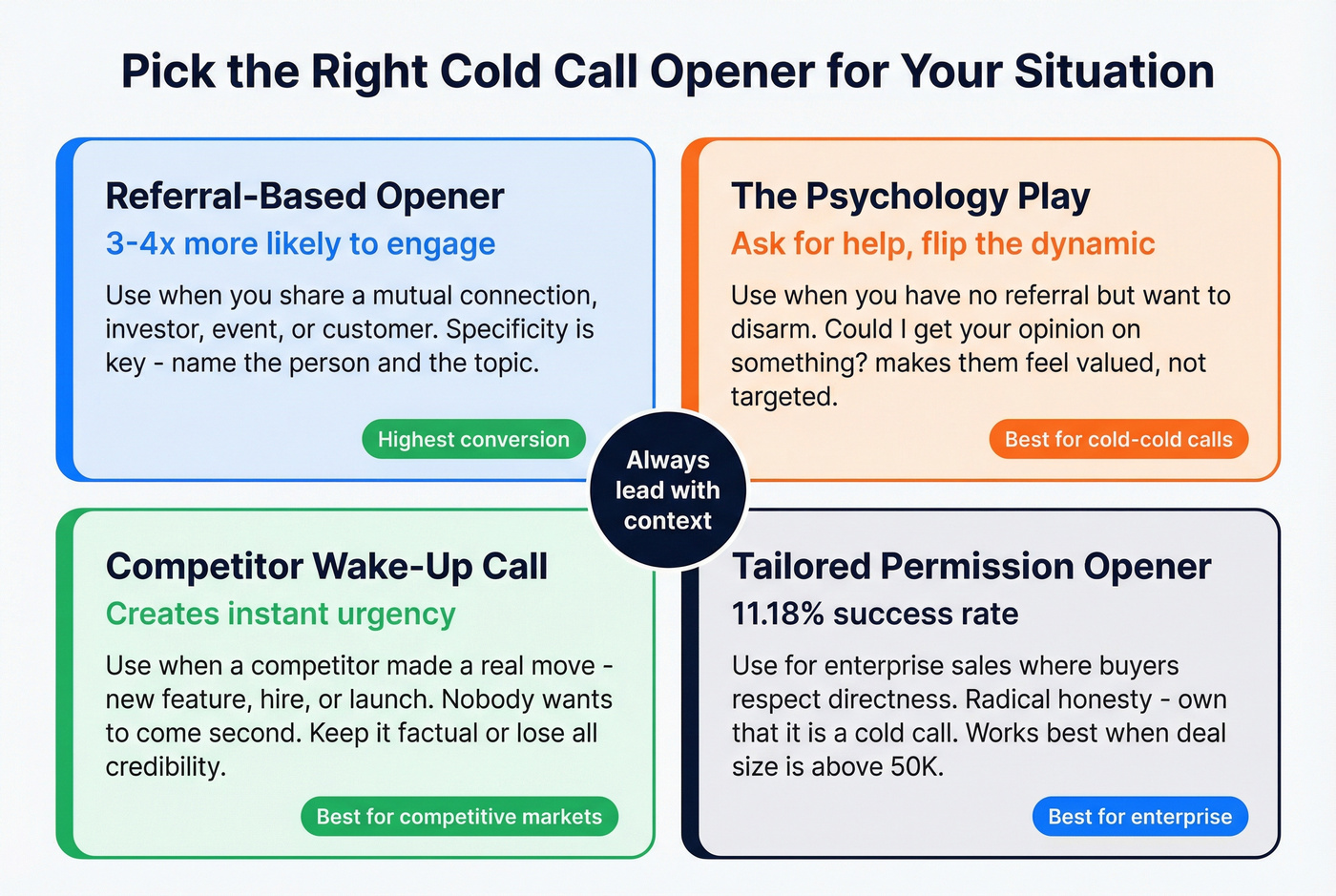
Cold Call Openers That Book Meetings
Beyond the 300M+ call dataset, several opener categories consistently perform across industries. Here's how to pick the right approach for conversations that actually convert.
Referral-Based Openers: The 3-4x Multiplier
Prospects are 3-4x more likely to engage when a mutual connection introduces them. That makes this the most powerful opener category - period. Even a loose connection works: a shared investor, a colleague who attended the same conference, a mutual customer. If you want copy/paste options, use these referral template email examples.
"Hey [name], [mutual connection] and I were talking about [topic], and your name came up. They mentioned you're working on [initiative] - I had a quick thought on that. Got 30 seconds?"
The key is specificity. "Your name came up" is vague. "Your name came up when we were discussing how [industry] teams are handling [specific challenge]" is magnetic.
The Psychology Play: Ask for Help
People are wired to help. It's one of the deepest social instincts we have. Flip the dynamic from "salesperson pitching" to "peer asking for input," and the prospect feels valued instead of targeted.
"Could I get your opinion on something?"
Chris Voss's no-oriented question technique works on the same principle. Instead of "Have you got a few minutes?" (which triggers a defensive "no"), try "Is now a bad time to talk?" Saying "no" to that question actually means "yes, I can talk" - and the prospect feels a sense of agency in the decision.
Scenario: The Competitor Wake-Up Call
Picture this: your prospect's biggest competitor just launched a feature that directly threatens their market position. You know about it because you track industry news. They don't. If you want a system for this, build a lightweight competitive intelligence for B2B sales workflow.
"Hi [name], I noticed [competitor] just launched [feature/initiative]. I was curious if you've considered how that impacts your approach to [area]..."
Nobody wants to come second. Mentioning a competitor's move creates instant urgency without faking it. The prospect's brain shifts from "why should I listen?" to "wait, what are they doing?"
Keep it factual. Reference real news, real launches, real hires. Fabricated competitor intel will destroy your credibility the moment they check.
Industry Adaptation: Insurance Example
These frameworks aren't just for SaaS. An insurance rep could open with: "Hi [name], I was reviewing the recent changes to [state] liability requirements and noticed companies in [their industry] are getting hit with 15-20% premium increases. I had a quick thought on how to get ahead of that - got 30 seconds?" The structure is identical - context, relevance, ask - but the language matches the buyer's world. Good openers always mirror the prospect's vocabulary, not yours.
The Prerequisite Nobody Talks About: Clean Data
Here's the thing: the best sales pitch opening in the world fails if you're calling a disconnected number or emailing an address that bounces.
I've seen teams obsess over script optimization while 35% of their contact data is garbage. That's not a sales problem - it's an infrastructure problem. If you’re diagnosing decay and refresh cycles, start with B2B contact data decay.

Meritt, an outbound agency, was running a 35% bounce rate before switching their data source. After moving to Prospeo, bounces dropped to under 4% and their connect rate tripled. That's not a marginal improvement - that's the difference between a pipeline and a graveyard.
If your bounce rate is above 5%, stop tweaking your opener and fix your data first. Everything else in this article assumes someone actually picks up.
Email Openers: What 85 Million Emails Reveal
The Rules From 85M+ Emails
Jason Bay's team analyzed 85M+ cold emails using Gong data. The findings are brutal:

- 1-4 words is the ideal subject line length. Shorter consistently outperforms longer.
- All lowercase beats title case and sentence case on open rates.
- Salesy language (think "exclusive offer," "limited time") tanks open rates by up to 17.9%.
- Top reps get 2.1x the opens compared to average reps - and they achieve 58%+ open rates.
- Empty subject lines boost opens by 30% but kill reply rates by 12%. It's a gimmick. Skip it.
The pattern: your subject line's job isn't to sell. It's to earn a click. Treat it like a text message to a colleague, not a billboard. For a full system beyond open rates, use these email opening best practices.
Four Subject Line Formulas That Work
Pervasive Problems: Reference a pain everyone in their role feels. "pipeline visibility" or "rep ramp time"
Industry Trends: Name a shift they're already thinking about. "ai replacing sdrs?" or "outbound in 2026"
1-2 Word Pattern Interrupts: So short it creates curiosity. "quick question" or just "[company name]"
Competitor Share: Name a peer company doing something relevant. "[competitor]'s approach" or "saw [competitor]'s launch"
All lowercase, all under four words, zero salesy language. The best subject lines look like they came from a colleague, not a vendor.
The Personalization-at-Scale Problem
A Reddit thread in r/sales nailed the tension: "Simple personalization still screams boring sales email" when everyone's doing it. The first-line personalization that worked in 2023 - "saw you're hiring for X" - is now table stakes. Prospects have seen it a thousand times. If you're using AI to scale this, avoid these AI cold email personalization mistakes.
In our experience, the teams hitting 58%+ open rates aren't writing better copy - they're picking better targets. You can't hand-personalize every email when your territory covers hundreds of accounts. But you can make sure your personalization is based on real signals - actual company news, real tech stack data, genuine hiring patterns - instead of template variables that feel robotic.
The real unlock isn't better templates. It's better inputs.
Social Selling Openers: Messages That Get Replies
Social messages play by different rules. Connection requests cap at 300 characters. Messages should stay under 5-7 sentences. The bar for personalization is higher because the prospect can see your profile, your content history, and your mutual connections in one glance.
Personalized connection requests typically see 15-30% acceptance rates. Generic ones hover around 5-10%. If you want benchmarks and data points to calibrate, see these social selling statistics.
That gap alone should tell you where to invest your time.
Connection Request - Bad: "I came across your profile and thought we should connect."
Translation: "I'm mass-connecting with everyone who matches a filter."
Connection Request - Good: "Been following [Company] since your recent [launch/news]. Impressive work. I help [role type] tackle [specific challenge] - happy to connect in case it's ever useful."
Accepted Connection Follow-Up - Bad: "Thanks for connecting! Let's set up 15 minutes to chat about how we can help." Instant unfollow energy.
Accepted Connection Follow-Up - Good: "Thanks for connecting. I'm always curious how [role]s at [industry] companies are approaching [challenge] this year. How are you thinking about it?"
Content Engagement Follow-Up - Good: "Appreciate the engagement on the [post topic] piece. That's been a hot topic in [industry] - curious if it's something your team is navigating right now?"
The pattern across all three: give before you take. Ask before you pitch. Reference something specific before you go generic.
Presentation and Demo Openers
The 10-Second Decision Window
Mary Beth Hazeldine - 24 years at JPMorgan, PwC, and RBS - puts it bluntly: your audience decides in the first 10 seconds whether to engage or resist. Not 10 minutes. Ten seconds.
Three techniques that survive that window:
Problem Activation: Start with a problem they already feel. "Your reps are spending 4 hours a day on admin. That's half their selling time - gone." You can't convince someone of your solution until they're engaged with the problem.
Startling Contrast: Juxtapose where they are vs. where they could be, with specific numbers. "Your team closes 12 deals a month. Your competitor across the street closes 31. Same market, same product category."
Provocative Question: Ask something they can't ignore. "What if I told you 60% of your pipeline will go dark in the next 30 days - and you already know which deals?"
Five Phrases That Kill Your Pitch
Stop using these. Seriously.
- "Let me introduce myself" - They don't care about you yet. They care about their problem.
- "Today's agenda covers..." - Administrative, not persuasive. You've already lost them.
- "Thank you for your time" - Signals you're about to take, not give.
- Starting with raw data - A chart on slide one invites analysis, not agreement. Lead with emotion, support with data.
- "I know you're busy" - You just primed them to think about everything else they should be doing.
Sales Pitch Ideas That Actually Land
Atlassian's sales pitch framework breaks effective presentation openers into five categories: statistics, pain points, questions, value propositions, and stories.
Mark Cuban used the story approach when he bought the Dallas Mavericks. Instead of pitching ticket features, he called former season ticket holders and reminded them of childhood game experiences - the smell of popcorn, the roar of the crowd. Emotional, not transactional. Ticket sales climbed. He bought the team for $280M; it's now valued at $3.3B.
Adam Goldstein, Hipmunk's CEO, went the opposite direction: a two-sentence pitch emailed to United Airlines' CEO. Got a response in 15 minutes. Secured $55M from investors.
Skip the story opener for cold calls - save it for presentations where you have more than 93 seconds. Both Cuban and Goldstein worked because they matched the opener to the context. The right opener depends on this audience, this moment, this channel.
Which Opener for Which Situation: The Decision Matrix
| Context | Best Opener Type | Why |
|---|---|---|
| Cold call, enterprise | Permission Opener | Enterprise buyers respect directness |
| Cold call, mid-market | "Heard the name tossed around?" | Familiarity plays well at scale |
| Cold call, warm lead | Referral-based | 3-4x engagement multiplier |
| Cold email, first touch | Pervasive problem subject line | Earns the click without selling |
| Cold email, follow-up | Competitor share | Creates urgency on second attempt |
| Social, connection request | Specific compliment + value hint | Personalization bar is highest here |
| Presentation, C-suite | Startling contrast with numbers | Execs want impact, not stories |
| Presentation, end users | Problem activation | They feel the pain daily |
| Demo, technical buyer | Provocative question | Engages analytical minds |
No competitor has published a cross-channel matrix like this because most guides focus on a single channel. Real outbound doesn't work that way. Your prospect gets a cold call Monday, an email Wednesday, and a connection request Friday. The opener needs to match the channel, not just the script.
The Psychology Behind Openers That Work
Why Emotion Beats Logic (Every Time)
95% of purchasing decisions are made subconsciously. People buy emotionally and justify rationally. This isn't pop psychology - it's how the brain processes decisions under uncertainty, which is exactly what a cold outreach moment is.
People remember stories 22x more than facts alone. That's why Mark Cuban's popcorn-and-crowd-noise pitch outsold every feature comparison. That's why "I work with companies like yours who are dealing with [problem]" outperforms "Our platform has 47 features including..."
Loss aversion is the most powerful framing tool you have. "You're losing $10K a month by not fixing this" consistently outperforms "You could gain $10K a month." The pain of losing is roughly twice as motivating as the pleasure of gaining. Use it in your opener: frame the cost of inaction, not the benefit of action.
Reps who study prospect psychology close 57% more deals. Personalized calls see 60% higher voluntary participation. And multi-channel sequences - cold call plus email plus social - drive 287% higher engagement than single-channel outreach.
Chris Voss Techniques for Sales Openers
Chris Voss's Never Split the Difference isn't a sales book, but it's the best sales book ever written. Three techniques translate directly to openers:
Mirroring: Repeat the last 2-3 words of whatever the prospect says. Prospect: "Your product is a little outside our budget." You: "Outside your budget?" Then silence. They'll elaborate, volunteer objections, and give you information you'd never get from a direct question. It works because it signals active listening without interrogation.
Labels: Statements that start with "It sounds like..." or "It seems like..." These qualify intent. "It sounds like you've been burned by vendors who overpromised on data quality." The prospect either confirms (and you're in a conversation) or corrects (and you learn their real concern). Either way, you win.
No-oriented questions: "Is now a bad time to talk?" beats "Have you got a few minutes?" every time. Saying "no" triggers a feeling of safety and control. "Have you given up on...?" and "Is it ridiculous to...?" work on the same principle - each invites a "no" that actually means "yes."
Cialdini's Principles in Your First Sentence
Three of Cialdini's six principles show up in every top-performing opener:
Social proof: "I work with [peer companies]" - this is why the top-performing opener works. You're borrowing credibility from companies the prospect already respects.
Reciprocity: Give value before asking for anything. Share an insight, a benchmark, a relevant data point. The prospect feels a subtle obligation to reciprocate with their attention.
Scarcity: "We're only working with three companies in [industry] this quarter" - creates urgency without faking it. Use sparingly and honestly.
The 300M+ call data makes more sense through this lens. "Heard the name tossed around?" uses social proof. The Permission Opener uses reciprocity (honesty as a gift). Both outperform openers that use nothing.
Openers That Kill Deals (Stop Using These)
I've watched every single one of these anti-patterns tank deals before they start:
The Immediate Pitch: Launching into your spiel before exchanging a single human sentence. It screams desperation. The prospect's brain goes straight to "how do I get off this call?"
The Generic Pitch: One-size-fits-all messaging that could apply to any company in any industry. If yours sounds like everyone else's, you're invisible.
The Bossy Pitch: "You should" and "you need to" come across as presumptive and pushy. Flip to "Teams like yours typically find that..." - same information, zero condescension.
The "Me" Pitch: "We're the leading provider of..." Nobody cares about your features. They care about their problems. Shift every sentence from "me" to "you."
Faking Urgency: "Act now - limited spots available!" Prospects see through manufactured scarcity instantly. Trust is the only currency that matters in the first 10 seconds.
The Never-Ending Pitch: A 90-second monologue before the prospect can speak. Average cold call duration is 93 seconds total. If you're talking for 60 of those, you've already lost.
And the data-backed worst performer: "Did I catch you at a bad time?" at 2.15%. It's polite. It's considerate. It's also giving the prospect a loaded exit ramp.
Find Your Voice: Why Frameworks Beat Scripts
A Reddit practitioner selling Voice of Customer solutions to Middle Eastern enterprises put it perfectly: "I learned that I can't copy scripts and styles. I have to develop something that fits with who I am."
That's the most important insight in this entire article.
Scripts have a shelf life. Cognism's own team acknowledges that opening phrases expire once enough reps use the same line. The "Heard the name tossed around?" opener works today because it's still relatively fresh. Give it two years of widespread adoption and prospects will recognize it instantly. The same applies to any collection of opening lines - they stop working the moment they become ubiquitous.
What doesn't expire is understanding why an opener works. Social proof. Permission. Loss aversion. Context-leading. These principles are permanent. The specific words are temporary.
Look, 83% of sales teams using AI have seen revenue growth compared to 66% without it. But AI's real value isn't writing your scripts - it's accelerating your research. Use AI to surface company news, identify trigger events, and understand the prospect's world before you dial. Then open with something that's authentically yours, informed by real context.
The reps who consistently nail their sales pitch opening aren't the ones with the best memorized lines. They're the ones who understand the psychology, do the research, and then say something that sounds like them - not like a blog post they read this morning.
The 11.24% winning opener works because reps lead with context - peer companies, relevant challenges, real familiarity. Prospeo's 30+ search filters and intent data across 15,000 topics give you that context before you ever dial.
Turn every cold call into a warm one with real buyer intelligence.
FAQ
How do you start a cold call without saying "How are you?"
Lead with context about their peer companies or ask a permission-based question. The 300M+ call dataset shows "Heard the name tossed around?" (11.24%) and the Tailored Permission Opener (11.18%) both outperform "How are you?" by 47-48%. Mention companies similar to theirs, introduce yourself second, and ask a question that earns the next 30 seconds.
How long should a sales pitch opening be?
Keep cold call openers under 15 seconds - prospects decide whether to engage within roughly 10 seconds. For emails, 1-4 word subject lines perform best across 85M+ analyzed messages. For presentations, deliver your hook in the first 10 seconds before pivoting to the problem you solve.
What's the best opening line for a sales email?
Use a 1-4 word lowercase subject line referencing a pervasive problem or industry trend. Salesy language tanks open rates by up to 17.9%. Top reps achieve 58%+ open rates by leading with the prospect's priorities, not their own product. Examples: "pipeline visibility" or "[competitor]'s approach."
Do sales pitch scripts actually work?
Frameworks outperform word-for-word scripts. Scripts expire once enough reps adopt the same line and prospects recognize it. Learn the psychology behind top openers - social proof, permission, loss aversion - then adapt those principles to your personality and industry. The best reps sound like themselves, not a playbook.
How do you make sure your opener reaches the right person?
Verify contact data before dialing or sending. Tools like Prospeo offer 98% email accuracy and 125M+ verified mobile numbers with a 30% pickup rate, so your opener reaches a live prospect instead of a voicemail box. Teams like Meritt cut bounce rates from 35% to under 4% after switching - meaning a third of their openers had been hitting dead air.