

Cold Calling Training: The 2026 Playbook for Reps and Managers
Most cold calling training fails for one dumb reason: teams polish scripts before they fix reachability and install a coaching loop. You can dial all month, "work hard," and still learn nothing.
This playbook does it in the right order: benchmarks, dial-to-connect-to-meeting math, scripts that sound like a real person, drills that build muscle memory, and a manager-run system that sticks.
Here's the thing: if you can't consistently reach humans, no script on earth saves you.
What you need (quick version)
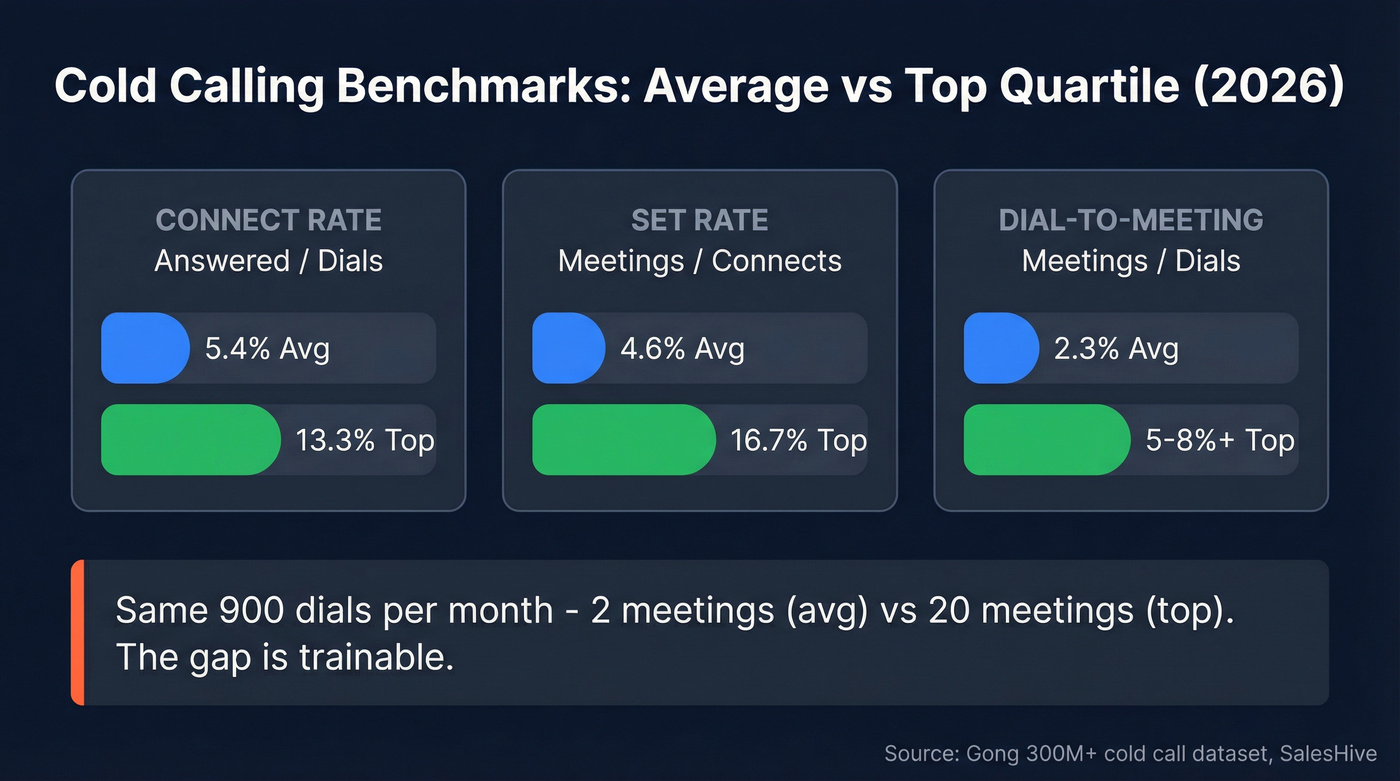
- Baseline the funnel (don't guess) Connect rate averages 5.4% and top quartile hits 13.3%; set rate averages 4.6% and top hits 16.7%.
- Fix reachability before you rewrite scripts 87% of mobile users ignore unknown numbers; 40% of non-answers happen because the call isn't identified properly.
- Coach one bottleneck at a time Low connect rate = data/timing/number reputation; low set rate = call structure/close; low show rate = meeting framing/confirmation.
- Install the loop (this is the whole game) Daily roleplay (30 min) + weekly call review + a pass/fail scorecard, using cold call role playing exercises that mirror your real ICP and objections.
- Run drills, not lectures Objections, gatekeepers, voicemail+email pairing, and timing windows get practiced on a schedule.
Why cold calling feels harder now (and why most training fails)
Cold calling feels harder because it is harder: people screen unknown numbers by default. When 87% don't answer and 40% of non-answers are tied to poor identification, your reps aren't "getting rejected"--they're getting filtered.
Most teams respond with a bootcamp and a script PDF. That's backwards. Results move when you improve reachability (get a human) and conversion behaviors (earn a meeting once you do).
One rep told me they did 3,000 calls in a month and still felt their stomach drop before every dialing block. They weren't "soft." They were stuck in a system where half the list was dead, nobody reviewed calls, and the only feedback was "do more."
I'm opinionated about this: grinding without a loop is the fastest way to make good reps hate outbound.
Cold calling is a production system. Treat it like one and it gets calmer fast, because you can see exactly what's broken.
Benchmarks: what "good" looks like in 2026 (so you stop guessing)
Gong's 300M+ cold call dataset gives a clean baseline for the two-step funnel (dials -> connects -> meetings). SalesHive's dial-to-meeting ranges help you plan activity without turning your team into KPI zombies.
Mini benchmark table (the only numbers that matter)
| Metric | Definition | Avg | Top |
|---|---|---|---|
| Connect rate | Answered ÷ dials | 5.4% | 13.3% |
| Set rate | Meetings ÷ connects | 4.6% | 16.7% |
| Dial-to-meeting | Meetings ÷ dials | 2.3-2.5% | 5-8%+ |
How to use this without overthinking it:
- If your connect rate is under 5%, stop "training objections" and fix reachability this week.
- If your connect rate is fine but set rate is under ~6%, your opener + reason + close are the problem.
- If your set rate is fine but show rate is weak, your meeting framing and confirmation process are sloppy.
Definitions that matter (and how to measure them)
Most teams track connect rate and call it a day. That's how you coach the wrong thing.
- Connect rate: any prospect answers.
- Decision-maker connect rate: the right person answers.
- Set rate: meetings booked per conversation.
- Dial-to-meeting: meetings booked per dial (best forecasting metric).
How to measure decision-maker connect rate (do this in your CRM today):
- Add dispositions: DM Connect, Non-DM Connect, Gatekeeper, Wrong Person, Bad Number, Voicemail.
- Require reps to log a disposition within 30 seconds of hanging up (no "later" logging).
- Review DM Connect rate weekly; it's the fastest signal that list quality is improving.
Targets by rep level
- New SDR (first 30 days on phones)
- Connect rate: 3-6%
- Set rate: 3-6%
- Dial-to-meeting: 1-2.5%
- Tenured SDR
- Connect rate: 6-10% (higher with great data + timing)
- Set rate: 8-15%
- Dial-to-meeting: 3-6% (top teams push 5-8%+)
- AE prospecting blocks (2-4 hrs/week)
- Judge AEs on conversations/week and meetings/conversation, not dials/day.
Hot take: if your average deal size is small, you probably don't need "enterprise outbound" anything. You need clean lists, tight talk tracks, and a manager who coaches weekly.
Daily activity expectations (what's sane)
For most B2B teams:
- 40-50 dials/day
- 4-6 quality conversations/day (when data + timing are decent)
When you see 80-120 dials/day, it's either a dialer + great lists... or KPI theater that burns reps out.

You just saw the math: same 900 dials, 2 meetings vs 20 - and the #1 lever is connect rate. When 87% of prospects ignore unknown numbers, you need verified direct dials that actually ring. Prospeo gives you 125M+ verified mobiles with a 30% pickup rate and 98% email accuracy - refreshed every 7 days, not every 6 weeks.
Stop training scripts on top of dead data. Fix reachability first.
Cold calling math: the dial -> connect -> meeting calculator (and why training pays back)
In Gong's 300M-call analysis, 800 dials/month turns into ~2 meetings/month for an average rep versus ~18 meetings/month for a top rep. Same activity. Completely different outcomes.
That gap is why you don't "train everything." You target a specific conversion step:
- Average reps need ~19 dials per conversation.
- Top reps need ~8 dials per conversation.
Calculator inputs (keep it simple)
- Dials/day
- Connect rate
- Set rate (meetings per connect)
- Workdays/month
Then:
- Connects/month = dials/day x workdays x connect rate
- Meetings/month = connects/month x set rate
Example:
- 45 dials/day x 20 days = 900 dials/month
- 900 x 5.4% = 49 connects
- 49 x 4.6% = 2.25 meetings/month
Same dials at top-quartile:
- 900 x 13.3% = 120 connects
- 120 x 16.7% = 20 meetings/month
Diagnose your team in 10 minutes (do this before you retrain)
Use last week's numbers and pick one fix for this week:

- Connect rate <5% -> list hygiene + timing windows + number reputation
- DM connect rate low (even if connect rate is fine) -> title accuracy + direct dials + routing
- Set rate <6% -> opener + reason-first + one-question flow + two-option close
- Show rate low -> meeting agenda + calendar hygiene + confirmation workflow
Pick one. Training everything at once is how nothing changes.
Call structure and scripts that actually move set rate
Most scripts fail because they read like marketing copy. Cold calls win when they sound like a normal professional who has a point and respects time.
The 4-part call (scorecard-ready)
- Opener (first 5 seconds) Identify yourself and earn the next 10 seconds.
- Problem statement (next 30 seconds) Reason for call + who you help + why now.
- Conversation (next 1-8 minutes) 1-2 questions, then shut up and listen.
- Close (final 30-60 seconds) Sell the meeting, not the product.

Openers: stop saying this / say this instead
Stop using:
- "Is this Bob?"
- "Did I catch you at a bad time?"
The "bad time" opener books 40% fewer meetings. It hands prospects an easy exit and makes you sound unsure.
Use a reason-first, brief opener:
Pattern (reason-first + one question): "Hi Bob, this is Maya from Acme. I'll be brief - I'm calling because we help RevOps teams cut demo no-shows. Quick question: are you still running confirmations manually?"
Or a softer version that still doesn't beg: "Bob - Maya from Acme. Reason I'm calling: we're seeing teams like yours lose pipeline to [specific problem]. Mind if I ask one question to see if it's relevant?"
Talk track rules that consistently work
- Reason-first wins. Stating the reason for the call boosts success 2.1x.
- Brevity beats buildup. If your first 30 seconds can't be repeated by someone half-listening, it's too long.
- Aim for ~55% talk time as a baseline; ask a real question early.
- One clear thought, then a question. Successful calls include longer monologues (53s vs 25s), but they're tight and purposeful, not rambling.
We've tested this in real coaching: reps don't need "better words" as much as they need fewer words, delivered cleanly, followed by a question they actually care about.
Close: sell the meeting, not the product
Close script (simple, non-cringey): "Got it. Next step: let's do 15 minutes so I can show you how teams are handling this and you can tell me if it's worth pursuing. Tuesday morning or Thursday afternoon?"
If they ask for info: "Happy to. If I send a short overview, are you open to a quick 10-15 minutes after you skim it so I'm not spamming you?"
Objections, gatekeepers, and voicemail: training drills (not theory)
Objections aren't a script problem. They're a reps-don't-practice problem. The fix is cadence: short reps, high repetition, immediate feedback.
Top objections (one-breath responses)
- "Send info." "Will do. So I don't send the wrong thing - what are you using today for [problem]?"
- "Not interested." "Fair. Is that because you're already solving [problem], or it's just not a priority?"
- "We already have [competitor]." "Makes sense. Are you happy with it for [specific outcome], or is there something you wish it did better?"
- "Who are you?" "Maya from Acme. We work with [peer group] on [one outcome]. I'm calling because [reason]."
Drill rule: prospect fires the objection fast; rep responds in one breath; coach scores pass/fail.
7-day objection drill schedule (copy/paste)
| Day | Drill (10 minutes) | Reps | Pass standard |
|---|---|---|---|
| Mon | "Send info" routing | 20 | Asks a question before agreeing to "send" |
| Tue | "Not interested" | 20 | Clarifies timing vs relevance in one line |
| Wed | Competitor installed-base | 20 | Asks outcome-based gap question |
| Thu | "No budget / not this quarter" | 20 | Secures a next step or timing checkpoint |
| Fri | "Just email me" | 20 | Gets permission + schedules a follow-up slot |
| Sat (optional) | Gatekeeper routing | 20 | Direct ask + outcome-based reason |
| Sun (optional) | Close-only reps | 30 | Two-option close + tight agenda |

Gatekeepers (goal: route, not pitch)
- Be direct: "Can you connect me with the person who owns [area]?"
- If they ask why: "It's about [outcome]. Who's best?"
Pitching to a gatekeeper is how calls die slowly.
Voicemail + email pairing (train it as one motion)
Voicemail alone is weak. Voicemail paired with a relevant email creates recognition.
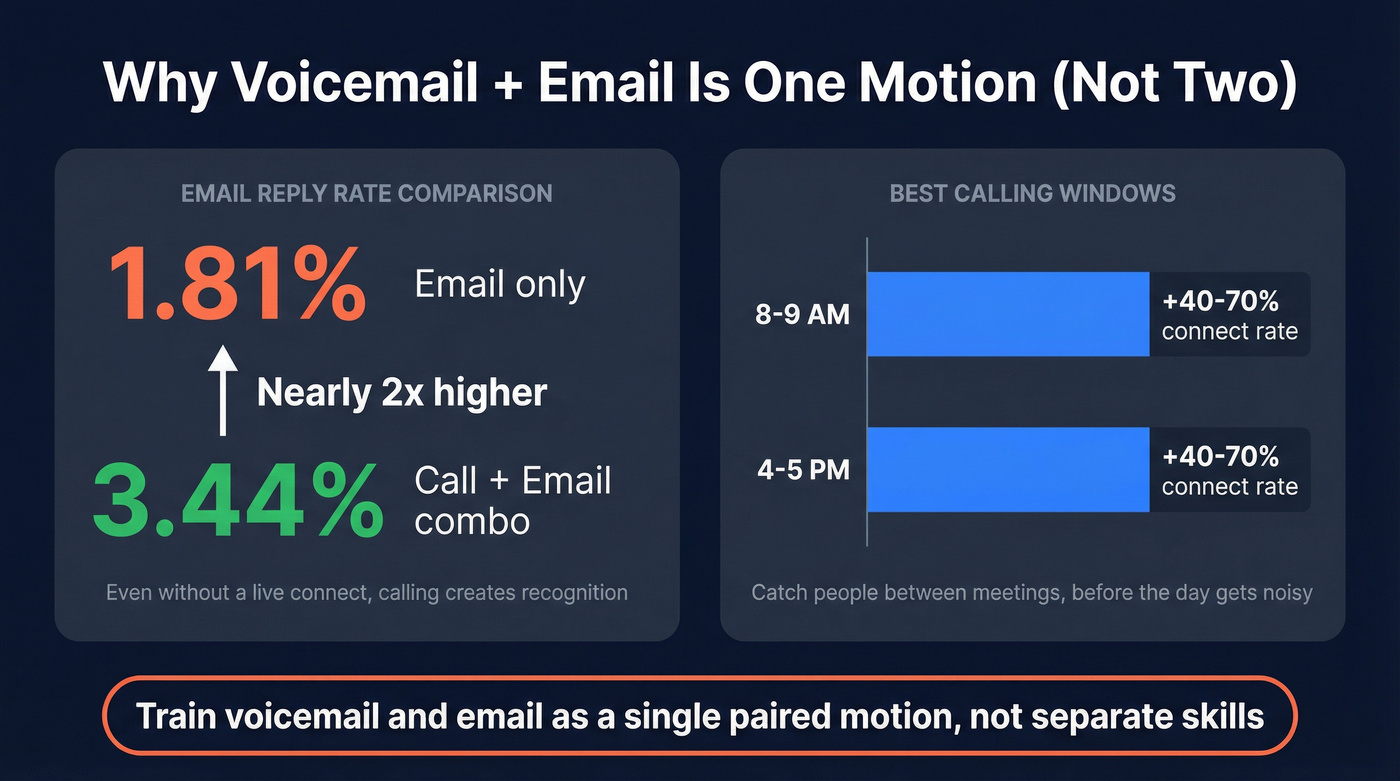
Calling nearly doubles email reply rates (3.44% vs 1.81%) even without a live connect. That's why "call + email" belongs in training.
Timing matters too: calling in 8-9am or 4-5pm windows can lift connect rates 40-70% versus random times. That's not magic. It's catching people between meetings, before the day gets noisy again.
Cold calling training system: roleplay + coaching loop that removes anxiety
Cold calling anxiety doesn't disappear with "confidence." It disappears when reps know what "good" sounds like and get coached on the same few behaviors until they're automatic.
I've watched teams buy fancy enablement content and still stall because managers weren't coaching weekly. Content isn't the bottleneck. The loop is.
Daily 30-minute roleplay block (pod format)
- 3 reps per pod: caller / prospect / coach
- 5-minute rounds
- One skill per week (opener, problem statement, objection, close)
- Coach scores only pass/fail behaviors. No vibes.
- Keep a rotating bank of cold call role playing exercises (fast objections, rushed prospect, skeptical gatekeeper, "already have a vendor") so practice matches what reps actually hear.
Weekly call review (lightweight, non-negotiable)
- 5 calls per rep per week (2 good, 3 painful-but-teachable)
- Pick calls by outcome (no-connect doesn't count unless it's a voicemail drill)
- Log 1-2 coaching notes:
- "Reason-first missing"
- "No question until 1:30"
- "Close turned into product pitch"
Listening to 1-5 calls per week and sending a weekly trend email (top objections, what's working, what's changing) is the reinforcement layer that turns training into behavior change.
Scorecard template (pass/fail behaviors)
Opener (5s)
- Said name + company clearly
- No "bad time" opener
- Earned 10 seconds (brevity)
Problem statement (30s)
- Stated reason for call
- Outcome-focused (not features)
- One clear hook
Conversation (1-8m)
- Asked 1-2 relevant questions
- Talk/listen roughly on target
- No rambling monologues
Close (30-60s)
- Proposed a specific next step
- Two time options
- Sold the meeting, not the product
Coaching gut-check: calls under 1 minute convert at basically 0%; around 5 minutes can hit ~16%; 10+ minutes can push ~30%. The goal isn't "talk longer." It's "create enough real conversation to earn a meeting."
Remediation logic (assign drills, not lectures)
- Low opener score -> 20 opener reps, timed to 12 seconds
- Low conversation score -> question-first drill (rep can't talk >20 seconds)
- Low close score -> two-option close reps + agenda reps
The 30/60/90 cold calling training plan (new reps + struggling reps)
A 30/60/90 plan only works when it's tied to funnel diagnosis. Otherwise it's just a calendar with vibes.
Days 1-30 (inputs + fundamentals + supervised dials)
- Learn ICP + top 3 pain triggers
- Memorize opener + reason-for-call + close
- 30 minutes daily roleplay
- 3 supervised call blocks/week (manager or peer listens live)
- Track: dials/day, connect rate, DM connects, set rate
Goal: remove randomness. New reps shouldn't be creative; they should be consistent.
Days 31-60 (objections + verticalization + consistency)
- Objection library (top 10) + drills
- Verticalized problem statements (2-3 industries)
- Timing experiments (8-9am, 4-5pm; mid-week focus)
- Weekly call review with scorecard trends
Goal: move set rate without increasing dials.
Days 61-90 (specialization + experimentation + peer coaching)
- Pick a lane (persona or vertical) and own it
- A/B test two openers and two closes for two weeks each
- Peer coaching: top reps run one roleplay block/week
- Manager focuses on 1-2 behaviors only (not 12)
Goal: build repeatable personal patterns that still fit the team system.
First week on phones: a drill schedule that prevents bad habits
This is the fastest way I've seen to get a rep dialing without turning them into a robot.
- Mon: 30 opener reps (timed) + 20 reason-first reps; 30 live dials
- Tue: 20 "send info" reps + 20 close reps; 40 live dials
- Wed: 20 "not interested" reps + voicemail+email pairing practice; 45 live dials
- Thu: 20 competitor objection reps + 10 gatekeeper reps; 45 live dials
- Fri: record 5 calls, self-score with scorecard, then manager scores the same 5; 40 live dials
Rule: the rep only levels up when the scorecard passes. That's how you prevent week-one habits from becoming month-three problems.
Fix your connect rate first: list quality + reachability (the hidden lever)
If your connect rate is under 5%, you don't have a training problem. You've got a reachability problem.
Every dead line and wrong number is a double tax: it wastes dials and it trains reps to expect rejection. I've watched teams spend weeks polishing scripts while calling stale lists; morale tanks, managers blame effort, and the best reps quietly stop dialing because they can tell the list is junk.
Decision tree: what to fix first
- Connect rate <5% -> list quality, direct dials, timing windows, caller ID + number reputation
- Connect rate >=5% but set rate <6% -> opener, reason-for-call, question flow, close
- Set rate fine but show rate low -> meeting framing, calendar hygiene, confirmation workflow
Caller ID & number reputation basics (practical, not gimmicky)
That "identification" stat is your clue: you need to look legitimate and consistent.
- Register branded caller ID where your carrier supports it; unbranded numbers get filtered harder.
- Use a small pool of consistent numbers (per rep or per team). Constantly swapping numbers trains spam filters to distrust you.
- Local presence is fine, deception isn't. Matching area codes can help connects; spoofing numbers is unethical and can be illegal.
- Watch number health: spikes in short calls, high complaint rates, and rapid-fire dialing can tank reputation.
- Respect consent and recording laws. If you record calls, your training system has to match your state/country requirements.
List hygiene checklist (the unsexy stuff that moves connect rate)
- Dead lines (disconnected, wrong company)
- Wrong titles (IC tagged as VP, or vice versa)
- Missing direct dials (only HQ numbers)
- Stale accounts (acquired, downsized, role changed)
- Duplicate contacts (same person hit twice in a week)
- No prioritization (everyone gets called, nobody gets called at the right time)
A practical aside on Prospeo (so your reps stop dialing dead lines)
Prospeo ("The B2B data platform built for accuracy") is one of the simplest ways to improve reachability fast because the data refreshes every 7 days (industry average: 6 weeks) and emails are verified at 98% accuracy. You also get access to 300M+ professional profiles, 143M+ verified emails, and 125M+ verified mobile numbers, with a 30% mobile pickup rate.
A clean workflow that doesn't turn into a RevOps science project:
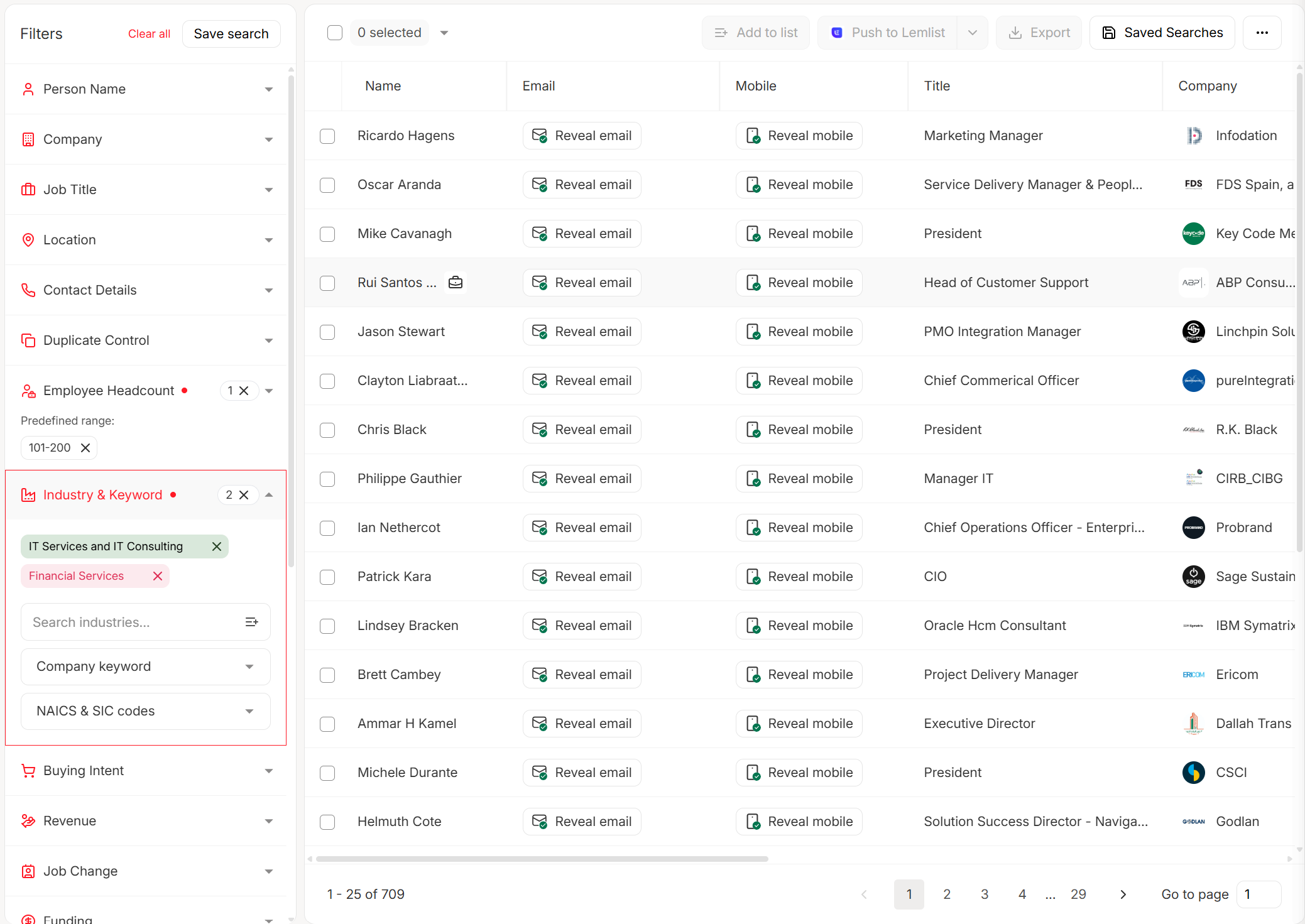
- Build your ICP list with 30+ filters (role, headcount, growth, intent topics, technographics).
- Prioritize contacts with verified mobile + verified email indicators.
- Call mobiles first, then use the verified email for the voicemail follow-up.
- Refresh weekly so you're not dialing last quarter's org chart.
Useful pages if you're setting this up: Mobile Finder, Chrome Extension, and Pricing.
Training options (courses + AI practice): what to buy vs what to build in-house
Courses are fine. They don't replace a coaching loop. If you buy training and don't install daily roleplay + weekly call review + a scorecard, you bought entertainment.
Comparison table (price, format, best for, limitation, missing piece)
| Provider | Price (typical, as of 2026) | Format | Best for | Limitation | Missing piece |
|---|---|---|---|---|---|
| Higher Levels | $595 one-time or 4x$175 (total $700) | Self-paced + live | SDRs who need tight fundamentals | Still needs manager enforcement | Weekly scorecard coaching |
| ColdCALR | $49.99/month | AI roleplay | Daily reps + instant feedback | Not real prospect nuance | Weekly real-call review |
| Dale Carnegie | $799 bundle anchor (Sales Essentials Certificate); $200-$400/seat (common standalone range) | Live seminar / live online | Enterprise teams that need HR-safe training | Generic unless customized | Outbound-specific scorecard |
| Klozers | $3,000-$10,000/day (team day rate) | Onsite/remote bootcamp | Team reset + manager alignment | Short-term spike risk | 30/60/90 reinforcement |
| Udemy | $15-$200 per course | Self-paced | Budget basics for individuals | No accountability | Practice cadence + coaching |
| Coursera | $49-$79/month subscription | Self-paced | Structured learning habits | Not cold-call specific | Call scripts + scorecard |
| Clay | $149-$800/month (workspace plans) | Workflow tool | Outbound ops + enrichment workflows | Not training | Talk tracks + coaching loop |
| Apollo | $59-$119/user/month (common tiers) | Database + sequencer | Starter outbound + list building | Data quality varies by segment | Verification + list hygiene |
| RB2B | $50-$300/month (typical SMB range) | Outbound tool | Website visitor capture / warm signals | Narrow use case | Calling cadence + scripts |
| Skyp | $30-$100/month (typical) | Outbound tool | Deliverability-first outbound ops | Not a training product | Coaching + call QA |
Buy vs build (decisive recommendations)
- Solo rep: buy ColdCALR for daily reps, then self-score 5 calls/week with the scorecard.
- Team with weak managers: buy Higher Levels, but make coaching attendance mandatory or it won't stick.
- Enterprise / HR-heavy org: use Dale Carnegie for broad sales skills, then add an internal cold-call scorecard and weekly call reviews.
- Skip Cardone if you need skill transfer, not hype. Motivation fades; drilled behaviors compound.
Practitioner reality-check (what people say vs what works)
A pattern shows up in practitioner threads: AI SDR "autopilot" tools get described as undercooked when teams expect them to replace prospecting. The stack that gets mentioned as actually working is boring and manual by comparison - tools like Skyp + RB2B + Clay + Apollo - because targeting and data hygiene still decide whether anyone replies.
My take: AI is great for training reps (reps-for-reps). It's still unreliable as a replacement for prospecting judgment, especially in niche industries where one wrong assumption blows up the call.
AI roleplay vs call recording coaching (how to use both)
AI roleplay is best early in ramp: it gives reps volume practice without burning real prospects. Call recording coaching is best once reps have live connects and you need to fix nuance: pacing, interruptions, question quality, and closing discipline.
Skip AI roleplay if your team won't do weekly call reviews. You'll end up with reps who "sound good" in practice and fall apart on real conversations.
Manager kit: the system you can run starting Monday
Search results love "best scripts." Scripts don't fix teams. Managers do - by running a simple cadence with visible metrics, tight feedback, and zero mystery about what "good" sounds like.
Weekly manager implementation checklist (30-45 minutes total)
- Monday (10 min): publish the week's focus skill (one behavior only) + the pass standard.
- Daily (5 min): confirm roleplay pods happened (attendance + one note per rep).
- Wednesday (10 min): spot-check dispositions (DM Connect vs Non-DM Connect vs Bad Number).
- Friday (15 min): review the KPI dashboard and pick next week's bottleneck.
15-minute 1:1 coaching agenda (repeatable)
- 2 min: rep self-diagnosis (connect vs set vs show)
- 5 min: listen to one call clip (best or worst)
- 5 min: drill the week's behavior (5 reps live)
- 3 min: commit: one change for next week + one metric to watch
KPI dashboard (the only four you need)
- Connect rate
- Decision-maker connect rate
- Set rate
- Show rate
If you track these four and coach the bottleneck, your "training" stops being motivational content and becomes a system.
FAQ
What's a good cold call connect rate and meeting rate in 2026?
A solid baseline is 5.4% connect rate and 4.6% set rate, with top-quartile reps around 13.3% connect and 16.7% set rate. For planning, many teams land at 2.3-2.5% dial-to-meeting, while top teams reach 5-8%+. Use these to diagnose one bottleneck at a time.
How many cold calls per day should an SDR make to improve?
For most B2B SDRs, 40-50 dials/day plus 30 minutes of daily roleplay is enough volume to improve without burning out. If you're consistently above 80 dials/day and results aren't moving, the issue is usually list quality, timing windows, or weak coaching, not effort.
What should a cold call scorecard include?
A useful scorecard is pass/fail across four sections: opener, problem statement, conversation, and close, with 8-12 total checks. Include specifics like "reason stated," "first question by 45 seconds," and "two-option close." Score the same 5 calls weekly so reps can see progress.
What's a good free tool to improve reachability for cold calling?
Your cold calling training won't move connect rates if half your list is wrong numbers and outdated titles. Prospeo's 300M+ profiles with 30+ filters - including job changes, department headcount, and intent data - mean your reps dial the right person at the right time. At $0.01 per email and 10 credits per mobile, cleaning your list costs less than one wasted dialing block.
Push your team from 5.4% connect rate to top quartile with data that's actually fresh.
Summary: what to do next
If you want cold calling training that works in 2026, stop treating it like content and start treating it like a production system: baseline connect/set/show rates, fix reachability before rewriting scripts, and run daily roleplay plus weekly call reviews with a pass/fail scorecard.
Do that for 30 days and the anxiety drops, because the process finally gives reps feedback that matters.