How to Motivate a Sales Team: Remove What Demotivates Them First
A RevOps lead we know ran an engagement survey last quarter. The top three complaints from reps weren't about recognition, team culture, or career pathing. They were: "I don't understand my comp plan," "My manager cancels our 1:1s," and "Half the numbers I dial are disconnected." Every motivation problem traced back to a system failure, not a mindset one.
The Short Version
If you can only fix three things: simplify your comp plan so every rep can explain it in 30 seconds, institute weekly 1:1 coaching that actually happens, and clean up your prospecting data so effort converts to conversations. Everything else is optimization.
The 2026 Reality of Sales Engagement
Global employee engagement sits at 21% - a two-point drop during 2024 alone. That disengagement cost the world economy $438 billion in lost productivity. Sales is worse. RepVue's Cloud Index, aggregating 57,000+ ratings across 272 companies, pegged quota attainment at 43.83% in Q4 2025. ICONIQ's GTM benchmark puts AE attainment closer to 58%.
The honest range is 40-60% of AEs hitting quota, depending on segment and dataset. Either way, more than half your team is missing target in any given quarter. That's not a motivation problem you solve with a pizza party. That's a structural issue baked into how most sales orgs operate - their comp plans, their coaching cadence, their data quality, and their territory design.
The question isn't "how do I get reps fired up?" It's "what's standing between effort and results?"
Why Most Motivation Advice Fails
Every sales leadership article tells you to "set clear goals" and "celebrate wins." Groundbreaking. The problem with most motivation advice is that it treats symptoms. Contests are a sugar high - a two-week dopamine hit that fades the moment the leaderboard resets.
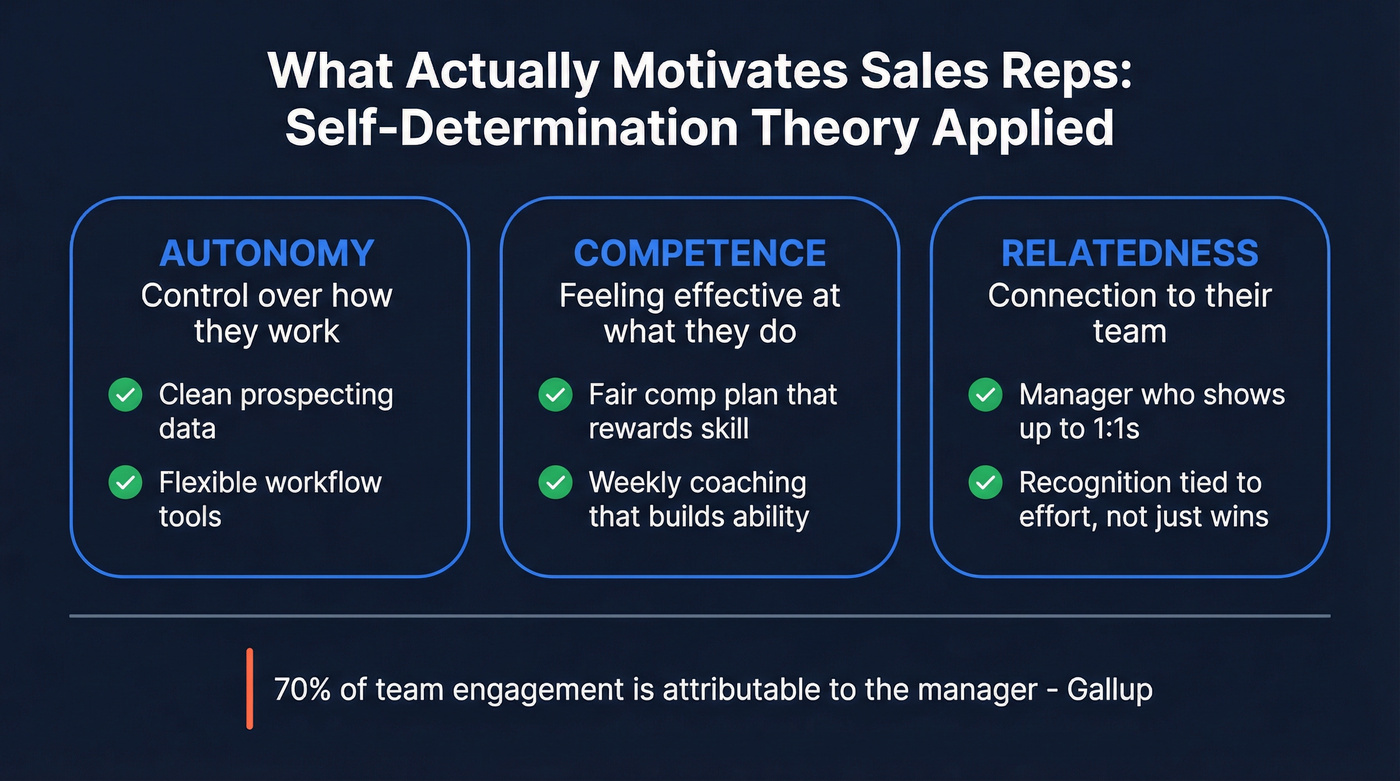
Here's the reframe that actually matters: stop trying to pump up your reps with rah-rah energy and instead remove what demotivates them. Gallup's research shows that 70% of team engagement is attributable to the manager. Not the SPIF, not the President's Club trip, not the Slack shoutout. The manager. And right now, only 27% of managers globally are engaged themselves.
Self-Determination Theory backs this up. Humans are driven by three intrinsic needs: autonomy (control over how they work), competence (feeling effective at what they do), and relatedness (connection to their team). A fair comp plan validates competence. Weekly coaching develops it. Clean prospecting data gives reps agency over their outcomes. Culture builds relatedness. Every fix in this article maps to one of those three drivers.
When your managers are burned out and your systems are broken, no amount of motivational energy fixes the underlying drag.
The Motivation Audit
Before you redesign anything, run a diagnostic. Most teams skip this step and jump straight to solutions - new comp plan, new contest, new tool. That's like prescribing medication without a diagnosis.
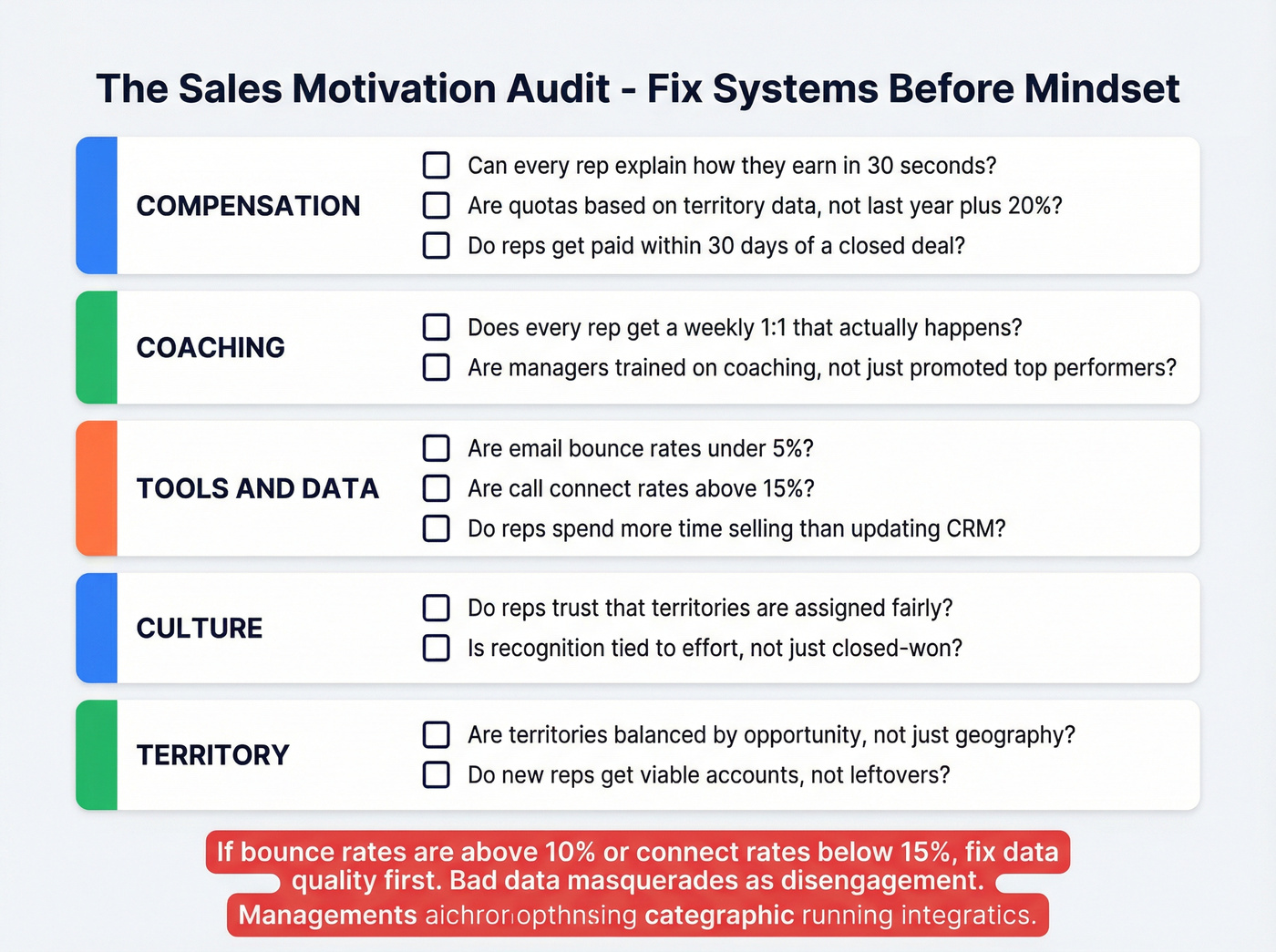
Work through these five categories with honest yes/no answers:
Compensation
- Can every rep explain how they earn in 30 seconds?
- Are quotas based on territory data, not last year's number plus 20%?
- Do reps get paid within 30 days of a closed deal?
Coaching
- Does every rep get a weekly 1:1 that actually happens?
- Are managers trained on coaching, or just promoted from top-performer roles? (See Sales Coaching.)
Tools and Data
- Are your email bounce rates under 5%? (Use a proper email verifier.)
- Are call connect rates above 15%? (Benchmark against answer rate.)
- Do reps spend more time selling than updating CRM fields? (The hidden tax is manual data entry.)
Culture
- Do reps trust that territories are assigned fairly?
- Is recognition tied to effort metrics, not just closed-won?
Territory
- Are territories balanced by opportunity, not just geography?
- Do new reps get viable accounts, or leftovers?
If your bounce rates are above 10% or call connect rates below 15%, fix your data quality before you redesign your comp plan. Bad data masquerades as disengagement every single day. (Start with a simple data quality scorecard.)
Different Reps, Different Drivers
HBR's model breaks sales teams into three groups: stars, core performers, and laggards. Each group responds to completely different incentives, and treating them the same is one of the most common mistakes in sales leadership.
| Segment | Primary Motivator | What Kills Drive |
|---|---|---|
| Stars | Uncapped upside | Commission caps |
| Core | Tiered milestones | Winner-take-all contests |
| Laggards | Quarterly bonuses | Annual-only payouts |
Stars
Commission caps are the single dumbest policy in sales compensation. Your best AE crushed Q3, brought in 140% of quota, and the reward is... the same rate on every dollar above target? Stars need accelerators - 1.5x to 2x multipliers above 120% attainment. Remove the ceiling and watch what happens.
Core Performers
This is where most of your revenue actually comes from. Core performers don't respond to winner-take-all contests because they know the stars will win. Tiered contests with varied prizes - where hitting 90%, 100%, and 110% each unlock something - move this group up the curve. Quarterly milestones keep them engaged across the full year, not just in the final push.
Laggards
When laggards are paid only annually, revenues drop 10%. Quarterly bonuses give them shorter feedback loops and a reason to stay engaged. Pair that with structured coaching and a clear 90-day improvement plan. Some will ramp up. Some won't. But at least you'll know within a quarter instead of wasting a year.

You just read it: if bounce rates top 10% or connect rates drop below 15%, bad data is masquerading as disengagement. Prospeo delivers 98% email accuracy and 30% mobile pickup rates - so every dial and every send gives your reps a real shot at a conversation. At $0.01 per email, cleaning up your pipeline costs less than one failed SPIF.
Stop motivating reps to work harder on broken data. Give them data that works.
Fix the Comp Plan First
Here's a stat that should make every CRO uncomfortable: 39% of revenue leaders admit their comp plans don't align with business goals. Only 21% of companies are happy with their sales compensation plans. If leadership can't figure out the comp plan, imagine how reps feel trying to calculate their paychecks.
The 30-second rule is the simplest test: if a rep can't explain how they earn in 30 seconds, the plan is too complex. Complexity breeds distrust, and distrust kills motivation faster than a bad quarter.
| Role | Base | OTE | Base % of OTE | Accelerator |
|---|---|---|---|---|
| SDR/BDR | $50-60k | ~$85k | 65-75% | - |
| AE (Mid-Market) | ~$77k | ~$154k | ~50% | 1.5-2x above 120% |
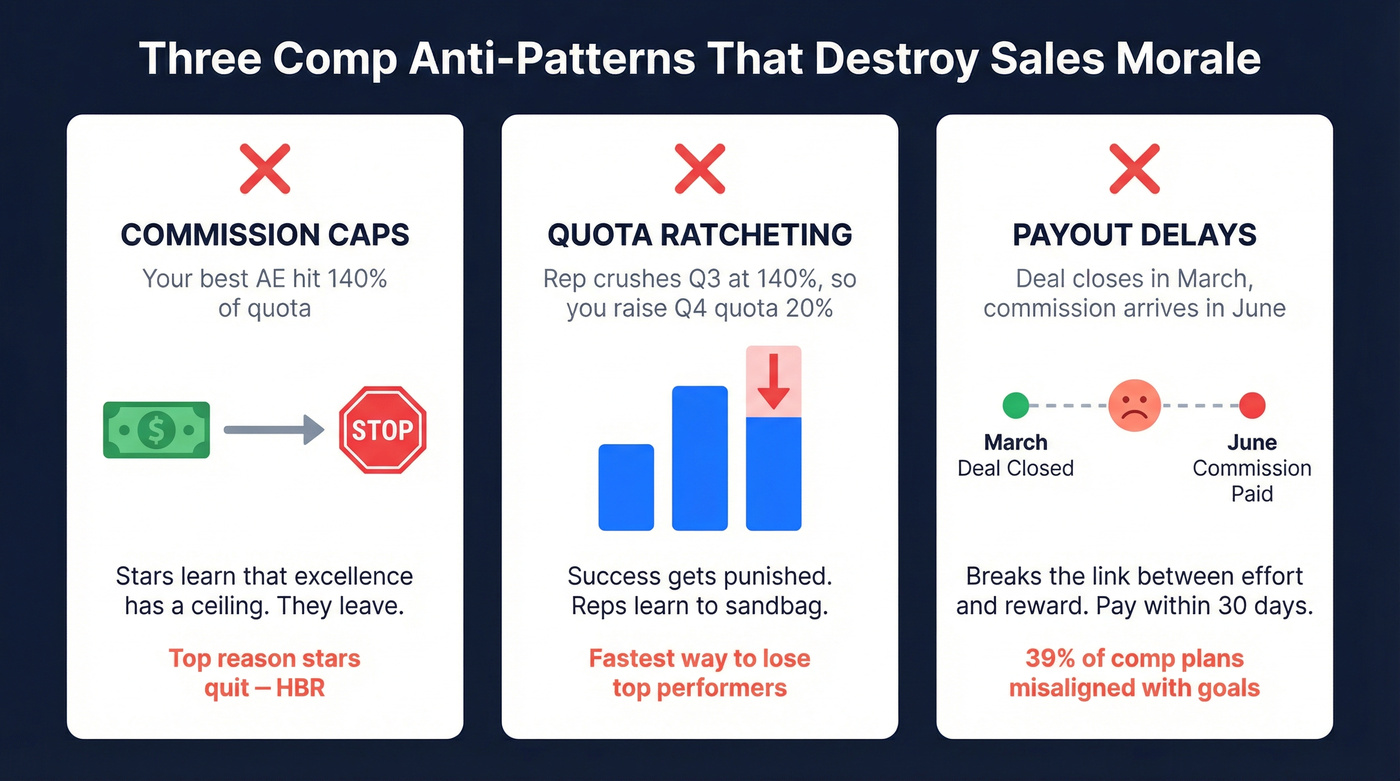
Three comp anti-patterns that destroy morale:
Caps. Already covered. Don't cap your best people.
Quota ratcheting. Your best AE crushed Q3 at 140%. So you raise their Q4 quota by 20%. Congratulations - you just taught them that success gets punished. Ask any rep on r/sales about quota ratcheting and you'll get an earful, because it's the fastest way to lose top performers.
Payout delays. If reps close a deal in March and don't see commission until June, you've broken the psychological link between effort and reward. Pay within 30 days. Period.
Build a Coaching System
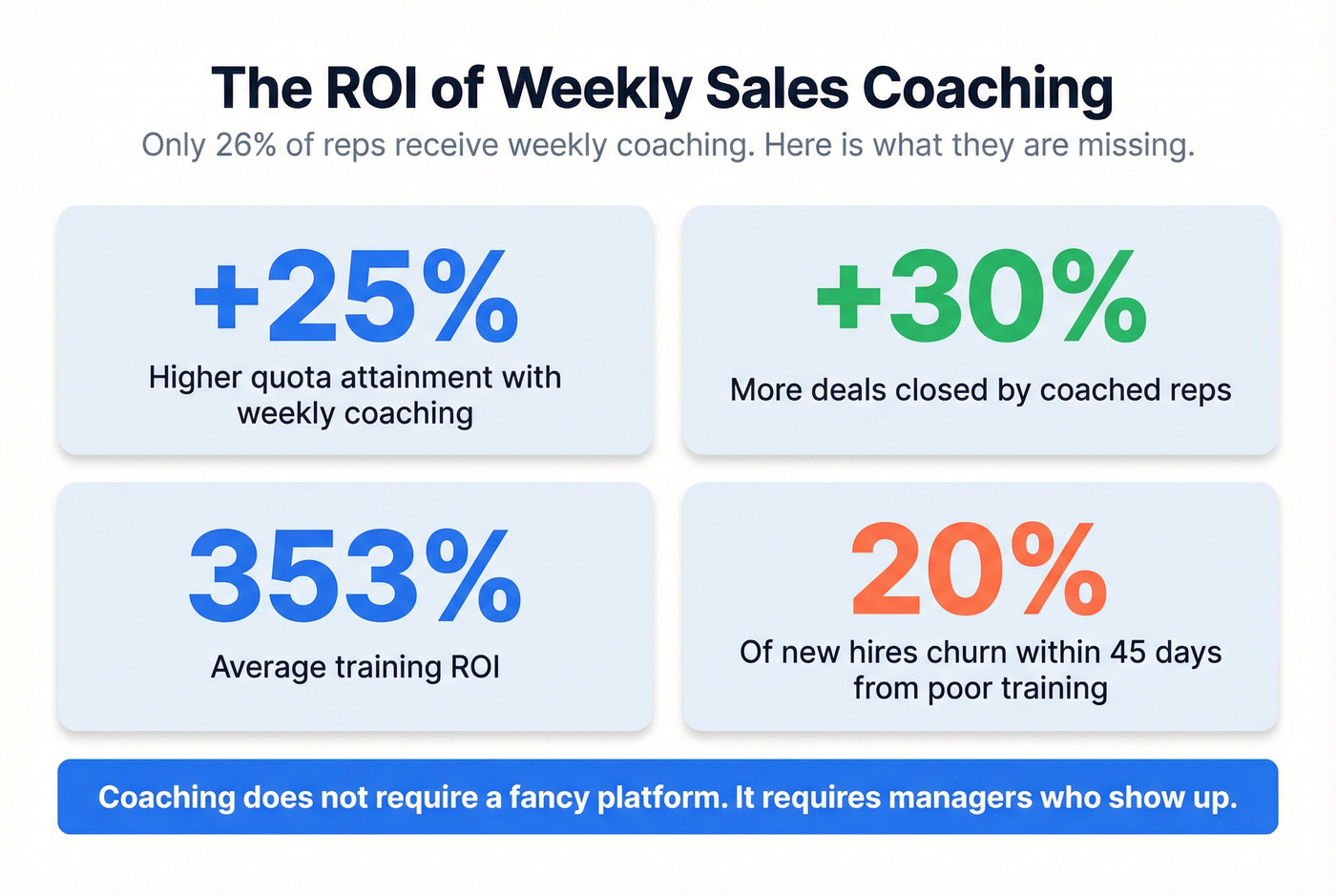
Only 26% of reps receive weekly coaching. That number is staggering when you consider the data: reps who get weekly coaching show 25% higher quota attainment and close 30% more deals. This isn't marginal - it's the single highest-leverage activity a sales manager can do. (If you need a repeatable structure, use a cold call coaching scorecard.)
A structured 30-minute weekly 1:1 focused on pipeline review and skill development outperforms any monthly team meeting or quarterly review. The cadence matters more than the content. Consistency builds trust, and trust is the foundation of coaching.
Training ROI runs around 353%, and structured onboarding retains 50% more new hires while cutting ramp time by 34%. Meanwhile, 20% of reps churn within their first 45 days due to poor training and unclear expectations. That's one in five new hires gone before they've even ramped. (See remote sales onboarding for a modern playbook.)
Look, coaching doesn't require a fancy enablement platform. It requires managers who show up, ask good questions, and actually listen. Most sales managers were promoted because they were great sellers, not great coaches. Training your managers to coach is the highest-ROI investment most orgs never make.
Remove Friction From Daily Workflows
Picture this: it's Tuesday morning. Your SDR sits down, pulls up the dialer, and starts working through a list. Two hundred dials planned. By noon, 40% of the numbers are disconnected. Another 15% ring through to the wrong person. The emails they sent yesterday? A 23% bounce rate. By 2 PM, they've had maybe eight real conversations from four hours of work.
That's not a motivation problem. That's a data problem.
Reps spend just 28% of their time selling - admin, data entry, and chasing bad contact information eat the rest. ICONIQ reports that 70% of companies now have moderate-to-full AI adoption in their GTM stack, and the teams using AI to automate admin work are freeing reps to actually sell. If your reps are still manually enriching leads and cleaning spreadsheets, you're losing to competitors who aren't. (A good starting point is reduce sales admin time with AI.)
Reps don't get demotivated because they're lazy. They get demotivated because effort doesn't correlate with results. When half your phone numbers are dead and emails bounce, the rational response is to disengage.
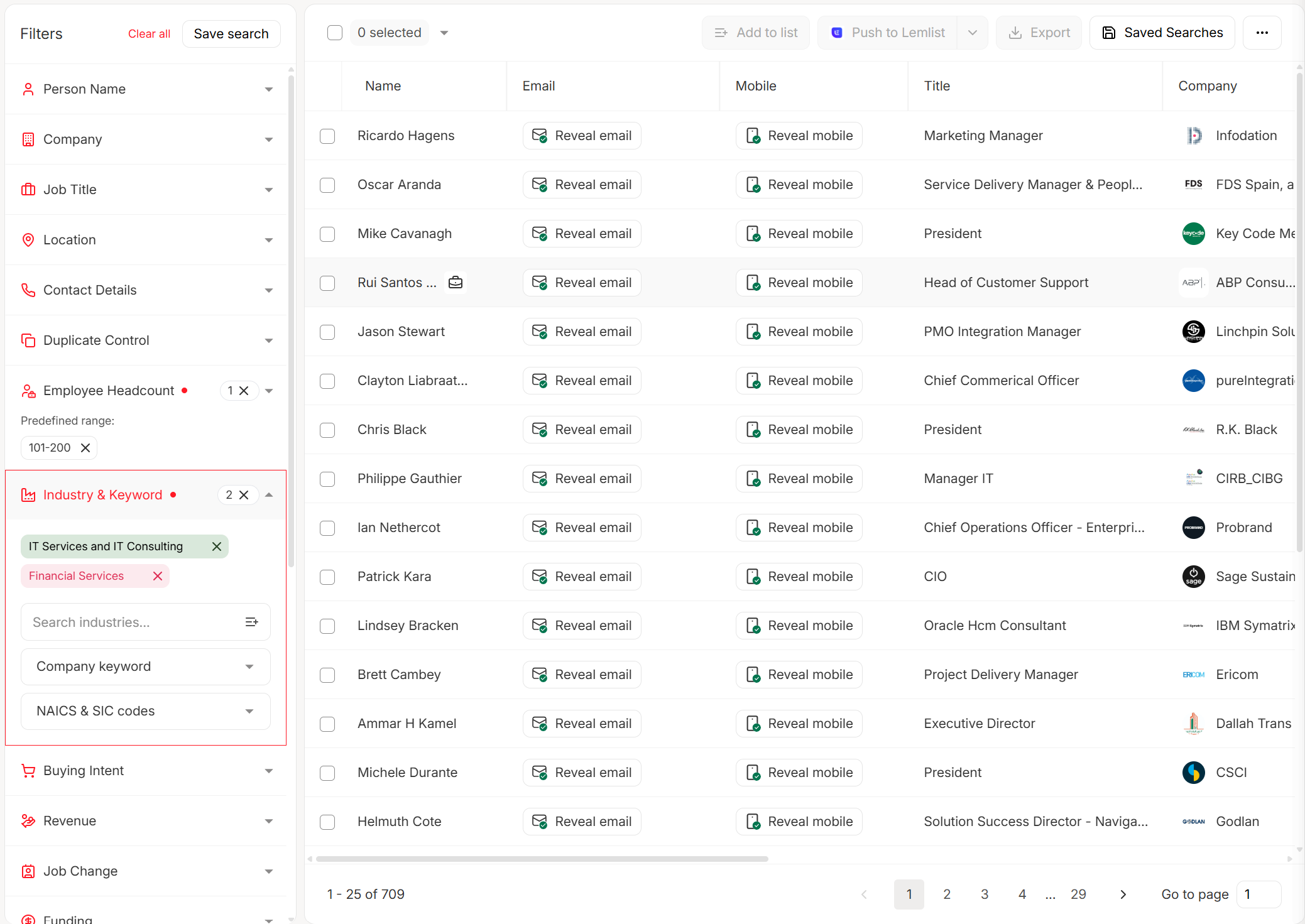
The fix is straightforward: give reps data they can trust. Snyk ran into exactly this problem - bounce rates between 35-40% across their 50-person AE team. After switching to Prospeo's verified contact data, bounce rates dropped under 5%, AE-sourced pipeline jumped 180%, and the team was generating 200+ new opportunities per month. GreyScout saw something similar: rep ramp time cut from 8-10 weeks down to 4 weeks, with pipeline up 140%. (If you're diagnosing why lists rot so fast, read B2B contact data decay.)
When reps dial numbers that connect and send emails that land, motivation takes care of itself.
Make Progress Visible
Gamification works - when it supplements a system, not when it replaces one. HP reported a 30-42% revenue increase over two months after deploying sales gamification, and Deloitte found a 30% rise in adoption of gamified training programs. Companies are investing here because visibility drives behavior. (If you want the mechanics, see gamification lead generation.)
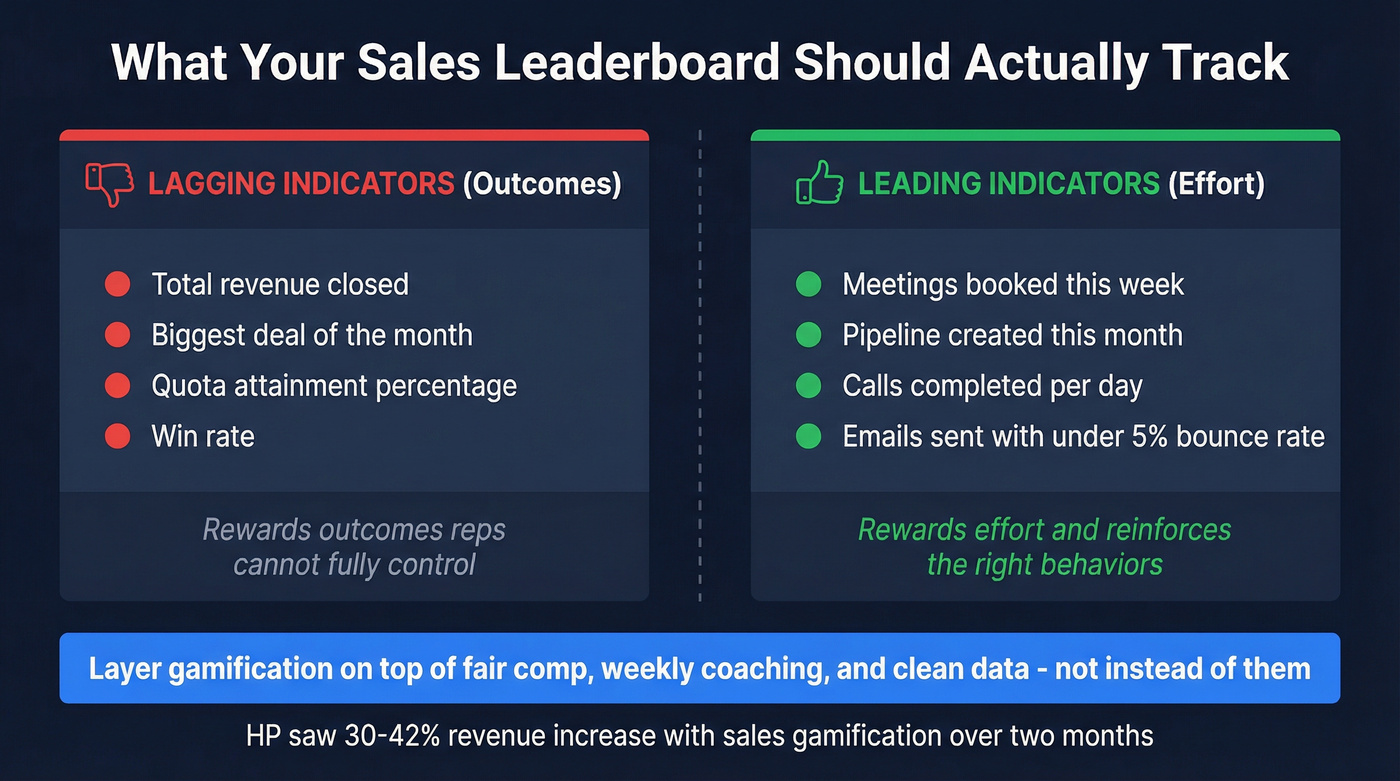
The key distinction is leading indicators versus lagging indicators. A leaderboard that only shows closed-won revenue rewards outcomes reps can't fully control. A leaderboard that tracks meetings booked, pipeline created, and calls completed rewards effort - and effort is what you want to reinforce.
Let's be honest: contests and leaderboards are the sugar high we mentioned earlier if they're your entire motivation strategy. But layered on top of fair comp, weekly coaching, and clean data? They're the accelerant. Celebrate the rep who booked 15 meetings this week, not just the one who closed the biggest deal.
Motivating Remote and Hybrid Teams
MIT Sloan's guidance on hybrid leadership boils down to one principle: manage outcomes, not hours. When companies monitor keystrokes and badge swipes, they get coffee badging and mouse jigglers - the appearance of work without the substance.
For sales teams, three practices make the biggest difference. Dedicate the first five minutes of every virtual meeting to personal connection - not status updates, actual human conversation. Let teams determine their own anchor days for in-person collaboration. And stop pretending flexibility is a perk while punishing people who use it. If the deal closes, the deal closes - whether the rep was in the office or not.
The Cost of Getting This Wrong
Sales turnover runs at 35% annually - nearly three times the 13% average across all other industries. Average rep tenure is 18 months. Average ramp time to full productivity is 3.2 months. Average time to fill a B2B sales position is 60 days.
Let's do the math on a single departure. Your AE quits. You spend 60 days finding a replacement. They take 3.2 months to ramp. That's roughly five months of lost productivity from one seat. If that AE was carrying a $600k quota, you just lost $250k in potential pipeline coverage - and 45% of B2B sales orgs have turnover rates above 30%, which means this is happening across multiple seats every year.
The compounding effect is brutal. Every rep who leaves takes institutional knowledge, customer relationships, and pipeline momentum with them. The remaining team watches colleagues leave and starts updating their own resumes. Demotivation is contagious, and the cost of ignoring it dwarfs the cost of fixing it.
Skip the complex motivation framework if your average deal size is under $10k. You need a simple comp plan, a manager who shows up, and contact data that doesn't waste your reps' time. The companies overthinking motivation are usually underthinking systems. (If you want a clean operating baseline, start with B2B sales pipeline management.)
Retention isn't a feel-good initiative. It's a revenue strategy.
The article's clear: reps who connect with real buyers stay motivated. When Snyk rolled out Prospeo to 50 AEs, bounce rates dropped from 35-40% to under 5% and AE-sourced pipeline jumped 180%. That's not a motivation hack - it's what happens when effort actually converts to conversations.
Replace disconnected numbers with 125M+ verified mobiles refreshed every 7 days.
FAQ
What's the biggest demotivator for sales reps?
Compensation misalignment - unrealistic quotas, commission caps, and payout delays. When 39% of revenue leaders admit their comp plans don't align with business goals, reps feel it daily. Fix comp structure before layering on contests or recognition programs.
How often should sales managers coach reps?
Weekly, without exception. Reps who receive weekly coaching show 25% higher quota attainment and close 30% more deals. A structured 30-minute 1:1 focused on pipeline review and skill development consistently outperforms monthly or quarterly reviews.
Does bad prospecting data actually affect team motivation?
Yes - it's one of the top hidden demotivators. When bounce rates exceed 10% and half your dials hit disconnected numbers, reps learn that effort doesn't produce results. Verified data with 98% email accuracy on a 7-day refresh cycle keeps contacts clean so reps spend time selling, not chasing dead leads.
What's the most effective long-term approach to motivate a sales team?
Remove systemic friction instead of layering on incentives. Simplify the comp plan, institute weekly coaching, and make sure reps have verified prospecting data. When effort reliably converts to pipeline and revenue, intrinsic motivation follows - and it lasts far longer than any contest or SPIF.