How to Reduce Sales Admin Time With AI (2026 Playbook)
Friday, 5pm. Salesforce is a week behind, reps are "catching up," and next week's forecast is basically vibes. That's not a training problem - it's an admin system problem. If you want to reduce sales admin time with ai, you don't need more enablement. You need fewer handoffs, tighter defaults, and automation that writes work back where it belongs.
Salesforce's 2026 sales stats are brutal: reps spend 60% of their time on non-selling tasks and only 40% actually selling. AI won't fix bad management, but it will delete a big chunk of the busywork that steals your week.
This playbook shows where to automate first, how to measure savings, and how to keep your CRM from turning into a junk drawer.
Why sales admin still eats your week (and what AI can actually fix)
Most sales orgs don't have an "admin problem." They've got a handoff problem.
Calls happen in one place. Notes live somewhere else. Next steps get typed into chat. CRM updates happen later (or never). Then RevOps spends Monday cleaning up fields so leadership can pretend the pipeline's real.
AI's great at three jobs in this mess:
- Capturing what happened (transcription, summaries, decisions, objections)
- Structuring it (mapping to fields, tasks, next steps, deal stages)
- Propagating it (writing back to CRM, generating follow-ups, logging activity)
What AI won't do: rescue a junk-drawer CRM. If your stages are inconsistent and required fields are "optional in practice," automation just scales the chaos.
Look, if your average deal size is in the low four figures, you don't need a "revenue intelligence transformation." You need ruthless defaults: auto-capture, minimal required fields, and clean data before outreach.
What you need (quick version): 3 lanes + 1 measurement system
If you want to cut admin without turning your stack into spaghetti, keep it to three automation lanes and one measurement system. Done right, this is how teams reduce admin work in sales without sacrificing CRM trust.

The 3 automation lanes
- Lane 1: Meeting -> CRM -> follow-up (end-to-end) Record/transcribe, extract action items, write back to CRM, draft follow-up, log activity.
- Lane 2: Inbox, scheduling, internal handoffs Auto-triage, scheduling, internal routing, fewer "where's that doc?" pings.
- Lane 3: Prospecting + enrichment Prevent bounced emails, wrong numbers, duplicates, and "who owns this account?" confusion. Clean, verified data stops cleanup work downstream.
The measurement system (don't skip this)
- Run a 3-7 day time audit (a full week's best).
- Track two numbers per rep:
- After-call admin minutes per call
- Weekly CRM cleanup minutes (dedupes, missing fields, bounced emails, wrong contacts)
Governance note: start human-in-the-loop, enforce least privilege, and set retention rules before you enable write-back or orchestration. That's how you avoid the "AI broke our CRM" story.
Measure it first: the 3-7 day audit + CFO cost model
You can't fix "admin overload" with vibes. Measure it for a week, then do the math like a CFO.
Step-by-step time audit (3-7 days)
Use a 3-7 day window. A full week's best because Mondays and Fridays skew.
Create a simple sheet with:
- Date
- Task
- Start time / End time
- Duration (minutes)
- Category (Selling / Meetings / Admin / Internal)
- Notes (what triggered it?)
Define "admin" like an operator:
- CRM updates (fields, stages, notes, activities)
- Follow-up drafting and logging
- Scheduling and rescheduling
- Prospect research + list cleanup
- Duplicate merges, bounced email cleanup, contact fixes
- Internal status updates that exist because the CRM isn't current
Simple savings calculator (prioritize what to automate)
After-call admin's the easiest place to model because it's repetitive.

Baseline: 5-15 minutes of after-call admin per call (notes, tasks, CRM fields, follow-up email, logging).
Weekly admin minutes saved = calls/week x minutes saved per call
Example:
- 18 calls/week
- 10 minutes after-call admin today
- AI reduces it to 3 minutes (because it writes back + drafts follow-up)
- Minutes saved per call = 7
18 x 7 = 126 minutes/week = 2.1 hours/week per rep
Then add the "hidden admin" line items:
- CRM cleanup (missing fields, wrong stages): 30-90 min/week
- Bounced email cleanup + contact fixes: 20-60 min/week
- Internal handoffs/context switching: 30-120 min/week
Add those up and it commonly pencils out to 3-8 hours/week/rep - without pretending AI's magic.
CFO cost model (hours -> dollars in 6 lines)
Use fully loaded cost (salary + benefits + taxes + tools). If you don't know it, use $120k-$220k/year for most quota-carrying roles in the US.

- Fully loaded hourly cost = fully loaded annual / 2,080
- Weekly savings $/rep = hourly cost x hours saved/week
- Annual savings $/rep = weekly savings x 52
- Team savings = annual savings/rep x # reps
- Subtract tool cost (annual)
- That's your ROI headline
Example at $180k fully loaded: $180,000 / 2,080 ~= $86.50/hour. Save 4 hours/week -> $346/week/rep -> about $18k/year/rep in capacity.

You just calculated 20-60 min/week on bounced email cleanup and contact fixes. Prospeo eliminates that line item. 98% email accuracy, 125M+ verified mobiles, and a 7-day data refresh cycle mean your reps never waste time fixing bad contact data again.
Delete Lane 3 admin entirely - start with 100 free credits.
Choose the right automation level (and stop buying "nice summaries")
Most teams buy "AI for sales" and end up with prettier notes... and the same admin load. They picked the wrong automation level.
- Assist: helps you think/write (summaries, suggestions). Low risk, modest time savings.
- Write-back: updates CRM fields and logs activities. Real time savings, real governance needs.
- Orchestrate: triggers multi-step workflows across tools. Biggest upside, biggest blast radius.
Automation levels table (typical time savings)
| Level | What it does | Typical time saved | Primary risk | Best for |
|---|---|---|---|---|
| Assist | Summaries, drafts | 10-30 min/day | Low | Early pilots, messy CRMs |
| Write-back | Updates CRM fields + logs | 1-4 hrs/week | Medium | CRM-heavy teams with clear field rules |
| Orchestrate | Multi-step workflows | 3-8 hrs/week (with governance) | High | Mature RevOps + stable processes |

Use this / skip this guidance
Use Assist when your CRM hygiene's inconsistent. You'll save writing time without poisoning your data.
Use Write-back when you've got defined fields, required properties, and a clear definition of done for a logged activity. That's where ROI shows up.
Skip Orchestrate in week one if you don't have governance. I've watched teams automate routing and create a month of territory drama in a day.
Maturity ladder (the roadmap most teams need)
- Stage 1 (Weeks 1-2): Assist + measurement Prove savings on after-call admin and follow-ups.
- Stage 2 (Weeks 3-6): Write-back + guardrails Map AI outputs to a small set of required fields and lock permissions.
- Stage 3 (Quarter 2+): Orchestrate + RevOps ownership Automate handoffs, routing, and sequences - only after data trust's real.
Lane 1: Meetings -> CRM -> follow-ups (fastest way to cut admin)
This lane's the fastest path to real savings because it hits the same loop all day:
record/transcribe -> action items -> CRM sync -> follow-up draft -> send + log
The goal isn't "a pretty summary." The goal is: the CRM's updated, next steps exist, and the follow-up's ready before the rep opens another tab.
The workflow (operator version)
- Capture: record + transcribe automatically
- Extract: decisions, objections, next steps, stakeholders, dates
- Write back: map to CRM fields (stage, next step date, close date, key pain)
- Generate: buyer follow-up + internal recap
- Execute + log: human sends; system logs
The most common failure mode: teams stop at step 2. They get summaries, then still do the CRM work manually.
Pricing + fit snapshot (lane 1)
| Tool | Best for | CRM write-back? | Key automation | Typical price |
|---|---|---|---|---|
| Avoma | Practical write-back without enterprise overhead | Yes | Notes -> CRM + follow-up drafts | $19-$39/recorder seat/mo (annual) |
| Fireflies.ai | Fast start + strong integrations | Yes | Action items + workflows | $0-$39/seat/mo (annual) |
| Gong | Coaching + deal inspection at scale | Yes | CI + analytics + enablement | ~ $1.6k/user/yr + fees |
| Otter.ai | Lightweight transcription + summaries | Limited (via integrations) | Notes + summaries | ~ $8.33-$30/user/mo |

Avoma - the "make CRM updates disappear" pick
Avoma wins when you want write-back that reps actually use. It's built around the post-call grind: summary notes, action items, and CRM sync that doesn't require a RevOps project plan.
One implementation tip that matters: only map 5-8 fields at first (stage, next step, next step date, pain, stakeholders). When teams try to auto-fill 25 fields, reps stop trusting it by week two.
Pricing's straightforward: $19 / $29 / $39 per recorder seat per month (annual). Viewers are free, and the Enterprise plan's annual-only with a 10-seat minimum. There are add-ons for deeper conversation intelligence.

Fireflies.ai - best "start today, govern later" ladder
Fireflies is the easiest way to prove value quickly. You can start free, then move up tiers as security and workflow needs get serious.
What users like (and why it saves time): it's strong on integrations + action items, so meeting outputs turn into tasks instead of dead summaries.
Here's the thing: if you don't standardize meeting types and naming, you end up with a messy library and people stop searching it. Fix that with three templates (disco/demo/renewal) and you're fine.
Pricing: Free ($0), Pro ($10), Business ($19), Enterprise ($39) per seat/month (annual).
Gong - the heavyweight (worth it only if you'll use the whole system)
Gong's the best choice when your real problem isn't "notes," it's deal truth: coaching, inspection, and forecast quality across a big team.
The rollout reality: reps push back when it feels like surveillance. If leadership positions Gong as a coaching tool with clear boundaries (and not a gotcha machine), adoption sticks. If they don't, it stalls.
Pricing's quote-based and typically includes per-user licenses plus a platform fee. Market estimates often land around $1,600 per user/year, plus platform and onboarding costs that can push total annual spend a lot higher for smaller teams.
Otter.ai - simplest option for notes (not a CRM automation engine)
Otter's the pick when you want reliable transcription and summaries without turning your sales stack upside down. It's not a full "meeting -> CRM" system by itself, but it's a clean baseline for teams that need searchable notes and quick recaps.
Pricing's usually around $8.33-$30 per user/month depending on tier and billing, with a free plan that's fine for light testing.
Lane 2: Inbox, scheduling, and internal handoffs (kill context switching)
This lane's less sexy, but it's where time leaks all day.
Most reps touch 10+ apps/day: email, calendar, CRM, chat, call tool, docs, enablement, sequencing, and whatever else your stack's accumulated. Context switching is the silent killer.
The concrete play: pick one "home" and force write-back
Choose a single system where work is finalized - usually your CRM. Then enforce:
- meeting outcomes -> CRM fields
- handoffs -> CRM tasks (with a standard template)
- customer context -> one record, not five threads
If you don't pick a home, you'll "save time" with AI drafts and lose it all hunting for the latest truth.
Salesforce's 2026 sales stats also flags the blocker: 51% of sales leaders using AI say tech silos delay or limit AI initiatives. That's not a mindset issue. It's an integration issue.
Tier 2/3 tool picks for lane 2 (with pricing signals)
HubSpot (CRM-native AI) If you run HubSpot, use its native AI first. The win's fewer tabs: drafts, summaries, and CRM updates happen inside the same workspace where reps already live. HubSpot has reported up to a 48% decrease in time to close for teams using its AI tools, which tracks when the system reduces handoffs instead of adding another app. Pricing varies by hub and tier, but most teams should expect roughly $20-$150/user/month depending on seats and plan.
Slack (internal handoffs) Slack's still the fastest way teams coordinate, which is exactly why it becomes an admin sink. Standardize one handoff format (deal link + 3 bullets + owner + due date) and automate the rest. Pricing's typically free, then about $8-$15/user/month on paid tiers.
Microsoft Teams (internal handoffs + meetings) If you're a Microsoft shop, Teams can replace a pile of point tools: chat, meetings, and files in one place. The admin win is consolidation, not "AI magic." Pricing usually comes via Microsoft 365 bundles; standalone Teams plans commonly land around $4-$12/user/month, while M365 business suites often run about $12-$57/user/month depending on tier.
Zapier (lightweight automation glue) Zapier's the quickest way to connect "meeting happened" -> "task created" -> "CRM updated" without engineering. It's perfect for Stage 2 write-back workflows when you want speed. Pricing typically ranges about $20-$100+/month depending on tasks and features.
Make (formerly Integromat) (heavier workflows, cheaper at scale) Make's better when you need more complex logic or higher volume at a lower cost. It's also easier to build multi-step scenarios that feel like real orchestration. Pricing usually ranges about $10-$50+/month, scaling with operations.
Lane 3: Prospecting + enrichment (the hidden admin sink: bad data)
Bad data doesn't just hurt deliverability. It creates admin work you never budgeted for:
- Bounced emails -> list cleanup -> domain reputation damage -> more manual QA
- Wrong titles -> reps re-research contacts -> "who's the right person?" loops
- Duplicates -> CRM merges -> broken attribution -> reporting fights
- Wrong numbers -> dials that go nowhere -> manual hunting for alternates
Salesforce's 2026 sales stats makes the point indirectly: 74% of sales teams using AI prioritize data hygiene. They're doing it because automation on dirty data is a time-waster.
Mini workflow: stop the cleanup before it starts
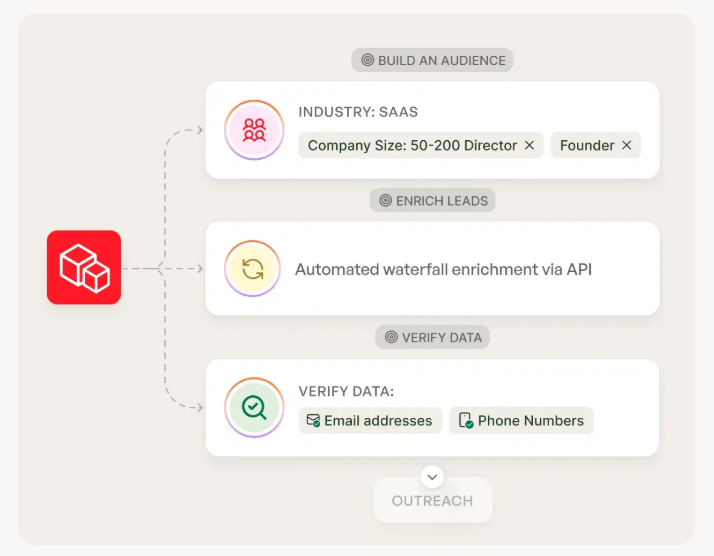
- Define ICP filters (industry, headcount, region, tech, intent)
- Enrich contacts before they hit sequences
- Verify emails before sending
- Deduplicate before pushing to CRM
- Only then automate outreach and logging
Tool pick (lane 3): Prospeo (accuracy + freshness + self-serve)
I've seen teams spend weeks tuning prompts and sequences, then lose a full afternoon to bounced emails, duplicate records, and "why is this contact in the CRM three times?" arguments. That's the dumbest kind of busywork because it feels unavoidable until you fix the input.
Prospeo is the B2B data platform built for accuracy, and it's the cleanest way I've found to stop the bounce-cleanup tax before it starts. You get 98% verified email accuracy, a 7-day data refresh cycle (industry average: 6 weeks), and enrichment that returns contact data for 83% of leads (with a 92% API match rate), which is exactly what you want if your goal's fewer manual fixes after lists hit sequences or the CRM.
It also includes 300M+ professional profiles, 143M+ verified emails, and 125M+ verified mobile numbers, and it's used by 15,000+ companies and 40,000+ Chrome extension users.
If you're running a pilot, the free tier's genuinely useful: 75 emails + 100 extension credits/month. For RevOps, the fastest win is running CRM/CSV enrichment so reps stop "researching" the same accounts every quarter: https://prospeo.io/b2b-data-enrichment
Deploy AI safely: governance, trust, and agent guardrails (2026 reality)
AI rollouts fail for two predictable reasons: security and trust.
Salesforce's 2026 sales stats puts a number on it: 51% of sales pros say data security concerns halt AI initiatives. If you're regulated, that's the default, not the edge case.
Governance checklist (what holds up in real companies)
- MFA everywhere (no exceptions)
- Least privilege access (reps don't need admin scopes)
- Quarterly access reviews (people change roles constantly)
- Data retention rules (what's stored, where, for how long)
- Encryption at rest and in transit
- Audit logs + alerts (you can't govern what you can't see)
- Vendor risk management: DPAs, sub-processors list, SOC 2 reports, and audit rights
If you're in finance or adjacent, build for defensibility: recordkeeping controls like WORM storage aligned to SEC Rule 17a-4(f), plus retention windows commonly 3-6 years depending on policy, which sounds boring until legal asks you to prove who changed a field and when.
What reps complain about (and what they actually like)
Complaints (design around these):
- "It feels like surveillance." If you don't set boundaries, adoption dies quietly.
- "It made my CRM messier." Duplicates and half-filled fields destroy trust fast.
- "Now I've got two sources of truth." If chat and CRM both hold "the update," nobody wins.
What reps like (and will keep using):
- Follow-ups that are 90% done right after the call.
- Not having to re-listen to calls to find one detail.
Tier 2 tool pick: Salesforce Agentforce (agentic automation with a leash)
Agentforce is powerful when you treat it like a production system, not a demo. Two rules I follow:
- Use a testing center or sandbox with synthetic data before anything touches real records.
- Keep agents to about 15 actions max. Past that, debugging gets miserable and failure modes multiply.
Pricing's Salesforce-style enterprise licensing. In practice, budget mid-to-high five figures per year and up for meaningful deployments once you include platform, add-ons, and implementation.
Week-one rollout plan (7 days) + copy/paste prompts (C-T-C-F)
Don't roll this out to the whole org. Pilot with 3-5 reps for a week, measure before/after, then scale.
I've watched teams waste months "evaluating AI" when they could've learned everything they needed in seven days.
Day-by-day rollout
Day 1: Baseline + scope
- Pick 3-5 reps across different styles (top performer, mid, new).
- Measure: after-call admin minutes/call + weekly cleanup minutes.
- Define "done": CRM updated within 2 hours of call + follow-up drafted.
Day 2: Meeting capture
- Turn on recording/transcription for pilot reps.
- Standardize meeting types (disco, demo, renewal) so outputs are consistent.
Day 3: Write-back mapping
- Map AI outputs to specific CRM fields.
- Lock required fields so the system can't half-update records.
Day 4: Follow-up automation
- Draft follow-ups automatically, keep human send.
- Add logging rules (email sent -> activity logged). If you're deciding what to standardize first, start with CRM automatic email logging.
Day 5: Internal handoffs
- Standardize a handoff format (chat message + CRM task).
- Kill duplicate updates (either CRM or chat, not both).
Day 6: Prompt library
- Create a shared prompt doc for reps.
- Add examples of good outputs so reps trust it.
Day 7: Review + decision
- Compare baseline vs week results.
- Decide: expand, adjust, or stop.
C-T-C-F prompt framework
- Context: what happened, who the buyer is, what product you sell
- Task: what you want produced
- Constraints: tone, length, do/don't say, compliance rules
- Format: exact structure (bullets, table, JSON, CRM fields)
Prompt template 1: Post-meeting pack (copy/paste)
Context: You're my sales assistant. Below is a raw meeting transcript and notes. We sell [product] to [ICP].
Task: Create a post-meeting pack for CRM + follow-up.
Constraints: Be factual. Don't invent numbers or timelines. Keep follow-up under 200 words.
Format:
- Summary (3 bullets)
- Action items table: Task | Owner | Due date
- Risks/objections (bullets)
- Next meeting goal (1 sentence)
- Follow-up email draft
Prompt template 2: CRM field update (copy/paste)
Context: Here's a call summary. Our CRM fields are: Stage, Next Step, Next Step Date, Pain, Use Case, Competitors, Stakeholders, Budget, Timeline, Close Date, Amount.
Task: Convert the summary into CRM-ready field values.
Constraints: If unknown, write "Unknown" (don't guess). Use buyer language.
Format: Output as a table with two columns: Field | Value.
FAQ
How do I calculate sales admin time saved with AI?
Track a 3-7 day baseline, then compare after rollout using: calls/week x minutes after-call admin saved + weekly CRM cleanup minutes saved. Use 5-15 minutes of after-call admin per call as a starting benchmark, then validate with your reps' actual before/after numbers.
What's the fastest AI workflow to reduce after-call admin?
Meeting capture + CRM write-back for 5-8 required fields (stage, next step, next step date, pain, stakeholders) is the fastest path to savings. Add an auto-generated follow-up draft but keep human send, and you typically remove 5-15 minutes of post-call work per meeting within a week.
Do AI meeting summaries reduce CRM work by themselves?
Summaries help, but they don't remove CRM work because reps still have to translate insights into fields, tasks, and logged activities. In most teams, insight-only setups still leave 5-10 minutes of manual updates per call; write-back is what turns "nice notes" into measurable time savings.
What's a good free tool to clean and verify prospect data before automation?
Summary: the operator move that actually frees up rep time
McKinsey (2020) is still a useful baseline: early sales automation adopters saw 10-15% efficiency improvements and up to 10% sales uplift, and about one-third of sales and sales ops tasks were already automatable. In 2026 tooling, the ceiling's higher, but the teams that win still do the boring part first: measure, standardize fields, then automate.
If you do one thing this week, implement Lane 1 write-back for a handful of fields and force the CRM to become the home base again. If you're seeing issues like duplicates and missing fields, fix the root cause with a simple data quality scorecard and SOP.
That's the moment reps feel their week get lighter.
And it's the foundation that makes every other workflow worth deploying to reduce sales admin time with ai. If you're building beyond week one, use a CRM integration for sales automation checklist so write-back doesn't turn into spaghetti.
Your CFO cost model showed $18K/year per rep in wasted admin capacity. The biggest hidden culprit? Dirty prospect data that creates downstream CRM cleanup. Prospeo's 5-step verification and catch-all handling at $0.01/email stops the mess before it starts.
Clean data in, zero cleanup out. That's the real automation.