

Competitive Win Rate: What It Is, How to Calculate It, and Why Yours Is Probably Wrong
Last QBR, a VP of Sales showed the board a 58% competitive win rate. Impressive - until you realized it came from 40 cherry-picked deals out of 300 total opportunities. The other 260? No-decisions, stalled deals, and untagged losses. That number was fiction.
We've seen this pattern across dozens of QBRs, and it almost always traces back to the same root causes: sloppy CRM hygiene, no-decision inflation, and reps who don't tag competitors because nobody makes them.
Quick version: Your competitive win rate only counts head-to-head deals where a competitor was present. If you're including no-decisions, your win rate is inflated by 10-15 points. Fix the measurement first, then fix the inputs.
What This Metric Actually Measures
Competitive win rate isn't your overall close rate. It's narrower and more honest: competitive wins / (competitive wins + competitive losses). Only deals where you went head-to-head with a named competitor and someone won.
Win rate measures decision-point outcomes. Close rate tracks all opportunities from creation to resolution - including deals that were never competitive. Here's what belongs in each bucket:
Include: Head-to-head deals competed to conclusion, deals where a competitor was named and tagged, clear wins and clear losses.
Exclude: Renewals and add-ons, sole-source deals, no-project outcomes where nobody won, slipped deals still open, unqualified opportunities.
Getting this classification right is the entire game. As PSP Enterprises explains, most CRMs aren't set up to report competitive win rates cleanly - it takes deliberate admin work to separate competitive contests from everything else.
How to Calculate It
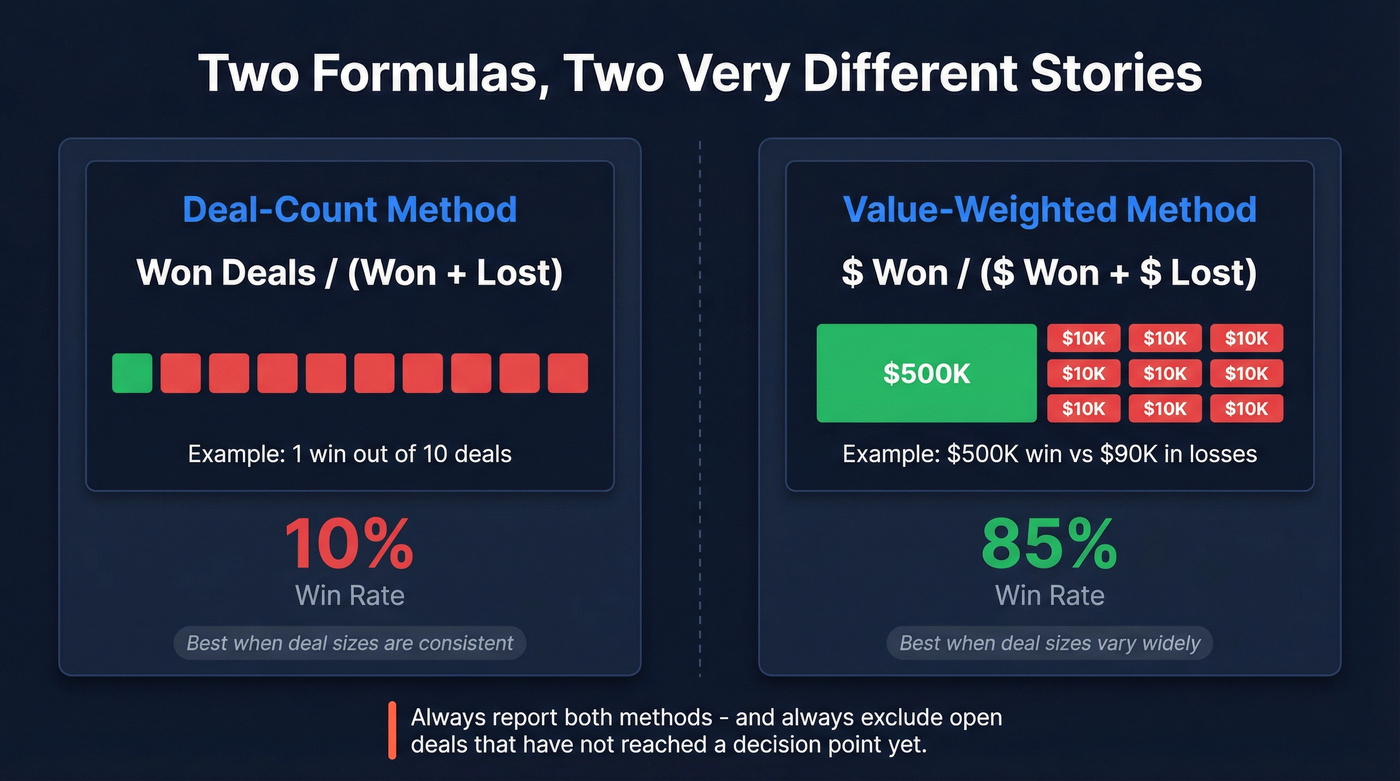
Two formulas. Two wildly different stories from the same pipeline.
| Method | Formula | Best when... |
|---|---|---|
| Deal-count | Won deals / (Won + Lost) | Deal sizes are consistent |
| Value-weighted | $ Won / ($ Won + $ Lost) | Deal sizes vary widely |
Say your team closes 1 deal worth $500K and loses 9 deals worth $10K each. Deal-count win rate: 10%. Value-weighted win rate: 69%. Always report both, and always exclude open deals - they haven't reached a decision point yet.
2026 Benchmarks by Deal Size
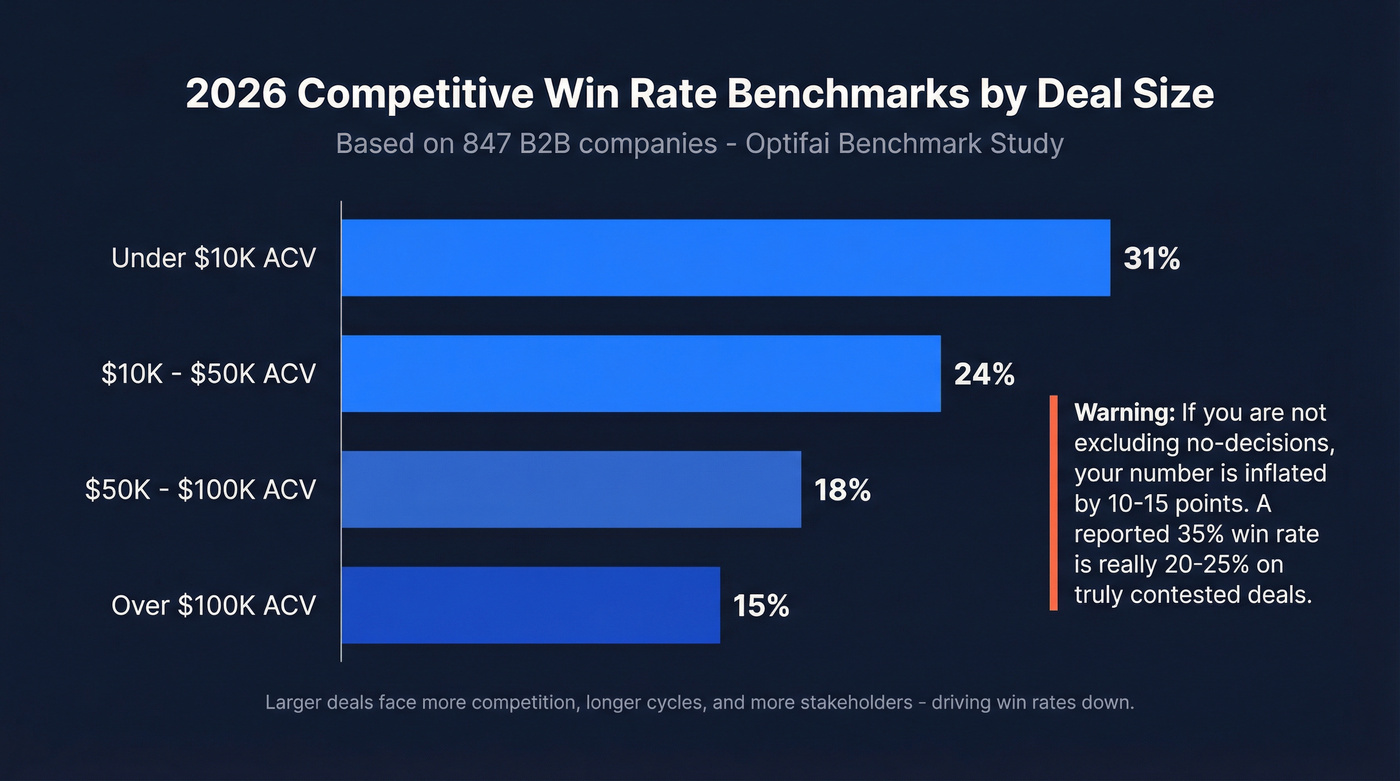
An Optifai benchmark study of 847 B2B companies provides the cleanest ACV-segmented benchmarks we've found:
| ACV Segment | Avg Win Rate |
|---|---|
| Under $10K | 31% |
| $10K-$50K | 24% |
| $50K-$100K | 18% |
| Over $100K | 15% |
The trend isn't encouraging. Outreach's analysis found the largest cohort of sales orgs sitting in the 21-25% bracket, down from 31-40% the prior year. Deals are harder to close, and buyers are pickier than ever.
If you're not excluding no-decisions, your number is inflated by 10-15 points. A "35% win rate" that includes no-decisions is really a 20-25% rate on truly contested deals.

Deals closed in under 50 days win at 47%. Multi-threading across 3+ contacts produces 2.4x higher close rates. Both require reaching the right people fast. Prospeo gives your reps 98% accurate emails and 125M+ verified mobiles - refreshed every 7 days - so they enter more deals and close them before competitors show up.
Stop losing deals you never entered. Fix your pipeline data first.
Why Your Number Is Probably Wrong
Three biases corrupt most competitive win rate data.
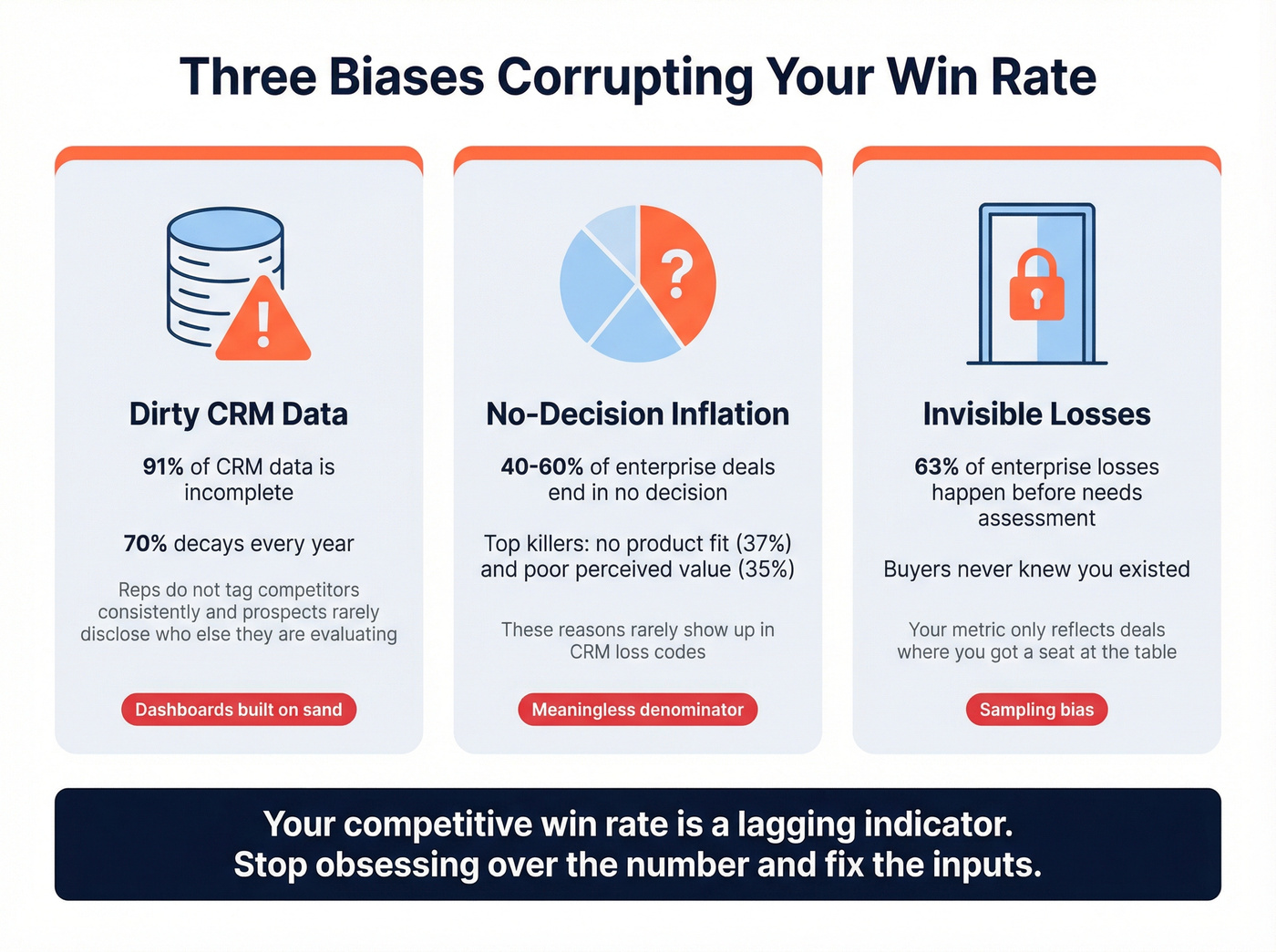
CRM data hygiene is terrible. 91% of CRM data is incomplete, and 70% becomes inaccurate annually. Ask any RevOps leader - the competitor field in their CRM is the least reliable data point they have. Reps don't tag competitors consistently, and prospects don't always disclose who else they're evaluating. Without reliable competitor mentions on deal records, you're building dashboards on sand.
No-decision inflation is massive. In enterprise pipelines, 40-60% of deals end in no decision. If those get lumped into your denominator, your win rate becomes meaningless. HubSpot's 2025 survey found the top deal-killers are no product fit (37%) and poor perceived value for money (35%) - reasons that rarely show up in CRM loss codes.
You can't measure deals you never entered. You win 0% of opportunities where the buyer never knew you existed. In fact, 63% of enterprise losses happen before needs assessment - most deals die before you even present a solution. Those invisible losses never appear in CRM, which means your metric only reflects deals where you got a seat at the table. It's a sampling bias problem that CRM data alone can't solve.
Here's the thing: your competitive win rate is a lagging indicator. Stop obsessing over the number and fix the inputs.
How to Improve It
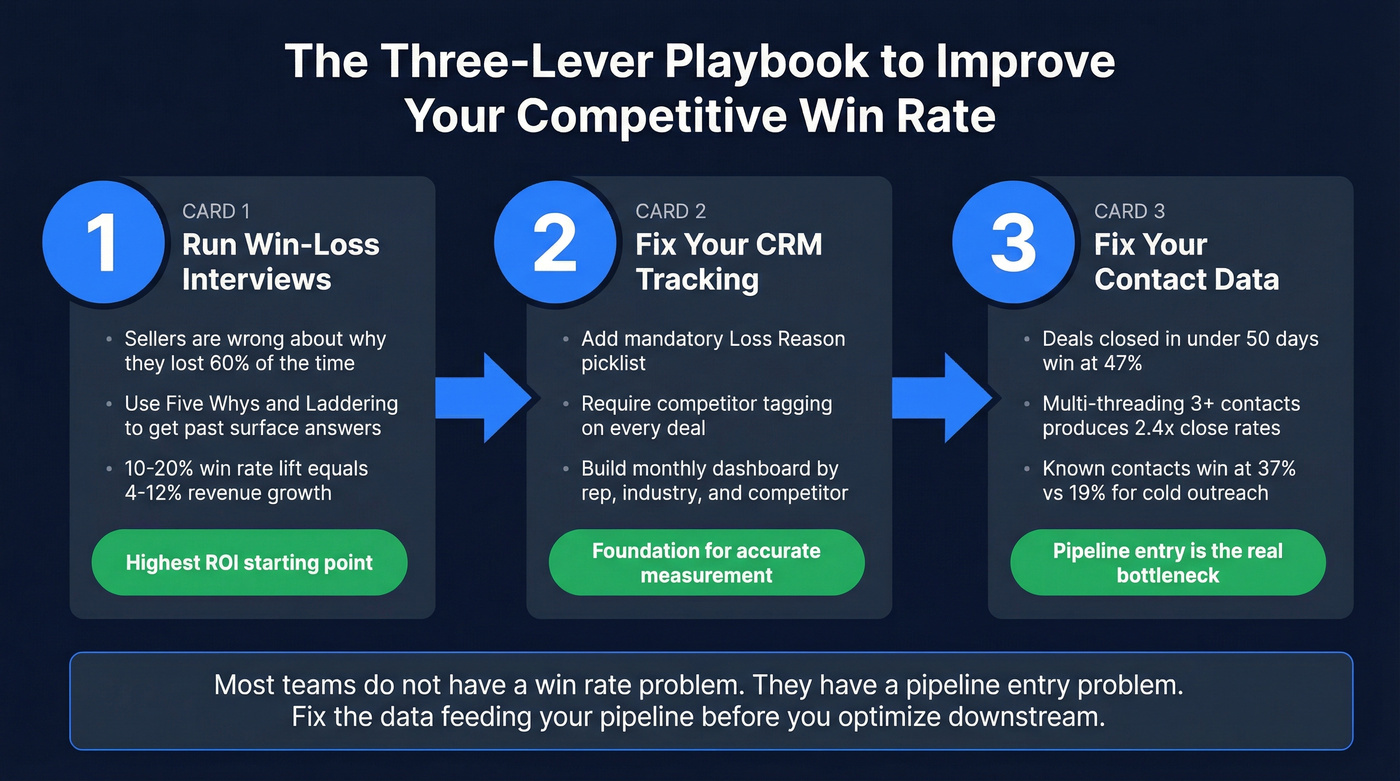
Three levers actually move the needle. Let's break them down.
Run win-loss interviews
Sellers are wrong about why they lost 60% of the time. Buyers say "pricing" when the real issue was perceived risk. Use Five Whys and Laddering techniques to get past surface answers. McKinsey estimates a 10-20% win-rate lift translates to 4-12% topline revenue growth - that's the kind of ROI that gets budget approved fast.
Fix your CRM tracking
Add a mandatory "Loss Reason" picklist. Set validation rules so reps can't close-lost without selecting one. Add competitor tagging. Then build a monthly dashboard showing win rate on competitive deals, segmented by rep, industry, and competitor - both by count and value. This sounds basic, but in our experience, fewer than 20% of teams actually enforce it.
Fix your contact data
Deals closed within 50 days carry a 47% win rate versus 20% or lower after that threshold. Multi-threading across 3+ contacts produces 2.4x higher close rates. And teams selling to known contacts win at 37% versus 19% for cold outreach.
All of that requires reaching the right people, fast. Prospeo's 98% email accuracy and 125M+ verified mobile numbers on a 7-day refresh cycle mean your reps reach decision-makers instead of hitting dead ends - and they enter more deals in the first place.

Most teams don't have a win rate problem. They have a sales pipeline challenges problem. You can't improve your competitive win rate if your reps never get into the deal. Fix the data feeding your pipeline before you optimize anything downstream.
How to Win Head-to-Head Deals
Knowing your numbers is half the battle. The other half is giving reps a genuine edge in every live contest.
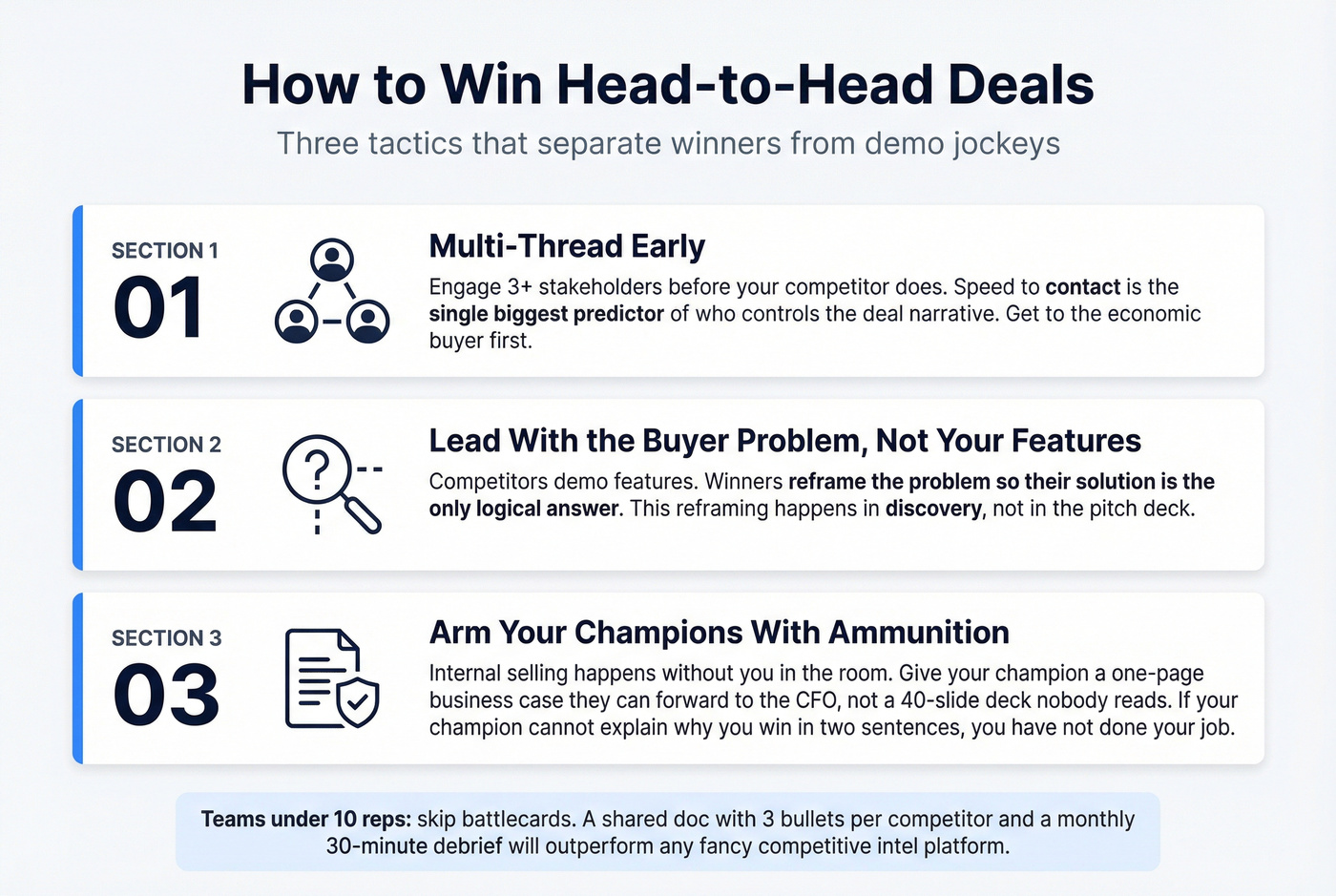
Multi-thread early. Engaging 3+ stakeholders before a competitor does makes it exponentially harder for the buyer to switch. Speed to contact is the single biggest predictor of who controls the deal narrative. The consensus on r/sales backs this up - threads about competitive deals almost always circle back to "who got to the economic buyer first."
Lead with the buyer's problem, not your feature set. Competitors demo features. Winners reframe the problem so their solution is the only logical answer. That reframing happens in discovery, not in the pitch deck.
Arm your champions with ammunition. Internal selling happens without you in the room. Give your champion a one-page business case they can forward to the CFO - not a 40-slide deck nobody reads. If your champion can't explain why you win in two sentences, you haven't done your job.
Skip the battlecard-heavy approach if your team is under 10 reps. At that size, a shared doc with three bullets per competitor and a monthly 30-minute debrief will outperform any fancy competitive intelligence platform.
Your competitive win rate is only as good as the deals your reps actually enter. 63% of enterprise losses happen before needs assessment - because reps never reached the decision-maker. Prospeo's 300M+ profiles with 30+ filters like buyer intent and job changes help you multi-thread into accounts before competitors even know the deal exists.
Win the deals that never hit your CRM - reach decision-makers first.
FAQ
What's the difference between win rate and competitive win rate?
Win rate counts all closed deals against total opportunities. Competitive win rate only includes head-to-head contests where a named competitor was present and someone won - excluding no-decisions, sole-source deals, and renewals. It's a narrower, more honest measure of how you perform when buyers are actively comparing you.
What's a good benchmark for enterprise SaaS?
For deals above $50K ACV, 15-25% is the realistic range in 2026. Anything above 30% likely means you're not properly excluding no-decision outcomes from your denominator. Below $10K ACV, 28-35% is typical for well-run teams.
How does contact data quality affect deal outcomes?
Reps with bad emails and dead phone numbers lose deals before they start - they never reach decision-makers, so the opportunity never materializes. Teams that fix their data quality consistently enter more competitive deals, which directly expands the pipeline your win rate is measured against.
What's the fastest path to improvement?
Start with win-loss interviews and CRM hygiene - not new tools. Most orgs see a 10-15 point correction just from properly excluding no-decisions and tagging competitors consistently. From there, focus on speed-to-contact and multi-threading to build a durable advantage in every contested deal.