

Discovery Call Tips Backed by 326K Sales Calls
You talked for 25 of the 30 minutes. The prospect said "this is really interesting, send me some info." You sent a deck, a case study, and a follow-up email. Never heard back. That call was dead the moment you opened your mouth - you just didn't know it yet.
The best discovery call tips aren't opinions. They're patterns extracted from 326K analyzed sales conversations, and they're surprisingly specific.
The Quick Version
- Talk 57% of the time or less. Won deals show a 5-point talk-time gap versus lost calls (57% vs 62%).
- Ask 15-16 questions, not 20. More questions correlate with losing. Depth beats volume.
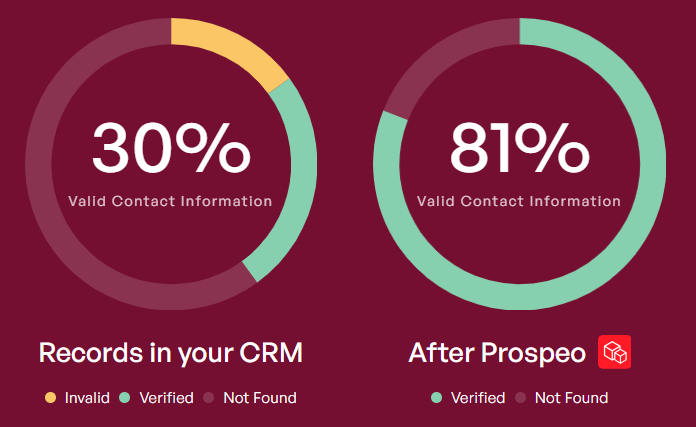
- Verify your prospect data before you prep. B2B contact data decays around 30% per year. If your research starts from stale records, your "personalized" opener is fiction. (If you want the benchmarks and fixes, see contact data decays.)
Why Discovery Matters More Than Ever
84% of reps missed quota last year. Buyers now use 10 interaction channels on average - up from 5 in 2016 - and spend just 17% of their buying time meeting with suppliers. Gartner projected 80% of B2B sales interactions would be digital by 2025, and the shift has only accelerated into 2026.
The window you get with a live human is shrinking. When you do get it, 87% of buyers expect you to act as a trusted advisor, not a pitch machine. And 89% of B2B buyers report at least one deal stalling in the past year. Discovery is where you earn trust or lose the deal - there's no second chance to re-diagnose a problem you never understood.
Data-Backed Tactics That Move Numbers
The 326K-call analysis produced the clearest benchmarks we have. The average rep talks 60% of the call. In closed-won deals, that drops to 57%. In lost deals, it climbs to 62%.
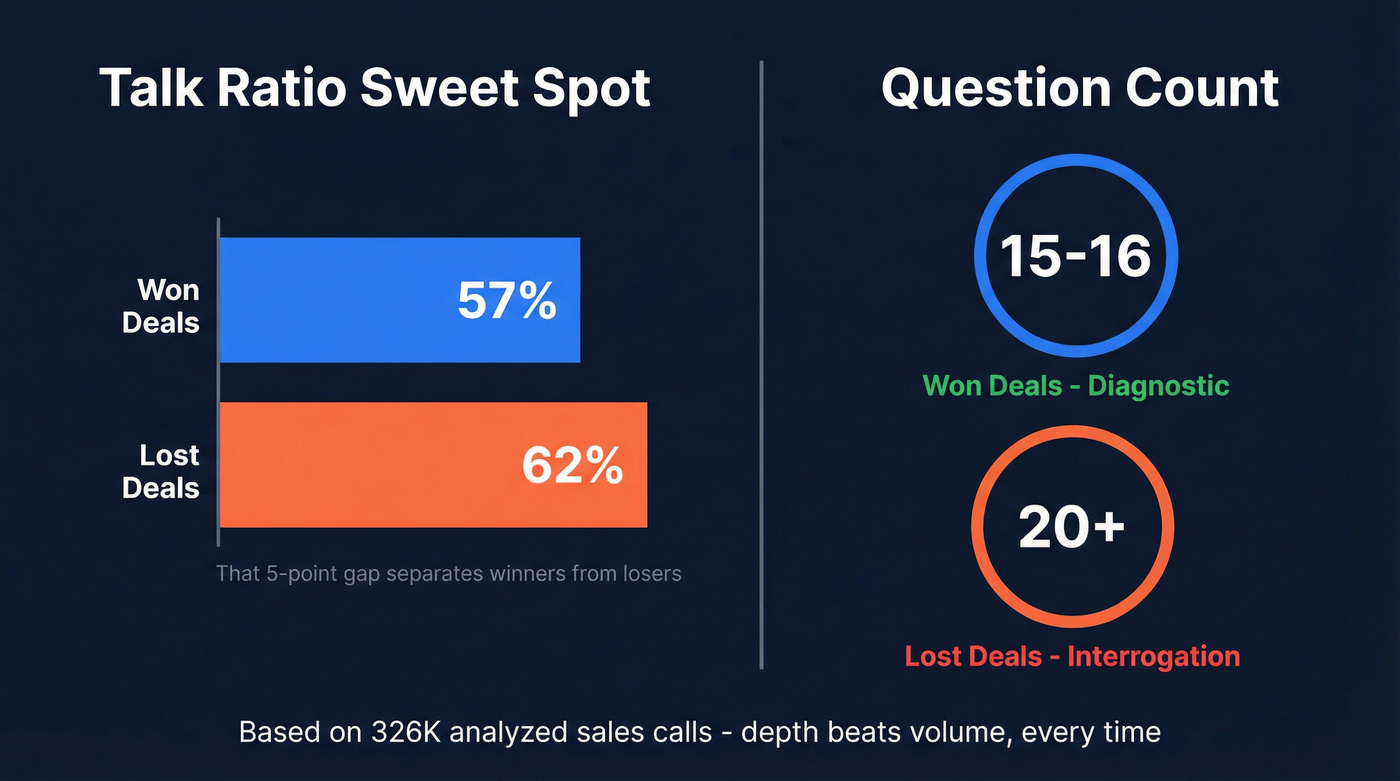
The question count finding is counterintuitive. Won deals averaged 15-16 questions. Lost deals averaged 20. More questions doesn't mean better diagnosis - it means interrogation. The prospect shuts down.
But the biggest differentiator isn't the ratio itself. It's consistency. We've seen this pattern across hundreds of call reviews: the reps who win aren't better talkers, they're more consistent. High performers maintain similar talk ratios whether they win or lose, while low performers swing 10 points - 54% talk in wins, 64% in losses. They don't have a system. They have good days and bad days. The fix is simple: a two-second pause after the prospect finishes speaking. It kills the impulse to jump in and creates space for them to elaborate. (If you want a broader view of what the data says, start with sales conversation science.)
Pre-Call Prep That Actually Works
Every discovery call guide tells you to research the prospect. None of them mention that your data is probably wrong.
Once your data is clean, pull the prospect's company into a one-page brief: recent funding, hiring patterns, tech stack, competitive landscape. Draft 3-5 tailored questions that connect their situation to problems you solve. Reps using AI to automate this prep step are generating 77% more revenue than those who don't - feed your CRM data and web research into an agent that outputs a structured brief. The whole process takes 10 minutes and separates you from the 84% who wing it. (Use a simple pre call research checklist so prep stays consistent.)
Running the Call
The ACE Opening
ACE stands for Appreciate, Confirm time, End goal. It takes 20 seconds:
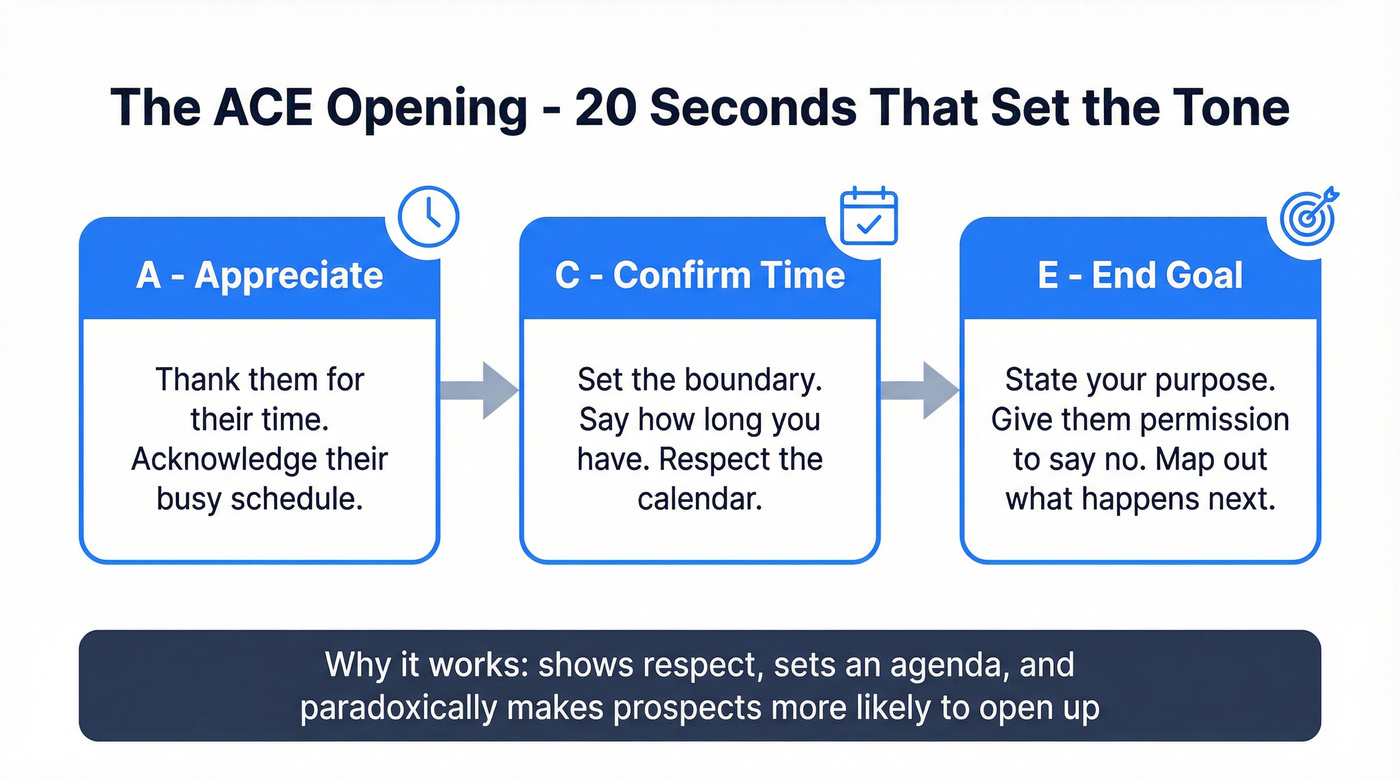
"Hey Sarah, thanks for making time today. I know you've got a packed calendar, so I want to be respectful of the 30 minutes we have. My goal is to understand what's happening with [specific challenge] and figure out if there's a fit. If there is, we'll map out next steps. If not, I'll point you in the right direction. Does that work?"
You've shown respect, set an agenda, and given the prospect permission to say no - which paradoxically makes them more likely to open up.
Questions That Win Deals
Don't fire 20 questions in sequence. Organize 10-12 across four categories and let the conversation guide which ones you pull. These techniques apply whether you're running a 15-minute intro or a 30-minute deep dive. (If you need a bank of prompts, pull from open-ended sales questions.)
Pain discovery:
- "Can you help me understand what's not working with your current process?"
- "What happens when that breaks down?"
- "How long has this been an issue?"
The phrasing "can you help me understand" prompts longer buyer responses, which the data correlates with closed deals. The best discovery conversations feel like dialogue, not interrogations.
Impact quantification:
- "What's the cost of not solving this in the next 6 months?"
- "How does this affect your team's ability to hit their number?"
Process, timeline, and stakeholders:
- "Walk me through how you're handling this today."
- "What's triggered the urgency to look at this now?"
- "Who else needs to weigh in on this decision?"
- "Have you tried solving this before? What happened?"
Advanced Tactics
Mirroring: Repeat the last 1-3 words the prospect said with an upward inflection. If they say "we've been struggling with pipeline visibility," you say "pipeline visibility?" and stop. This Chris Voss technique prompts elaboration without asking another question.
Labeling: Name the emotion you're hearing. "It sounds like you're frustrated with the lack of visibility into what's actually working." Then stop talking. The prospect will either confirm and go deeper, or correct you - both are wins.
Re-validation: For follow-up calls, open with "What's changed since we last talked?" Discovery isn't a single stage - it's ongoing. This surfaces new stakeholders, shifted priorities, or budget changes before you waste 20 minutes on an outdated understanding.

The article says it: prepping from stale data destroys credibility in the first 30 seconds. B2B contact data decays ~30% per year. Prospeo refreshes every 7 days - not every 6 weeks like competitors - so your pre-call brief starts with the right title, company, and verified email. 98% accuracy, $0.01 per lead.
Stop opening discovery calls with outdated intel.
Common Mistakes
Even with strong prep and the right framework, a few mistakes can tank an otherwise solid conversation.
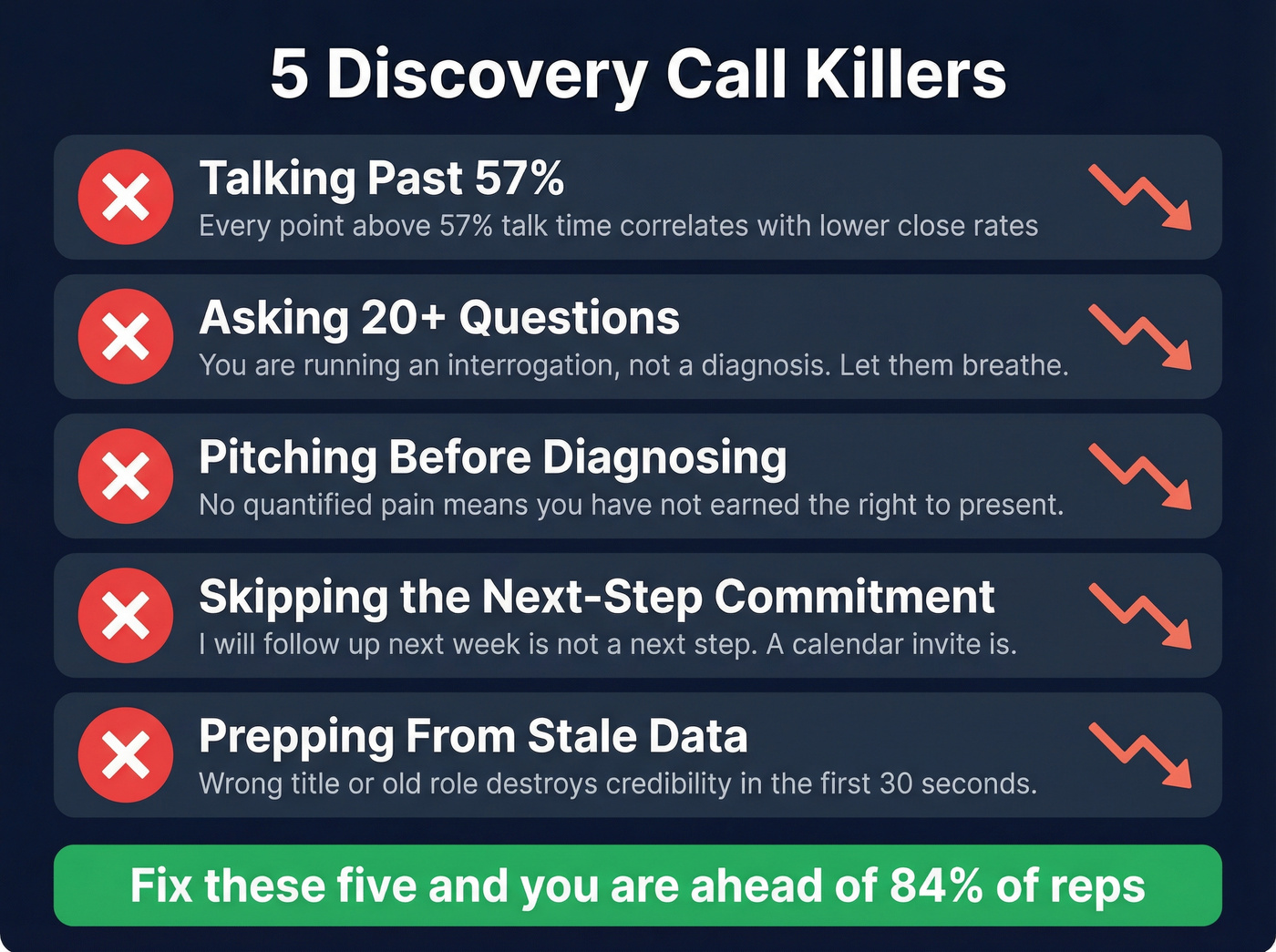
- Talking past the 57% mark. Every percentage point above 57% talk time correlates with lower close rates.
- Asking 20+ questions. You're running an interrogation, not a diagnosis. Let the prospect breathe.
- Pitching before you've diagnosed. If you haven't quantified the pain, you haven't earned the right to present a solution.
- Skipping the next-step commitment. "I'll follow up next week" isn't a next step. A calendar invite with an agenda is. (If this is a recurring issue, use a tighter how to end a sales call process.)
- Prepping from stale data. Opening with the wrong title or referencing a role the prospect left six months ago destroys credibility in the first 30 seconds.
Which Framework Fits Your Deal?
| Framework | Best For | Deal Size | Stakeholders | Cycle |
|---|---|---|---|---|
| BANT | Transactional / SMB | <$50K | 1-3 | <60 days |
| MEDDIC | Enterprise SaaS | >$100K | 5+ | 3-9 months |
| SPIN | Question method (layer inside others) | Any | Any | Any |
| POWERFUL | Complex / trust-heavy | >$50K | 3+ | 60+ days |
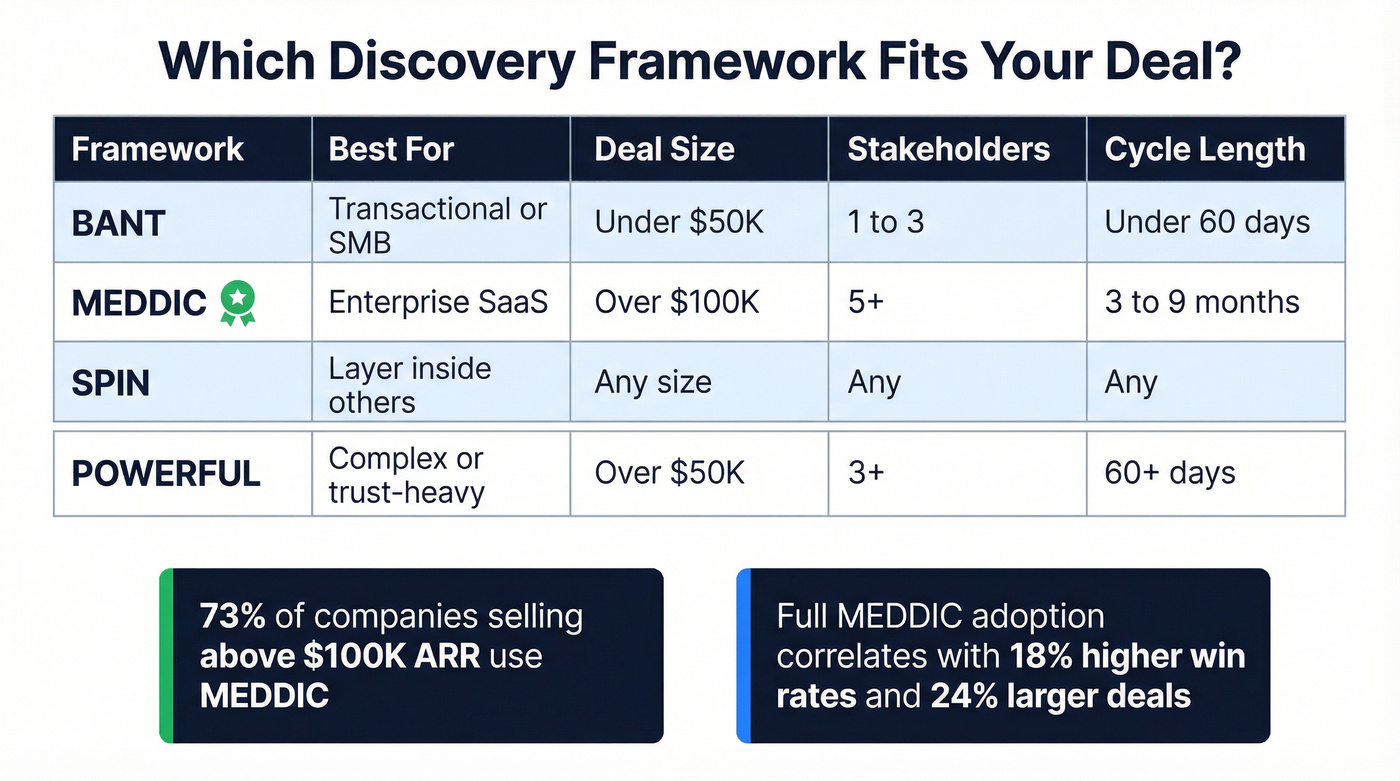
BANT works for transactional deals with short cycles and few decision-makers. 73% of companies selling above $100K ARR use some version of MEDDIC, and full adoption correlates with 18% higher win rates and 24% larger deal sizes. SPIN is a questioning methodology you layer inside BANT or MEDDIC - not a standalone framework. Salesforce's POWERFUL framework adds dimensions like fear of failure and trust, which matters in complex buying committees. Challenger works when your value prop requires teaching the buyer something new. (If you're choosing between enterprise qualification models, see MEDDIC vs MEDDPICC.)
Use whatever fits your deal complexity. Just use something consistently.
Handling "Just Send Me Info"
When a prospect says "just send me some info," they're trying to end the call politely. Don't comply blindly.
"Happy to send you something tailored. So I don't waste your time with a generic deck - what specifically would be most useful for you to see?"
For budget pushback: "How are you currently budgeting for similar solutions?" For "we're evaluating other options": "What criteria are you using to compare?" The goal isn't to push past the objection. It's to understand what's behind it. (This is easier when you practice handling sales objections with curiosity.)
After the Call
Here's the thing: the single biggest predictor of whether a discovery call converts isn't your talk ratio or your question count. It's whether you booked the next meeting before hanging up. Everything else is optimization on top of that foundation.
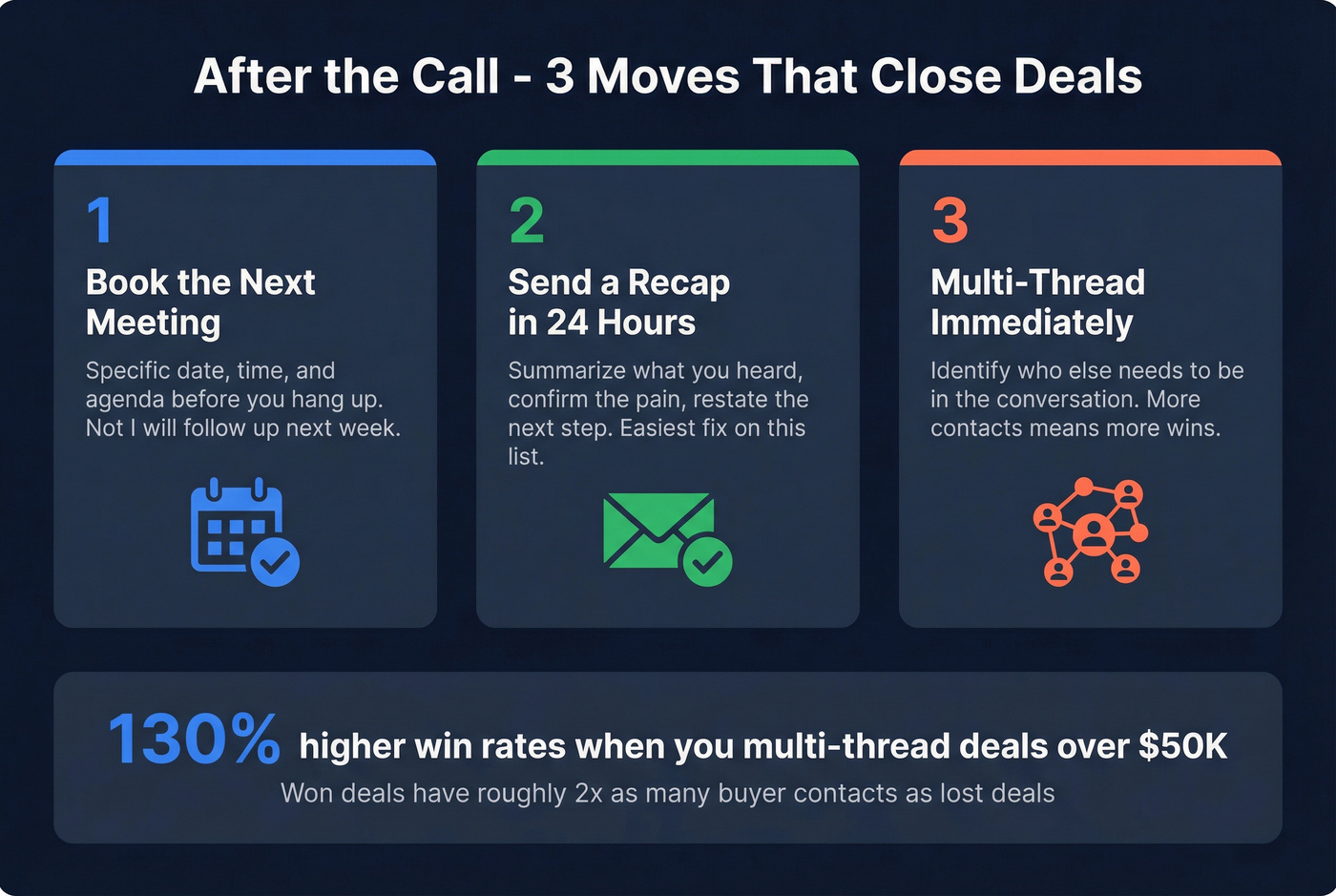
Secure the next step before you hang up. A specific date, time, and agenda - not "I'll follow up next week."
Send a recap within 24 hours. Summarize what you heard, confirm the pain, restate the next step. This is where most reps drop the ball, and it's the easiest fix on this entire list. (If your follow-ups are inconsistent, use a prospect follow up cadence.)
Multi-thread immediately. Multi-threading boosts win rates by 130% for deals over $50K, and closed-won deals have roughly 2x as many buyer contacts as lost deals. Strategic enterprise deals average 17 contacts. After your first call, identify who else needs to be in the conversation. (If you want the mechanics, read what is multithreading in sales.)
Discovery-to-next-step conversion runs 10-30% depending on ICP fit. If you're below 10%, your targeting or your call execution needs work. (Start by tightening account qualification.)
Tools Worth Using
Prospeo - Free tier with 75 emails/month; roughly $0.01/email on paid plans. This addresses the pre-call data quality problem that most reps ignore entirely. 98% email accuracy, 7-day data refresh, 50+ data points per contact. If your discovery prep starts with stale data, nothing else on this list matters. (If you're comparing options, see email ID validators.)
Gong is the gold standard for conversation intelligence, but it's custom-priced and enterprise-oriented. If your org can afford it, the insights are unmatched.
Fireflies.ai is the best value play for call transcription. Free plan available, Pro at $19/mo per user. It won't fix your data quality, but it'll make sure you capture everything once the conversation gets going.
Skip Enthu.AI ($59/agent/month) unless you're managing a team and need QA workflows. For individual reps, it's overkill.
Reps using AI-powered prep generate 77% more revenue. Feed Prospeo's 50+ enrichment data points - funding, tech stack, headcount growth, intent signals - into your pre-call brief and walk into every discovery call knowing exactly which pain points to probe. 92% match rate on enrichment, 30+ search filters.
Turn 10 minutes of prep into the best discovery call of your quarter.
FAQ
How long should a discovery call last?
15-30 minutes is the sweet spot. Enough to diagnose the problem without drifting into a premature pitch. If you're consistently going over 30, you're monologuing or interrogating - both patterns correlate with lost deals in the 326K-call dataset. Set the time expectation in your ACE opener.
How many questions should I ask?
15-16 per call. Won deals averaged 15-16 across 326K analyzed calls; lost deals averaged 20. Use "tell me more" instead of firing another question - fewer questions with longer answers outperform rapid-fire interrogation every time.
What's the single most impactful habit for sales reps?
Book the next meeting before you hang up. Clean data so your opener is relevant, talk ratio at or below 57%, and a confirmed next step - those three habits separate top performers from the 84% who wing their calls.
How do I fix outdated CRM data before a call?
Run your contact list through a verification tool with a weekly refresh cycle. A 7-day data refresh and 98% email accuracy mean you're working with current titles and verified contacts - not last quarter's snapshot. Clean data keeps your opener relevant and eliminates the awkward first two minutes spent confirming whether someone still holds their role.