

Best Sales Tools for Sales Managers in 2026, Ranked by the Jobs You Actually Do
Your reps spend 60% of their time on non-selling tasks - CRM updates, hunting for contacts, searching for content they can't find. Meanwhile, 42% of sellers feel overwhelmed by the tools meant to help them, and overwhelmed reps are 45% less likely to hit quota. With roughly 1,200 solutions across 43 categories competing for your budget, most "best tools" roundups list 27 of them and call it helpful. That's the opposite of helpful.
Here's the thing: 69% of reps fell short of quota last year. The right sales tools for sales managers won't fix bad process, but the wrong ones - or too many of them - will make everything worse. This article covers the 6 jobs you actually do, the one tool that wins each job, and a framework for what to buy first so you don't create the very problem you're trying to solve.
Our Picks at a Glance
Short on time? Here's the cheat sheet.
| Workflow | Top Pick | Why | Starting Price |
|---|---|---|---|
| Data quality (start here) | Prospeo | 98% accuracy, 7-day refresh | Free / ~$0.01/email |
| CRM | HubSpot Sales Hub | Free CRM, forecasting at Pro | Free / Pro ~$90/user/mo |
| Coaching | Gong | Conversation intelligence standard | ~$120-250/user/mo + platform fees |
| Forecasting | Clari | AI pipeline + revenue intel | ~$200-400/user/mo |
| Budget stack | Prospeo + HubSpot Free + Instantly | Full outbound under $100/mo | ~$70-100/mo total |
Every stack on this list starts with data quality. Your $250/user/month Gong subscription is analyzing garbage if reps are calling dead numbers. Get the foundation right first.
6 Jobs That Define Your Stack
Every tool you buy should map to one of these workflows. If it doesn't, it's shelfware. Understanding what separates sales planning tools from execution tools helps you avoid buying overlapping software that confuses reps.
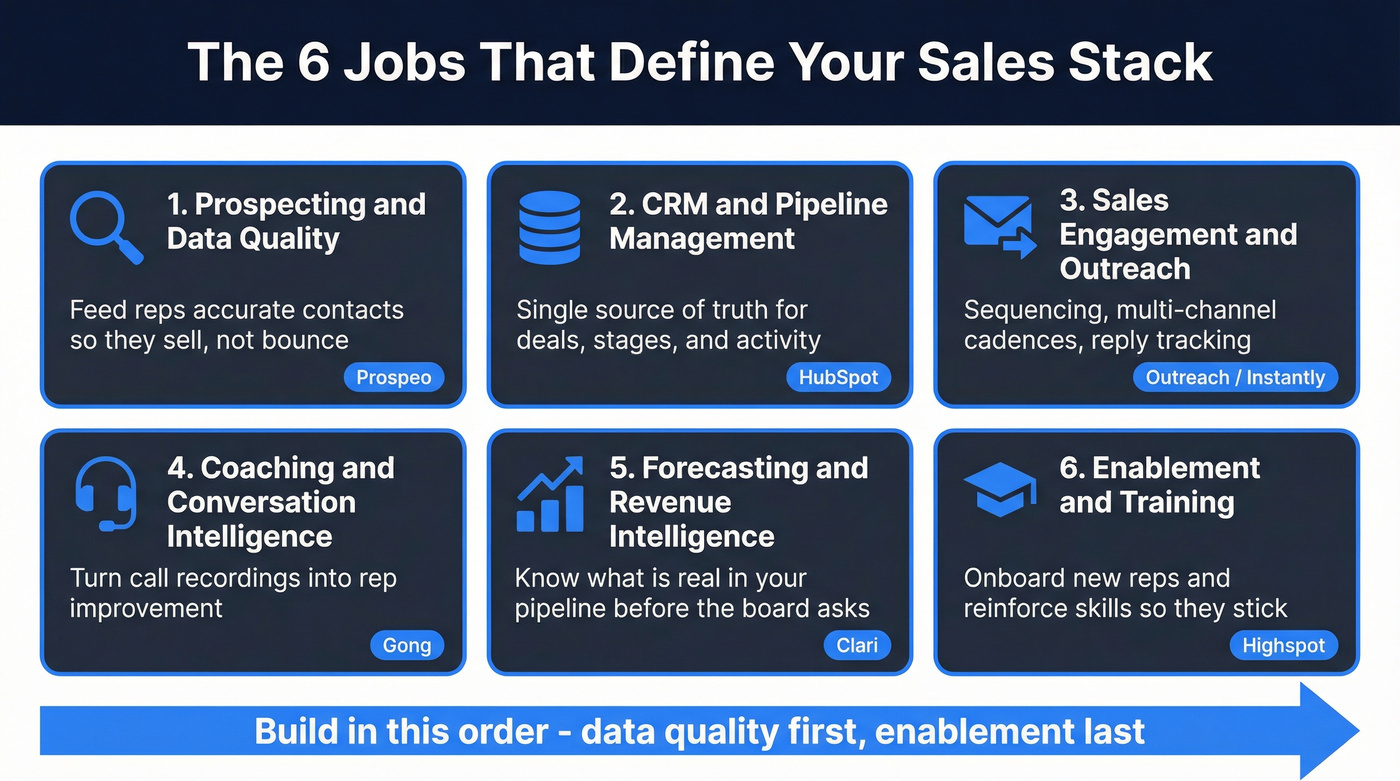
- Prospecting & data quality - feeding reps accurate contacts so they sell instead of bouncing emails
- CRM & pipeline management - the single source of truth for deals, stages, and activity
- Sales engagement & outreach - sequencing, multi-channel cadences, and reply tracking
- Conversation intelligence & coaching - turning call recordings into rep improvement
- Forecasting & revenue intelligence - knowing what's real in your pipeline before the board asks
- Enablement & training - onboarding new reps and reinforcing skills so they stick
We excluded CPQ tools, proposal software, and pure marketing automation - those are different buying decisions for different stakeholders.
Best Picks by Workflow
Prospecting & Data Quality
Your newest SDR just burned through 500 emails. 180 bounced. Your domain reputation dropped, and now even the good emails are landing in spam. We've seen this exact scenario play out at multiple companies we've worked with, and it always traces back to the same root cause: data quality wasn't the first line item in the budget.
The proof point that matters most: Snyk's team of 50 AEs was running bounce rates of 35-40%. After switching, bounces dropped under 5%, AE-sourced pipeline jumped 180%, and the team was generating 200+ new opportunities per month - that's 4+ new opportunities per AE per month, up from roughly 1.5 before the switch. Built-in intent data tracks 15,000 topics via Bombora, so reps can prioritize accounts actively researching solutions rather than spraying cold outreach. Native integrations with Salesforce, HubSpot, Outreach, Instantly, and Lemlist mean it slots into whatever engagement stack you're already running. Pricing starts free with 75 verified emails per month, and paid plans scale at roughly $0.01 per email - no contracts, no sales calls required.

Clay is a workflow automation layer, not a database. It pulls from dozens of data providers and lets you build enrichment waterfalls - powerful if you have a RevOps person who can configure it, overkill if you don't. Starts at ~$134/month.
CRM & Pipeline Management
The CRM question isn't "which is best?" It's "which fits your team size and implementation bandwidth?"
Pick HubSpot Sales Hub if you're a team under 50 reps and want to be operational in days, not months. The free CRM is genuinely usable. Forecasting, custom reporting, and sequences unlock at the Professional tier, typically ~$90/user/month. HubSpot's biggest strength for managers is visibility without configuration - pipeline dashboards, activity tracking, and deal stages work out of the box. For any head of sales evaluating software, HubSpot offers the fastest time-to-value without requiring a dedicated admin.
Pick Salesforce Sales Cloud if you're 100+ reps, need deep customization, and have a dedicated admin. Pricing typically runs $25-330/user/month depending on tier. A 10-person team spending 6 months on Salesforce implementation chose wrong.
Pick Pipedrive for small teams that need a CRM tomorrow. Setup takes 2-3 days. Pricing starts around $14-15/user/month. It won't scale to enterprise, but for teams under 20 reps who need clean pipeline visibility without the overhead, it's the fastest path to value.
| CRM | Setup Time | Starting Price | Best For |
|---|---|---|---|
| HubSpot | 1-2 weeks | Free / Pro ~$90/user/mo | Mid-market, fast ROI |
| Salesforce | 2-6 months | ~$25-330/user/mo | Enterprise, deep custom |
| Pipedrive | 2-3 days | ~$14-15/user/mo | SMB, speed |
Sales Engagement & Outreach
This category is splitting in two: enterprise platforms that do everything, and lightweight tools that do one thing well. Pick your lane.
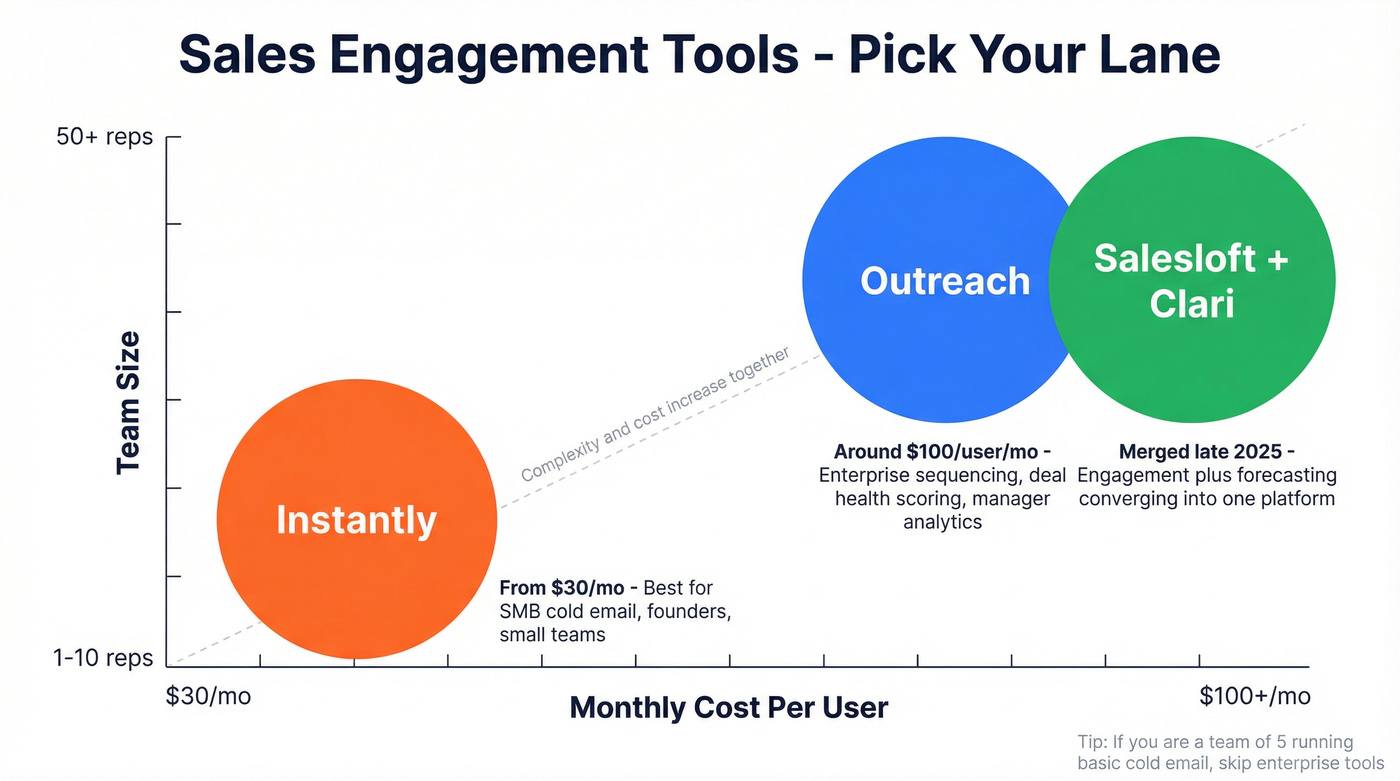
Use Outreach if you need enterprise-grade sequencing with deal health scoring and manager-level analytics. Multi-channel cadences, A/B testing, and rep performance dashboards are all strong. Pricing runs ~$100/user/month. Skip it if you're a team of 5 running basic cold email - you'll pay for features you won't touch. If you're evaluating platforms, this guide on how to choose a sales engagement platform helps you avoid overlap.
Salesloft merged with Clari in late 2025, combining to roughly $450M ARR. That consolidation signals where the category is heading: engagement + forecasting + revenue intelligence converging into unified platforms.
Instantly is the budget pick for SMB outbound - from $30/month for email sending. It won't replace Outreach for a 50-rep team, but for founders and small teams running cold email, it punches well above its price. If you're comparing options, see our breakdown of cold email marketing tools.
Coaching & Conversation Intelligence
AI coaching programs can drive 3.3x year-over-year quota attainment, cut sales cycles by 56%, and ramp new reps 30-40% faster. Those numbers make conversation intelligence one of the highest-ROI categories in your stack - if you pick the right tool and actually use it.
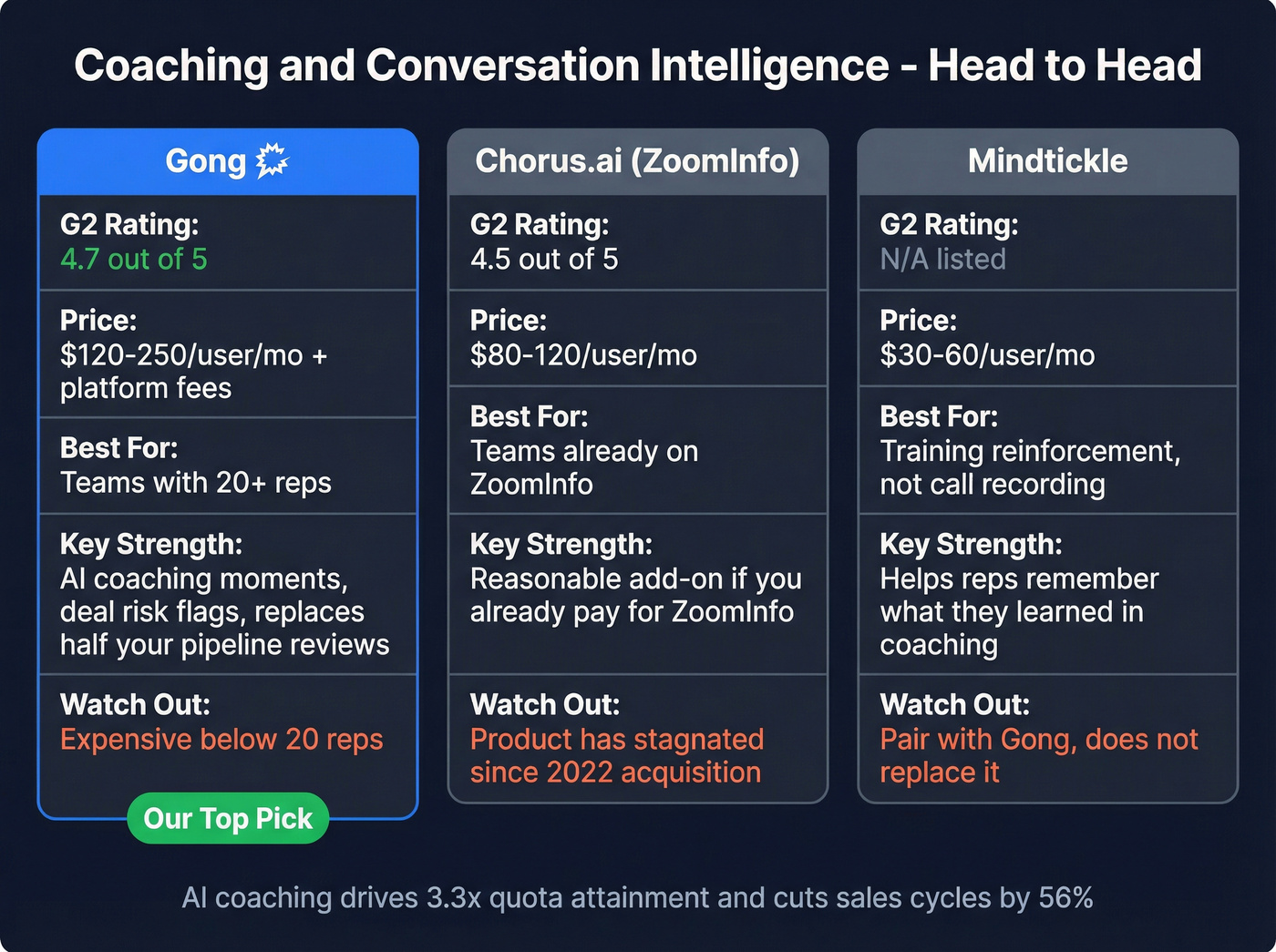
Gong is the single best tool purchase a sales manager can make - but only if you have 20+ reps. Below that threshold, you're overpaying for infrastructure. Above it, the per-rep coaching lift justifies every dollar. Gong records calls, surfaces coaching moments, flags deal risk, and gives managers a dashboard that replaces half your pipeline review meetings. The G2 rating sits at 4.7/5, and the insights are genuinely actionable - not just transcription with keywords highlighted. Pricing runs $120-250/user/month plus platform fees. If you want a system to make the insights stick, pair it with a lightweight sales coaching best practices cadence.

Chorus.ai (now owned by ZoomInfo) runs $80-120/user/month and requires ZoomInfo. The product has stagnated since the 2022 acquisition, and its G2 rating of 4.5/5 reflects that drift. If you're already paying for ZoomInfo, Chorus is a reasonable add-on. Don't let it be the reason you start.
Mindtickle is a different animal - training reinforcement and readiness, not call recording. At ~$30-60/user/month, it's best paired with Gong rather than replacing it. Think of it as the tool that makes sure reps remember what they learned in coaching sessions.
Forecasting & Revenue Intelligence
It's Monday morning. Your CRM says $2.3M in pipeline. You know 30% of it is dead. You just can't prove it.
Only 41% of CEOs are confident in their CRO's ability to deliver, and roughly 50% of revenue leaders missed multiple forecasts last year. Gartner published its first Magic Quadrant for Revenue Action Orchestration in December 2025 - a signal that the category has matured enough to warrant formal evaluation.
Clari is the enterprise answer. It ingests CRM data, email activity, call signals, and rep behavior to surface what's actually going to close versus what's sitting in pipeline for show. G2 rating: 4.6/5. Pricing runs $200-400/user/month. It's expensive, and it's worth it if you're managing 50+ reps and reporting to a board. For leaders who need sales strategy software that goes beyond spreadsheets, Clari turns pipeline guesswork into data-backed revenue calls. If forecast misses are a recurring issue, start with deal forecast accuracy fundamentals before adding more tooling.
Use Avoma for mid-market teams that don't want to pay Clari prices. Forecasting features unlock at the Business plan ($79/user/month) with no platform fees and a 14-day free trial. It won't match Clari's depth on scenario modeling or multi-team rollups, but for a single manager running a 10-30 person team, it covers the essentials.
Skip both if you're under 10 reps - HubSpot's built-in forecasting at the Professional tier handles the basics without adding another tool to the stack.
Enablement & Training
84% of organizations invest in enablement, but reps forget 70% of training within a week. The tools aren't the problem - implementation is.
Highspot combines content management with coaching and analytics at ~$50-80/user/month. It's a strong option for teams that need to manage battlecards, playbooks, and onboarding content in one place. If you don't build reinforcement loops into your enablement workflow, though, your investment is shelfware regardless of which vendor you pick.
QuotaPath solves a different problem: commission transparency. Starting at $25/user/month, reps can see exactly how deals translate to earnings, and managers get visibility into comp plan performance. It's not traditional enablement, but nothing kills motivation faster than confusion about how you're getting paid.

You just read how Snyk's 50 AEs cut bounce rates from 35% to under 5% and grew pipeline 180%. That's what happens when sales managers fix the data layer first. Prospeo gives your team 300M+ profiles, 125M+ verified mobiles, and intent data across 15,000 topics - refreshed every 7 days.
Stop managing around bad data. Start managing a team that actually connects.
Full Pricing Comparison
Managers need to budget. Here's every tool in one view - because vendors would rather you "talk to sales" than see this table.
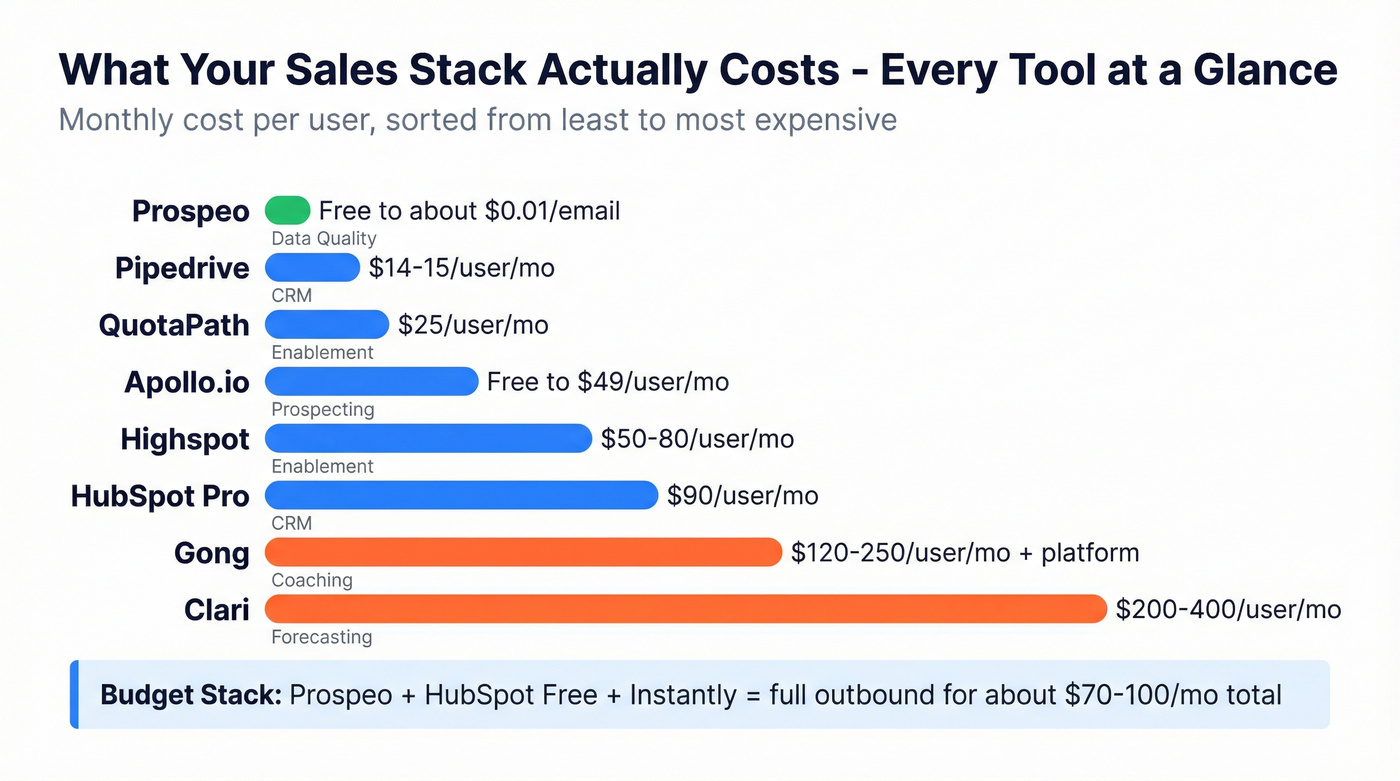
| Tool | Category | Starting Price | Best For |
|---|---|---|---|
| Prospeo | Data quality | Free / ~$0.01/email | Verified emails + mobiles |
| HubSpot Sales Hub | CRM | Free / Pro ~$90/user/mo | Mid-market CRM |
| Gong | Coaching | ~$120-250/user/mo + platform fees | Call coaching 20+ reps |
| Clari | Forecasting | ~$200-400/user/mo | Enterprise revenue intel |
| Apollo.io | Prospecting | Free / ~$49/user/mo | Budget prospecting |
| Salesforce | CRM | ~$25-330/user/mo | Enterprise CRM |
| Pipedrive | CRM | ~$14-15/user/mo | SMB pipeline |
| Outreach | Engagement | ~$100/user/mo | Enterprise sequences |
| Salesloft | Engagement | ~$75-125/user/mo | Mid-market + Clari bundle |
| Instantly | Engagement | From $30/mo | Budget cold email |
| Avoma | Forecasting | $79/user/mo (Business) | Mid-market forecasting |
| Highspot | Enablement | ~$50-80/user/mo | Content + coaching |
| Chorus.ai | Coaching | $80-120/user/mo | ZoomInfo ecosystem |
| Mindtickle | Training | ~$30-60/user/mo | Training reinforcement |
| QuotaPath | Compensation | From $25/user/mo | Commission transparency |
| Clay | Enrichment | From $134/mo | Workflow automation |
What to Buy First
Not every team needs 16 tools. Here's how to build your stack based on what you can actually spend - and the principle is the same at every tier: data quality first. Everything downstream - your sequences, your coaching insights, your forecast accuracy - depends on whether reps are reaching real people at real companies.
Budget stack (~$100/month): Prospeo for verified contact data, HubSpot's free CRM for pipeline management, and Instantly for cold email sequences. This gets a small team prospecting, tracking deals, and running outbound for less than most teams spend on a single seat of anything. It's not glamorous, but it works. If you want a broader blueprint, use this B2B sales stack framework.
Growth stack (~$500/month): Add HubSpot Professional for CRM + forecasting, Outreach for multi-channel engagement, and Avoma for conversation intelligence and lightweight forecasting. This is the sweet spot for teams of 10-30 reps who need visibility without enterprise overhead.
Enterprise stack (no budget limit): Salesforce for CRM, Gong for coaching, Clari for forecasting, and Highspot for enablement. This is the full picture - and it only works if you have the RevOps headcount to implement and maintain it.
High-growth companies that deploy more tools see a 5% improvement in quota attainment, but only when reps actually adopt them. Sellers using AI tools are 3.7x more likely to meet quota. The technology works. The question is whether your team will use it.
The budget stack in this article runs under $100/month. Prospeo is the foundation - 98% email accuracy at $0.01/email, native integrations with HubSpot, Salesforce, Instantly, and Lemlist. No contracts, no sales calls, no 6-week-old data dragging your team down.
Build the stack your reps will actually use, starting at $0.
Mistakes That Kill Adoption
You can buy the right tools and still fail. We've watched it happen more times than we'd like to admit.
Tool overload is the #1 killer. Reps use 8 tools on average, 42% feel overwhelmed, and overwhelmed sellers are 45% less likely to hit quota. If you're adding a seventh or eighth tool to the stack, you need to retire something first. More tools without fewer tasks just means more tabs and less selling.
Training decay is real. Reps forget 70% of what they learn within a week. Any tool that requires a 3-hour onboarding session and then never reinforces the workflow will become shelfware by month two. Buy tools with built-in reinforcement, or build your own cadence of refresher sessions - the consensus on r/sales is that short weekly drills beat marathon training sessions every time.
Buying enterprise tools for SMB teams. A 10-person team doesn't need Salesforce. A 5-rep startup doesn't need Gong. Match the tool to the team size, not to the aspirational org chart you drew on a whiteboard. The most expensive mistake in sales tech isn't buying the wrong tool - it's buying the right tool two years too early.
Skipping change management. Even the best software fails if reps don't understand why it's being introduced. Before you flip the switch on a new platform, invest a week in change management: communicate the "why," run hands-on workshops, and assign tool champions on each team. Without that groundwork, adoption stalls and your investment becomes another line item nobody uses. Gartner's research on technology adoption consistently backs this up.
Ignoring data quality. This is the mistake that compounds silently. Your Gong subscription is analyzing calls to wrong numbers. Your Outreach sequences are burning domain reputation on bounced emails. Your Clari forecast is built on pipeline created from bad contact data. Fix the foundation before you optimize the roof.
How to Run a Software Rollout
Buying the tool is the easy part. Getting 30 reps to actually use it is where most managers fail.
A structured rollout follows a predictable sequence: pilot with 3-5 reps for two weeks, measure adoption and output against a control group, then expand in waves rather than flipping the switch for everyone on day one. During the pilot, document the workflows that change - which steps disappear, which steps are new, and where reps get stuck. Use those findings to build a 30-minute onboarding session and a one-page quick-reference guide, not a 90-slide deck nobody reads.
Assign one power user per pod as the go-to for questions. After the pilot, roll out to the next cohort every two weeks until the full team is live. This phased approach reduces resistance and gives you time to fix configuration issues before they affect the whole org. I've seen teams try the "big bang" approach - everyone gets access on Monday, figure it out by Friday - and it almost always ends with 40% adoption at best. HubSpot's rollout playbook has a solid template for phased launches if you want a starting framework.
FAQ
What are the must-have sales tools for sales managers?
Five to seven, maximum. You need a data quality tool, a CRM, and an engagement platform as the foundation. Coaching and forecasting layer on once you have 20+ reps. Overwhelmed sellers are 45% less likely to hit quota, so every tool you add needs to earn its place by replacing a manual task, not creating a new one.
What should a manager buy first?
A data quality tool and a CRM - everything else depends on accurate contact data and clean pipeline records. Prospeo's free tier paired with HubSpot's free CRM gets you operational in a day with zero spend. Add engagement and coaching tools only after that foundation is solid.
What's a reasonable per-rep budget?
$150-400/rep/month covers a strong stack including CRM, data, engagement, and one intelligence tool. Enterprise stacks with Gong and Clari can run $500-800/rep/month. The budget stack with a free CRM and Instantly comes in under $100/month total for the whole team.
Is Salesforce worth it for small teams?
Usually not. Implementation takes 2-6 months and cost scales fast with add-ons and admin headcount. HubSpot or Pipedrive gets teams under 20 reps to value in days, not months, at a fraction of the total cost of ownership.
Do AI sales tools actually improve quota attainment?
Yes - sellers using AI tools are 3.7x more likely to meet quota. AI coaching programs drive 3.3x year-over-year quota attainment and cut sales cycles by 56%. The ROI is proven; the challenge is adoption and consistent usage, not the technology itself.