

BANT vs MEDDIC: Which Framework Fits Your Sales Motion
Your VP of Sales just mandated MEDDIC after two blown forecasts. Half the team is Googling the acronym. The other half is quietly still running BANT because it's what they know. Pipeline reviews are a mess and nobody's qualifying deals the same way.
This isn't a "which is better" debate. It's a fit question. We'll give you concrete thresholds so you can pick a framework by Friday and actually enforce it.
Quick Comparison at a Glance
BANT is a speed filter. Use it for high-velocity deals under $50K ACV with one decision-maker and cycles shorter than 60 days. It answers one question: "Should we spend time here?"
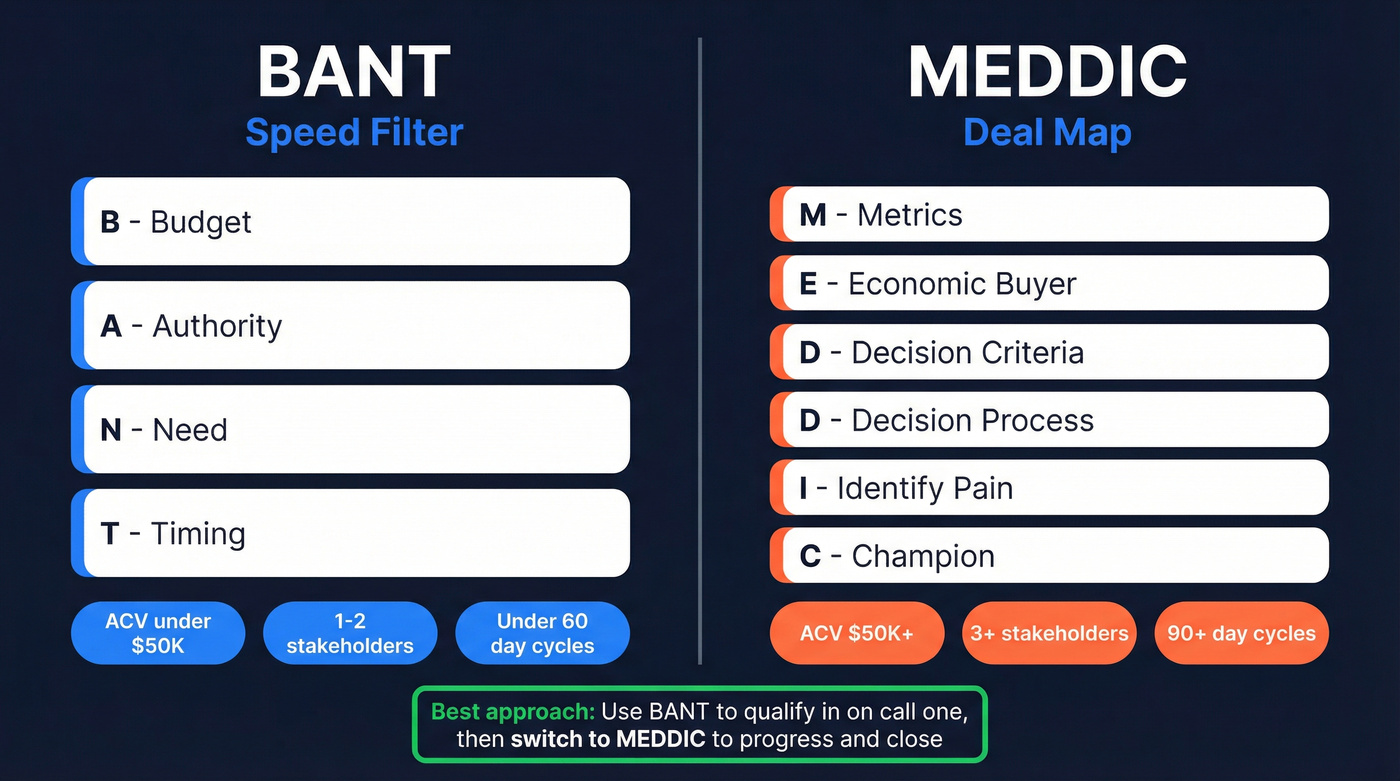
MEDDIC is a deal map. Use it for enterprise deals above $50K ACV with 3+ stakeholders and cycles running 90+ days. It answers a different question: "How do we win this?"
The real answer most teams land on: use BANT to qualify in on the first call, then switch to MEDDIC to progress and close everything that matters. Ask any enterprise AE and they'll tell you the same thing - BANT gets you through the first call, MEDDIC keeps you honest through the forecast. Most experienced sellers already do this; they just don't formalize it.
Here's the thing, though. Neither framework works if your contact data is wrong. You can't qualify someone you can't reach, and you can't identify a Champion who doesn't pick up the phone.
What Is BANT?
BANT stands for Budget, Authority, Need, and Timing. IBM developed it in the 1950s as a way for reps to quickly screen whether a prospect was worth pursuing. Seventy years later, a Gartner Digital Markets survey found 52% of salespeople still find it reliable for qualifying prospects, and 41% value its flexibility.
Budget - Does the prospect have money allocated, or can they get it? This isn't "what's your budget?" on call one. It's understanding their spending authority and procurement reality.
Authority - Are you talking to someone who can sign, or someone who can only recommend? In smaller deals, these are often the same person.
Need - Is there a real problem driving this conversation, or are they just browsing? The stronger the pain, the faster the deal moves.
Timing - When does something need to happen? Don't accept "ASAP" - anchor to a key event like a contract renewal, board meeting, or fiscal year end and work backward.
Discovery Questions You Can Steal
- Budget: "How much have you allocated for solving this problem?" / "What does your typical budget approval process look like?"
- Authority: "Who else needs to weigh in before a decision is final?"
- Need: "What motivated you to look for a solution right now?" / "What happens if this problem doesn't get solved this quarter?"
- Timing: "Is there a specific event driving your timeline - a renewal, a launch, a board review?"
Bluleadz's BANT question bank has 30 more variations worth bookmarking.
What Is MEDDIC?
MEDDIC was developed at PTC in the 1990s and is often credited with helping PTC grow from $300M to $1B in revenue in four years. Where BANT filters, MEDDIC forces reps to map every moving part of a complex deal before forecasting it.
Metrics - What quantifiable outcomes does the buyer need? Think "reduce churn by 15%" or "cut onboarding time from 8 weeks to 3." If you can't attach a number to the value, the deal stalls.
Economic Buyer - The person who can say yes when everyone else says no. Not your day-to-day contact - the one who controls the budget and has final authority.
Decision Criteria - What specific requirements will the buyer use to evaluate vendors? Technical specs, compliance needs, integration requirements, pricing structure.
Decision Process - The actual steps between "we're interested" and "here's the PO." Who reviews what, in what order, with what approvals?
Identify Pain - Not surface-level frustration, but the business pain that's costing them money, time, or competitive position right now.
Champion - An internal advocate who has power, influence, and a personal stake in your solution winning. No Champion, no deal. This is the single most important element in MEDDIC, and it's the one reps skip most often. Modern B2B buying groups range from 5 to 16 people across as many as 4 functions, according to Gartner. You can't navigate that with four yes/no questions - you need a Champion guiding you through the maze.
Discovery Questions for MEDDIC
- Metrics: "What does success look like in numbers - revenue impact, time saved, cost reduced?"
- Economic Buyer: "Who ultimately signs off on a purchase of this size?"
- Decision Criteria: "What are the three things your evaluation team cares about most?"
- Decision Process: "Walk me through what happens between our next call and a signed contract."
- Identify Pain: "What's this problem costing you today - in dollars, hours, or missed targets?"
- Champion: "Who on your side is most invested in making this change happen?"
MEDDIC vs MEDDPICC vs MEDDICC
MEDDPICC adds two letters: Paper Process, covering the legal, procurement, and contracting steps that can stall a deal for weeks, and Competition, tracking which other vendors are in the evaluation. Use MEDDIC for moderately complex sales. Use MEDDPICC when deals involve legal review, procurement teams, or competitive bake-offs - which describes most enterprise deals over $100K ACV.
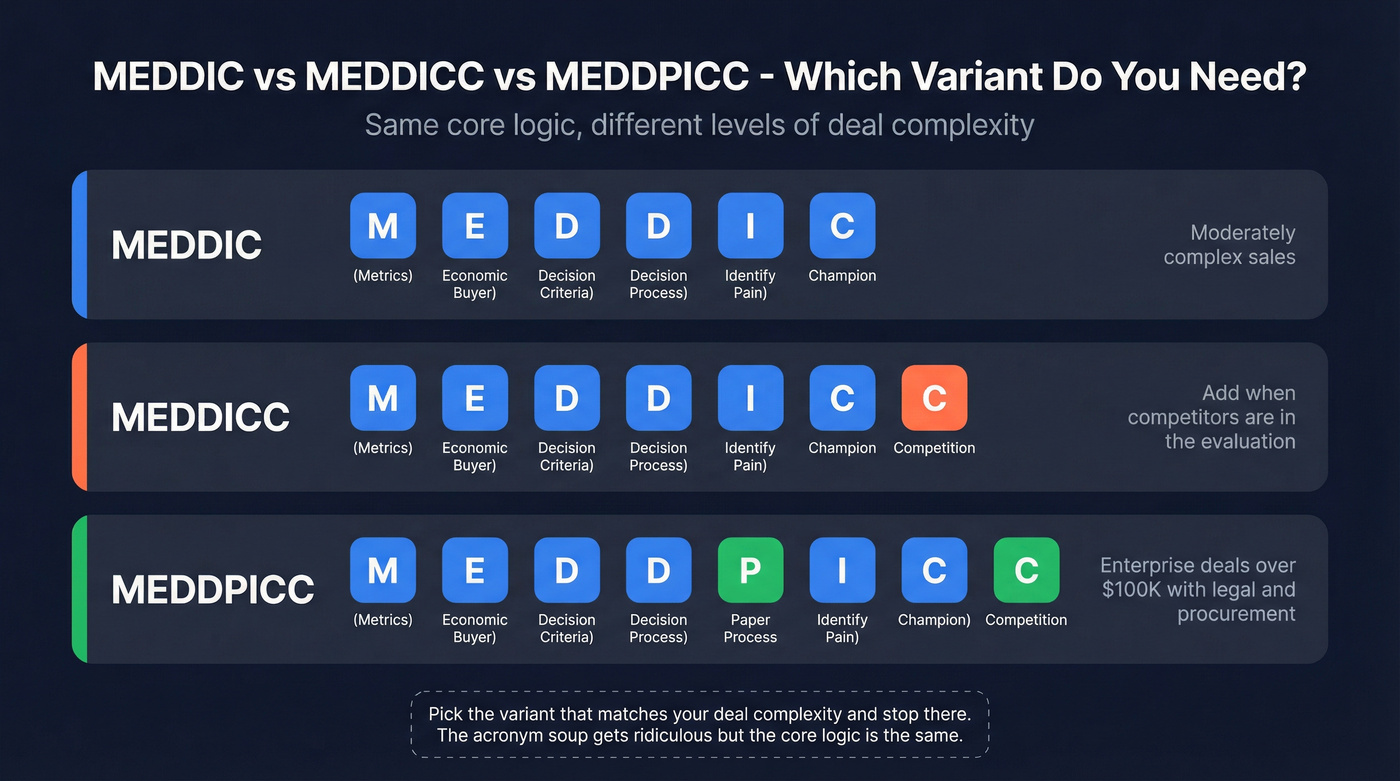
MEDDICC splits the difference by adding only Competition. You'll also encounter MEDDPPICC, which tacks on Implications of Pain - useful when you need to quantify the cost of inaction to justify urgency. Let's be honest: the acronym soup gets ridiculous, but the core logic is the same. Pick the variant that matches your deal complexity and stop there.
Side-by-Side Comparison
| Criterion | BANT | MEDDIC |
|---|---|---|
| Philosophy | Filter (qualify in/out) | Map (understand to win) |
| Ideal ACV | Under $50K | $50K+ |
| Cycle length | Under 60 days | 90+ days |
| Stakeholders | 1-2 | 3+ |
| Complexity | Low to moderate | High |
| Forecast accuracy | Lower | Higher |
| Time to implement | Days | Weeks |
| Best for | SMB / high-velocity | Enterprise / complex |
Treating these as competitors is the wrong framing. They operate at different stages of the sales cycle.

You can't qualify a deal if you can't reach the decision-maker. Prospeo gives you 98% accurate emails and 125M+ verified mobile numbers with a 30% pickup rate - so when BANT asks 'Authority,' you're already talking to the right person.
Reach the Economic Buyer on the first try, not the fifth.
How to Choose the Right Framework
Here's the hot take most comparison articles won't give you: if your average deal size is under $25K, you probably don't need MEDDIC at all. The overhead of mapping six criteria for a deal that closes in three weeks with one signer is a waste of your reps' time. We've tested both approaches across hundreds of pipeline reviews, and the pattern is clear.
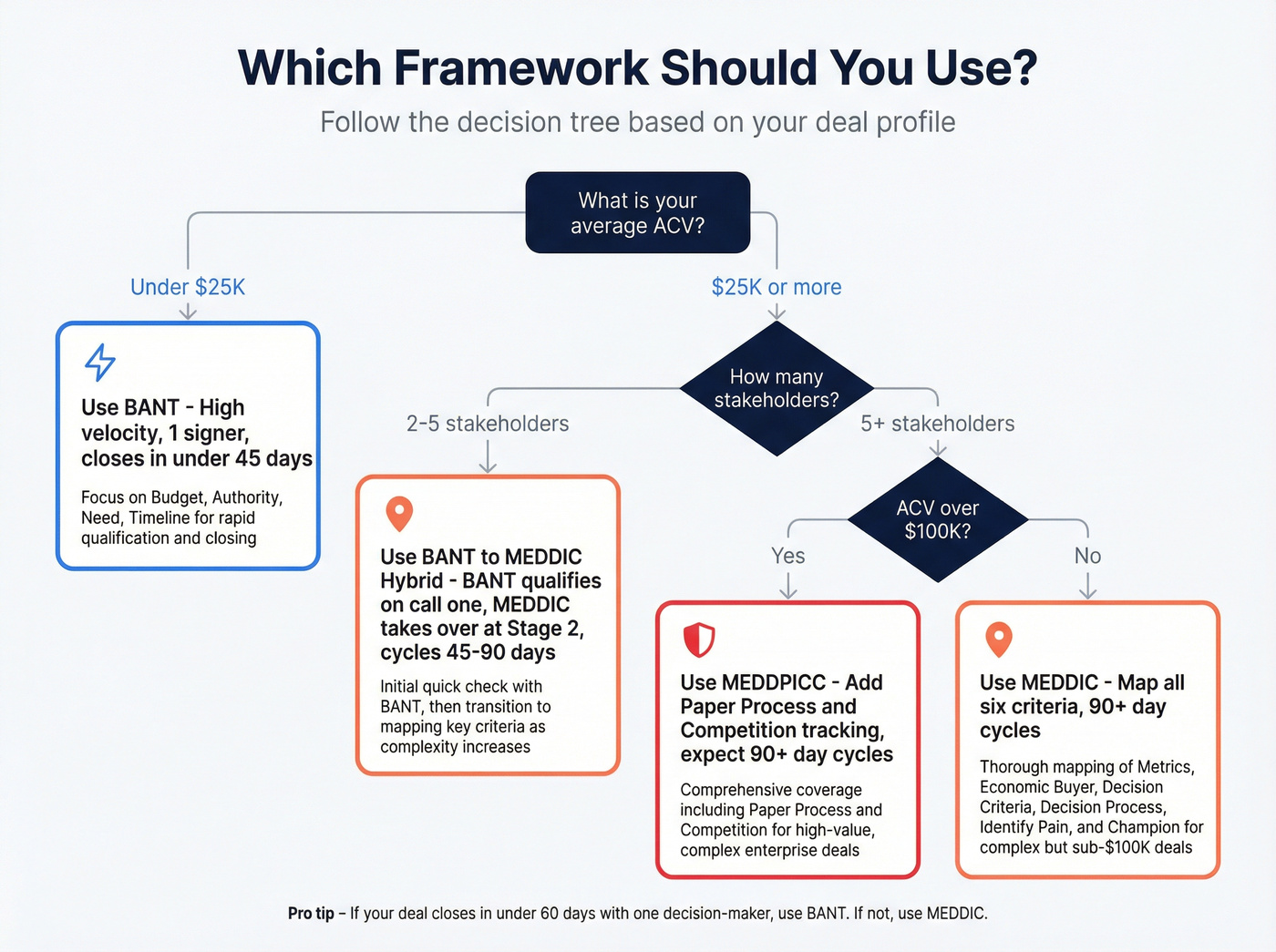
| Deal Profile | ACV | Stakeholders | Cycle | Framework |
|---|---|---|---|---|
| High-velocity SMB | Under $25K | 1 | Under 45 days | BANT |
| Mid-market | $25K-$100K | 2-5 | 45-90 days | BANT → MEDDIC hybrid |
| Enterprise | $100K+ | 5+ | 90+ days | MEDDPICC |
| SaaS / recurring revenue | Any | Varies | Varies | SPICED |
The hybrid zone is where most mid-market teams live. ACV $25K-$100K, 2-5 stakeholders, cycles that drag past 60 days but rarely hit 6 months. BANT qualifies on the first call, MEDDIC takes over for pipeline progression. In our experience, the hybrid approach works best when you formalize the handoff point - typically when a deal moves from Stage 1 to Stage 2 in your CRM.
The enterprise zone demands MEDDPICC. You need Paper Process mapped because procurement will add 3-6 weeks you didn't plan for, and you need Competition tracked because there's always a bake-off at this price point.
If your average deal closes in under 60 days with one decision-maker, use BANT. If it doesn't, use MEDDIC. That's the entire decision tree.
One warning worth repeating: MEDDIC without discipline is just CRM checkbox data entry. I've watched teams adopt MEDDIC, fill in the fields with garbage, and wonder why forecast accuracy didn't improve. The framework only works if managers inspect the data during pipeline reviews and hold reps accountable for real answers, not placeholder text. The consensus on r/sales echoes this - reps complain about MEDDIC being "busywork" when leadership mandates the fields but never actually reviews them.
The Data Prerequisite Nobody Talks About
Both BANT and MEDDIC assume you're talking to the right person at a reachable contact. Bain & Company research shows 70% of companies struggle to integrate sales plays into CRM systems. But the problem starts earlier than CRM adoption - it starts with data.
Your rep can't identify an Economic Buyer who never picks up. Your Champion identification falls apart when the "Director of IT" in your CRM left the company six months ago.
Before you qualify anyone, verify you're reaching the right person. Prospeo handles this upstream problem with 98% email accuracy, 300M+ professional profiles, and 125M+ verified mobile numbers on a 7-day data refresh cycle. CRM and CSV enrichment returns 50+ data points per contact at a 92% API match rate - job title, seniority, department, direct dial - so reps walk into discovery calls with context instead of guessing.
MEDDIC says no Champion, no deal. But Champions are useless if your contact data is stale. Prospeo refreshes every 7 days - not 6 weeks - so you're always reaching real people at current roles, not bouncing off outdated inboxes.
Stop qualifying ghosts. Start with data that's never more than a week old.
CRM Implementation Tips
The framework only sticks if it's embedded in your CRM. Here's what to build.
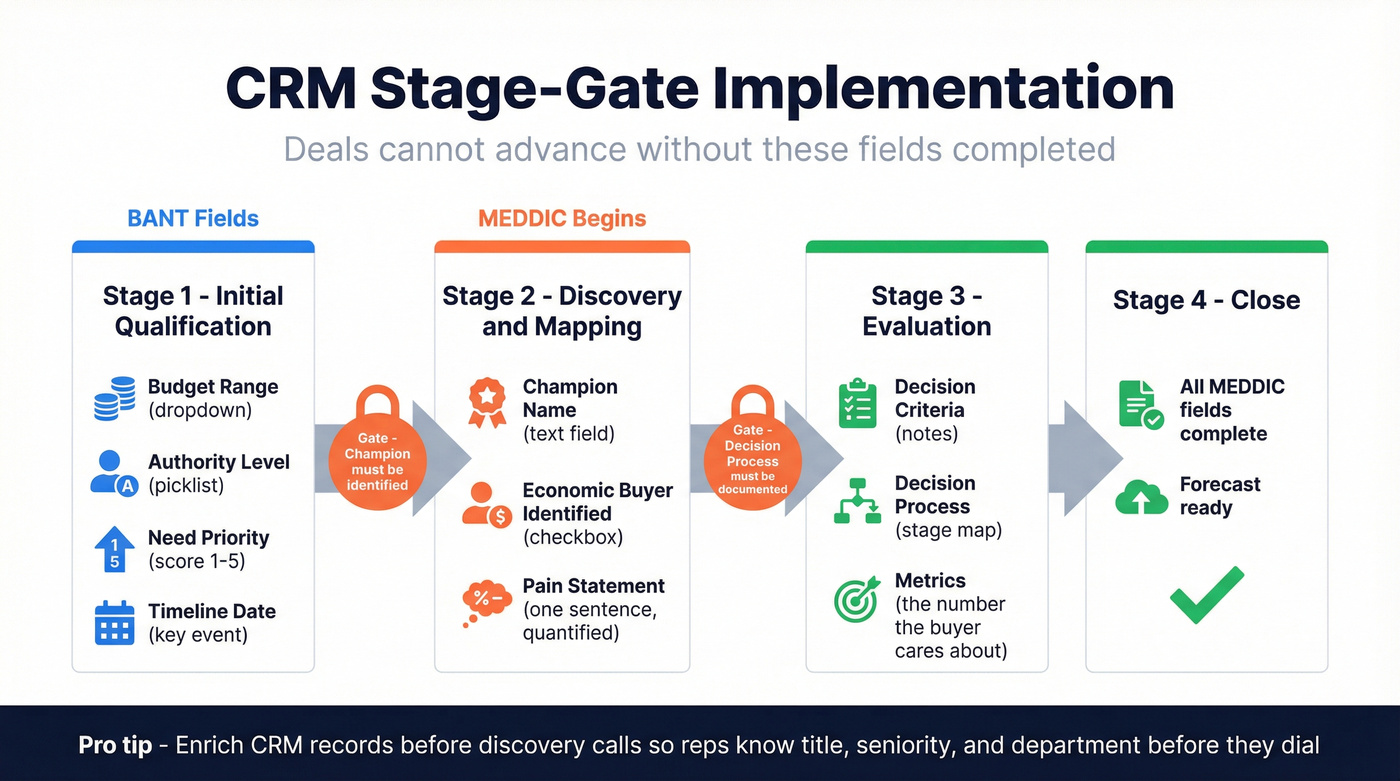
For BANT:
- Budget Range - dropdown: <$10K / $10-25K / $25-50K / $50K+
- Authority Level - picklist: Decision Maker / Influencer / End User
- Need Priority - score 1-5
- Timeline Date - date field tied to a key event
For MEDDIC:
- Champion Name - text field. If it's blank, the deal isn't real.
- Economic Buyer Identified - checkbox
- Decision Criteria - notes field
- Decision Process - notes field with stage mapping
- Pain Statement - one sentence, quantified
- Metrics - the number the buyer cares about
Set stage-gate logic: a deal can't move past Stage 2 without a Champion identified, and it can't move past Stage 3 without Decision Process documented. This is where MEDDIC transforms from theory into forecast accuracy. Enrich CRM records before discovery calls so reps know the prospect's title, seniority, and department before they dial.
If you want a deeper operational rollout, use a sales process doc and a pipeline predictability cadence so managers inspect the same fields every week.
Other Frameworks Worth Knowing
BANT isn't the only lightweight option. If your team finds the budget-first approach too aggressive or too shallow, several alternatives address those gaps without jumping straight to MEDDIC's complexity.
SPICED (Situation, Pain, Impact, Critical Event, Decision) was developed by Winning by Design for SaaS and recurring-revenue models. It emphasizes tying pain to measurable impact and anchoring the deal to a trigger date. Winning by Design claims SPICED drives 78% more ARR - that's a vendor number, so take it accordingly - but the framework's consultative approach genuinely fits subscription businesses where expansion revenue matters as much as the initial close. The quick mental model: BANT is simple but may miss nuance, MEDDIC goes deep but requires heavy information gathering, and SPICED sits in between with stronger empathy for the buyer's situation.
CHAMP (Challenges, Authority, Money, Prioritization) is BANT reordered to lead with the buyer's challenges instead of your budget question. It's a better fit for mid-market teams that find opening with "what's your budget?" too aggressive. Same DNA, friendlier sequencing.
PACTT (Pain, Authority, Consequence, Target Profile, Timing) takes a similar challenge-first approach but adds Consequence - the cost of inaction - and Target Profile to ensure reps are prospecting the right accounts in the first place. Skip PACTT if your team already has strong ICP definitions baked into your prospecting workflow; the Target Profile step will feel redundant.
If you're standardizing qualification across inbound and outbound, align this with your lead qualification rules and account qualification criteria so reps don't argue about what "qualified" means.
FAQ
Is BANT outdated?
No. 52% of salespeople still find it reliable for qualifying prospects. BANT is outdated for complex enterprise deals with multiple stakeholders - not for high-velocity SMB motions where speed matters more than depth. If your deals close in under 60 days with one signer, BANT works fine in 2026.
Can you use BANT and MEDDIC together?
Yes, and most experienced sellers already do. Use BANT on the first call to qualify in or out quickly, then switch to MEDDIC for deal progression on anything over $50K ACV. They aren't competitors; they operate at different stages of the sales cycle.
What's the difference between MEDDIC and MEDDPICC?
MEDDPICC adds Paper Process (legal/procurement steps) and Competition (rival vendors in the evaluation). Use MEDDPICC for enterprise deals over $100K ACV where procurement involvement and competitive bake-offs are standard.
Which framework improves forecast accuracy?
MEDDIC. Its structured approach to mapping decision criteria, economic buyers, and champions gives managers visibility into deal health - not just rep optimism. Deals with an identified Champion and documented Decision Process close at significantly higher rates because every deal has documented evidence, not gut feeling.
How do you ensure qualification data stays accurate?
Start upstream by verifying contact data before discovery calls so reps actually reach the right stakeholders. Bad data makes any framework useless - you can't run MEDDIC on a contact who left the company three months ago.