

Best CRM for Sales Management in 2026 (Top 10)
Your forecast was off by 40% last quarter. Not because your reps can't sell - because half the contacts in your pipeline had changed jobs, and nobody noticed until the deals went dark. Choosing the right CRM for sales management starts with an uncomfortable truth: the biggest problem isn't which platform you pick. It's whether the data inside it is any good.
Every CRM on this list gets evaluated through that lens - features, price, and how well it actually keeps your pipeline honest. For every $1 spent on CRM, companies average $8.71 in return. But only if reps use the thing, and only if the data's accurate.
Quick Recommendations by Use Case
| Use Case | Pick | Starting Price |
|---|---|---|
| Best free CRM | HubSpot Smart CRM | $0 |
| Best for pipeline-focused teams | Pipedrive | $14/seat/mo |
| Best for enterprise (50+ reps) | Salesforce Sales Cloud | $25/user/mo |
| Best lightweight AI CRM | Freshsales | $9/user/mo |
| Best for high-velocity calling | Close | $35/seat/mo |
| Best for Google Workspace teams | Copper | $9/seat/mo |
Our Picks at a Glance
| Tool | Best For | Starting Price | Free Tier | G2 Rating |
|---|---|---|---|---|
| HubSpot Smart CRM | Free CRM | $0 | Yes | 4.4/5 |
| Pipedrive | Pipeline-focused teams | $14/seat/mo | No | 4.3/5 |
| Salesforce Sales Cloud | Enterprise (50+ reps) | $25/user/mo | No | 4.4/5 |
| monday CRM | monday.com teams | $12/seat/mo | No | 4.6/5 |
| Zoho CRM | Budget all-rounder | $14/user/mo | Yes (3 users) | 4.1/5 |
| Freshsales | Lightweight AI CRM | $9/user/mo | Yes (3 users) | 4.5/5 |
| Close | High-velocity calling | $35/seat/mo | No | N/A |
| Less Annoying CRM | Solo operators | $15/user/mo | No | 4.9/5 |
| Copper | Google Workspace teams | $9/seat/mo | No | N/A |
What Sales Managers Actually Need
Most CRM feature lists are written for marketers or support teams. Here's what separates a useful sales management platform from an expensive address book.
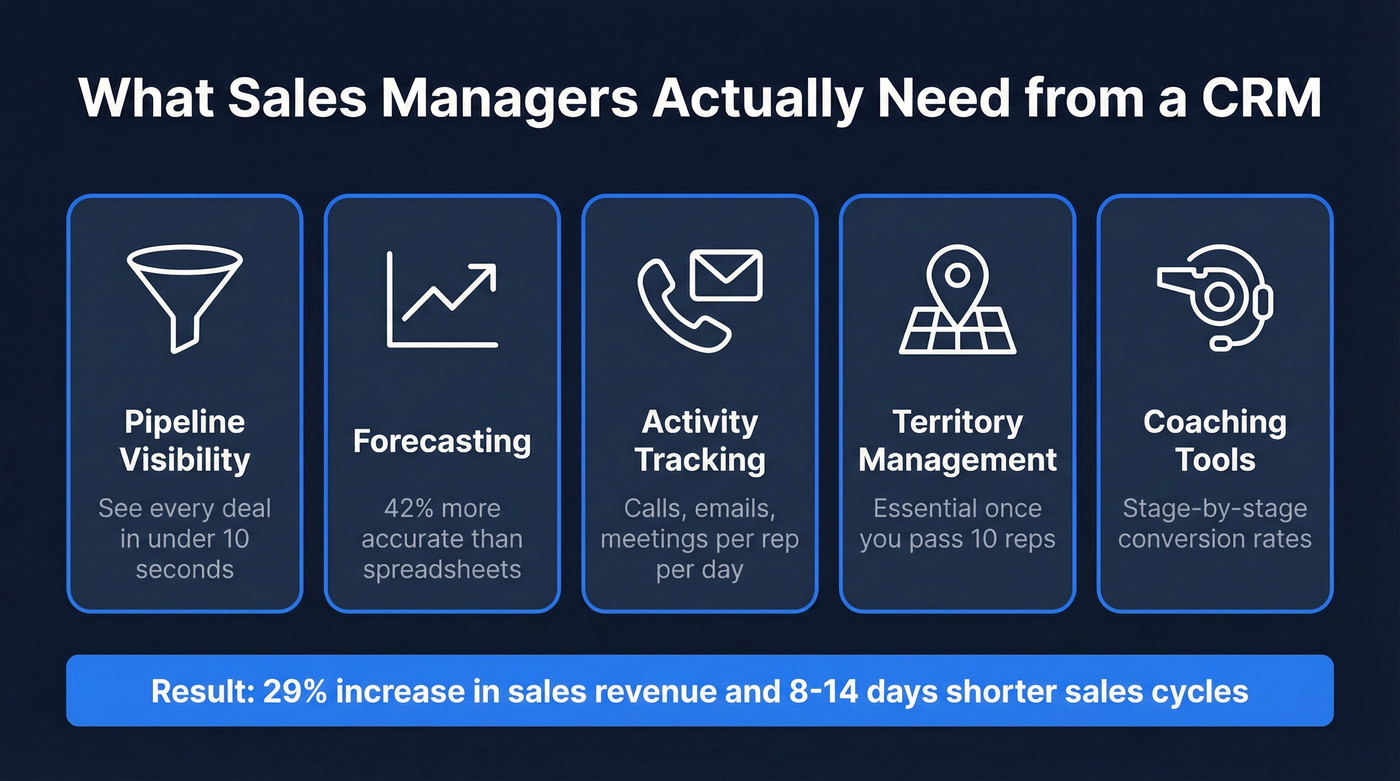
Pipeline visibility. A single view showing every deal by stage, owner, and expected close date. If you can't see your pipeline in under 10 seconds, the CRM is failing you.
Forecasting. CRM-driven forecasting delivers a 42% improvement in accuracy over spreadsheet guessing. Weighted pipeline, commit categories, and AI-assisted predictions are table stakes in 2026. (If you want to go deeper, see forecast accuracy benchmarks and fixes.)
Activity tracking. Calls logged, emails sent, meetings booked - per rep, per day. This is how you coach. Without reliable activity data, you're managing by vibes.
Quota and territory management. Once you're past 10 reps, you need rules for who owns what. The platform should handle territory assignment and quota rollups without a spreadsheet sidecar.
Coaching tools. Call recordings, deal inspection, and stage-by-stage conversion rates. The best sales managers use CRM data to coach specific behaviors, not just review numbers.
The payoff is real: companies that implement CRM properly see a 29% increase in sales revenue and shorten sales cycles by 8-14 days. That's how the right system improves outcomes across the entire org - not just for individual reps.
Top 10 CRM Tools for Sales Teams
HubSpot Smart CRM - Best Free CRM
Use this if: You're a startup or small team that needs a real sales management platform without spending a dollar. HubSpot's free plan is genuinely generous - pipeline management, contact management, email tracking, and basic reporting. (If you're comparing platforms, our HubSpot vs Salesforce breakdown is a good next read.)
Skip this if: You need advanced reporting, custom objects, or predictive lead scoring without paying enterprise prices. Paid plans start at $9/seat/mo, which is fine. But Sales Hub Professional jumps to $100/user/mo with a mandatory $1,500 onboarding fee, and Sales Hub Enterprise hits $150/user/mo with the same onboarding requirement. That escalation catches a lot of growing teams off guard.
The free tier is a brilliant wedge. Just go in knowing that HubSpot's business model is designed to make you upgrade - and budget accordingly.
Pipedrive - Best for Pipeline-Focused Teams
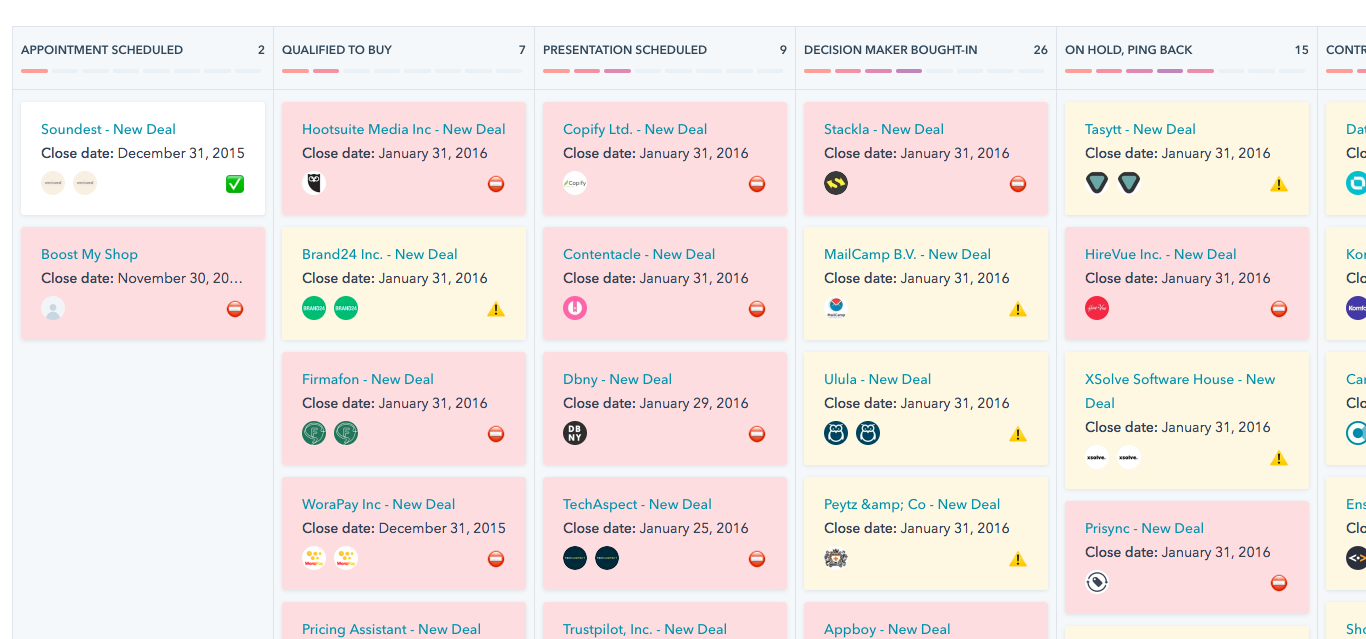
Pipeline management is Pipedrive's entire identity, and nothing at this price point does it better. The visual deal tracking with drag-and-drop simplicity is the reason reps adopt it fast compared to heavier platforms. (For more options in this category, see our guide to Pipedrive alternatives.)
The 2025 plan restructure renamed all four tiers: Essential became Lite ($14/seat/mo), Advanced became Growth ($39), Professional/Power became Premium ($59), and Enterprise became Ultimate ($79) - all billed annually. Growth adds forecast views and forecast reports, and Premium includes LeadBooster. The 14-day free trial doesn't require a credit card.
Where Pipedrive falls short is depth in advanced reporting and marketing automation. You'll likely get more features from alternatives at the same price. But if pipeline visibility is your top priority and you want reps actually using the tool within a day of setup, Pipedrive is the answer.

Salesforce Sales Cloud - Best for Enterprise Teams
Salesforce is the most powerful sales CRM on the market. It's also the most expensive mistake small teams make. (If you're weighing fit, this Pipedrive vs Salesforce comparison helps clarify the tradeoffs.)
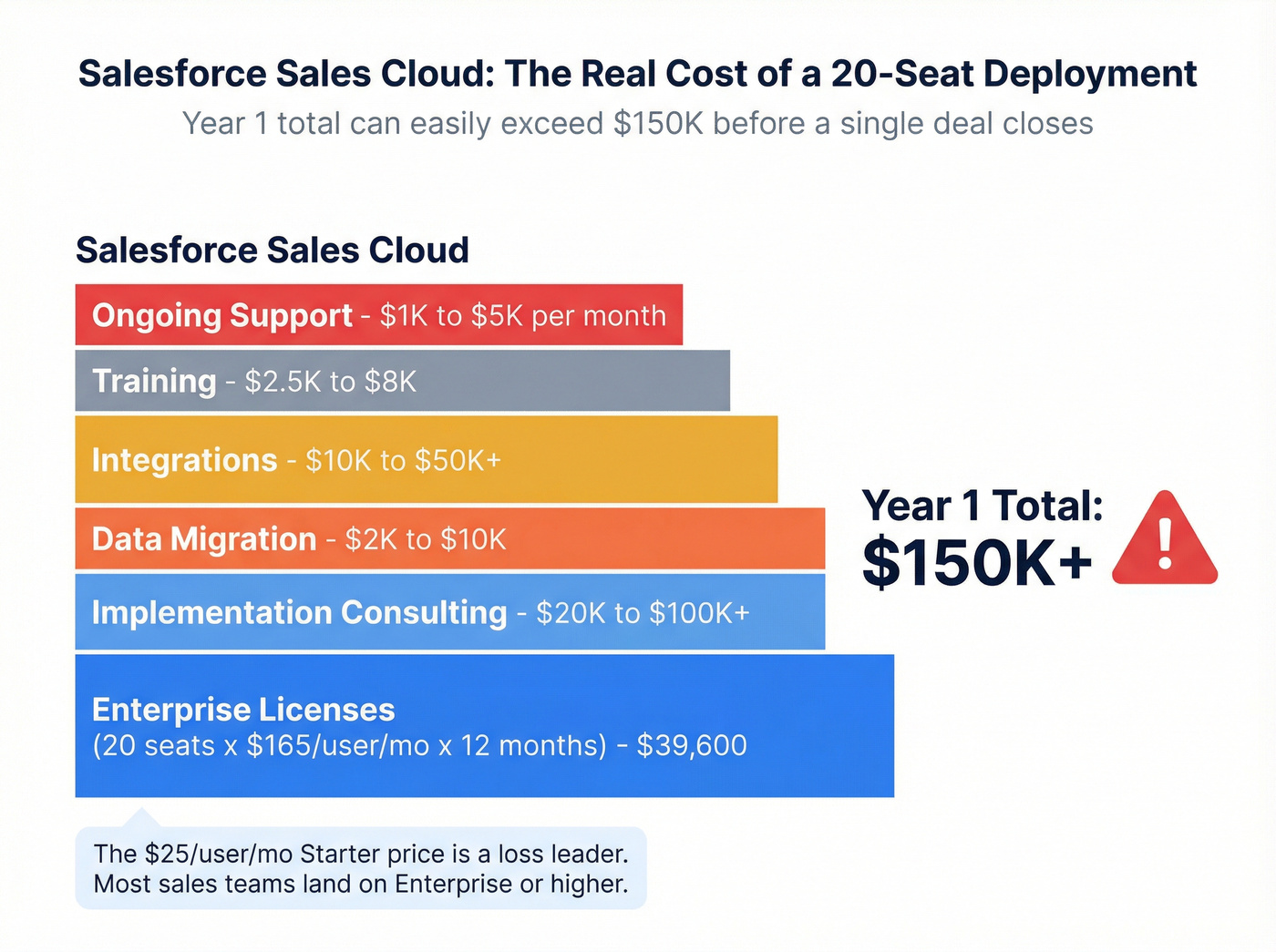
List pricing starts at $25/user/mo for Starter Suite, but most sales orgs land on Enterprise at $165/user/mo or Unlimited at $330/user/mo. The Agentforce 1 Sales tier hits $550/user/mo. Those are just license costs.
A consulting firm will charge $20K-$100K+ to set it up properly. Add data migration ($2K-$10K), integrations ($10K-$50K+), training ($2.5K-$8K), and ongoing support ($1K-$5K/month). A 20-seat Enterprise deployment can easily run $150K+ in year one before a single deal closes.
Here's the thing: Salesforce complexity is a common complaint, and it's earned. Below 50 reps, you're paying for complexity you don't need. Above 50, with a dedicated RevOps team and multi-product lines, nothing else matches its territory management, custom objects, and ecosystem depth. G2 rating: 4.4/5.
monday CRM - Best for monday.com Teams
monday CRM makes the most sense if your company already lives inside monday.com for project management. At $12/seat/mo with a 14-day trial, it's affordable, and the G2 rating of 4.6/5 reflects genuine user satisfaction. The interface is colorful and intuitive - less "enterprise software," more "tool your reps will actually open."
Forecasting, territory management, and advanced automation lag behind Pipedrive and HubSpot. It's a great pick when your team values simplicity and already pays for monday. For everyone else, it's a nice-to-have.
Zoho CRM - Budget All-Rounder
Zoho CRM packs an absurd amount of functionality into a budget-friendly package. The free tier supports up to 3 users, and paid plans range from $14 to $65/user/mo. For teams that want a simpler entry point, Bigin by Zoho earned PCMag's Editors' Choice for SMB CRM - it's approachable and low-cost, though it lacks AI features.
The G2 rating (4.1/5) is the lowest on this list, and that reflects a common complaint: the interface feels dated compared to Pipedrive or HubSpot. But feature-for-feature at this price point, nothing else comes close. Zoho's browser-first design means your team can access it from any device without installing anything.
Freshsales - Lightweight AI CRM
Freshsales is the platform for small teams that want AI without the enterprise price tag. The free plan covers up to 3 users, paid plans start at $9/user/mo, and the 21-day trial is one of the longest on this list. Freddy, the built-in AI assistant, handles lead scoring, deal insights, and email suggestions at a fraction of what Salesforce charges for Einstein. (If you're implementing automation, AI CRM data entry automation is worth skimming.)
The catch: the base plan limits you to a single sales pipeline. Running multiple product lines or segments? You'll need to upgrade quickly. G2 sits at 4.5/5, and the "lightweight and simple" positioning is accurate - this tool punches above its weight on AI.
Close - High-Velocity Calling
| Feature | Close | Pipedrive + Dialer Add-on | HubSpot + Calling Integration |
|---|---|---|---|
| Built-in power dialer | Native | Requires add-on | Third-party |
| Email sequences | Native | Growth tier+ | Paid tier+ |
| Starting price | $35/seat/mo | $39/seat/mo + add-ons | $100/user/mo (Sales Hub Pro) |
Close is built for SDR and BDR teams that live on the phone. Built-in calling and email sequences are native - not bolted-on integrations. If your reps make 50+ calls a day, evaluate this one first. (For a broader view, see outbound calling strategy.) The consensus on r/sales is that Close's calling experience is the smoothest of any CRM, and we've found that holds up in practice.
Less Annoying CRM - Solo Operators
One plan. $15/user/mo. No upsells.
Less Annoying CRM earns its 4.9/5 G2 rating - the highest on this list - by being exactly what the name promises. Reporting is limited, but if you're a solo operator or a team of 2-3 who just needs contact management and a simple pipeline, nothing else is this straightforward. The 30-day trial gives you plenty of time to decide.
Copper - Google Workspace Teams
Copper lives inside Gmail. If your team runs on Google Workspace, Copper auto-logs emails, creates contacts from conversations, and eliminates most manual data entry. Plans range from $9 to $99/seat/mo, and the 14-day trial lets you test the Gmail integration before committing. It's a niche pick, but for the right team, it removes more friction than any other option on this list. (If you're evaluating similar tools, check Copper alternatives.)

Half your pipeline going dark because contacts changed jobs? Prospeo refreshes 300M+ profiles every 7 days - not every 6 weeks like most providers. Enrich your CRM with 50+ data points per contact at a 92% match rate, so your reps stop chasing ghosts.
Stop managing a pipeline full of dead data. Enrich it now.
Pricing Comparison
| Tool | Free/Trial | Starting Price | Upper Tier Price | Notable Extra Costs |
|---|---|---|---|---|
| HubSpot | Free forever | $0 | $150/user/mo (Enterprise) | $1,500 onboarding (Pro + Enterprise) |
| Pipedrive | 14-day trial | $14/seat/mo | $79/seat/mo (Ultimate) | Add-ons from $6.67-$41/mo |
| Salesforce | 30-day trial | $25/user/mo | $550/user/mo (Agentforce) | $20K-$100K+ implementation |
| monday CRM | 14-day trial | $12/seat/mo | Not public | None reported |
| Zoho CRM | Free (3 users) | $14/user/mo | $65/user/mo | Add-ons for telephony, analytics |
| Freshsales | Free (3 users) / 21 days | $9/user/mo | Not public | Extra bot sessions at scale |
| Close | 14-day trial | $35/seat/mo | $139/seat/mo (Scale) | Calling credits at volume |
| Less Annoying | 30-day trial | $15/user/mo | $15/user/mo | None |
| Copper | 14-day trial | $9/seat/mo | $99/seat/mo | None reported |
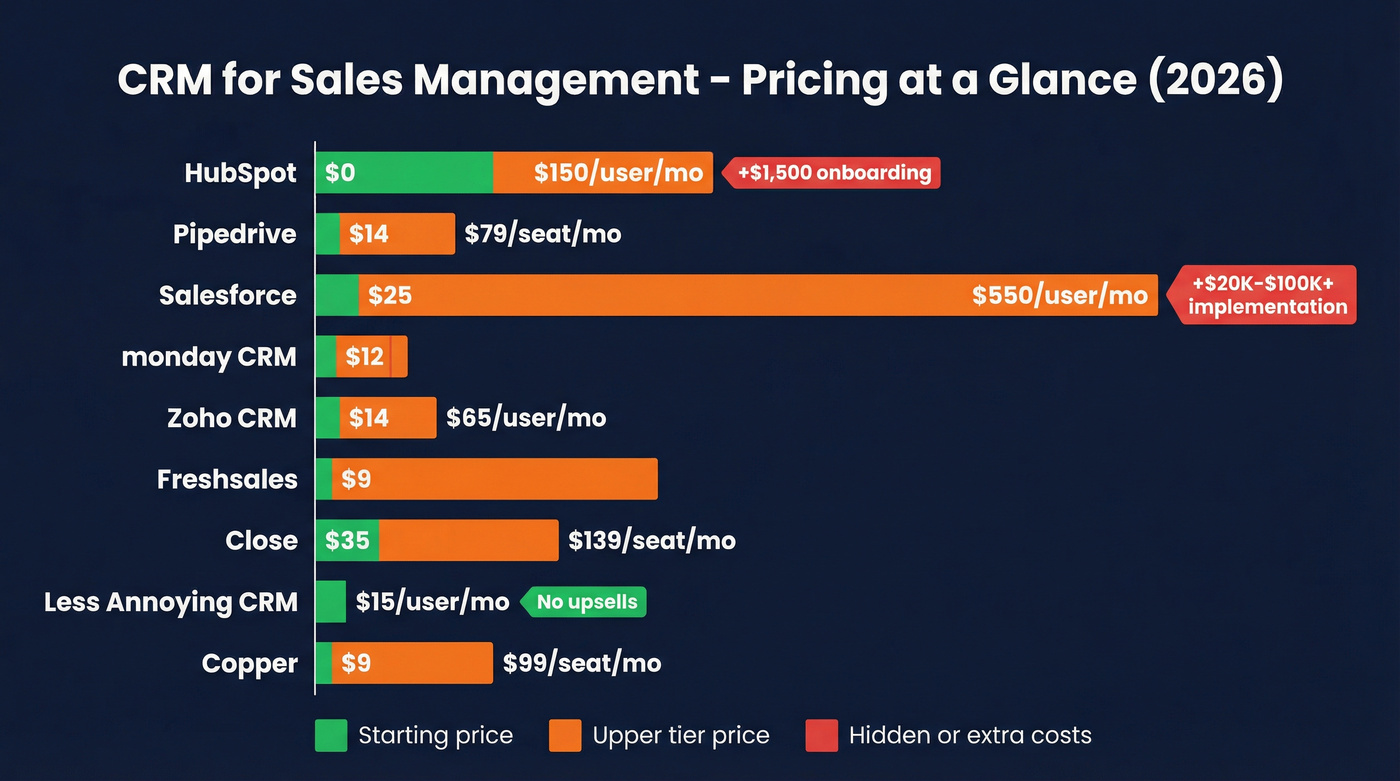
The Salesforce row deserves a second look. That $25/user/mo Starter price is a loss leader - most sales teams end up on Enterprise ($165/user/mo) plus five- to six-figure implementation costs. Budget accordingly.
AI Features That Actually Matter
Let's be honest: 90% of what vendors call "AI" is basic automation with a chatbot skin. The tools that actually move revenue focus on three things - lead scoring, forecasting assistance, and email generation. Not conversational agents that summarize your last meeting. (Related: AI sales analytics is where most teams see real lift.)
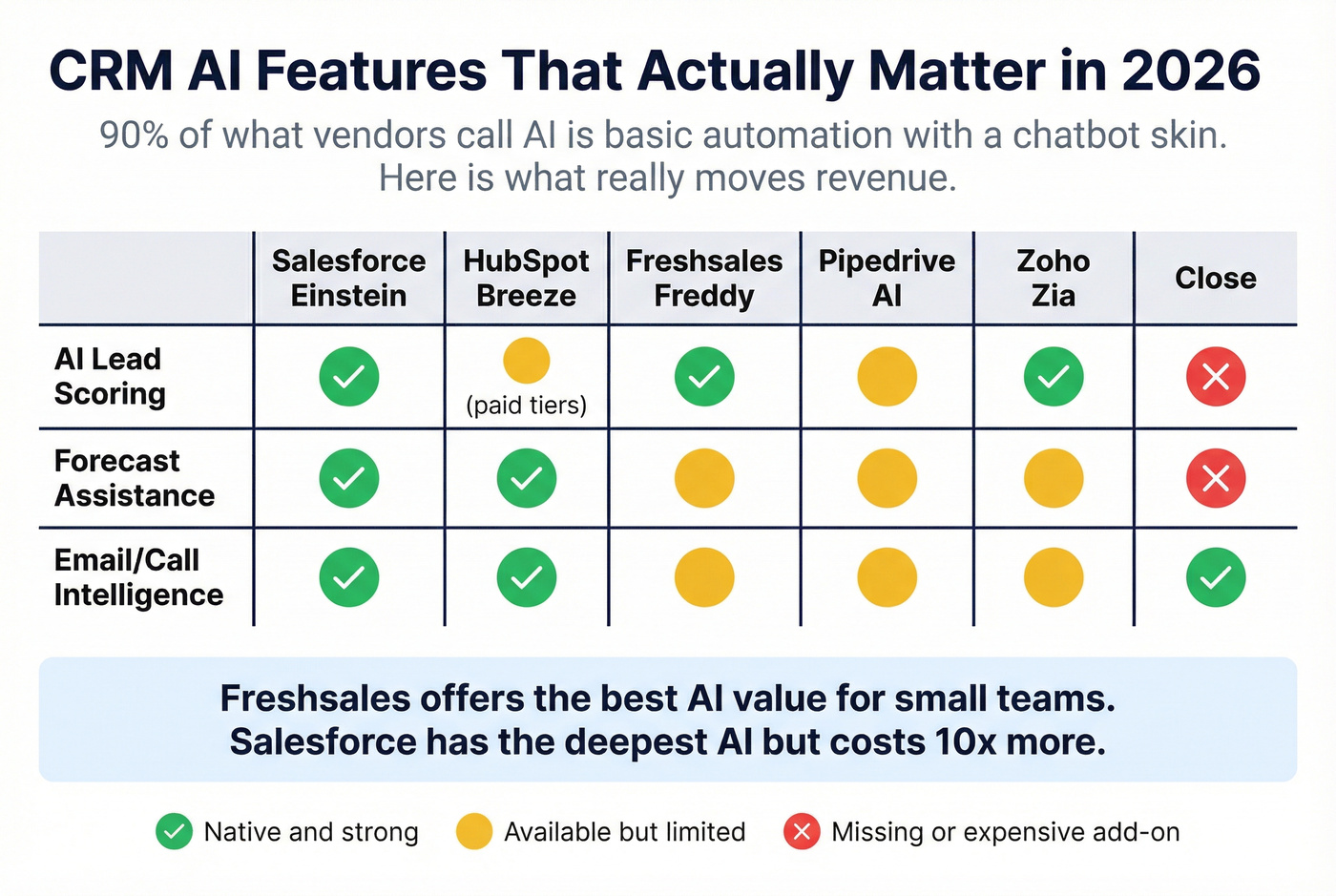
A 2026 benchmark study of 938 B2B companies found that AI-native CRMs deliver 287% ROI compared to 87% for non-AI tools. That's a meaningful gap. But the same study found the average sales stack runs 8.3 tools at $187/rep/month, with 73% of teams reporting tool overlap that wastes $2,340/rep/year.
Our take on agentic AI: Every vendor is pitching autonomous AI agents that "run your sales process." Salesforce's Agentforce 1 Sales tier costs $550/user/mo for it. For mid-market teams in 2026, agentic AI is mostly vaporware - impressive demos, underwhelming production results. The AI features worth paying for today are lead scoring that actually prioritizes your pipeline and forecasting that replaces your spreadsheet model. An AI chatbot that writes mediocre follow-up emails isn't worth a premium.
The Hidden Cost: Your CRM Data
Contact data decays fast. People change jobs, get promoted, switch companies. Within weeks, a meaningful percentage of your CRM records are stale. And only 20% of small business owners use CRM reporting weekly - which means bad data sits unnoticed until a forecast blows up or a sequence bounces 30%. (If you want the benchmarks and decay curves, read B2B contact data decay.)
This is where a data enrichment layer pays for itself. Prospeo's 7-day refresh cycle keeps records current while most providers update every six weeks. Connect your Salesforce or HubSpot instance, and it pushes 50+ data points per contact with a 92% API match rate and an 83% enrichment match rate - plus intent data tracking 15,000 topics via Bombora so you can prioritize accounts actively researching solutions.
The proof is in the numbers. Meritt tripled their pipeline from $100K to $300K per week and dropped bounce rates from 35% to under 4% after adding enrichment to their CRM workflow. Snyk's 50-person AE team grew their sourced pipeline by 180% and cut bounce rates from 35-40% to under 5%.
A $14/month CRM with verified contact data outperforms a $165/month platform full of dead emails. The CRM is the container. The data is the product.

CRM Mistakes That Kill Adoption
The most common failure has nothing to do with features - it's capturing too many inputs at launch. Start with 5-7 required fields. You can always add more later. You can't undo the damage of reps abandoning the system because every deal update takes 10 minutes.
A close second: skipping change management entirely. A rollout without training, an exec sponsor, and designated power users will fail. Budget for adoption, not just licenses.
Beyond those two killers, watch for these:
- No mobile access. 73% of people use personal smartphones for work. If your platform doesn't have a functional mobile app, reps will log activities "later" - which means never.
- No defined success metrics. What does "good usage" look like? Define it before launch: activities logged per rep, pipeline coverage ratio, data completeness percentage. (A sales management dashboard helps make this measurable.)
- Ignoring data quality. Schedule full data cleanups twice a year at minimum. Pair your system with an enrichment tool that refreshes records automatically. (Use a CRM hygiene checklist so it actually happens.)
- Being too ambitious. Start with pipeline management and activity tracking. Layer in automation, scoring, and advanced reporting after adoption stabilizes. We've seen teams try to launch everything at once and end up with a tool nobody trusts.
How to Choose by Team Size
| Team Size | Recommended CRM | Expected Monthly Cost |
|---|---|---|
| Solo / 1-5 reps | HubSpot Free | $0-$50/mo |
| 5-20 reps | Pipedrive Growth | $200-$900/mo |
| 20-50+ reps | Salesforce Enterprise | $4K+/mo (incl. impl. amortized) |
For small teams, the math is simple: HubSpot's free tier gives you a pipeline tool and basic reporting for zero dollars. As you grow, Pipedrive Growth at $39/seat/mo adds forecasting and sequences without the complexity jump of Salesforce. Either option works well - the key is matching the tool's depth to your team's actual workflow.
For enterprise teams, Salesforce is the right call - but budget $50K+ for year one when you factor in implementation, migration, and training. Regardless of which CRM for sales management you choose, layer in data enrichment from day one. It's the cheapest investment with the highest impact on pipeline accuracy.
No CRM fixes bad data. Prospeo feeds yours with 98% verified emails and 125M+ direct dials - at $0.01 per email. Native integrations with Salesforce and HubSpot mean enrichment runs automatically, not manually.
Give your sales team contacts that actually pick up the phone.
FAQ
What's the best free CRM for sales management?
HubSpot Smart CRM offers the strongest free plan - pipeline management, contact management, email tracking, and basic reporting with no time limit or user cap. For teams that also need verified contact data, pairing HubSpot Free with a data enrichment tool covers both pipeline tracking and data accuracy at zero cost.
How much does a sales CRM actually cost?
SMB tools run $9-$25/user/month. Mid-market platforms like Pipedrive Growth cost $39/seat/month. Enterprise systems like Salesforce range from $165-$330/user/month in licensing alone, plus $20K-$100K+ in implementation. Always budget for total cost of ownership, not just the per-seat license.
Do I need AI features in my CRM?
AI-native CRMs deliver 287% ROI versus 87% for non-AI tools, based on a benchmark of 938 B2B companies. Lead scoring and forecasting are the highest-value AI features. Skip chatbot gimmicks - focus on AI that replaces a separate tool in your stack or saves reps measurable time per day.
How do I keep my CRM data accurate?
Pair your CRM with a data enrichment tool that refreshes contact records automatically - a weekly refresh cycle beats the industry-standard six-week cadence. Schedule full data cleanups twice a year, assign a data quality owner on your RevOps team, and track completeness metrics monthly.
What's the biggest CRM implementation mistake?
Trying to roll out every feature at once. Start with pipeline management and activity tracking - the two capabilities reps use daily. Layer in automation, custom reporting, and advanced workflows after adoption stabilizes, typically 60-90 days post-launch.