

The Best No Bounce Email Checkers for 2026
Your last campaign bounced 4.7%. The ESP flagged your domain, sender reputation tanked, and now you're one bad send from the blacklist. You're staring at 30,000 contacts wondering how many are dead weight.
A no bounce email checker fixes this - but picking the wrong one wastes money and still leaves you exposed. Email databases decay by roughly 25% per year, and the industry benchmark is to keep total bounces below 2%, with top performers targeting hard bounces under 1%. Seven tools are worth your time right now.
Our Picks
Three tools, three use cases - source-level prevention, full deliverability suite, and budget bulk cleaning:
- Prospeo - Best for teams who want emails that arrive pre-verified. 98% accuracy, 7-day refresh, no list cleaning step needed. Starts free.
- ZeroBounce - Best dedicated verification suite with deliverability scoring, spam-trap detection, and data enrichment baked in.
- MillionVerifier - Best for cheap bulk list cleaning at ~$3.70 per 1,000 verifications. Credits never expire.
Side-by-Side Comparison
Every tool on one screen. We evaluated each on accuracy, pricing transparency, catch-all handling, and integration depth.
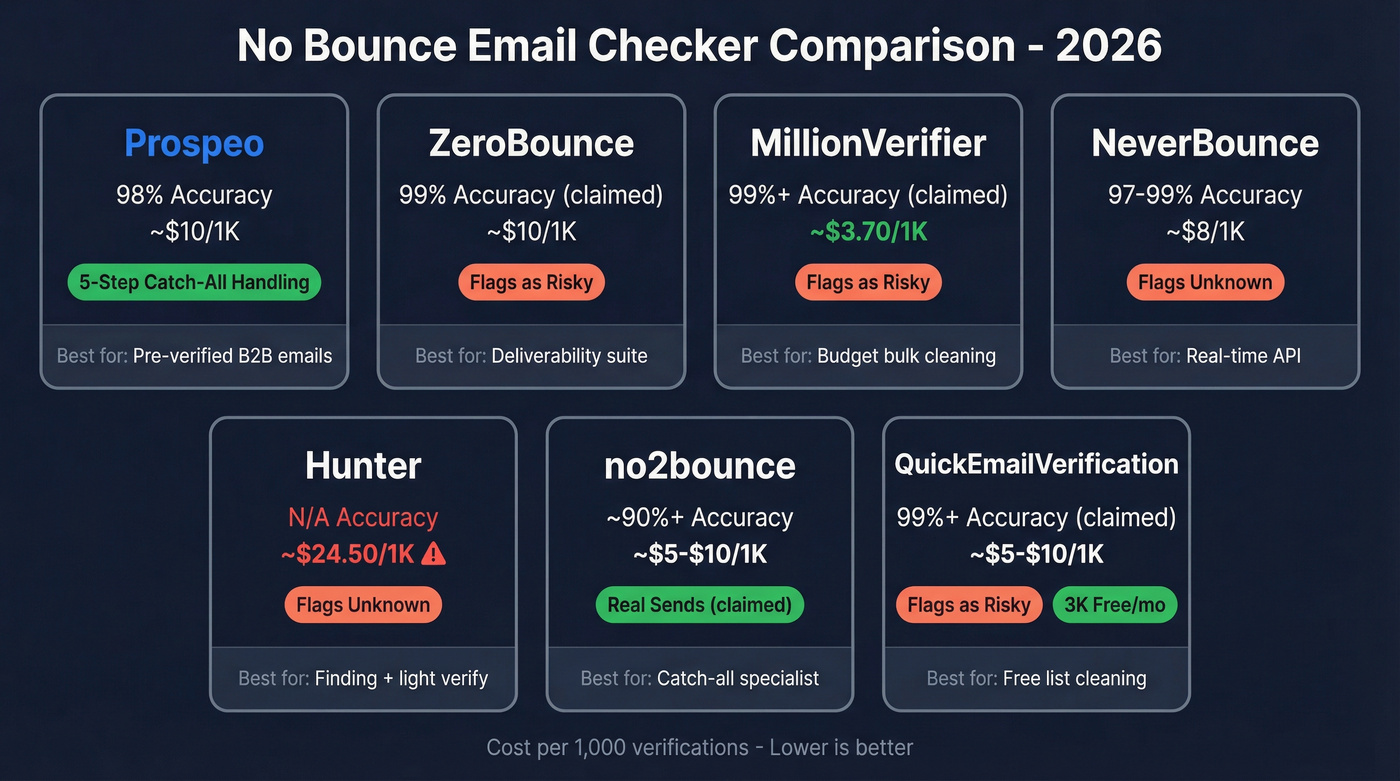
| Tool | Accuracy | Cost/1K | Catch-All | Best For |
|---|---|---|---|---|
| Prospeo | 98% | ~$10 (75 free/mo) | 5-step handling | Pre-verified B2B emails |
| ZeroBounce | 99% (claimed) | ~$10 (100 free) | Flags as risky | Deliverability suite |
| MillionVerifier | 99%+ (claimed) | ~$3.70 | Flags as risky | Budget bulk cleaning |
| NeverBounce | 97-99% | ~$8 (1,000 free credits) | Flags unknown | Real-time API |
| Hunter | N/A | ~$24.50 | Flags unknown | Finding + light verify |
| no2bounce | ~90%+ | Est. ~$5-$10 | Real sends (claimed) | Catch-all specialist |
| QuickEmailVerification | 99%+ (claimed) | Est. ~$5-$10 (3K free/mo) | Flags as risky | Free list cleaning |

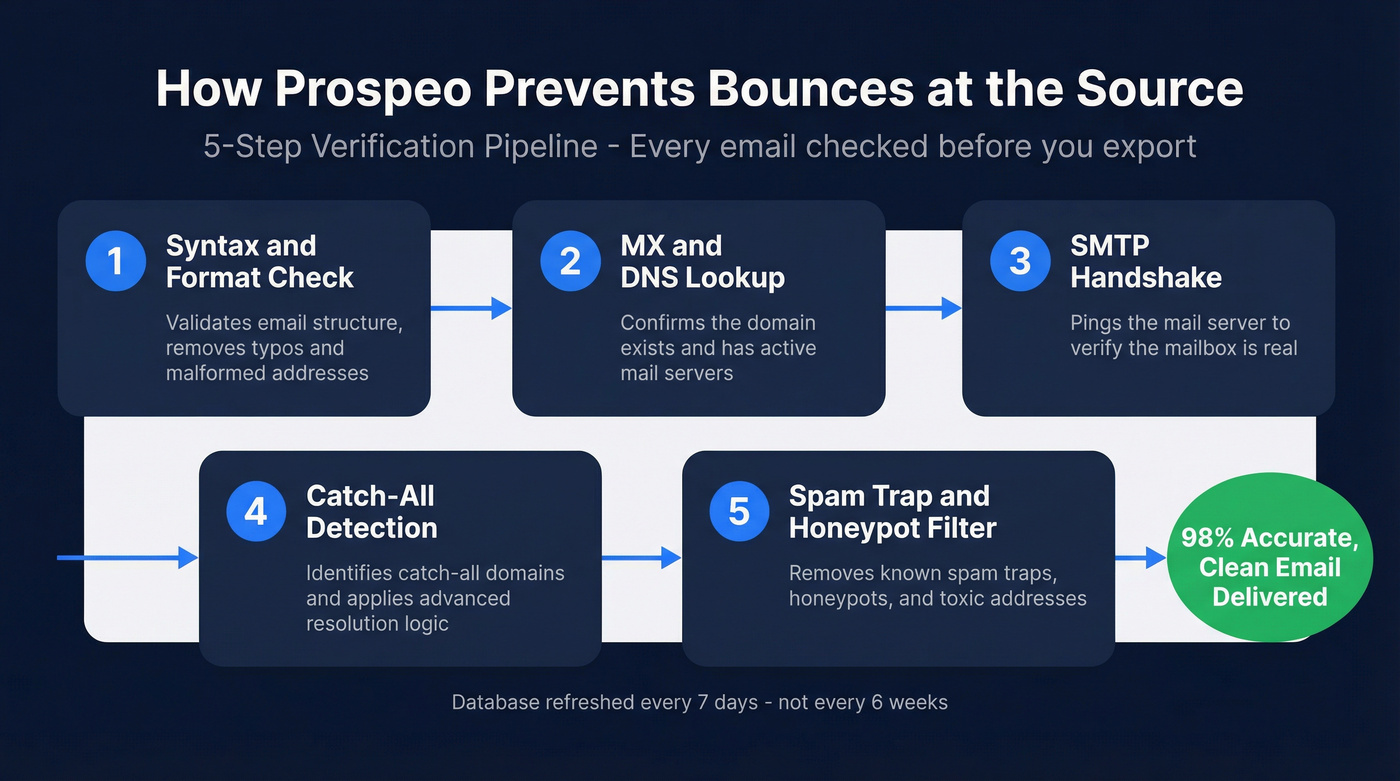
Why clean dirty data when you can start with clean data? Prospeo's 143M+ emails are pre-verified through a 5-step process with catch-all handling, spam-trap removal, and honeypot filtering - refreshed every 7 days, not every 6 weeks. Snyk dropped from 35% bounce to under 5%. Stack Optimize runs under 3% bounce across every client with zero domain flags.
Skip the list cleaner. Get emails that land for $0.01 each.
Top Email Verification Tools Reviewed
Prospeo
Most tools on this list fix the symptom - bad data already sitting in your CRM. Prospeo fixes the cause. Its database of 143M+ verified emails runs through a 5-step verification process with catch-all handling, spam-trap removal, and honeypot filtering before you ever export a contact. You're paying for clean data at the source, not cleaning dirty data after the fact.
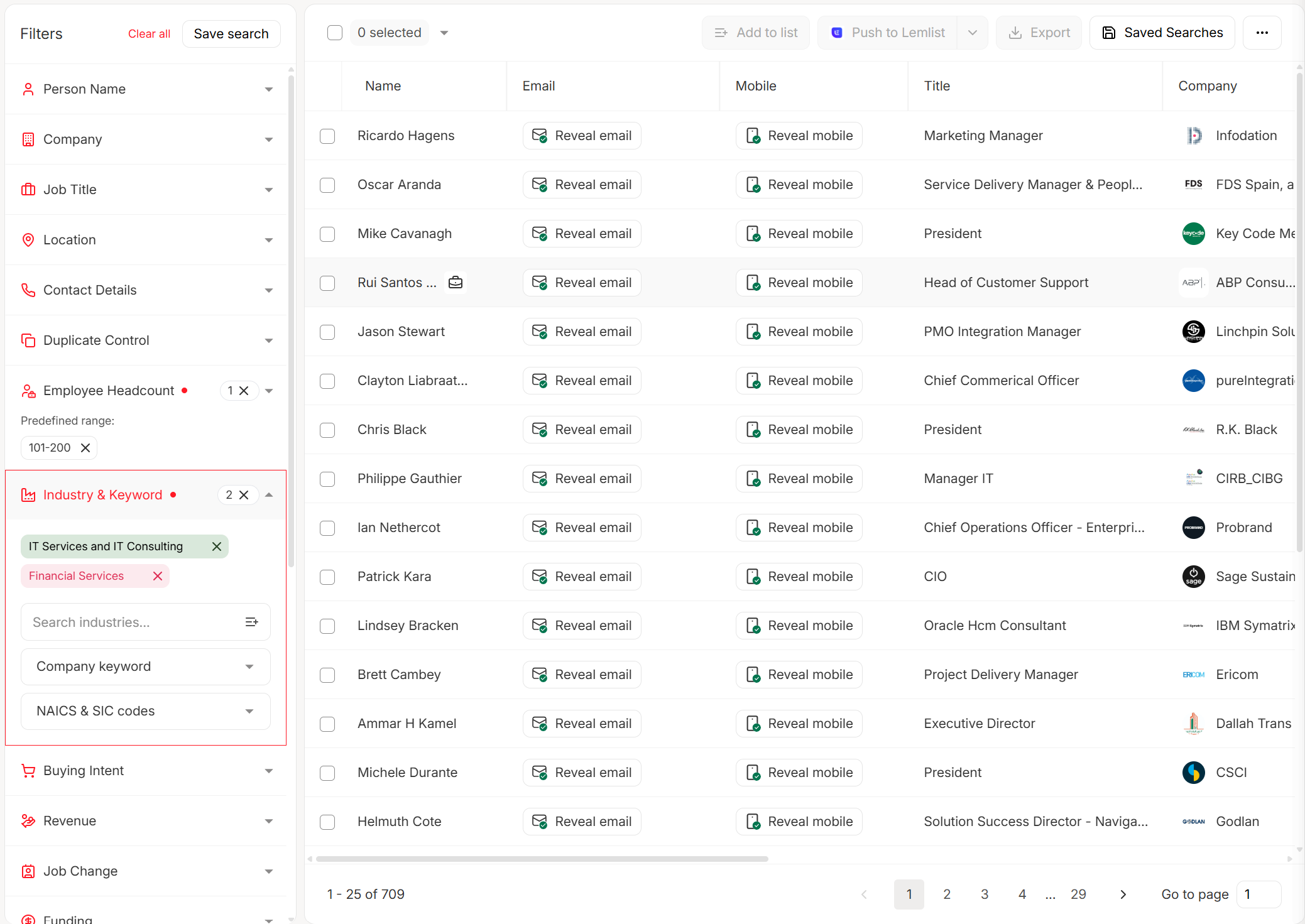
The numbers back this up. Snyk's 50-person AE team went from a 35-40% bounce rate to under 5% after switching, generating 200+ new opportunities per month. Stack Optimize runs under 3% bounce across all clients with zero domain flags. That's what a 7-day data refresh cycle does - while most providers update every six weeks, Prospeo's records stay current enough that a separate cleaning step becomes unnecessary.
If you're building outbound lists, this is also where CRM hygiene and data quality stop being "nice to have" and start being the difference between scaling and getting throttled.
Use this if: you're building B2B prospect lists and want zero-bounce data from the source. At ~$0.01 per email with 75 free emails/month, it's the most cost-effective path to never needing a list cleaner.
Skip this if: you already have a massive legacy list and just need to clean it. Pair with MillionVerifier for that workflow.
ZeroBounce
ZeroBounce goes beyond pass/fail verification into a full deliverability toolkit. You get spam-trap detection, abuse email flagging, deliverability scoring, and basic data enrichment alongside validation. For marketing teams managing large subscriber lists, that breadth saves you from stitching together three separate tools.
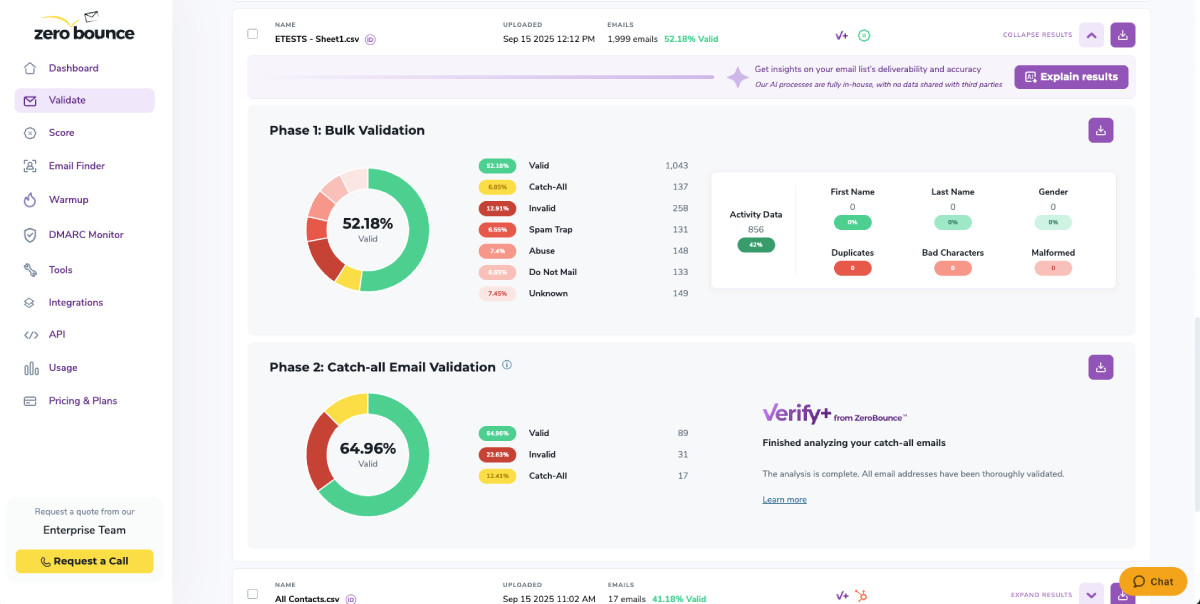
Pricing starts at ~$0.01 per verification with a 2,000-credit minimum ($20). Catch-all addresses get flagged as "risky" rather than resolved - a limitation shared by most tools on this list. The 100 free credits let you test before committing.
Use this if: you need deliverability scoring and enrichment alongside verification. It's the most complete single-tool solution for email marketers.
Skip this if: you just need cheap bulk cleaning. You're paying a premium for features you won't touch.
MillionVerifier
Here's the thing: most teams overpay for email verification by 3-5x. MillionVerifier exists to fix that. At ~$3.70 per 1,000 verifications, it's roughly 3x cheaper than ZeroBounce and nearly 7x cheaper than Hunter. Credits never expire - a surprisingly rare feature that most competitors quietly avoid offering. Their EverClean monitoring service automatically re-verifies your lists on a schedule, catching decay before it hits your campaigns. The consensus in email marketing communities like r/emailmarketing is that MillionVerifier is the go-to for teams on tight budgets, and for good reason.
The tradeoff is clear: you get no catch-all resolution and no deliverability scoring. MillionVerifier flags catch-alls as risky and moves on. If that's a dealbreaker, look elsewhere. If not, nothing else touches it on price.
If you're doing bulk cleanup, pair it with a broader email deliverability checklist so you don't "verify your way out" of infrastructure issues.
NeverBounce
NeverBounce's real strength isn't bulk list cleaning - it's real-time API verification. If you're running sign-up forms, webinar registrations, or any workflow where emails enter your system one at a time, NeverBounce's API catches bad addresses before they ever hit your database. That single capability makes it worth considering even if you use a different tool for bulk cleaning.
At ~$8 per 1,000 with 1,000 free credits to start, it's priced fairly for mid-market teams. The integration library connects natively to most ESPs and CRMs, and they offer multiple implementation paths - REST API, JavaScript widget for front-end form validation, and webhook callbacks for async workflows. Where it falls short is catch-all handling: those get flagged as "unknown" and left for you to decide.
If you're verifying at the point of collection, it's worth aligning this with your email sending infrastructure so form-level validation and sending reputation move together.
Hunter
The math on Hunter tells you everything. The Starter plan runs $49/month for 2,000 credits. Most teams split credits between finding and verifying, which pushes the effective verification cost to ~$24.50 per 1,000 - that's 3-6x more expensive than dedicated verifiers. Even burning every credit on verification alone, you'd still pay ~$12.25 per 1,000.
Use Hunter for finding emails. Use something else for cleaning lists. That's not a knock on the product - it's genuinely excellent at email discovery. But treating it as a bounce prevention tool is like using a Swiss Army knife to chop firewood.
If you're primarily in discovery mode, you'll get more leverage from a dedicated email hunter workflow than trying to force Hunter into bulk verification.
no2bounce
no2bounce occupies a narrow but real niche: catch-all email verification. Their approach uses "real sends" to test whether a catch-all mailbox actually exists - something most verifiers won't attempt. They've validated 500M+ emails to date, and Trustpilot reviews sit at 4.5/5 with 23 reviews, with users reporting ~90%+ accuracy on catch-all addresses.
Pricing isn't published transparently, but expect roughly $5-$10 per 1,000 verifications based on their positioning. The "real sends" methodology raises deliverability questions of its own - we haven't tested this one deeply enough to recommend it with full confidence, but it's on our radar for teams drowning in catch-all domains.
QuickEmailVerification
The free option. QuickEmailVerification hands you 3,000 credits per month at no cost - enough to clean a small list every month without spending a dollar. It includes disposable email detection, basic API access for form-level validation, and standard MX/SMTP checks. Paid plans land around $5-$10 per 1,000 for higher volume. Not a long-term solution for serious scale, but unbeatable for one-off cleanups and startups watching every dollar.
If you're comparing free tiers, this pairs well with a broader email verification free breakdown so you know what "free" actually includes.
Honorable mentions: Verifalia offers a developer-friendly API with detailed result codes and a generous free tier. Email Hippo provides real-time and bulk verification with strong UK/EU coverage. Neither made the main list, but both are solid options worth evaluating.
Hard Bounces vs. Soft Bounces
Hard bounce - permanent failure. The address doesn't exist, the domain is dead, or the server has explicitly blocked you. Average hard bounce rate sits around 0.21%. Remove immediately. No second chances.
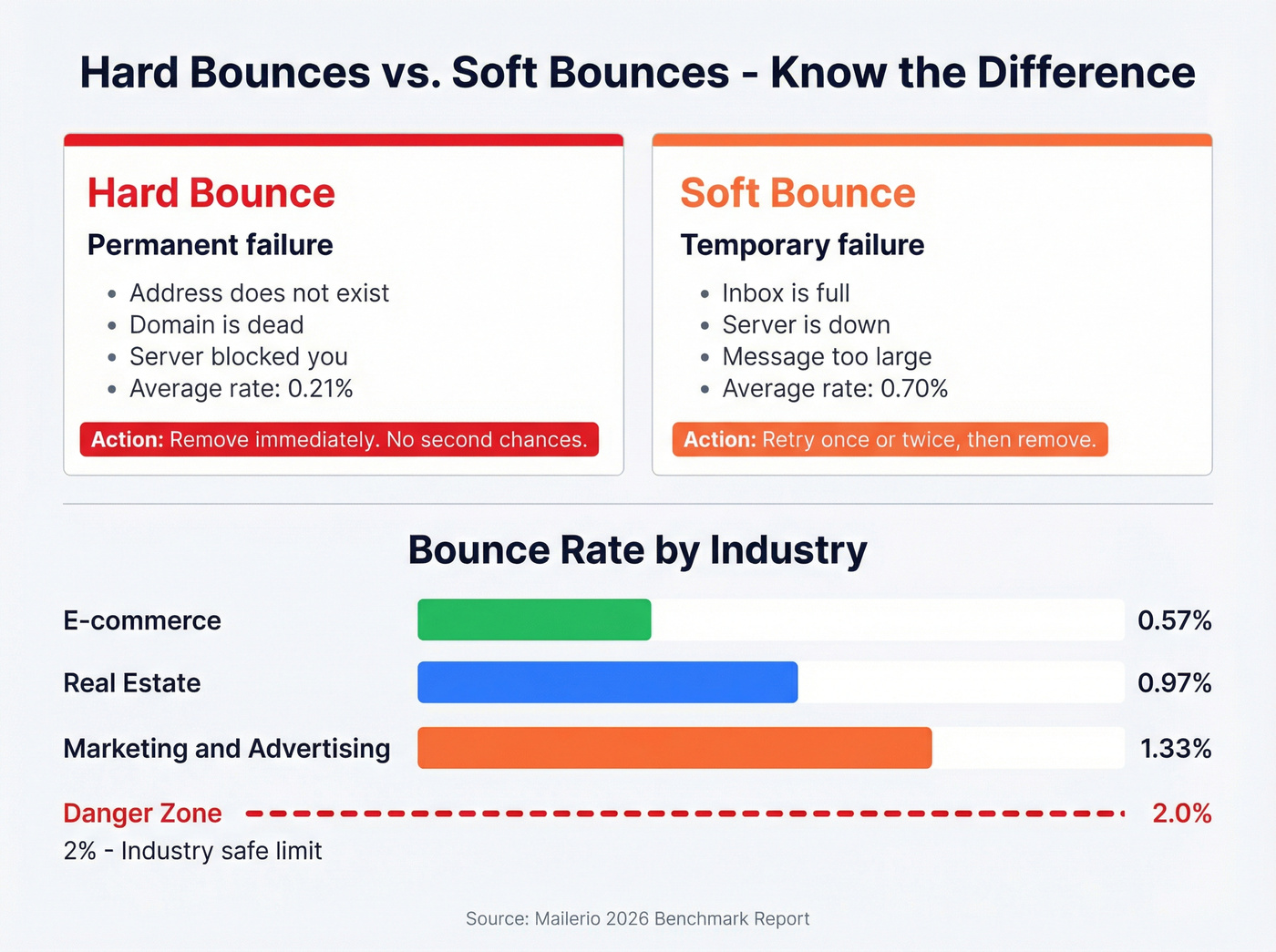
Soft bounce - temporary failure. Full inbox, server downtime, message too large. Average soft bounce rate is ~0.70%. Retry once or twice, then remove if it keeps bouncing.
For context, benchmarks vary by industry: e-commerce averages 0.57% total bounce, real estate runs 0.97%, and marketing/advertising sits at 1.33%. If you're above your industry's average, your sender reputation is climbing toward the blacklist with every send.
If you want the deeper definitions and remediation steps, see our guide on hard bounce.
Why Prevention Beats List Cleaning
Every tool on this list fixes the symptom. The smarter move is fixing the cause.
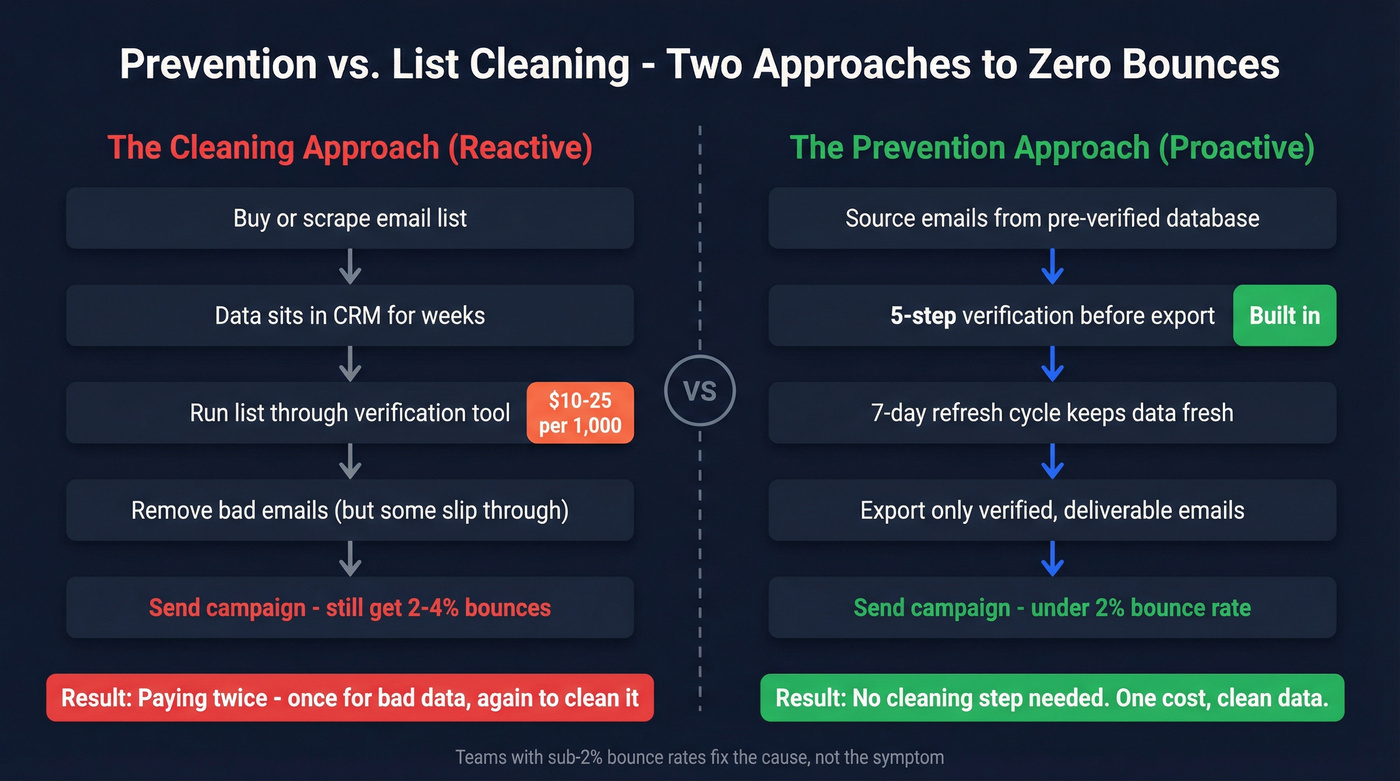
Let's be honest - if your data source delivers stale emails last verified six weeks ago, you'll always need a cleaning step. People change jobs, domains expire, inboxes get deactivated. The teams we've seen with consistently sub-2% bounce rates aren't the ones with the best verifier. They're the ones starting with better data, verifying at the point of collection, refreshing weekly, and delivering only addresses that pass multi-step checks before they ever reach a CRM.
Prevention beats cure every time. That's the core argument for choosing a no bounce email checker that works upstream rather than downstream - and it's the reason we built our own verification into the data source itself rather than bolting it on after the fact.
If you're scaling volume, combine verification with how to prevent email blacklisting and a real email deliverability guide so you don't fix bounces while ignoring reputation.
Every bounced email chips away at your sender reputation. Prospeo eliminates that risk at the source - 98% email accuracy, 7-day data refresh, and a proprietary 5-step verification pipeline that catches dead addresses before they ever reach your CRM. No separate cleaning tool. No wasted credits on bad data.
Stop paying twice - once for bad data, again to clean it.
FAQ
How does an email bounce checker actually work?
Most tools run syntax validation, MX record lookup, and an SMTP handshake to test whether a mailbox exists - all without sending an actual message. Better tools add catch-all detection, spam-trap filtering, and disposable email flagging on top. Implementation typically happens via REST API, JavaScript widget for form validation, or bulk CSV upload for list cleaning.
How often should I clean my email list?
At minimum, quarterly. Email databases decay by roughly 25% per year, so monthly cleaning is safer for weekly senders. Teams running daily outbound should verify in real time via API or use a source that refreshes records every 7 days automatically.
Can any tool guarantee zero bounces?
No. Catch-all domains make 100% accuracy impossible because the server accepts everything regardless of whether a specific mailbox exists. The best approach is verifying at the point of collection and refreshing frequently. A residual bounce rate of 1-2% is normal and expected across any verification tool on the market.
What's a good free email verification option?
QuickEmailVerification offers 3,000 free credits per month for basic list cleaning. Prospeo provides 75 free verified emails monthly with full 5-step verification and catch-all handling included - a better fit for teams running real outbound campaigns who want pre-verified data rather than post-hoc cleaning.