

Company Introduction Email to Client: 7 Templates (2026)
Why Most Intro Emails Fail
The biggest reason a company introduction email to client fails isn't the writing - it's that the email never reached the inbox. Belkins analyzed 16.5M cold emails across 93 business domains throughout 2024 and found the average reply rate sitting at just 5.8%, down 15% from the year before.
That's brutal. And before you rewrite your subject line for the tenth time, make sure the fundamentals are covered.
What You Need (Quick Version)
- Keep it under 150 words with one clear CTA. Emails with a single ask get 371% more clicks than those with multiple competing requests.
- Send on Thursday - and test 8-11 PM. Thursday is the best-performing day at a 6.87% reply rate, and 8-11 PM is the strongest time window, peaking at 6.52%.
- Verify every email address before sending. A bounce rate above 5% risks your sender reputation. We've seen teams tank an entire domain with a single unverified list.
Anatomy of an Intro Email That Works
47% of recipients decide whether to open based on the subject line alone, and 69% will mark an email as spam based on the subject line without reading a word. Here's what separates the emails that get replies from the ones that get deleted.
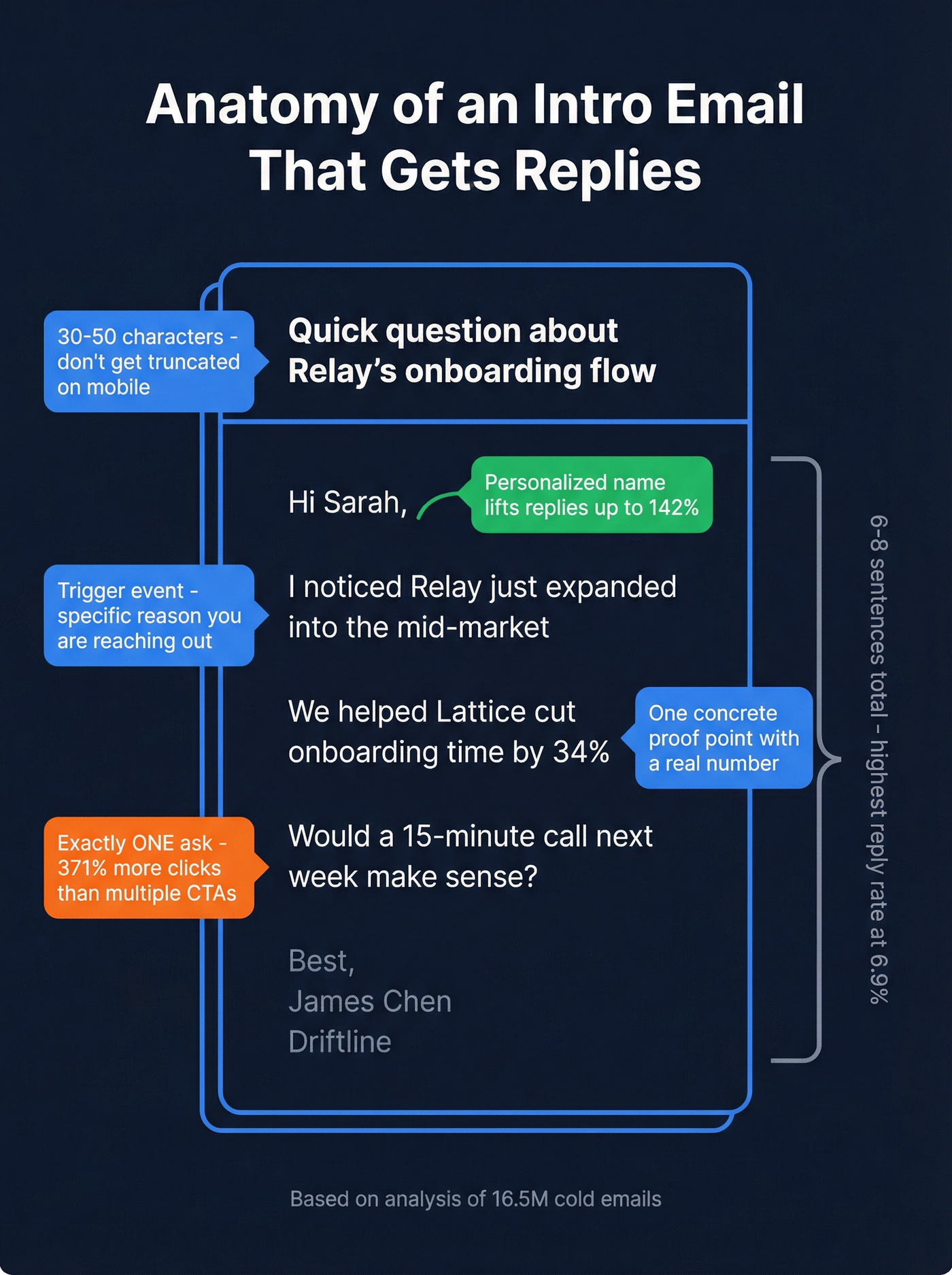
Do this: Write subject lines between 30-50 characters so they don't get truncated on mobile. Personalized greetings alone can lift replies up to 142%, so "Hi [Name]" beats "Dear Sir/Madam" every time. Open with a specific reason you're reaching out - a trigger event, a mutual connection, a relevant metric. Keep the body to 6-8 sentences, which produces the highest reply rates at 6.9%. End with exactly one question or one ask.
Skip this: "I hope this email finds you well" is a dead opener for cold outreach - it signals the recipient doesn't know you, which is the opposite of what you want. Don't stack multiple CTAs. Don't write paragraphs longer than two sentences. And remember that 60%+ of emails are opened on mobile - if your formatting breaks on a phone screen, nothing else matters.
7 Templates That Get Replies
1. Cold Outreach to a Prospect
Subject: Quick question about [Company]'s onboarding flow
Hi Sarah,
I noticed Relay just expanded into the mid-market - congrats on the Series B. We helped Lattice cut their onboarding time by 34% after a similar move, and I think there's a fit.
Would a 15-minute call next week make sense to see if we can help?
Best, James Chen, Driftline
This template works because it's specific, references a real trigger, and asks for one thing. In our experience, specificity beats cleverness every time.
2. Referral Follow-Up
Subject: [Mutual connection's name] suggested I reach out
Hi Marcus,
Elena Voss mentioned you're rethinking your outbound stack and thought we should connect. We build prospecting workflows for teams scaling past 5 SDRs - Elena's team cut their list-building time by 60% last quarter.
Worth a quick chat this week?
Cheers, Priya Sharma
3. New Employee Handoff
Subject: Meet your new account lead, [Name]
Hi [Client Name],
I wanted to introduce [New Employee], who'll be taking over as your account manager starting [Date]. They've spent 4 years in our enterprise team and already know your account inside out.
Please CC [New Employee] on future emails regarding [Project]. I'll stay looped in through the transition.
Best, [Your Name]
The CC instruction pattern prevents messages from falling through the cracks during handoffs - a small detail that saves real headaches.
4. Post-Event Follow-Up
Subject: Good meeting you at [Event Name]
Hi [Name], enjoyed our conversation about [specific topic] at [Event]. I'd love to continue that discussion - are you free for a 15-minute call next Tuesday or Wednesday?
Short. Direct. No filler. That's the whole point.
5. Partnership Inquiry
Subject: [Your Company] x [Their Company] - quick idea
Hi [Name], we work with [similar companies] on [specific outcome]. I think there's a natural overlap with what [Their Company] is building. Open to a quick call to explore it?
6. Service or Product Introduction
Subject: Cutting [specific metric] for teams like [Their Company]
Hi [Name], we help [type of company] solve [specific problem]. [One-sentence proof point with a number.] If that's relevant, I'd love to share how - 15 minutes this week?
Use this template when you're reaching out to someone who has no prior relationship with your brand. Lead with the outcome, not your company's backstory - nobody wants to read three paragraphs about your founding story in a cold email.
7. Re-Engagement After Going Quiet
Subject: Still relevant, [Name]?
Hi [Name], we spoke in [Month] about [topic]. I know timing wasn't right then. [One new development or reason to reconnect.] Worth revisiting?

A bounce rate above 5% tanks your domain - and your intro emails never reach the inbox. Prospeo's 5-step verification delivers 98% email accuracy with catch-all handling and spam-trap removal, so every company introduction email you send actually lands.
Stop crafting perfect intro emails for addresses that don't exist.
Choosing the Right Template
Not every business introduction email needs the same approach. If you're sending a cold outreach, template #1 is your starting point. When a mutual contact made the connection, the referral follow-up carries more weight because it borrows trust. For teams that need to share a company profile with client contacts - say, after a trade show or inbound request - the post-event and service introduction templates let you attach a one-pager without the email feeling like a brochure dump.
Let's be honest: most people overthink template selection. Pick the one that matches how the prospect first heard about you, customize the proof point, and send it.
What the Data Says
Reply rate is the only metric that matters for cold outreach. Open rates are noisy - Apple Mail Privacy Protection inflates them, and MailerLite's own analysis confirms real open rates are lower than dashboards show. Focus on replies.
| Metric | Benchmark |
|---|---|
| Avg reply rate | 5.8% (16.5M emails, 2024) |
| Best day | Thursday (6.87%) |
| Best send time | 8-11 PM (peak 6.52%) |
| Optimal length | 6-8 sentences / under 200 words |
| Contacts per company | 1-2 = 7.8% reply |
| Personalized subject lines | 22-36% higher opens |
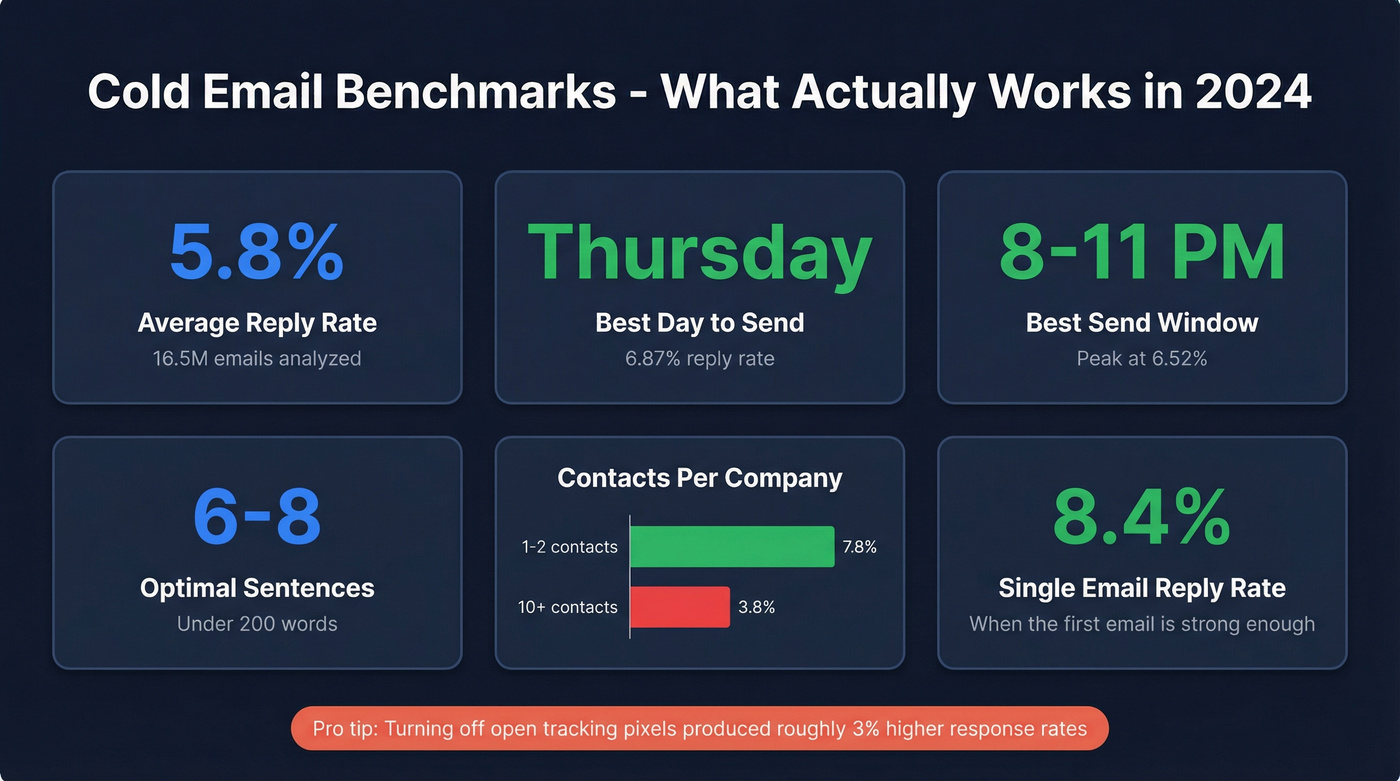
Two numbers jump out. First, emailing 1-2 contacts per company produces a 7.8% reply rate. Blast 10+ contacts at the same company and that drops to 3.8%. Precision beats volume every time.
Second, single-email campaigns had the highest reply rate at 8.4% - when the first email is strong enough, sequences aren't even necessary.
One underrated move: turning off open tracking pixels produced roughly 3% higher response rates. Fewer tracking elements means fewer spam triggers. If your reply rate matters more than your open rate vanity metric, kill the pixel.
Our take: If your average deal size is under $5k, you don't need a 12-step multichannel sequence. You need one great intro email sent to the right person at a verified address. Most teams over-engineer their outreach and under-invest in list quality. We've watched agencies spend weeks perfecting copy while sending to lists with 15%+ bounce rates. Fix the list first.
The Follow-Up Sequence
Here's the thing: your first follow-up can lift replies by up to 49%. But by the fourth follow-up, response rates drop 55% and spam complaints triple from 0.5% to 1.6%. The data doesn't support 7-touch email-only sequences. Stop after three.
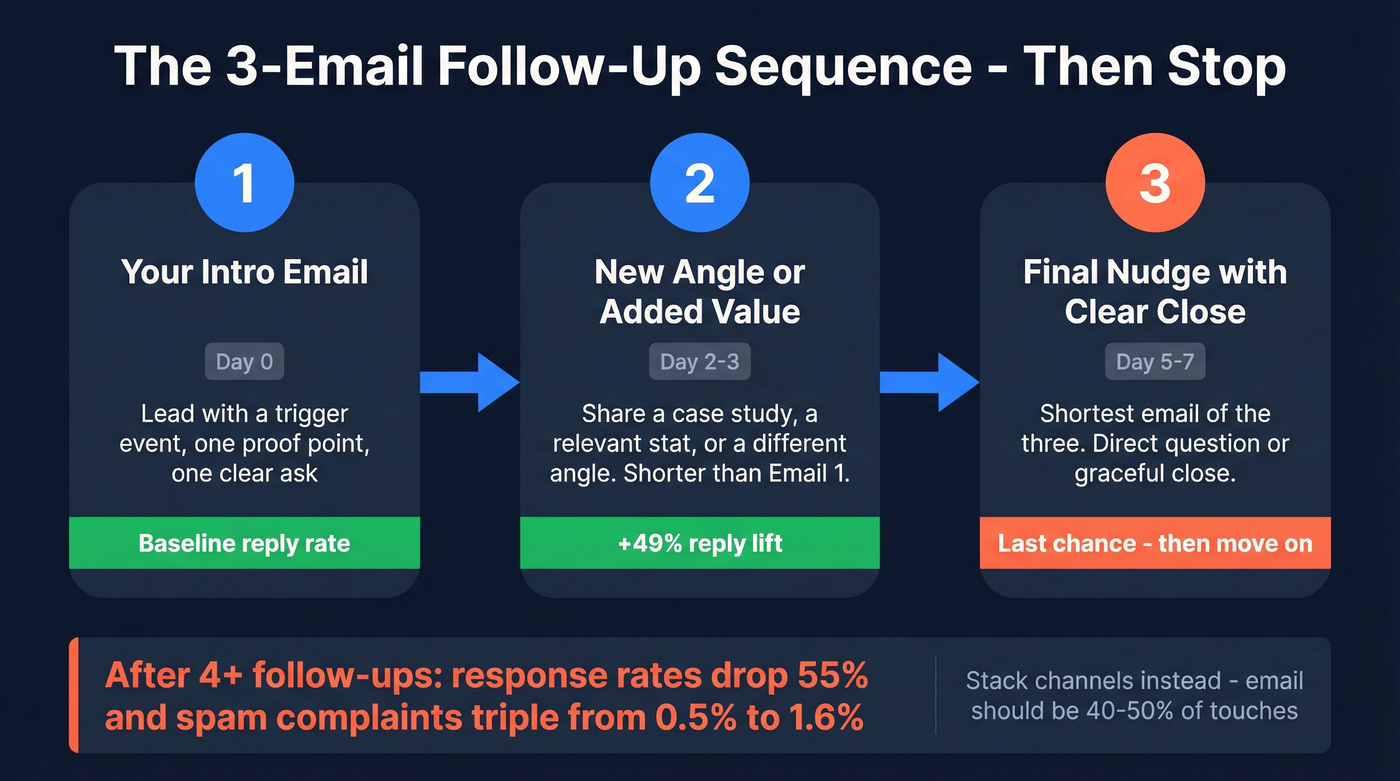
- Email #1: Your intro (Day 0)
- Email #2: New angle or added value (Day 2-3)
- Email #3: Final nudge with a clear close (3-4 days after Email #2)
Each follow-up should be shorter than the last. Add something new - a case study, a relevant stat, a different angle. Don't just "bump this to the top of your inbox." That's lazy and everyone sees through it. If you're running a multichannel cadence, Outreach's framework suggests email should be 40-50% of touches, with phone and social filling the rest. Stack channels, not sends.
Before You Hit Send
There's a difference between delivery and deliverability. Delivery means the server accepted your email. Deliverability means it landed in the inbox - not promotions, not spam. Run through this before every company introduction email to client goes out:
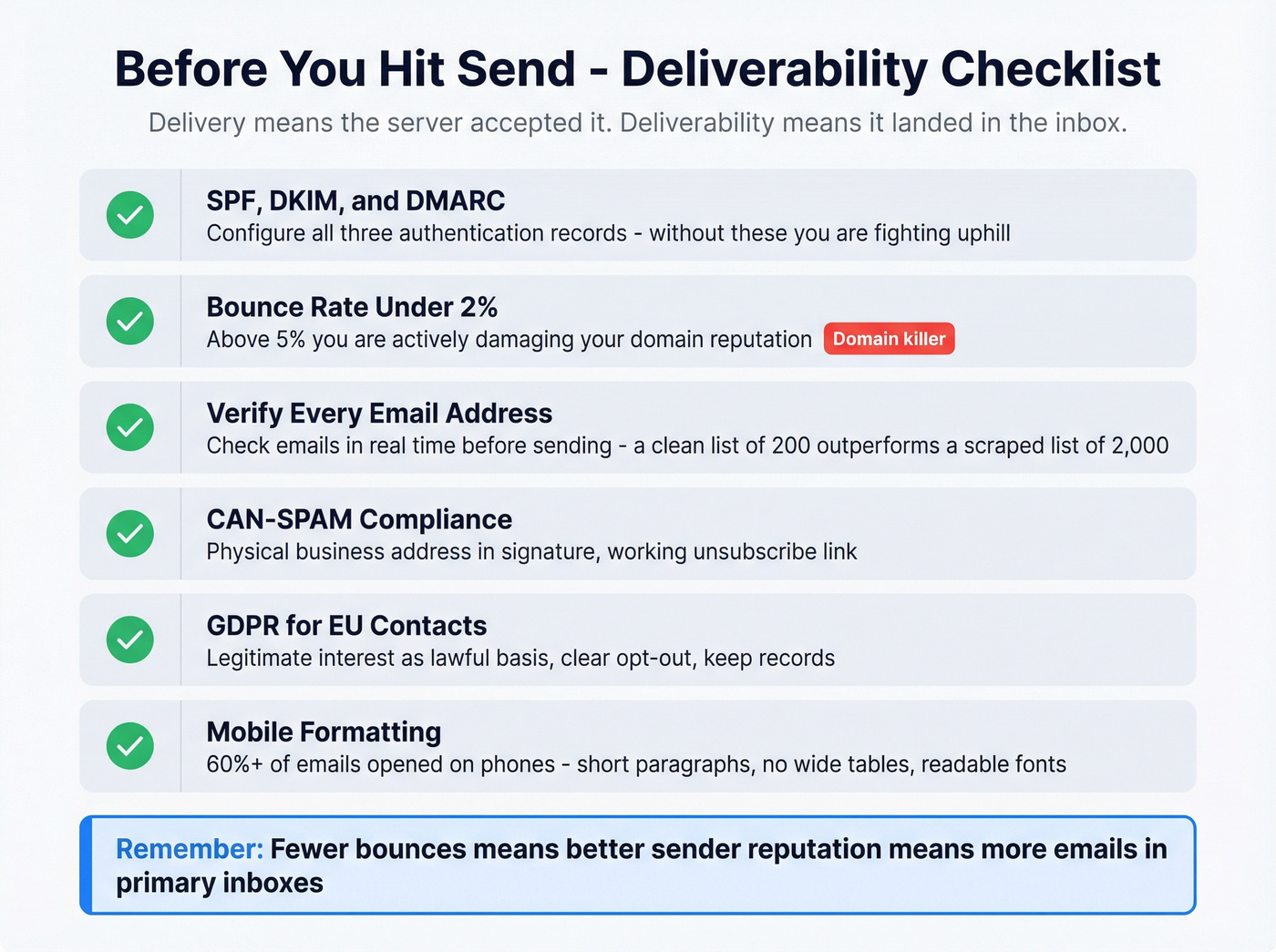
Authentication: SPF, DKIM, and DMARC records configured. Without these, you're fighting uphill before you type a word. (If you need a walkthrough, start with SPF, DKIM, and DMARC.)
Bounce rate: Keep it under 2%. Above 5%, you're actively damaging your domain reputation and inbox placement. If you're troubleshooting, check hard bounce causes first.
List verification: Verify every address before sending. Prospeo checks emails in real time with 98% accuracy on a 7-day refresh cycle - the free tier covers 75 email verifications per month plus 100 Chrome extension credits. For tool comparisons, see email validators.
CAN-SPAM compliance: Physical business address in your signature. Working unsubscribe mechanism. (Details: CAN-SPAM physical address requirement.)
GDPR for EU contacts: Legitimate interest as your lawful basis. Clear opt-out. Keep records of your rationale. (More: GDPR for Sales and Marketing.)
Mobile formatting: Over 60% of emails are opened on phones. Short paragraphs, no wide tables, readable font sizes.
Look - sales practitioners on r/sales and r/coldemail consistently report that a clean, verified list of 200 contacts outperforms a scraped list of 2,000 by a wide margin. The math isn't complicated: fewer bounces mean better sender reputation, which means more emails landing in primary inboxes. This is especially true when you're introducing your company to clients at scale, because one bad batch can poison deliverability for weeks.
The data is clear: emailing 1-2 verified contacts per company gets a 7.8% reply rate. Prospeo gives you 300M+ profiles with 30+ filters - buyer intent, job changes, funding - so you reach the right person with the right intro, every time.
Precision beats volume. Find the exact decision-maker for $0.01.
FAQ
How long should a business introduction email be?
Six to eight sentences, or under 200 words. A 16.5M-email study found this length produces the highest reply rates at 6.9%. Anything longer and recipients skim or delete.
What should I include in a company profile email?
Lead with the outcome you deliver, not your company history. Include one proof point like a metric or client result, a single sentence on what you do, and one clear CTA. If the recipient requested your profile, attach it as a one-page PDF rather than pasting it into the body.
How many follow-ups should I send after an intro email?
Two to three maximum. The first follow-up lifts replies by 49%, but by the fourth follow-up, response rates drop 55% and spam complaints triple from 0.5% to 1.6%.
How do I make sure my intro email doesn't bounce?
Verify every address before sending. Tools like Prospeo check emails in real time with 98% accuracy across 143M+ verified addresses, keeping bounce rates under 2% and your sender reputation intact.
Should I skip intro emails and just call?
It depends on your market. For mid-market and enterprise, a warm intro email before a call increases pickup rates because the prospect recognizes your name. For SMB with shorter sales cycles, a direct call paired with a same-day follow-up email often works better. Test both.