

The 10 Best Free Bulk Email Checkers in 2026 (Tested)
You've got a list of 5,000 contacts from a webinar, a trade show, or a scraping run. You paste them into your sequencer, hit send, and watch 600 bounce back before lunch. Your domain reputation tanks, your deliverability craters, and your next three campaigns land in spam.
A good free bulk email checker would've caught those dead addresses in minutes. But most tools advertising "bulk" capabilities cap you at 25-100 emails - barely enough to test a single segment.
The global inbox placement rate sits around 83.5%. Nearly one in five emails never reaches the inbox even under ideal conditions, and sending to unverified lists makes those odds far worse. We tested 10 tools that actually let you upload a list for free. Here's how they stack up on what matters: accuracy, free limits, and real pricing.
Our Picks (TL;DR)
| Pick | Best For | Why |
|---|---|---|
| Prospeo | Finding AND verifying B2B emails | Sources and verifies in one step. 98% accuracy, 75 free/mo |
| MillionVerifier | Most generous free tier | 500 free credits - enough to test on a real list segment |
| Clearout | Best bounce guarantee | 3% or less bounce rate guarantee, 20+ validation checks, 100 free credits |
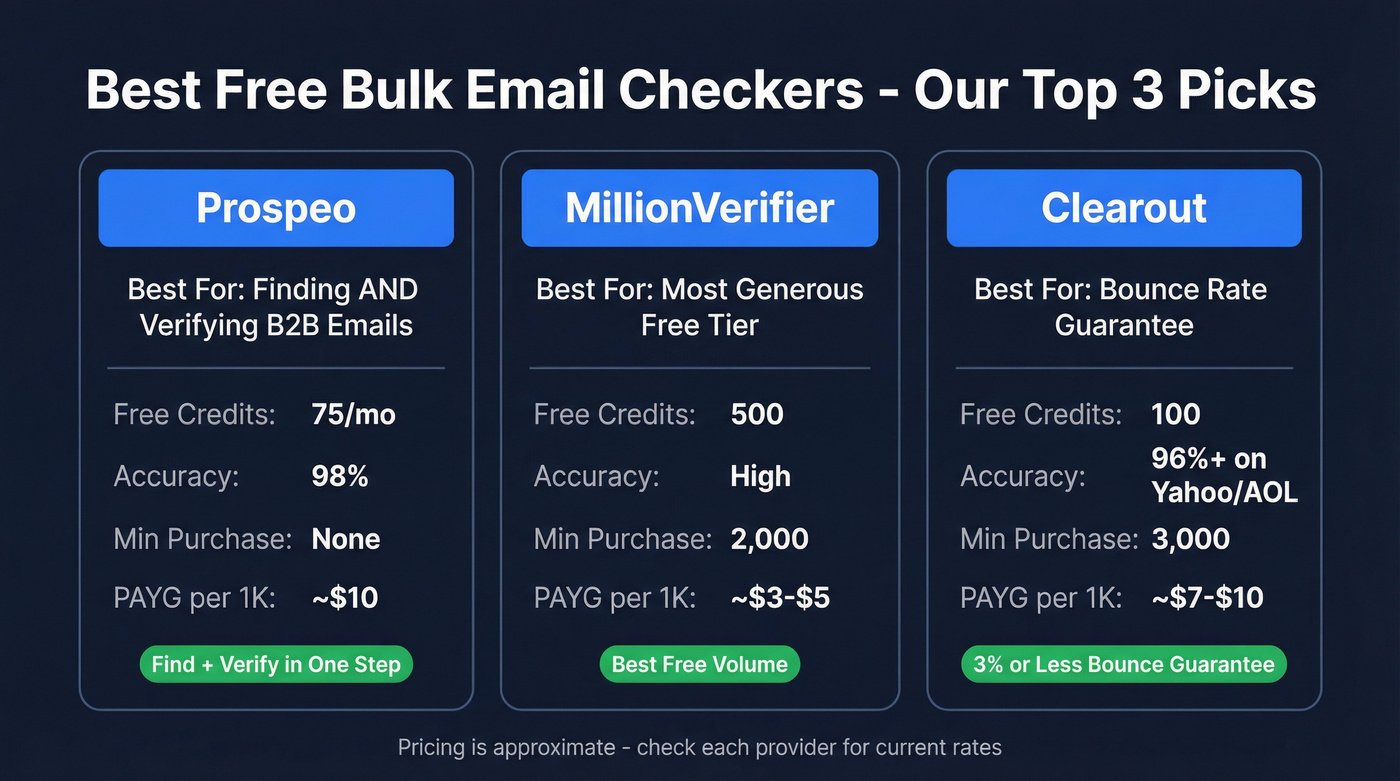
Prospeo is the pick if you don't have a list yet and need to build one with verified emails from the start. MillionVerifier wins on raw free volume. Clearout is the safest bet if you already have a list and want the tightest bounce guarantee.
Bulk Email Verification Comparison Table
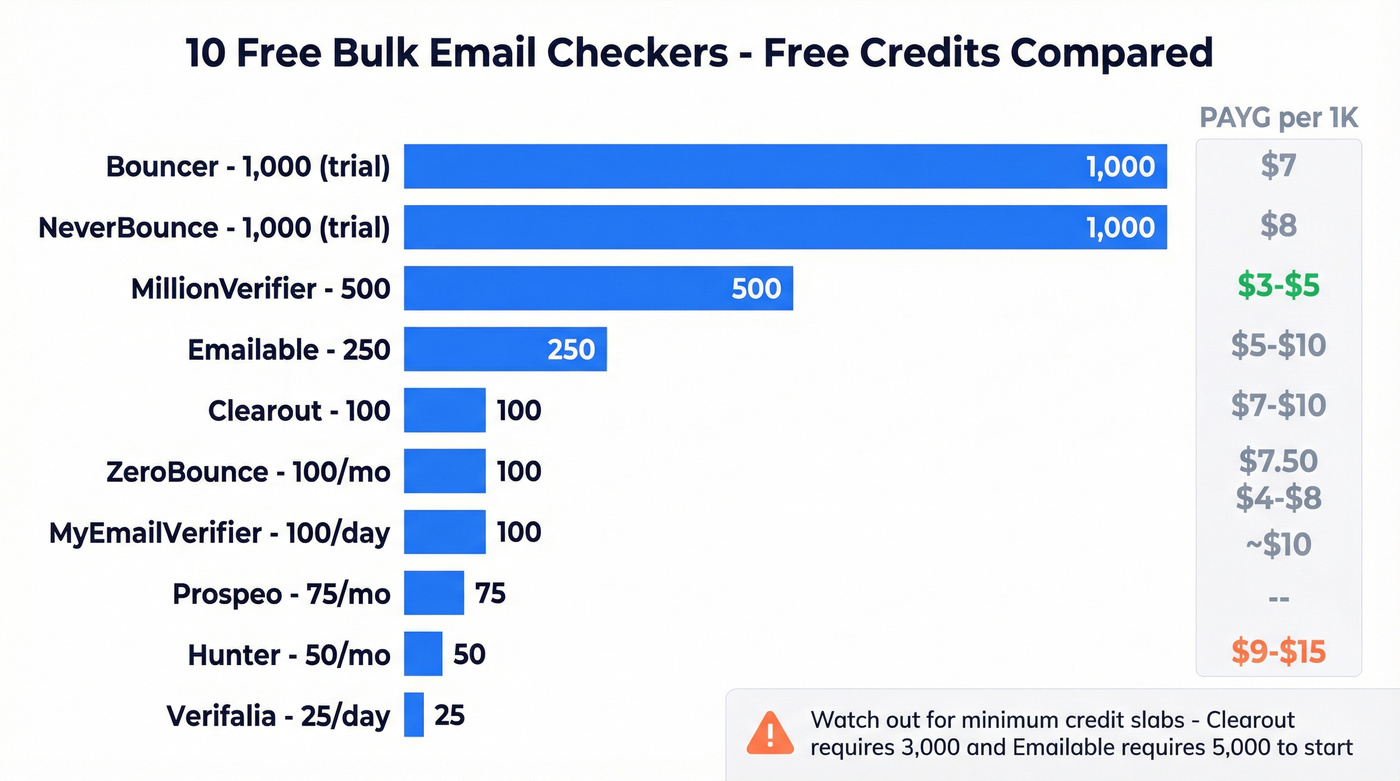
Let's be honest: 100 free credits is a rounding error. It's enough to confirm a tool works, not enough to clean a real campaign list. Still, free tiers matter for testing, so here's the full breakdown.
| Tool | Free Credits | Bulk Upload? | Min Paid Slab | PAYG ~per 1K |
|---|---|---|---|---|
| Prospeo | 75/mo | Yes (find + verify) | No minimum | ~$10 |
| MillionVerifier | 500 | Yes | 2,000 | ~$3-$5 |
| Clearout | 100 | Yes | 3,000 | ~$7-$10 |
| Bouncer | 1,000 (trial) | Yes | None | ~$7 |
| NeverBounce | 1,000 (trial) | Yes | None | ~$8 |
| ZeroBounce | 100/mo | Yes | 2,000 | ~$7.50 |
| MyEmailVerifier | 100/day | Yes | None | ~$4-$8 |
| Emailable | 250 | Yes | 5,000 | ~$5-$10 |
| Hunter | 50/mo | Yes | None | - |
| Verifalia | 25/day | Yes | None | ~$9-$15 |
PAYG rates are approximate and vary by volume tier - check each tool's pricing page for current numbers.
The hidden cost most people miss: minimum credit slabs. Clearout requires a 3,000-credit minimum purchase. Emailable starts at 5,000. If you only need to verify 1,000 emails, you're overpaying unless the tool offers true pay-as-you-go.
If you're comparing broader options beyond bulk checkers, see our roundup of email checker tools.
The 10 Best Tools for Bulk Verification
Prospeo
Use this if you're building a B2B prospect list from scratch and want verified emails without a separate verification step. Prospeo's 300M+ profile database with 143M+ verified emails means you search, find, and verify in one workflow. The 5-step verification process - catch-all handling, spam-trap removal, honeypot filtering - delivers 98% email accuracy. That's the result of verifying at the data-sourcing stage rather than bolting verification on after the fact.
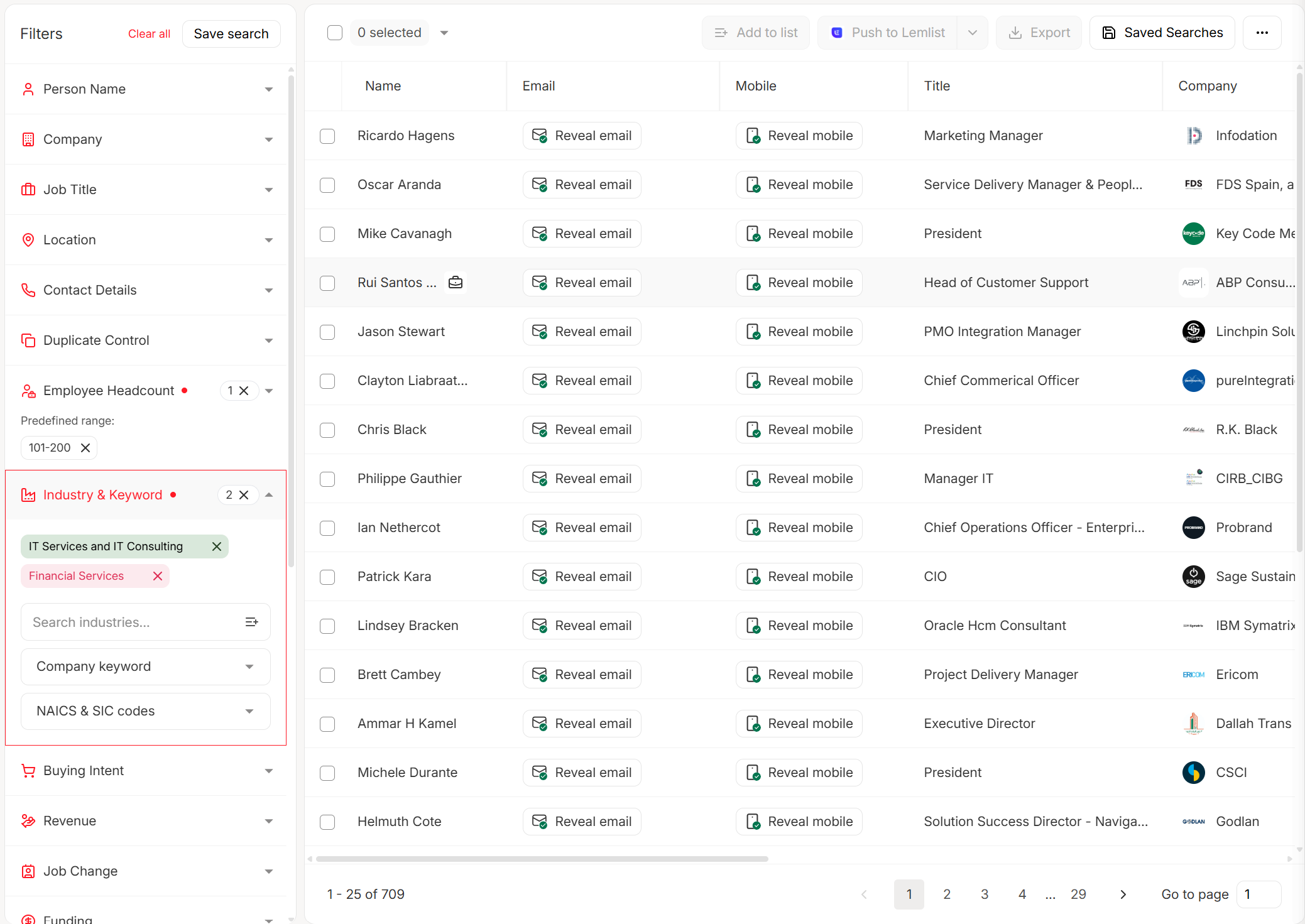
The free tier gives you 75 verified emails per month. At scale, that drops to roughly $0.01 per email with no minimums and no contracts. Prospeo pushes directly into major sequencers like Smartlead, Instantly, and Lemlist, plus CRMs like HubSpot and Salesforce via native integrations. The 7-day data refresh cycle means the emails you pulled last week are still current - most competitors refresh every 4-6 weeks.
If you're building lists (not just cleaning them), pair this with a modern list building workflow.
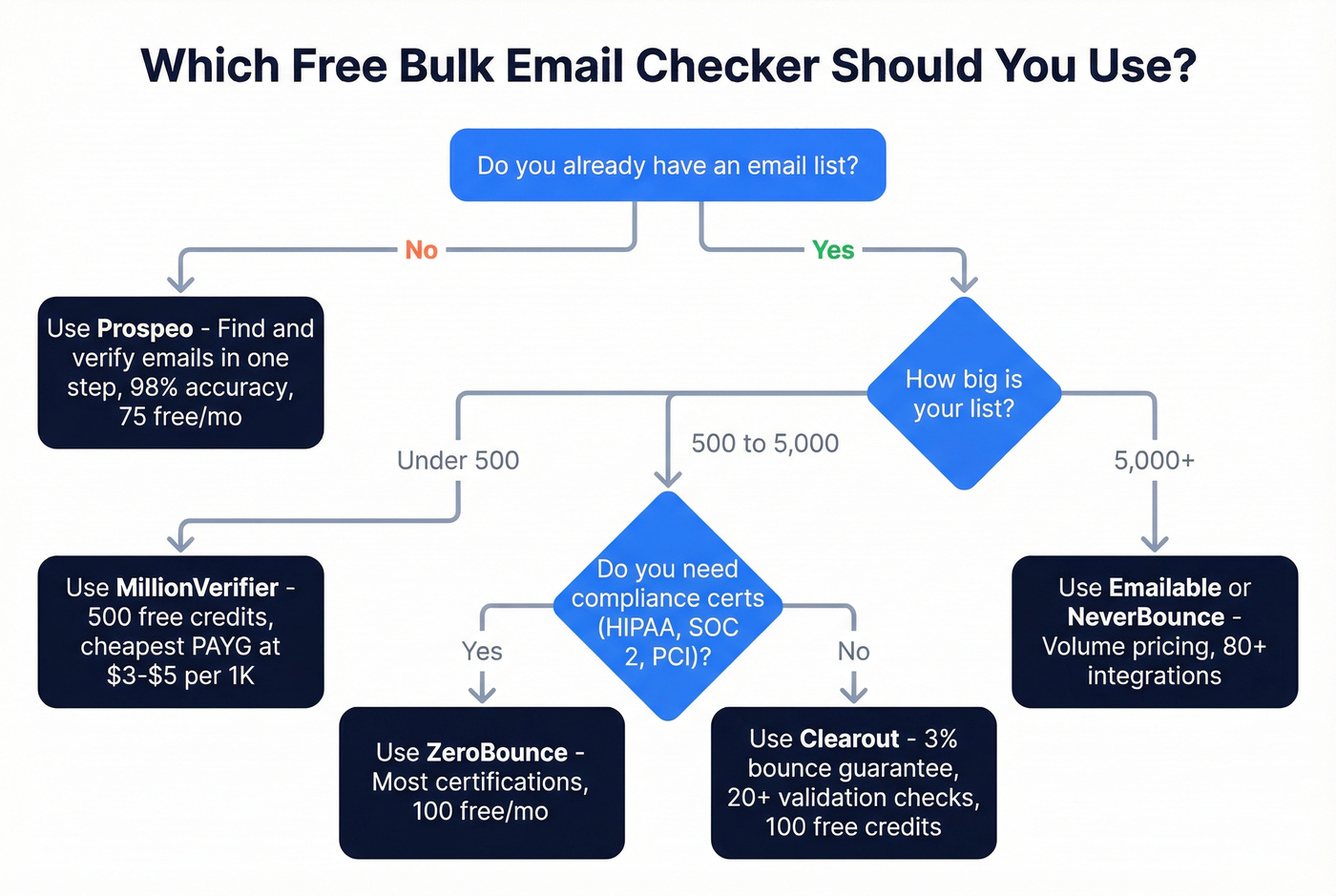
Best paired with a dedicated bulk verifier like MillionVerifier if you also have large legacy lists to clean. Prospeo's strength is the combined find-and-verify workflow, so for massive existing lists with zero need for email finding, pair it with a pure cleaner for that specific job.
MillionVerifier
Use this if you have an existing list and want the most free credits to test with. MillionVerifier hands you 500 free credits on signup - enough to run a meaningful sample and see real results before paying anything.
If you're verifying specifically for outbound, this pairs well with an email verification for outreach checklist.
Paid pricing is one of the lowest in the category: around $3-$5 per 1,000 emails at volume, with a 2,000-credit minimum purchase. Results come back categorized as valid, invalid, risky, or unknown. The interface is no-frills. Upload a CSV, download results. No CRM integrations to configure, no enrichment features to navigate.
Skip this if you need email finding, enrichment, or anything beyond list cleaning. MillionVerifier is a single-purpose tool.
Clearout
Use this if accuracy guarantees matter more than free credits. Clearout's bounce rate guarantee - 3% or less - is one of the most concrete promises in this space. They back it with 20+ validation checks including greylisting verification), catch-all detection, DNSBL/URIBL blocklist verification, disposable email filtering, and extended SMTP validation. Clearout also handles Yahoo/AOL domains with 96%+ accuracy, which are notoriously difficult domains that trip up many competitors.
If you're trying to improve overall sending performance, use an email deliverability checklist alongside verification.
The free tier is 100 credits - modest, but each verification runs deeper than most competitors. Clearout is rated 4.9/5 on G2 and lists compliance certifications including GDPR, ISO 27001/2013, and SOC 2 Type 2. Paid plans start with a 3,000-credit minimum slab, and pricing typically lands around $7-$10 per 1,000 depending on volume. They also offer real-time form verification (Form Guard) for catching bad emails at the point of entry.
Skip this if you're on a tight budget and need maximum free volume. The 100-credit free tier and 3,000-credit minimum purchase make Clearout a better fit for teams ready to pay for quality.
Bouncer
Bouncer gives you 1,000 free credits on signup - tied with NeverBounce for the most generous trial. PAYG pricing runs $7 per 1,000 emails with no minimum slab requirement, which makes it accessible for small teams.
In Hunter's benchmark of 15 email verifiers, Bouncer scored 65.43% overall accuracy - mid-pack, but ahead of NeverBounce and ZeroBounce. No email finding here. This is pure verification. The accuracy score trails Clearout (68.37%) and Hunter (70%) in the same test. Bouncer is a solid pick if you want a generous trial with no strings, but it won't wow you on accuracy or features.
NeverBounce
NeverBounce matches Bouncer's 1,000 free trial credits and is known for deep integrations - 80+ of them. If you're running email marketing rather than just cold outbound, that integration depth is hard to beat. PAYG runs roughly $8 per 1,000 emails.
The catch: accuracy scored 63.17% in the same Hunter benchmark. Custom pricing is available for enterprise customers. NeverBounce is best for teams that want verification tightly connected to the rest of their sending stack.
ZeroBounce
ZeroBounce stands out for one reason: compliance. 100 free verifications per month on a recurring basis, plus SOC 2 Type 2, ISO 27001, PCI-DSS, GDPR, CCPA, and HIPAA certifications. If you're in healthcare or finance and need verification with an audit trail, ZeroBounce checks boxes others don't.
The tradeoff is accuracy - 60.70% in Hunter's benchmark. The minimum purchase is 2,000 credits at about $15 for 2,000 emails ($7.50 per 1,000). The feature set includes email scoring and activity data, but those extras add complexity most teams don't need. Pick ZeroBounce for compliance, not for accuracy.
MyEmailVerifier
MyEmailVerifier's 100 free verifications per day makes it effectively unlimited for small, steady workflows. It supports bulk uploads up to 100,000 emails at once with a 10MB max file size, and credits never expire. The service positions itself around reducing bounce rates to 2%, and it lists GDPR compliance and SOC 2 certification.
The tradeoff is a less polished UI and fewer integrations than the bigger names - you use this for the price, not the experience. Paid pricing typically lands around $4-$8 per 1,000 depending on volume.
If you're troubleshooting bounces, start with the basics on hard bounces.
Emailable
250 free credits on signup, but the 5,000-credit minimum paid slab is the highest on this list. That makes Emailable a poor fit for small teams testing the waters. Per-1,000 pricing is competitive once you commit to volume. If you know you'll need 5,000+ verifications, Emailable is cost-effective. If you're not sure, start elsewhere.
If you're considering other options in the same category, compare Emailable alternatives.
Hunter
Hunter gives you 50 free verifications per month. In their own benchmark, Hunter scored 70% accuracy - the highest overall score in that test, though they note a methodology caveat that may advantage their own tool. The real value is the combined find-and-verify workflow, though the free tier is too small for bulk use.
If you need more than verification, look at free email finder tools.
Verifalia
25 free verifications per day with a conservative, reliability-first approach. Verifalia's slower processing and stricter categorization mean fewer false positives, but the daily cap makes it impractical for anything beyond spot-checking individual addresses. Paid plans are priced at a premium compared to budget verifiers.

Most bulk email checkers only clean lists you already have. Prospeo builds verified lists from scratch - 300M+ profiles, 143M+ verified emails, 98% accuracy. No separate verification step. No bounced campaigns.
Skip the cleanup. Start with emails that are already verified.
The Accuracy Problem
Every email verification tool claims 99% accuracy on their marketing page. The actual numbers tell a different story.
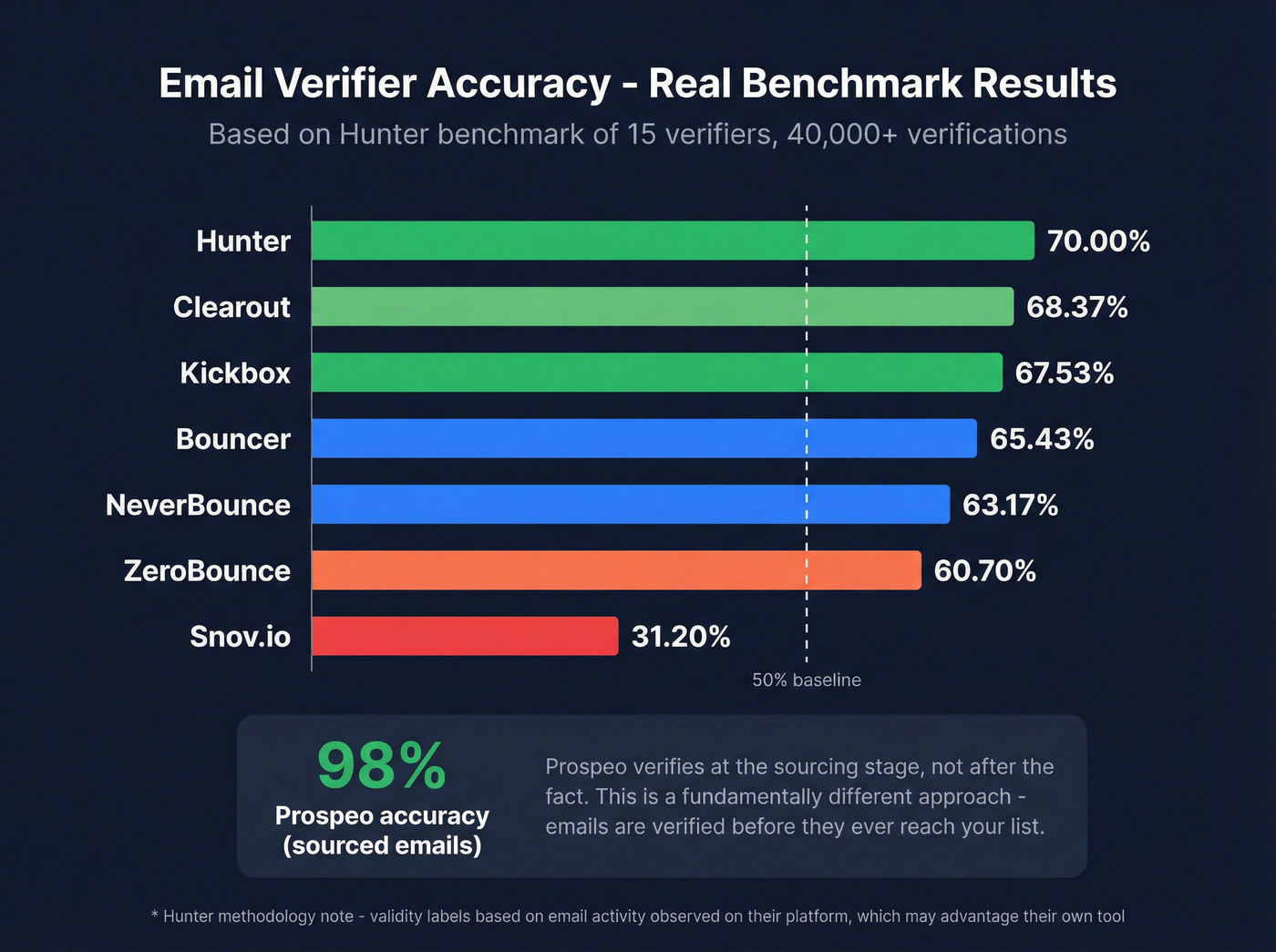
Hunter ran a benchmark across 15 email verifiers using 3,000 real business emails - 2,700 valid and 300 known invalid - segmented by company size, totaling 40,000+ verifications under identical conditions. The results:
| Tool | Overall Accuracy |
|---|---|
| Hunter | 70.00% |
| Clearout | 68.37% |
| Kickbox | 67.53% |
| Bouncer | 65.43% |
| NeverBounce | 63.17% |
| ZeroBounce | 60.70% |
| Snov.io | 31.20% |

The gap between the best performer at 70% and the worst at 31% is enormous. Even the top tool only correctly predicted 7 out of 10 outcomes. The methodology has a caveat - Hunter's validity labels came from email activity observed on their own platform, which may advantage their tool - but the relative rankings reveal how wide the accuracy spread really is.
Here's the thing: if your average deal size is under $10K, you probably don't need the most accurate verifier. You need the cheapest one that keeps bounce rates under 2%. The difference between 65% and 70% accuracy matters at enterprise scale. At 500 emails a month, it's a rounding error.
Those benchmark scores measure verification of pre-existing email lists. Prospeo's 98% accuracy applies to emails sourced through its own database - a fundamentally different approach where verification happens before the email enters your list. You never collect bad data in the first place.
How Bulk Email Verification Works
Understanding the verification pipeline helps you spot which tools are thorough and which are cutting corners. The standard process runs five steps:
- Syntax check - Does the email follow valid formatting rules? Catches typos like "john@@company.com" or missing TLDs.
- DNS/MX record lookup - Does the domain exist and accept email? If there's no mail server configured, the address is dead regardless of format.
- SMTP handshake - The verifier connects to the mail server and asks "would you accept a message for this address?" without actually sending one. This is where most invalid addresses get caught.
- Catch-all detection - Some domains accept email for any address. The server says "yes" to everything, so the verifier can't confirm the specific mailbox exists. This is the hardest problem in email verification and the biggest source of false positives.
- Disposable and spam-trap filtering - Flags temporary email services like Guerrilla Mail and Mailinator, plus known spam traps that'll destroy your sender reputation.
Syntax plus MX checks alone give you a false sense of security. They'll catch the most obvious dead addresses but miss inactive mailboxes, spam traps, and catch-all domains - the cases that actually cause deliverability damage. Any tool skipping steps 3-5 isn't doing real verification.
Mistakes That Waste Your Free Credits
Verifying stale lists without filtering first. Before you burn credits on a 5,000-row CSV, remove obvious duplicates, role-based addresses like info@ and support@, and contacts who haven't engaged in 6+ months. A quick filter pass can cut your verification volume by 20-30%, stretching those free credits much further.
Treating "Valid" and "Accept-All" the same. Accept-all results mean the mail server accepted the query, but the specific mailbox might not exist. We've seen teams send to accept-all addresses at scale and watch their bounce rates spike to 8-10%. Segment them separately and send in smaller batches with careful monitoring.
Verifying once and forgetting. Email lists decay roughly 2% per month. After four weeks, a "clean" list of 10,000 contacts has ~200 newly invalid addresses - enough to trigger spam filters on a large send. Re-verify before every major campaign. The target is keeping bounce rates below 2%, ideally under 1%.
If you're scaling volume, follow a deliverability-first outbound email campaign process.
A 35% bounce rate doesn't just waste credits - it torches your domain. Prospeo's 5-step verification catches spam traps, honeypots, and catch-all domains before you ever hit send. Data refreshes every 7 days, not 6 weeks.
Protect your sender reputation at $0.01 per verified email.
FAQ
Email verification vs. validation?
Validation checks syntax and format - is this structured like a real email? Verification goes deeper with SMTP-level checks to confirm the mailbox actually exists and accepts mail. When shopping for a free bulk email checker, look for SMTP verification. Syntax-only checking catches only the most obvious problems.
Can I verify 10,000 emails for free?
Not with a single tool. You can stack free tiers: MillionVerifier's 500 credits, Bouncer's 1,000 trial credits, NeverBounce's 1,000 trial credits, and MyEmailVerifier's 100/day over time. Realistically, for 10,000 emails, expect to pay $7-15 per 1,000 depending on the tool - $70-150 total, far cheaper than the deliverability damage from sending unverified.
What's a catch-all email?
A catch-all domain accepts email sent to any address at that domain, whether the specific mailbox exists or not. Verification tools can't confirm individual mailboxes on these domains, making catch-all the single biggest accuracy gap in email verification. Treat catch-all results as risky and send to them in small, monitored batches.
How often should I re-verify?
Every 30 days minimum. Lists decay approximately 2% per month as people change jobs, companies shut down domains, and mailboxes get deactivated. Always re-verify before a large campaign, even if the list was clean last month.
Is there a tool that finds AND verifies emails?
Yes. Prospeo sources emails from a 300M+ profile database with 98% accuracy and 5-step verification built into the data-sourcing process. Instead of finding emails with one tool and verifying with another, you get verified contacts in a single workflow - 75 free verified emails per month, roughly $0.01 per email on paid plans with no contracts.