The Best List Building Tools in 2026: Inbound, Outbound, and Everything Between
You burned through 500 prospecting credits last quarter, and 40% of the emails bounced before a single reply came in. That's not a strategy problem - it's a data problem. The list building tools you pick determine how fast you can build and how long that list stays useful.
"List building" means completely different things depending on who you are. Sales teams need verified prospect databases they can actually reach. Marketing teams need popups, forms, and landing pages that capture subscribers. B2B contact data decays at roughly 30% per year, so whatever you build today is already rotting - and the gap between a good tool and a mediocre one compounds every week you wait.
Our Picks (TL;DR)
B2B Prospecting:
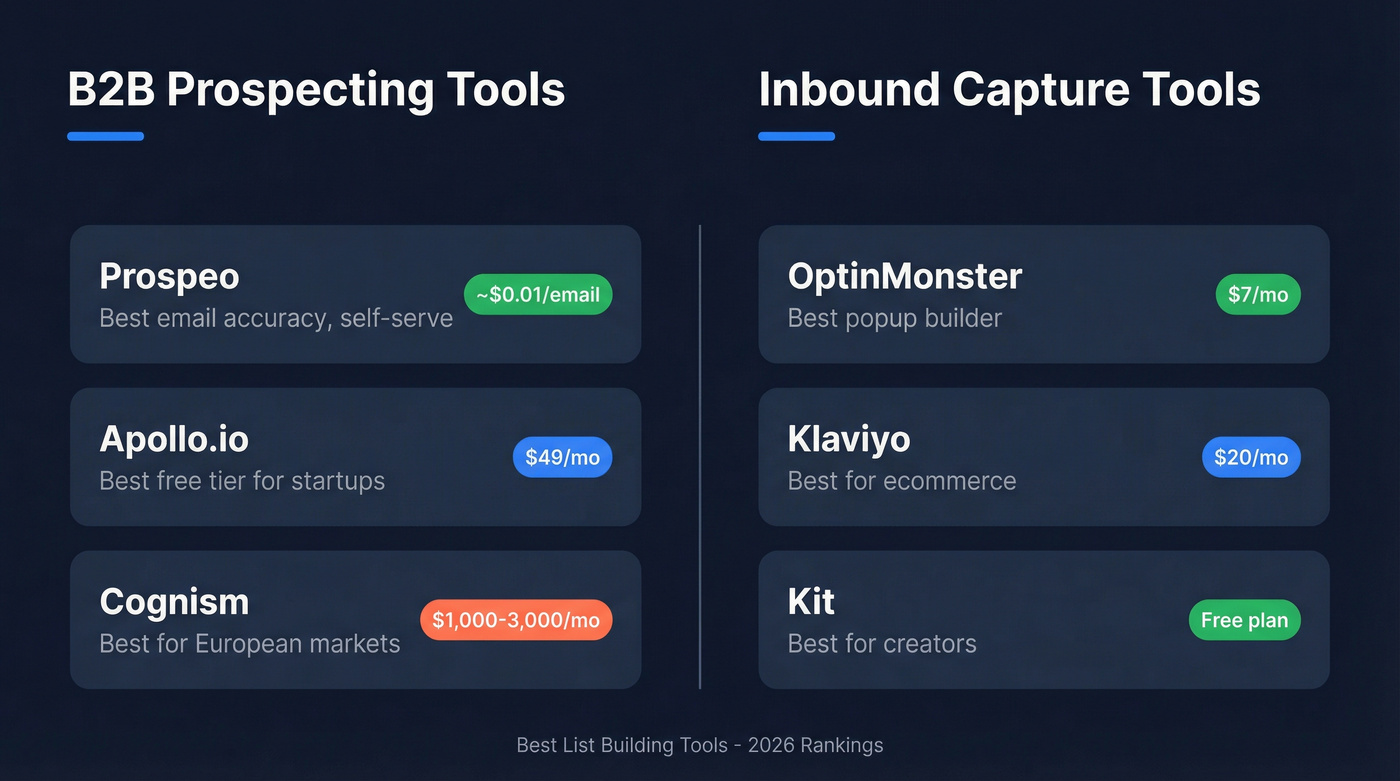
| Tool | Verdict | Starting Price |
|---|---|---|
| Prospeo | Best email accuracy, self-serve | ~$0.01/verified email |
| Apollo.io | Best free tier for startups | $49/mo |
| Cognism | Best for European markets | Custom (often $1,000-3,000/mo) |
Inbound List Building:
| Tool | Verdict | Starting Price |
|---|---|---|
| OptinMonster | Best popup builder | $7/mo |
| Klaviyo | Best for ecommerce | $20/mo |
| Kit | Best for creators | Free plan available |
B2B List Building Tools
A CleanList benchmark test evaluated prospect data platforms on the same task - build a list of 100 US SaaS VPs of Sales with verified emails and direct dials. Here's how the field stacked up:
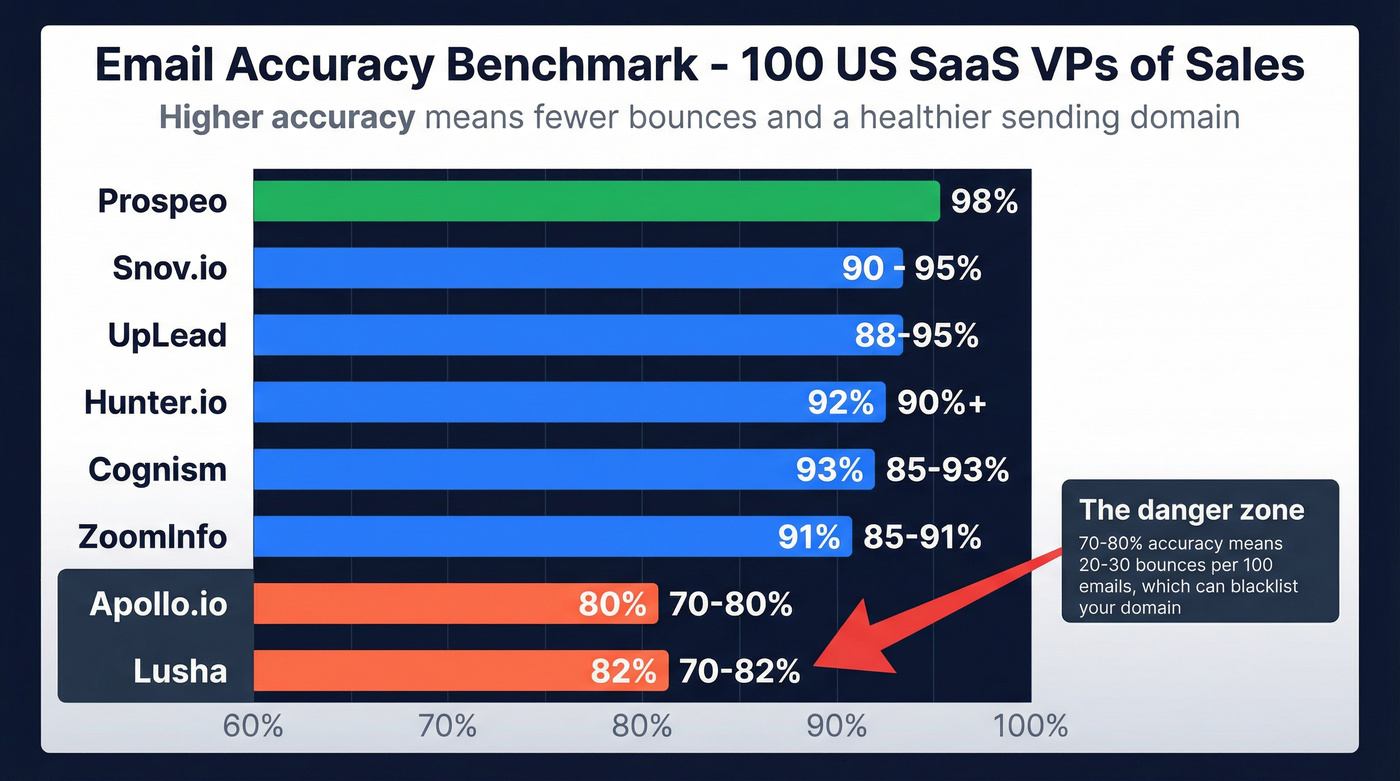
| Tool | Email Accuracy | Phone Coverage | Speed (100 leads) | Starting Price |
|---|---|---|---|---|
| Apollo.io | 70-80% | 30-60% | 3-5 min | $49/mo |
| ZoomInfo | 85-91% | 60-75% | 5-8 min | $14,995/yr |
| Cognism | 85-93% | 55-70% | 5-10 min | Custom |
| Lusha | 70-82% | 40-55% | 2-4 min | $36/mo |
| UpLead | 88-95% | 50-65% | 5-8 min | $99/mo |
| Hunter.io | 90%+ | No phone data | 5-8 min | $34/mo |
| Snov.io | 90-95% | No phone data | 5-10 min | $30/mo |
The real differentiator isn't speed - it's what happens after you hit export. A list that's 70% accurate means 30 bounced emails per hundred, and that tanks your domain reputation fast. We've tested these tools head-to-head, and the gap between a 70% tool and a 98% tool is the difference between a healthy sending domain and a blacklisted one.
Data freshness matters more than database size. Intent data and technographics are table stakes for modern B2B prospecting now - if your tool can't filter by tech stack or buying signals, you're working with a 2020 playbook.

Prospeo
Use this if: You need the highest email accuracy available without signing an annual contract. You're running outbound sequences and can't afford bounces killing your domain. If you're comparing vendors, start with a broader view of sales prospecting platforms before you commit.
Skip this if: You need a full-suite GTM platform with built-in dialing and conversation intelligence - pair Prospeo with a sequencer like Instantly or Smartlead instead. (If you're building a modern stack, use a B2B sales stack blueprint to avoid overlap.)
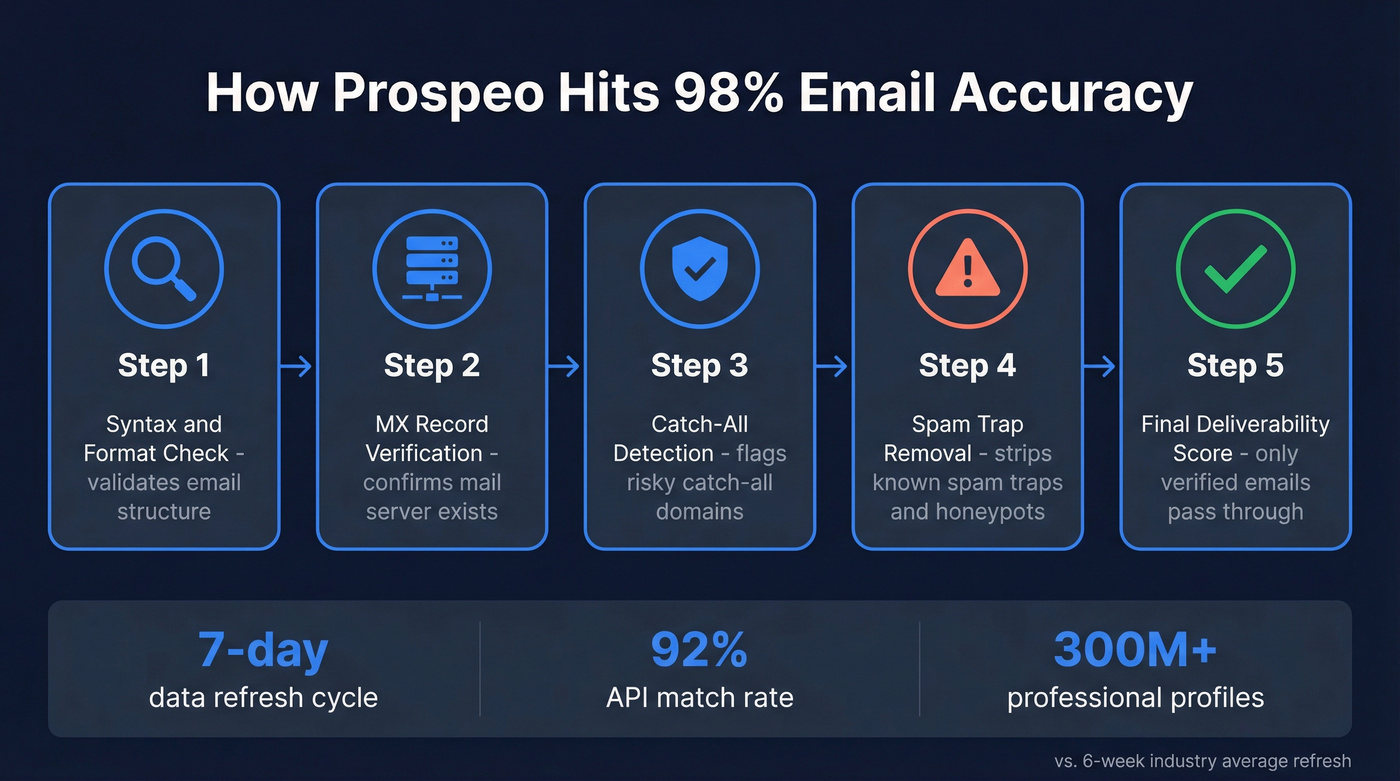
Prospeo's database covers 300M+ professional profiles, 143M+ verified emails, and 125M+ verified mobile numbers. The 98% email accuracy comes from a proprietary 5-step verification process that includes catch-all handling, spam-trap removal, and honeypot filtering. Snyk's team of 50 AEs saw their bounce rate drop from 35-40% to under 5% after switching from their previous data provider, with AE-sourced pipeline up 180%.
The 30+ search filters go well beyond standard firmographics - buyer intent across 15,000 Bombora topics, technographics, job changes, headcount growth, and funding signals. The Chrome extension with 40,000+ users lets you pull verified contacts from any website or CRM in one click. For teams evaluating prospect data platforms, this combination of accuracy and filter depth is hard to beat.
Where Prospeo really separates from the pack is the 7-day data refresh cycle versus the 6-week industry average. CRM enrichment returns 50+ data points per contact at a 92% API match rate, and 83% of leads come back with contact data. Native integrations push directly into Salesforce, HubSpot, Smartlead, Instantly, Lemlist, Clay, Zapier, and Make. Pricing starts free - 75 emails and 100 Chrome extension credits per month - with paid plans at roughly $0.01 per verified email. No contracts, no sales calls required.
Apollo.io
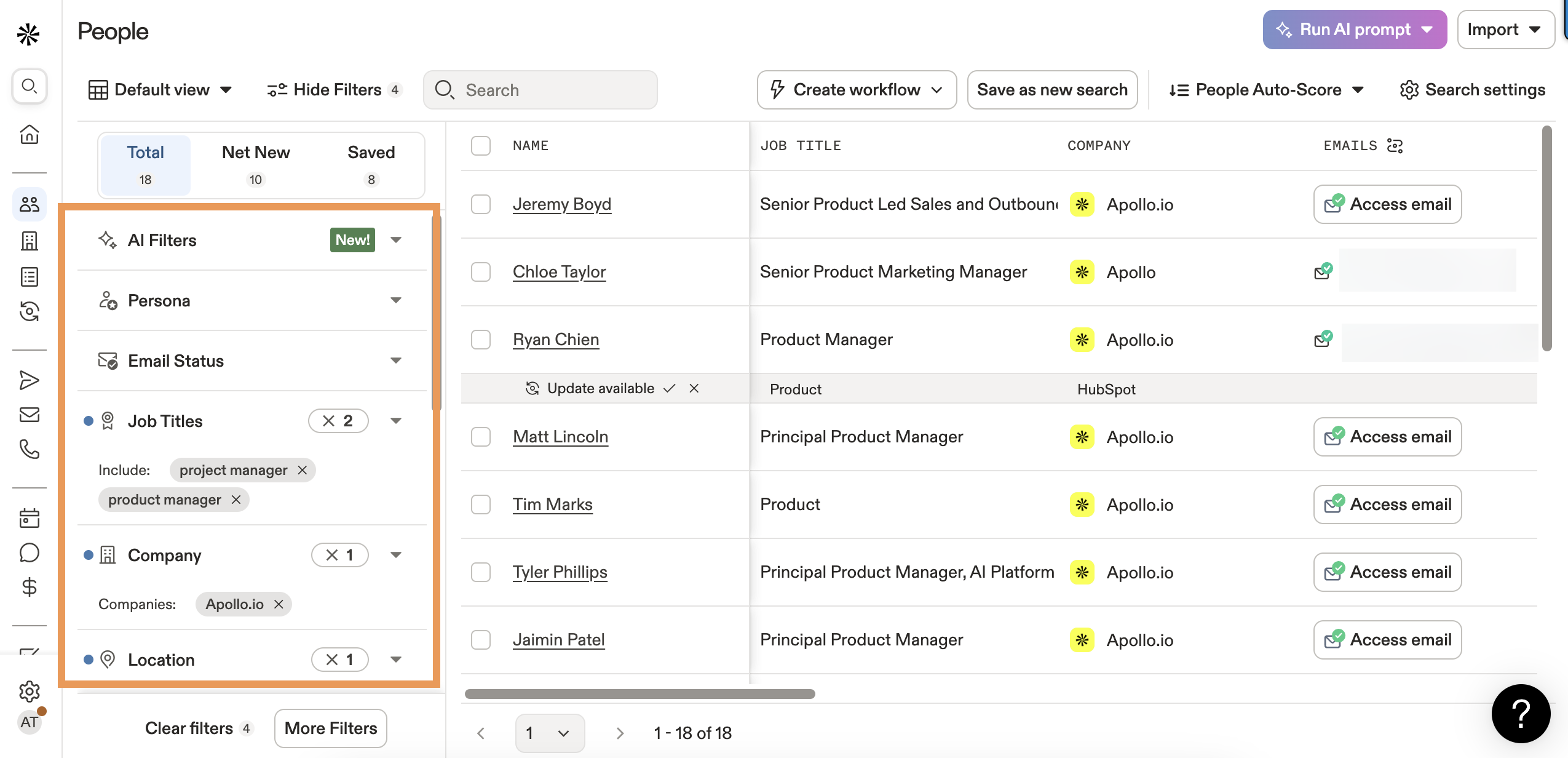
Apollo is the gateway drug of B2B prospecting. The free tier gives you limited credits and access to a 210M+ contact database, which is enough to validate your ICP before spending a dollar. Paid plans run $49-119/user/mo, and the platform doubles as a lightweight sequencer - search, enrich, sequence from one UI. (If you're running sequences, compare options in cold email marketing tools.)
Here's the catch: at 70-80% email accuracy in benchmark testing, you're looking at 20-30 bounces per hundred contacts. That's manageable for small batches but dangerous at scale. We've seen teams outgrow Apollo's data quality within 6-12 months, especially once they're sending 500+ emails per week and domain reputation becomes critical. If you're troubleshooting bounces, start with the basics of a hard bounce.
Let's be honest - Apollo is the best place to start prospecting, but it's rarely the best place to stay. If your average deal size is under $5K and you're sending fewer than 200 emails a week, Apollo's free tier is genuinely hard to beat. The moment you scale past that, accuracy becomes the bottleneck.
ZoomInfo: The $15K Question
ZoomInfo provides access to over 500 million business contacts and 100 million companies worldwide. Its 85-91% email accuracy and 60-75% phone coverage are solid, and the workflow breadth works well for enterprise orgs with 50+ reps. It also layers in technographics and buyer intent signals, syncing with Salesforce, HubSpot, Outreach, Salesloft, and dozens of other sales tools. If you're weighing the tradeoffs, see 6sense vs ZoomInfo.
But here's the number that should give you pause: a 10-seat contract with intent data and mobile numbers runs $40-60K/year. A common complaint across review sites and Reddit threads is paying for modules you never fully activate. If you're a team under 20 people, that's real money for a Series A company, and you'll end up subsidizing features that collect dust.
Cognism
Cognism answers a specific question: "How do I prospect in Europe without getting fined?" Their Diamond Data offers phone-verified mobile numbers, and the database is checked and cleaned against global DNC lists. GDPR and CCPA compliance is built in, not bolted on. Custom pricing often lands around $1,000-3,000/mo for small teams. If you're negotiating, use a Cognism pricing breakdown to sanity-check quotes.
If your entire TAM is US-based, skip Cognism. ZoomInfo and other platforms have deeper North American coverage. But for teams selling into the UK, DACH, or broader EMEA, Cognism's compliance infrastructure alone justifies the premium. The DNC filtering is indispensable when building target account lists in regulated European markets. (For the legal side, start with GDPR for Sales and Marketing.)
Budget B2B Options
Lusha starts at $36/mo and builds lists fast - 2-4 minutes for 100 leads in testing. But 70-82% email accuracy puts it in the same tier as Apollo, and phone coverage at 40-55% is middling. Decent for quick lookups, not for high-volume outbound.
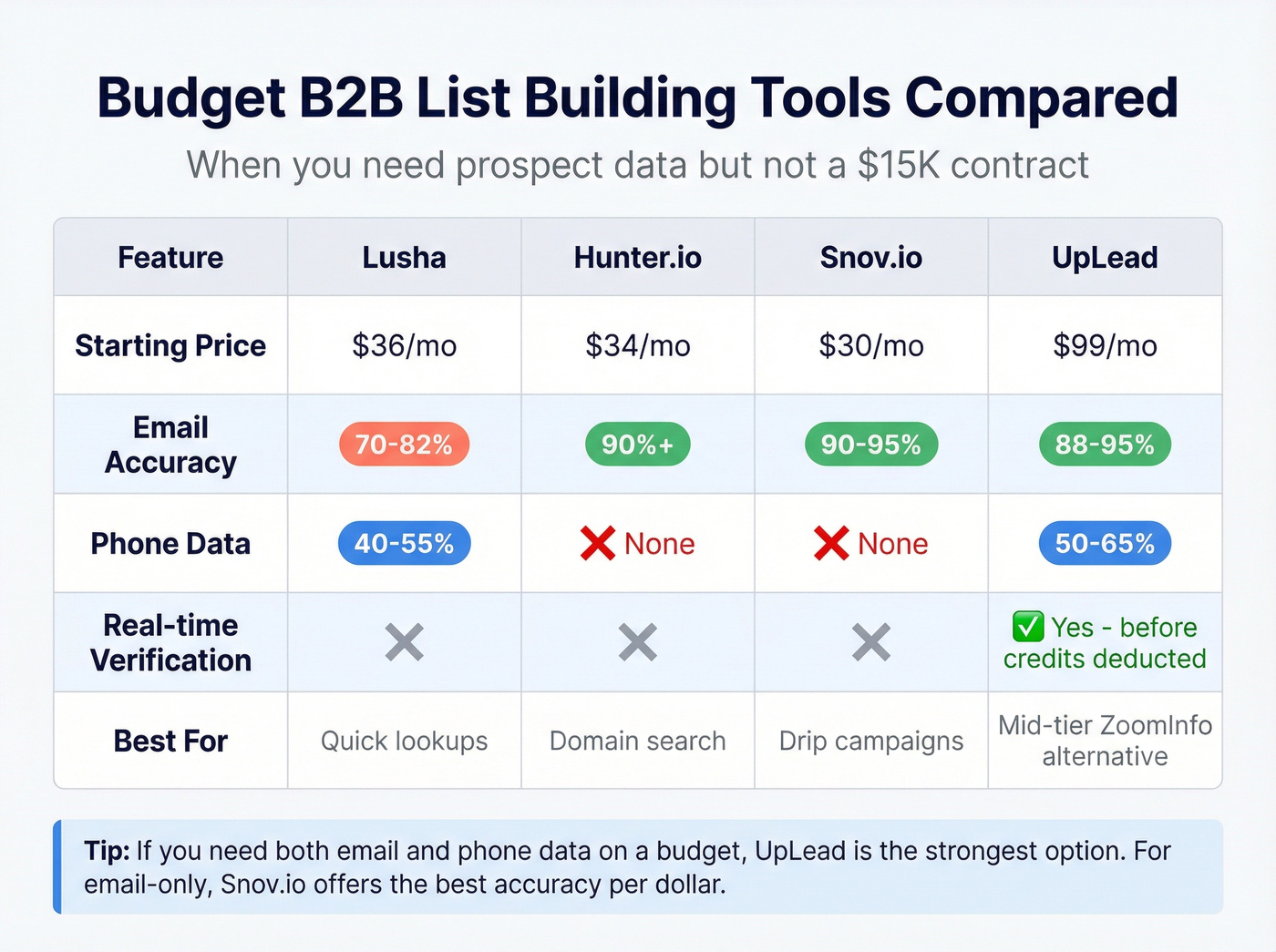
Hunter.io ($34/mo) and Snov.io ($30/mo) are email-only tools - no phone data at all. Both verify well at 90%+, but if you need direct dials, you'll need a second tool. Hunter's strength is domain search; Snov.io edges it on drip campaign features. If you're comparing similar products, see our guide to email hunter tools.
UpLead ($99/mo) verifies emails in real time before deducting credits, which means you never pay for a bad address. At 88-95% accuracy and 50-65% phone coverage, it's a solid mid-tier option - think of it as a self-serve ZoomInfo at a fraction of the cost.

The article above shows the gap between 70% and 98% email accuracy - that's the difference between a blacklisted domain and a booked meeting. Prospeo's 5-step verification, 7-day refresh cycle, and 30+ filters let you build lists that actually convert.
Build a list of 75 verified emails free - no credit card, no sales call.
Inbound Email Capture Tools
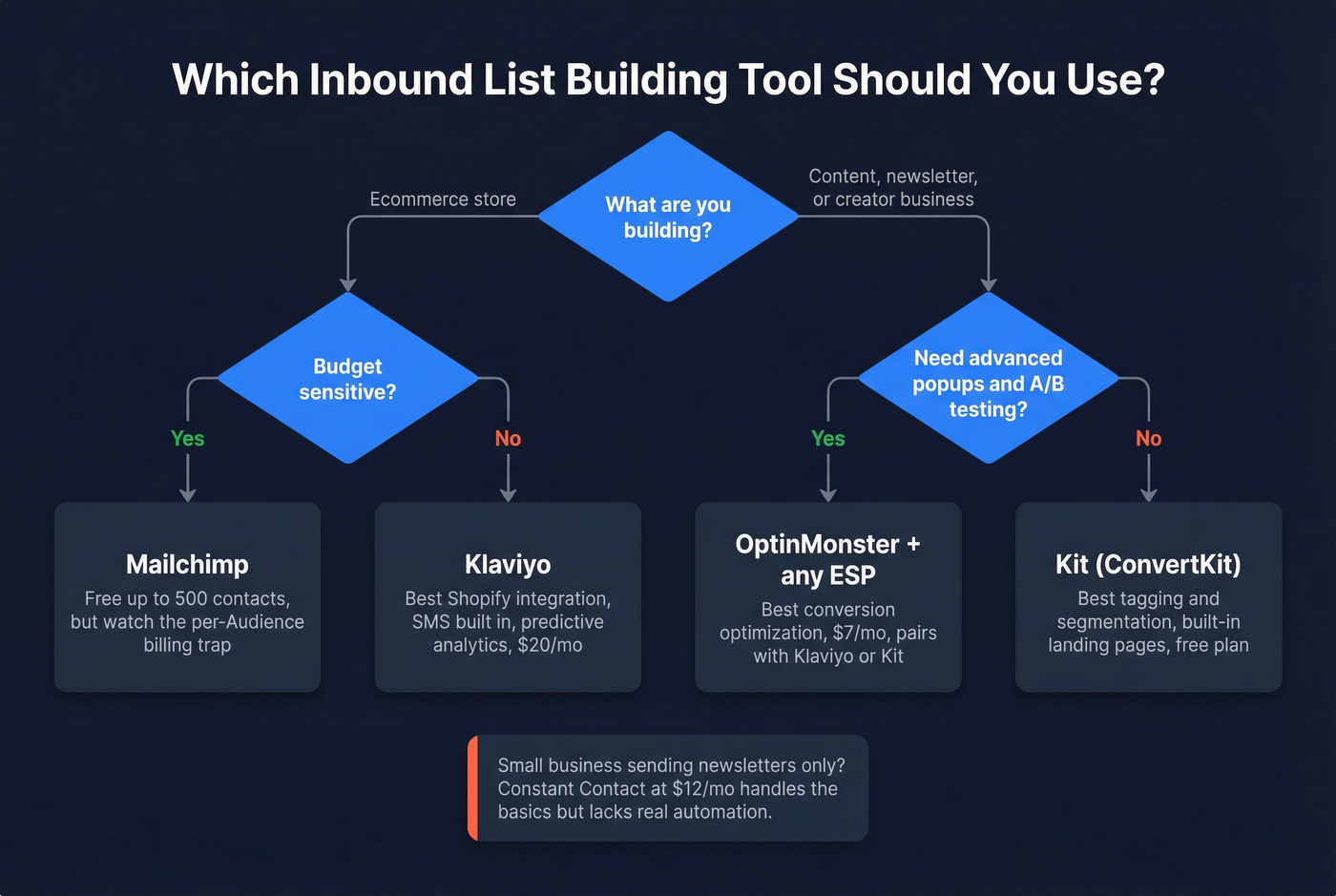
Different problem, different tools. If you're capturing subscribers through your website, you need popups, forms, and email platforms - not a B2B database. If you're building the inbound side end-to-end, start with B2B lead capture benchmarks and workflows.
| Tool | Starting Price | Best For | Key Limitation |
|---|---|---|---|
| OptinMonster | $7/mo | Popup/opt-in campaigns | No email sending |
| Klaviyo | $20/mo | Ecommerce email + SMS | Price scales steeply |
| Kit | Free | Creators & content | Weaker ecommerce |
| Mailchimp | ~$5/mo | Beginners on a budget | Per-Audience billing |
| Constant Contact | $12/mo | Small business email | Limited automation |
OptinMonster
The most conversion-optimized popup builder on the market. 700+ templates, Exit Intent technology on Pro plan and above, and A/B testing on Plus and above. Pricing starts at $7/mo for Basic, scaling to $49/mo for Growth.
One thing to understand: OptinMonster charges by campaign impressions, not pageviews. Basic gets you 2,500 campaign impressions; Growth gets 100,000. Exceed your limit and they'll automatically upgrade you to the next tier - they recommend choosing a plan with 20-30% more impressions than your pageview count. OptinMonster captures leads but doesn't send emails, so pair it with Klaviyo, Kit, or any ESP.
Klaviyo
If you run an ecommerce store, especially on Shopify, Klaviyo's integration depth is among the best available. Abandoned cart flows, browse abandonment, and post-purchase sequences all work out of the box. SMS is built in. Predictive analytics help identify which subscribers are most likely to convert, adding a layer of intelligence that basic ESPs can't match. Free up to 250 contacts, then $20/mo - and it climbs fast as your list grows.
The pricing trajectory is the consistent complaint across Capterra reviews and user forums. Klaviyo earns a 4.6/5 with 521 reviews, but snippets repeatedly flag unexpected price increases as lists scale past 5K-10K contacts.
Kit (ConvertKit)
Kit is purpose-built for creators, newsletter operators, and content businesses. The tagging and segmentation system is best-in-class for audience management, and built-in landing pages mean you don't need a separate tool. Free plan available with limited features, paid from $29/mo. Skip Kit if you're running an ecommerce store - its commerce features exist but can't match Klaviyo's depth.
Mailchimp
Mailchimp is everywhere, and the free tier with 500 contacts gets people in the door. But here's the billing trap that catches teams off guard: Mailchimp counts the same contact multiple times if they're in different "Audiences." Klaviyo counts them once. On a 10K list with 3 segments, your actual Mailchimp bill can run 2-3x what you'd expect. The consensus on r/emailmarketing is that Mailchimp's pricing model punishes you for organizing your data well.
Constant Contact
Constant Contact ($12/mo) handles small business email reliably but lacks meaningful automation. If your needs don't extend beyond newsletters and basic drip sequences, it works. The moment you need behavioral triggers or advanced segmentation, you'll outgrow it.
Snyk's 50 AEs cut bounce rates from 35-40% to under 5% and grew AE-sourced pipeline 180%. Stack Optimize built a $1M agency on Prospeo data with sub-3% bounce rates. Your list building tool is either compounding results or compounding damage.
Get 98% accurate emails at $0.01 each - 90% cheaper than ZoomInfo.
Landing Page Builders
These aren't list building tools by themselves - they're the front door. Pair them with an email platform.
Unbounce ($99-249/mo) is the premium option with AI-powered smart traffic routing and strong A/B testing. Leadpages ($37-74/mo) is simpler and cheaper - solid for small businesses that need a landing page up by Friday. ClickFunnels ($97-297/mo) goes deeper into multi-step funnels but carries a learning curve and a price tag to match. If you're just capturing emails, Leadpages is usually enough. When you're running paid traffic to multiple variants, Unbounce earns its premium.
How to Choose the Right Tool
You need two tools, not ten. One for inbound capture, one for outbound prospecting. The mistake we see repeatedly is teams buying a Swiss Army knife platform that does everything at 60% quality instead of two focused tools that each do their job at 95%. If you want a broader framework, use these sales tools checklist principles to keep the stack lean.
| Your Situation | Recommended Tool(s) | Why |
|---|---|---|
| Tight budget, just starting | Apollo (free) + OptinMonster ($7/mo) | Free B2B credits + affordable popups |
| Ecommerce store | Klaviyo + OptinMonster | Email/SMS + conversion-optimized popups |
| B2B outbound team | Prospeo | 98% accuracy, ~$0.01/verified email, no contracts |
| Agency scaling clients | Prospeo + Instantly/Smartlead | Verified data + sending infrastructure |
| Content creator | Kit (free tier) | Built-in landing pages, tagging |
What to Look For
Data accuracy and freshness. B2B data decays at 30% per year. A tool that refreshes weekly beats one that refreshes monthly, regardless of database size. If you want the deeper numbers and fixes, see B2B contact data decay.
Pricing model transparency. Credits, seats, impressions, contacts - every tool charges differently. Understand what you're paying per lead before you commit.
Compliance. GDPR, CCPA, and DNC list checking aren't optional if you're prospecting in Europe or calling US numbers. Phone-verified data and DNC scrubbing can mean the difference between a productive dial session and a compliance violation.
Integrations. Your data platform needs to feed your CRM and sequencer without manual CSV exports. In our experience evaluating dozens of these platforms, the single biggest predictor of ROI is email accuracy - not database size, not feature count. If you're auditing accuracy, use these prospect data accuracy benchmarks.
Automation. Software that enriches and refreshes contacts on a schedule saves hours of manual work each week. Look for tools that trigger enrichment workflows based on CRM events or ICP criteria changes.
FAQ
What's the difference between list building and lead generation?
List building is assembling the contact list - names, emails, phone numbers, company data. Lead generation is the full process of attracting, qualifying, and converting those contacts into pipeline. List building is step one of the lead gen process, not a synonym for it.
How often should I clean my contact list?
At minimum, quarterly. B2B contact data decays at roughly 30% per year, meaning a list built in January has ~7-8% dead records by April. Tools with automatic refresh cycles reduce the need for manual cleaning significantly.
What's the best free option for B2B prospecting?
Apollo's free tier gives the most generous access to a large contact database. Prospeo's free plan includes 75 verified emails and 100 Chrome extension credits monthly - fewer credits, but at 98% accuracy you waste almost nothing on bounces. For inbound subscriber capture, Kit's free plan is a strong starting point.
Do I need separate tools for inbound and outbound?
Yes. Inbound tools capture subscribers through forms and popups. Outbound tools search databases for prospects matching your ICP. They solve fundamentally different problems, and no single platform does both well. Pick one of each and connect them through your CRM.
Which tools work best for cold outreach campaigns?
For email-first cold outreach, you want 98%+ accuracy to protect your domain, paired with a sending platform like Instantly or Smartlead to handle the actual sequences. For phone-heavy teams, Cognism's phone-verified mobiles or ZoomInfo's direct dial coverage are stronger choices. The key is combining high data accuracy with native sequencer integrations so leads flow straight into campaigns without manual exports.