

6sense vs ZoomInfo: Which One Is Worth the Budget in 2026?
Your VP of Sales came back from a conference convinced the team needs to evaluate 6sense vs ZoomInfo and asked you to decide by Friday. That's like asking whether you need a CRM or a marketing automation platform. These tools aren't in the same category, and the comparison only makes sense once you understand what each one does - and what it actually costs.
30-Second Verdict
Pick ZoomInfo if you're a sales-led org that needs a massive contact database for outbound and wants reps productive within weeks, not months.
Pick 6sense if you're running enterprise ABM across 50+ target accounts and have the RevOps muscle to implement predictive models, train the team, and wait for the data to compound. Know this going in: 6sense onboarding requires four separate admin roles (Primary, Marketing, Sales Intelligence, and AI Email).
| ZoomInfo | 6sense | Prospeo | |
|---|---|---|---|
| Primary use | Contact database + outbound | ABM orchestration + intent | Verified contact data |
| Starting price | $14,995/yr+ | $0 (free tier) / ~$50k-$120k+ paid | Free / credit-based plans |
| G2 rating | 4.5/5 (9,013 reviews) | 4.0/5 (882 reviews) | 4.8/5 |
| Ease of setup (G2) | 8.9/10 | 7.8/10 | Self-serve, minutes |
What Each Platform Actually Does
These aren't the same type of tool.
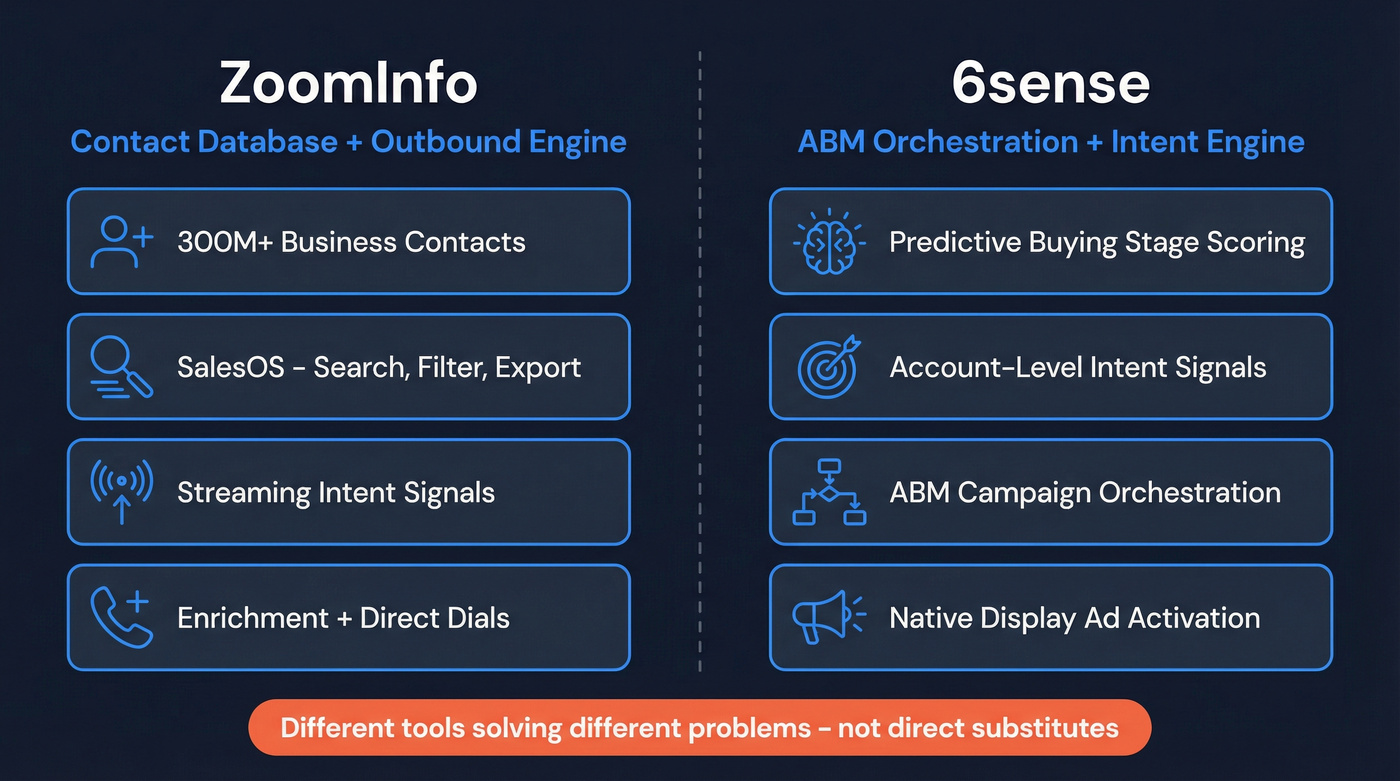
ZoomInfo is fundamentally a B2B contact database with intent, enrichment, and workflow features bolted on. Its core value is SalesOS - a searchable database of contacts and companies that reps use to build lists, find direct dials, and feed sequences. MarketingOS and TalentOS extend the platform, but most buyers start with SalesOS and that's where most of the budget goes.
6sense is an ABM orchestration engine. Its core value is predictive intent scoring - identifying which accounts are in-market, what buying stage they're in, and who on the buying committee to target. It has contact data via its Revenue AI suite, but the database isn't the point. The intelligence layer that tells you when and where to engage is the point. A team that needs 10,000 verified emails for an outbound campaign and a team that needs to coordinate marketing and sales across 200 enterprise accounts are solving completely different problems, which is why this comparison trips people up so often.
Feature Comparison
| Feature | ZoomInfo | 6sense |
|---|---|---|
| Database size | 300M+ business contacts | Undisclosed (intent layer is the selling point) |
| Intent approach | Streaming Intent + Guided Intent | Signalverse buyer signals + predictive scoring |
| ABM capabilities | Basic (account lists) | Deep (orchestration + ads) |
| Enrichment | Strong (Enrich add-on) | Available via credits |
| Integrations | Salesforce, HubSpot, Outreach, Salesloft | Salesforce, HubSpot, Marketo, Drift |
| Ease of use (G2) | 8.8/10 | 7.9/10 |
| Ease of setup (G2) | 8.9/10 | 7.8/10 |
| Support quality (G2) | 8.7/10 | 8.0/10 |
| Meets requirements | 8.7/10 | 7.6/10 |
| Advertising/activation | Limited | Native display ads |
No third-party accuracy benchmark exists for either platform's intent signals. We've seen teams get excited about "surging" accounts only to discover half the signals are noise. Both platforms produce false positives - 6sense's predictive models need training data and time to calibrate, while ZoomInfo's Streaming Intent can flag accounts that are researching your category but have zero budget or timeline.
Plan for a 30-60 day evaluation period with either tool. Build internal scoring thresholds before you trust the signals. Anyone who tells you intent data is plug-and-play is selling you something.
What Real Users Say
| G2 Category | 6sense | ZoomInfo |
|---|---|---|
| Overall rating | 4.0/5 (882 reviews) | 4.5/5 (9,013 reviews) |
| Ease of use | 7.9 | 8.8 |
| Ease of setup | 7.8 | 8.9 |
| Quality of support | 8.0 | 8.7 |
| Meets requirements | 7.6 | 8.7 |
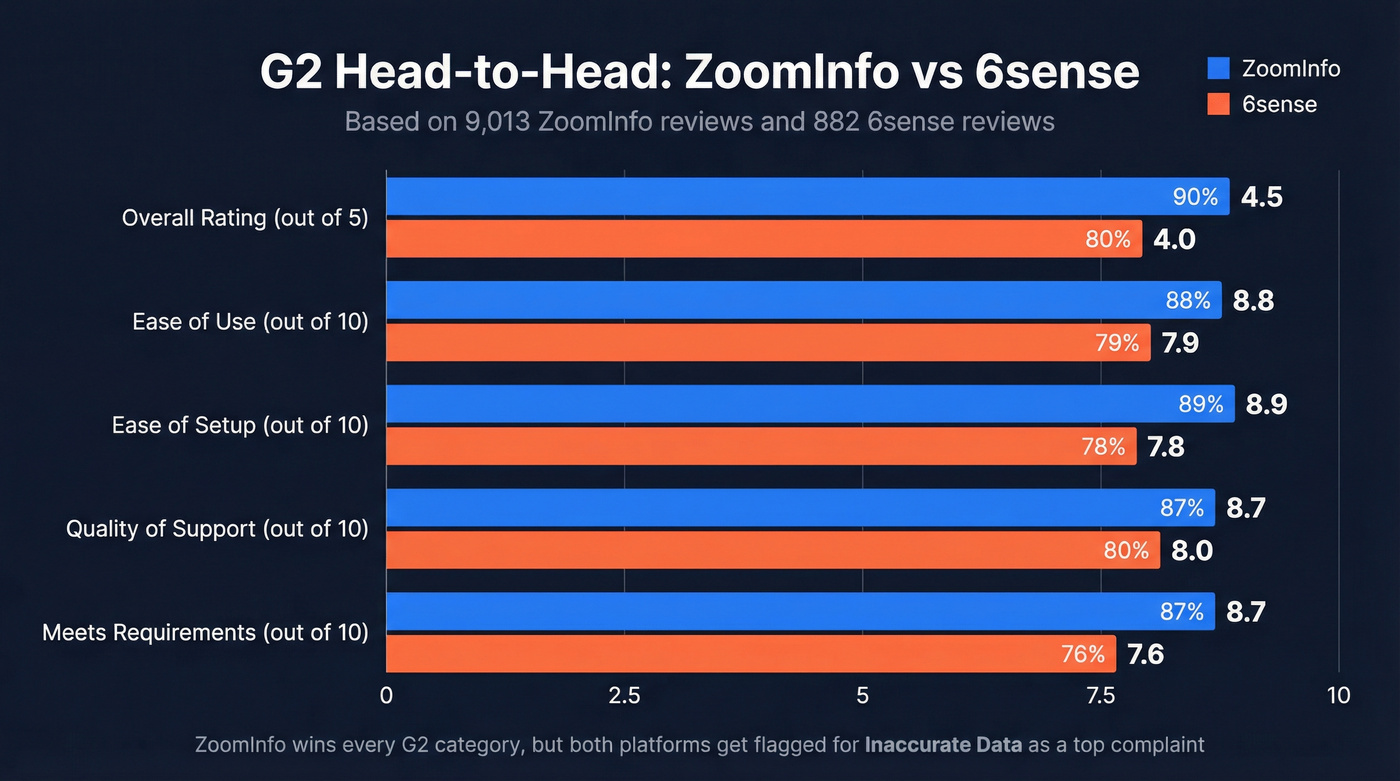
The G2 comparison page tells a revealing story through its "Pros & Cons" tags. 6sense's top pro tags are Lead Generation (181 mentions) and Intent Data (178) - users love the intelligence layer. But Inaccurate Data shows up 133 times as a con. ZoomInfo's top pro is Contact Information (421 mentions), and Data Accuracy is its second-most-common pro tag at 397 mentions. Yet Inaccurate Data (219) and Outdated Data (219) are its most common complaints too. The data is polarizing, not universally bad - your experience depends heavily on the industries and geographies you're targeting.
On Trustpilot, ZoomInfo sits at 1.5/5 across 293 reviews. Recurring themes are brutal: outdated contact information, aggressive sales outreach after initial demos, and renewal lock-in when teams miss the cancellation window. One reviewer put data accuracy at "around 55%." That's anecdotal, but it matches the pattern across G2 tags.

Both 6sense and ZoomInfo users flag "Inaccurate Data" as a top complaint on G2. Prospeo delivers 98% verified email accuracy through a proprietary 5-step verification process - with a 7-day data refresh cycle, not the 6-week industry average. At ~$0.01 per email, a 10-person team spends $2-5K/year instead of $65-75K.
Stop debating which expensive tool has less bad data. Start with data that's actually accurate.
Pricing Breakdown
Neither platform publishes transparent pricing. Here's what teams actually spend.
6sense Pricing
Based on Vendr's benchmark data across 302 purchases, the median annual contract lands at $58,310/year. The range runs from ~$10,600 for smaller deployments to $137,000+ for enterprise implementations.
- Sales Intelligence + Data Credits: $50,000-$80,000/year
- Sales Intelligence + Predictive AI: ~$50,000/year plus add-ons
- Full stack (SI + Credits + Predictive): $100,000-$200,000+/year
- Enterprise ceiling: $300,000+/year for large TAM + multiple modules
6sense offers a free plan - $0 with 50 credits/month, company and people search, and a Chrome extension. It's a genuine entry point, though the gap between "free" and enterprise pricing is a canyon. Enterprise deployments often require a two-year commitment, and credits don't roll over.
ZoomInfo Pricing
ZoomInfo's tiers start lower but scale fast:
- Professional: $15,000-$18,000/year (3 seats, 5,000 bulk credits)
- Advanced: $25,000-$30,000/year (3 seats, 10,000 bulk credits)
- Elite: $40,000-$45,000+/year (3 seats, 10,000 bulk credits)
Those are base prices. Most teams land at $30,000-$60,000+ after adding seats ($1,500-$5,000 per seat/year depending on plan), extra credits (roughly $5,500 for 10,000 credits up to $32,000 for 100,000 credits), and module add-ons like Enrich ($10-15k/year) or Global Data ($10k+/year). Renewals typically increase 10-20%, and you need to give 60-90 days notice before term end to avoid auto-renewal.
TCO for a 10-Person Sales Team
| Cost Component | ZoomInfo | 6sense | Prospeo |
|---|---|---|---|
| Base platform | ~$25-30k (Advanced) | ~$58k (median) | ~$2-5k/yr |
| Extra seats | ~$10.5-35k (7 seats) | Varies by contract | Per-credit, no seats |
| Overages/add-ons | ~$15-20k | Implementation costs | Scale as needed |
| 12-month total | ~$70-75k | ~$65-80k | ~$2-5k |
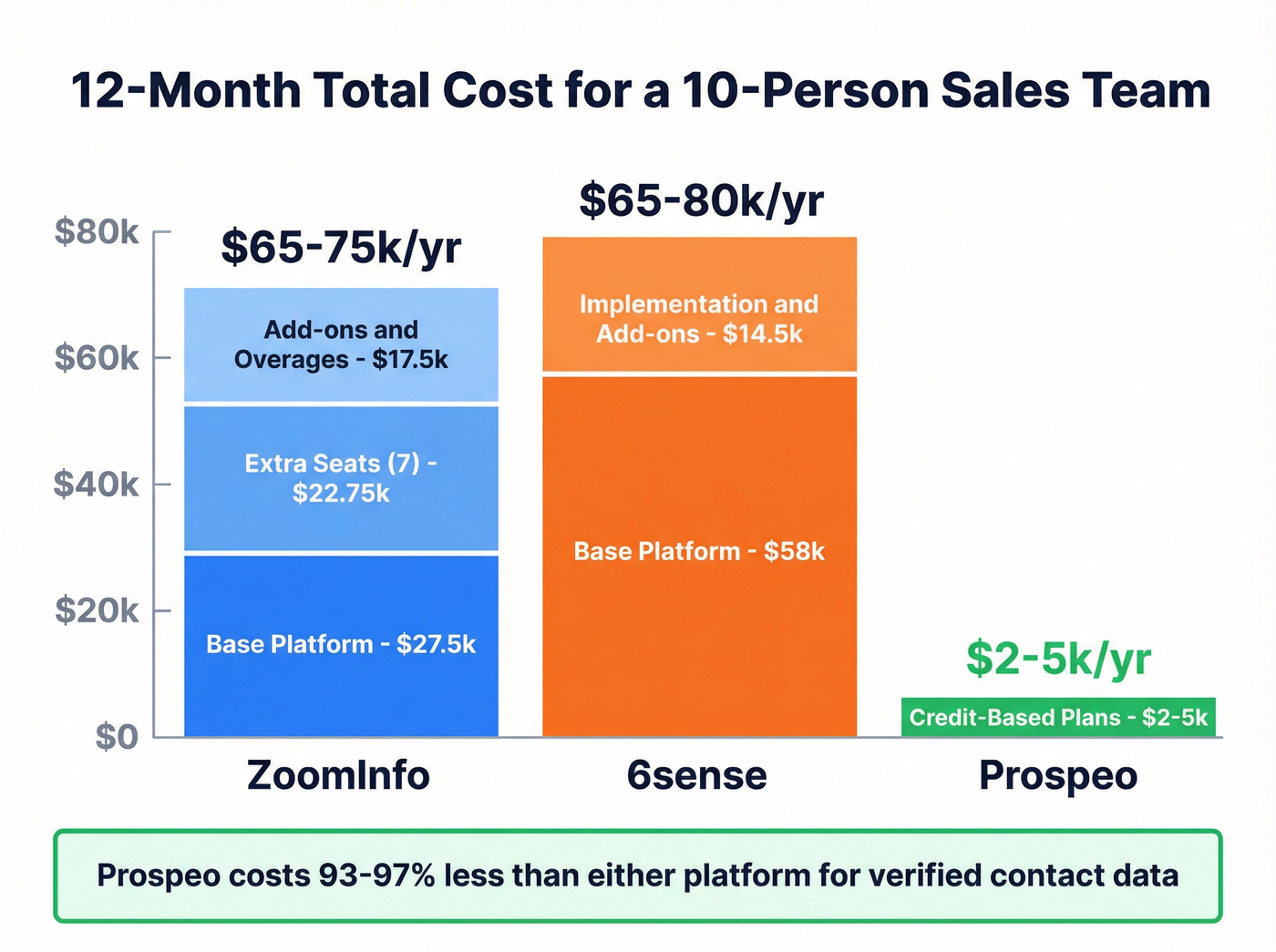
Let's be honest - those numbers are hard to stomach for a team that hasn't proven its outbound motion yet.
Implementation & Time-to-Value
ZoomInfo can get your team productive in days, not months. Database access is near-immediate - reps can search and export contacts on day one. Full intent and enrichment setup takes configuration, but the core value of finding people to call works out of the box. The G2 ease of setup score of 8.9 reflects this.
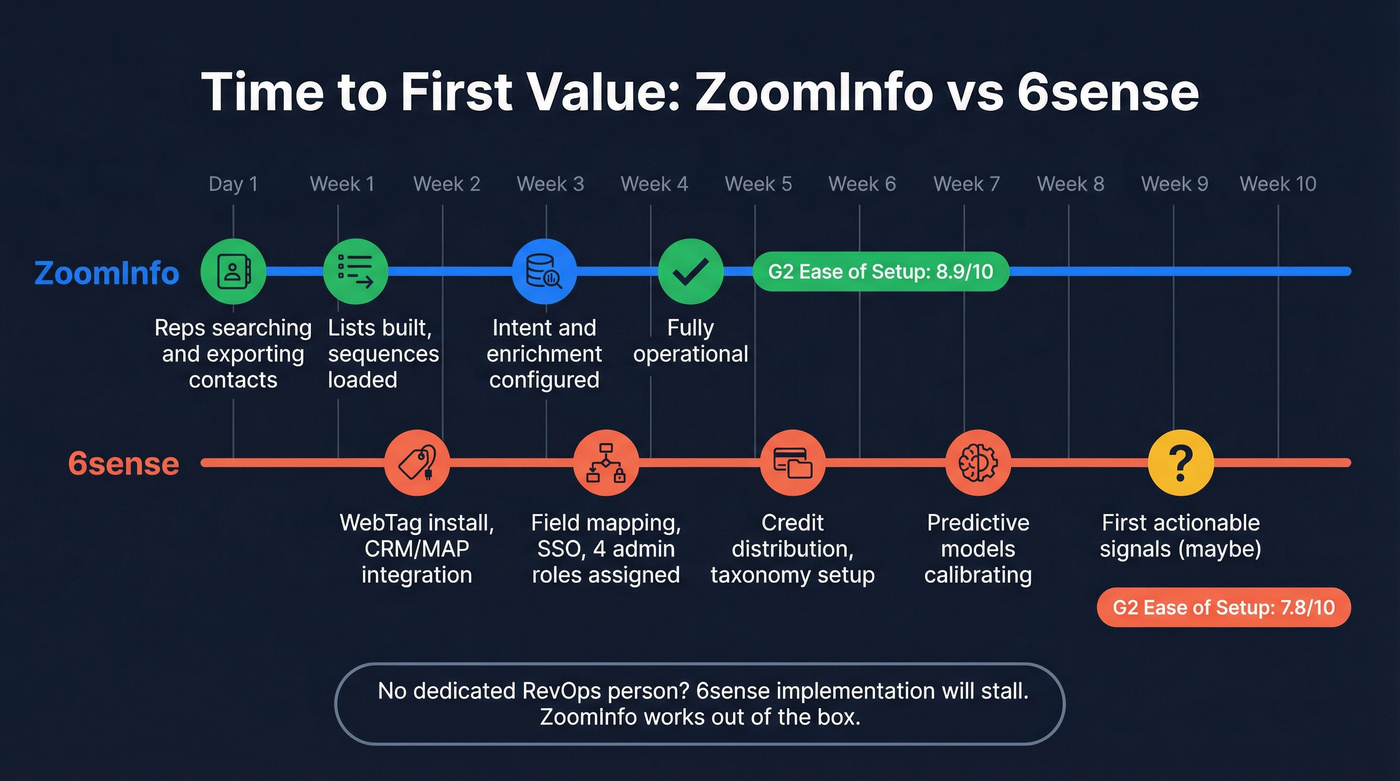
6sense is a different story entirely. Implementation requires installing the 6sense WebTag, integrating your CRM/MAP/SEP, mapping and standardizing fields across systems, configuring SSO and security, and setting up credit distribution. If you've purchased the Predictive add-on, add data taxonomy setup and opportunity definition modeling on top. Four separate admin roles need to be assigned and trained. Don't have a dedicated ops person? Skip 6sense. The G2 ease of setup score of 7.8 tells the story: this isn't a tool you turn on, it's a platform you implement.
We've talked to teams that spent eight weeks just getting 6sense's predictive models calibrated before they saw a single actionable signal. That's fine if you're a 500-person company with a RevOps team of five. It's a disaster if you're a 30-person startup trying to hit quarterly targets.
Vendor Stability
ZoomInfo posted $1.25B in FY2025 revenue (+3% YoY) with 1,921 customers at $100k+ ACV; the upmarket segment represents 74% of total ACV. The company is profitable and buying back shares aggressively. But the 90% net revenue retention rate is a yellow flag - existing customers are spending less on average, signaling consolidation pressure or churn at the margins. The 2026 growth outlook is flat. ZoomInfo isn't going anywhere, but it isn't accelerating either.
6sense has raised $576M in total funding and reported $200M+ ARR in FY2024 with 30% customer base growth. Strategic C-suite hires in early 2025 suggest the company is investing in growth, not preparing for an exit. ISO 27001:2022 and SOC 2 Type 2 certifications check the enterprise security boxes.
The Data Accuracy Problem
Here's the thing nobody wants to say out loud: "Inaccurate Data" is a top G2 con for both platforms - 133 mentions for 6sense, 219 for ZoomInfo. We've watched this scenario play out repeatedly: a team exports 5,000 contacts, 30-40% of emails bounce on the first sequence, and domain reputation takes weeks to recover.
This is where running exports through a verification layer before they touch a sequence becomes essential. Prospeo's email finder hits 98% accuracy with a 7-day data refresh cycle, and its mobile finder covers 125M+ verified numbers with a 30% pickup rate. At ~$0.01/lead with no contracts, it's not a replacement for ABM orchestration or intent - it's the accuracy layer that protects your sender reputation regardless of where the original data came from.
If you're trying to reduce bounces and protect deliverability, start with an email verification workflow before you scale volume.
When to Choose Which
Choose ZoomInfo if you're a sales-led organization that needs a large contact database for outbound, your team can absorb $30-60k+/year, and you want reps productive in days. Be prepared to negotiate contracts aggressively and watch for renewal creep.
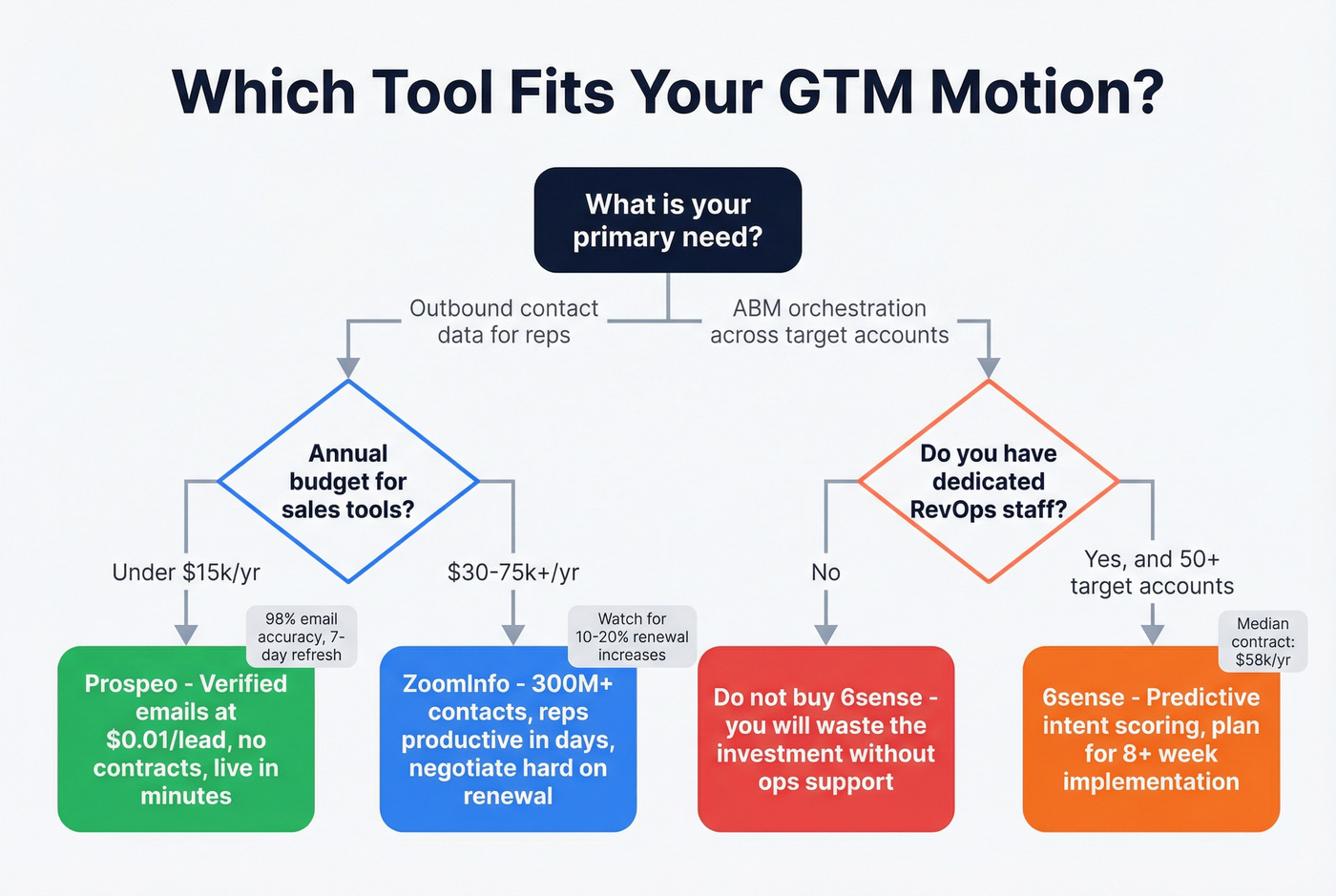
Choose 6sense if you're running enterprise ABM with 50+ target accounts, you have dedicated ops resources for a multi-week implementation, and you need predictive buying-stage intelligence to coordinate marketing and sales motions. Budget $60-120k+/year.
For teams that don't fit either profile - and in our experience, that's most teams asking this question - the 6sense vs ZoomInfo debate is the wrong frame. Most teams don't need predictive ABM orchestration or a $40k database. They need verified emails and direct dials that actually connect. Start there, prove the outbound motion works, then layer on intent and ABM when the pipeline justifies the spend. Think of it as a GTM maturity ladder: early-stage outbound teams start with self-serve data tools, scaling sales-led orgs graduate to ZoomInfo, and enterprise ABM with marketing-sales alignment is where 6sense earns its price tag.
If you're building a lean stack, compare options in our guide to sales prospecting platforms and list building tools.
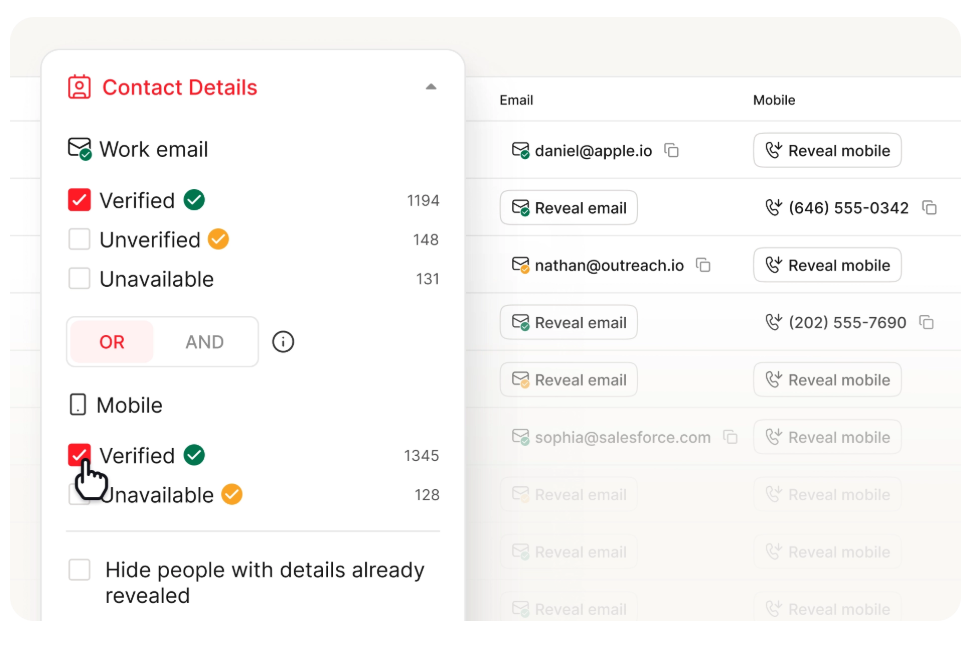
You saw the TCO table: $70K+ for ZoomInfo, $65-80K for 6sense, or $2-5K with Prospeo. That's not a typo. 300M+ profiles, 125M+ verified mobiles, 30+ search filters including intent data powered by Bombora - all self-serve with no annual contracts or 60-day cancellation traps.
Get enterprise-grade contact data at 90% less than ZoomInfo. No sales call required.
Quick mentions for your shortlist: Demandbase is the closest 6sense alternative for ABM orchestration with a different approach to account intelligence - expect $40-100k+ annually. Apollo is the self-serve play if ZoomInfo's pricing is a dealbreaker; paid plans run ~$49-99/mo per user with 275M+ contacts.
If you're evaluating ABM seriously, use an ABM maturity model and tighten your ABM account prioritization before you buy.
FAQ
Is 6sense or ZoomInfo better for small teams?
Neither is built for small teams. ZoomInfo starts at ~$15k/year; 6sense's median contract is $58k/year per Vendr benchmarks. Teams under 20 reps get better ROI from self-serve tools - 75 free emails/month, no annual contracts, and credit-based scaling from ~$0.01/lead.
Can you use 6sense and ZoomInfo together?
Yes - some enterprise teams use 6sense for account prioritization and buying-stage intelligence while pulling contact-level data from ZoomInfo. Expect $100k+ in combined annual cost and significant integration work to keep the two platforms synced with your CRM.
Why is ZoomInfo's Trustpilot rating so low?
ZoomInfo holds 1.5/5 on Trustpilot across 293 reviews. The recurring complaints center on outdated contact data, aggressive sales outreach after initial demos, and renewal lock-in when cancellation windows are missed - a pattern consistent with its G2 con tags.
How long does 6sense take to implement?
Expect a multi-week onboarding process including WebTag installation, CRM/MAP integration, field mapping, SSO configuration, and credit distribution setup. Predictive features add data taxonomy definition and opportunity model training. Four admin roles need assignment - plan 30-60 days before the platform delivers reliable signals.
What does ZoomInfo actually cost per year?
Base tiers start at $15-18k/year for 3 seats, but most teams land at $30-60k+ after adding seats ($1,500-$5,000 each), extra credits, and module add-ons. Renewals typically increase 10-20%, and missing the 60-90 day cancellation window locks you into another term.