

Email Verification for Outreach: The 2026 Guide to Protecting Your Domain
A founder we know sent 2,000 scraped emails without verifying a single one. Bounce rate hit 14%. Gmail flagged the domain within three days, and it took six weeks to claw back deliverability. That wasn't a disaster because the list was bad - it was a disaster because nobody checked first. In ZeroBounce's most recent analysis, only 62% of emails submitted for verification were actually valid. The other 38%? Landmines sitting in your sequences right now.
Email verification for outreach isn't a nice-to-have. It's the difference between a domain that books meetings and one that lands in spam - for every email you send, including your CEO's investor updates.
Three Rules Before You Send
- Verify before every campaign. Not once a quarter. Every time.
- Stay under 2% hard bounces. That's the line between invisible and flagged.
- Re-verify monthly. Lists decay roughly 23% per year. A six-month-old list is already 11-12% bad.
If you want to skip the scrape-then-verify cycle entirely, start with a pre-verified data source like Prospeo - 7-day refresh, 98% email accuracy, 143M+ verified email addresses. If you need a standalone verifier, Bouncer and MillionVerifier offer the best value at their respective price points.
Why This Protects Your Domain
Email service providers don't give you a warning letter. They give you a cliff.
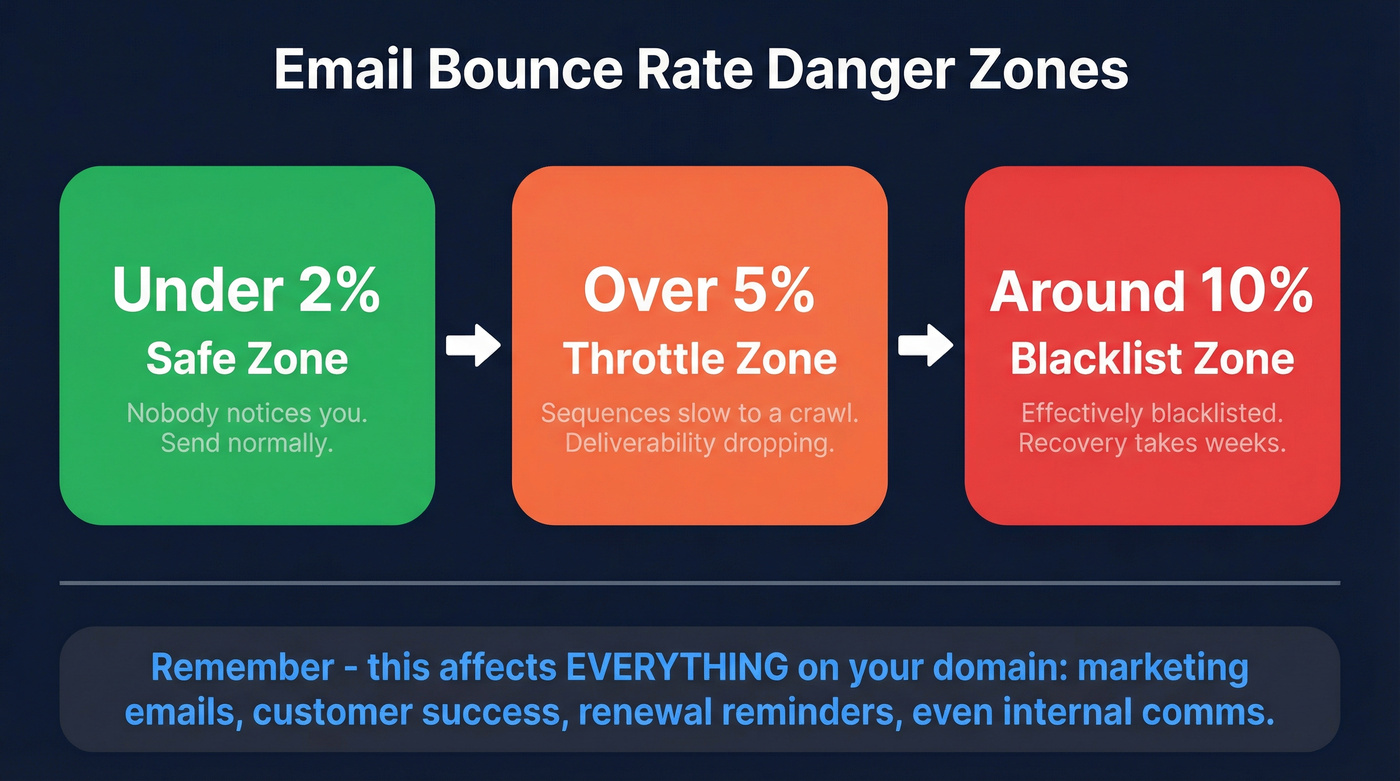
Bounce-rate thresholds:
- Under 2%: Safe. Nobody notices you.
- Over 5%: Throttling begins. Your sequences slow to a crawl.
- Around 10%: Effectively blacklisted. Recovery takes weeks.
These thresholds aren't just about your cold outreach domain. When your sender reputation tanks, it affects everything tied to that domain - marketing newsletters, customer success emails, internal communications. We've seen teams lose deliverability on renewal reminders because an SDR burned the domain with unverified lists. That kind of collateral damage is entirely preventable.
People change jobs, companies shut down mailboxes, IT admins reconfigure domains. If you're not verifying regularly, you're sending to an increasingly rotten list every single month.
How Verification Actually Works
Every verification tool runs roughly the same six-step process. Understanding it helps you spot which tools cut corners.
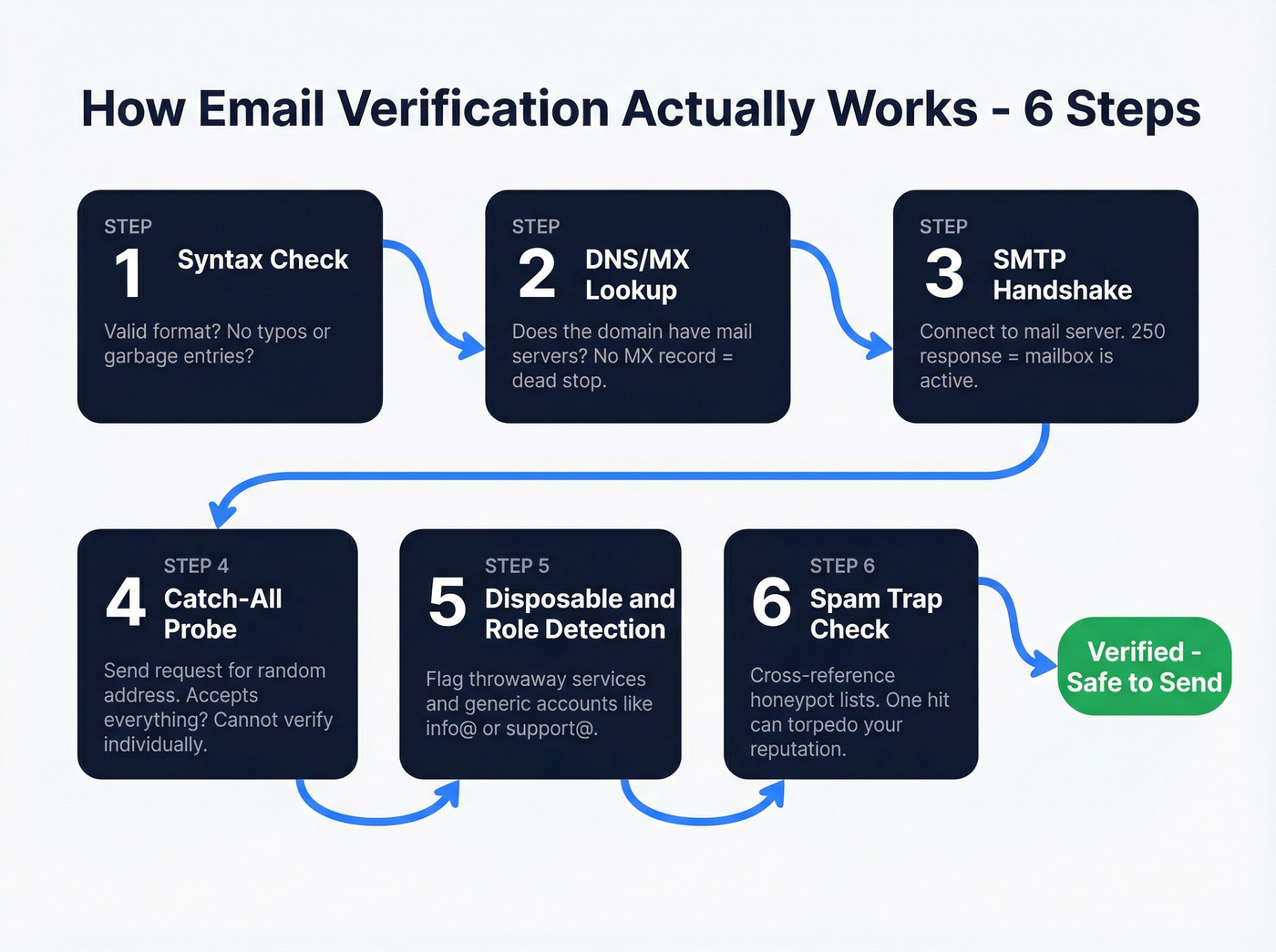
Syntax check. Confirms valid formatting per RFC 5322 - local part under 64 characters, domain under 255, no illegal characters. This catches typos and garbage entries.
DNS/MX lookup. Queries the domain's DNS records to confirm mail exchange servers exist. No MX record means the domain can't receive email. Dead stop.
SMTP handshake. Opens a connection to the mail server and issues HELO, MAIL FROM, and RCPT TO commands. A 250 response means the mailbox is active. A 550 means it doesn't exist.
Catch-all probe. Sends a request for a randomly generated address at the domain. If the server accepts it, the domain is catch-all - it accepts everything, making individual verification impossible through SMTP alone.
Disposable and role-based detection. Addresses from throwaway services and generic role accounts like info@ or support@ get flagged. These rarely convert and often signal spam traps.
Spam trap check. The best tools cross-reference against known spam trap databases and honeypot lists. Hitting even one spam trap can torpedo your sender reputation overnight.

You just read the 6-step verification process every tool runs. Prospeo runs all six - including catch-all handling, spam-trap removal, and honeypot filtering - before you ever see the email. 143M+ emails at 98% accuracy, refreshed every 7 days. Snyk dropped from 35-40% bounces to under 5% and added 200+ opportunities per month.
Skip the scrape-then-verify cycle. Start with clean data.
The Workflow That Keeps You Safe
Knowing how verification works is step one. Knowing when to verify is what actually keeps you out of spam.
Three verification moments: at capture, when an email first enters your CRM; pre-campaign, right before launch even if the list was clean last month; and monthly sweep, your entire active database. Quarterly is the absolute floor, but monthly is the standard for teams sending at scale. If you're building a repeatable system, use a documented CRM hygiene process so verification doesn't get skipped.
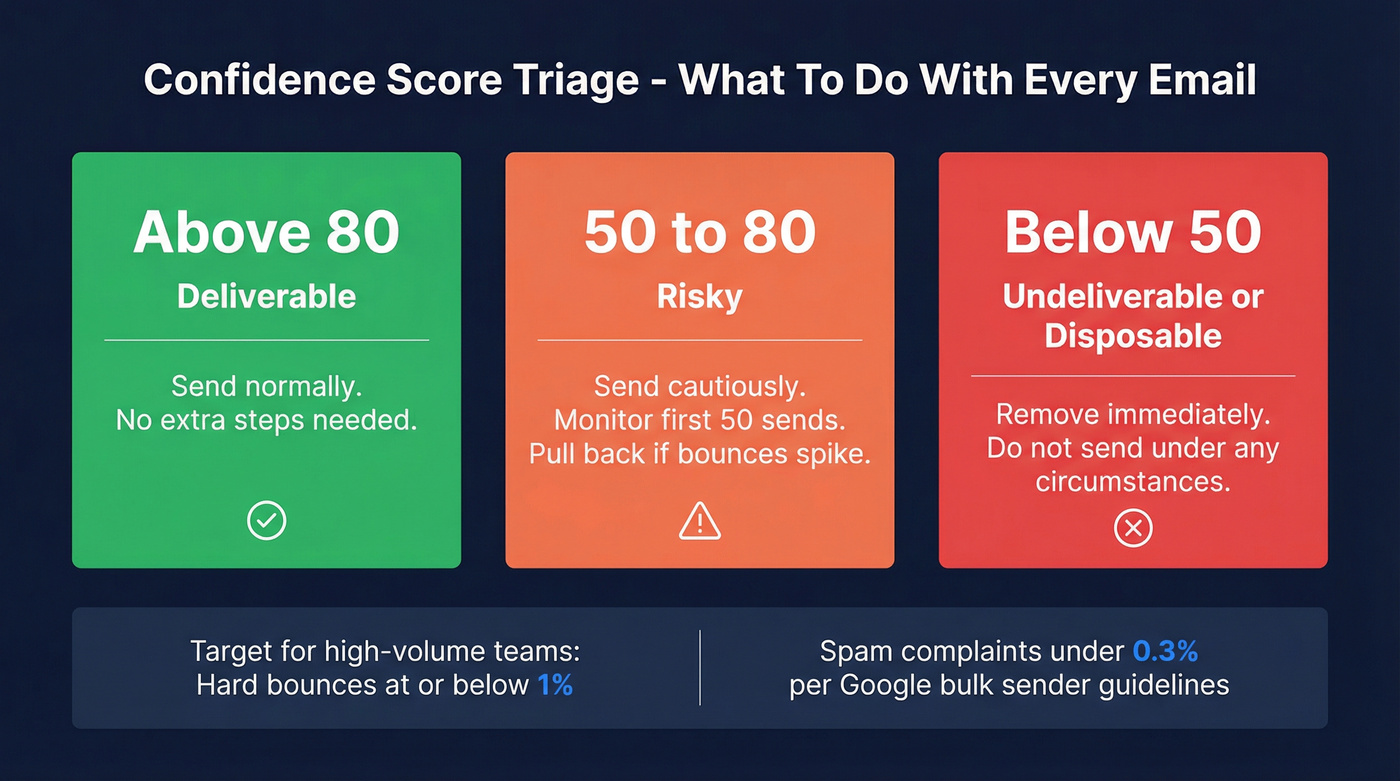
Confidence-score triage:
Most verification tools return a confidence score, not just a binary valid/invalid. Use it aggressively.
- Above 80 (deliverable): Send normally.
- 50-80 (risky): Send cautiously. Monitor the first 50 sends. Pull back if bounces spike.
- Below 50 (undeliverable/disposable): Remove immediately.
For teams running high-volume sequences - especially agencies managing multiple client domains - the targets are tighter: hard bounces at or below 1% and spam complaints under 0.3%. Those numbers align with Google's bulk sender guidance and give you headroom before anything gets flagged. Pair this with an email deliverability checklist so you’re not fixing issues after the fact.
Best Verification Tools for Cold Outreach
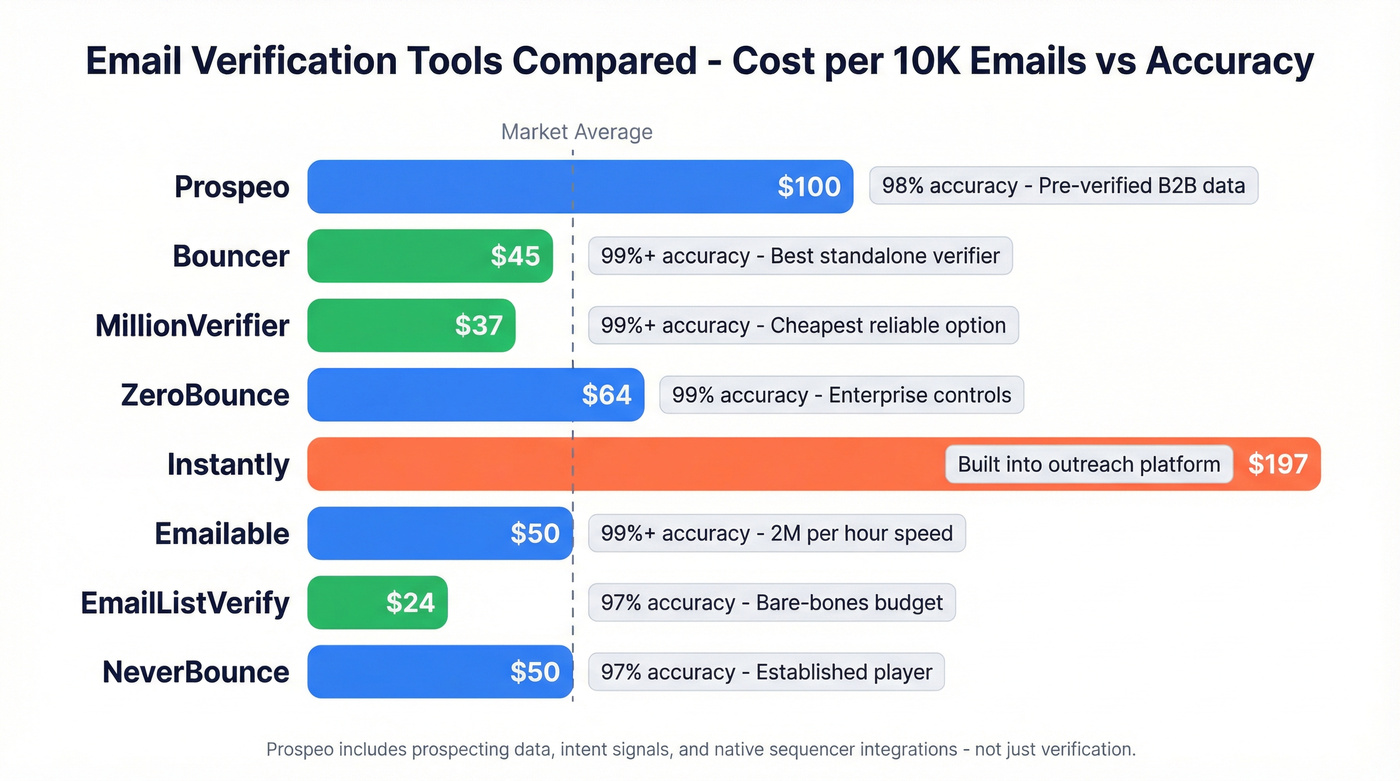
| Tool | Accuracy | Free Tier | Cost / 10K | Best For | Key Strength |
|---|---|---|---|---|---|
| Prospeo | 98% | 75 verified emails/mo | ~$100 | Outbound teams | Pre-verified B2B data |
| Bouncer | 99%+ | 100 | $45 | Standalone accuracy | Highest-rated verifier |
| MillionVerifier | 99%+ | None | ~$37 | Tight budgets | Cheapest reliable option |
| ZeroBounce | 99% | 100 | $64 | Regulated industries | Enterprise controls |
| Instantly | - | None | $197/mo (10K credits) | Instantly users only | Built into outreach |
| Emailable | 99%+ | 250 | $50 | Bulk speed | 2M/hr processing |
| EmailListVerify | 97% | 100 | $24 | Lowest cost | Bare-bones budget pick |
| NeverBounce | 97% | 10 | $50 | Mid-market default | Established player |
Prospeo
If you're running outbound at any real scale, start here. Prospeo isn't a standalone verifier - it's a B2B data platform where verification is baked into the data before you ever export it. Instead of scraping emails and running them through a separate tool, you're pulling from 143M+ emails that have already passed a 5-step verification process including catch-all handling, spam-trap removal, and honeypot filtering.
The database covers 300M+ professional profiles with 98% email accuracy, refreshed on a 7-day cycle while the industry average sits at six weeks. At roughly $0.01 per email, it's competitive with standalone verifiers - except you're also getting prospecting data, 30+ search filters, intent data across 15,000 topics, and native integrations with Instantly, Smartlead, Lemlist, HubSpot, and Salesforce. Snyk's team of 50 AEs dropped their bounce rate from 35-40% to under 5% after switching, generating 200+ new opportunities per month. Free tier gives you 75 verified emails to test.
For teams that need verified leads ready to sequence, this is the fastest path from search to send. If you’re comparing platforms, see our breakdown of sales prospecting platforms.
Bouncer
Bouncer is the tool we'd recommend if you need a pure standalone verifier and nothing else. It holds a 4.9 on Capterra from 233 reviews and a 4.8 on G2 from 232 - those are exceptional scores, and the consensus on r/sales and r/coldemail threads consistently backs it up for standalone verification accuracy.
Use this if: You already have a data source and just need to clean lists before sending. At $0.008 per email on pay-as-you-go or $50/month for 10,000 verifications, it's the best value standalone option. Processing speed hits 180K emails per hour.
Skip this if: You need prospecting data too. Bouncer only verifies - you still need a separate source to find the emails in the first place. If that’s your bottleneck, start with email hunter tools or a list building workflow.
MillionVerifier
Use this if: You're on a tight budget and need to verify large lists without overthinking it. At roughly $37 for 10,000 verifications, it's the cheapest option that still delivers reliable results.
Skip this if: You need deep integrations, compliance certifications, or real-time API verification at scale. MillionVerifier is a no-frills tool - upload a CSV, get results, move on.
ZeroBounce
The enterprise pick for teams that want more controls and reporting around list hygiene. At $64 for 10K verifications it's pricier than Bouncer or MillionVerifier, but you're paying for the extra tooling and 45 integrations. Worth it if you're in a regulated industry where audit trails matter.
Instantly
Instantly's verification makes sense only if you're already running outreach on the platform. Verifying leads inside the same tool where you build campaigns eliminates CSV exports and third-party accounts. If you're still choosing your stack, compare cold email marketing tools before you commit.
The tradeoff is cost. Credits run $47/month for 1,500, $97/month for 5,000, or $197/month for 10,000. That's about 3-5x the cost of standalone verifiers. Worth it for convenience; not worth it if cost-per-verification matters to you.
Emailable, EmailListVerify, NeverBounce
Emailable is the speed pick - 2M emails per hour, $50 for 10K. EmailListVerify is the absolute cheapest at $24 for 10K but bare-bones. NeverBounce is solid but unremarkable at $50 for 10K. Nothing wrong with it, nothing that makes you switch to it either.
The Catch-All Problem
More than 9% of verified emails land in catch-all domains. That's a significant chunk of any B2B list, and most verification tools just flag them as "risky" and leave the decision to you.
Send to catch-alls if: The contact is high-value, the domain is a known company, and you can throttle volume. In our experience, sending to the first 50 catch-all addresses in a batch and monitoring bounce rates catches problems before they scale.
Skip catch-alls if: You're running high-volume sequences where even a small bounce spike could damage your domain, or if you're warming a new sending address. If you’re also tightening your setup, make sure your SPF, DKIM, DMARC is correct before scaling volume.
Here's my honest take: if your deal sizes are under five figures, you probably shouldn't be spending time manually triaging catch-all domains at all. Use a data source that resolves them for you, or skip them entirely. The math doesn't justify the risk.
Start With Verified Data Instead
The best verification workflow is the one you don't need.
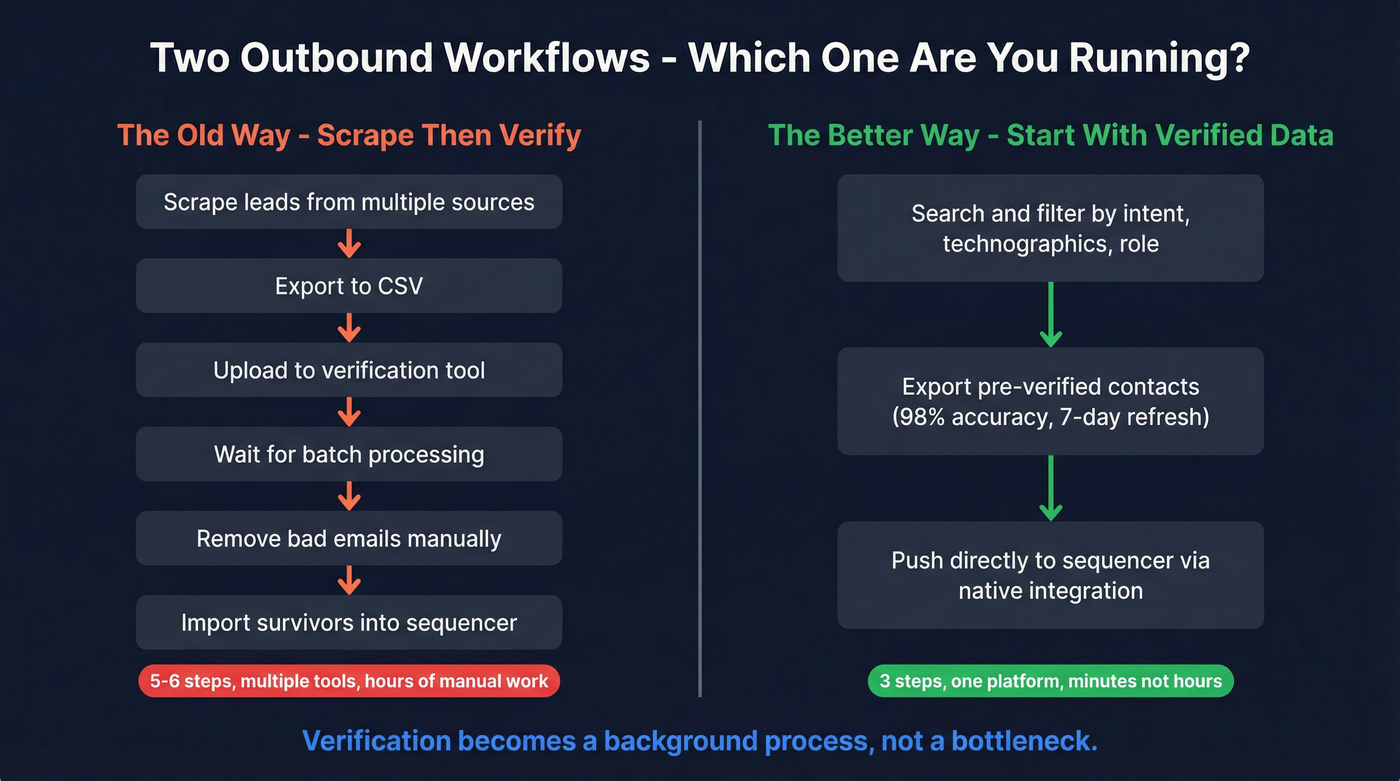
Most outbound teams follow the same cycle: scrape leads from various sources, dump them into a CSV, run them through a verifier, remove the bad ones, load the survivors into a sequencer. It works, but it's like buying spoiled groceries and hoping your fridge fixes them.
The alternative is starting with clean data. When your source refreshes every 7 days and every email has already passed catch-all handling and spam-trap removal before export, you eliminate an entire step in the workflow. No separate verification tool subscription, no CSV round-trips, no waiting for batch processing. You search, filter by buyer intent and technographics, export verified contacts, and push them directly to your sequencer through native integrations. If you want the broader system, follow a documented prospecting workflow.
Let's be real about the tradeoffs: Bouncer's published accuracy is 99%+ and Prospeo delivers 98% with a 7-day refresh cycle. The budget options work but require more manual cleanup. For teams doing serious outbound, the time saved by starting with pre-verified data pays for itself within the first week. Verification becomes a background process rather than a bottleneck. If you’re scaling, use cold email volume best practices to avoid deliverability whiplash.
Every month you don't re-verify, your list loses another 2% to job changes and dead mailboxes. Prospeo's 7-day refresh cycle handles that automatically - no monthly sweeps, no third-party verifier bills. At $0.01 per email, it costs less than most standalone verification tools, and the data arrives ready to sequence.
Pre-verified emails that stay fresh. Protect your domain from day one.
FAQ
How often should I re-verify my email list?
Monthly at minimum. With roughly 23% annual decay, a six-month-old list is already 11-12% bad - well past the threshold where providers start throttling. Teams sending over 1,000 emails per week should verify weekly or use a source with a 7-day refresh cycle.
What's a safe bounce rate for cold outreach?
Under 2% is safe. Over 5% triggers throttling. Hit 10% and you're effectively blacklisted for weeks. Agencies managing multiple client domains should target hard bounces at or below 1% and spam complaints under 0.3%.
Should I send to catch-all emails?
Yes, but throttle carefully. Send to the first 50 catch-all addresses in a batch and monitor bounces in real time. Pull back immediately if the rate spikes above 2%. For lower-value campaigns, skip them entirely.
Are free verification tools reliable enough?
Free tiers work for testing - Emailable gives 250 credits, Bouncer and ZeroBounce each offer 100, and Prospeo provides 75 pre-verified emails monthly. They won't scale past a few hundred leads, but they're enough to evaluate accuracy before committing.
What's the difference between verification and validation?
In practice, they're interchangeable. Technically, "validation" sometimes refers to syntax-only checks like format and domain existence, while "verification" includes full SMTP-level confirmation that the specific mailbox exists and accepts mail.