Is ZoomInfo's Email Verification Actually Good Enough?
You export 5,000 contacts from ZoomInfo on Monday. By Wednesday, your sequence has an 8% bounce rate and your ESP is threatening to throttle your domain. The contacts were "verified." So what happened?
ZoomInfo email verification is supposed to prevent exactly this. But email lists decay by roughly 3% every month - people change jobs, companies sunset domains, mailboxes get deactivated. With global inbox placement sitting around 83.5%, you can't afford to stack bad data on top of existing deliverability headwinds. Verification is only as good as its last refresh, and that's where the database model starts to crack.
The Short Answer
ZoomInfo's verification is real infrastructure. They integrated NeverBounce technology, built a 20+ step process, and run a massive contributory network. But the refresh cadence creates a gap between "verified" and "deliverable." If you're running cold outbound, layer an external verifier on every export - or switch to a source that refreshes weekly.
How ZoomInfo Verifies Emails
ZoomInfo integrated NeverBounce's technology in March 2019 and built verification around a proprietary cleaning process with more than 20 steps. Each contact gets checked up to 75 times through syntax validation, bad/defunct/disposable domain detection, MX record checks, real-time SMTP connection queries, and machine-learning models trained on historical send data.
The raw data isn't the problem - ZoomInfo's database spans 500M+ contact profiles and 100M+ company profiles. The problem is structural.
SMTP checks can only accurately validate about 50% of business domains. Enterprise mail servers running Mimecast, Proofpoint, or similar security layers often behave like catch-all gateways, making it impossible to confirm whether a specific mailbox exists from SMTP alone. ZoomInfo fills this gap with proprietary send-and-bounce data and a contributory network of 200,000+ members feeding them 20M+ email signatures per month. They employ 300+ in-house researchers and data analysts, updating 4M individuals daily. But scale doesn't solve the timing problem.
Is the Verification Good Enough?
Here's the math that matters.
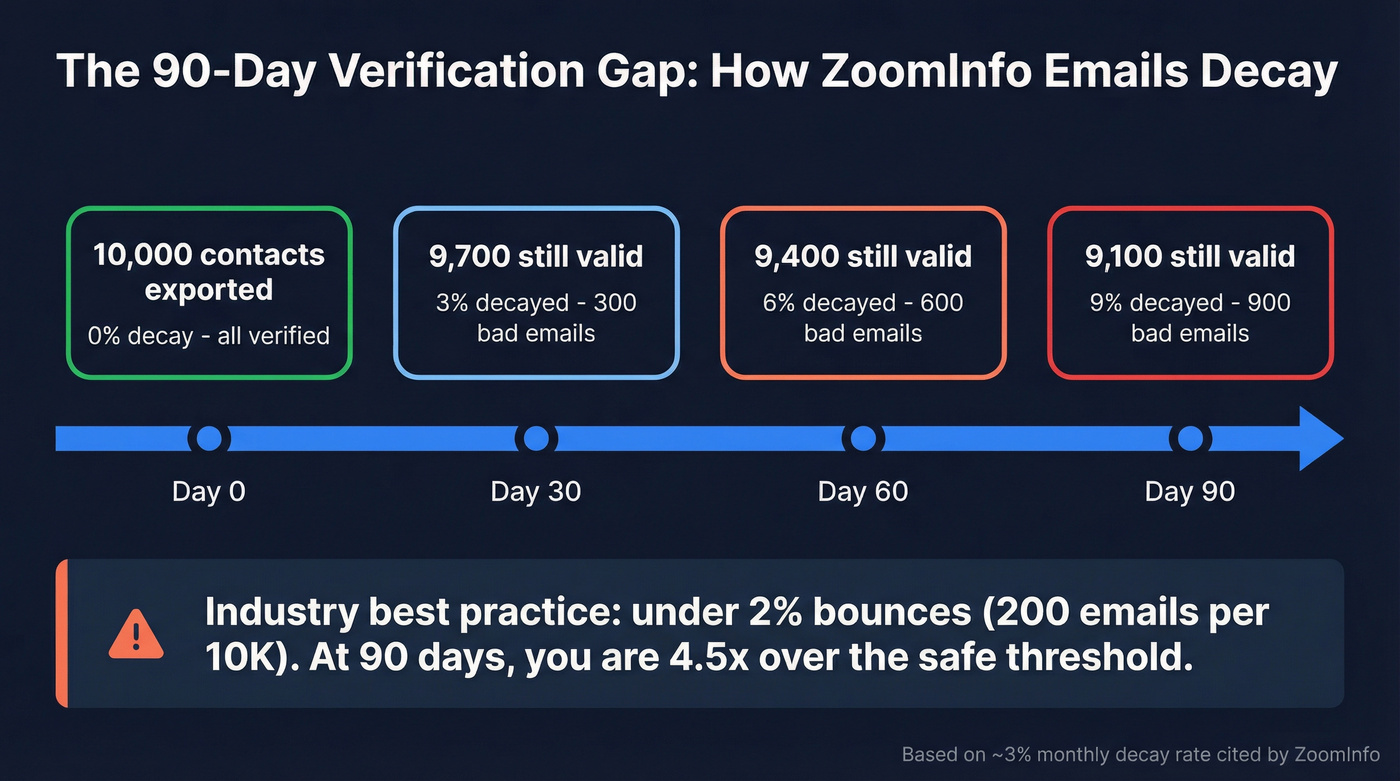
ZoomInfo says email lists decay at ~3% per month. A commonly cited update cadence for ZoomInfo data is around 90 days. If your "verified" status is that old, you're looking at roughly 9% decay over that window - meaning a meaningful chunk of emails can be dead even if they were valid when last checked. For a deeper breakdown of list decay mechanics, see B2B Contact Data Decay.
Put that in real numbers. You pull 10,000 contacts for an outbound campaign. If ~9% have decayed since the last verification pass, that's ~900 bad emails. Industry best practice - and ZoomInfo's own guidance - is to keep total bounces below 2%. That's 200 emails on a 10,000-contact list. Without re-verification right before sending, you'll blow past that threshold easily.
Independent benchmarks back this up. Hunter's 2026 verifier test ran 3,000 real business emails through 15 tools. NeverBounce - the engine ZoomInfo integrated - scored 63.17% accuracy. The best tool in that test hit 70%. Hunter acknowledges dataset bias in their methodology, so the exact numbers aren't gospel. But the pattern is clear: verification has limits, and bundled verification inside a database platform has inherent freshness constraints. If you want a broader view of options, compare email checker tools and dedicated email ID validators.
We've seen teams burn sender domains in a single week by trusting bundled verification alone. The consensus across deliverability communities is consistent: always run external verification on purchased lists, ZoomInfo included. (If you're troubleshooting bounces specifically, start with Hard Bounce.)

Your ZoomInfo exports decay 3% every month. Prospeo's 7-day refresh cycle and 5-step verification deliver 98% email accuracy - so you never pay twice to clean data you already bought.
Get emails that land without a second verification bill.
What to Do Before You Hit Send
If you're sticking with ZoomInfo, this workflow keeps your domain safe:
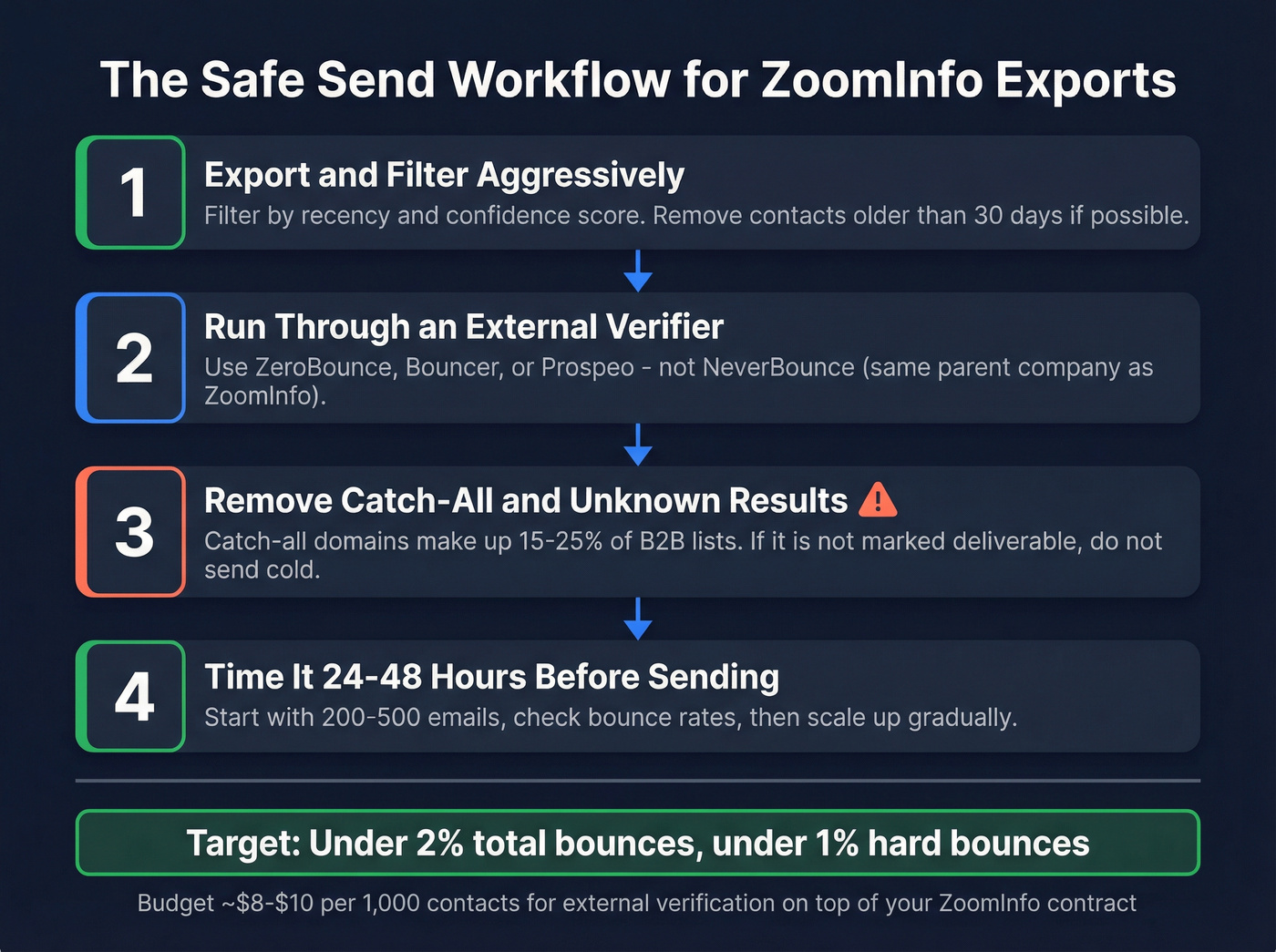
- Export your list - filter aggressively by recency and confidence score.
- Run the export through a dedicated verifier - ZeroBounce, Bouncer, or Prospeo's standalone email verification all work. (More on email verification for outreach.)
- Remove catch-all and unknown results. Exports often include statuses like "risky" or "catch-all." Treat anything that isn't "deliverable" as a no-send for cold outreach.
- Time your verification 24-48 hours before sending - not at import time. Start with 200-500 emails, check bounce rates, then scale.
Catch-all domains often make up 15-25% of B2B lists. Removing them is non-negotiable if you care about sender reputation. If you're building a deliverability-first process, use an email deliverability checklist.
The cost implication is real: roughly $8-$10 per 1,000 contacts for external verification, stacked on top of a $15-40k/year ZoomInfo contract depending on seats and modules. You're paying to verify data you already paid for.
ZoomInfo vs. Dedicated Verifiers
Let's be honest: ZoomInfo is still a strong all-in-one sales intelligence platform. But most teams don't need all-in-one. They need emails that actually land. If you're evaluating alternatives, start with sales prospecting platforms and a modern B2B sales stack.
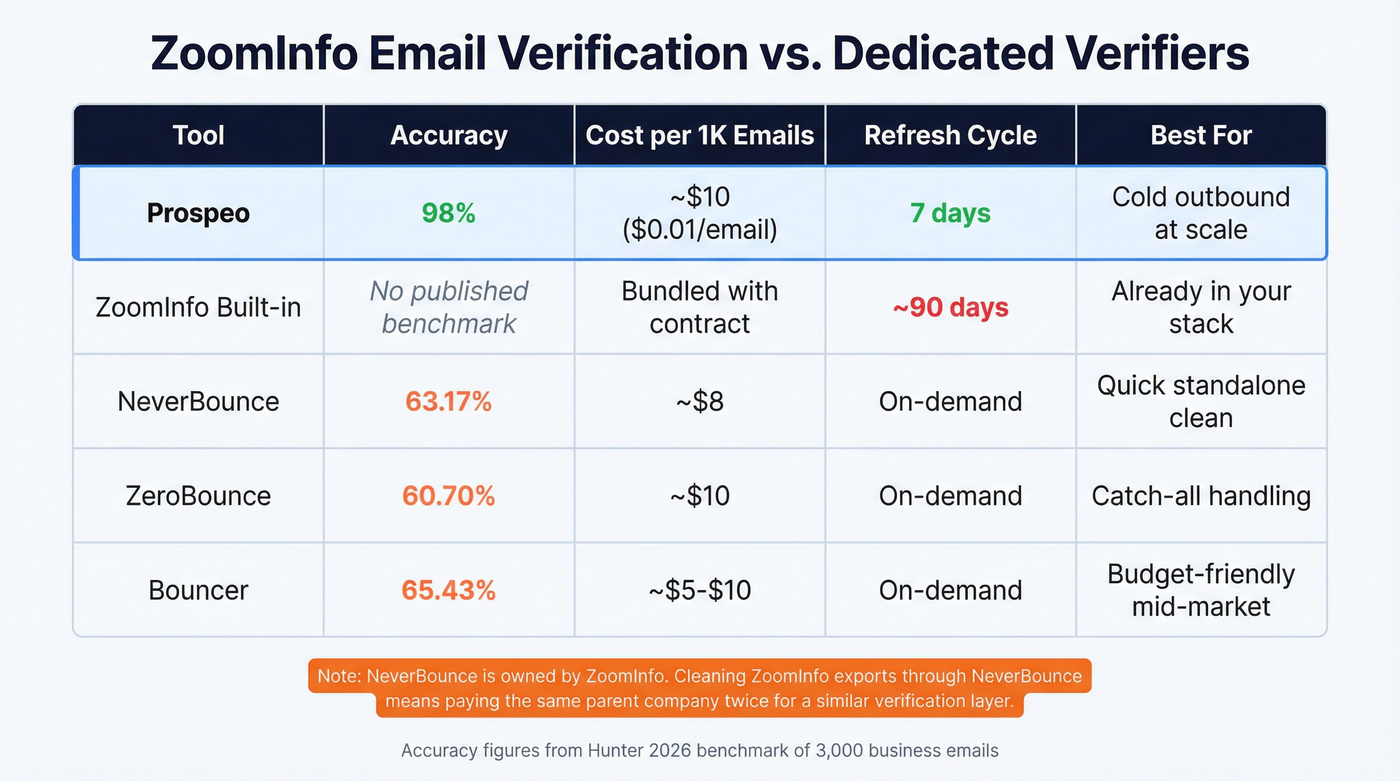
| Tool | Accuracy | Cost per 1K | Refresh | Best for |
|---|---|---|---|---|
| Prospeo | 98% email accuracy | ~$10 (~$0.01/email) | 7 days | Cold outbound at scale |
| ZoomInfo built-in | No published benchmark | Bundled with contract | ~90 days | Already in your stack |
| NeverBounce | 63.17%* | ~$8 | On-demand | Quick standalone clean |
| ZeroBounce | 60.70%* | ~$10 | On-demand | Catch-all handling |
| Bouncer | 65.43%* | ~$5-$10 | On-demand | Budget-friendly mid-market |
*Accuracy per Hunter's 2026 benchmark of 3,000 business emails.
Notice the NeverBounce line. It's owned by ZoomInfo. If you're exporting from ZoomInfo and cleaning through NeverBounce, you're paying the same parent company twice for a very similar verification layer.
A Different Approach: Don't Verify Stale Data - Start Fresh
There's a third path worth considering. Instead of verifying stale data after export, start with a source that doesn't go stale. This is also where data quality and prospect data accuracy matter more than tool branding.
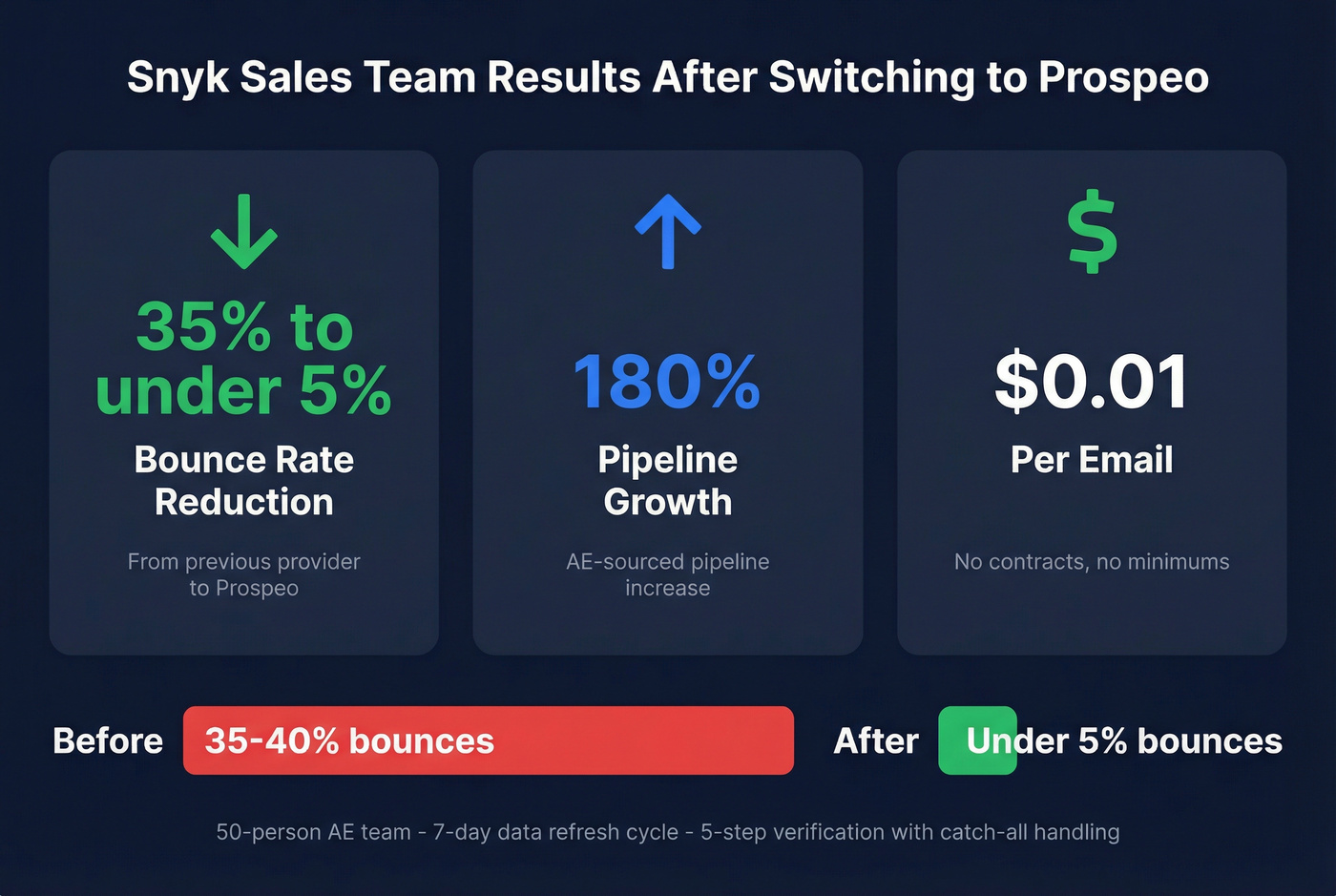
Prospeo runs a 5-step verification process with catch-all handling, spam-trap removal, and honeypot filtering across 300M+ professional profiles - all on a 7-day refresh cycle. When Snyk's 50-person AE team switched from their previous provider, their bounce rate dropped from 35-40% to under 5%, and AE-sourced pipeline jumped 180%. At roughly $0.01 per email with no contracts, it sidesteps the "pay to verify data you already paid for" problem entirely.
Skip this approach if your team is locked into a multi-year ZoomInfo contract and genuinely uses the full platform - intent data, org charts, technographics, the works. In that case, just add an external verification step and budget accordingly.
Snyk's 50-person sales team cut bounce rates from 35% to under 5% and grew pipeline 180% after switching. At $0.01 per email with no contracts, Prospeo replaces both your database and your verifier.
Stop stacking tools. Start with data that's already verified this week.
FAQ
Does ZoomInfo verify emails in real time?
ZoomInfo offers real-time verification and bulk list cleaning, but a "verified" label inside the database can still be weeks or months old by the time you send. For true send-time confidence, run a dedicated verifier 24-48 hours before launch. Tools like ZeroBounce or Bouncer provide an independent validation layer that catches decay ZoomInfo's refresh cycle missed.
What bounce rate should I expect from ZoomInfo exports?
Expect 2-8% bounces without external verification, depending on list age and industry. Best practice is under 2% total bounces with hard bounces below 1%. High-turnover sectors like tech and staffing trend toward the upper end. Always re-verify before sending.
Is NeverBounce the same as ZoomInfo verification?
Largely, yes. ZoomInfo acquired NeverBounce and integrated its cleaning technology into the platform in 2019. Using NeverBounce separately to clean ZoomInfo exports means paying the same parent company twice for a very similar underlying layer. If you want a genuinely independent validation pass, use a different provider.