How to Email C-Level Executives: A Data-Backed Playbook
A RevOps lead I know spent three months cold emailing directors and managers. Response rates hovered around 4%. Then she shifted the same campaign - same offer, same product - up to VPs and C-suite. Positive reply rate jumped to 14%. The emails didn't get better. The audience did.
Here's the counterintuitive truth buried in the data: C-level executives reply 3.3x more often than managers, with a 14.16% positive reply rate across 2M+ emails analyzed by Sales.co. Meanwhile, average cold email reply rates dropped from 6.8% in 2023 to 5.8% in 2024 - a 15% year-over-year decline. C-level rates held steady. The problem isn't that executives ignore cold email. It's that 95% of cold emails give them nothing worth responding to.
A typical CEO receives 120-150 emails per day. Decision-makers get about 15 cold emails per week on top of that. The bar is high, but the payoff is enormous - when a CEO replies, they mean it.
What You Need (Quick Version)
The "ideal cold email" to a C-level executive, based on data from 2M+ sends:
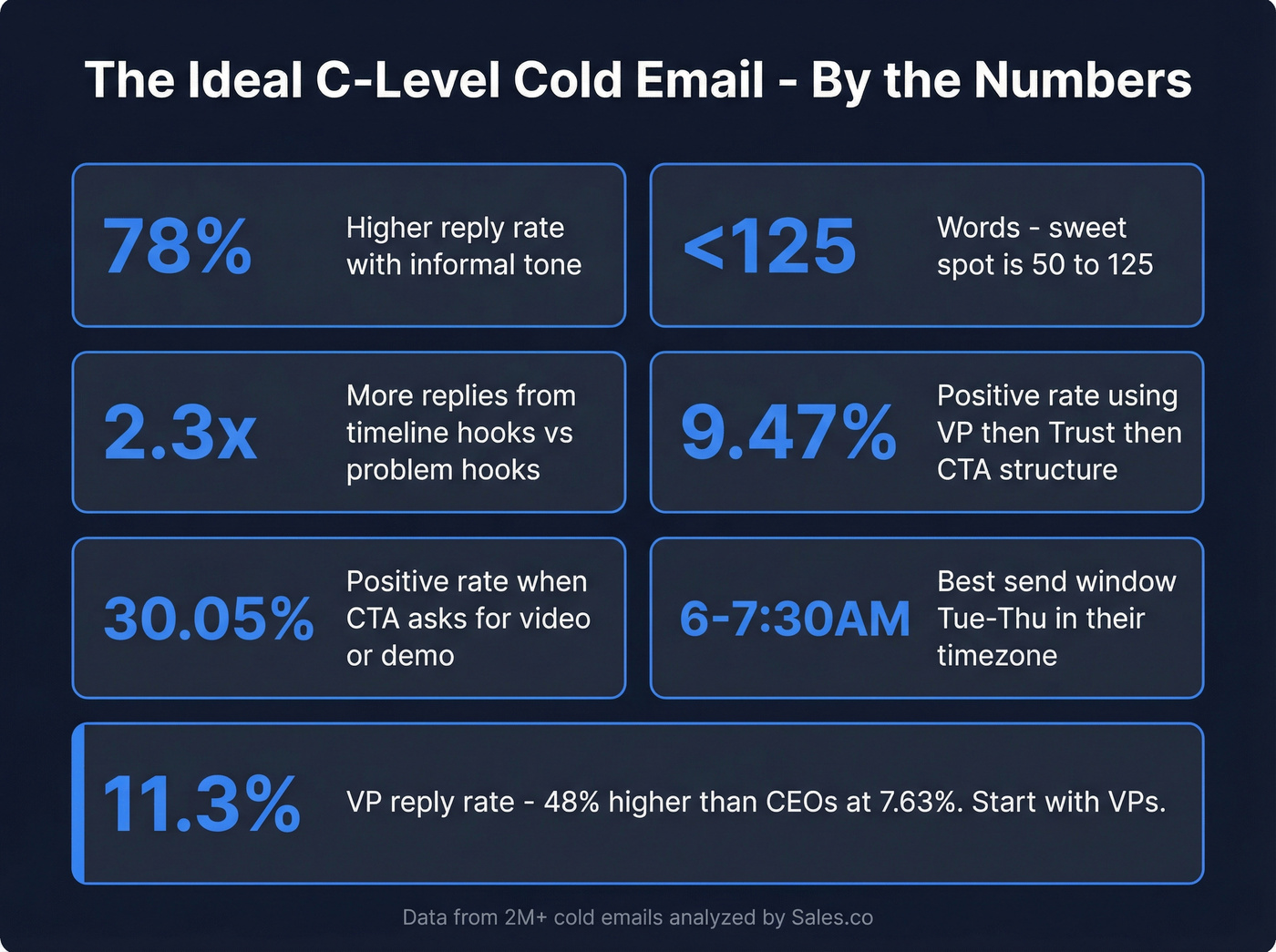
- Tone: Informal. 78% higher positive reply rate than formal.
- Length: Under 125 words. The 50-125 word range hits ~50% reply rates.
- Hook: Timeline-based. 2.3x more replies than problem hooks.
- Structure: VP -> Trust -> CTA (9.47% positive rate).
- CTA: Video or demo request. 30.05% positive rate - 3.5x better than "mind if I send info?"
- Send window: Tuesday-Thursday, 6-7:30 AM recipient's time. 41% higher open rates.
- Target: VPs reply at 11.3% - 48% higher than CEOs (7.63%). Start there.
Before writing a single word, verify the email address. A bounced email burns your domain reputation for nothing.
Inside the Executive Inbox
43% of executives say they spend too much time on email. That's the mindset your message lands in.

People with "CEO" in their title tend to be more fast-paced than 90% of the general population and more dominant than 99%, according to Crystal's personality data. They don't read your email the way you read your email.
Here's the thing: executives aren't ignoring you because they're too busy. They're ignoring you because your email doesn't pass a 3-second filter.
Decision-makers receive an average of 15 cold emails per week. Across the broader C-suite inbox, 95% of cold emails never get any response. The reasons are brutally consistent:
- 71% are ignored for lack of relevance
- 43% fail on personalization
- 36% lack trust signals
That's not a wall. That's a checklist.
Fix those three things and you're already in the top 5% of emails hitting that inbox. From the executive's side, here's what actually happens: they glance at the subject line and the first sentence - usually in a notification preview on their phone. If those 15 words don't signal relevance, they swipe and delete without ever opening. Your message gets the same consideration as a spam notification.
The executive's mental model is simple: "Is this worth my time in the next 10 seconds?" They're scanning for signal, not noise, which means your email needs to reference something specific to their world, not yours.
One more thing most guides skip: executives checking email before 7 AM and after 5 PM are doing it on mobile. Your beautifully formatted HTML email with three embedded images? It renders like garbage on an iPhone at 6:15 AM. Plain text wins.
Find the Right Executive Email Address First
You can write the perfect email. If it bounces, none of it matters. A bounce rate above 5% actively damages your sender reputation, and once your domain gets flagged, every email you send - including to warm leads - starts landing in spam.
Google search operators are the free starting point:
"firstname.lastname@company.com"- sometimes indexed on press releases or conference pagessite:company.com + "email" + "CEO"- catches contact pages and team biosfiletype:pdf + "contact" + "executive name"- finds speaker bios and event programs
Common email format patterns cover most companies: firstname.lastname@company.com, firstinitial.lastname@company.com, or firstname@company.com. Once you know the pattern for one person at a company, you know it for everyone.
The newsletter reply trick: If the CEO publishes a personal newsletter or blog, subscribe and reply with something thoughtful. That reply goes straight to their inbox - no gatekeeper, no spam filter.
Never buy email lists. The data quality is terrible, the compliance risk is real, and you'll burn your domain on stale addresses.
To skip the manual work, use Prospeo's email finder. Paste a company URL or upload a CSV of target accounts and get verified emails back in seconds. With 98% email accuracy and a 7-day data refresh cycle, you're not burning your domain on stale data. The free tier gives you 75 verified emails per month - enough to test your first executive campaign without spending a dollar.

A bounced email to a CEO doesn't just waste your best copy - it torches your domain reputation for every future send. Prospeo's 5-step verification and 7-day data refresh mean 98% of the executive emails you send actually land.
Verify your executive list before you burn your domain on stale data.
You just spent 10 minutes researching a CFO and writing three perfect sentences. Don't send that email to an address that hasn't been verified in six weeks. Prospeo refreshes every 7 days - not the 6-week industry average - at ~$0.01 per verified email.
Your research deserves an inbox, not a bounce notification.
Research Before You Write
The difference between a sub-1% response rate and a 10-15% response rate is almost entirely personalization. Not merge tags. Real research.
The 3-level personalization framework:
- Basic: First name, company name, job title. This is table stakes. Everyone does it. It's not enough.
- Deep: Recent activity on professional profiles, company news (funding, launches, hires), industry involvement (speaking, podcasts), professional achievements. Takes 2-3 minutes per prospect.
- Scale: AI-powered research that pulls signals automatically. Tools like Clay or ChatGPT can pull recent company news and summarize it into a personalization snippet - but always review the output before sending.
What deep research looks like in practice: A salesperson targeting a CFO at a mid-market company followed this path: company website bio, professional profile, college dates, non-profit board memberships, press releases about a recent acquisition, then a situational analysis of what that acquisition meant for the CFO's career. The resulting email was three sentences long. It referenced the acquisition, offered to connect the CFO with a valuable local contact, and appended a one-line business question.
The whole research process took maybe 10 minutes. The email took 2 minutes to write.
A hundred generic emails produce fewer meetings than ten researched ones. If you want a tighter process, use a prospect research checklist.
The professional boundary: publicly available professional information is fair game. Company news, speaking engagements, published articles, board memberships - all fine. Personal or family information crosses the line. Don't reference someone's kids' school or their vacation photos. It's creepy, and executives will blacklist you instantly.
Writing the C-Level Email - Structure, Hooks, and Templates
This is where most guides give you a template and call it a day. The data tells a more nuanced story. Your subject line, hook type, body structure, and CTA each independently affect whether you get a reply - and the differences aren't marginal.
Subject Lines That Get Opened
Two massive datasets - Belkins analyzing 5.5M emails and Gong analyzing 85M - converge on the same findings.

| Factor | Data Point |
|---|---|
| 2-4 words | Highest open rates |
| Personalized | 46% vs 35% open rate |
| All lowercase | Highest opens per Gong's 85M-email analysis |
| Salesy language | Reduces opens 17.9% |
| "Free" / ALL CAPS | Triggers spam filters |
The four best-performing subject line formulas, per 30MPC's analysis of Gong data:
- Pervasive Problems - name a pain the entire industry shares. "Pipeline coverage gap"
- Industry Trends - reference something happening in their market. "AI in fintech underwriting"
- 1-2 word pattern interrupts - so short they create curiosity. "Quick thought" or just "Timing"
- Competitor Share - imply competitive intelligence. "[Competitor] + [topic]"
What kills open rates: marketing jargon, generic greetings ("Hello, friend"), urgency words ("ASAP"), and anything that reads like a newsletter. Top reps get 2.1x the opens compared to average reps - and the difference is almost entirely in the subject line.
A/B test two subject lines on 20% of your list, then send the winner to the remaining 80%. It takes five minutes to set up and compounds over every campaign. If you need a bank of options, pull from these cold email subject lines.
Real talk: empty subject lines increase opens by 30% but tank reply rates by 12%. It's a party trick, not a strategy.
Choose the Right Hook (This Is the Biggest Lever)
Your opening line - the hook - determines whether the executive reads past the first sentence. The data here is dramatic.

| Hook Type | Reply Rate | Positive Rate | Meeting Rate |
|---|---|---|---|
| Timeline | 10.01% | 65.36% | 2.34% |
| Numbers | 8.57% | 61.76% | 1.86% |
| Social Proof | 6.53% | 53.44% | 1.25% |
| Problem | 4.39% | Not reported | 0.69% |
Timeline hooks outperform problem hooks by 2.3x in replies and 3.4x in meetings booked. For CEOs specifically, reply rates range from 4.26% (problem hooks) to 10.44% (timeline hooks) - a 2.45x difference based on nothing but how you open the email.
Timeline hook example: "Your team just closed the Series C. Most companies at this stage hit a wall scaling outbound within 90 days."
Numbers hook example: "Companies your size typically lose $340K/year to manual data entry in the CRM. We cut that by 60% for [similar company]."
Social proof hook example: "[Competitor CEO] switched to us last quarter after hitting the same integration wall your team posted about."
Problem hook example: "Struggling with pipeline coverage?" - This is what most people write. It's also the worst performer by a wide margin.
Executives don't respond to vague pain. They respond to specificity, urgency, and relevance to their current moment. For more first-line ideas, use these email opener examples.
Structure the Email Body
Do this:
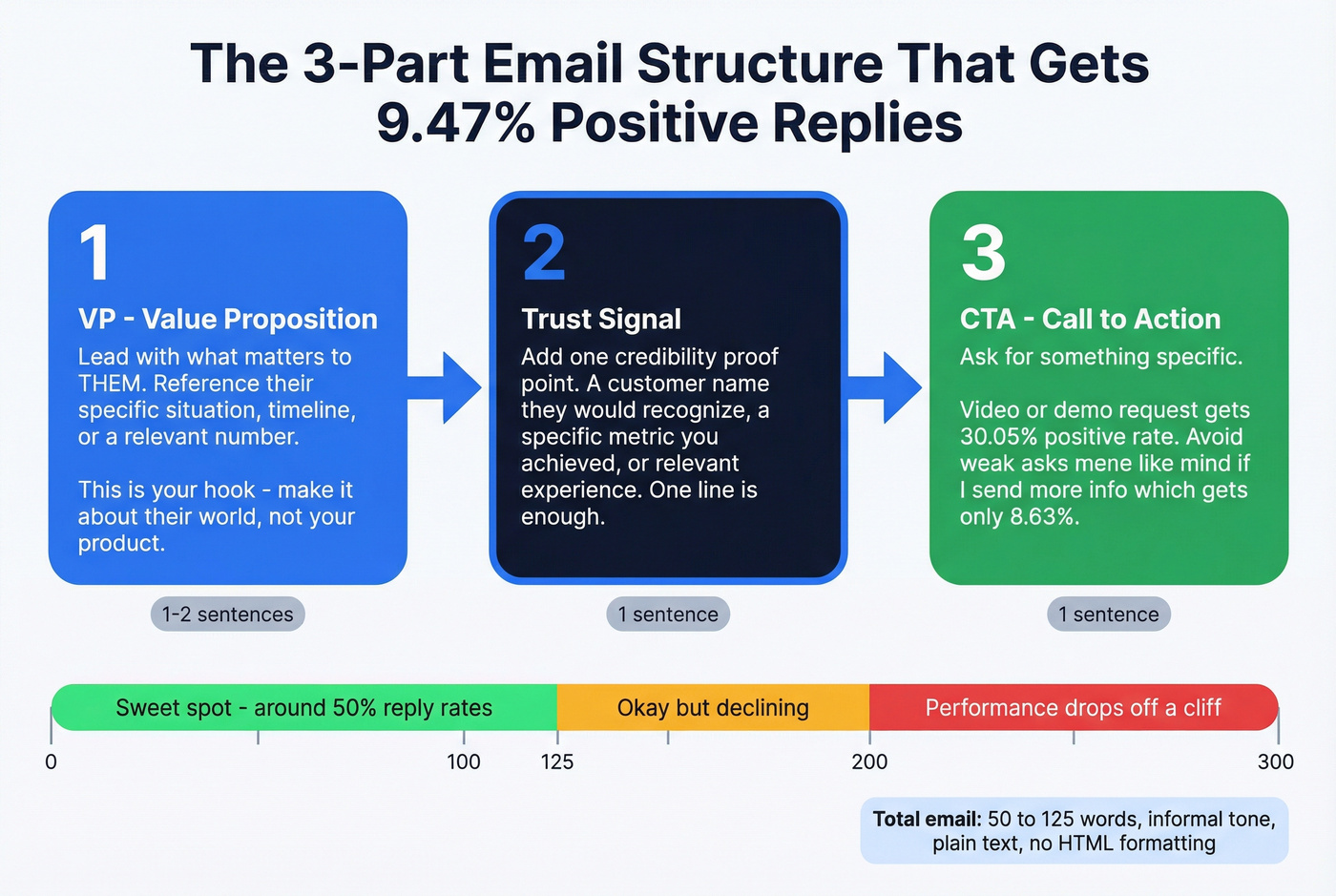
- Use the VP -> Trust -> CTA structure. It hits a 9.47% positive reply rate. "VP" means you lead with a value proposition. "Trust" means you add a credibility signal (customer name, metric, relevant experience). "CTA" means you close with a specific ask.
- Keep it between 50-125 words. Emails in this range hit ~50% reply rates. Once you cross 200 words, performance drops off a cliff.
- Use a video or demo CTA. This is the single biggest CTA lever in the data: video/demo requests convert at 30.05% positive - 3.5x better than "mind if I send more info?" at 8.59%. If you change nothing else, change your CTA. (More on asks that convert: sales CTA.)
- Write informally. Informal tone produces a 78% higher positive reply rate than formal tone. "Hey Sarah" beats "Dear Ms. Johnson."
- Write at an 8th-grade reading level. 85% of people understand information at this level. Your email isn't a whitepaper.
- Maintain a 1:2 ratio of "I/my" to "you/your." Every sentence about you should be balanced by two about them.
Skip this if you want replies:
- Don't ask for "15 minutes of your time." Ask a qualifying question answerable via email, or offer a link to something useful. Lower the commitment.
- Don't write in complete formal paragraphs. Short lines. Fragments are fine. Executives scan, they don't read.
Good vs. Bad: The Same Email, Rewritten
Here's what the difference looks like in practice:
Bad version:
Subject: Re: Innovative Solution for Your Business Needs
Dear Mr. Thompson,
I hope this email finds you well! My name is Jake and I'm the VP of Sales at DataSync Solutions. We are a leading provider of synergistic data integration platforms that help companies like yours achieve paradigm-shifting results. I know you're busy, but I was hoping to get 15 minutes of your time to discuss how we can help your organization leverage our best-in-class technology stack. When you have a moment, please let me know if you'd be open to a brief call. I look forward to hearing from you!
136 words. Formal tone. Fake "Re:" subject line. Zero personalization. Hedging language everywhere. "Mind if I send info?" energy. This email gets deleted in 2 seconds.
Good version:
Subject: post-acquisition data sync
Hey David,
After the Meridian acquisition, your team is probably merging two CRMs with different schemas. [Similar Company CTO] hit the same wall - we cut their sync time from 4 hours to 12 minutes.
I recorded a 90-second walkthrough of how it works for companies mid-acquisition. Want me to send it?
52 words. Timeline hook tied to a public event. Specific social proof. Video CTA. Informal tone. This is the email that gets a reply.
Five Templates You Can Steal Today
Before using these, here's how response rates break down by role:
| Role | Reply Rate | Primary Motivation |
|---|---|---|
| VP-Level | 11.3% | Operational gains |
| CEO/Founder | 7.63% | Strategic opportunity |
| CFO | 7.59% | ROI / cost reduction |
| CTO/VP Tech | 7.59-7.68% | Technical solutions |
My hot take: if your deal size is under $50K, you probably don't need to email the CEO at all. VPs reply more often, make most operational buying decisions, and are far easier to build a relationship with. Save the CEO outreach for strategic, company-wide plays.
Template 1: CEO - Strategic Opportunity + Timeline Hook
Subject: post-series C scaling
Hey [First Name],
Congrats on the raise. Most companies at your stage hit a wall scaling outbound within 90 days - pipeline generation stalls while the team doubles.
We helped [Similar Company CEO] avoid that by [specific result, e.g., "cutting ramp time from 10 weeks to 4"]. Happy to share the playbook in a 2-minute Loom - want me to send it?
Key move: Timeline hook tied to a public event + video CTA (30% positive rate). Under 80 words.
Template 2: CFO - ROI / Cost Reduction + Numbers Hook
Subject: $340K in manual data costs
Hey [First Name],
Companies your size typically spend $340K/year on manual CRM data entry. [Customer] cut that by 60% in one quarter.
I put together a 90-second breakdown of how the math works for [Company]. Worth a look?
Why it works: Numbers hook with a specific dollar figure. CFOs respond to quantified waste. Low-commitment CTA.
Template 3: CTO - Technical Solution + Social Proof Hook
CTOs respond to technical specificity - not marketing language. The social proof hook works here because it references a known peer and a concrete problem.
Subject: [Competitor]'s integration problem
Hey [First Name],
[Competitor CTO] hit the same API rate-limiting issue your team flagged on [public forum/job posting]. We built a workaround that cut their sync time from 4 hours to 12 minutes.
Want the technical brief? It's 2 pages, no fluff.
Template 4: VP Sales - Operational Improvement + Timeline Hook
Subject: Q3 pipeline gap
Hey [First Name],
Q3 is 6 weeks out and most sales teams are realizing their pipeline coverage is at 2.1x, not the 3x they need. [Customer VP] closed that gap by [specific tactic] - added $1.2M in qualified pipeline in 30 days.
I can walk you through their exact sequence in a 15-min call. Thursday work?
VPs are more meeting-ready than CEOs - a direct calendar ask works here where it'd fail with a CEO.
Template 5: Any Role - Warm Referral
Subject: [Mutual Connection] suggested I reach out
Hey [First Name],
[Mutual Connection] mentioned you're [specific initiative - e.g., "rebuilding the outbound motion after the reorg"]. We helped their team [specific result] and they thought it'd be relevant for you.
Worth a quick conversation, or should I send over what we did for [Mutual Connection's company] first?
Warm referrals close in 3 months vs 6+ for cold outreach, and 92% of people trust recommendations from someone they know. The "or" CTA gives them an easy out that still moves the conversation forward.
Cheat Sheet: The Numbers That Matter
| Element | Target | Why |
|---|---|---|
| Word count | 50-125 | ~50% reply rate in this range |
| Hook type | Timeline | 2.3x more replies than problem hooks |
| Structure | VP -> Trust -> CTA | 9.47% positive reply rate |
| CTA type | Video/demo | 30.05% positive - 3.5x best performer |
| Tone | Informal | 78% higher positive reply rate |
| Subject line | 2-4 words, lowercase | Highest open rates across 85M emails |
| Send time | Tue-Thu, 6-7:30 AM | +41% open rate |
| Best role to target | VP-level | 11.3% reply rate |
When to Hit Send
Timing is a free lever most people ignore.
Data from Mailpool's analysis of 10M+ sends shows C-suite executives check email before 7 AM and after 5 PM - your email needs to be sitting at the top of their inbox when they do. If you want to operationalize this, use send-time optimization and a time zone workflow.
| Window | Day | Impact |
|---|---|---|
| 6-7:30 AM | Tue-Thu | +41% open rate |
| 8-10 AM | Tue-Thu | +23-28% open rate |
| 4-5 PM | Thursday | +15-19% reply rate |
| Sunday evening | Sun | Review habit (send Sat PM) |
What to avoid:
- Monday: open rates drop 22% vs Tuesday. Executives are triaging the weekend backlog.
- Friday afternoon: 31% lower reply rates than Thursday. People are mentally checked out.
- Any time that isn't segmented by the recipient's time zone. Sending at 7 AM EST hits your West Coast prospects at 4 AM. Use your sequencer's timezone feature - every major tool has one.
Thursday is the best overall day at a 6.87% reply rate. If you're only sending one batch per week, make it Thursday morning.
Follow Up Without Being Annoying
The first message drives 79.4% of all replies and has a higher positive rate (8.90% vs 7.55% for follow-ups). Your initial email is doing most of the work. But follow-ups still matter - the first follow-up alone boosts replies by 49%.
The optimal cadence is 3-7-7:
- Day 0: Initial email
- Day 3: First follow-up (short, adds new info)
- Day 10: Second follow-up (different angle or asset)
- Day 17: Final attempt (graceful exit)
This captures 93% of total replies by Day 10. After that, you're in diminishing returns territory. For more sequences and timing, see this follow up email sequence strategy.
Here's where most people screw up: they follow up with "just checking in" or "bumping this to the top of your inbox." That's not a follow-up. That's noise.
Each follow-up needs to add something - a new data point, a relevant article, a case study, a different angle on the same problem. Think of C-level engagement like drip irrigation. You'd never dump a bucket of water on a plant and expect it to thrive. Small, consistent, valuable touches over time.
The hard limit: stop after 3-4 attempts. Spam complaints grow from 0.5% on the first email to 1.6% by the fourth. Unsubscribe rates jump to 2% by the fourth follow-up. Executives need roughly 9 touches to engage vs. just 4 for lower-level contacts - but that's 9 touches total across email, social, phone, and direct mail. Not 9 emails.
Phrases That Kill Your Executive Email
CEOs are more dominant than 99% of the population and more fast-paced than 90%. Passive, hedging language doesn't just fail to connect - it actively signals that you're not worth their time.
10 phrases to delete from every executive email:
"I know you're busy, but..."- Just get to the point. They know they're busy."Hope you're doing well!"- Empty filler. Start with value."Can I get 15 minutes of your time?"- Ask a question answerable via email instead."I was hoping to..." / "I just wanted to..."- "I" + hedging verb = weak. State what you're offering."It would be great if..."- Be direct. "Here's what I'd suggest.""Sorry for my persistence..."- Never apologize for doing your job."Pick your brain"- Executives don't want their brains picked. Offer something first."To be honest..."- Implies everything else wasn't honest."When you have a moment..."- They won't "have a moment." Create urgency."Not sure if you saw my previous email..."- They saw it. They chose not to reply. Add new value.
Real bad email examples from BoardEx's executive perspective:
- The copy-paste disaster: An email that left another prospect's name and company in the body. Instant delete. This happens more than you'd think, and it's the fastest way to get blacklisted.
- The buzzword bomb: A three-paragraph company description filled with jargon and vague promises - followed by a presumptuous meeting request. The executive learned nothing about what's in it for them.
- The $100 referral bribe: Offering a C-level executive a $100 gift card for a referral. Sad and cheesy. Know your audience. A CEO doesn't care about $100.
The fix for all three is the same: lead with something relevant to their world, keep it under 125 words, and make the CTA low-commitment.
Beyond Email - Multi-Channel Strategy
Email alone won't cut it. Prospects contacted through 3+ channels respond at 2x the rate of single-channel outreach.
The recommended sequence:
- Email - your initial outreach (everything above applies)
- 3-4 days later: Social touch with new information - not a connection request with a pitch
- One week later: Phone call to the assistant, referencing the email
- Two weeks later: Send a piece of research with no ask attached
Email plus social doubles response rates. Add direct mail and you're at a 2.5x lift. Direct mail has a 91% open rate - and 75% of marketers say it's the best channel for C-suite engagement. If you're building this out, use an ABM multi-threading approach to cover the whole buying committee.
Warm referrals remain the ultimate shortcut. They close in 3 months vs 6+ months for cold outreach, and 92% of people trust recommendations from someone they know. If you can get an intro, take it every time.
I've seen teams build beautiful multi-channel sequences and then watch them fail because 15% of their email addresses bounced on the first send. Verify every address before you send. The upstream data quality step isn't glamorous, but it's the foundation everything else sits on.
Don't Get Sued - Legal Rules for Cold Email
Cold emailing executives is legal in every major market - with conditions. Here's what you need to know by jurisdiction.
CAN-SPAM (United States):
- Opt-out model - you can email without prior consent
- Must include: accurate sender info, truthful subject lines, physical address, working opt-out mechanism
- Honor opt-outs within 30 days
- Penalty: up to $53,088 per non-compliant email
GDPR (European Union):
- B2B cold email is legal under Article 6(1)(f) - "legitimate interest"
- You must document a Legitimate Interest Assessment covering Purpose Test, Necessity Test, and Balancing Test
- 70% of enforcement actions cite improper email sourcing - where you got the address matters
- Honor opt-outs promptly
- Penalties: up to EUR 20M or 4% of global revenue
- No-reply sender addresses undermine legitimate interest claims
CASL (Canada):
- Requires express or implied consent
- Implied consent applies to published business emails related to the recipient's role
- Honor unsubscribe within 10 business days
- Penalties: up to $10M per violation
Two developments to watch:
The Washington State 2025 ruling established that deceptive subject lines - like "Re: Our conversation" when no prior conversation existed - carry a $500 per email penalty. At least 8 lawsuits have been filed. Stop using fake "Re:" subject lines. It's not clever. It's litigation bait.
The EU AI Act, taking effect August 2026, will likely require AI-generated emails sent to EU recipients to include machine-readable markers identifying them as AI-generated. Enforcement details are still emerging, but if you're using AI to draft executive emails at scale, start tracking this now.
FAQ
Do C-level executives actually read cold emails?
Yes. C-level executives respond 23% more often than non-C-suite contacts, with a 14.16% positive reply rate across 2M+ emails. The key is relevance and brevity. When a CEO replies, the reply is almost always substantive and decision-oriented.
How do I get past an executive assistant who screens email?
Ask a question the assistant can't answer alone, forcing a forward to the executive. Reference something specific from the executive's recent public activity - a conference talk, a published article, a company announcement. Keep the email under 4 sentences so it's easy to forward intact.
Should I email the CEO directly or start with a VP?
VPs reply at 11.3% - 48% higher than CEOs at 7.63% - and they're often the real decision-makers for operational purchases. Start with VPs unless your product requires CEO-level strategic buy-in like M&A advisory or company-wide platform decisions.
How do I find a C-level executive's verified email address?
Use Google search operators, check company websites, or use a verification tool like Prospeo, which covers 300M+ professional profiles with 98% email accuracy and a 7-day data refresh cycle. Never buy email lists - bounce rates will damage your domain and create compliance risk under GDPR and CASL.
Is it legal to cold email executives in Europe under GDPR?
Yes, B2B cold email is legal under GDPR's "legitimate interest" provision (Article 6(1)(f)), but you must document a Legitimate Interest Assessment and honor opt-outs promptly. The email address must come from a legitimate source - 70% of enforcement actions cite improper sourcing.