Sales Email Writing Tips Backed by Data From 300K+ Emails
The average cold email reply rate is 3.43%. Top-quartile performers hit 5.5%+. The elite - the top 10% - clear 10.7%. The gap between average and elite isn't talent or luck. It's a handful of decisions most reps get wrong before they write a single word.
Here's what separates the two groups:
- Fix deliverability first. SPF, DKIM, DMARC, verified data, proper warmup - if your emails don't arrive, nothing else matters.
- Swap your CTA. Stop asking for time. Ask for interest. Interest-based CTAs are 2x+ more likely to book a meeting.
- Personalize around triggers, not first names. Funding rounds, leadership changes, new hires - trigger-based emails are 497% more effective than batch-and-blast.
What "Good" Actually Looks Like
Before rewriting a single subject line, you need targets.
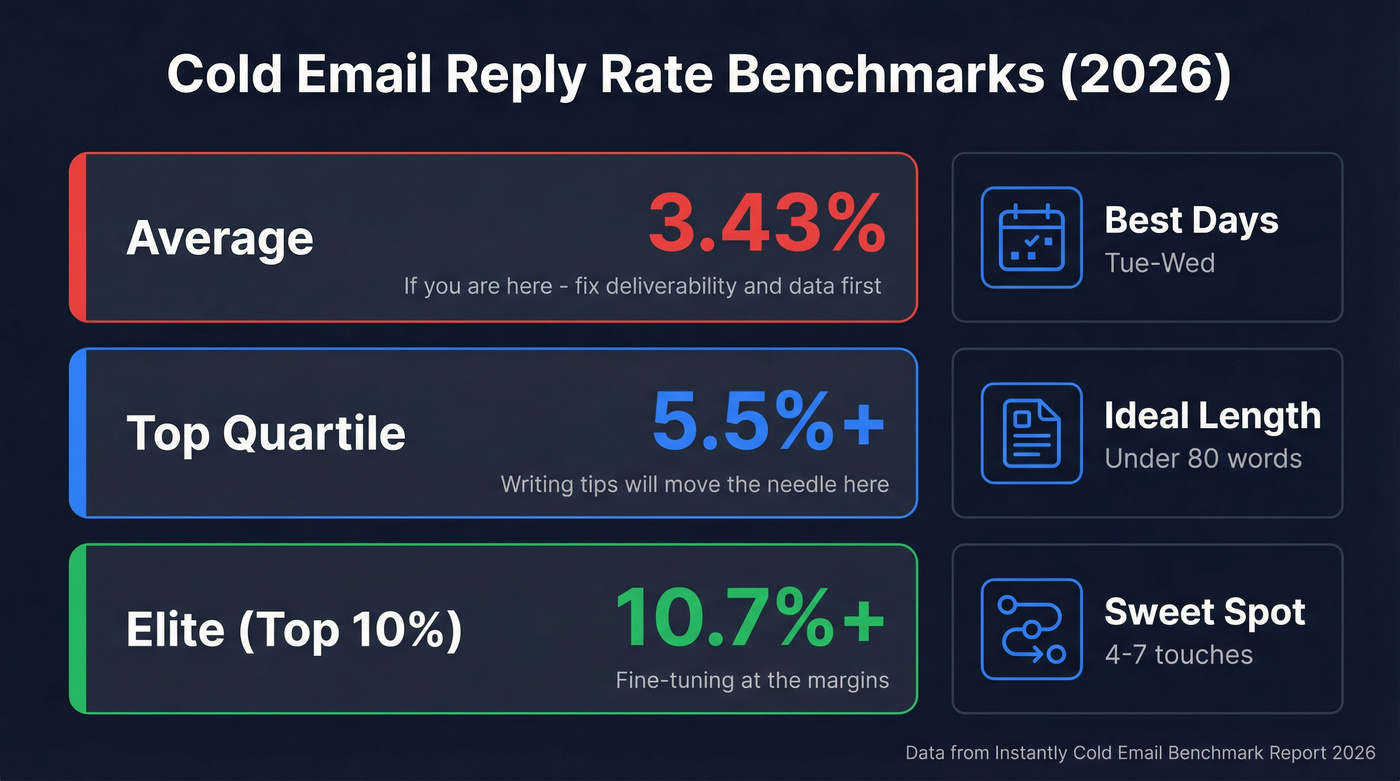
| Metric | Benchmark |
|---|---|
| Average reply rate | 3.43% |
| Top quartile | 5.5%+ |
| Elite (top 10%) | 10.7%+ |
| Best send days | Tue-Wed |
| Ideal email length | <80 words |
| Sequence sweet spot | 4-7 touches |
If you're below 3%, don't rewrite your copy yet. The problem is almost certainly upstream - deliverability or data quality. Between 3-5%, the tips below will move the needle. Above 5%, you're already doing most things right and fine-tuning at the margins.
Make Sure Emails Arrive First
Every writing tip in this article is worthless if your emails land in spam. Deliverability is the prerequisite nobody wants to talk about because it's boring. But it's where most campaigns actually fail.
The checklist before you send a single cold email:
- SPF, DKIM, DMARC configured and passing on your sending domain
- Spam complaint rate under 0.3%, bounce rate under 2%
- Warmup: start at 5-10 emails/day, ramp over 4-6 weeks (see IP warming schedules)
- Custom tracking domain (never use a shared one)
- Dedicated subdomain for cold outreach - protect your primary domain
- Inbox placement of 80%+ on seed tests before you scale
Bounces are the silent killer. Every hard bounce chips away at your sender reputation, and once that's damaged, recovery takes weeks. The upstream fix is verified contact data. If you want a quick pre-send check, run an email bounce test before scaling volume. One outbound agency we work with, Meritt, was running a 35% bounce rate before switching their data source - they got it under 4% and tripled their pipeline in the process. That's the difference between a domain that's slowly dying and one that's healthy enough to scale.

Subject Lines That Get Opened
64% of recipients decide whether to open based on the subject line alone. That's the gate. Everything else is behind it.
Short, lowercase, curiosity-driven. That's the formula. Salesy language - "exclusive offer," "limited time," "act now" - drops opens by up to 17.9%. Question marks push open rates to 20% versus 12% without them. Including a number boosts opens by 57%, and currency values nearly double them.
Think "quick question about [specific thing]" - not "Exclusive Partnership Opportunity for [Company]." Cliffhanger-style lines work because they create an open loop the reader needs to close. If you want more patterns to steal, start with these sales email subject examples and the broader breakdown of sales email subject lines. This is one of the most underrated skills in any rep's toolkit, and it takes five minutes to test three variations before each send.

Your subject lines and CTAs won't matter if 35% of your emails bounce. Prospeo's 5-step email verification delivers 98% accuracy - the same data that took Meritt from a 35% bounce rate to under 4% while tripling their pipeline.
Fix your data before you fix your copy.
How to Write Emails That Convert
An analysis of 304,174 emails found that emails with 4+ sentences are 15x more effective at booking meetings than ultra-short ones. But Instantly's benchmarks favor under 80 words. These aren't contradictory - concise doesn't mean short. It means every sentence earns the next one. Four tight sentences beat two vague ones and eight rambling ones every time.
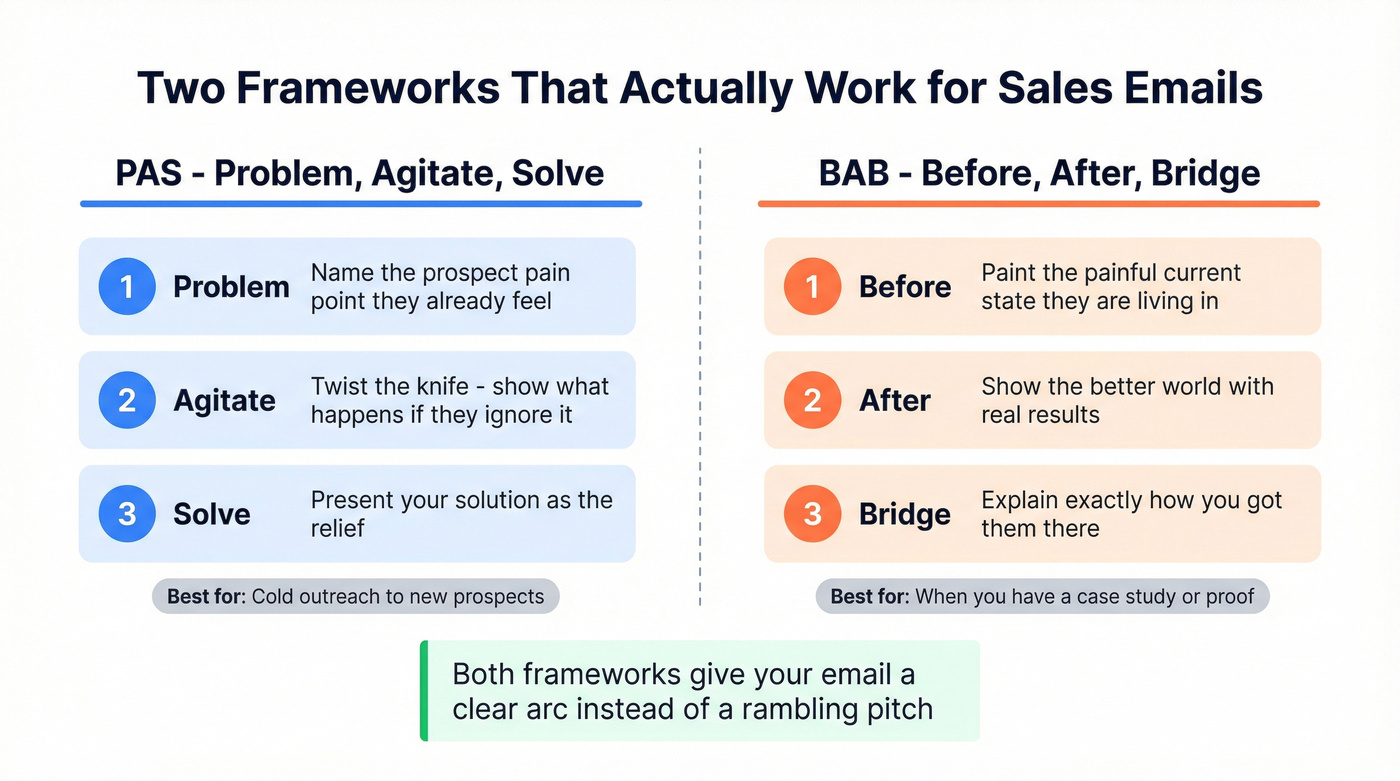
Two frameworks worth internalizing. PAS (Problem-Agitate-Solve) works for cold outreach: name the prospect's problem, twist the knife, present your solution as the relief. BAB (Before-After-Bridge) works when you have a case study - paint the "before," show the "after," bridge with how you got there. Both give your message a clear arc instead of a rambling pitch. (If you want a more rigid structure, the BASHO email structure is another solid option.)
The biggest lever, though, is trigger-event personalization. Funding announcements, new hires, leadership changes - Woodpecker's analysis of 20M+ cold emails found highly personalized messages boost reply rates up to 142%. Here's what that looks like in practice:
Before: "Hi {first_name}, I'd love to show you how we help companies like yours grow revenue. Do you have 15 minutes this week?"
After: "Saw you just raised a Series B - congrats. That usually means the team's scaling fast and outbound data quality becomes a bottleneck. We helped a similar post-Series B team cut bounce rates from 35% to under 4% in two weeks."
The second version works because it proves you did your homework. AI writing assistants can draft first versions, but the personalization layer - trigger events, specific pain points - still needs a human eye. You can't automate genuine relevance.
Keep emails plain text. Skip HTML templates, images, and multiple links. Write the way you'd actually message a colleague - contractions, short paragraphs, conversational tone. If you're debating format, see plain text vs HTML emails.
Ask for Interest, Not Time
Use this: "Worth exploring?" / "Is this on your radar?" / "Interested in seeing how this works?"
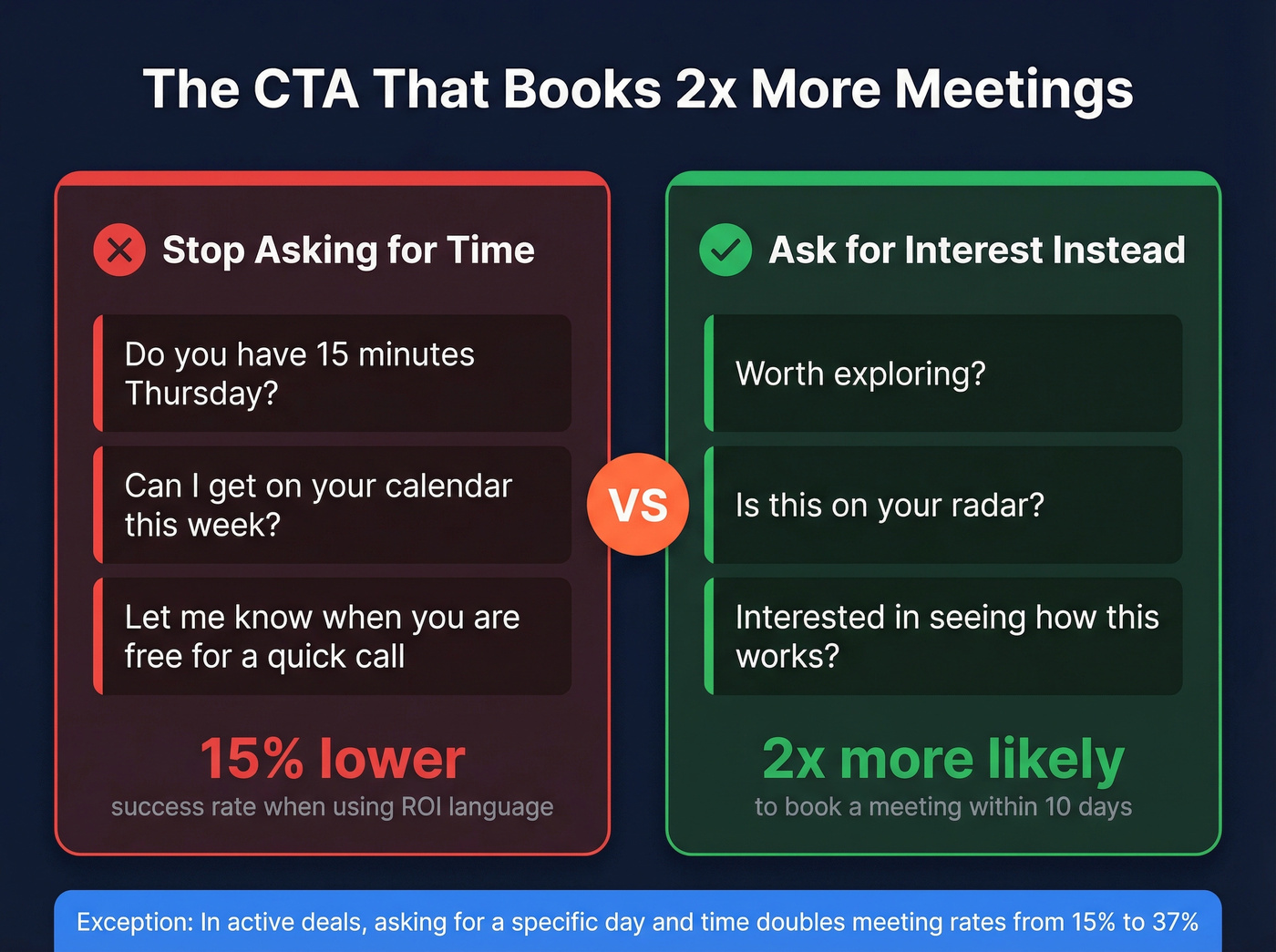
Skip this: "Do you have 15 minutes Thursday?" / "Can I get on your calendar this week?"
An analysis of 304,174 emails found interest-based CTAs are 2x+ more likely to book a meeting within 10 days. Asking for time feels like a commitment. Asking for interest feels like a conversation. ROI language - "10x your pipeline," "see 42% improvement" - actually decreases success rates by 15%. One CTA per email, never two. The moment you give the reader a choice between two actions, they choose neither.
Here's the exception: once you're in an active deal, asking for a specific day and time doubles meeting-booked rates from 15% to 37%. The right CTA changes depending on where the prospect is in the conversation. Internalize that and you'll outperform most reps immediately.
Follow-Up Strategy That Builds Pipeline
58% of replies come from the first email in a sequence - which means 42% come from follow-ups. If you're sending one email and moving on, you're leaving nearly half your replies on the table.
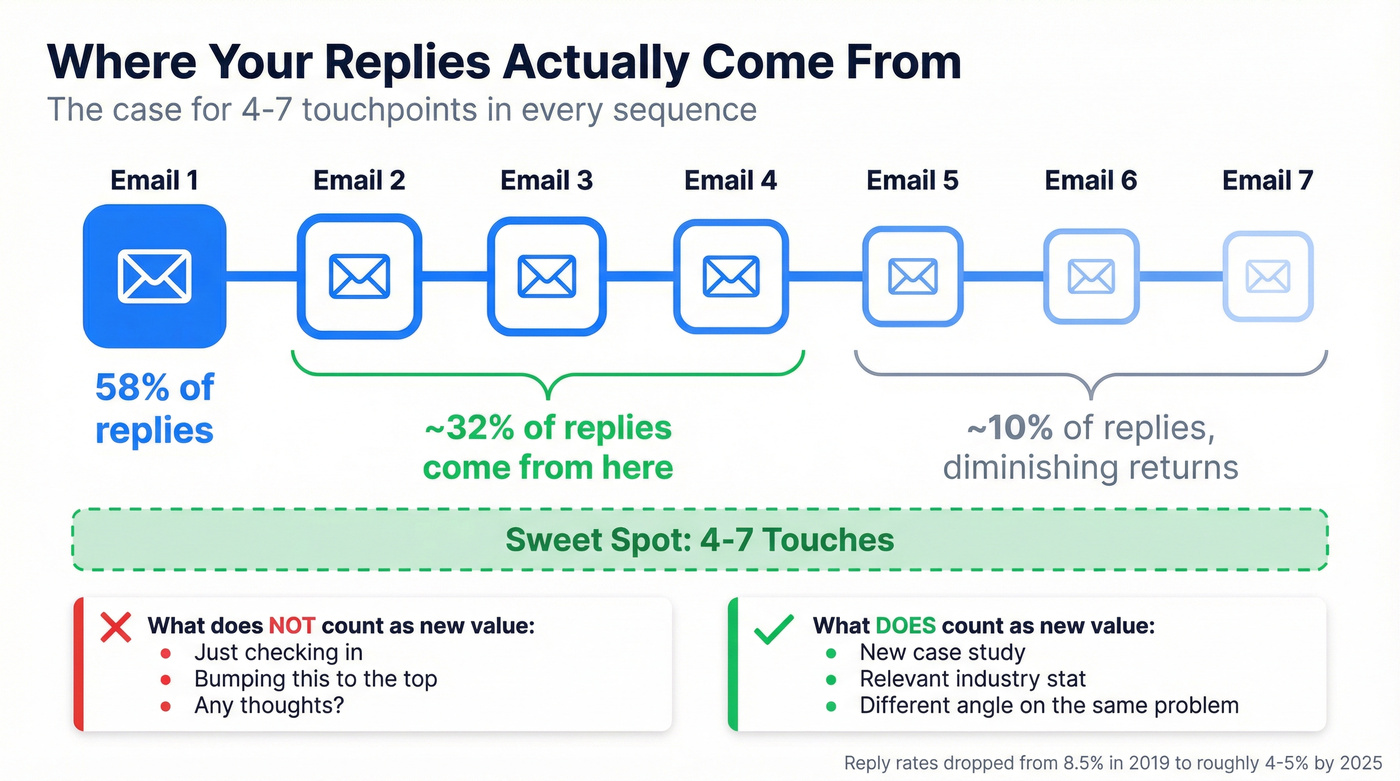
The sweet spot is 4-7 touchpoints. Under four and you're quitting too early. Beyond seven and returns diminish sharply unless each touch adds genuinely new value. "Just checking in" isn't new value. A new case study, a relevant stat, a different angle on the same problem - that's new value. For more sequencing rules, use this cold email follow-up best practices guide.
We've tested this across hundreds of campaigns: the teams that treat each follow-up as a standalone pitch consistently outperform the ones sending "bumping this" reminders. The consensus on r/sales backs this up too - the threads about follow-up cadences almost always conclude that adding new information per touch is what separates persistent from annoying. If you need copy you can send today, pull from these bump email templates.
Reply rates dropped from 8.5% in 2019 to roughly 4-5% by 2025, and inboxes have only gotten more crowded since. Persistence isn't optional anymore - it's the baseline.
Mistakes That Kill Reply Rates
- Sending from an unwarmed domain or a brand-new inbox
- Using a shared tracking domain instead of a custom branded one
- HTML templates, embedded images, or multiple links in cold emails
- Generic templates with no personalization beyond {first_name}
- Multiple CTAs competing for attention in the same email
- Missing unsubscribe link or ignoring compliance requirements (use email compliance best practices)
- Sending cold outreach from your primary company domain
- Leading with features instead of the prospect's problem
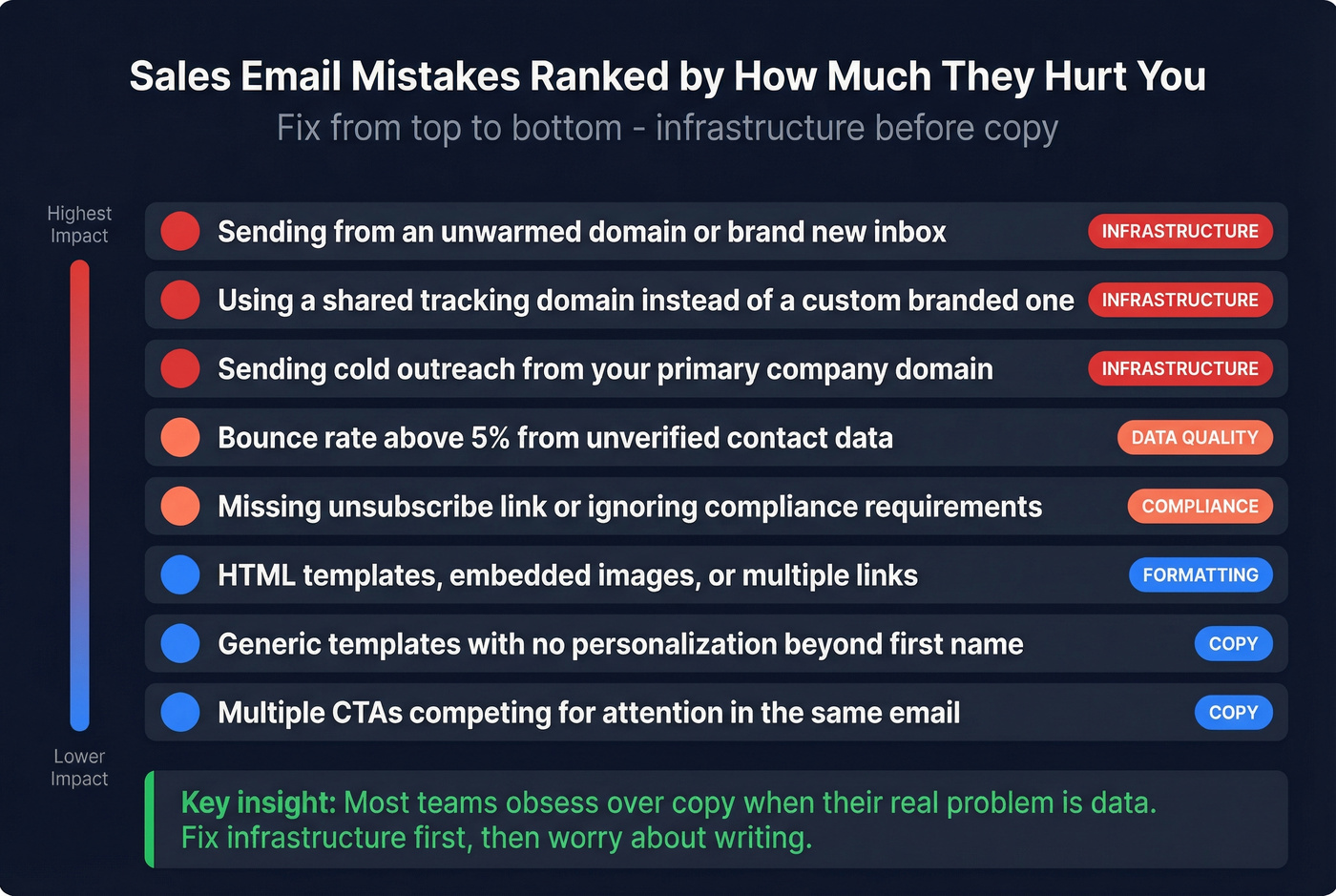
Let's be honest: most teams obsess over copy when their real problem is data. In our experience, the biggest reply-rate gains come from deliverability fixes - not subject line A/B tests. We've seen teams fix just the tracking domain and warmup issues and double their reply rates without changing a word of copy. If your bounce rate is above 5%, no amount of clever phrasing will save you. Fix the infrastructure first, then worry about the writing.
Trigger-event personalization drives 142% higher reply rates - but only if you can find the right contacts fast. Prospeo tracks funding rounds, job changes, and hiring signals across 300M+ profiles so every email you write lands with someone who actually cares.
Send fewer emails to better prospects at $0.01 each.
FAQ
How long should a sales email be?
Research across 300K+ emails shows 4+ sentence emails are 15x more effective at booking meetings, while benchmarks favor under 80 words total. The rule: every sentence must earn the next. Cut filler, keep substance. Four dense sentences beat eight fluffy ones every time.
What's a good cold email reply rate?
The average is 3.43%. Top quartile hits 5.5%+. Elite performers reach 10.7%+. If you're below 3%, check deliverability and data quality before rewriting copy - the problem is almost certainly upstream of your messaging.
How do I verify emails before sending?
Use an email verification tool to catch invalid addresses before they bounce and damage your sender reputation. If your bounce rate is above 2%, verification pays for itself immediately - one bad send can set your domain back weeks.
What are the best sales email writing tips for beginners?
Start with three things: verify your list so emails actually arrive, write short subject lines in lowercase, and end every email with an interest-based CTA like "Worth exploring?" instead of asking for calendar time. Those three changes alone will put you ahead of most reps running generic templates.