

Email Compliance Best Practices for 2026: The Practitioner's Playbook
Your marketing ops person just got an email from legal asking for proof of consent for last quarter's outbound campaign. Nobody knows where the records are. The SDR team says "sales owns it," marketing says "we just send what they give us," and legal is quietly panicking.
That's how email compliance best practices break down - not with a lawsuit, but with an ownership vacuum.
What You Need (Quick Version)
Build your program for GDPR plus Gmail/Yahoo's bulk sender requirements, and you'll cover most modern deliverability and opt-out expectations by default. You still need to meet each law's specific requirements - CAN-SPAM disclosures, CASL consent rules - but if you can pass GDPR-level accountability and Gmail/Yahoo-level sender standards, you're operating at a high bar.
Five non-negotiable actions:
- Authenticate everything - SPF, DKIM, and DMARC on every sending domain
- Get real consent - double opt-in where possible, never pre-ticked boxes
- Make unsubscribe instant - one-click, processed within 2 days
- Verify your list before every send - bounces and spam traps destroy sender reputation and create legal exposure
- Audit quarterly - consent records, authentication alignment, complaint rates, inactive contacts
The Rules at a Glance
Most teams don't need to become experts in six different regulations. They need a reference table they can check when a question comes up. Here's the one we keep bookmarked.
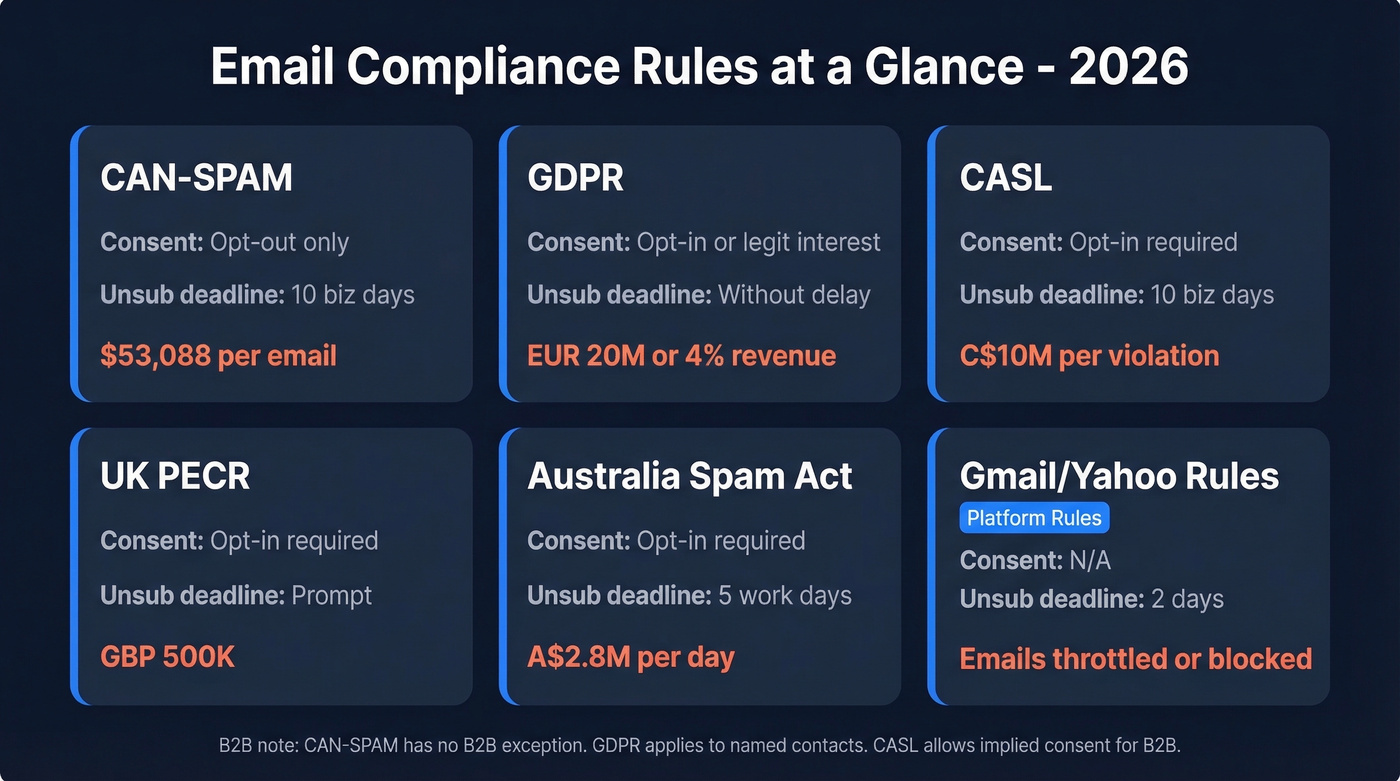
| Regulation | Consent | Unsub Deadline | Max Penalty / Enforcement |
|---|---|---|---|
| CAN-SPAM | Opt-out | 10 biz days | $53,088 per email in violation |
| GDPR | Opt-in / legit interest | "Without delay" | EUR 20M or 4% revenue |
| CASL | Opt-in | 10 biz days | C$10M per violation |
| UK PECR | Opt-in | Prompt | GBP 500K |
| Australia Spam Act | Opt-in | 5 work days | A$2.8M per day |
| Gmail/Yahoo | N/A (platform rules) | 2 days | Messages throttled or blocked |
B2B note: CAN-SPAM has no B2B exception. GDPR applies to named contacts. CASL allows implied consent for B2B. UK PECR offers a corporate subscriber exemption.
The FTC's $53,088 per-email-in-violation penalty makes CAN-SPAM violations extraordinarily expensive at scale - a 10,000-email campaign in violation could theoretically generate $530M in fines. These aren't hypothetical risks: Amazon was fined EUR 746M under GDPR in 2021, and Verkada faced $2.95M in CAN-SPAM penalties in 2024.
Why Gmail/Yahoo Rules Matter More Than CAN-SPAM
Since February 2024, Gmail and Yahoo require bulk senders (5,000+ messages per day) to implement SPF, DKIM, and DMARC authentication. No exceptions. They also mandate one-click unsubscribe via the List-Unsubscribe header and enforce a spam complaint rate below 0.1%, with 0.3% as the danger zone where deliverability drops sharply.
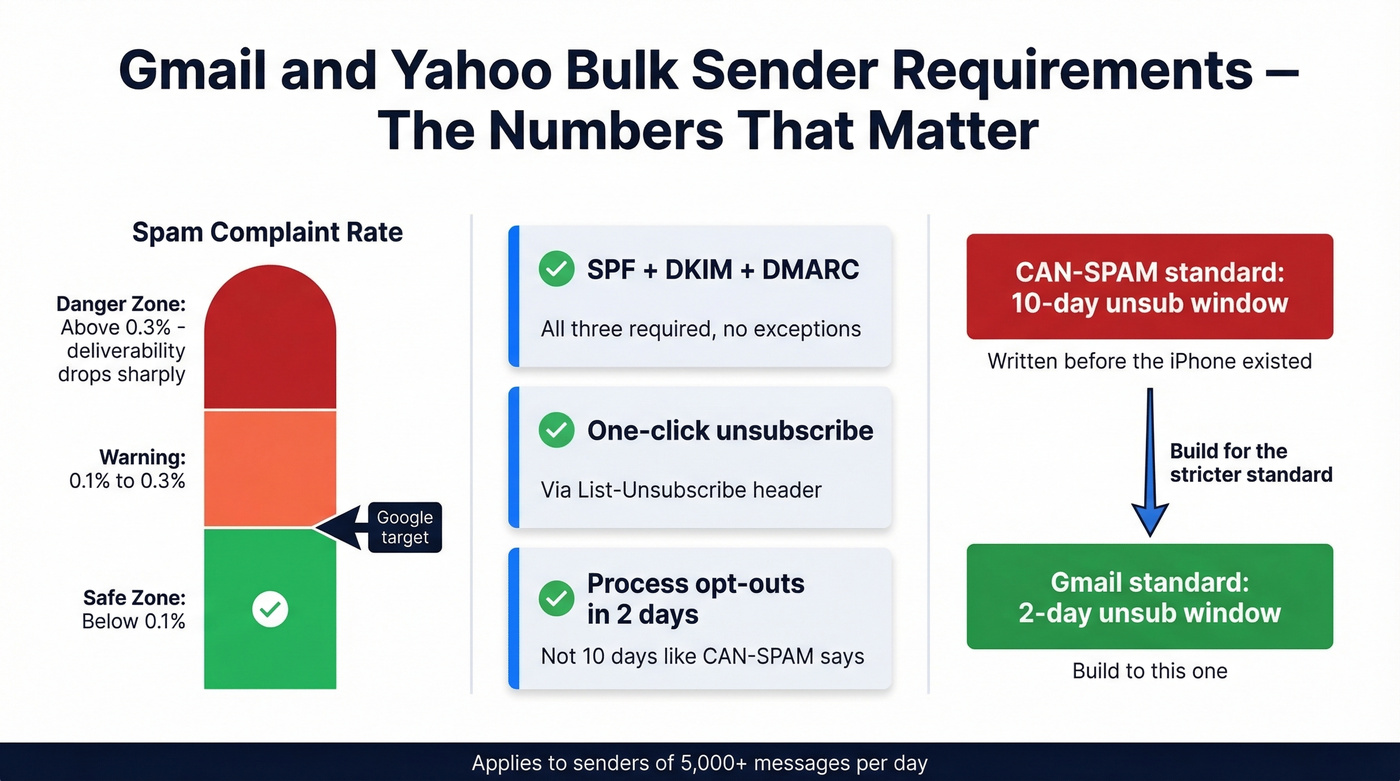
Here's the thing: CAN-SPAM's 10-day unsubscribe window is absurd in 2026. Gmail expects 2 days. If you're building to CAN-SPAM's minimum, you're building to a standard that predates the iPhone. Build for Gmail's standard instead - it's stricter, it's what actually determines whether your emails land in inboxes, and it keeps you aligned with how real people expect opt-outs to work.

Gmail demands sub-0.1% complaint rates. Bad data makes that impossible. Prospeo's 5-step verification with spam-trap removal and honeypot filtering delivers 98% email accuracy - refreshed every 7 days, not every 6 weeks.
Stop risking $53,088 per violation. Start with verified data.
B2B Email Compliance - What's Actually Different
The most persistent myth in B2B sales is that compliance laws don't apply to business emails. Wrong. The FTC is explicit: CAN-SPAM "makes no exception for business-to-business email." Every commercial message must comply.
GDPR applies to B2B because you're emailing individuals, not companies. John.smith@acme.com is personal data. Generic addresses like info@company.com may fall outside personal data scope, but for named contacts, your lawful basis is typically legitimate interest - which requires a three-part test: the outreach serves a clear purpose, it's necessary, and the recipient's privacy rights don't outweigh your interest. Build prospect lists from verified B2B databases rather than purchasing unverified lists. That's both a compliance and a deliverability decision, and adopting a privacy-first mindset at the prospecting stage means fewer complaints and stronger sender reputation down the line.
The UK offers a practical B2B angle through its corporate subscriber exemption under PECR Regulation 22, which allows cold emailing corporate addresses as long as you identify yourself and include an opt-out.
Eight Practices for Compliant Email Programs
1. Authenticate everything. SPF tells receiving servers which IPs can send on your behalf. DKIM adds a cryptographic signature proving the message wasn't altered. DMARC ties them together. All three are mandatory for Gmail/Yahoo bulk senders, and we've seen teams go from 15% inbox placement to 85%+ just by fixing DMARC alignment across their subdomains.
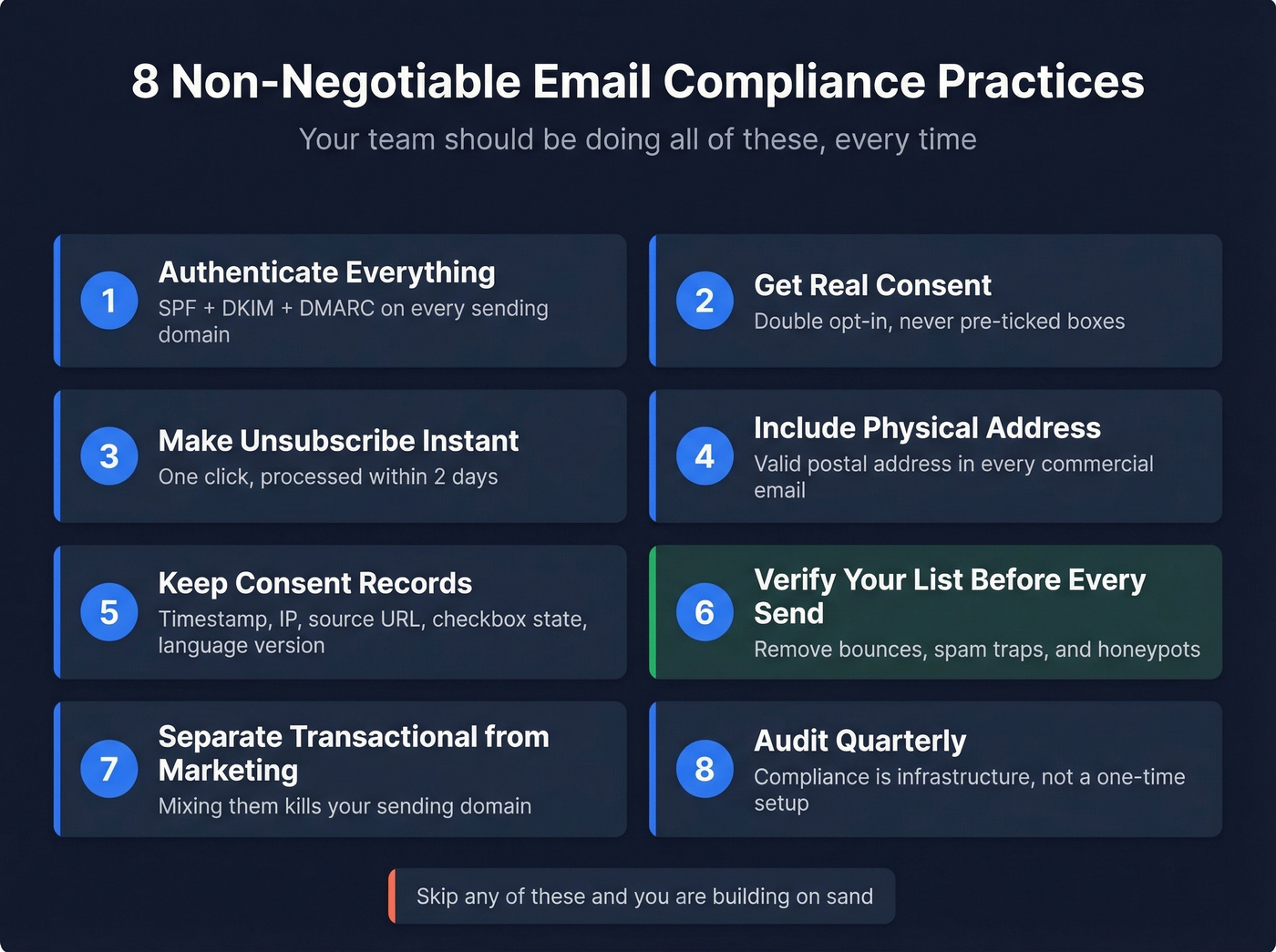
2. Get real consent. Double opt-in is the gold standard. Pre-ticked boxes are invalid under GDPR, and single opt-in leaves you vulnerable to bot signups and consent disputes. If someone didn't actively choose to hear from you, you're building on sand.
3. Make unsubscribe instant. One click. No login required. Include a List-Unsubscribe header and process removals within 2 days. The consensus on r/Emailmarketing is that multi-step unsubscribe flows are the fastest way to get reported as spam - and they're right.
4. Include a physical address. CAN-SPAM requires a valid postal address in every commercial email. A PO box works.
5. Keep consent records. When an audit hits, you need proof. Record these five fields for every opt-in:
| Field | Example |
|---|---|
| Timestamp | 2026-03-15T14:22:07Z |
| IP address | 192.168.1.1 |
| Source URL | yoursite.com/newsletter |
| Checkbox state | Unchecked (user checked) |
| Consent language version | v3.2 |
CASL requires retaining consent records for 3 years - a good baseline for any jurisdiction.
6. Verify your list before every send. List hygiene isn't optional. Bounces, spam traps, and honeypots don't just hurt deliverability - they create real legal exposure. A single CAN-SPAM violation costs up to $53,088. Verifying your entire list costs a few dollars. Prospeo runs every address through a 5-step verification process with catch-all handling, spam-trap removal, and honeypot filtering, delivering 98% email accuracy on a 7-day refresh cycle.
7. Separate transactional from marketing. This is one of the most common questions on r/SaaS - and getting it wrong triggers spam complaints.
- Transactional: confirms a transaction, delivers an agreed-upon product or service, or provides account/security updates
- Everything else: marketing - must include ad disclosure, physical address, and unsubscribe option
- The trap: a "product update" email that's really a feature announcement is marketing, not transactional
Skip this distinction at your own risk. We've watched companies lose entire sending domains because they stuffed promotional content into transactional email streams and their complaint rate spiked past 0.3% overnight.
8. Audit quarterly. Compliance isn't a one-time setup. It's infrastructure.
Your Quarterly Compliance Audit Checklist
Run through this every quarter. Pin it somewhere your ops team can't ignore it.
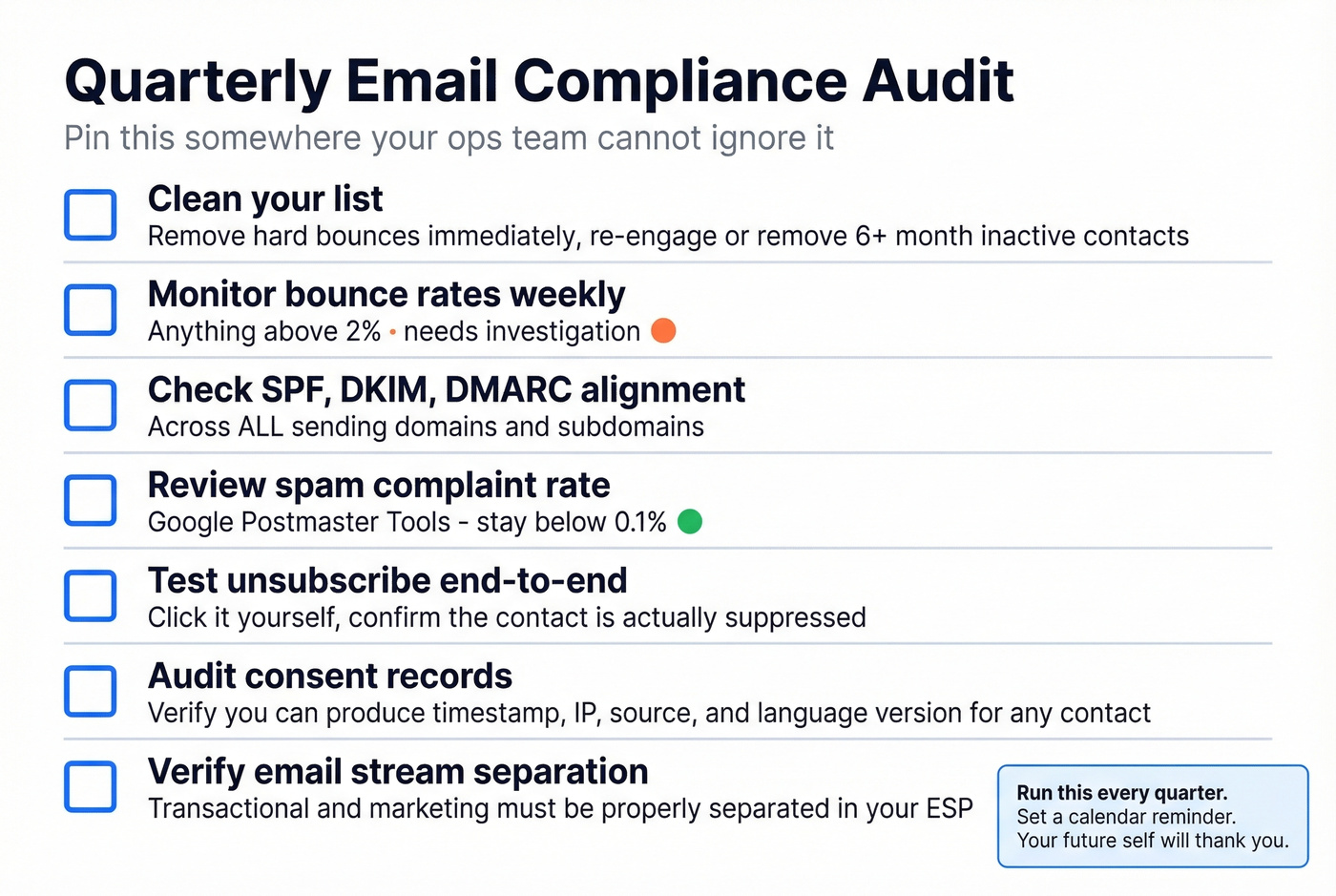
- Clean your list - remove hard bounces immediately, re-engage or remove contacts inactive for 6+ months
- Monitor bounce rates weekly; anything above 2% needs investigation (use bounce rate benchmarks as a sanity check)
- Check SPF/DKIM/DMARC alignment across all sending domains and subdomains
- Review spam complaint rate in Google Postmaster Tools - stay below 0.1% (and keep an eye on sender reputation)
- Test your unsubscribe mechanism end-to-end (click it yourself, confirm the contact is actually suppressed)
- Audit consent records - verify you can produce timestamp, IP, source, and language version for any contact
- Verify transactional and marketing email streams are properly separated in your ESP
For teams that don't have the bandwidth to scrub lists manually, automated verification tools pay for themselves after a single campaign. A 35% bounce rate dropping to under 4% isn't unusual - that's what Meritt experienced after switching to verified data, tripling their pipeline from $100K to $300K per week in the process.
Building prospect lists from unverified sources is a compliance and deliverability liability. Prospeo's 300M+ profiles pass catch-all handling, spam-trap removal, and honeypot filtering before you ever hit send. At $0.01 per email, list hygiene costs less than a single bounce.
Clean lists aren't a best practice - they're your legal shield.
What's Coming - AI and the Privacy Patchwork
There are now 20+ US state privacy laws either active or taking effect. CCPA/CPRA alone kicks in at $25M revenue or 100,000 consumers - thresholds that catch a lot of mid-market companies off guard. AI regulation is next, adding complexity around automated decision-making and profiling. For teams that have already committed to privacy-compliant marketing, these new requirements will layer on top of existing workflows rather than forcing a rebuild from scratch.
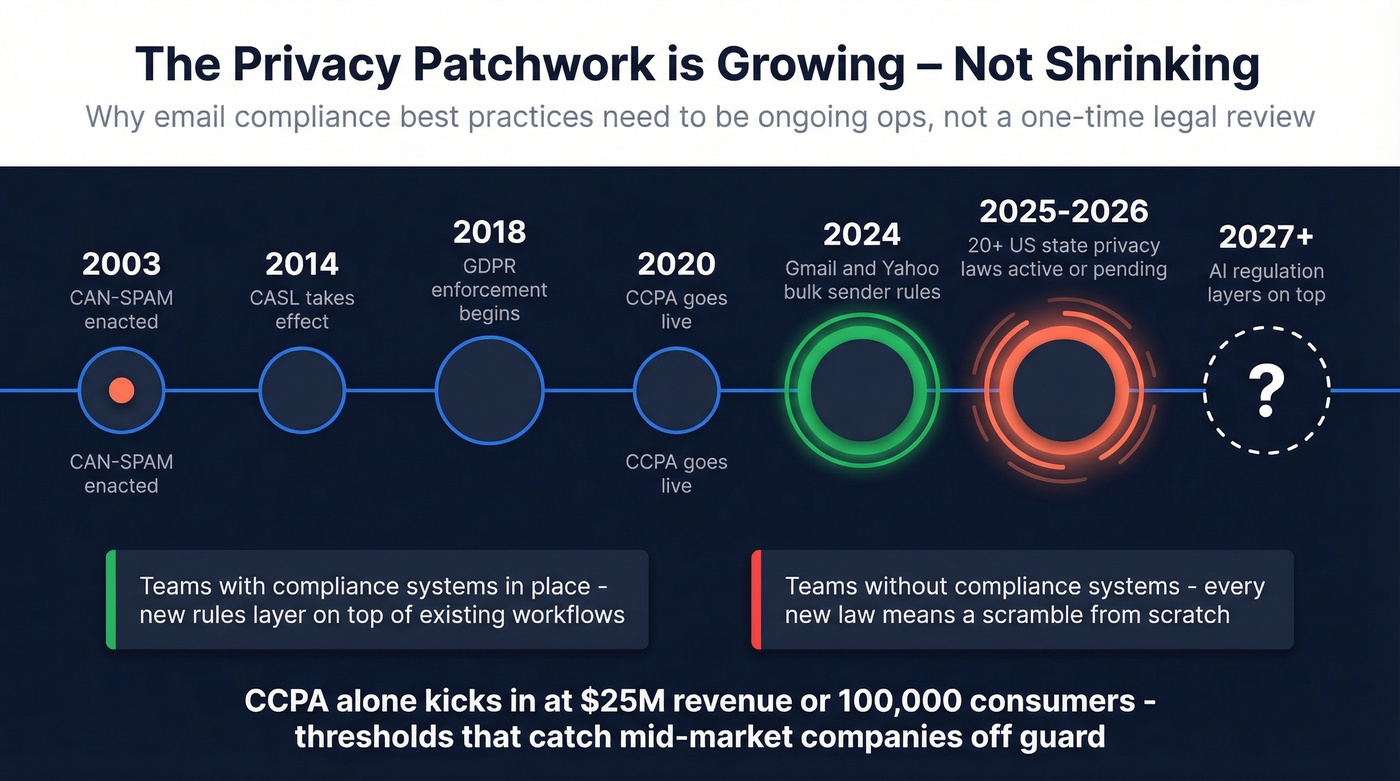
Let's be honest: if your average deal size is under five figures, you probably don't need a dedicated compliance officer. But you absolutely need a compliance system. Nobody's consolidating this patchwork anytime soon. The teams that struggle are the ones still treating compliance as a one-time legal review instead of ongoing ops infrastructure. Embedding email compliance best practices into your quarterly cadence is the only way to stay ahead of the regulatory creep.
If you're running outbound, it also helps to standardize the rest of your motion - from cold email outreach to sequence management - so compliance controls don't get bypassed in the name of speed.
FAQ
Does CAN-SPAM apply to B2B emails?
Yes. The FTC states CAN-SPAM "makes no exception for business-to-business email." Every commercial message - B2B or B2C - must comply with all requirements including accurate headers, physical address, and opt-out mechanism. Penalties reach $53,088 per email in violation.
What's the difference between transactional and marketing emails?
Transactional emails confirm a transaction, deliver an agreed-upon product, or provide account and security updates. Everything else is marketing and must include ad disclosure, a physical address, and a working unsubscribe option. Getting this classification wrong is one of the most common compliance mistakes we see.
How often should I verify my email list?
Verify before every major campaign and do a full list scrub at least quarterly. Remove hard bounces immediately after every send and re-engage or purge contacts inactive for 6+ months. Upload a CSV to Prospeo's verification tool and get verified results in minutes - 98% accuracy, 7-day data refresh, free tier at 75 emails per month.