

AI Cold Email Outreach: The Practitioner's Playbook for 2026
You're stuck at a 2-3% reply rate. You've rewritten the subject line four times, swapped CTAs, even tried humor. Then you check your bounce rate - 11%. Turns out 17% of cold emails never hit an inbox. Your copy wasn't the problem. Your data was.
The average cold email reply rate in 2026 is 3.43%. The top 10% of senders exceed 10.7%. Those teams aren't using a magic prompt - they've fixed the boring stuff first. Here's the system behind AI cold email outreach that actually books meetings.
Three Things, in Order
- Fix your data. Verified emails, not purchased lists. A 98%-accuracy provider with a 7-day refresh cycle changes everything.
- Build multi-domain infrastructure before you write a single word. SPF, DKIM, DMARC, warmup, custom tracking domains.
- Use the prompt template below - tested across 200+ outreaches at 15-20% reply rates.
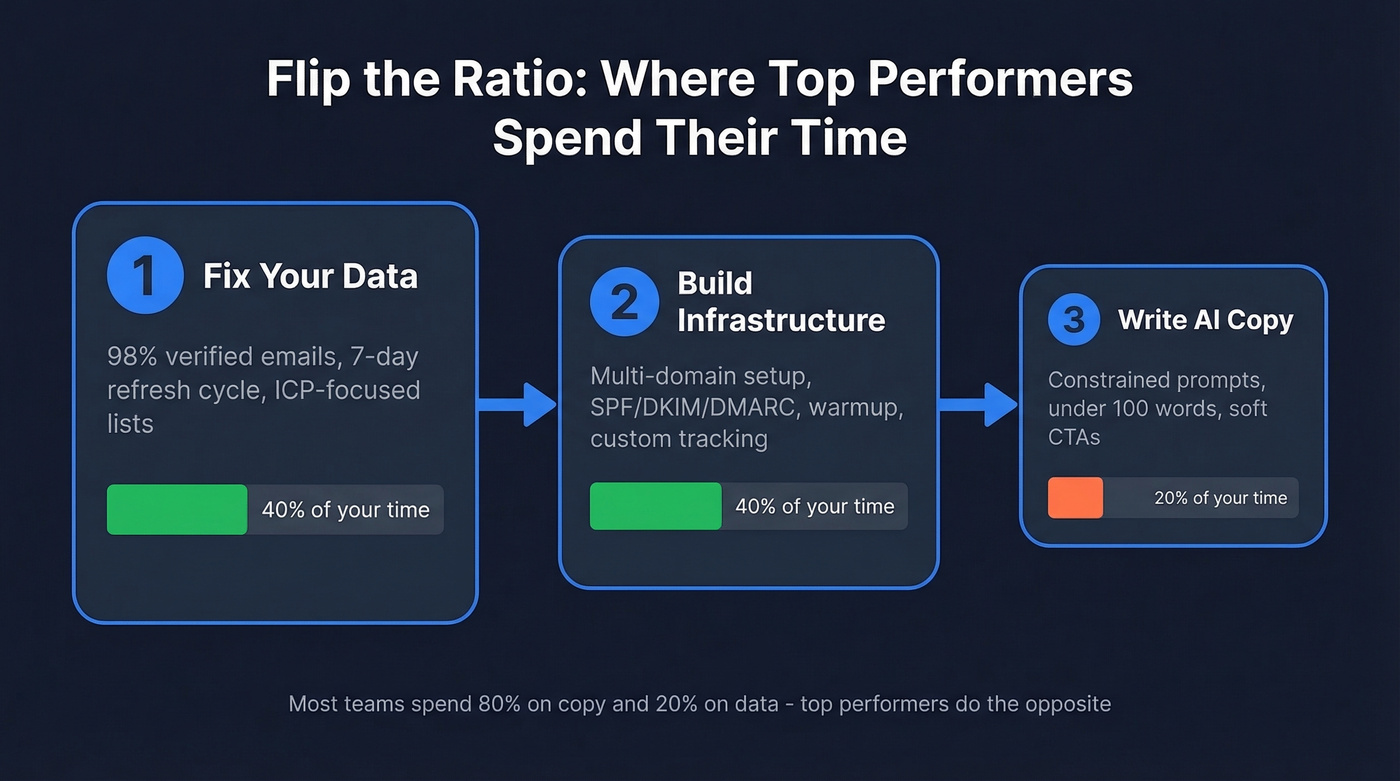
Here's the thing: most teams spend 80% of their time on AI copy and 20% on data and infrastructure. Flip that ratio and your reply rate will double before you change a single word.
2026 Cold Email Benchmarks
| Metric | Number |
|---|---|
| Avg reply rate | 3.43% |
| Top 25% | 5.5%+ |
| Top 10% | 10.7%+ |
| Avg open rate | 27.7% |
| First-touch replies | 58% |
| Follow-up replies | 42% |
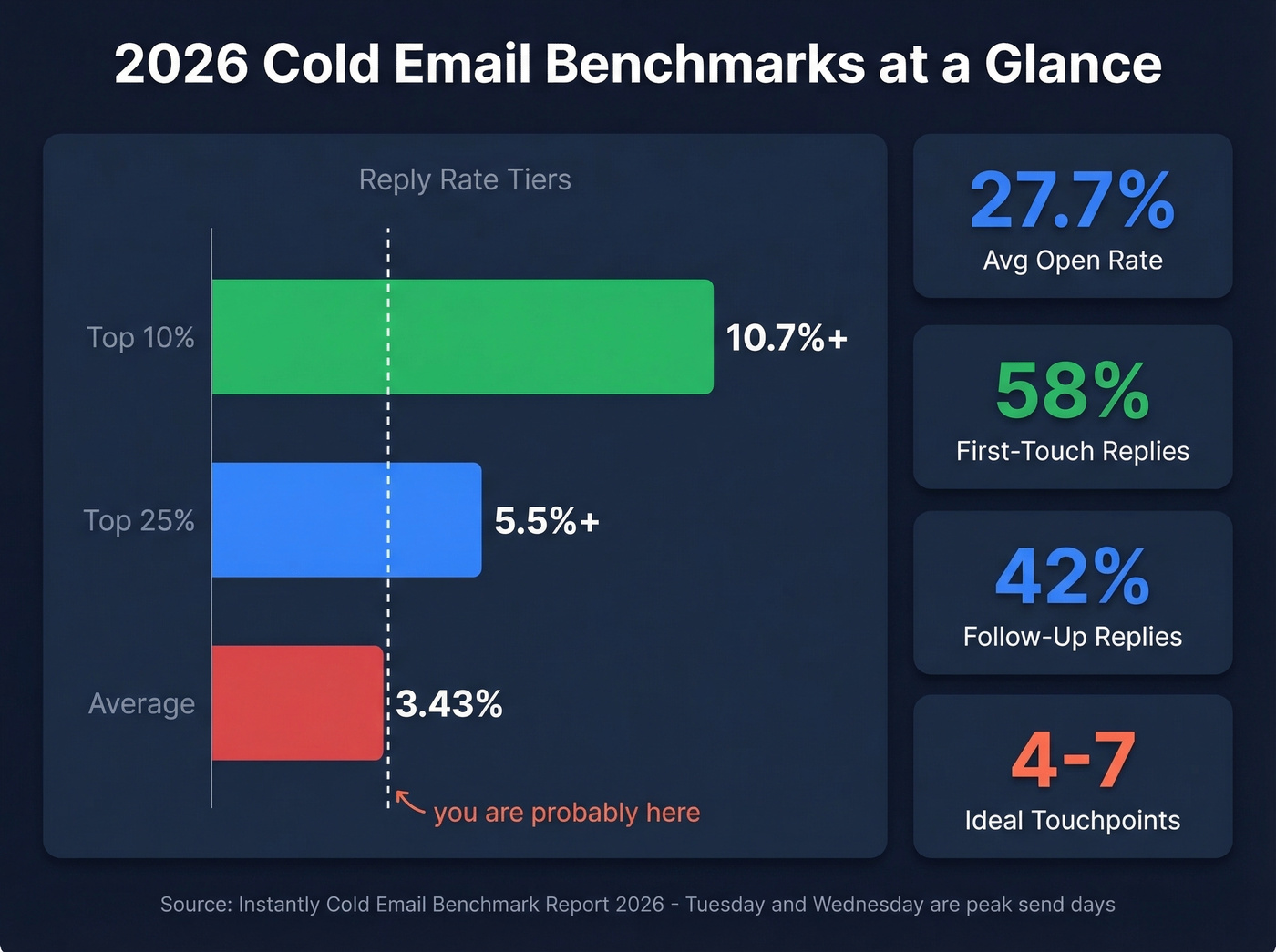
The sweet spot for sequence length is 4-7 touchpoints. Beyond that, diminishing returns unless each step adds genuine new value. Tuesday and Wednesday are peak send days, with Wednesday consistently highest.
Fix Your Data Before You Touch AI
Every guide on AI cold emails jumps straight to prompts and subject lines. They skip the part that actually determines whether your message lands in an inbox or a spam folder.
Start with your ICP. Before you build any list, define your Ideal Customer Profile tightly - industry, headcount range, tech stack, funding stage. A laser-focused ICP with 200 verified contacts will outperform a 5,000-name purchased list every single time. We've seen this play out across dozens of client campaigns, and the pattern never breaks.
One practitioner on r/Entrepreneur documented dropping their bounce rate from 11% to under 2% by ditching purchased lists and manually verifying contacts. Their reply rate doubled - from 3% to 6% - and the copy barely changed.
You don't need to do that manually. Prospeo runs 98% email accuracy across 143M+ verified addresses. The 5-step verification process - catch-all handling, spam-trap removal, honeypot filtering - refreshes every 7 days, while the industry average sits around 6 weeks. At roughly $0.01 per email, that's a fraction of what you'd spend on AI email personalization lines. Stack Optimize built to $1M ARR on the platform's data, with their clients maintaining 94%+ deliverability, under 3% bounce, and zero domain flags.


Your infrastructure is dialed in - now feed it data that won't burn your domains. Prospeo's 5-step verification delivers 98% email accuracy across 143M+ contacts, refreshed every 7 days. That's how Stack Optimize hit 94%+ deliverability with zero domain flags across every client campaign.
Kill your bounce rate before it kills your sender reputation.
Build the Infrastructure
Clean data means nothing if your sending setup is broken.
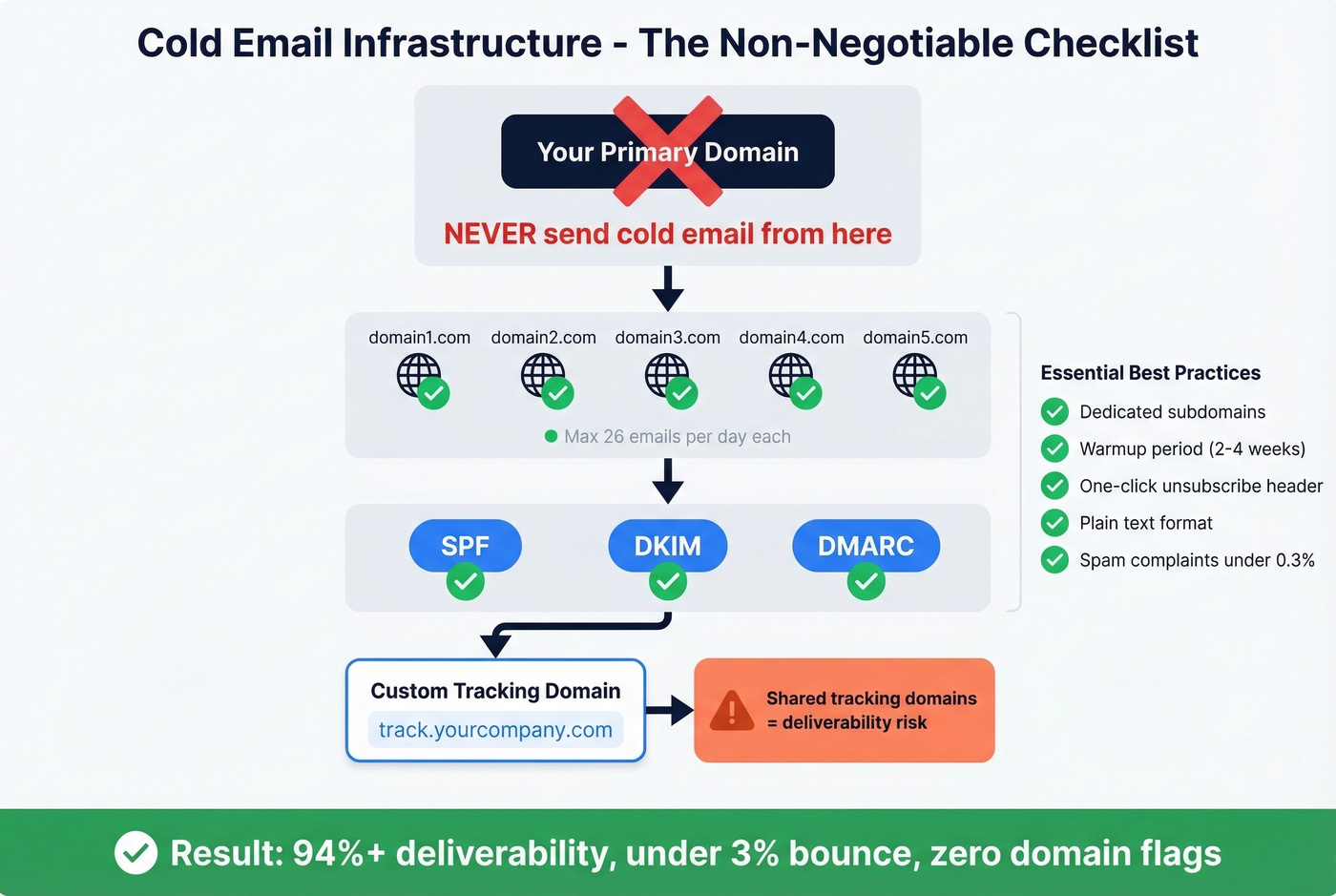
- Multiple domains. The case study above went from 3 to 7 domains, each sending max 26 emails/day. More domains, lower volume per domain, better sender reputation.
- Authentication. SPF, DKIM, and DMARC on every domain. Non-negotiable. (If you need the full setup, start with sender authentication.)
- Custom tracking domain. Shared tracking domains are a deliverability risk. Set up something like
track.yourcompany.com. If you're auditing your stack, use this email tracking tools guide. - Dedicated subdomain. Never cold email from your primary domain.
- Spam complaint rate under 0.3%. Go above that and you're cooked.
- Warmup period. New domains get crushed without it - the consensus on r/SaaS is that inbox providers are harsher about this than ever. If you're sending from Google, follow a real Gmail warm up plan. Some platforms like Instantly let you buy domains and inboxes in-app, which cuts the registrar juggling.
- One-click unsubscribe header. Required for bulk senders in 2026.
- Plain text format. Heavy HTML, images, and multiple links trigger spam filters. Strip it down.
Skip this section at your own risk. We've watched teams with brilliant copy get 0.5% reply rates because they sent from a single unwarmed domain with no authentication. Infrastructure isn't glamorous, but it's the foundation everything else sits on.
AI personalization at 15-20% reply rates means nothing if 11% of your list bounces. At ~$0.01/email, Prospeo's catch-all handling and spam-trap removal ensure every AI-crafted message actually reaches a real inbox. Teams using Prospeo book 35% more meetings than Apollo users - because the data connects.
Send fewer emails. Reach more buyers. Start with accurate data.
Write AI Cold Emails That Don't Sound Like AI
Recipients correctly identify AI-written emails about half the time. The giveaways? Repetitive phrasing, overly formal tone, formulaic structure. When they spot it, 47% of B2B professionals say they're less likely to reply.
The good news from a Hunter.io survey of 200 decision-makers: 67% don't mind AI-written emails as long as they're relevant.
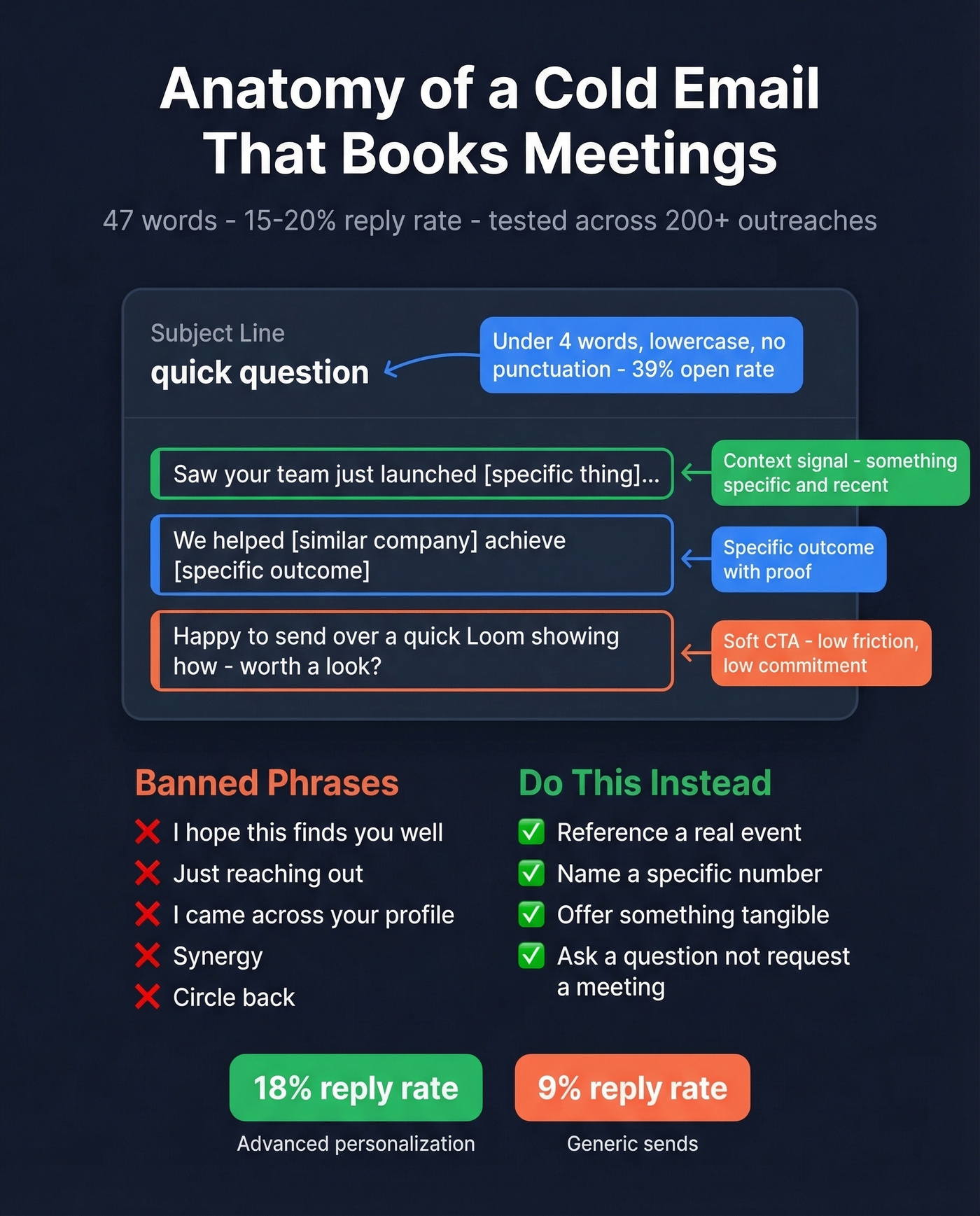
So the fix isn't avoiding AI. It's constraining it. This prompt framework was tested across 200+ outreaches at 15-20% reply rates:
You are writing a cold email. Follow these rules strictly:

- Under 100 words. No exceptions.
- No exclamation points.
- Banned phrases: "I hope this finds you well", "just reaching out",
  "I came across your profile", "synergy", "circle back"
- First line must reference something specific and recent about the
  recipient or their company.
- End with a low-commitment ask. Not a meeting request.
- Write like the 3rd email someone has sent that day   -   not the first,
  not the last. Casual-professional.
- Do NOT write until I provide: my role, recipient's role/company,
  2-3 sentences of context, and a 1-sentence value prop.
The trend in 2026 is 40-60 words max. One practitioner's best-performing structure runs about 47 words: context signal, specific outcome, proof, soft ask. The offer does the heavy lifting, not the personalization. Best-performing offers are specific and low-friction - something like "I'll audit your top 3 landing pages and send a Loom with fixes."
Advanced personalization pushes reply rates to 18% versus 9% for generic sends. We've tested the prompt template above against default AI outputs across dozens of campaigns, and it consistently delivers 3-4x the reply rate of unprompted drafts.
Subject lines matter too. That same case study used "Quick question" and hit 39% opens. Keep them under 4 words, lowercase, no punctuation. If you want more patterns, pull from these email subject lines that get responses.
One note on models: Claude nails the casual-professional tone better than GPT-4 without heavy guardrails. Worth testing both with the same prompt.
Sequence and Send Smart
- Send Tuesday-Wednesday, 8-11 AM in the recipient's timezone. The case study above saw a 16% open improvement from timezone-based sending alone. (If you're planning your calendar, see best days to send email marketing.)
- 4-7 touchpoints. Don't stop at one. 42% of replies come from follow-ups, yet 48% of reps never send a second email. That's pipeline left on the table. Use a proven follow up email sequence strategy to keep cadence tight.
- A/B test weekly. Elite performers in Instantly's dataset do this consistently.
- Soft CTAs. "Worth a conversation?" outperforms hard meeting asks. Low friction, low commitment.
- Go multichannel. Combining email with phone and social touches can boost results by 287%+ - but email is the scalable foundation you build everything else on. For a full system, use this multichannel sales outreach playbook.
Tools for AI Cold Email Outreach
Let's be honest - every sequencer added an AI button in 2024. The tool matters less than the system. Here's a stack that runs about $420/month total and generates real pipeline:
| Layer | Tool | Starting Price | Role |
|---|---|---|---|
| Sending | Instantly | $30-$37/mo | Warmup, inbox rotation |
| Sending | Saleshandy | ~$36/mo | Unlimited warmup, sequencing |
| Sending | Smartlead | ~$39/mo | Inbox rotation, alternative to Lemlist |
| AI Writing | ChatGPT / Claude | Free-$20/mo | Drafting with prompt template |
| AI Personalization | Lyne.ai | $0.30/contact | Intro line generation (optional) |
If you're just starting out and budget is tight, skip Lyne.ai entirely. The constrained prompt template above gets you 80% of the way there for free. If you're comparing options, start with an AI email writer breakdown.
Where AI Helps (and Where It Doesn't)
AI works for: lead sourcing, prospect research, draft messaging, personalization at scale. The biggest gains come from research and first-draft speed - not from replacing human judgment.
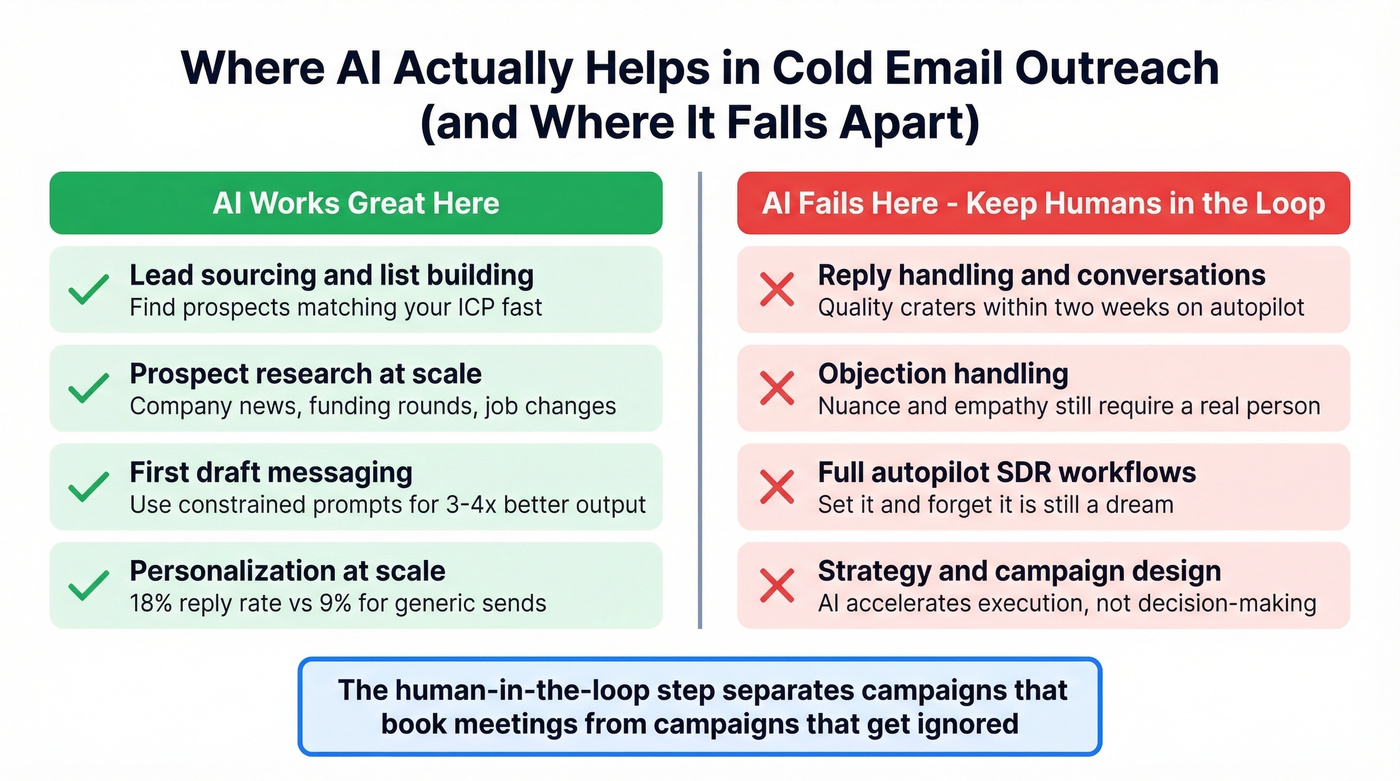
AI fails at: reply handling, objection handling, running full-autopilot SDR workflows. I've watched teams try to automate the entire sequence end-to-end and seen response quality crater within two weeks. The "set it and forget it" dream is still a dream.
Minor manual edits - even intentional typos - increase conversion. The Reddit consensus on r/SaaS is clear: the human-in-the-loop step separates campaigns that book meetings from campaigns that get ignored. AI accelerates your workflow. It doesn't replace the strategy behind it.
FAQ
How much does an AI cold email outreach stack cost?
About $420/month for a complete setup covering data, sending, and AI writing. Data verification starts free at 75 emails/month with Prospeo, sending tools like Instantly or Saleshandy run $36-$39/month, and ChatGPT or Claude cost $0-$20/month. One practitioner documented generating 16 qualified leads/month at that spend.
Can prospects tell if AI wrote my cold email?
About half the time. They pick up on repetitive phrasing, overly formal tone, and formulaic structure. Use the constrained prompt template above - it eliminates those patterns and consistently hits 15-20% reply rates in our testing.
What reply rate should I expect?
The 2026 average sits at 3.43%, while the top 10% exceed 10.7%. The gap isn't which AI writes your emails - it's verified data, proper domain infrastructure, and disciplined sequencing. Teams that fix all three typically land in the 6-10% range within 60 days.