

Best Days to Send Email Marketing: What 17B+ Emails Reveal
You scheduled your product launch email for Tuesday at 10 AM because that's what every guide told you to do. So did 10,000 other marketers. Your carefully crafted email landed in an inbox already stuffed with competitor campaigns, product updates, and newsletters - all sent at the exact same time, following the exact same advice.
We pulled data from five major studies covering over 17 billion emails to find the best days to send email marketing campaigns. The answer isn't Tuesday. It isn't simple. And the studies don't even agree - which is actually the most useful part.
Quick Answer: Best Days and Times
If you need a number before the nuance, here's where the data lands:
| Metric | Best Day | Best Time | Source |
|---|---|---|---|
| Opens | Friday (49.72%) | 8-11 AM local | MailerLite |
| Clicks | Friday (8.09%) | 8-9 PM | MailerLite |
| Conversions | Friday (5.74%) | - | Omnisend |
| Safest start | Wednesday | 10 AM local | Consensus |
Friday dominates across opens, clicks, and conversions - and almost nobody recommends it. Wednesday at 10 AM is your safest control if you're starting from scratch. But the real answer requires digging into what these studies actually measured.
What 5 Major Studies Found
Here's the problem with "best day to send email" advice: the five largest studies can't agree. We ran these numbers side by side specifically because no single study tells the full story.
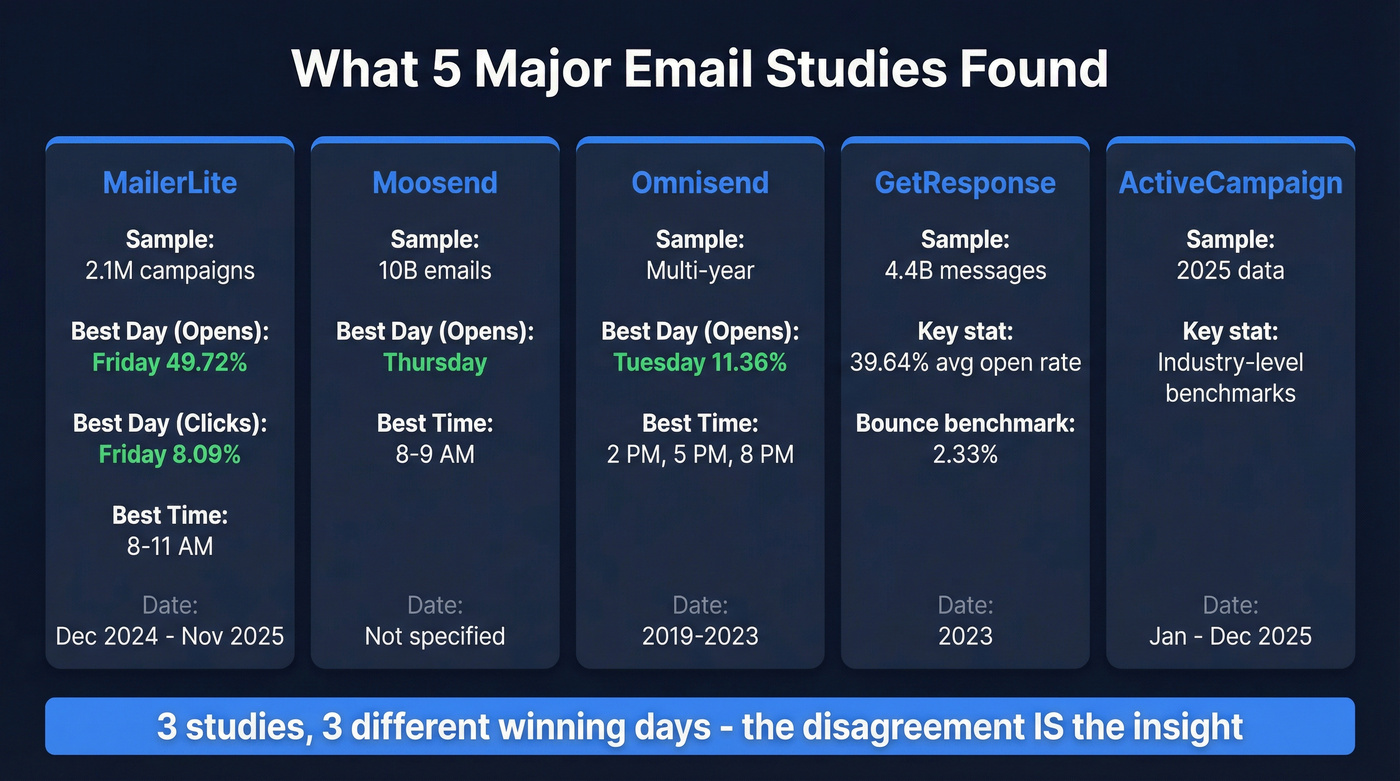
| Study | Sample | Best Day (Opens) | Best Day (Clicks) | Best Time | Date Range |
|---|---|---|---|---|---|
| MailerLite | 2,138,817 campaigns | Friday (49.72%) | Friday (8.09%) | 8-11 AM | Dec 2024-Nov 2025 |
| Moosend | 10B emails | Thursday | - | 8-9 AM | Not specified |
| Omnisend | Multi-year | Tuesday (11.36%) | - | 2 PM, 5 PM, 8 PM | 2019-2023 |
| GetResponse | 4.4B messages | - | - | - | 2023 |
| ActiveCampaign | 2026 benchmarks (2025 data) | - | - | - | Jan 1-Dec 10, 2025 |
The 2,138,817-campaign analysis says Friday. The 10-billion-email dataset says Thursday. The multi-year e-commerce analysis says Tuesday. Three studies, three different winners.
That contradiction isn't a flaw - it's the story. Each platform has a different user base, a different mix of B2B and B2C senders, and a different date range. Omnisend's data runs from 2019 to 2023, spanning pre- and post-pandemic email behavior plus the early impact of Apple Mail Privacy Protection. The MailerLite dataset is the freshest, covering December 2024 through November 2025, which makes it the closest thing we have to a current snapshot of how people actually interact with email right now.
GetResponse and ActiveCampaign don't break down by day of week in their published benchmarks, but they contribute critical baselines. The 4.4-billion-message GetResponse dataset gives us a 39.64% average open rate and a 2.33% bounce rate benchmark, while ActiveCampaign provides highly granular industry-level data.
Ask any email marketer on r/emailmarketing about Tuesday at 10 AM and you'll get eye-rolls. It's the most memed piece of email advice in the industry, and community threads are full of marketers reporting that their best-performing day was one they discovered by accident, not by following a guide.
Best Day by Goal
The optimal send day depends entirely on what you're optimizing for. The best day for opens isn't the best day for revenue, and that distinction matters more than any single benchmark.
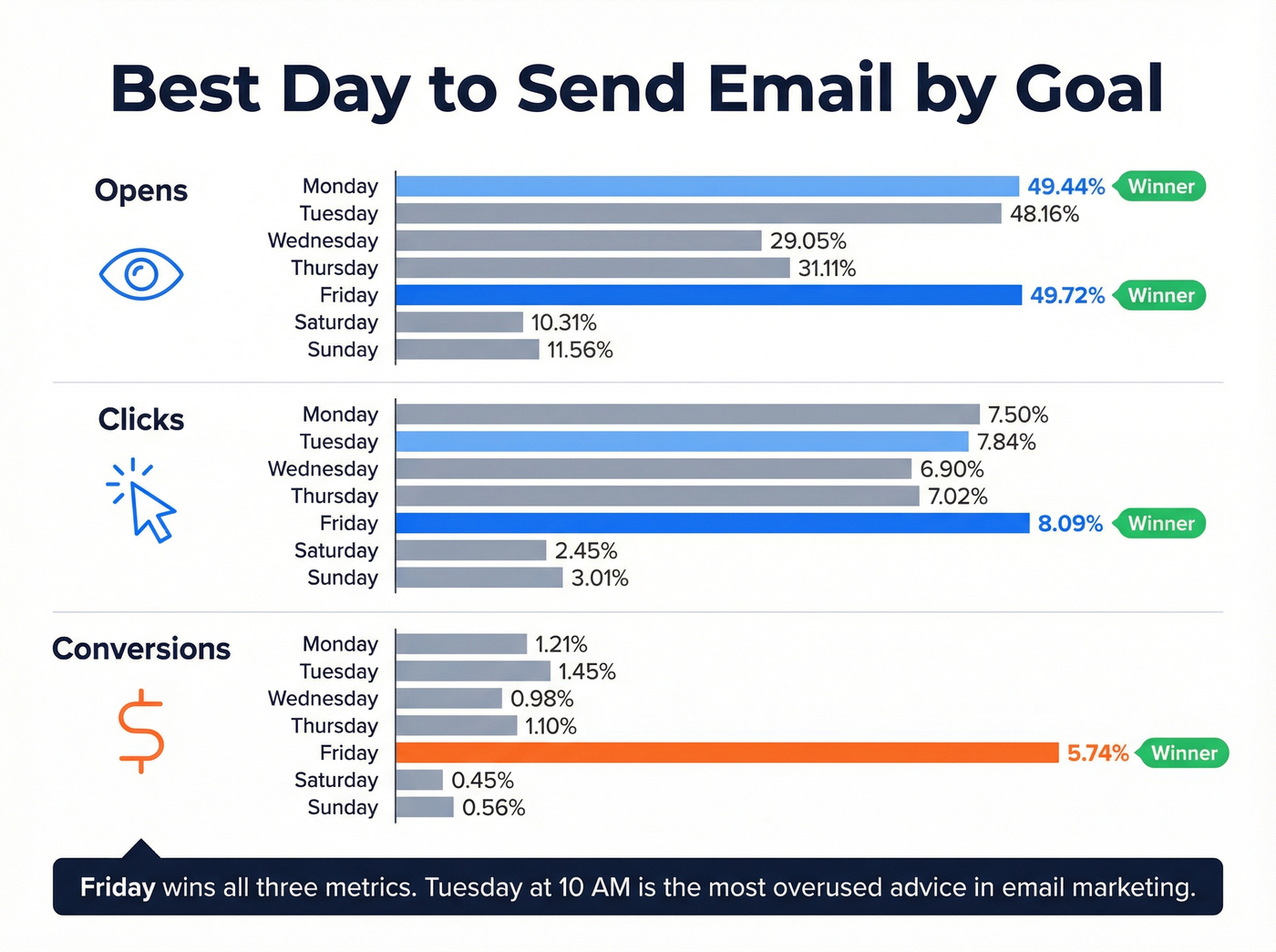
Optimizing for opens? Friday wins at 49.72%, with Monday close behind at 49.44%. The gap is narrow enough that either day works, but Friday gets a fraction of the send volume - less competition, more visibility.
Optimizing for clicks? Friday again. Its 8.09% click rate edges out Tuesday's 7.84%. The difference is small but consistent.
Optimizing for conversions? This is where Friday pulls away. Omnisend's data shows Friday delivering a 5.74% conversion rate - significantly higher than any other day. No other ranking article properly uses this stat, and it's the one that actually matters for revenue.
Let's be honest: Tuesday at 10 AM is the most overused advice in email marketing. Friday is criminally underrated.
Best Time of Day
Morning sends win opens. Evening sends win clicks. The pattern is remarkably consistent across studies.
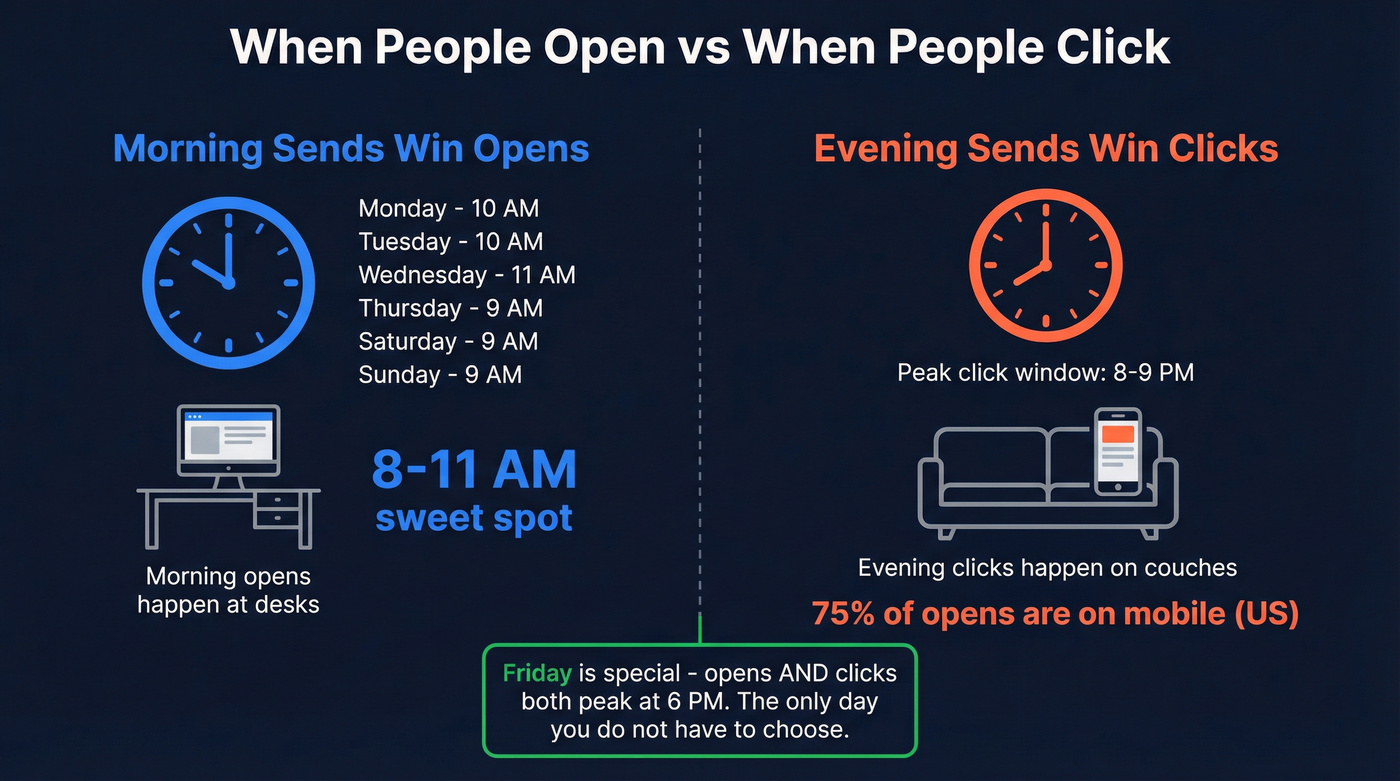
The day-by-day peak open times from the 2.1-million-campaign dataset tell a clear story: Monday 10 AM, Tuesday 10 AM, Wednesday 11 AM, Thursday 9 AM, Saturday and Sunday 9 AM. The 8-11 AM window captures the morning email-check habit across time zones. The 10-billion-email analysis confirms this, pinpointing 8-9 AM as the peak delivery window.
Clicks follow a different rhythm entirely. Evening sends - particularly the 8-9 PM window - consistently outperform mornings for click-through rate. Morning opens happen at desks. Evening clicks happen on couches. The Moosend data shows 75% of email opens now happen on mobile devices in the US, which helps explain the evening engagement spike.
Friday is the only day where opens and clicks peak at the same time: 6 PM. That convergence makes Friday evening sends uniquely efficient - you don't have to choose between optimizing for opens or clicks.
Why These Studies Disagree
Five studies, five different answers. That's not a data quality problem. It's a dataset composition problem.
The MailerLite user base skews toward small businesses and creators. Omnisend is heavily e-commerce. Moosend serves a broad mix. Each platform's "best day" reflects the behavior of its specific sender population, not a universal truth. A B2B SaaS audience checking email at 8 AM on Tuesday behaves nothing like a DTC shopper browsing promotional emails on Friday evening.
Date ranges compound the issue. Omnisend's 2019-2023 window spans a period of massive behavioral change - pandemic work-from-home patterns, the rollout of Apple MPP in 2021, and the return-to-office shift. The December 2024-November 2025 dataset reflects current behavior more accurately.
Regional variation adds another layer. GetResponse data shows North American open rates at 45.30% versus Asia at 28.04% - a 17-point gap that would completely change "best day" calculations depending on where your subscribers sit.
Then there's the inbox congestion problem. When every marketer follows the same "Tuesday at 10 AM" advice, ISPs see send volume spikes that can trigger throttling. The consensus creates its own competition.

You just optimized your send day. Now make sure those emails actually land. Prospeo's 98% verified emails keep your bounce rate under 4% - so your perfectly timed Friday campaign hits real inboxes, not spam folders.
Perfect timing is wasted on bad data. Fix the data first.
Open Rates Are Broken
Your platform shows a 48% open rate. Half those "opens" are Apple's proxy servers, not humans.
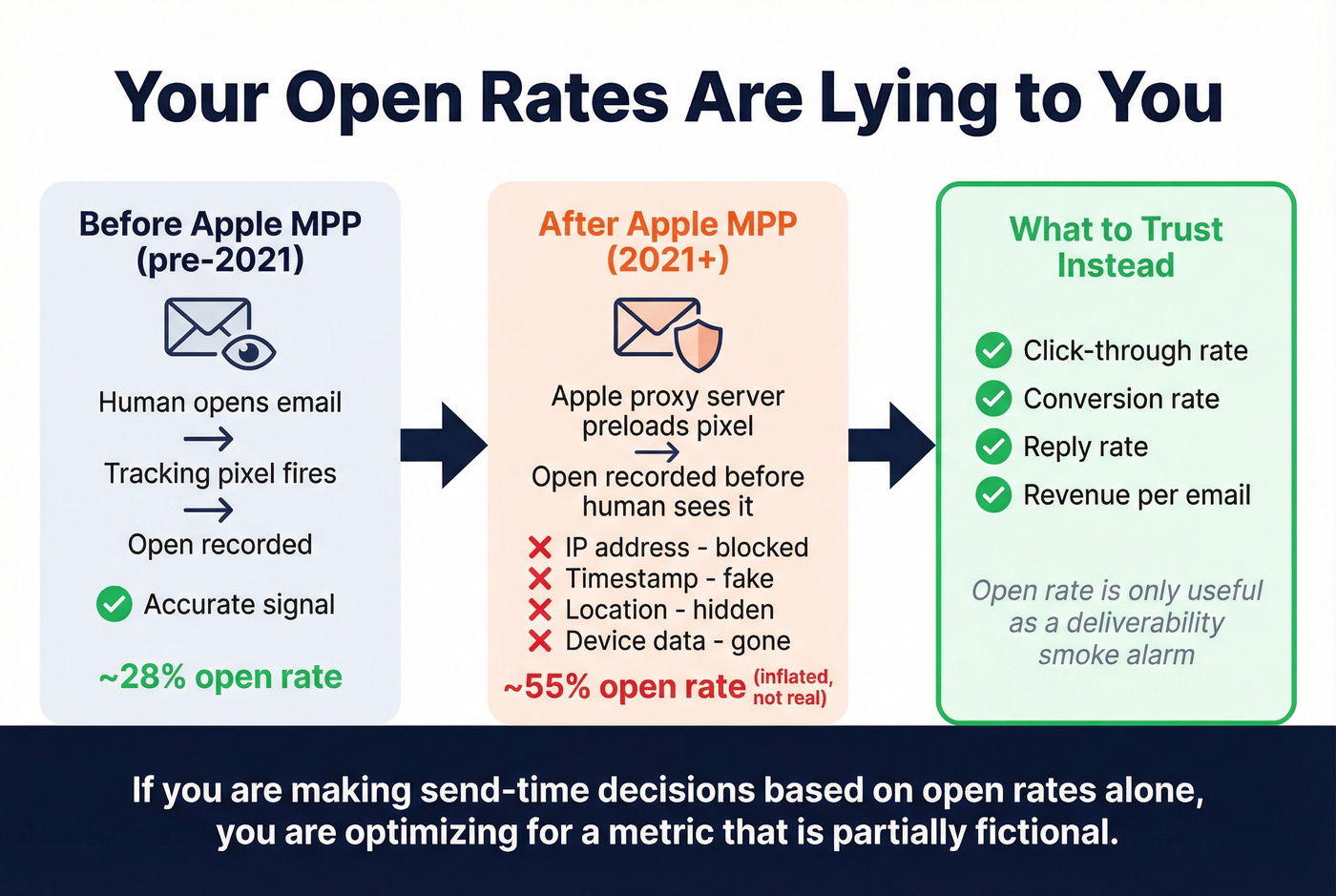
Apple Mail Privacy Protection, rolled out in 2021, preloads tracking pixels via proxy servers before the recipient ever sees the email. It blocks IP addresses, open timestamps, geolocation, and device data. The result: open rates that spike from 28% to 55% overnight with zero change in actual human engagement. GetResponse explicitly acknowledges this in their benchmark methodology, noting that Apple's Mail Privacy feature "distorts the data with its auto-opens."
Look - if you're making send-time decisions based on open rates alone, you're optimizing for a metric that's partially fictional. Click-through rate, conversion rate, and reply rate are the metrics that still reflect genuine human behavior. Open rate works as a rough deliverability proxy (if it drops to zero, something's broken), but it's not a reliable timing signal anymore. For a deeper breakdown, see Open Rate vs Click Rate.
Send Day Performance by Industry
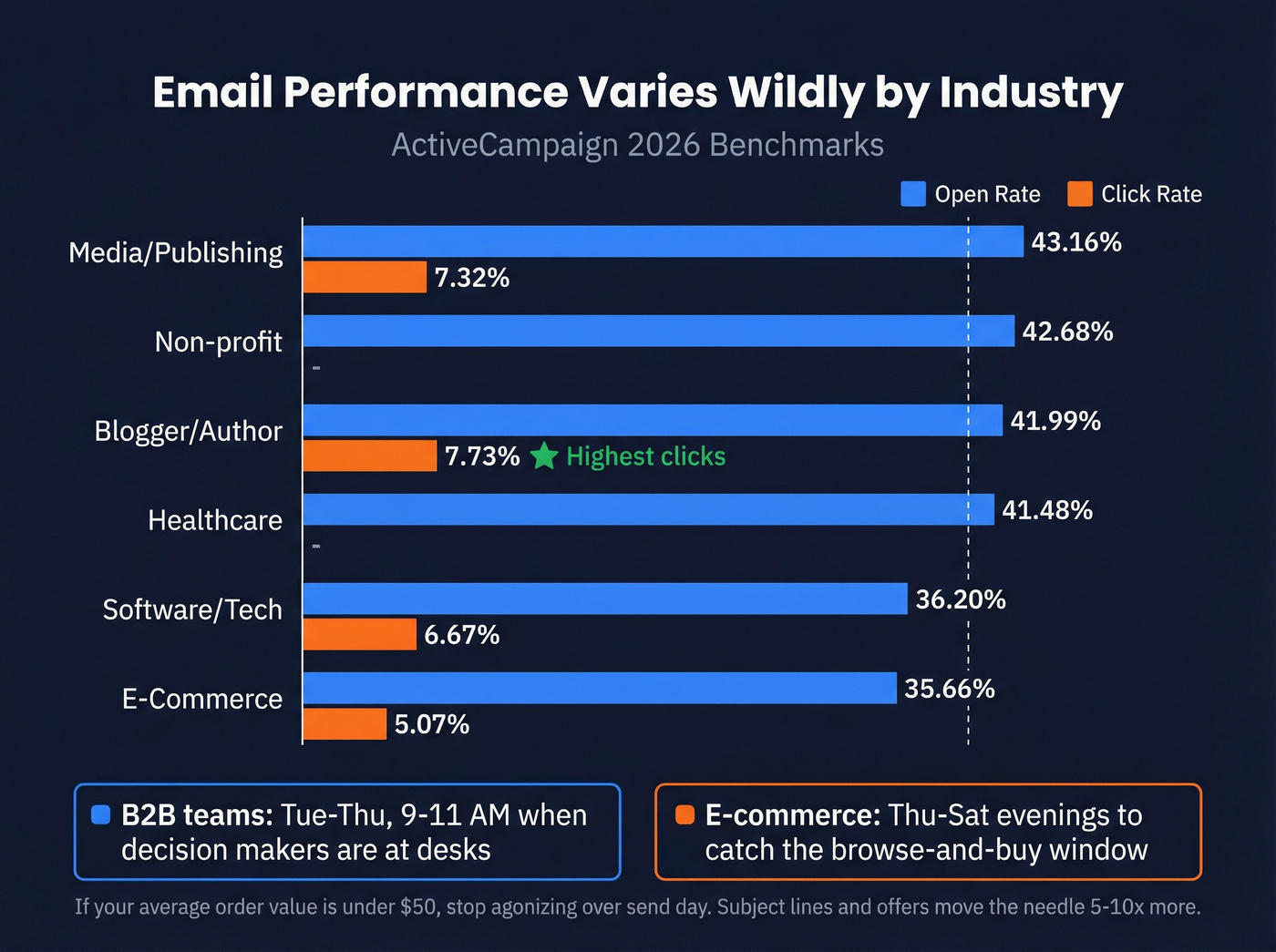
Not all inboxes behave the same. ActiveCampaign's 2026 benchmarks reveal significant variation across verticals.
| Industry | Open Rate | Click Rate |
|---|---|---|
| Media/Publishing | 43.16% | 7.32% |
| Non-profit | 42.68% | - |
| Blogger/Author | 41.99% | 7.73% |
| Healthcare | 41.48% | - |
| Software | 36.20% | 6.67% |
| E-Commerce | 35.66% | 5.07% |
The gap between media/publishing and e-commerce is nearly 8 points on opens. Click rates tell a different story - blogger/author content drives the highest clicks at 7.73%, while e-commerce lags at 5.07%.
For B2B teams, the heuristic holds: Tuesday through Thursday, 9-11 AM, when decision-makers are at their desks. If you're running outbound, compare this with the best time to send prospecting emails. E-commerce brands should lean into Thursday through Saturday with evening sends to capture the browsing-and-buying window. During Black Friday/Cyber Monday, Twilio SendGrid found peak sends at 7 AM with peak opens at 8-9 AM MDT - earlier than most marketers expect.
If your average order value is under $50, stop agonizing over send day entirely. The difference between your best and worst day is maybe 1-2 percentage points on clicks. Spend that energy on subject lines and offers instead - they'll move the needle 5-10x more than shifting from Tuesday to Friday.
Use Send-Time Optimization
Send-time optimization delivers emails based on each subscriber's individual engagement history rather than a fixed schedule. Instead of guessing whether 10 AM or 6 PM works better for your list, STO tools analyze when each person actually opens and clicks, then schedule delivery accordingly.
The results aren't subtle. Braze's Intelligent Timing case studies show what individualized send times can do: OneRoof saw a 23% increase in click-to-open rates and a 57% uplift in unique clicks. foodora hit a 41% conversion rate with a 26% reduction in unsubscribe rate during an onboarding flow test. KFC Ecuador got a 15% open rate increase after implementing Intelligent Timing.
Braze specifically notes they exclude "machine opens" from their engagement signals - a critical detail given the Apple MPP distortion we covered earlier. Most major ESPs now offer some form of STO. If yours does, turn it on. If it doesn't, that's a reason to switch.
Fix Your List Before Optimizing Timing
Every timing guide skips this step. If 10-15% of your list bounces, none of the advice above matters.
Bad email addresses don't just waste sends - they actively damage your sender reputation. ISPs track bounce rates, spam trap hits, and engagement signals to decide whether your emails reach the inbox or the spam folder. A dirty list tanks deliverability for every future campaign, regardless of when you send it. The GetResponse benchmark puts the average bounce rate at 2.33%. If you're above that, you have a list hygiene problem that no amount of send-time optimization will fix. Start with an email deliverability checklist and a proper email marketing audit.
We've seen this play out with our own users. Meritt went from a 35% bounce rate to under 4% after running their list through Prospeo's 5-step verification process, and their pipeline tripled from $100K to $300K per week. That kind of deliverability improvement compounds with every subsequent send - better reputation means better inbox placement means better engagement data means better timing decisions. If you’re diagnosing bounces, see Hard Bounce and Invalid Emails.
How to Find Your Ideal Send Day
Generic benchmarks give you a starting point. Testing gives you an answer. Here's the framework we recommend:
Start with Wednesday at 10 AM local as your control. It's the safest consensus pick and gives you a clean baseline.
Test one variable at a time. Change the day OR the time, never both simultaneously. If you shift to Friday and 6 PM in the same test, you won't know which variable moved the needle. Use a dedicated email A/B testing workflow to keep results clean.
Run each test for 4-6 weeks minimum. One week of data is noise. You need multiple send cycles to account for holidays, seasonal patterns, and random variation.
Measure clicks and conversions, not opens. Opens are inflated by Apple MPP. Clicks and conversions reflect actual human engagement.
Segment by time zone before testing. Sending at 9 AM Eastern means your European subscribers get it at 2 AM. That's not a timing test - it's a deliverability test. If you do global outbound, follow a time zone playbook.
Use a verified list segment. If you're testing send times on a list full of dead addresses, your results are noise, not signal. Run your test segment through a verification tool first - clean data is the prerequisite for clean test results. (If you need options, start with an email checker tool.)
The biggest mistake? Sending randomly and hoping for the best. The second biggest: following outdated advice without testing it against your own audience. The best days to send email marketing campaigns are the ones your data confirms - not the ones a blog post told you to use.
Open rates are inflated by Apple MPP. Bounce rates don't lie. Teams using Prospeo's 5-step verified emails cut bounce rates from 35% to under 4% and tripled their pipeline. At $0.01 per email, bad data is a choice.
Send on Friday. Send to verified contacts. Watch conversions climb.
FAQ
Is Tuesday really the best day to send marketing emails?
Not according to the freshest data. The 2.1-million-campaign MailerLite analysis found Friday delivers the highest open rate (49.72%) and click rate (8.09%), while Omnisend's older dataset favors Tuesday at 11.36% opens. Tuesday also carries the heaviest inbox competition. Test both against your own list.
What's the best time of day for email campaigns?
For opens, 8-11 AM local time wins across most studies. For clicks, 8-9 PM consistently outperforms mornings. Friday is the only day where opens and clicks peak together at 6 PM, making it uniquely efficient for a single send.
Are email open rates still reliable in 2026?
No. Apple Mail Privacy Protection generates fake opens that inflate rates by 20+ points. Click-through and conversion rates are far more reliable for timing decisions. Treat open rate as a deliverability signal, not an engagement metric.
Does the ideal send day differ by industry?
Significantly. B2B performs best Tuesday through Thursday during business hours. E-commerce sees strong results Thursday through Saturday evenings. Open rates range from 35.66% in e-commerce to 43.16% in media/publishing - fundamentally different audience behavior requiring separate testing.
Should I verify my list before testing send times?
Always. Testing on a list with high bounce rates produces unreliable data and damages sender reputation. Clean your list first, establish a baseline, then run your timing tests. Skip this step and you're optimizing on bad data.