

The 9 Best Email Checker Tools in 2026: Accuracy, Pricing, and What Nobody Tells You
You exported 5,000 leads from your last campaign, loaded them into your sequencer, and watched the bounce rate climb to 6.2%. Now your ESP is threatening to throttle your sending domain - and you're scrambling to figure out which contacts were dead before you ever hit send.
B2B email data decays at over 22% per year. That means roughly one in five addresses on any list older than six months is already invalid. The right email checker tool catches those before they torch your sender reputation. The wrong one charges you full price and still lets bad addresses through.
We've tested and tracked these tools across real outbound campaigns, dug through Reddit threads and G2 reviews, and compared pricing at scale. Here's what actually holds up.
Our Picks (TL;DR)
Best for B2B teams that need email finding and verification in one step: Prospeo - proprietary 5-step infrastructure, 98% accuracy, 7-day data refresh. Free tier: 75 emails/mo.
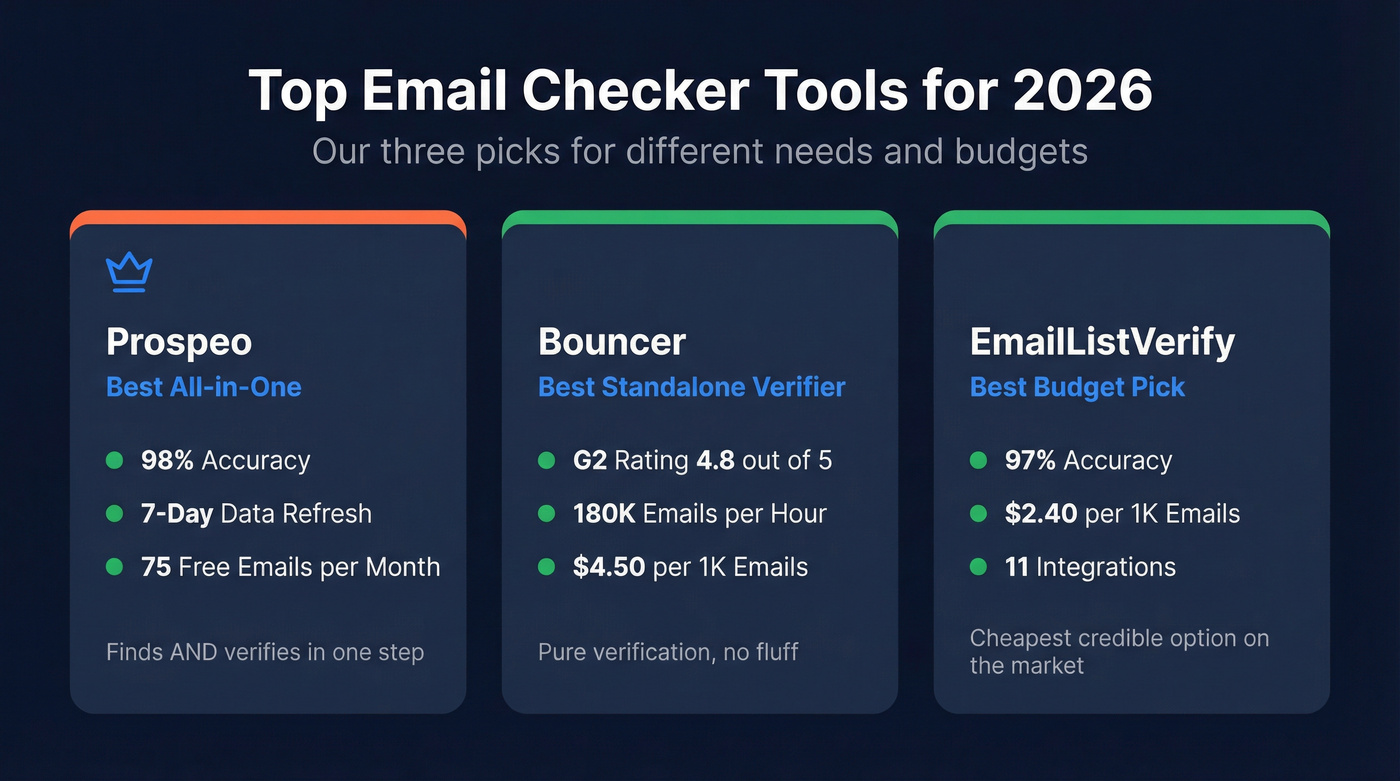
Best standalone verifier: Bouncer - G2 4.8 (232 reviews), Capterra 4.9 (233 reviews), $4.50/1K emails, 180K emails/hour throughput.
Best budget pick: EmailListVerify - $2.40/1K emails, one of the cheapest credible options on the market. 97% accuracy, 11 integrations.
How Email Verification Actually Works
Email verification isn't a single check. It's a five-step pipeline, and each step catches problems the others miss.
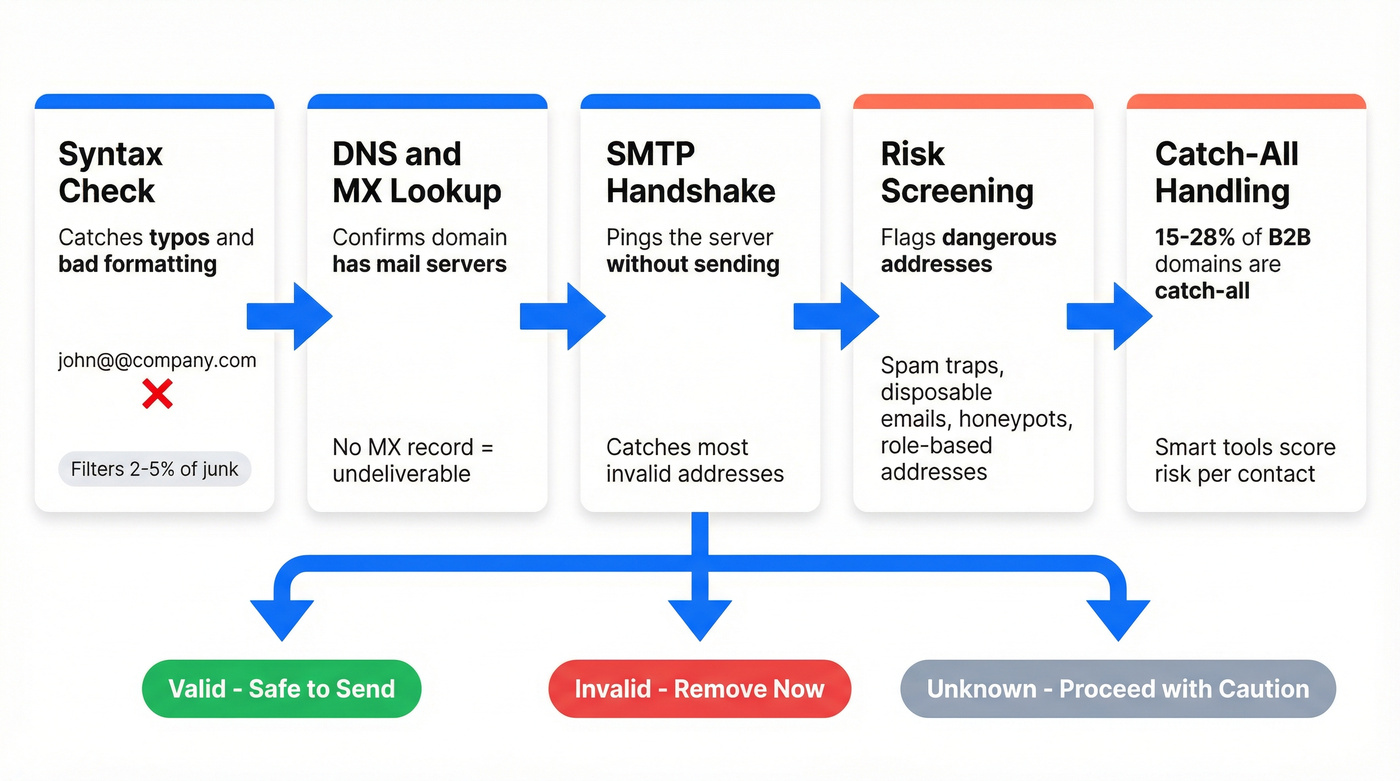
Syntax check. Is the address formatted correctly? Catches typos like "john@@company.com" or missing TLDs. Simple, but it filters out 2-5% of garbage before anything else runs.
DNS and MX lookup. Does the domain exist, and does it have mail servers configured? No MX record means the address can't receive email. Period.
SMTP handshake. The tool pings the mail server and asks "would you accept a message for this address?" without actually sending one. This is where most invalid addresses get caught.
Risk screening. The tool checks for spam traps, disposable email services like Guerrilla Mail or Mailinator, honeypots, and role-based addresses (info@, sales@, support@). These won't bounce, but they'll wreck your deliverability or waste your sends. SaaS companies also use this step at sign-up to block fake accounts before they enter the system.
Catch-all handling. This is the hard one. Between 15-28% of B2B domains are catch-all, meaning the server accepts all incoming mail regardless of whether the specific mailbox exists. Cheap tools just label these "unknown" and charge you anyway. Better tools apply contact-level risk scoring - safe, risky, or unknown - so you can decide whether to send.
Results come back in three buckets: valid (safe to send), invalid (remove immediately), and unknown/risky (your call, but proceed with caution). If your verification provider handles EU data, confirm they're GDPR compliant before uploading any lists.
Email Finder vs. Email Verifier
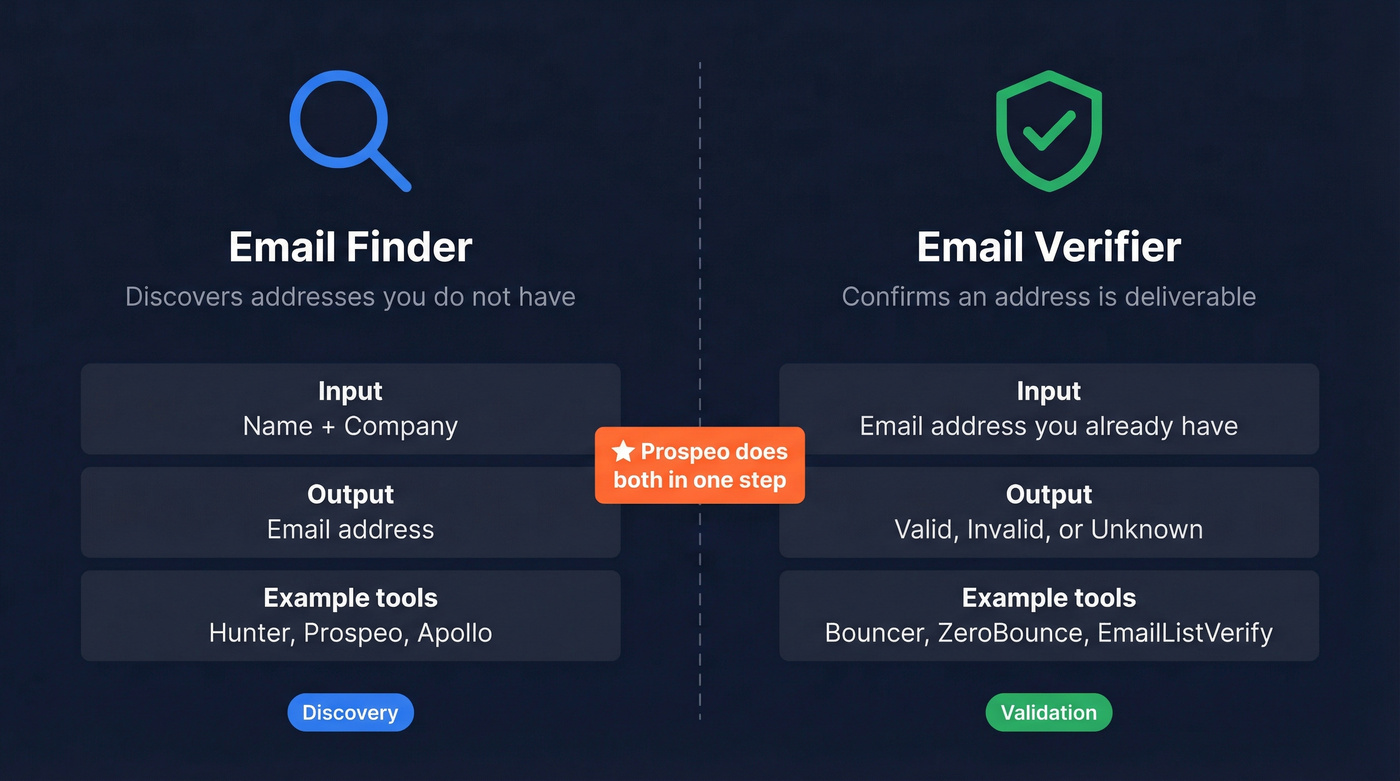
These are two different jobs, and most people conflate them. An email finder discovers addresses you don't have - you give it a name and company, it returns an email. A verifier confirms that an address you already have is deliverable.
The 9 Best Email Checker Tools in 2026
Prospeo - Best for Finding + Verifying in One Step
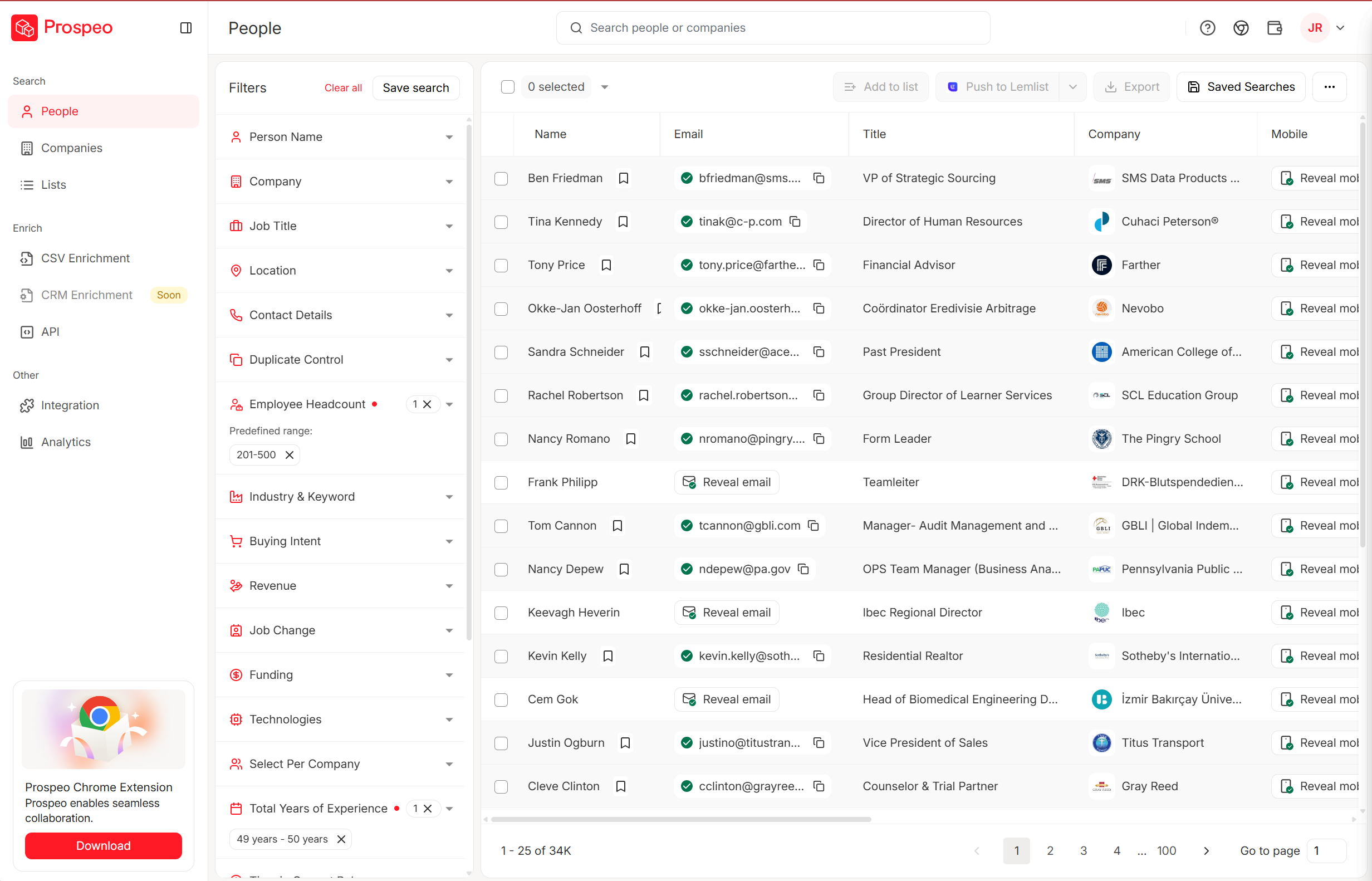
Most email verification tools confirm addresses you already have. Prospeo works differently - it finds emails from 300M+ professional profiles and runs each one through a proprietary 5-step verification pipeline before you ever see the result. No separate finding step, no separate verification step, no paying two tools for what should be one workflow.
The numbers: 98% email accuracy, 143M+ verified emails in the database, and a 7-day data refresh cycle versus the industry average of six weeks. Catch-all handling, spam-trap removal, and honeypot filtering are all built in - not bolted on from a third-party validator.
Real results from actual customers: Meritt dropped their bounce rate from 35% to under 4%. Snyk - with 50 AEs prospecting daily - went from 35-40% bounces to under 5% and added 200+ new opportunities per month. Stack Optimize built to $1M ARR while keeping client deliverability above 94% with zero domain flags.
Use this if: You need email discovery and verification in one workflow, you're tired of stitching together multiple tools, or you want data that's actually fresh.
Skip this if: You already have a clean list and just need the cheapest possible per-email verification.
Pricing: Free tier includes 75 emails/mo + 100 Chrome extension credits. Paid plans start at ~$39/mo. ~$0.01 per email - and that includes finding, not just verifying.
Bouncer - Best Standalone Verifier
If you already have your lists and just need them cleaned, Bouncer is the standout standalone verifier. G2 rating of 4.8 across 232 reviews, Capterra 4.9 across 233.
Bouncer processes 180K emails per hour, which means a 50,000-contact list finishes in under 17 minutes. It connects to 16 platforms natively, and 99%+ accuracy is the headline spec in most comparisons. The consensus on r/sales and r/Emailmarketing is that Bouncer is reliable and straightforward - no surprises, no hidden costs.
Use this if: You have lists from events, purchased data, or scraped contacts and need fast, reliable cleaning before sending.
Skip this if: You need to find emails, not just verify them. Bouncer doesn't do discovery.
Pricing: 100 free credits to start. $45 per 10K emails ($4.50/1K) on pay-as-you-go.
EmailListVerify - Best Budget Pick
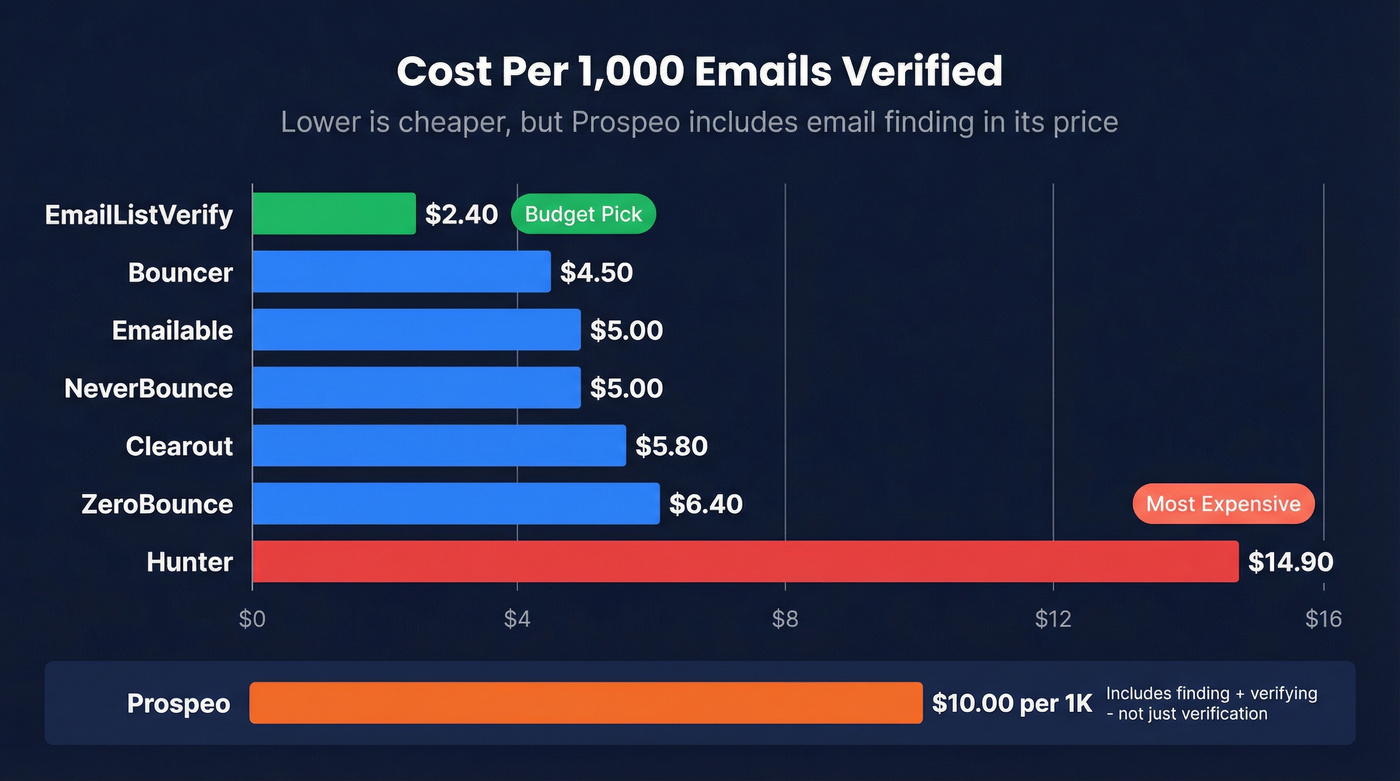
EmailListVerify is the price leader among mainstream verifiers. At $24 per 10K emails ($2.40/1K), it's nearly half the cost of Bouncer and far cheaper than Hunter's verification pricing. For teams running high-volume list cleaning on a tight budget, that math compounds fast - we're talking hundreds of dollars saved per quarter at 50K+ volumes.
Accuracy sits at 97%, a touch below the premium tools but solid enough for most outbound workflows. It connects to 11 platforms covering the basics: HubSpot, Mailchimp, Zapier. You get 100 free credits to test before committing.
Use this if: Budget is the primary constraint and you're cleaning large lists regularly.
Skip this if: You need advanced catch-all scoring or deep CRM integration. EmailListVerify keeps things simple - sometimes too simple for complex workflows.
Pricing: 100 free credits. $24/10K ($2.40/1K). Volume discounts available.
ZeroBounce - The Integration Play
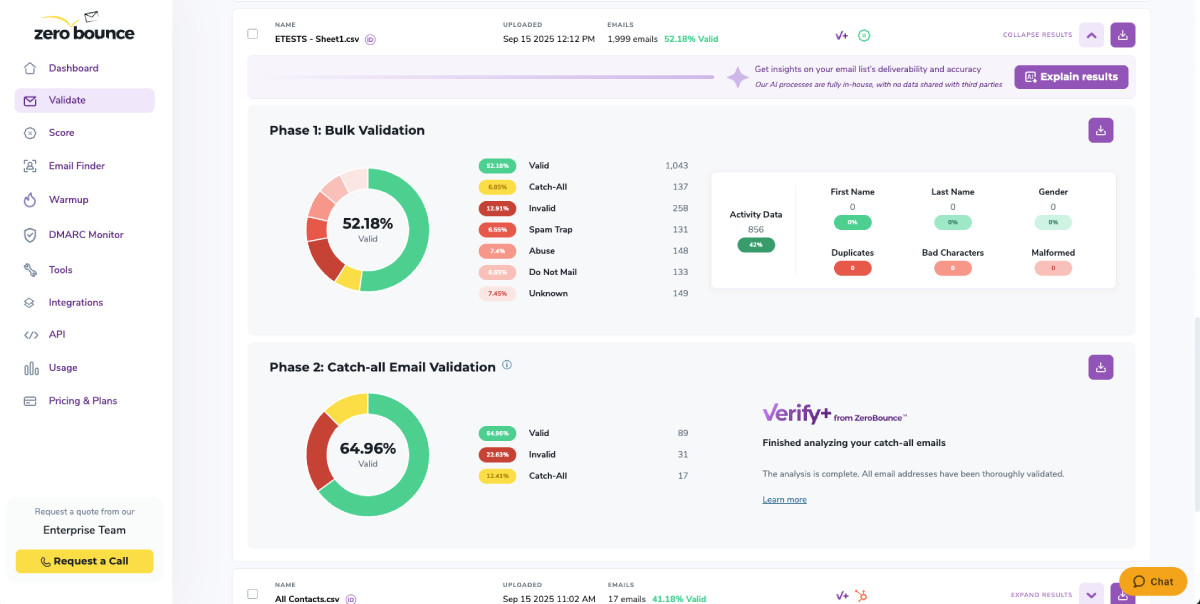
ZeroBounce connects to 45 platforms natively. If your stack is complex - spanning Salesforce, Marketo, and a custom data warehouse - ZeroBounce often plugs in without custom work. It processes 133K emails/hour and delivers 99% accuracy with 100 free verifications per month.
The tradeoff is price. At $64 per 10K, it sits at the premium end for a standalone verifier. Worth it if integrations save you engineering time. Overpriced if you just need CSV cleaning.
Emailable - Built for Speed
If throughput is your bottleneck, Emailable blows past the competition at 2M emails per hour - more than 10x Bouncer's speed. It also offers a generous free tier at 250 credits, enough to genuinely test accuracy before paying. Pricing lands at $50/10K with 22 integrations.
The tool is straightforward, the UI is clean, and it doesn't try to upsell you on features you don't need. It won't wow you with advanced catch-all intelligence, but for high-volume senders who need raw throughput, it's the obvious pick.
NeverBounce - Reliable but Redundant?
NeverBounce has been around long enough that it's baked into a lot of existing workflows. It runs $50/10K, lists 97% accuracy, and processes 100K emails/hour.
Here's the thing: Dropcontact's benchmark commentary argues that many enrichment tools rely on the same third-party validators - including ZeroBounce, NeverBounce, DeBounce, and Bouncer - which limits differentiation in validation logic. NeverBounce is still a reliable choice if it's already in your stack, but it's not one we'd adopt fresh in 2026 without a clear reason.
Hunter - Great Finder, Expensive Verifier
Hunter is probably the best-known email finder on the market. But as a verifier? It's the most expensive option here at $149 per 10K - roughly $14.90/1K. You get 50 free verifications per month and 24 integrations. Our recommendation: use Hunter for finding, pair it with a cheaper verifier for cleaning.
Clearout
Mid-tier pricing at $58/10K with solid verification fundamentals. Clearout makes sense if you're already using their prospecting tools - the ecosystem integration is smooth. Otherwise, Bouncer or EmailListVerify offer better value at their respective price points.
Email Hippo
Email Hippo gives you 100 free verifications per day - the most generous daily free allowance on this list. Their four-product structure (CORE for bulk, MORE for API, INSIGHT for intelligence, ASSESS for fraud) is overkill for most sales teams, but handy if you need light daily checking without a subscription.

Why run emails through a separate checker when you can get them pre-verified? Prospeo's 5-step verification pipeline catches spam traps, honeypots, and catch-all risks before you ever see the result. 98% accuracy, 7-day data refresh, ~$0.01 per email - finding included.
Meritt dropped their bounce rate from 35% to under 4%. Your list is next.
Pricing Comparison
Here's what each tool costs at 10,000 emails, normalized for comparison:
| Tool | Free Tier | Cost per 10K (per email) | Speed/hr | Best For |
|---|---|---|---|---|
| **Prospeo*** | 75/mo | ~$100 (~$0.01)* | N/A (finder+verifier) | Finding + verifying |
| Bouncer | 100 | $45 ($0.0045) | 180K | Standalone cleaning |
| EmailListVerify | 100 | $24 ($0.0024) | - | Budget bulk cleaning |
| ZeroBounce | 100/mo | $64 ($0.0064) | 133K | Complex integrations |
| Emailable | 250 | $50 ($0.005) | 2M | Raw throughput |
| NeverBounce | 10 | $50 ($0.005) | 100K | Legacy workflows |
| Hunter | 50/mo | $149 ($0.0149) | - | Email finding (not verifying) |
| Clearout | - | $58 ($0.0058) | - | Clearout ecosystem users |
| Email Hippo | 100/day | Varies by product | - | Free daily checks |
Prospeo's price includes email finding - standalone verifiers charge separately for discovery. That's an apples-to-oranges comparison that most pricing tables ignore.
Per-email costs vary by volume tier. Tools like DeBounce have offered rates as low as $1.50-2 per 1K, though availability and accuracy vary.
The sticker price trap: A benchmark of 20,000 tests across 15 tools found that Aeroleads, at EUR42/mo for 2,000 searches, delivered only a 35.5% usable email rate - making the real cost EUR47.75 per 1,000 usable emails. The cheapest tool on paper can be the most expensive tool in practice.
How Accurate Are These Tools, Really?
Every tool on this list advertises 97-99% accuracy. Those numbers are self-reported, measured under ideal conditions. Real-world performance tells a different story.
That same benchmark testing 20,000 contacts across 15 tools - the most comprehensive large-scale test we've seen - found effective enrichment rates ranging from 14% to 55%. That's a massive spread for tools that all market near-perfect accuracy. Hunter landed at 32.5%. GetProspect at 26.1%. FindThatLead at 14.2%.
Many enrichment tools rely on the same third-party validators under the hood. You can end up paying different prices for essentially similar verification logic.
Let's be honest about the most common operational complaint: catch-all handling. Teams see 20-30% of their lists come back as "unknown" with no actionable guidance - just a charge on their invoice. Any email checker tool worth its price should give you risk-level granularity on those results, not just a shrug.

The real differentiator isn't the accuracy percentage on the marketing page. It's what happens with catch-all domains. When 15-28% of B2B domains accept all incoming mail regardless of whether the mailbox exists, a tool that labels those "unknown" and charges full price is giving you a coin flip. The best verifiers provide contact-level risk scoring so you can segment your sends accordingly.
Our take: If your average deal size is under $5K, you probably don't need the most expensive verifier on the market. A $24/10K option like EmailListVerify paired with quarterly re-verification will get you 90% of the way there. Save the premium budget for tools that actually find you new leads, not just confirm the ones you have.
What Bounce Rate Should You Target?
Before you pick a tool, know what "good" looks like:
| Rating | Bounce Rate | What It Means |
|---|---|---|
| Excellent | <1% | Clean list, strong hygiene |
| Good | 1-2% | Healthy for most teams |
| Acceptable | 2-3% | Time to re-verify |
| Concerning | 3-5% | ESP warnings incoming |
| Critical | >5% | Immediate list cleaning needed |
B2B and SaaS teams typically land at 0.5-1.5%. E-commerce runs higher at 1.5-3%. Hard bounces specifically should stay under 0.5-1% - anything above that signals a list quality problem, not a sending problem. Keep complaint rates below 0.1%, because ISPs don't give second chances on that threshold.
5 Mistakes That Kill Your Results
Verifying once and never re-checking. Email data decays at roughly 2.1% per month. A list you cleaned in January has hundreds of dead addresses by April. Quarterly re-verification is the minimum. Monthly is better for high-volume senders.
Ignoring catch-all results. When 15-28% of B2B domains are catch-all, ignoring those results means ignoring a huge chunk of your list. Don't treat them all as valid, and don't delete them all either. Use risk scoring to segment and send cautiously.
Treating "unknown" as "valid." This is the most common mistake we see in our customers' workflows. A tool returns "unknown," and the sender assumes it's fine. It's not fine. Unknown means the tool couldn't confirm the address - sending to unknowns is how bounce rates spike from 2% to 8% overnight.
Skipping role-based email detection. Addresses like info@, sales@, and support@ won't bounce, but they tank deliverability in other ways. They're often monitored by multiple people, rarely lead to conversations, and frequently trigger spam complaints. Filter them out or send to them separately with adjusted expectations.
No API integration. If you're still downloading CSVs, uploading them to a verifier, downloading results, and re-uploading to your CRM, you're wasting hours and creating gaps where unverified emails slip through. The right approach is to verify at four touchpoints: form capture, CRM import, pre-send, and scheduled rechecks. Most tools on this list offer APIs that make this possible.
Email data decays 22% per year, yet most providers refresh every 6 weeks. Prospeo refreshes every 7 days. That's why Snyk cut bounces from 40% to under 5% across 50 AEs - without a separate email checker tool in their stack.
Get 75 verified emails free and see what fresh data actually looks like.
FAQ
Are free email checker tools accurate enough?
Free tiers (10-250 credits) are useful for testing a tool's accuracy before committing money, but they're too small for production list cleaning. Expect to pay $2-$8 per 1,000 emails at volume - trivial compared to the cost of a burned sending domain.
How often should I re-verify my email list?
Re-verify quarterly at minimum. B2B email data decays at roughly 22% per year, so a list cleaned in January could have hundreds of dead addresses by April. High-volume senders (10K+ emails/month) should re-verify monthly to keep bounce rates under 2%.
What's the difference between a hard bounce and a soft bounce?
Hard bounces mean the address doesn't exist - remove it immediately. Soft bounces are temporary issues like a full inbox or server outage. After 3-5 consecutive soft bounces on the same address, treat it as a hard bounce and remove it.
Can one tool find and verify emails simultaneously?
Yes. Prospeo finds emails from 300M+ professional profiles and verifies each through its proprietary 5-step pipeline at ~$0.01 per email. Hunter also offers both functions but charges $14.90/1K for verification alone. For most teams, a combined tool saves money and eliminates workflow gaps between discovery and validation.
Why do some verifiers return "unknown" on so many addresses?
Catch-all domains accept all incoming email regardless of whether the specific mailbox exists - 15-28% of B2B domains work this way. Basic verifiers label these "unknown" and charge you anyway. Better tools provide risk scoring (safe, risky, or unknown) so you can make informed sending decisions instead of guessing.