

Best AI Email Finder Tools in 2026: Real Data, Real Prices
You ran a 5,000-contact sequence last month and 11% bounced. Your domain reputation took a hit, reply rates cratered, and now you're shopping for a new email finder. Every vendor claims 95%+ accuracy - independent benchmarks put the real numbers between 18% and 49% for yield and 31% to 70% for verification accuracy, depending on what's being measured. The gap between marketing and reality in this category is wider than almost anywhere else in sales tech.
We've tested these tools against the same prospect lists, dug through every independent benchmark we could find, and talked to teams running serious outbound volume. Here are 11 tools with real pricing, benchmark data, and clear guidance on which ones deserve your budget.
Our Top Picks
| Pick | Tool | Why | Starting Price |
|---|---|---|---|
| Best accuracy & freshness | Prospeo | 98% email accuracy, 7-day refresh | Free; ~$0.01/email |
| Best free tier | Hunter | 50 free credits/mo, simple credit system | $0/mo |
| Best all-in-one | Apollo | Unlimited email credits + built-in sequences | ~$59/user/mo |
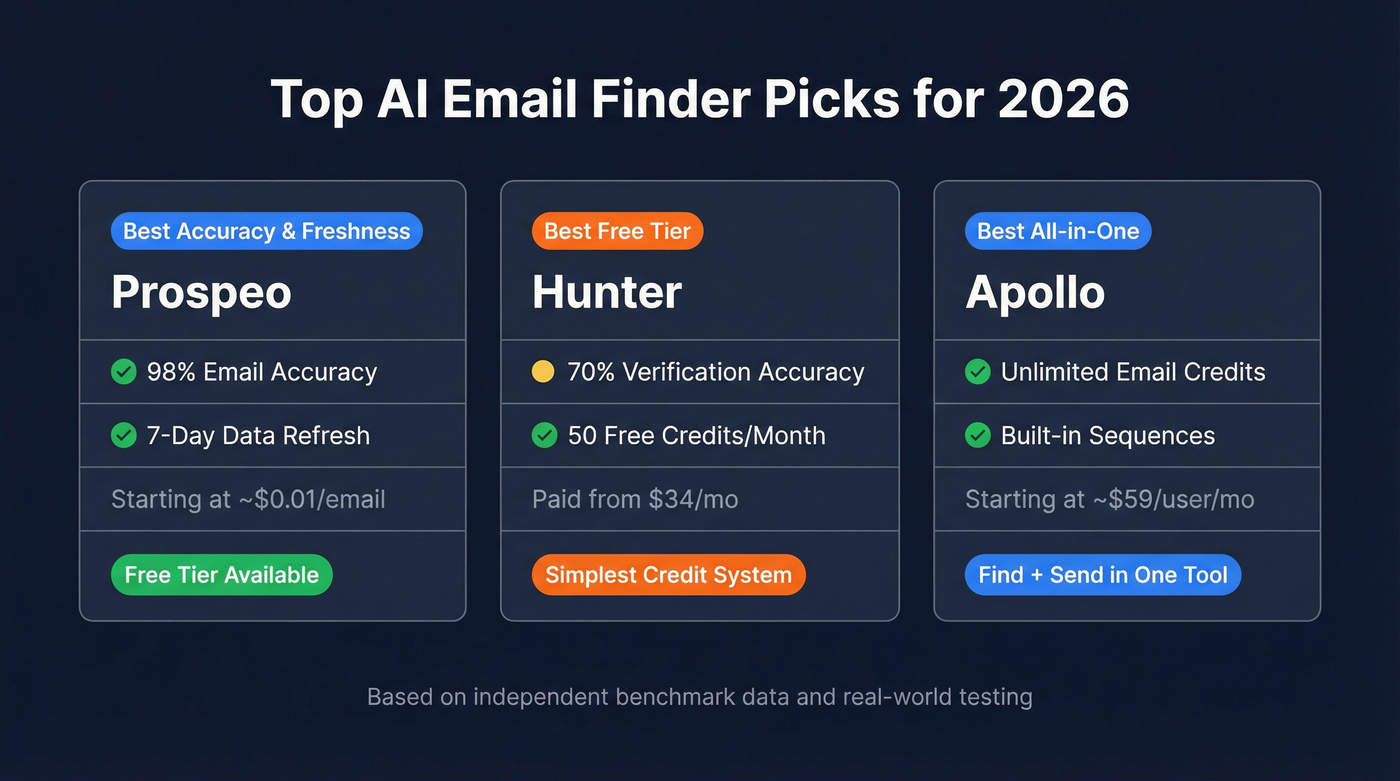
Prospeo wins on verified email accuracy and data freshness - its 7-day refresh cycle is unmatched. Hunter is the easiest way to test the category without spending a dollar. Apollo gives you the most functionality per dollar if you want finding and outreach in one platform.
What "AI" Actually Means in Email Finders
Most tools slap "AI-powered" on their marketing page and call it a day. Let's break down what AI actually does in this category, because the differences matter more than the label.
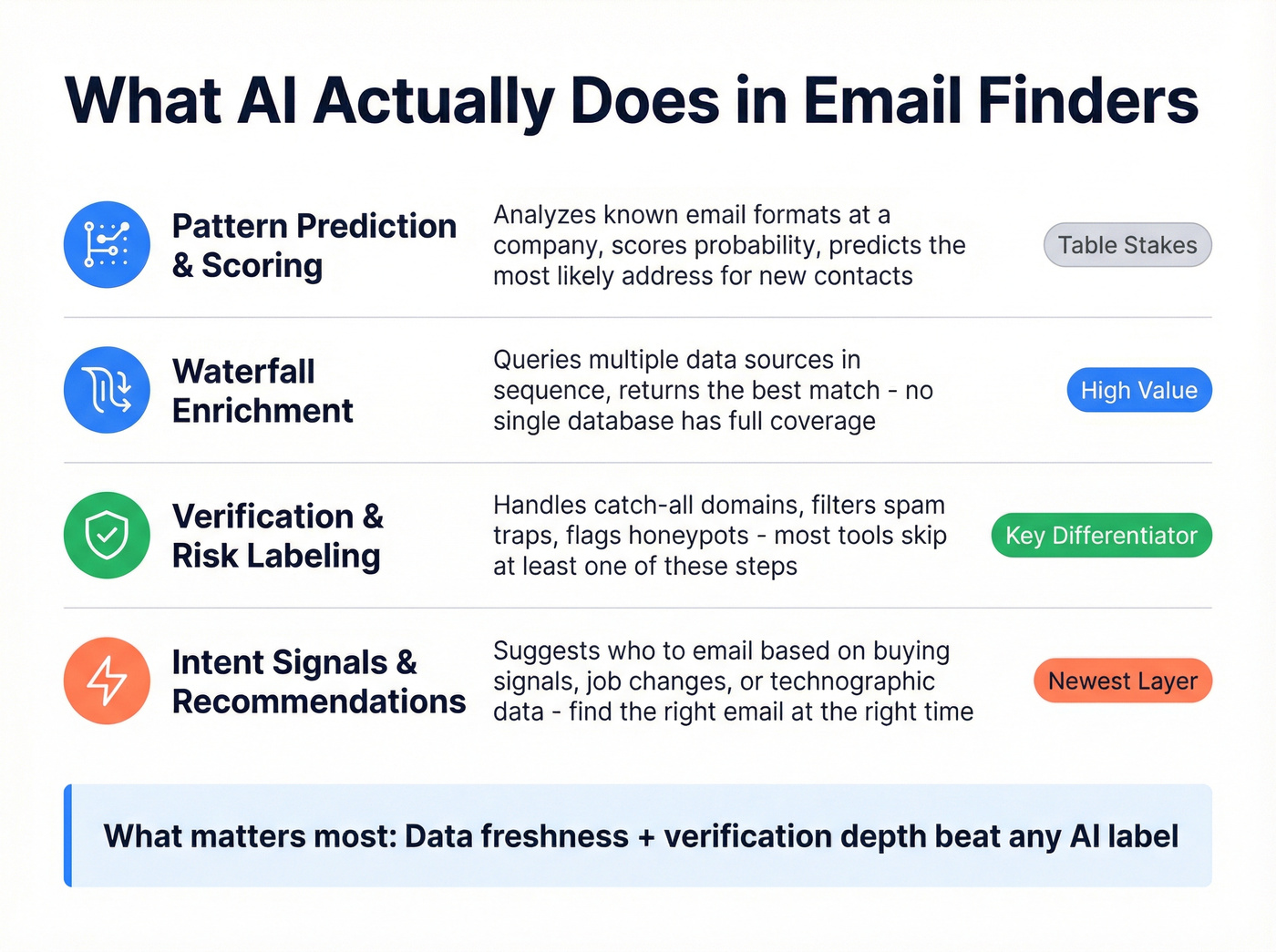
Pattern prediction and scoring. The tool analyzes a company's known email formats (firstname.lastname@, f.last@), scores the probability of each pattern, and predicts the most likely address for a new contact. This is the oldest application - useful but not magic.
Waterfall enrichment across providers. Instead of relying on a single database, the tool queries multiple data sources in sequence and returns the best match. Some platforms run waterfall enrichment across 5+ providers. This is genuinely valuable because no single source has complete coverage, and power users typically stack 2-3 finders in waterfall setups rather than trusting any single tool's database.
Automated verification and risk labeling. This is where real differentiation lives. Good tools don't just check if an email server responds - they handle catch-all domains, filter spam traps, and flag honeypots. Most tools skip at least one of these steps. The ones that don't will save you from domain damage. (If you want to go deeper on verification, see our guide to AI email verification.)
Intent signals and recommendations. The newest application: tools that suggest who to email based on buying signals, job changes, or technographic data. This moves beyond "find an email" into "find the right email at the right time." (Related: intent signals.)
Here's the thing: the "AI" label matters less than two concrete metrics - data freshness and verification depth. A tool with a stale database and basic SMTP checks will underperform one with fresh data and multi-step verification, regardless of how many times either says "AI" on its homepage.
11 Best AI Email Finder Tools in 2026
Prospeo
Prospeo's database covers 300M+ professional profiles, 143M+ verified emails, and 125M+ verified mobile numbers. The headline number is 98% email accuracy, achieved through a proprietary 5-step verification process that includes catch-all handling, spam-trap removal, and honeypot filtering. Unlike most tools in this list, Prospeo doesn't rely on third-party email providers - the infrastructure is built in-house.

The 7-day data refresh cycle is the standout differentiator. The industry average sits around 6 weeks, which means most databases are serving you contacts who changed jobs a month ago. Search filters go deep: buyer intent powered by Bombora across 15,000 topics , technographics, job changes, funding events, and headcount growth. The Chrome extension (40,000+ users) lets you find verified emails from any website in one click, and API enrichment matches 92% of leads and returns 50+ data points per contact. (More on building enrichment workflows: data enrichment for cold email.)
Real results back this up. Meritt cut their bounce rate from 35% to under 4% after switching, and their pipeline tripled from $100K to $300K per week. Snyk's 50-person AE team generated 200+ new opportunities per month, with AE-sourced pipeline up 180%.
Pricing runs ~$0.01 per email with a free tier of 75 emails plus 100 Chrome extension credits per month. No contracts, no sales calls required. Native integrations with Salesforce, HubSpot, Instantly, Smartlead, Lemlist, Clay, Zapier, and Make. (If integrations are a must-have, compare options in our guide to an email finder with CRM integration.)
Use this if: You need the highest verification accuracy and freshest data without enterprise pricing or annual lock-in.
Hunter
Hunter is the most transparent tool in the category when it comes to credit accounting. One credit equals one email found. Half a credit equals one verification. If no email is found, no credits are consumed. That clarity is rare and useful when you're forecasting costs.

Domain Search is the standout feature - paste a company domain and get every associated email with confidence scores. The Chrome extension and CRM integrations with Salesforce and HubSpot complete a focused product. (If you're comparing more options, see our roundup of email hunter tools.)
Pricing: Free ($0, 50 credits/mo), Starter ($49/mo or $34/mo annual), Growth ($149/mo or $104/mo annual), Scale ($299/mo or $209/mo annual).
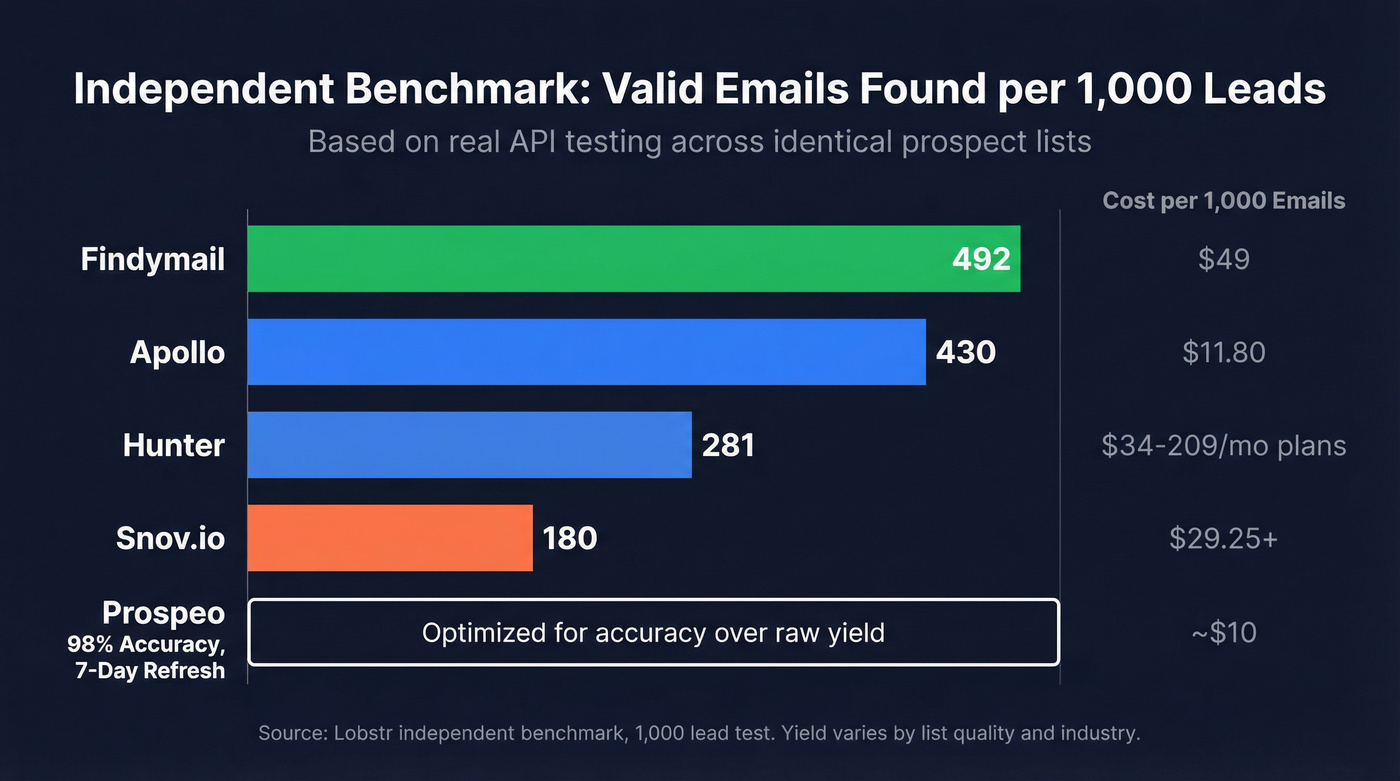
The limitation: an independent benchmark test of 1,000 leads showed Hunter returning 281 valid emails - mid-pack yield. Hunter's verification benchmark scored 70% accuracy across 3,000 emails, the highest score in that test, but still missing 30% of the time.
Use this if: You want simplicity, a generous free tier, and predictable costs.
Skip this if: You need high-volume yield or phone numbers alongside emails.
Apollo
Apollo is the obvious starting point if you want finding and outreach in one platform. The free tier gives you database access that most tools charge for, and paid plans include unlimited email credits - though phone and export credits are separate and metered.
Independent testing showed Apollo returning 430 valid emails per 1,000 leads at $11.80 per 1,000 emails - the cheapest cost per valid email in that Lobstr benchmark. Built-in sequences mean you can go from search to send without leaving the platform. (For more outreach stack options, see our list of cold email marketing tools.)
Pricing runs ~$59-149/user/month depending on tier. The "unlimited email credits" headline is real, but watch the fine print on mobile credits and export limits - that's where costs creep up.
The tradeoff: accuracy degrades at scale. Apollo's data refresh cycle is slower than specialized finders. We've compared Apollo and dedicated verification tools side-by-side on the same 5K list, and the bounce rate difference was immediate and significant.
Use this if: You want one platform for prospecting, finding, and emailing - especially at the SMB level.
Skip this if: Deliverability is your top priority and you're sending 10K+ emails per month.
Snov.io
Snov.io bundles finding, verification, email sequences, and professional-network automation ($69/seat add-on) into one platform. Starter runs $29.25/mo for 1,000 credits; Pro is $74.25/mo for 5,000. Each prospect found and each verification consumes one credit, so budget accordingly.
The all-in-one pitch sounds good at a low entry price, and for small teams that want outreach built in without juggling multiple subscriptions, it delivers. But the numbers tell a harder story: independent testing showed just 180 emails per 1,000 leads - the lowest yield in the benchmark. A separate accuracy test reported 20.1%. Volume users will burn through credits fast with low return rates.
Skip this if: You're sending at scale and need strong yield per credit spent.
RocketReach
If your outbound strategy depends on phone alongside email, RocketReach deserves a look. Three tiers: Essentials at $69/mo for email only, Pro at $119/mo for email plus phone, and Ultimate at $209/mo adding API access, intent data, and org charts. Five free lookups to start. (Full breakdown: RocketReach pricing.)
The Ultimate tier's org charts and intent data add genuine prospecting value for enterprise sellers who need to map buying committees. One thing to watch: pricing is A/B tested by region, so what you see on the pricing page may differ from what a colleague in another country sees. Overage rates run $0.30-0.45 per lookup, which adds up quickly if you exceed your plan.
Findymail
Findymail earned the crown in independent API testing: 492 valid emails per 1,000 leads - the highest yield of any tool tested - and the fastest speed at 4 minutes per 1,000 requests. It doesn't return risky or catch-all emails, which keeps bounce rates under 5%.
This is the API-first pick. With 300 concurrent request support, it's built for developers and automation workflows, not for someone who wants a Chrome extension and a pretty UI. At ~$49 per 1,000 verified emails, it's mid-range on cost. No built-in outreach - purely a data tool. If you're building enrichment pipelines in Clay or n8n, Findymail is the engine you want under the hood. (More: Findymail pricing.)
Cognism
Selling into European markets or compliance-heavy industries? Cognism is purpose-built for that reality. Phone-verified mobile numbers with an 87% claimed connect rate and GDPR compliance aren't nice-to-haves in EMEA - they're table stakes. (If you're budgeting, see Cognism pricing.)
Custom pricing only, typically $1,000-3,000/mo for small teams. No self-serve option. If you just need emails for a US-focused outbound motion, you're paying for compliance infrastructure you'll never use.
Wiza
Wiza's pay-as-you-go model is unique in a category dominated by subscriptions: $0.15 per email, no monthly commitment. Pro runs $30/mo for 100 credits; Growth is $50/mo for 300. It's commonly used to pull contacts from professional profile searches. (Details: Wiza pricing.)
Zero commitment makes it perfect for occasional prospectors or founders who need 50 emails this month and zero next month. The math stops working at volume - 300 credits per month on the Growth plan won't sustain a team running serious outbound.
GetProspect
Free tier gives you 50 emails/month. Paid plans start at $49/mo for 1,000 valid emails plus 2,000 verifications. An independent accuracy test scored GetProspect at 61.9% - mid-pack but serviceable for budget-conscious small teams testing the waters. (More: GetProspect pricing.)
Voila Norbert
$39/mo for 1,000 searches with 50 free to start. Clean UI, simple pricing. Independent testing scored it at 36.0% accuracy - below average. Better suited for occasional lookups than bulk prospecting.
Lusha
Lusha is a major player that shows up in nearly every competitive roundup. It's best known for fast browser-based lookups and Salesforce workflows. Pricing is credit-based with a free tier, and paid plans typically run ~$50-$100/user/month depending on features and volume. For mid-market teams that want a clean UI and decent phone number coverage without Cognism's price tag, Lusha fills that gap.

You just read that independent benchmarks put most email finders between 31-70% verification accuracy. Prospeo's 5-step verification - with catch-all handling, spam-trap removal, and honeypot filtering - hits 98%.
Stop comparing AI email finders and start using the one that actually verifies.
Pricing at a Glance
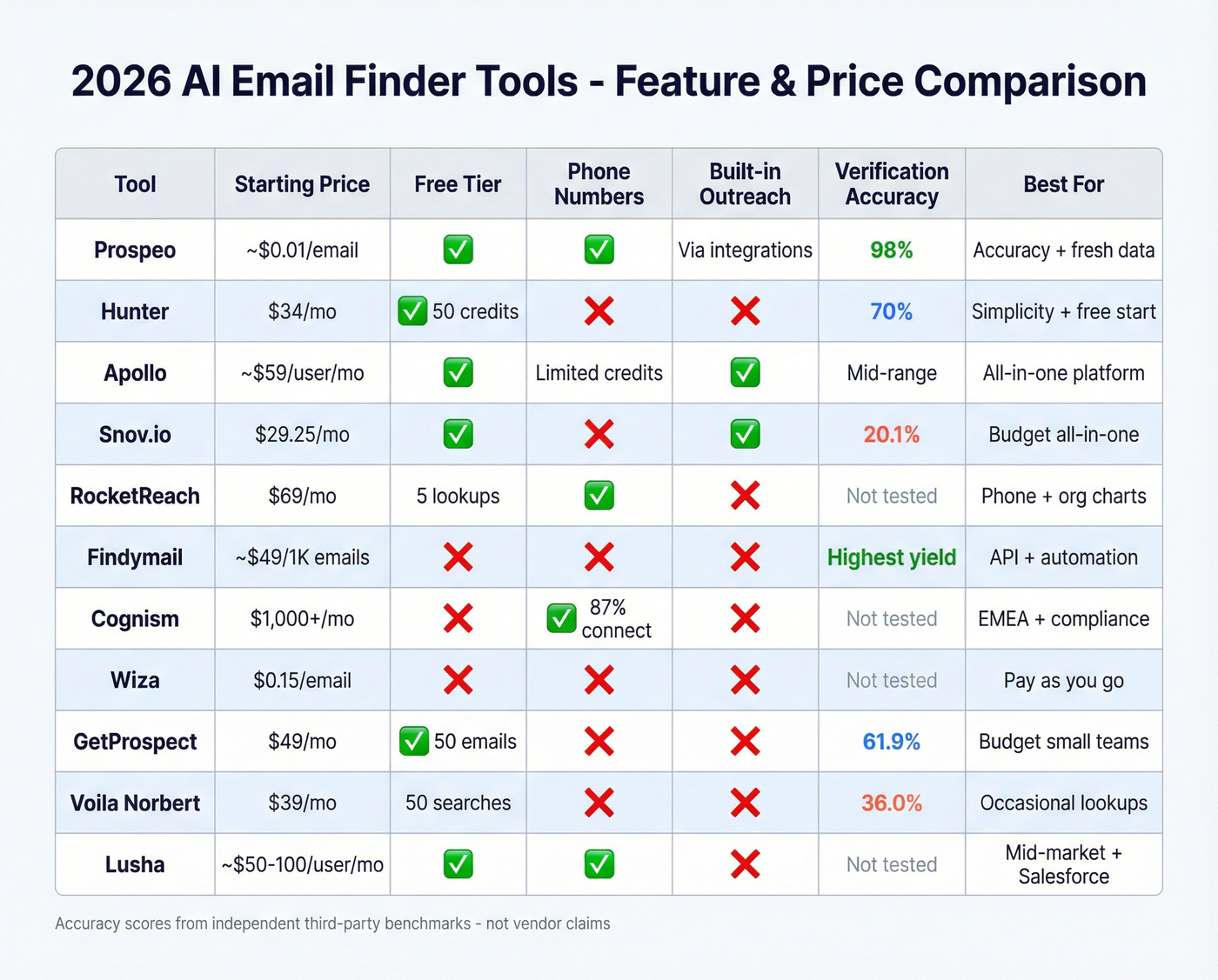
| Tool | Free Tier | Starting Price | Credits | ~Cost/Valid Email |
|---|---|---|---|---|
| Prospeo | 75 emails/mo | ~$0.01/email | Pay per email | ~$0.01 |
| Hunter | 50 credits/mo | $49/mo | 2,000/mo | ~$0.05 |
| Apollo | Yes (limited) | ~$59/user/mo | Unlimited emails | ~$0.012 |
| Snov.io | Trial | $29.25/mo | 1,000/mo | ~$0.04 |
| RocketReach | 5 lookups | $69/mo | Varies by tier | ~$0.06 |
| Findymail | No | ~$49/1K emails | Per batch | ~$0.049 |
| Cognism | No | ~$1,000/mo | Custom | ~$0.10+ |
| Wiza | Pay-as-you-go | $0.15/email | Per email | $0.15 |
| GetProspect | 50 emails/mo | $49/mo | 1,000/mo | ~$0.05 |
| Voila Norbert | 50 searches | $39/mo | 1,000/mo | ~$0.04 |
| Lusha | Yes (credit-based) | ~$50-$100/user/mo | Varies by tier | ~$0.05 |
What the Benchmarks Show
Two independent tests give us the best available data on how these tools actually perform. Neither is perfect - both were run by vendors with skin in the game - but they're the most concrete numbers available.
The Lobstr API bake-off tested 9 email finder APIs against the same 1,000-lead dataset and measured valid emails returned:
- Findymail: 492
- Apollo: 430
- Dropcontact: 383
- Skrapp: 373
- Hunter: 281
- Snov.io: 180
Apollo delivered the best cost efficiency at $11.80 per 1,000 emails. Findymail had the highest raw yield but at $49 per 1,000.
The Hunter verification benchmark tested 15 verifiers against 3,000 real business emails. Accuracy ranged from 70% down to 31%. Even the top performer missed 30% of the time. The Tomba benchmark tested finding accuracy separately, with results ranging from 20.1% (Snov.io) to 80.3%.

The critical takeaway: yield and accuracy measure different things. A tool can find 492 emails but verify poorly. Another can verify well but find very few. The tools that win are the ones that score high on both - and then keep the data fresh enough that those verified emails are still valid when you actually send.
In our testing, the gap between claimed and actual accuracy was consistently 15-25 percentage points. The consensus on r/sales echoes this: most reps report needing to stack at least two tools to get reliable coverage, and nobody trusts the vendor's accuracy number at face value. (If you're troubleshooting bounces, start with our guide to a hard bounce.)
The Freshness Problem Nobody Talks About
Roughly 2% of a verified email list goes invalid every four weeks. People change jobs, companies restructure, domains expire. If you verified a list 6 weeks ago and send to it today, you're looking at 3%+ invalid addresses before you even account for catch-all domains. (This is part of the broader issue of B2B contact data decay.)
That matters because the deliverability threshold is 2% total bounces. Hit 5% and you're in danger territory. Hit 10% and Gmail and Outlook start actively suppressing your messages. Your sender reputation doesn't recover overnight - it can take weeks of careful warm-up to claw back. (If you need a full playbook, see our email deliverability checklist.)
Most email finder databases refresh every 4-6 weeks. That gap is why bounce rates vary so dramatically between tools using what appear to be similar verification methods. The verification step is only as good as the data it's verifying, and stale data produces stale results.
There's also the catch-all problem. Accept-all domains represent a significant chunk of business emails and require risk-based handling, not a blanket "valid" label. Tools that mark every accept-all as valid are inflating their accuracy numbers and passing the bounce risk to you.
Look, if your average deal size is under five figures, you probably don't need the most expensive tool in this list. But you absolutely need the most accurate one. A single burned domain costs more than a year of any email finder subscription.
Stale data is the reason your last sequence bounced 11%. Prospeo refreshes every 7 days - not 6 weeks like the industry average - so you're emailing people who still work there. At $0.01 per email, accurate data costs less than bad data.
Fresh emails, 98% accuracy, no contracts - start with 75 free credits.
How to Pick the Right Tool
Volume is the first filter. Solo prospectors can live on Hunter's free tier. Teams sending 5K+ emails per month need the scale of Apollo's unlimited credits or a pay-per-email model that doesn't cap out. API-heavy workflows point to Findymail. (If you want a step-by-step process, see how to use an email finder tool.)
For teams that want outreach built in, Apollo or Snov.io save you a separate subscription. But if you already use Instantly or Lemlist, a dedicated finder with native integrations is cleaner - and usually cheaper than paying for outreach features you'll never touch.
Bounce rate tolerance matters more than most teams realize, and it's the thing we wish more people optimized for early. Anything above 2% is dangerous when you're running cold email at scale. Prioritize verification depth and data freshness over raw yield. We've seen too many teams optimize for "emails found" and ignore "emails that actually land." When evaluating AI email finder tools, your north star metric should be post-send bounce rate - not the vendor's claimed accuracy number.
For phone numbers, RocketReach and Cognism are strongest. And if you're in a GDPR-regulated market, Cognism is built for that - most US-focused tools treat compliance as an afterthought.
FAQ
Are AI email finders legal?
Yes. B2B email finding is legal under GDPR and CCPA when used for legitimate business interest. Tools with compliance features include opt-out enforcement and data processing agreements. Always honor unsubscribe requests and check local regulations before launching outbound campaigns.
How accurate are AI email finder tools really?
Independent benchmarks show yield rates of 18-49% and verification accuracy of 31-70%. Vendor claims of 95%+ refer to different metrics than what benchmarks test. The number that matters is your post-send bounce rate - keep it under 2% to protect your domain reputation.
Free vs. paid - what do you lose?
Free tiers like Hunter's 50 credits or Prospeo's 75 emails are enough for testing and light prospecting. Paid plans unlock bulk search, API access, CRM integrations, and higher credit volumes. The real cost difference between tiers is credits per month, not feature access.
Should I use more than one email finder?
Power users run 2-3 tools in a waterfall: primary finder, secondary finder for misses, then a standalone verifier. This maximizes yield without relying on a single database's coverage gaps. Tools like Clay and Zapier make multi-tool workflows straightforward to automate.
How often should I re-verify my email list?
Every 2-4 weeks. Roughly 2% of a verified list goes invalid each month due to job changes and domain turnover. If you're sending to a list older than 30 days without re-verification, expect bounce rates to climb. Tools with automatic refresh cycles reduce this burden significantly.