

AI Email Verification: What It Actually Does and Which Tools Get It Right
You ran 10,000 emails through a verification tool. It came back 94% valid. You loaded the list into your sequencer, hit send, and watched 7% bounce inside 48 hours. Your ESP flagged the domain. Now you're warming up a backup and wondering what "AI email verification" actually means - and whether any of these tools actually work.
That gap between what verification vendors promise and what they deliver is the core tension of this space in 2026. Let's break down what's real, what's marketing fluff, and which tools earn your trust.
The Short Version
AI verification adds a scoring layer on top of traditional SMTP checks, primarily to handle catch-all domains - which make up 30-40% of many B2B lists. In Hunter's 2026 benchmark, real-world accuracy topped out at 70% overall, not the 99% vendors plaster across their landing pages. Other published tests using different methodologies show higher numbers, often in the 96-99% range. That's exactly why you should care about how accuracy is measured, not just the headline number.
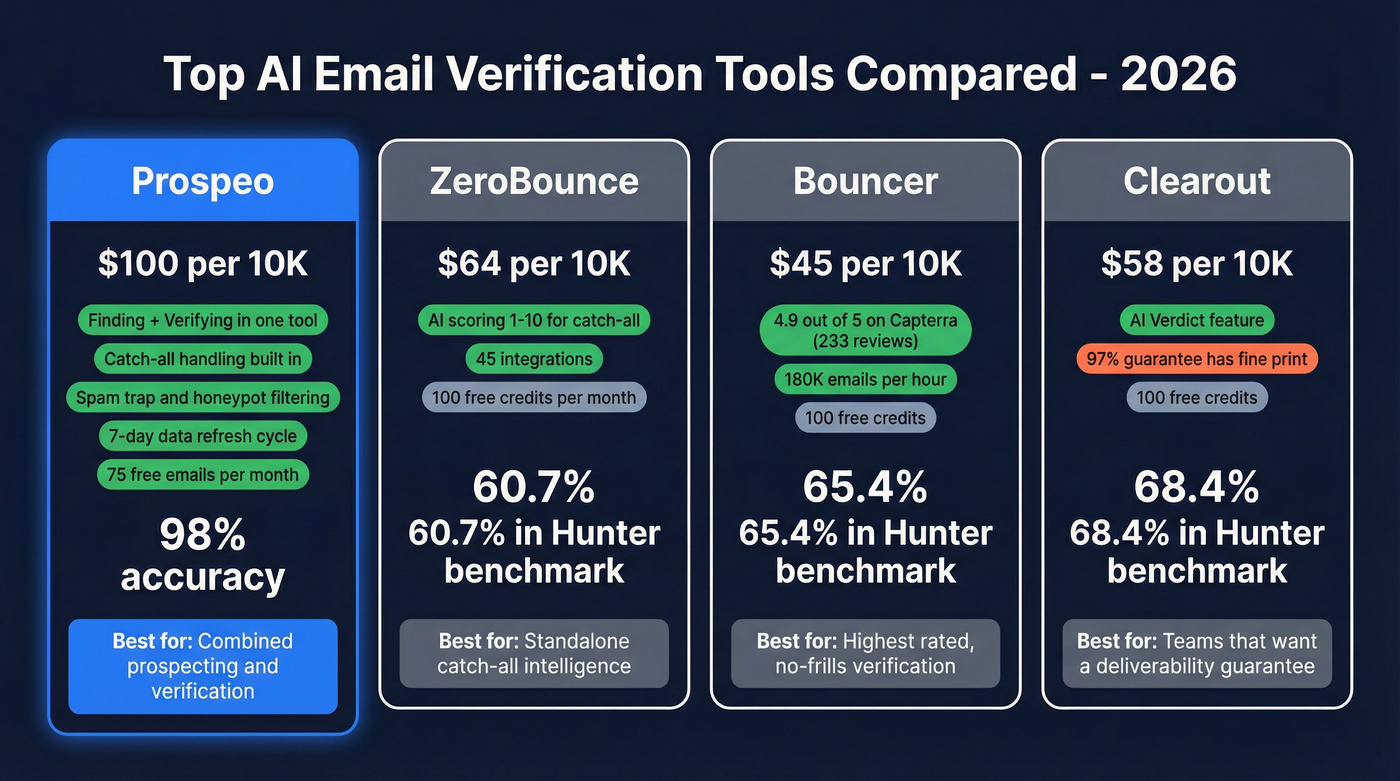
For standalone catch-all scoring, ZeroBounce's 1-10 system is the most granular option among mainstream verifiers. For the highest review ratings in the category, Bouncer. For the best combination of data freshness and built-in verification, Prospeo.
What Is AI Email Verification?
Traditional email verification runs three steps: a syntax check to confirm the format is valid, an MX/DNS lookup to confirm the domain accepts mail, and an SMTP handshake to confirm the mailbox exists. That pipeline catches obvious invalids - typos, dead domains, nonexistent mailboxes. It's been the standard for a decade.
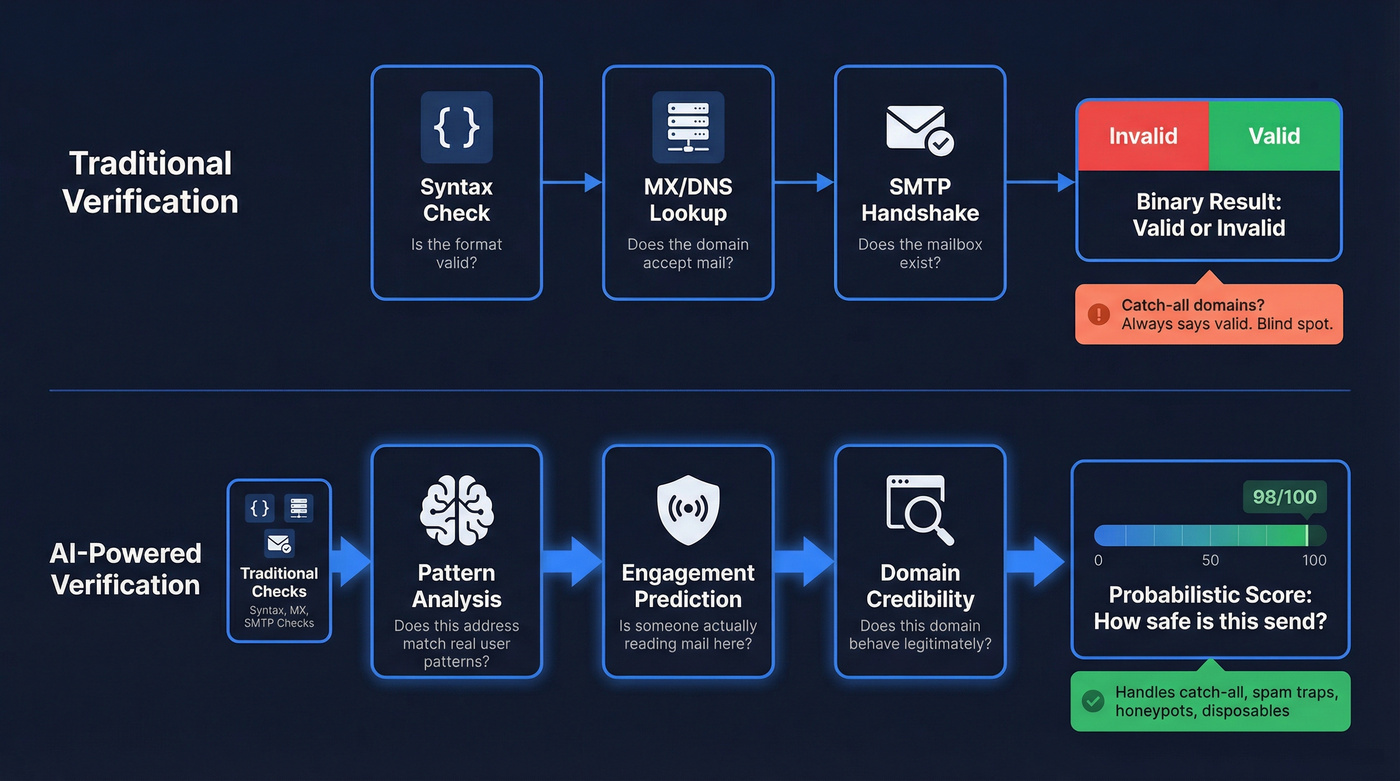
AI-powered verification layers on top. It uses pattern analysis, engagement prediction, and domain credibility assessment to evaluate addresses that SMTP can't definitively confirm or deny: catch-all domains that accept everything at the server level, disposable email services, spam traps, and honeypots. This is where an AI-driven verifier diverges from legacy tools - it doesn't just check whether a mailbox exists, it predicts whether sending to it is safe.
Newer LLM-based approaches add anomaly detection and domain credibility scoring, flagging domains that look legitimate but behave like fraud operations, or addresses following patterns associated with abandoned mailboxes. The practical output is a probabilistic score rather than a binary valid/invalid. That matters when nearly a quarter to a third of email lists decay every year.
Why Verification Accuracy Matters
Roughly one in six emails never reaches the inbox, according to Validity's benchmark data. The numbers vary wildly by ISP: Gmail delivers to the inbox 87.2% of the time, Microsoft sits at 75.6%, Yahoo/AOL lands around 86%, and Apple Mail at 76.3%. Gmail specifically starts throttling when spam complaint rates exceed 0.3%.
Bounce rates compound the problem fast. Once you cross 2% total bounces, ISPs start throttling your sending. Above 5%, you're looking at serious list quality issues and a real risk of domain-level deliverability damage. We've seen teams burn through three backup domains before realizing the problem was data freshness, not verification quality - each bounce degrades your sender reputation, which pushes more emails to spam, which reduces engagement signals, which degrades reputation further. It's a death spiral.
B2B/SaaS lists typically run 0.5-1.5% when properly maintained. But email lists decay 25-33% annually, meaning 2-3% goes stale each month. Without regular verification, a clean list becomes a liability within a quarter.
The Truth About Accuracy Claims
Every verification vendor claims 97-99% accuracy. The actual numbers tell a different story.
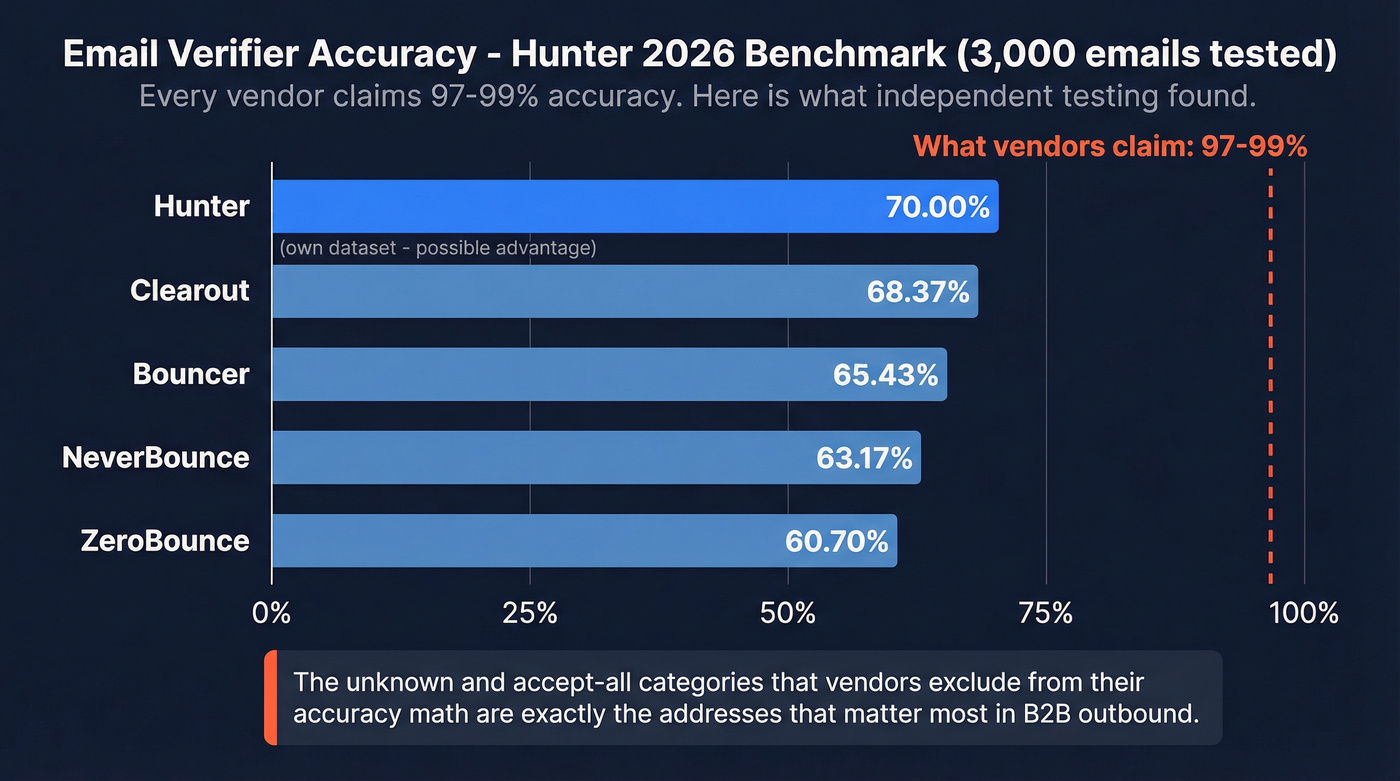
Hunter's 2026 benchmark tested 15 email verifiers against 3,000 emails - 2,700 real business addresses and 300 known invalids. The top accuracy score was 70%, from Hunter's own tool. ZeroBounce hit 60.7%. Clearout came in at 68.37%. Bouncer at 65.43%. NeverBounce at 63.17%. Hunter acknowledges their dataset may have given them an edge, since validity was derived from email activity in their own system. But even accounting for that bias, the gap between marketing claims and measured performance is enormous.
A separate 47,000-email test by LaGrowthMachine showed similar variance, with top performers clustering around 96-99% by their methodology - still a reminder that "accuracy" depends heavily on dataset, definitions, and whether "unknown" gets excluded from the denominator.
Here's our hot take: the "unknown" and "accept-all" categories that vendors quietly exclude from their accuracy math are exactly the addresses that matter most in B2B outbound. If your tool can't handle those, the accuracy number is meaningless.

You just read that catch-all domains make up 30-40% of B2B lists and most verifiers can't handle them. Prospeo skips that problem entirely - our 5-step verification with catch-all handling, spam-trap removal, and honeypot filtering delivers 98% email accuracy. And because every record refreshes every 7 days, you're not running AI scores on dead addresses.
Stop rescuing bad data. Start with data that doesn't need rescuing.
How AI Handles Catch-All Domains
Catch-all domains are the verification blind spot. These servers accept mail to any address at the domain - valid or not - so SMTP checks always return "valid." Then the server silently bounces or discards the message after the fact.
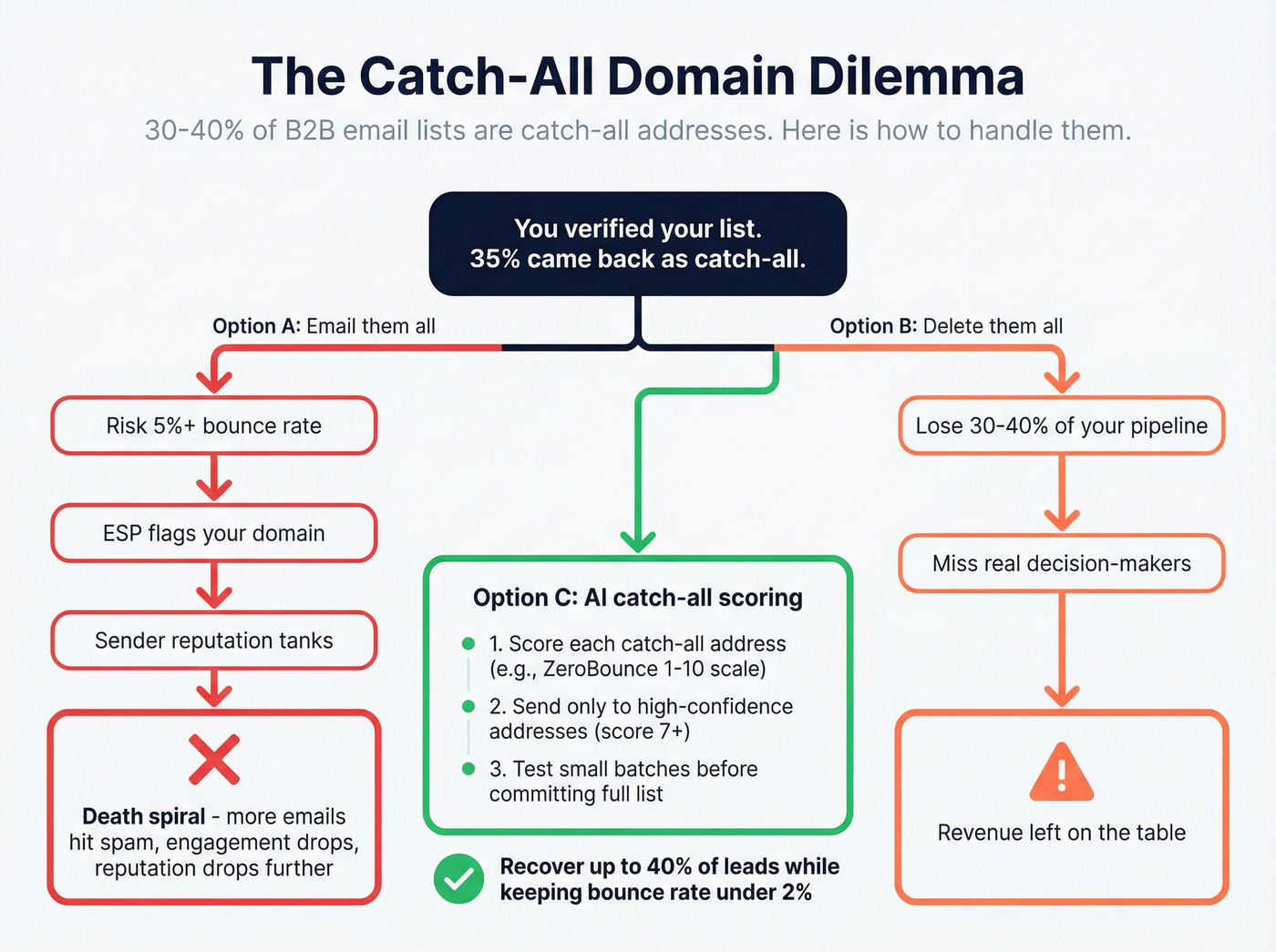
On B2B lists, catch-all addresses represent 30-40% of results. That's the dilemma: email all of them and risk a 5%+ bounce rate, or delete them and lose a third of your pipeline.
AI-based scoring is the only practical solution right now. ZeroBounce assigns a 1-10 quality score using engagement likelihood signals, costing 1 extra credit per address on top of the base validation credit. Clearout offers an "AI Verdict" feature that attempts similar classification. Instantly claims catch-all verification recovers up to 40% of leads, though they don't publish independent benchmarks to back that up.
Clay's internal testing of catch-all verifiers showed wide variance in data quality and coverage, with per-lookup costs ranging from $0.0015 to $0.011. Kitt AI emerged from that test claiming sub-0.1% bounce rates on catch-all addresses - a number worth watching but too new to fully trust. The consensus on r/sales and r/coldemail threads is that catch-all scoring is still more art than science, with most users recommending you test small batches before committing a full list.
Data Freshness Beats AI Labels
Look, the most sophisticated AI scoring in the world can't fix stale data. If someone changed jobs three months ago and you're still emailing their old address, no algorithm saves you. The email is dead.
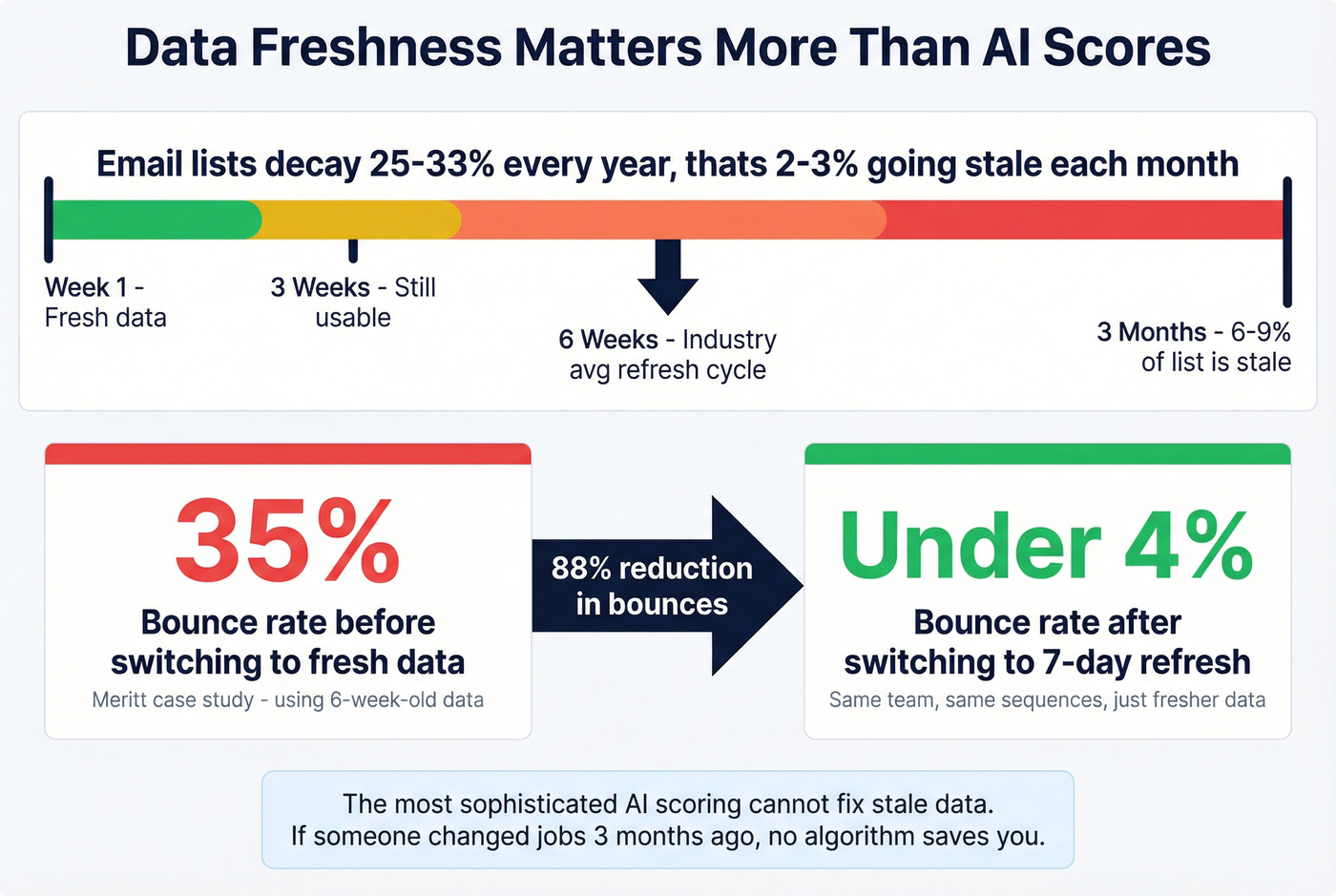
The industry average data refresh cycle among major B2B data providers is roughly 6 weeks. That means the contact you pulled last month might already be outdated by the time your sequence fires. In our experience, a weekly-refreshed database is more valuable than any score applied to stale data. Meritt saw their bounce rate drop from 35% to under 4% after switching to a platform with a 7-day refresh cycle, largely because the data was current when it hit their sequences.
Best AI Email Verification Tools
| Tool | Price/10K | AI Feature | Free Tier | Best For |
|---|---|---|---|---|
| Prospeo | ~$100 | 5-step w/ catch-all | 75 emails/mo | Finding + verifying |
| ZeroBounce | $64 | AI scoring 1-10 | 100 credits/mo | Catch-all scoring |
| Bouncer | $45 | Standard + high acc. | 100 credits | Best review ratings |
| Clearout | $58 | AI Verdict, 97% guar. | 100 credits | Guarantee use cases |
| NeverBounce | $50 | Bounce-rate refund | No free tier | Refund protection |
| Emailable | $50 | Speed (2M/hr) | 250 credits | Bulk volume |
| EmailListVerify | $24 | Standard checks | 100 free verifications | Budget teams |
| Kickbox | $80 | Deliverability tools | 100 verifications | Deliverability tooling |
Prospeo
Prospeo isn't a standalone verification tool - it's a B2B data platform where verification is baked into the finding process. Every email in its 143M+ database goes through a 5-step verification pipeline that includes catch-all handling, spam-trap removal, and honeypot filtering. The result is 98% email accuracy at roughly $0.01 per email.
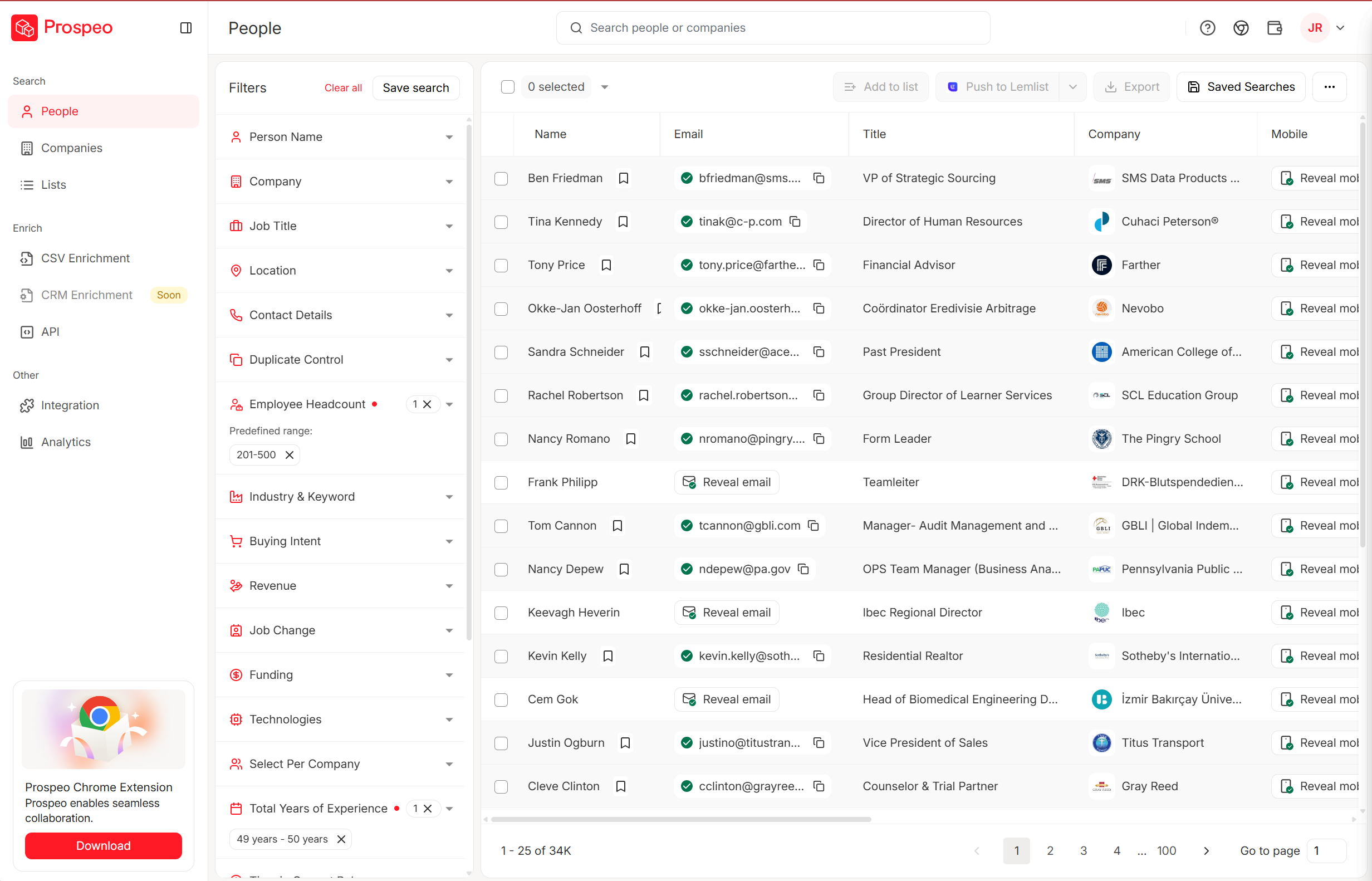
You're not paying twice - once to find, once to verify - and the data refreshes every 7 days. The Chrome extension has 40,000+ users who pull verified contacts directly from professional profiles and company websites. Snyk's 50-person AE team dropped their bounce rate from 35-40% to under 5% after switching, and Stack Optimize runs under 3% bounce across all their clients with zero domain flags.
For cold outbound teams, the combined workflow eliminates the duct-tape stack of separate scraper, verifier, and sequencer tools. That's where the real time savings live - not in the per-email cost, but in the workflow consolidation.
ZeroBounce
ZeroBounce's standout feature is its AI scoring system for catch-all addresses. It assigns a 1-10 quality score based on engagement likelihood - the most granular catch-all intelligence available from a mainstream standalone verifier. You pay 1 credit for validation and 1 for scoring, so 2 credits total per address.
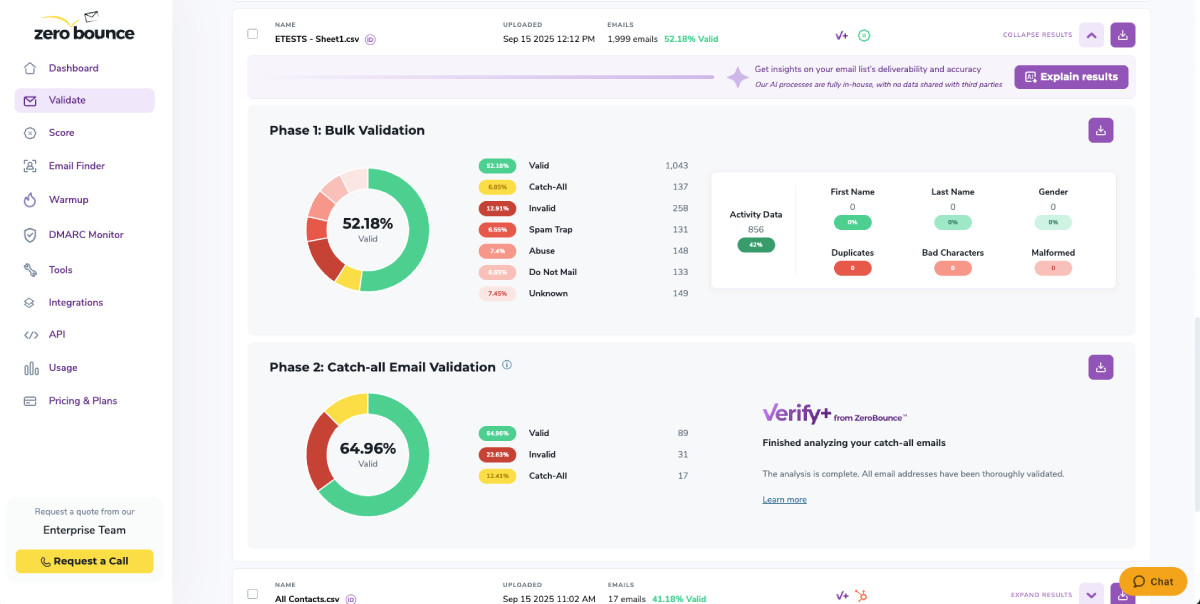
At $64 per 10,000 verifications, it's mid-range on price. The 45 integrations make it easy to plug into existing workflows. In the Hunter benchmark, ZeroBounce scored 60.7% overall accuracy - below marketing claims but competitive within the field. The real value is the catch-all scoring, not the base verification.
Use this if you already have lists and need catch-all intelligence layered on top. Skip this if you need to find emails and verify them in one step - ZeroBounce is verification-only.
Bouncer
Bouncer has the highest review ratings in the category: 4.9/5 on Capterra across 233 reviews and 4.8/5 on G2 across 232 reviews. At $45 per 10,000 verifications, it's also one of the cheapest Tier 1 options. Processing speed hits 180,000 emails per hour with 16 integrations available.
Bouncer doesn't market an "AI scoring" feature the way ZeroBounce does - it focuses on doing standard verification exceptionally well. The community trust is earned through consistency rather than flashy features. Pick Bouncer when you want the highest-rated verification without AI complexity.
Clearout
Clearout's headline feature is a 97% deliverability guarantee - but read the fine print. The guarantee requires you to send within 24 hours of verification, only covers opt-in addresses, and excludes Yahoo/AOL domains. That effectively rules out most cold outbound use cases.
The "AI Verdict" feature adds catch-all classification at $58 per 10,000 verifications. Solid tool, but the guarantee sounds better in marketing than it works in practice.
NeverBounce, Emailable, EmailListVerify, Kickbox
NeverBounce runs $50 per 10,000 verifications with a bounce-rate refund policy - if your verified list bounces above their threshold, you get credits back. Good for risk-averse teams who want a financial backstop on verification quality.
Emailable processes 2 million emails per hour, the fastest in the category, at $50 per 10,000. If you're running massive lists and speed matters more than AI scoring, it's the obvious pick.
EmailListVerify is the budget option at $24 per 10,000, roughly half the price of most competitors. Standard checks, no AI frills, gets the job done for teams watching every dollar.
Kickbox sits at $80 per 10,000 and adds deliverability tools on top of verification - useful if you want more than a pass/fail result but don't need catch-all scoring specifically.
Meritt dropped their bounce rate from 35% to under 4% and tripled pipeline to $300K/week. Stack Optimize built a $1M agency with sub-3% bounce rates and zero domain flags. The difference wasn't a better verification layer - it was starting with fresher, cleaner data at $0.01 per email.
Fresh data at a penny per email beats any AI score on stale records.
How to Choose the Right Tool
Match the tool to the problem, not the marketing.
Cold outbound teams need finding and verification combined. Running separate tools creates data gaps at every handoff. A platform with built-in verification and weekly data refresh eliminates the duct-tape - and the bounce spikes that come with stale handoff data.
Teams sitting on existing lists with a catch-all problem - you've got contacts but 30-40% come back as catch-all. Layer AI scoring with ZeroBounce's 1-10 system to decide which catch-alls are worth the send risk. Test a small batch first before committing the full list.
For marketing list hygiene on a budget, you're maintaining opt-in lists and need periodic cleanup. Bouncer at $45/10K or EmailListVerify at $24/10K handles this without complexity. Don't overpay for AI features you won't use on opt-in data.
If you're building a modern outbound stack, it also helps to map verification into your broader email deliverability and email sending infrastructure decisions.
FAQ
Is AI verification worth the extra cost?
Yes, if catch-all domains make up a significant portion of your list - typically 30-40% in B2B outbound. For clean opt-in marketing lists, standard SMTP checks are sufficient. AI scoring adds roughly $0.003-$0.01 per email, which pays for itself if it prevents even a handful of reputation-damaging bounces.
How often should I re-verify my list?
Re-verify every 30 days minimum. Email lists decay 25-33% annually, meaning 2-3% goes stale each month. Platforms with weekly data refresh cycles reduce the need for separate re-verification since contacts are pre-verified at the source.
What bounce rate should I target?
Keep total bounces under 2% and hard bounces under 0.5%. Anything above 5% indicates serious list quality issues. Once you cross 2%, the snowball effect kicks in - degraded sender reputation causes more spam filtering, which reduces engagement, which degrades reputation further.
Do I need a standalone verifier or is built-in verification enough?
If you're sourcing contacts from a B2B data platform that already runs multi-step verification on every record, a separate tool adds cost without meaningfully improving accuracy. Standalone verifiers make more sense when you're importing lists from events, webforms, or older CRMs where data quality is unknown.