How to Build a Competitive Intelligence Strategy That Actually Wins Deals
Your reps rate their competitive preparedness a 3.8 out of 10. Nearly 7 in 10 deals involve a head-to-head competitor, and 55% of companies see more competitive opportunities year over year. That gap between "we know who we're up against" and "we actually win those fights" costs mid-market companies $2M-$10M annually.
A strong competitive intelligence strategy is what closes it.
Most CI programs end up as abandoned Notion pages - not because of bad data, but because there's no system. Here's how to build one that survives past Q1.
Three Non-Negotiables
Executive sponsor. Only 48% of CI programs have one. Those that do see a 76% boost in competitive effectiveness. Without top-down buy-in, CI becomes a side project that dies the moment pipeline dips.
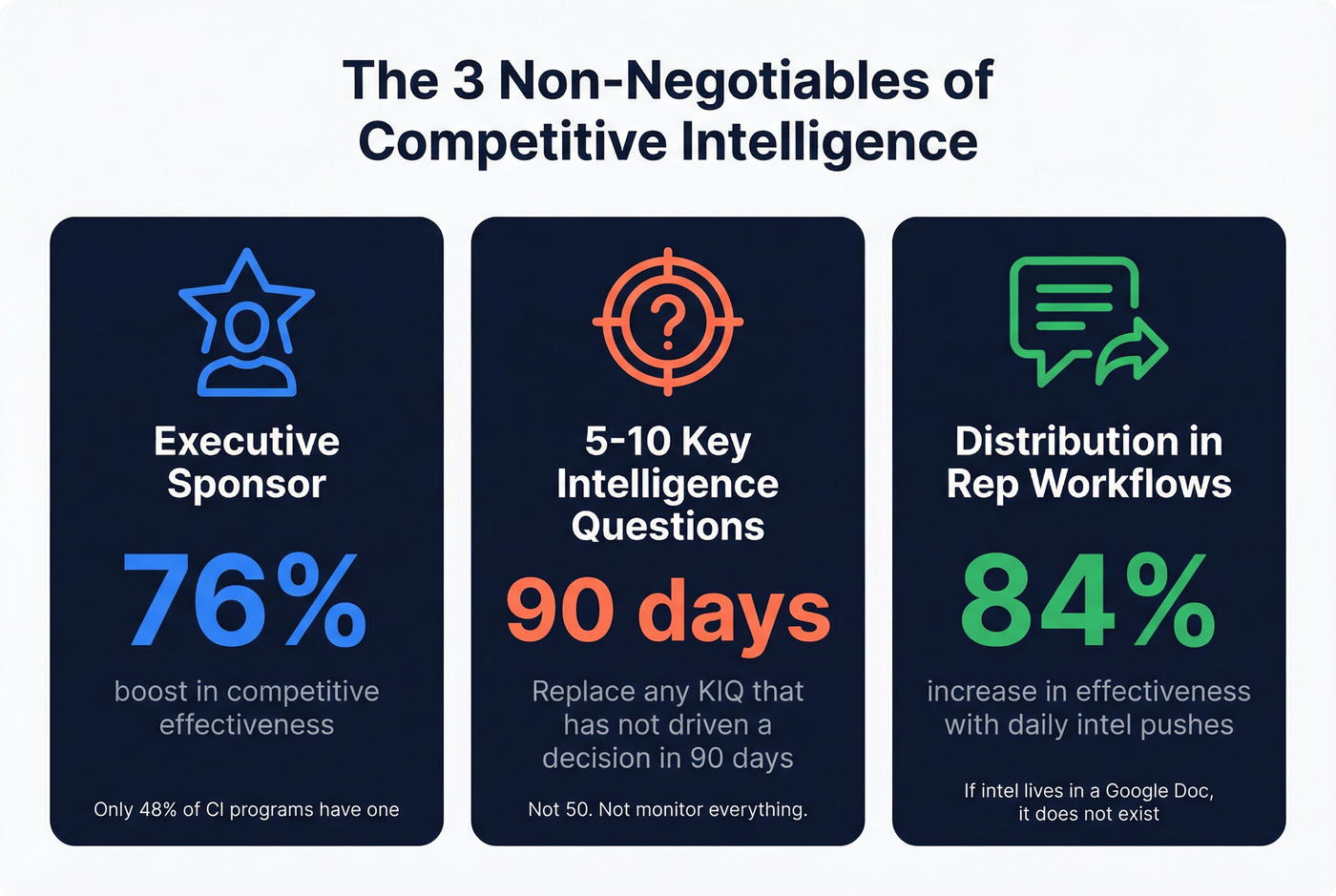
5-10 Key Intelligence Questions. Not 50. Not "monitor everything." Five to ten questions that would change how you sell, price, or position. Refresh them quarterly.
Distribution that meets reps where they work. If intel lives in a Google Doc reps have to go find, it doesn't exist. Push it through Slack, CRM, and call-prep workflows.
A 50-person sales org burns over $400k/year on ad-hoc competitive research - reps spending 8-12 hours a month Googling competitors instead of selling, plus the PMM and enablement time spent rebuilding battlecards nobody reads.
What CI Actually Covers
Here's the thing: CI isn't market intelligence and it isn't business intelligence. Competitive intelligence is the systematic collection, analysis, and distribution of information about specific competitors to inform business decisions. Market intelligence covers broader industry trends and customer segments. Business intelligence mines your own operational data. CI sits between them, externally focused and competitor-specific.
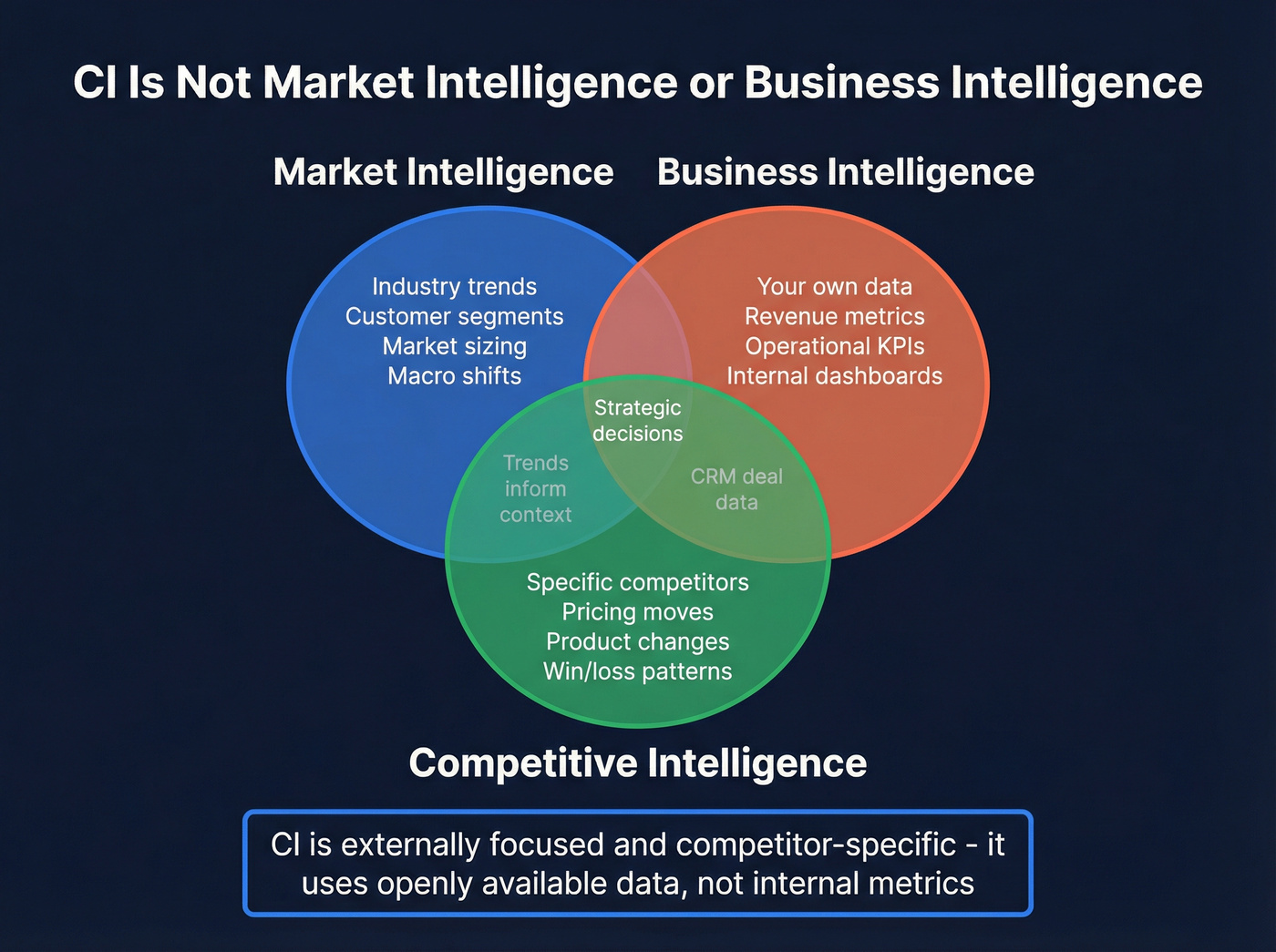
The best programs draw on both market and competitive intelligence. Macro trends inform context, while competitor-specific data drives tactical decisions.
The critical distinction: CI uses openly available data - public filings, job postings, pricing pages, reviews, press releases. Industrial espionage involves stealing protected confidential information. The line matters legally and ethically, and it's not as blurry as some people make it sound.
The sales intelligence market reached $4.85B in 2025 and is on track for $10.25B by 2032, with CI platforms growing around 20% annually. By 2027, 95% of seller research workflows will begin with AI. The money flowing into this space tells you everything about where B2B competition is heading.
The 6-Step CI Framework
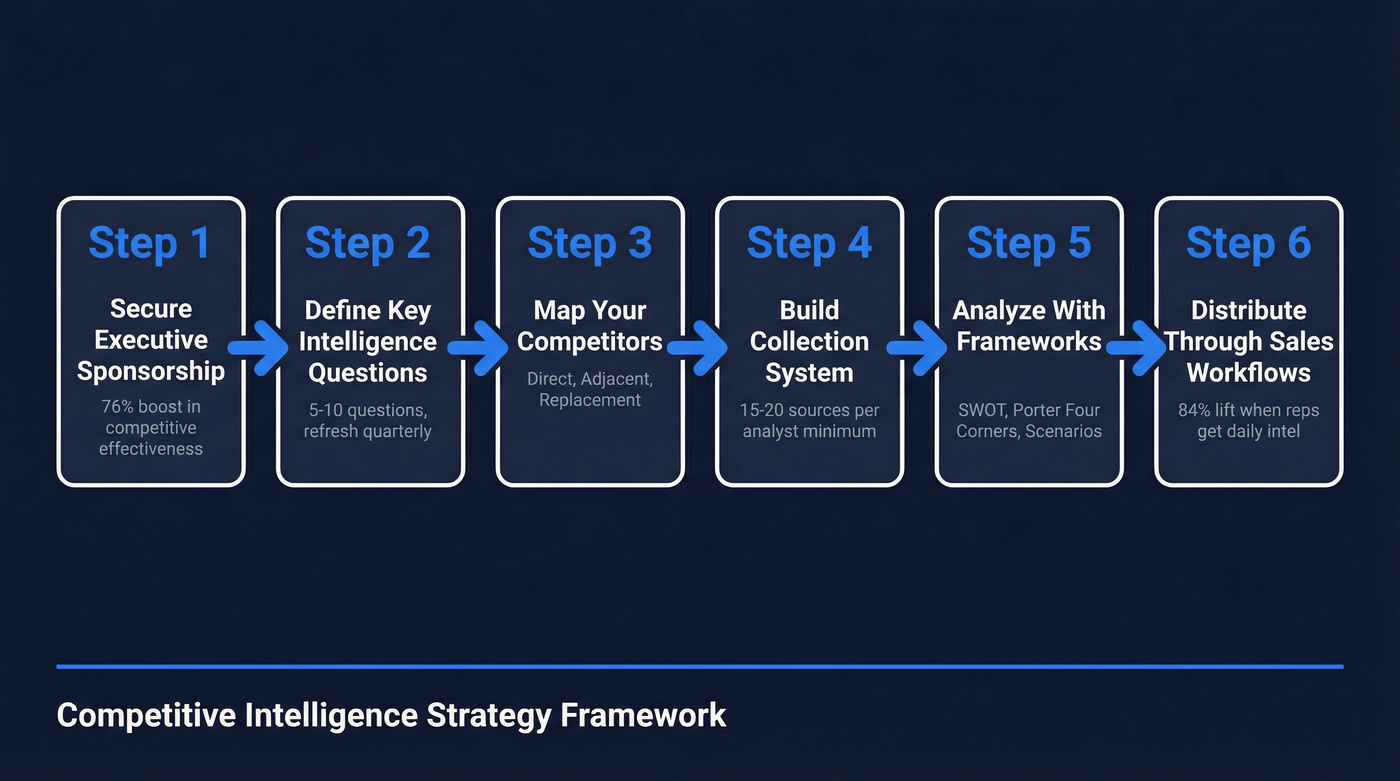
1. Secure Executive Sponsorship
Programs with a VP of Sales or CRO actively reviewing competitive win/loss data monthly see a 76% increase in competitive sales effectiveness. Without that, you're a PMM shouting into the void.
What sponsorship looks like in practice: budget for tooling, accountability for reps logging competitor mentions in the CRM, and a monthly review of competitive win/loss data. We've seen teams spend $20k-$40k/year on Klue only to have reps ignore it because no one above them cared. That's not a tool problem. It's a leadership problem.
2. Define Key Intelligence Questions
KIQs are the backbone of your collection effort - the 5-10 questions that would materially change your competitive positioning. Think: "How is Competitor X pricing their enterprise tier relative to ours?" or "What does Competitor Y's hiring pattern signal about their product roadmap?"
The biggest CI mistake isn't collecting too little. It's collecting too much. If a KIQ hasn't driven a decision in 90 days, replace it.
3. Map Your Competitors
Don't just list companies selling similar software. Use a Jobs-to-be-Done lens to identify three categories:
| Category | Definition | Example |
|---|---|---|
| Direct | Same product, same buyer | Your closest 3-5 CRM competitors |
| Adjacent | Different product, overlapping buyer | A marketing platform adding sales features |
| Replacement | Not software at all | Excel, agencies, internal teams, doing nothing |
For each, track four dimensions: Target (who they sell to), Promise (core value prop), Proof (case studies, logos, metrics), and Pricing (published or estimated). This positioning map becomes the foundation for battlecards. The "replacement" category is the one most teams skip, and it's often the biggest threat - especially at the SMB level where "we'll just use a spreadsheet" kills more deals than any named competitor.
4. Build Your Collection System
A single analyst can monitor 15-20 sources manually. Growth-stage companies quickly hit 50+. Start with high-signal sources: public pricing pages, G2 and TrustRadius reviews, job postings that reveal strategic priorities, press releases, earnings calls, and public webinars. Layer in monitoring tools - Google Alerts for basics, Owler for company news, Visualping for website change detection.
One source most CI guides overlook: primary research. Win/loss interviews produce insights no web scraper can match. But they require accurate contact data to reach churned customers, lost prospects, and competitor users - the kind of primary CI that actually changes deal outcomes.
5. Analyze With Frameworks
Raw data isn't intelligence. Three frameworks that earn their keep:
SWOT works for quick competitor snapshots reps will actually read. Porter's Four Corners is better when you need to predict a competitor's next move by mapping their drivers, assumptions, strategy, and capabilities. Scenario analysis fits when a competitor's direction is genuinely uncertain - model two or three possible moves and prepare responses for each.
The trap: generic differentiation. "Competitor X has a strong brand" tells reps nothing. "Competitor X wins on brand trust with enterprise buyers but loses on implementation speed - here's how to exploit that on a call" gives them something they'll actually use.
6. Distribute Through Sales Workflows
Let's be honest: the biggest CI failure isn't bad analysis. It's bad distribution. Battlecards go stale within 30 days, but most teams update them quarterly. That's a three-month window of selling against outdated intel.
Teams that enable sales daily see an 84% increase in competitive effectiveness. Teams using conversational intelligence to track competitor mentions on calls see an 82% lift in win rates. Push intel through tools reps already live in: Slack alerts for competitor moves, CRM fields that surface battlecard snippets during deal stages, and call-prep summaries triggered by opportunity updates.
Over 50% of CI programs aren't pushing intel through sales' existing tools. That's the single biggest distribution failure, and it's entirely fixable.
CI Ethics and Governance
Product marketers own CI in roughly 80% of organizations. Build a Competitive Intelligence Charter with five components: objectives, scope, approved methods, roles, and an escalation path.
| Category | Examples | Guidance |
|---|---|---|
| 🟢 Green | Pricing pages, reviews, job postings, press releases | Always safe |
| 🟡 Yellow | Ex-employee intel, private groups, customer data | Check NDAs first |
| 🔴 Red | Impersonation, leaked docs, bribery | Never acceptable |
The yellow zone is where missteps happen. A former competitor employee can share general market knowledge but not proprietary roadmaps or customer lists. When in doubt, escalate to legal.

Win/loss interviews are the highest-signal CI source - but only if you can actually reach churned customers and lost prospects. Prospeo gives you 98% accurate emails and 125M+ verified mobile numbers so your primary research connects, not bounces.
Stop losing CI insights to bad contact data.
Seven Ways a CI Program Fails
- Generic differentiation. If your battlecard reads like a Wikipedia summary, reps will ignore it. Tie every insight to a specific objection or selling scenario. (If you need a tighter objection taxonomy, start with types of objections.)
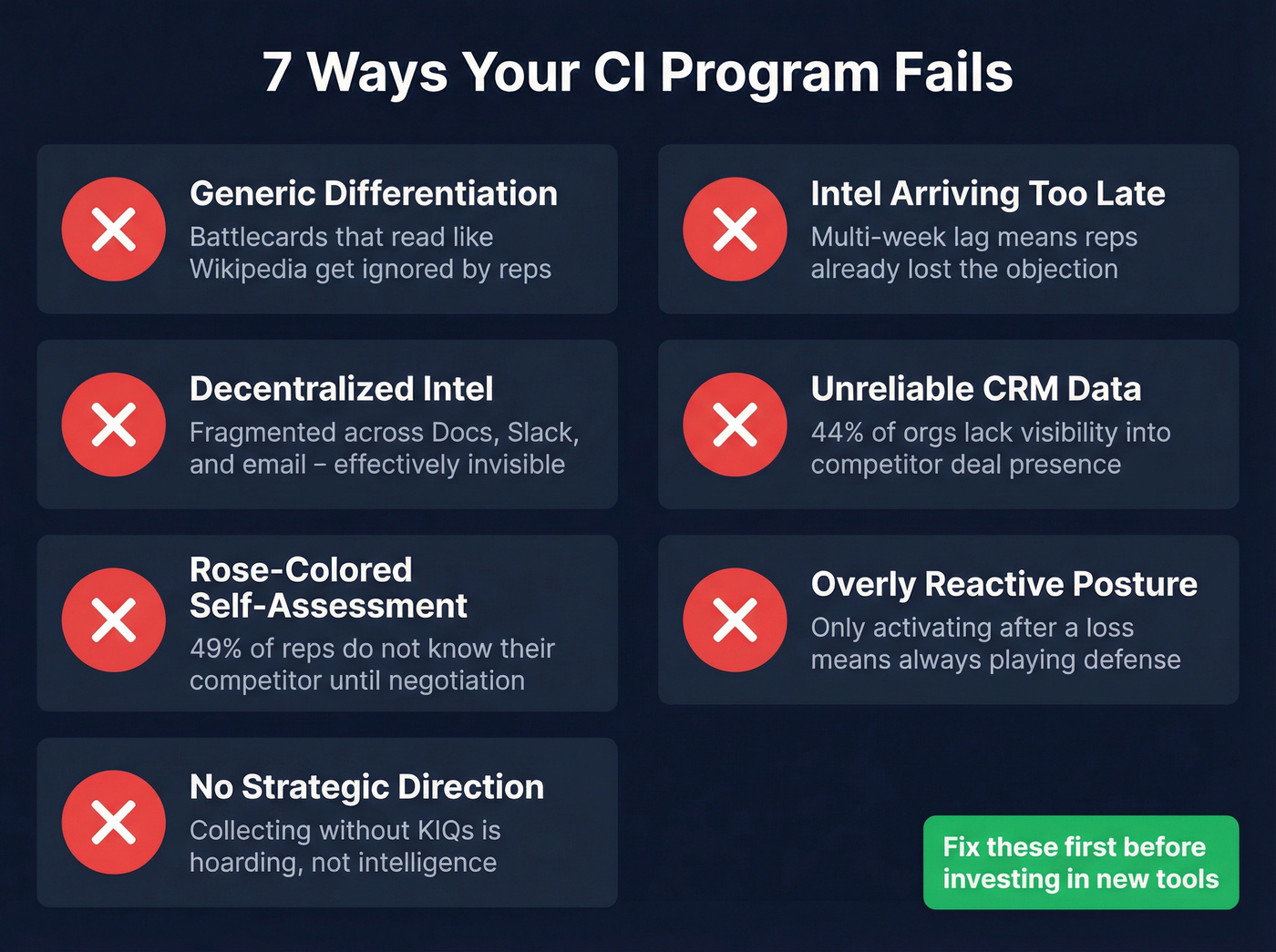
Decentralized intel. Battlecards in Docs, competitor notes in Slack threads, pricing intel in someone's email. Fragmented intelligence effectively doesn't exist.
Rose-colored self-assessment. Nearly half of reps don't know who they're competing with until negotiation. 13% don't know even after the deal closes.
No strategic direction. Collecting intel without KIQs is hoarding, not intelligence.
Intel arriving too late. A multi-week lag from competitor move to seller enablement is the norm for manual programs. By the time your battlecard is updated, three reps have already lost the objection on a call.
Unreliable CRM data. 44% of organizations lack visibility into which competitors appear in which deals. Fixing this usually starts with CRM hygiene and consistent fields.
Overly reactive posture. If CI only activates when a rep says "I just lost to Competitor X," you're always playing defense. The best programs anticipate moves through hiring signals and product roadmap analysis.
The CI Tool Stack for 2026
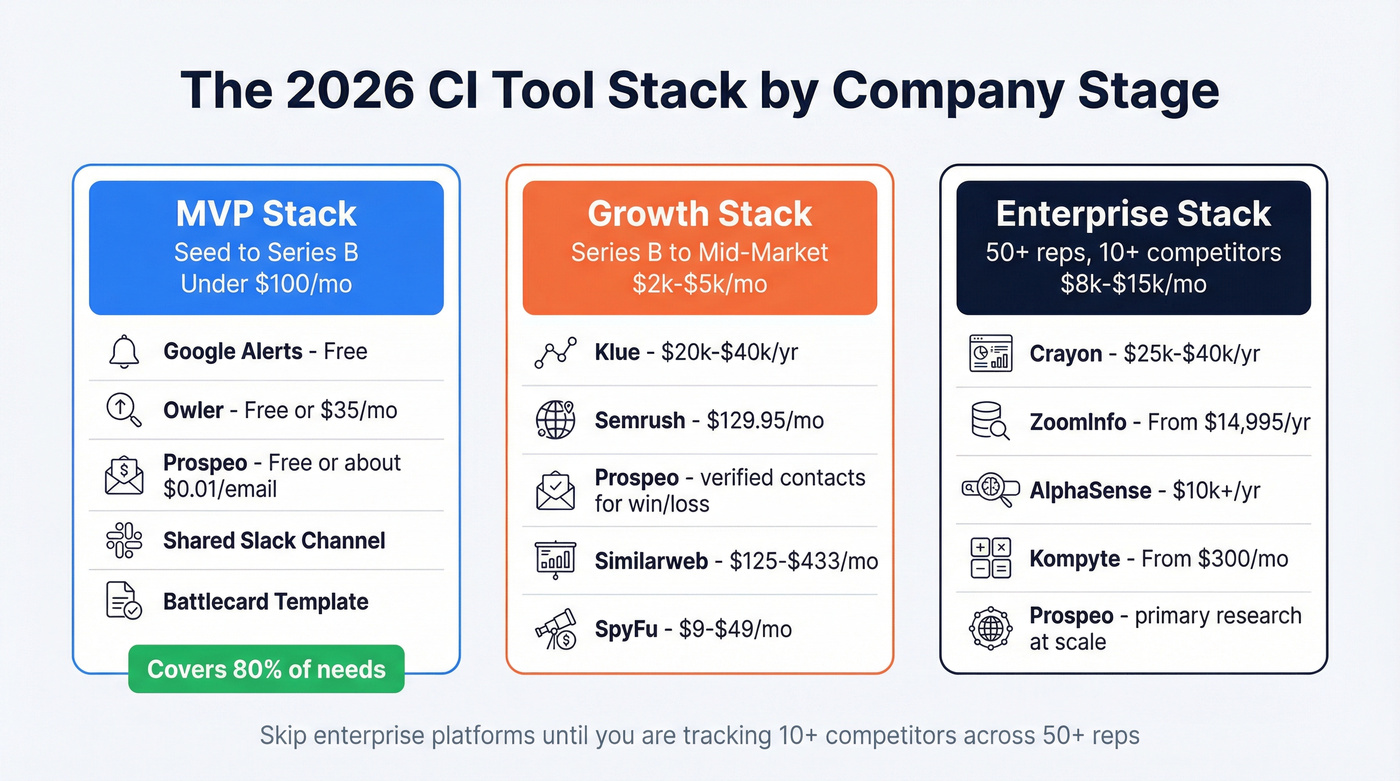
We compiled pricing that most CI vendors hide behind "contact sales" walls. In our experience, the biggest CI bottleneck isn't the platform - it's the data feeding it.
| Tool | Starting Price | Best For |
|---|---|---|
| Prospeo | Free / ~$0.01/email | CI research contacts - 98% email accuracy, 7-day refresh |
| Klue | ~$20k-$40k/yr | Mid-market battlecard automation |
| Crayon | ~$25k-$40k/yr | Automated competitive monitoring at scale |
| Semrush | $129.95/mo | Digital competitive analysis - SEO/SEM intel |
| ZoomInfo | From $14,995/yr | Enterprise org charts + intent data |
| AlphaSense | ~$10k+/yr | Enterprise research - 175K+ expert transcripts |
| Owler | Free / $35/mo | Free company monitoring and news alerts |
| SpyFu | $9-$49/mo | Budget PPC intelligence and ad spend tracking |
| Similarweb | $125-$433/mo | Traffic benchmarking against competitors |
| Google Alerts | Free | Zero-budget keyword tracking |
| Kompyte | From $300/mo | Automated CI tracking without enterprise pricing |
You don't need a $30k platform to start. An MVP stack of Google Alerts + Owler + Prospeo + a shared Slack channel + a battlecard template runs under $100/month and covers 80% of what a seed-to-Series-B company needs. Skip the enterprise platforms until you're tracking 10+ competitors across 50+ reps - before that, you're paying for features nobody uses.
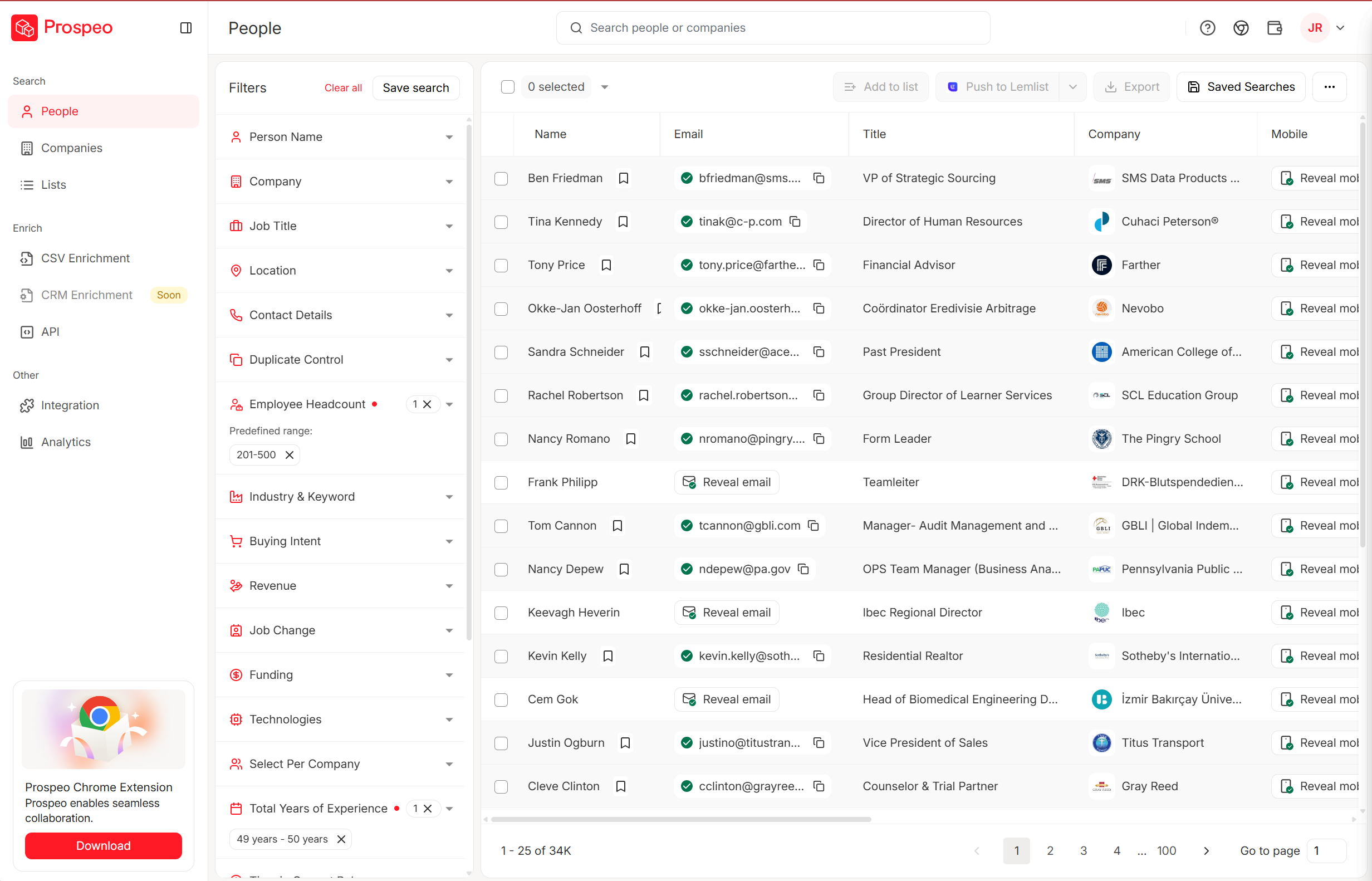
The data quality layer is where most CI stacks break. When you need to run win/loss interviews, map an account's org chart, or reach a competitor's churned customers, stale contact data kills the workflow before it starts. Prospeo's 143M+ verified emails and 7-day refresh cycle keep that primary research pipeline clean, and the free tier gives you 75 verified emails per month - enough to test whether primary CI research moves the needle for your team.
If you're building this into your outbound motion, pair CI with a repeatable prospecting workflow and a deliverability-safe outbound email campaign.
Competitive intelligence starts with knowing who your competitors are selling to - and reaching those buyers first. Prospeo's 30+ filters including buyer intent, technographics, and headcount growth let you map competitor targets and beat them to the deal.
Outflank competitors with data refreshed every 7 days, not 6 weeks.
Measuring CI ROI
Organizations that systematically track CI ROI see 23% higher revenue growth and 18% better profit margins. That's the number that keeps executive sponsors engaged - lead with it in your first quarterly review.
| KPI | Expected Range | Timeframe |
|---|---|---|
| Win-rate improvement | 8-18% | 2-3 quarters |
| Sales cycle acceleration | 15-25% | 2-3 quarters |
| CPA reduction | 12-30% | 3-4 quarters |
| Market share gains | 0.5-2.3% annually | 12+ months |
| Pricing optimization | 3-15% revenue increase | 6-12 months |
| Market entry success rate | 67% higher with CI | Per initiative |
Start by measuring win-rate lift in competitive deals. Tag deals as "competitive" in your CRM, track win rates before and after CI enablement, and report the delta quarterly. If you want a clean definition and tracking model, use a dedicated competitive win rate metric.
PMMs in the Product Marketing Alliance community consistently report that this single metric is the fastest path to securing ongoing CI budget.
Use Cases Beyond Sales
Battlecards and deal support are the most visible applications, but a well-built competitive intelligence strategy extends across the entire business. Product teams use CI to prioritize roadmap features that close competitive gaps. Marketing uses it to sharpen positioning and ensure messaging directly addresses the alternatives buyers are evaluating. Pricing teams model elasticity against competitor tiers. Executive leadership uses CI to inform M&A due diligence and market entry decisions.
The broader you scope your program, the more organizational value it delivers - and the easier it becomes to justify budget.
FAQ
CI vs. Market Intelligence?
CI focuses on specific competitors' strategies, pricing, and product moves. Market intelligence covers broader industry trends and macro forces. The most effective programs run both, because the overlap between market and competitive intelligence often surfaces the highest-value insights.
How Many Competitors Should You Track?
Actively track 3-5 primary competitors identified from CRM win/loss data. Monitor 10-15 passively through automated alerts. Spreading focus across more than 15 dilutes analyst time without improving deal outcomes.
How Long Until CI Shows ROI?
Teams with executive sponsorship and daily sales enablement typically see 8-18% win-rate improvements within 2-3 quarters. Without a sponsor, expect 6+ months of slow adoption before measurable impact.
Can You Run CI Without a Dedicated Platform?
Absolutely. Google Alerts, Owler, a data enrichment tool, and a shared Slack channel form a viable MVP for under $100/month. Dedicated platforms like Klue or Crayon justify their cost once you're tracking 10+ competitors across 50+ reps.