Types of Objections: Legal and Sales Guide for 2026
You're mid-trial, opposing counsel asks a compound question loaded with facts nobody's testified to, and you've got about two seconds to stand up and say the right words. Or you're on a cold call, the prospect hits you with "we don't have budget for this," and your brain goes blank. Different worlds, same core skill: knowing your types of objections cold.
Most professionals encounter both - courtroom and sales - but the skills rarely get taught together. If you're here for courtroom objections, jump to the legal objections section. We cover 25+ objection types with Federal Rules of Evidence citations and sample phrasing. If you're here for sales objections, jump to the sales objections section - six common categories that kill or save deals, plus the upstream fix most objection training ignores.
Quick-Reference Objections Table
Here's a quick-reference list covering major types, plain-language definitions, common FRE citation anchors, and sample phrasing you can use in court. Labels and preferred phrasing vary by judge and jurisdiction, so treat this as a practical starting point - not a script.
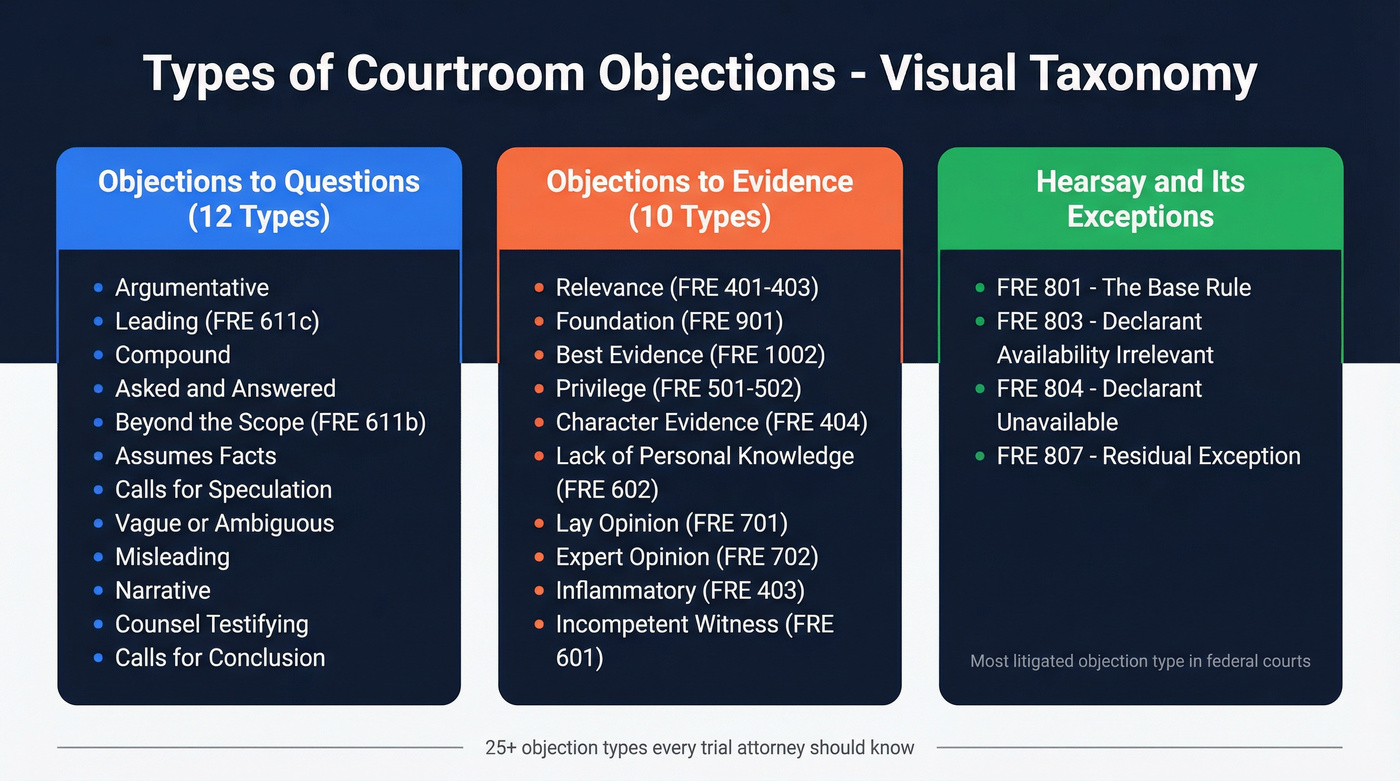
| Objection | Plain-Language Definition | FRE Rule | Sample Phrasing |
|---|---|---|---|
| Relevance | Not related to the case | 401-403 | "Objection, relevance." |
| Unfair prejudice | Relevant but misleading/unfairly harmful | 403 | "Objection, Rule 403." |
| Hearsay | Statement offered for its truth | 801-807 | "Objection, hearsay." |
| Leading | Suggests the answer | 611(c) | "Objection, leading." |
| Authentication / foundation | No basis established for what the exhibit is | 901 | "Objection, lack of foundation." |
| Argumentative | Arguing, not questioning | - | "Objection, argumentative." |
| Compound | Two questions in one | - | "Objection, compound." |
| Asked and answered | Already addressed | - | "Asked and answered." |
| Beyond the scope | Outside direct/cross limits | 611(b) | "Beyond the scope." |
| Assumes facts | Presumes unproven facts | - | "Assumes facts not in evidence." |
| Calls for speculation | Witness can't know | - | "Calls for speculation." |
| Vague/ambiguous | Unclear question | - | "Objection, vague." |
| Misleading | Distorts facts | - | "Objection, misleading." |
| Narrative | Witness rambling | - | "Objection, narrative." |
| Counsel testifying | Lawyer stating facts | - | "Counsel is testifying." |
| Calls for conclusion | Asks for a legal/ultimate conclusion | - | "Calls for a conclusion." |
| Best evidence | Original required (with exceptions) | 1002 | "Best evidence." |
| Privilege | Protected communication | 501-502 | "Objection, privilege." |
| Character evidence | Improper character proof | 404 | "Improper character evidence." |
| Lack of personal knowledge | Witness didn't observe | 602 | "Lacks personal knowledge." |
| Lay opinion | Non-expert giving opinion | 701 | "Improper lay opinion." |
| Expert opinion | Expert testimony not properly supported | 702 | "Improper expert testimony." |
| Inflammatory | Designed to provoke | 403 | "Objection, inflammatory." |
| Incompetent witness | Witness unqualified/can't testify competently | 601 | "Witness is incompetent." |
| Improper impeachment | Wrong impeachment method | 607-609, 613 | "Improper impeachment." |
| Non-responsive | Answer doesn't match question | - | "Non-responsive, move to strike." |
How Courtroom Objections Work
An objection is a formal request for the judge to enforce the rules of evidence or procedure. Counsel stands, says "Objection," states the legal basis, and - if needed - adds a brief clarification. That's it. "Objection, your honor. Hearsay." No speeches.
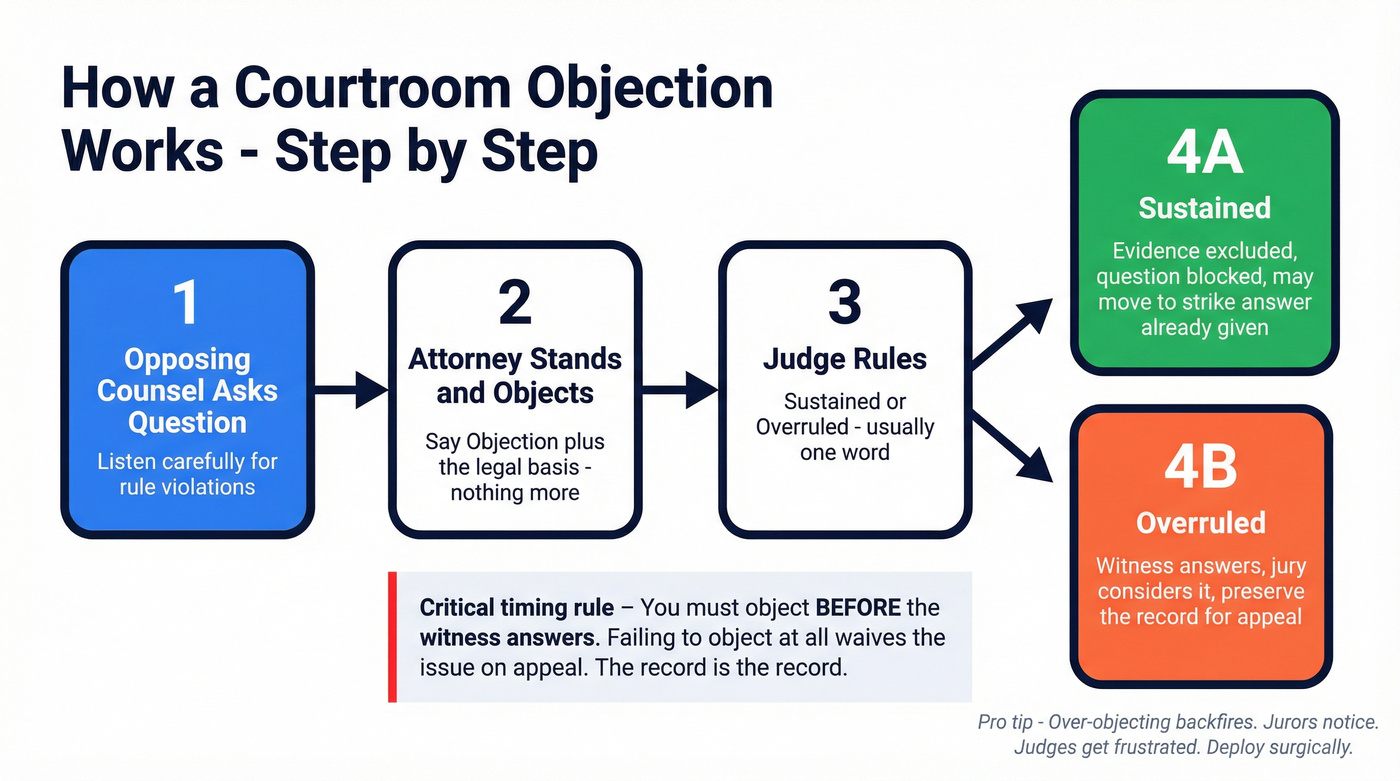
Sustained means the judge agrees with you. The evidence gets excluded, the question gets blocked, and the judge may strike an answer already given and instruct the jury to disregard it. Overruled means the judge disagrees - the witness answers, and the jury considers it.
Timing is everything. You must object immediately - before the witness answers if possible. A delayed objection can limit the court's ability to correct the error, and failing to object at all waives the issue entirely. You can't raise it on appeal. The record is the record.
Here's the strategic tension most guides skip: over-objecting backfires. Jurors notice. Judges get frustrated. If you stand up every 30 seconds, the jury starts thinking you're hiding something. The best trial lawyers master a small set of objections cold and deploy them surgically, rather than memorizing 40 and firing at everything that moves. We've watched newer attorneys worry about missing objections while experienced litigators worry about making too many - and the experienced ones win more.
Types of Legal Objections
Objections to Questions
These target how opposing counsel frames their questions. They're the most common objections in trial because they come up during every direct and cross-examination.
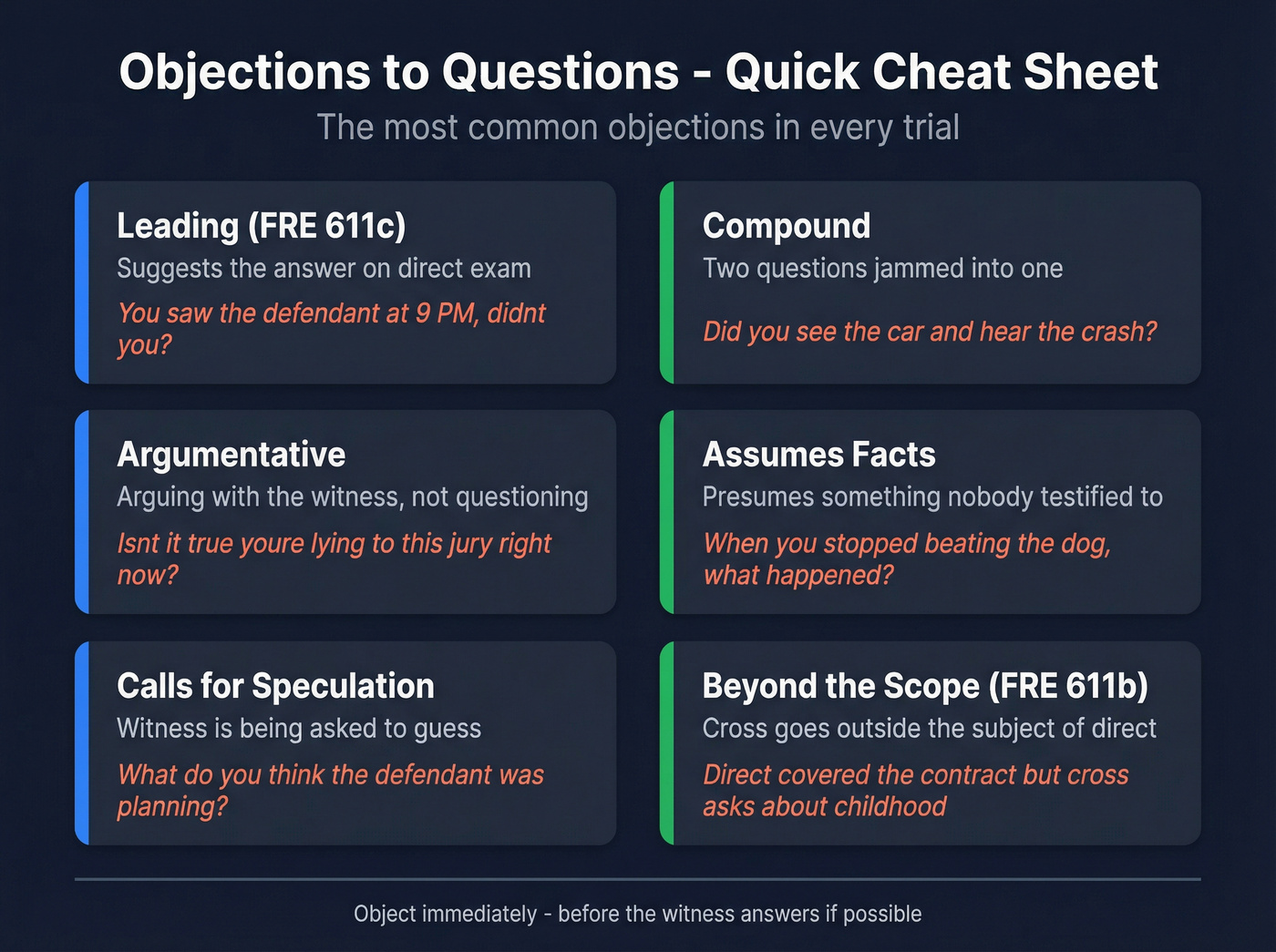
Argumentative. The attorney is arguing with the witness rather than asking a question. "Isn't it true you're lying to this jury right now?" That's a closing argument, not a question. Object.
Leading. The question suggests the answer. "You saw the defendant at 9 PM, didn't you?" Leading questions are generally prohibited on direct examination under FRE 611(c) but allowed on cross. This is the objection new attorneys forget to make - and the one they make incorrectly on cross.
Compound. Two or more questions jammed together. "Did you see the car and hear the crash?" The witness can't answer both clearly, and the record becomes ambiguous. Judges hate ambiguous records.
Asked and answered. Counsel already got an answer and is repeating the question, usually hoping for a different one. Object before the witness gets confused or contradicts themselves.
Beyond the scope. In federal court, cross-examination is generally limited to the subject matter of direct and matters affecting credibility under FRE 611(b), though judges can allow broader inquiry. If direct covered the contract signing and cross veers into the defendant's childhood, that's beyond the scope.
Assumes facts not in evidence. "When you stopped beating the dog, what happened next?" presumes the witness beat the dog. If no testimony established that fact, the question is improper.
Calls for speculation. The witness is being asked to guess. "What do you think the defendant was planning?" Unless the witness has personal knowledge, this calls for speculation.
Vague or ambiguous. The question is too unclear for a meaningful answer. "What happened with the thing?" Judges want precision.
Misleading. The question distorts testimony or facts already in evidence. Counsel is recharacterizing what a witness said, and the record needs protecting.
Narrative. This arises when the witness gives a long, unstructured story instead of answering the specific question. "Move to strike as narrative."
Counsel testifying. The attorney is making factual statements disguised as questions. "The light was red, the road was wet, and you were speeding - correct?" That's testimony from the lawyer's mouth.
Calls for a conclusion. Asks the witness to draw a legal or ultimate conclusion they're not qualified to make. "Was the defendant negligent?" That's for the jury.
Objections to Evidence
These target what gets admitted - documents, testimony, physical evidence. They're often more consequential because they can exclude entire categories of proof.
Relevance / Rule 403 (FRE 401-403). Evidence must make a fact of consequence more or less probable. Even relevant evidence can be excluded under the 403 balancing test if its probative value is substantially outweighed by unfair prejudice, confusion, or waste of time. This is one of the most litigated objections in federal courts.
Foundation/Authentication (FRE 901). Before evidence comes in, counsel must establish what it is and where it came from. A document needs a witness who can identify it. A recording needs someone who can verify it's authentic. No foundation, no admission.
Best evidence rule (FRE 1002). If you're proving the contents of a writing, recording, or photograph, produce the original. Copies are allowed under certain exceptions, but the rule exists to reduce disputes over inaccurate reproductions.
Privilege (FRE 501-502). Attorney-client, spousal, doctor-patient - privileged communications are protected. If opposing counsel tries to introduce a conversation between the defendant and their lawyer, object immediately.
Improper character evidence (FRE 404). You generally can't introduce evidence of a person's character to prove they acted in conformity with it. "He's stolen before, so he probably stole this time" is exactly what Rule 404 targets, with narrow exceptions in criminal cases.
Lack of personal knowledge (FRE 602). A witness can only testify about things they personally observed. "My neighbor told me the car was blue" isn't personal knowledge - it's hearsay layered on a foundation problem.
Lay opinion vs. Expert opinion (FRE 701, 702). Lay witnesses can offer opinions rationally based on their perception - "he seemed drunk." But they can't opine on technical matters. Expert witnesses can, but only after their qualifications and basis are established under FRE 702 and must satisfy the Daubert framework in federal court.
Inflammatory/Prejudicial (FRE 403). Graphic photos, emotionally charged testimony, or evidence designed to provoke rather than inform. The 403 balancing test is the gatekeeper here.
Incompetent witness (FRE 601). The witness lacks the capacity to testify - they can't perceive, recall, or communicate meaningfully. Rare, but it comes up with very young children or witnesses with severe cognitive impairment.
Improper impeachment (FRE 607-609, 613). There are specific rules for how you attack a witness's credibility. Using the wrong method, or failing to handle a prior inconsistent statement correctly, draws this objection.

Sales objections like "we don't have budget" often mask a deeper problem: you're reaching the wrong person. Prospeo's 30+ search filters - including buyer intent, job changes, and department headcount - connect you to decision-makers who actually own the budget. 98% email accuracy means your message lands.
Stop handling objections from people who were never your buyer.
Hearsay - The Most Misunderstood Objection
Hearsay is an out-of-court statement offered to prove the truth of the matter asserted under FRE 801. It's generally excluded because the statement wasn't tested the way trial testimony is - oath, cross-examination, and the jury's ability to evaluate the declarant.
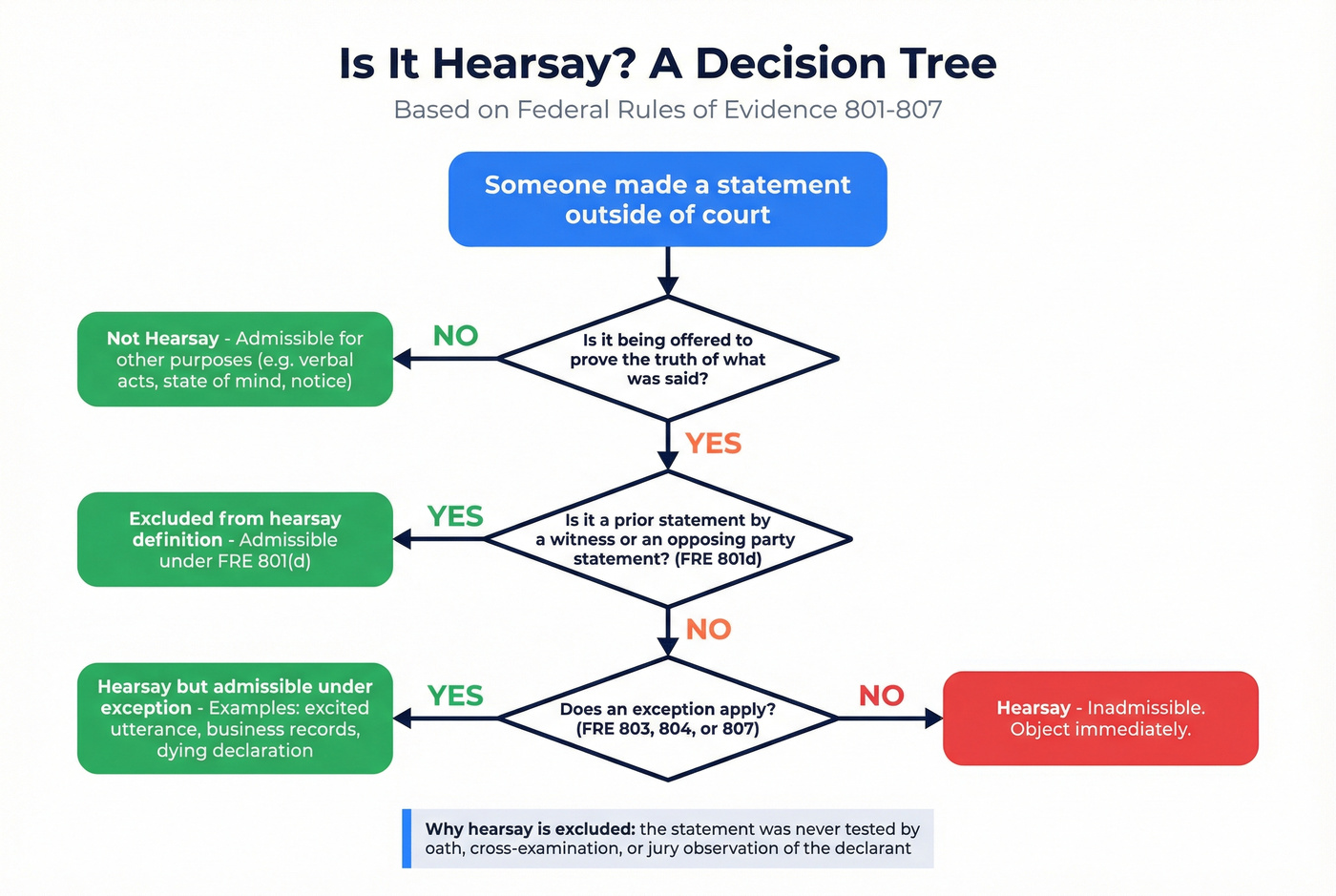
Here's the thing: a lot of objection reference charts skip hearsay entirely. That's a gap, because hearsay is where "simple rule, complicated exceptions" becomes painfully real in practice.
FRE 803 lists exceptions that apply regardless of whether the declarant is available. The big ones:
- Present sense impression (803(1))
- Excited utterance (803(2))
- Then-existing condition (803(3))
- Statements for medical diagnosis (803(4))
- Recorded recollection (803(5))
- Business records (803(6))
- Public records (803(8))
- Learned treatises (803(18))
FRE 804 adds exceptions that apply only when the declarant is unavailable. Two high-frequency ones: dying declarations (804(b)(2)) and statements against interest (804(b)(3)).
Deposition vs. Trial Objections
Objections work differently in depositions than at trial. Understanding the distinction prevents wasted motions and preserved-error disasters.
| Factor | Deposition | Trial |
|---|---|---|
| Effect of objection | Noted; witness still answers | Evidence excluded if sustained |
| Form objections | Must be made or waived | Made in real time |
| Speaking objections | Restricted under many rules/orders | Argument handled at sidebar |
| Preservation | Form objections waived if not raised | Must object or risk waiver |
| Judge present? | No | Yes |
In a deposition, when you say "objection to form," you're putting a marker on the record. The witness still answers. The fight over admissibility happens later, at trial or in a motion in limine. If you don't object to form during the deposition, many jurisdictions treat that objection as waived.
Speaking objections - where counsel explains the basis at length, essentially coaching the witness - are restricted under many court rules and orders. "Object to form" is usually sufficient. Save the argument for the judge.
At trial, objections have immediate consequences. Sustained means the jury never hears it. That's a fundamentally different dynamic.
When to Object (and When Not To)
Not every objectionable question deserves an objection. The decision is strategic, not reflexive.
Object when the answer would genuinely hurt your case and the objection is likely to be sustained. Object when you need to preserve the issue for appeal - even if you think the judge will overrule. These are non-negotiable situations where silence costs you.
Skip the objection when the answer is harmless or actually helps you, when objecting would spotlight damaging testimony the jury might otherwise ignore, or when you've already stood up three times in the last five minutes and the jury is staring. The jury perception risk is real. We've watched trials where aggressive objection strategies backfired precisely because the jury interpreted every "Objection!" as "Please don't let them hear the truth."
Let's be honest about this: master 8-10 objections deeply rather than memorizing 40 superficially. Know relevance, hearsay, foundation, leading, speculation, compound, beyond the scope, and 403 prejudice cold. Those cover the vast majority of what you'll actually need in a courtroom.
Common Sales Objection Categories
Sales objections follow a different taxonomy, but the principle is the same: recognize the type instantly, and you'll know the right response. A common sales training framework groups buyer pushback into six categories.
Price and Budget
Reps instinctively offer discounts when they hear "we don't have budget for this." Don't. The discount reflex is the single most expensive habit in B2B sales.
Reframe the conversation around value and cost of inaction. What does the prospect lose by not solving this problem for another quarter? If the answer is "not much," you have a qualification problem, not a price problem. And if the prospect genuinely can't afford it, no amount of reframing helps - that's a targeting miss, not an objection to overcome. The consensus on r/sales tends to agree: discounting on the first objection trains buyers to always push back on price.
Authority and Decision-Maker
If prospects keep saying "I'd need to run this by my VP" or "I'm not the one who makes this decision," you don't have an objection-handling problem. You have a targeting problem.
In our experience, reps who constantly hear "I need to check with my boss" are reaching the wrong level of the org chart. The real fix is reaching decision-makers before the call - using tools like Prospeo that provide verified emails and direct mobile numbers for specific job titles, so authority objections never come up in the first place. When you do get this objection, ask to loop in the decision-maker for the next call and treat it as a signal to tighten your targeting upstream.
Need and Relevance
"We're not really looking for this right now" or "I don't see how this applies to us."
Picture this: you've spent 15 minutes pitching your platform's features to a marketing director who doesn't manage the budget, doesn't feel the pain your product solves, and took the call because your email subject line was vague enough to be curious about. That's not an objection - that's a wasted meeting. The fix is upstream: qualify harder before the call. If you're hearing this objection frequently, your ICP definition needs work, not your talk track.
Timing and Urgency
"Not right now" and "circle back next quarter" are the polite brushoffs of B2B sales. Sometimes they're genuine - budgets are locked, priorities shifted, a reorg just landed. Sometimes they're a soft no dressed up as a maybe.
The distinction matters. For genuine timing issues, set a concrete follow-up date with a specific reason to reconnect: a trigger event, a new quarter, a product launch that changes the calculus. For soft nos, push gently for the real objection underneath. The worst response is "When would be a better time?" because it hands all control to the prospect and kills momentum.
Trust and Competitor
"We already use [competitor]" is actually one of the best objections you can hear. It means the prospect has budget, understands the category, and has already been sold on the problem. Your job just got easier - you only need to differentiate, not educate.
The mistake reps make is going broad: "We're better than them." That bounces off every time. Instead, know what the competitor does poorly and lead with that specific gap. If you're selling against a tool with stale data, talk about data freshness. If you're selling against a platform with mandatory annual contracts, talk about flexibility. Generic differentiation is no differentiation at all.
Better Data Means Fewer Objections
Most objection-handling guides focus on what to say after the objection lands. That's treating the symptom.
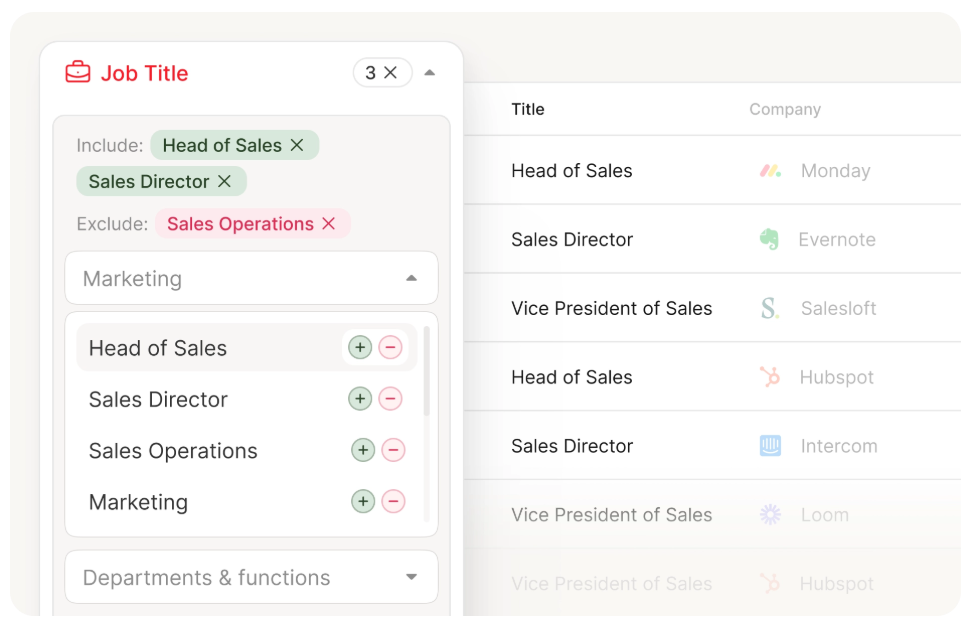
The real fix is better targeting. When reps reach the right person - a decision-maker who actually has the problem you solve - authority objections vanish, need objections drop, and price conversations happen with someone who has budget authority. One team we've worked with, Snyk, saw AE-sourced pipeline jump 180% after switching to verified contact data, generating 200+ new opportunities per month. When you're talking to the right person, half your objection categories simply don't come up.
If your deal sizes are modest, you probably don't need a $30k/year data platform. But you absolutely need accurate contact data for the people who can say yes. That's the highest-return investment in any sales stack.
"We already have a solution" is the #1 sales objection - and the hardest to overcome cold. Prospeo tracks 15,000 intent topics via Bombora so you reach buyers actively researching alternatives. Teams book 35% more meetings than Apollo users because they start conversations prospects already want to have.
Reach buyers before they object - target in-market signals instead.
FAQ
What are the most common objections in court?
Relevance, hearsay, leading, foundation, and argumentative cover the majority of day-to-day trial objections. Master these five before worrying about niche grounds like best evidence or improper impeachment - they'll handle 80%+ of what you encounter.
How many types of objections exist?
Courts recognize 25-40 distinct objection grounds across federal and state jurisdictions, though labels vary by judge. This guide covers the core set used under the Federal Rules of Evidence, which most state rules mirror closely.
What's the difference between sustained and overruled?
Sustained means the judge agrees with the objection and excludes the evidence or blocks the question. Overruled means the judge disagrees - the witness answers, and the jury considers the testimony. Failing to object at all typically waives the issue for appeal.
What are the 6 sales objection categories?
Price/budget, authority/decision-maker, need/relevance, timing/urgency, trust/credibility, and competitor/status quo. Each requires a different response, but the most effective approach is reducing objections upstream by ensuring reps reach verified decision-makers before the call.
How do you reduce sales objections before they happen?
Start with verified contact data so reps reach actual decision-makers - this eliminates authority and need objections caused by reaching the wrong person. Everything else (talk tracks, battle cards, frameworks) builds on that foundation of knowing you're talking to someone who can say yes.