How to Cold Call Without Sounding Like a Salesman
It's 9:47am on a Tuesday. You've made 14 dials. Two voicemails. One wrong number. You finally get a live answer and your voice jumps an octave, your cadence speeds up, and you hear yourself say "How's your day going?" to a stranger who didn't ask to talk to you.
You already lost.
If you want to learn how to cold call without sounding like a salesman, the fix isn't a better script - it's a better approach. 82% of B2B buyers accept cold calls when the approach feels authentic. The average success rate hovers around 2.3%, but once you actually reach someone and have a real conversation, 65.6% convert to a next step. The problem isn't cold calling. It's how you sound doing it.
The Quick Version
- Fix your opener. The first 10 seconds decide everything. Use a permission-based or pattern-interrupt line, not "How's your day?"
- Stop pitching, start asking. Break your value prop into micro-steps with a question after each one. (If you need a bank of prompts, start with open-ended sales questions.)
- Fix your data before your delivery. Calling verified numbers for the right person eliminates the desperation energy that comes from 12 dead dials in a row. If your lists are aging out, B2B contact data decay is usually the hidden culprit.
Mistakes That Make You Sound Salesy
Here's the thing: stop trying to not sound like a salesman. You ARE a salesman. The goal is to sound like a good one - someone who's prepared, relevant, and respectful of their prospect's time. We've coached reps who didn't realize they were doing half of these until they heard a recording of themselves. (If you want a tighter system, use a cold call checklist to self-audit.)
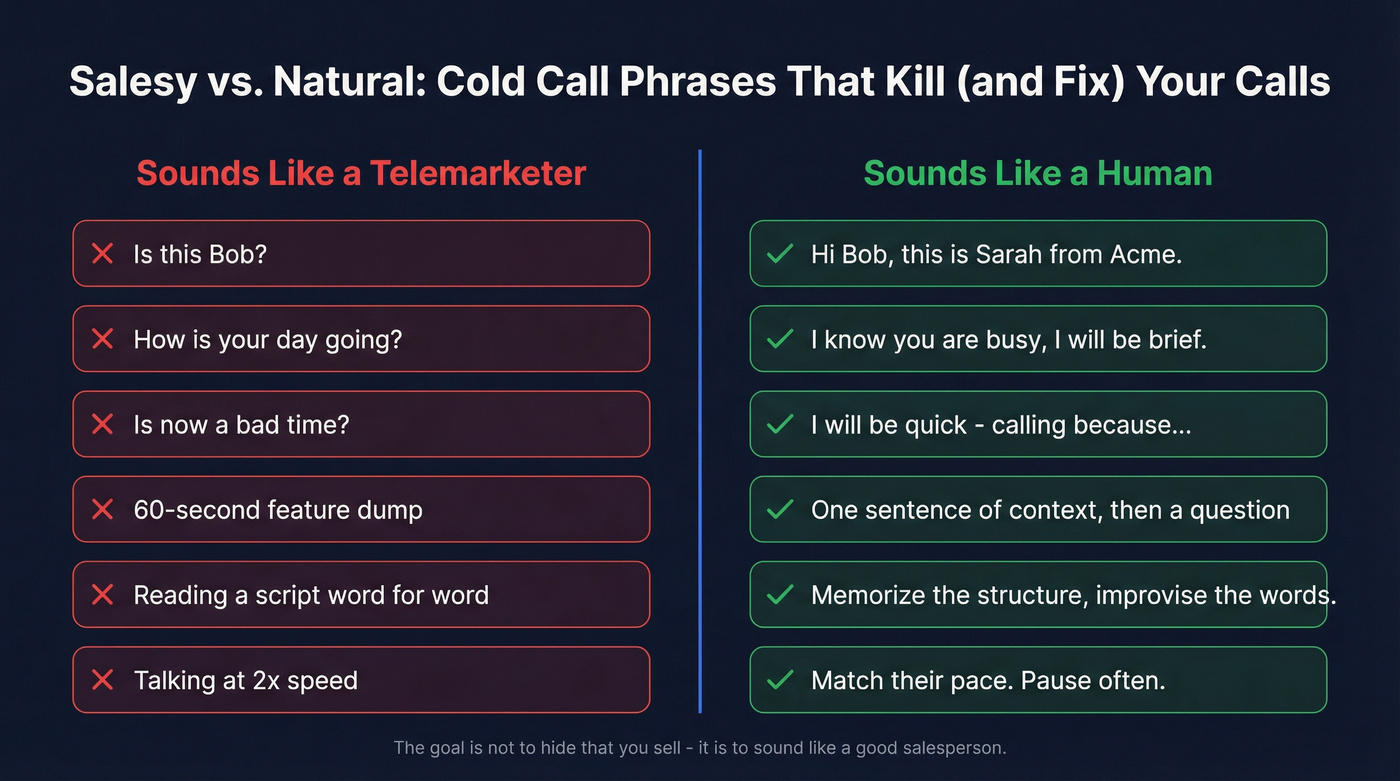
| What You Say | Why It Kills You | What to Say Instead |
|---|---|---|
| "Is this Bob?" | Sounds like a debt collector | "Hi Bob, this is [Name] from [Company]." |
| "How's your day?" | Lumps you in with telemarketers | "I know you're busy, I'll be brief." |
| "Is now a bad time?" | Hands them an easy exit | "I'll be quick - calling because..." |
| 60-second feature dump | They tune out after 15 seconds | One sentence of context, then a question |
| Reading a script verbatim | The cadence gives it away instantly | Memorize the structure, improvise the words |
| Talking at 2x speed | Signals nervousness and erodes trust | Match their pace. Pause often. |
Openers That Start Conversations
The best openers aren't scripts. They're flexible frameworks you adapt to each call. Here are five that consistently start conversations instead of triggering hang-ups:
1. Transparency opener: "Full transparency - this is a sales call. But it's a well-researched one. Mind if I share why I'm calling?" Radical honesty disarms people because nobody expects a cold caller to admit they're cold calling.
2. Pattern interrupt: "I promise this isn't another generic sales call. I have a specific question about how your team handles [problem]." Specificity signals preparation, and specificity is the opposite of spam.
3. Social proof: Picture this - you've been working with three VPs at similar companies. You call the fourth, introduce yourself, then ask: "Heard the name tossed around?" Social proof and curiosity in one move.
4. Qualifier: "Are you the right person to talk to about [specific area]?" Simple, respectful, immediately qualifies. No explanation needed. (For more, see cold call qualifying questions.)
5. Warm callback: "Hey [Name], how've you been?" This works best when you have any prior touchpoint - a webinar attendance, a content download, even a previous voicemail. This approach is 6.6x more successful than traditional openers because it mimics how humans actually greet each other.

Bad data is the #1 reason reps sound desperate on cold calls. After 12 dead dials, your voice betrays you. Prospeo gives you 125M+ verified mobile numbers with a 30% pickup rate - so you reach the right person on the first try and bring your A-game every time.
Fix your data before you fix your delivery. Start free today.
What to Say After "Go Ahead"
You got permission to keep talking. Now most reps blow it by launching into a 90-second pitch about features nobody asked about.
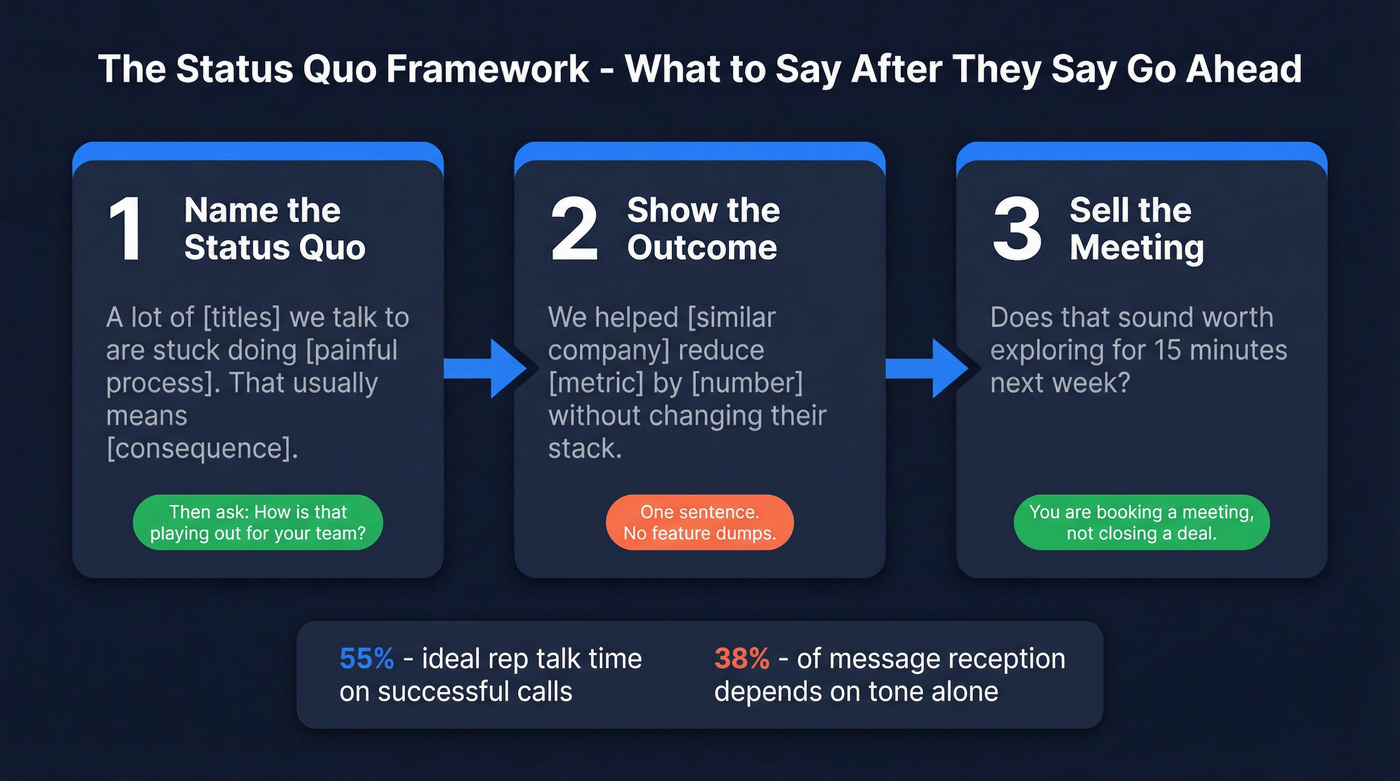
Use the status quo framework instead.
Step 1: Name the status quo, then break it. "A lot of [titles] we talk to are stuck doing [current painful process]. That usually means [consequence]. How's that playing out for your team?" You're showing you understand their world and immediately inviting them to talk about it.
Step 2: Show the outcome. Not features - outcomes. "We helped [similar company] reduce [metric] by [number] without changing their existing stack." One sentence. Concrete.
Step 3: Sell the meeting, not the product. "Does that sound like something worth exploring for 15 minutes next week?" That's it. Don't oversell the call you're already on. (If you want more scripts for this moment, borrow from how to secure a meeting on a cold call.)
Successful cold calls land around 55% rep talk time overall, then shift into questions once the prospect engages. And 38% of how your message is received depends on tone of voice alone - not what you say, but how you say it. The goal isn't to talk less. It's to make every second of talk time earn the next question. (To go deeper, study cold call tonality.)
Handling "Not Interested" Without Crumbling
Gong's analysis of 300M+ cold calls found the top objection categories account for 74% of all pushback: dismissive at 49.5%, situational at 42.6%, and existing solution at 7.9%.
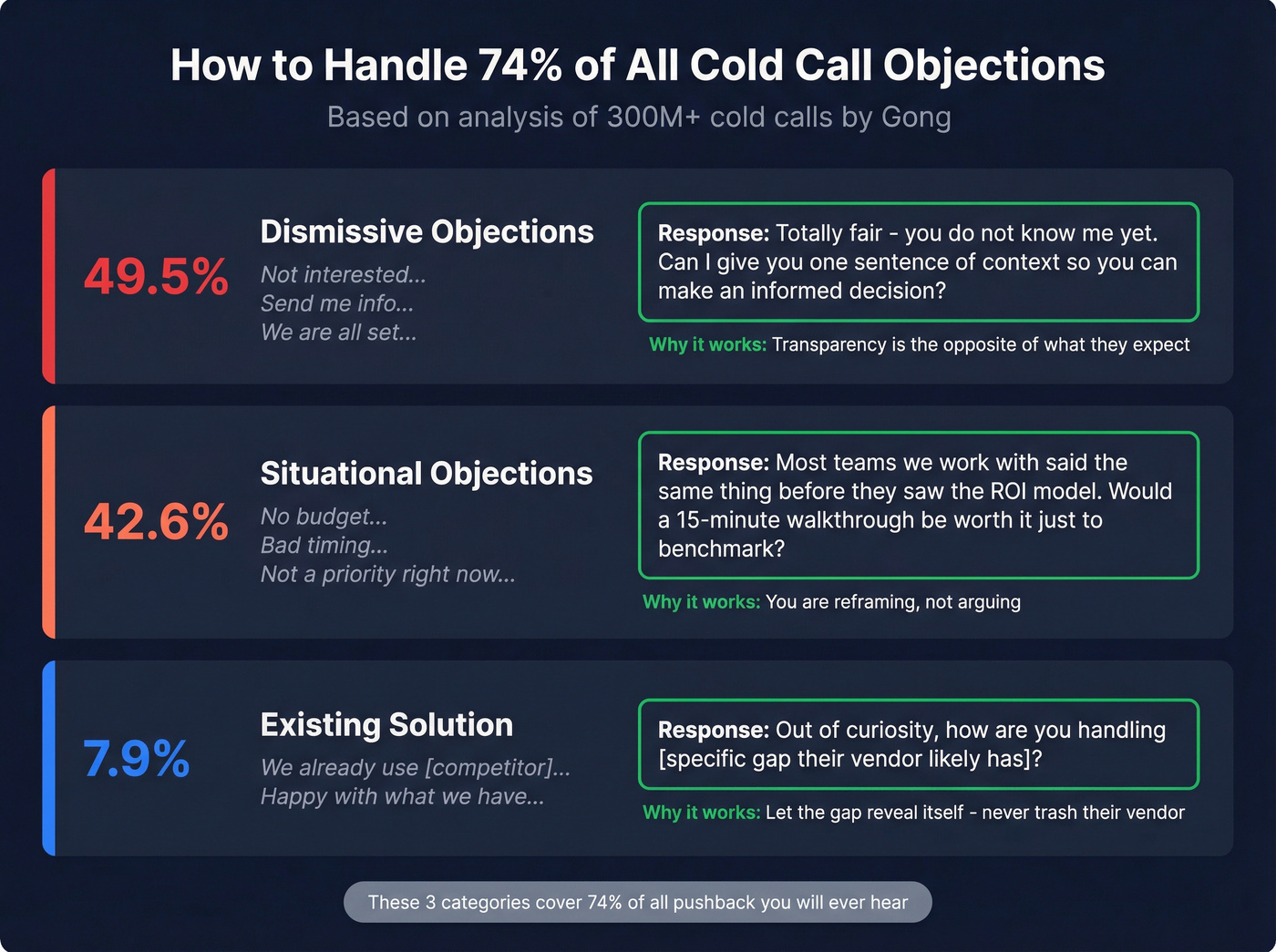
Dismissive ("Not interested," "Send me info"): Be disarmingly blunt. "Totally fair - you don't know me yet. Can I give you one sentence of context so you can make an informed decision?" Transparency is the opposite of what they expect, and that pause often buys you 15 more seconds.
Situational ("No budget," "Bad timing"): Agree with the objection, then redirect. "Most teams we work with said the same thing before they saw the ROI model. Would a 15-minute walkthrough be worth it just to benchmark?" You're not arguing - you're reframing.
Existing solution: Never trash their vendor. Instead: "Out of curiosity, how are you handling [specific gap their vendor likely has]?" Let the gap reveal itself. If there's no gap, respect that and move on - forced persistence here is exactly what makes reps sound desperate.
The 5-Minute Pre-Call Rule
Connect rates run 3-10%, and it takes 18+ dials to reach a single prospect. The 5-minute research rule changes the math. Before each call, check:
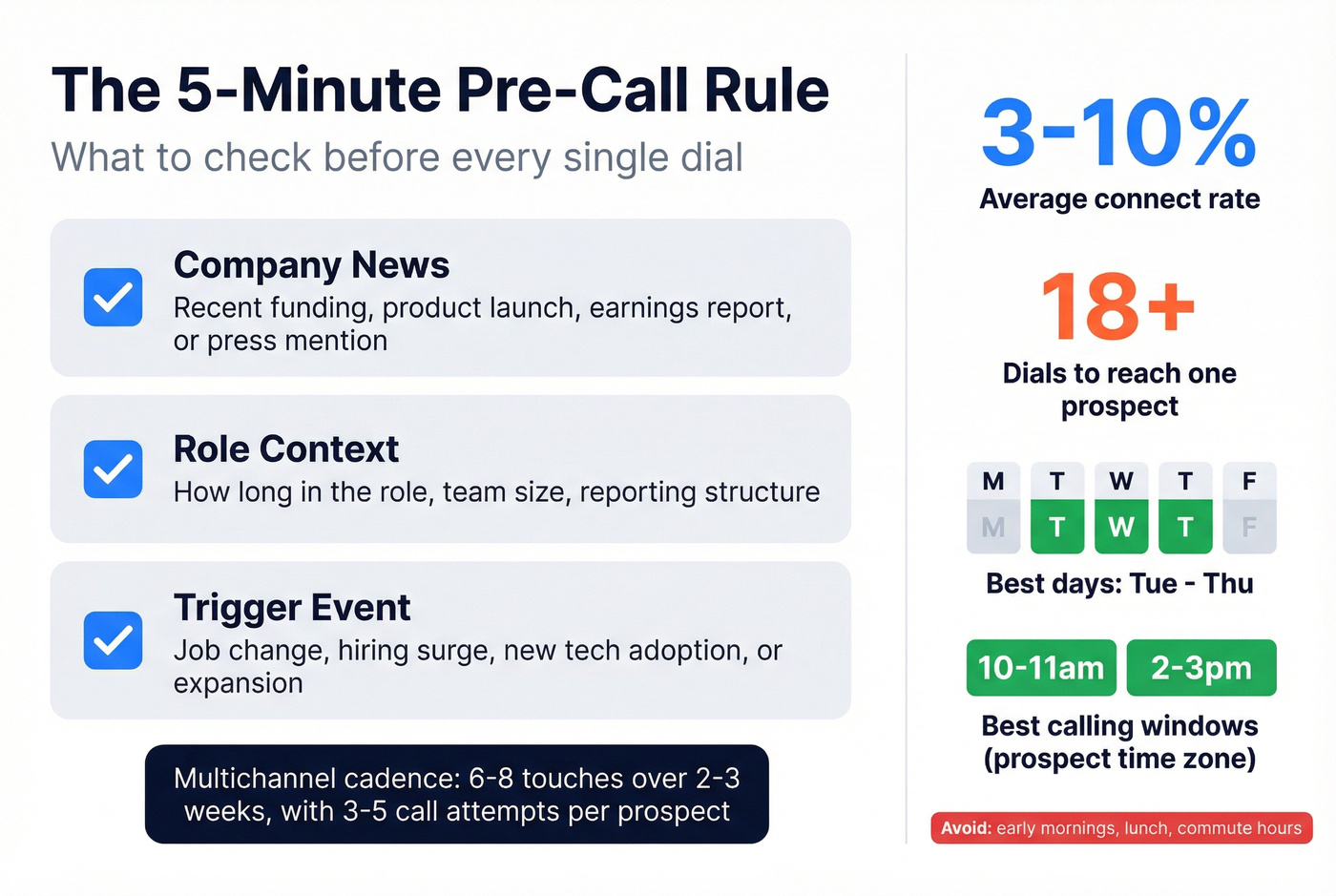
- Company news - recent funding, product launch, earnings
- Role context - how long they've been in the role, team size
- Trigger event - job change, hiring surge, tech adoption
Best timing: Tuesday through Thursday, 10-11am and 2-3pm in the prospect's time zone. Avoid early mornings, lunch, and commute hours. Cold calls work best inside a multichannel cadence - 6-8 touches over 2-3 weeks, with 3-5 call attempts per prospect. (If you want templates, use a pre call research checklist.)
Let's be honest about something: half the desperation energy reps carry comes from bad data, not bad technique. When you're dialing dead numbers and reaching the wrong people all morning, the frustration bleeds into your voice on the calls that do connect. We've seen this pattern over and over - a rep "can't close" on the phone, but the real problem is they've burned through 40 minutes of wrong numbers and gatekeepers before they ever reach a decision-maker. Prospeo's verified mobile numbers (125M+ with a 30% pickup rate, refreshed weekly) solve that upstream problem so you can actually focus on the conversation itself. (If you’re rebuilding lists, start with prospect data accuracy.)
How to Stop Sounding Scripted
64% of salespeople say their initial cold calling training was inadequate. That tracks - most onboarding is "here's a script, go dial." But companies with formal coaching programs see 20-22% higher win rates. (A structured cold call coaching program usually fixes this fast.)
Being natural on the phone is a skill, not a personality trait. The biggest reason reps end up sounding robotic is that they memorize words instead of intent - they know what to say but not why they're saying it. Record your next 10 calls and listen back. You'll catch verbal tics, rushed transitions, and pitch-mode triggers you never noticed live.
The consensus on r/sales is pretty consistent: stand up while you call, smile (it genuinely changes your vocal tone), and do a 30-second vocal warm-up before your first dial - deep breaths, hum, loosen your jaw. It sounds ridiculous. It works.
Follow a 30/60/90-day progression. First month, nail ICP knowledge and openers. Second month, sharpen objection handling. Third month, focus on meeting quality and conversion. Skip the third month if your connect rate is still below 5% - go back and fix your data and targeting first, because no amount of technique compensates for reaching the wrong people. The reps who sound effortless on cold calls aren't naturals. They've just practiced enough that the framework disappears and the conversation takes over.
The 5-minute pre-call rule works better when your data is already right. Prospeo's 30+ search filters - including job changes, hiring surges, and tech adoption - give you the trigger events and verified direct dials you need before every call. At $0.01 per email and 10 credits per mobile, enterprise-grade research costs less than your morning coffee.
Turn pre-call research from guesswork into a competitive advantage.
FAQ
How long should a cold call last?
Successful cold calls typically run 90-180 seconds. Under 60 seconds means you're getting dismissed at the opener. Over 5 minutes usually signals you're pitching instead of qualifying - book a meeting and go deeper there.
What's a good cold call success rate?
The average is roughly 2.3%, but that number is misleading. Once you reach a live prospect and have a real conversation, 65.6% convert to a next step. Focus on improving connect rate first - that closes the gap faster than any script tweak.
Should I use a script for cold calls?
Use a framework, not a script. A framework gives you an opener, a transition, and 2-3 key questions. Memorize the structure, not the words. You'll sound prepared instead of robotic - and that's the core of how to cold call without sounding like a salesman.
How many calls does it take to reach a prospect?
Plan for 18+ dials per prospect. That's why multichannel cadences matter - pair your calls with emails and social touches across 2-3 weeks so each dial builds on prior context instead of starting cold every time.