

Cold Call Tonality: The Skill That Separates 2 Meetings a Month From 18
Your manager said "sound more confident." Helpful, right? About as useful as telling a golfer to "hit it straighter." Cold call tonality isn't a feeling you summon - it's a set of mechanical choices you make with your voice. Pitch, pace, volume, articulation. Those are the levers, and they're all trainable.
Here's the proof. Gong Labs analyzed 300M+ cold calls and found average reps connect on 5.4% of dials while top-quartile reps hit 13.3% - that's 19 dials per conversation versus 8. The set rate gap is even wider: average reps convert 4.6% of conversations into meetings, top reps hit 16.7%. Run the math on 200 dials per week. The average rep books roughly 2 meetings a month. The top rep books 18. Same phone, same CRM, same territory. The difference is how they sound in the first few seconds.
Fix one thing today: replace upward inflection with downward inflection on your opener. Then commit to the 15-minute drill at the end of this article.
What Tonality Actually Is (And Why Mehrabian Is Misquoted)
You've heard the stat - "93% of communication is nonverbal." It's everywhere in sales training, and it's misapplied. Mehrabian's research only applies when verbal and nonverbal cues conflict around emotional messages like sincerity or frustration. But that's exactly what happens on a cold call. Your words say "I'd love to help you" while your tone says "I'm reading a script and I hate my job." When tone and words clash, tone wins.
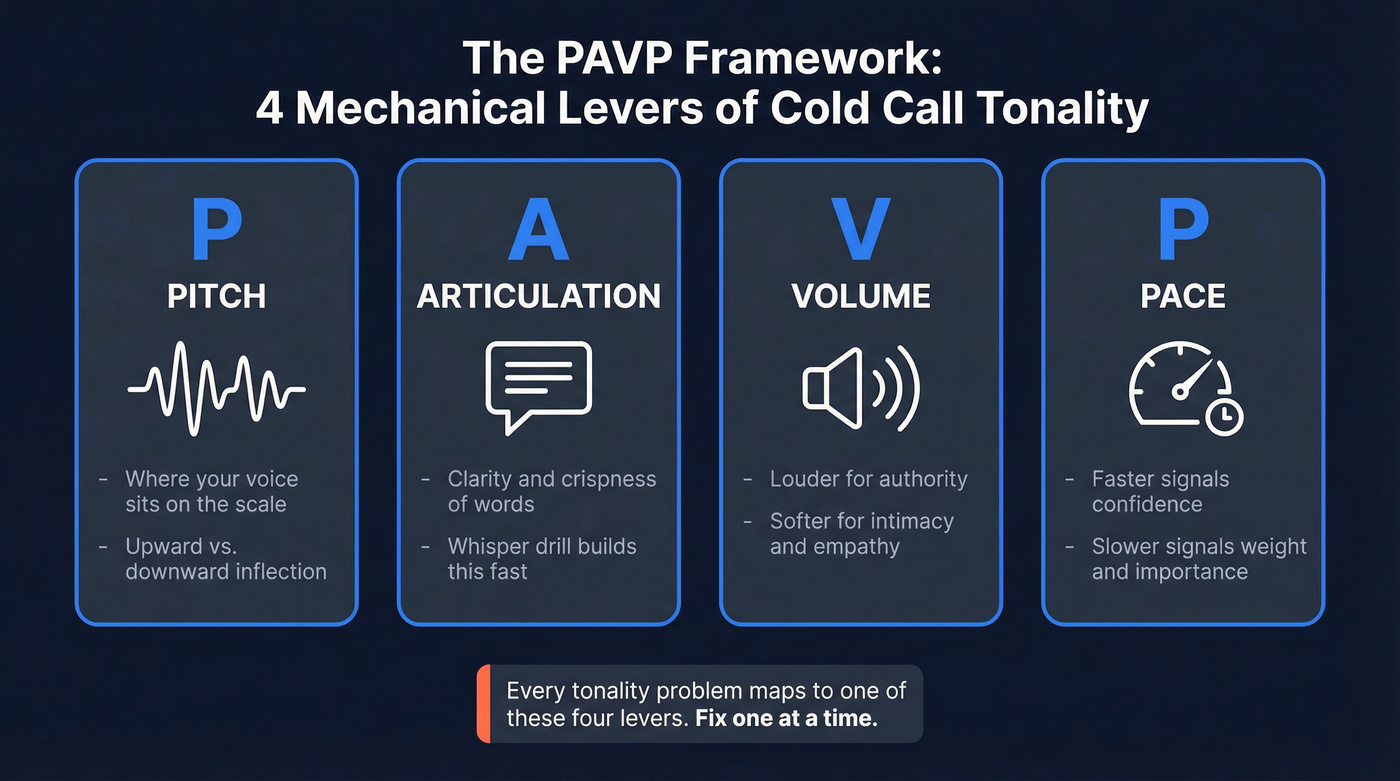
The PAVP framework gives you four mechanical levers to fix this:
- Pitch - where your voice sits and how it moves (upward vs. downward inflection)
- Articulation - clarity and crispness of your words
- Volume - louder for authority, softer for intimacy
- Pace - faster signals confidence, slower signals weight
Every tonality problem maps to one of these. "You sound nervous" = pace too fast + pitch too high. "You sound like a robot" = no variation in any lever. We've coached reps who went from 3 meetings a month to 12 just by identifying which single lever was off and drilling it for two weeks.
Four Tones Mapped to Call Stages
You're not picking one tone for the whole call. You're shifting between them. The reps who sound "natural" are making deliberate transitions that match the emotional moment.
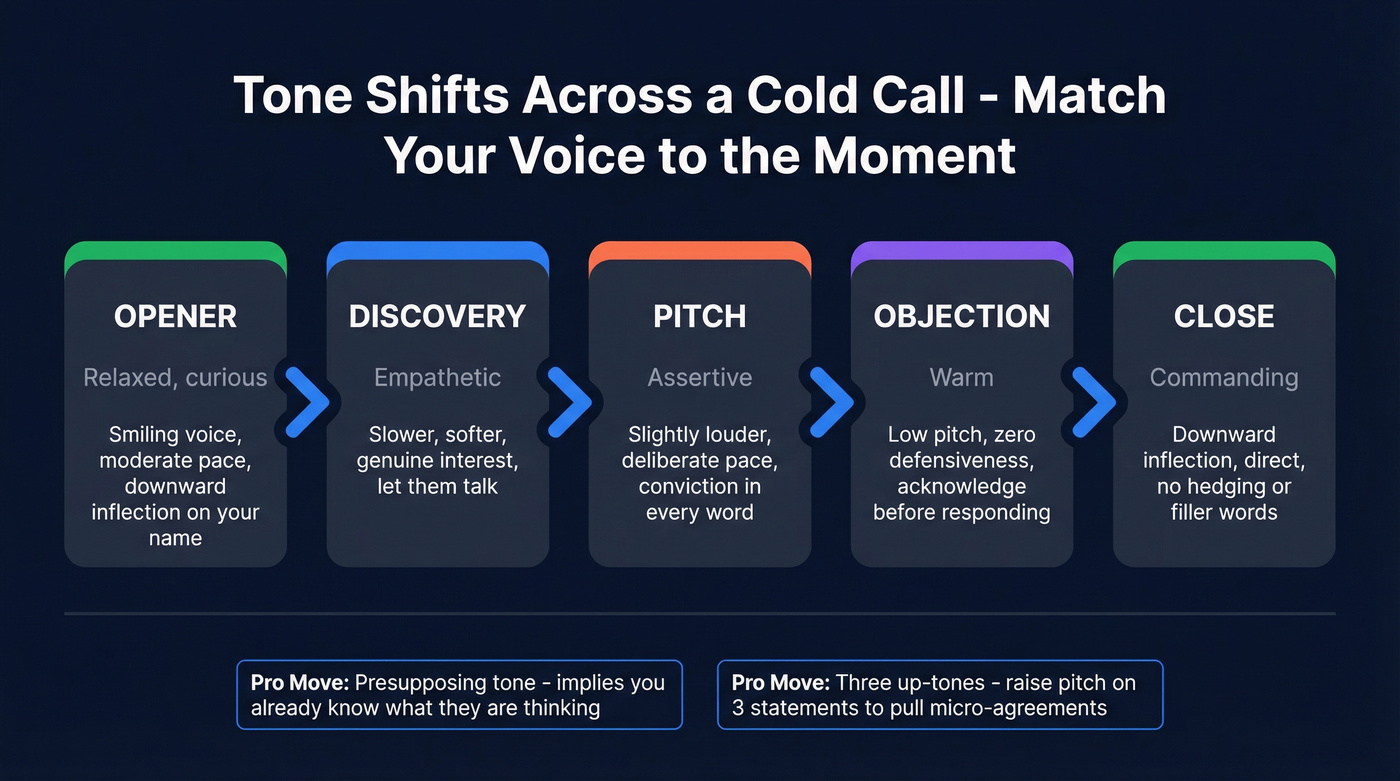
| Call Stage | Tone | Sounds Like |
|---|---|---|
| Opener | Relaxed, curious | Smiling voice, moderate pace |
| Discovery | Empathetic | Slower, softer, genuine interest |
| Pitch | Assertive | Slightly louder, deliberate pace |
| Objection handling | Warm | Low pitch, zero defensiveness |
| Close | Commanding | Downward inflection, direct |
Two techniques separate good reps from great ones. The presupposing tone implies you already know what the prospect is thinking - it conveys authority without arrogance. And the three up-tones technique from Close's tonality guide: raise your pitch slightly at the end of three consecutive statements to pull micro-agreements before you ask for anything. It feels manipulative on paper. In practice, it just sounds like someone who's genuinely engaged in the conversation.
The First 7 Seconds
The average cold call lasts 93 seconds. If your tone is wrong in the first 7, you usually won't get the other 86.
Here's a permission-based opener, annotated for tone:
"Hey Sarah, it's Mike from Acme." ↓ (Downward inflection - statement, not question. Relaxed pace.) [one-beat pause] "I know I'm catching you out of the blue --" (Slightly softer, empathetic) "do you have a quick minute?" (Curious, slight upward inflection - the ONE place rising pitch works)
The single highest-impact fix you'll make this quarter: replace upward inflection on your name and company with downward inflection. "Hi, this is Mike from Acme?" sounds like you're asking permission to exist. "Hey Sarah, it's Mike from Acme." sounds like a peer.
One of the fastest ways to kill a cold call is sounding like a telemarketer - and upward inflection on statements is a big reason why.

You just learned how to nail the first 7 seconds. But 87% of cold calls go to voicemail because reps are dialing switchboards. Prospeo gives you 125M+ verified mobile numbers with a 30% pickup rate - so your perfected tonality actually reaches a human.
Stop practicing your opener on voicemail greetings.
The 15-Minute Daily Drill
Look, practicing on live prospects burns leads and brand equity. Five-minute warm-ups aren't enough either - you need at least 15 minutes to build real muscle memory. Run this before your first dial block:
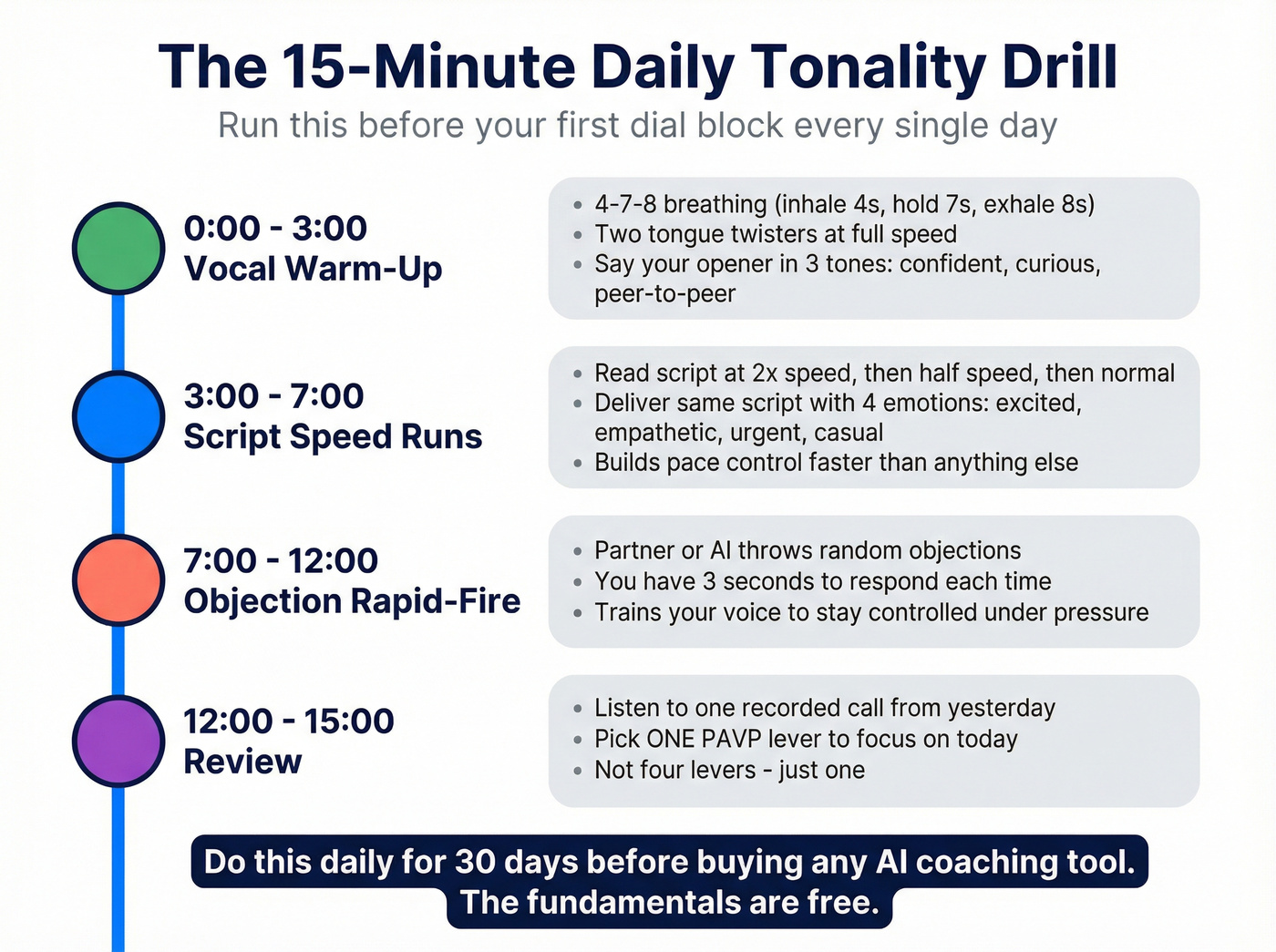
Minutes 0-3: Vocal Warm-Up Do 4-7-8 breathing - inhale 4 seconds, hold 7, exhale 8 - to steady your voice. Then run two tongue twisters at speed and say your opener in three tones: confident, curious, peer-to-peer. Try the whisper technique: deliver your entire opener in a whisper, which forces precise articulation and breath control that carries over when you return to full volume.
Minutes 3-7: Script Speed Runs Read your script at 2x speed, then half speed, then normal. This builds pace control faster than anything else. Then deliver the same script with four emotions: excited, empathetic, urgent, casual. Repetition like this is how you make deliberate technique feel automatic.
Minutes 7-12: Objection Rapid-Fire Have a partner or AI roleplay tool throw random objections. You have 3 seconds to respond. This trains your voice to stay controlled under pressure instead of going defensive and high-pitched. In our experience, reps who do this drill for two weeks straight stop flinching at "not interested" entirely.
Minutes 12-15: Review Listen to one recorded call from yesterday using your dialer's recording feature, Gong, or even your phone's voice memo app. Pick ONE PAVP lever to focus on today. Not four. One.
The mirror method sounds silly until you try it: watch your face while you dial. If you're frowning, your voice sounds flat. A slight smile physically changes your vocal tone - it's physiology, not positive thinking.
Three Mistakes That Kill Your Tone
Going monotone after call 20. This is worse than bad scripts, worse than weak value props. Energy drops as the day wears on. Stand up, walk around, do 10 jumping jacks between calls. Your body drives your voice.
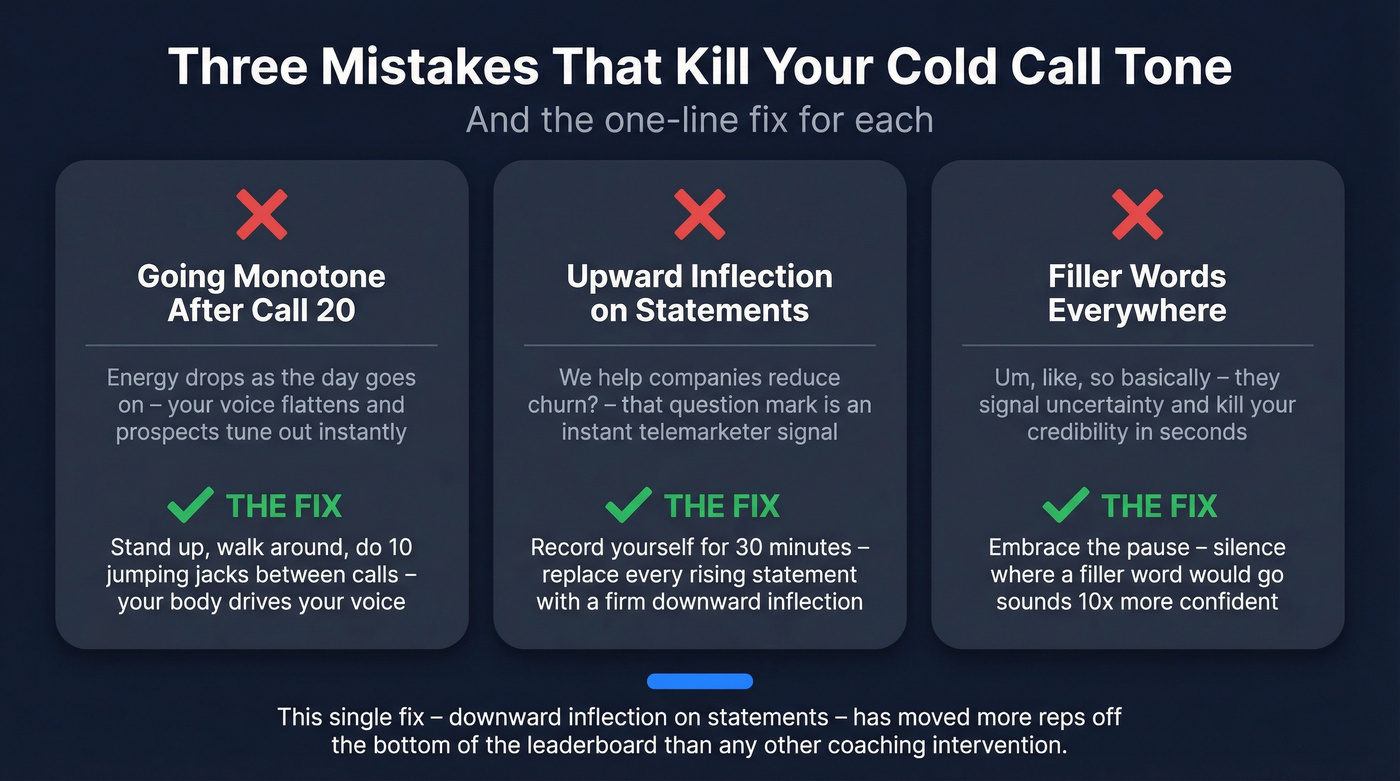
Upward inflection on statements. "We help companies reduce churn?" That question mark is an instant telemarketer signal. Record yourself for 30 minutes and you'll be horrified how often it happens. I've seen this single fix move more reps off the bottom of the leaderboard than any other coaching intervention. Getting your tone right on statements - not questions - is the foundation everything else builds on.
Filler words. "Um," "like," "so basically" - they signal uncertainty. The prospect hears someone who doesn't believe what they're saying. Embrace the pause instead. Silence where a filler word would go sounds 10x more confident.
Let's be honest: if your deal sizes are under $50k and you're spending money on AI call coaching software before you've done this 15-minute drill daily for 30 days, you're solving the wrong problem. The drill is free. The fundamentals come first. Skip the fancy tools until you've earned the right to optimize.
But Tonality Only Works If Someone Picks Up
Here's the thing nobody talks about in tonality training - none of it matters if you're dialing bad numbers and hitting voicemail 90% of the time. You can't practice tone on a recording prompt. Prospeo's 125M+ verified mobile numbers hit a 30% pickup rate, which means more live conversations per hour and faster reps through the learning curve.
If you want the full system around scripts, benchmarks, and KPIs, start with our B2B cold calling guide.
The math from this article: top reps book 18 meetings a month on 200 dials. But that assumes you're dialing the right people at the right numbers. Prospeo's 125M+ verified direct dials and 98% accurate emails mean every dial block counts - no gatekeepers, no dead numbers, no wasted reps.
Turn your 15-minute drill into 18 meetings a month.
FAQ
Does tonality matter more than the script?
When your words and voice conflict, prospects trust your tone. Mehrabian's research confirms this for emotional signals like sincerity - exactly what cold calls test. A mediocre script delivered with confident, peer-level tonality outperforms a perfect script read in a monotone or nervous voice every time.
How long does it take to improve cold call tonality?
Most reps see measurable improvement in 2-3 weeks of daily 15-minute drills. Focus on one PAVP lever at a time - typically downward inflection first, then pace control. Reps who record and review one call per day accelerate fastest, often doubling their meeting-set rate within 30 days.
What's the best tone for a cold call opener?
Use a relaxed, peer-to-peer tone with downward inflection on your name and company. Speak at moderate pace with a slight smile. Save upward inflection for one moment only - the permission question ("do you have a quick minute?"). This pattern signals confidence without aggression.
How do I get more live conversations to practice on?
Verified mobile numbers are the bottleneck for most teams. More pickups mean more reps per dial session and faster tonality improvement through real-world practice. If your current data provider's connect rates are below 15%, that's a data problem, not a skills problem.