

The B2B Cold Calling Guide You'll Actually Use in 2026
It's 9:47 AM on a Tuesday. You've made 23 dials. Zero conversations. The CRM says these are "verified" contacts, but half the numbers ring to a switchboard that hasn't been staffed since 2023.
The b2b cold call isn't dead - 59% of senior executives prefer the phone for initial contact, and 82% of buyers accept meetings at least occasionally with sellers who reach out cold. But the average success rate sits at a brutal 2.3%, while top teams hit 5-8%. The gap between those numbers comes down to three things: your data (stop calling dead numbers), your opener (ditch "Hi, how are you?"), and your follow-up discipline (93% of conversations happen by the 3rd attempt). This guide gives you the exact scripts, benchmarks, objection responses, and tools to close that gap.
What B2B Cold Calling Actually Is
B2B cold calling is an outbound phone call to a business contact who hasn't requested it. The modern version looks nothing like the boiler-room image most people picture.
Today's b2b cold call is informed outreach. You've researched the prospect's company, identified a trigger - new hire, funding round, tech stack change - and you're calling with a specific reason. Buyers aren't allergic to the phone. They're allergic to lazy, irrelevant pitches. The distinction between cold and warm isn't binary anymore; it's a spectrum of how much homework you've done before dialing.
2026 Benchmarks
Let's ground this in real numbers. An analysis of 204,000+ cold calls and 27,000+ conversations gives us hard benchmarks:
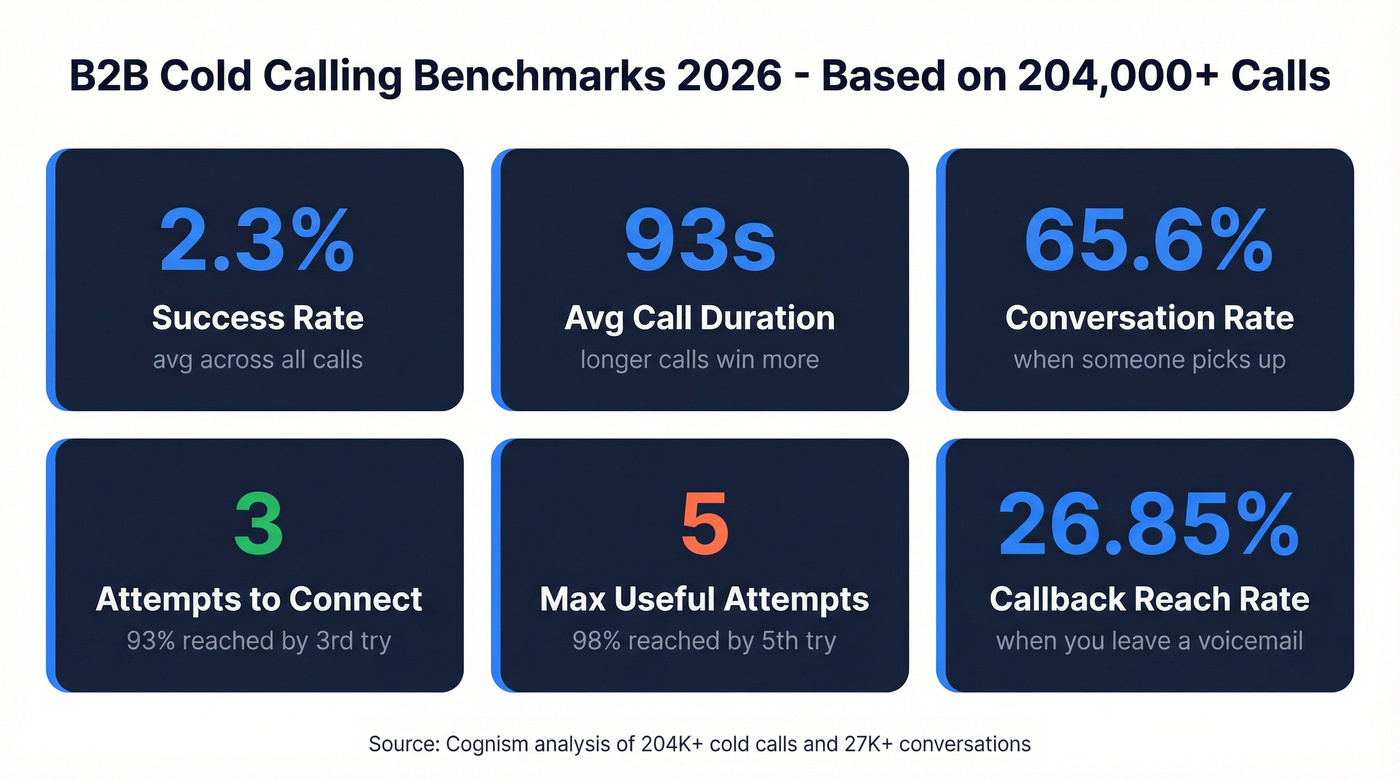
| Metric | Benchmark |
|---|---|
| Success rate | 2.3% |
| Call duration | 93 seconds |
| Conversation rate | 65.6% |
| Attempts to connect | 3 avg (93% by 3rd) |
| Attempts before diminishing returns | 5 (98% by 5th) |
| Callback reach rate | 26.85% |
Here's what those numbers mean in practice. If an SDR makes 60 dials, a 2.3% success rate works out to roughly 1-2 booked meetings. That's your baseline.
The 93-second average call duration is telling: once you're past the first minute, you're giving the conversation a real chance. Longer calls correlate with better outcomes because the prospect is actually engaging instead of looking for the exit.
When to Call
Timing isn't everything, but it's not nothing. ZoomInfo's analysis of 1.4M+ outbound calls gives us clear patterns:
| Day | Performance | Notes |
|---|---|---|
| Monday | Highest efficiency | 1.19% call-to-demo; 4.8% positive rate |
| Tuesday | Best overall | 44% of demos (with Wed) |
| Wednesday | Best overall | 44% of demos (with Tue) |
| Thursday | Strong | Solid across all metrics |
| Friday | Worst | Lowest on every metric |
For time of day, the data points to 10-11 AM in the prospect's local time as the sweet spot, with 2-3 PM as a strong second window. Avoid early morning, lunch, and end-of-day. People are either ramping up, eating, or mentally checked out.
The practical takeaway: stack your heaviest dial blocks on Tuesday through Thursday mornings. Use Monday for research and list prep. Write off Friday afternoons entirely.
The 3-Minute Call Script
The best cold calls follow a tight structure. You're not winging it, and you're not reading a script verbatim. You're running a framework with room to breathe.
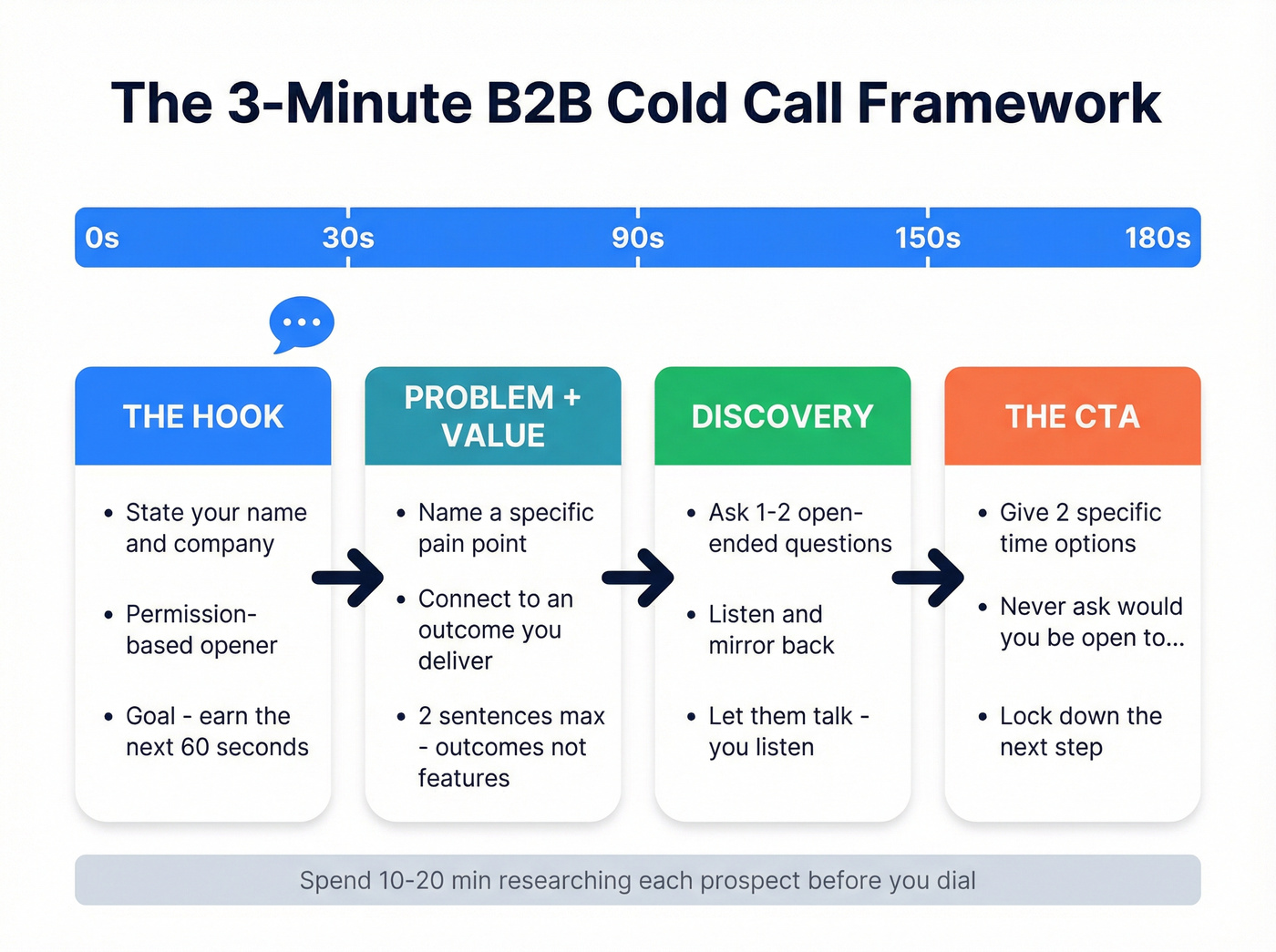
0-30 seconds: The Hook. State your name, company, and a permission-based opener. Your only goal is earning the next 60 seconds. "I know I'm catching you cold - mind if I take 30 seconds to tell you why I called?"
30-90 seconds: Problem and Value. Name a specific problem their role or company faces. Connect it to an outcome you deliver. Two sentences max - outcomes, not features. "We help VP Sales teams at Series B companies cut rep ramp time by 40%. The reason I'm calling is I noticed you just posted three new AE roles."
90-150 seconds: Discovery. Ask one or two open-ended questions. This is where you listen. "How are you handling onboarding for those new hires right now?" Let them talk. Mirror back what they say. (If you want a bigger bank of prompts, use these open-ended questions as a starting point.)
150-180 seconds: The CTA. Don't ask "would you be open to a meeting?" - give two specific time options. "I'd love to show you how this works. Does Thursday at 2 PM or Friday at 10 AM work better?"
Spend 10-20 minutes researching each prospect before you dial. That prep is what separates informed outreach from spam - use a pre-call research workflow so it stays consistent.
Openers That Work
Your opener determines whether you get 30 more seconds or a dial tone. Here are four approaches we've seen work across different markets.
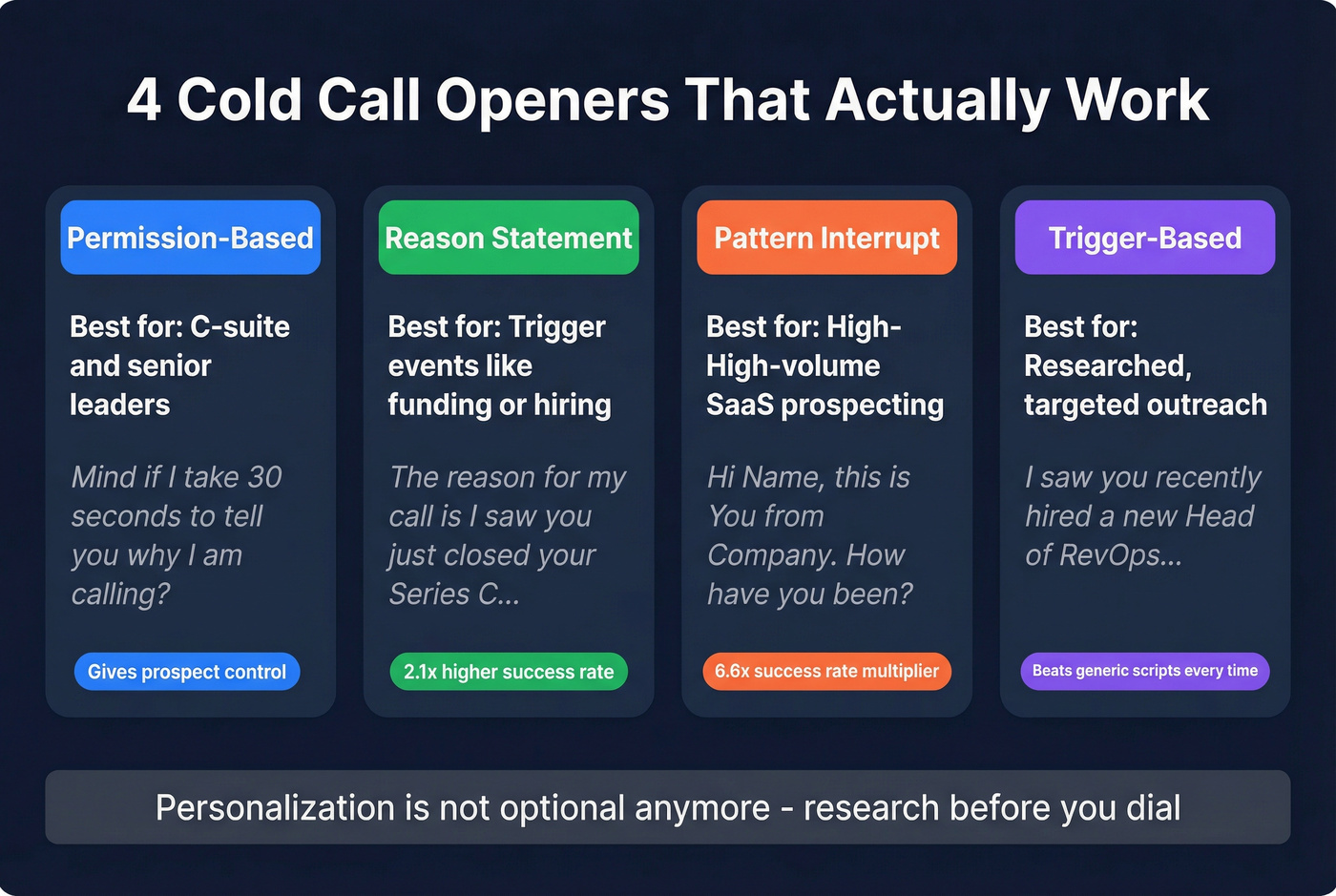
The Permission-Based Opener
Best for C-suite or senior leaders who value their time being respected. Less effective with mid-level managers who respond better to directness.
"Mind if I take 30 seconds to tell you why I'm calling? Then you can decide if it makes sense to continue."
This works because it gives the prospect control and disarms the "who is this and what do you want" reflex.
The Reason Statement
Only use this when you have a genuine trigger - a job posting, funding round, or tech change. Without substance, "the reason for my call" sounds hollow.
"The reason for my call is I saw you just closed your Series C, and companies at that stage usually hit a wall with [specific problem]."
This approach shows a 2.1x higher success rate over generic openers because it immediately signals relevance.
The Pattern Interrupt
I first heard about this from an SDR who was averaging 8 meetings per week. Instead of "How are you?", he'd open every call with:
"Hi [Name], this is [You] from [Company]. How have you been?"
The swap makes the prospect pause - it sounds like they should know you. This approach delivers a 6.6x success rate multiplier. It won't land in conservative industries where it feels too casual, but for high-volume SaaS prospecting, it's a high-ROI change you can make today.
The Trigger-Based Opener
Requires real research. Getting the trigger wrong is worse than not using one at all.
"I saw you recently hired a new Head of RevOps - I had a quick question about how you're handling [related challenge]."
In our experience, openers referencing something specific about the prospect's company beat generic scripts every time. Personalization isn't optional anymore. If you want to systematize this, build around signal-based outbound instead of generic lists.

Every dead number kills your momentum and burns dial time. Prospeo gives you 125M+ verified mobile numbers with a 30% pickup rate - that's 3x the industry average. At $0.10 per direct dial, you pay only when a number is found.
Stop calling switchboards. Start reaching decision-makers on their direct line.
Handling Objections
First, separate objections from obstructions. An objection is a real reason they won't buy - budget, authority, need, timing. An obstruction is a reflex excuse to get off the phone. (If you want a clean taxonomy, see these types of objections.)
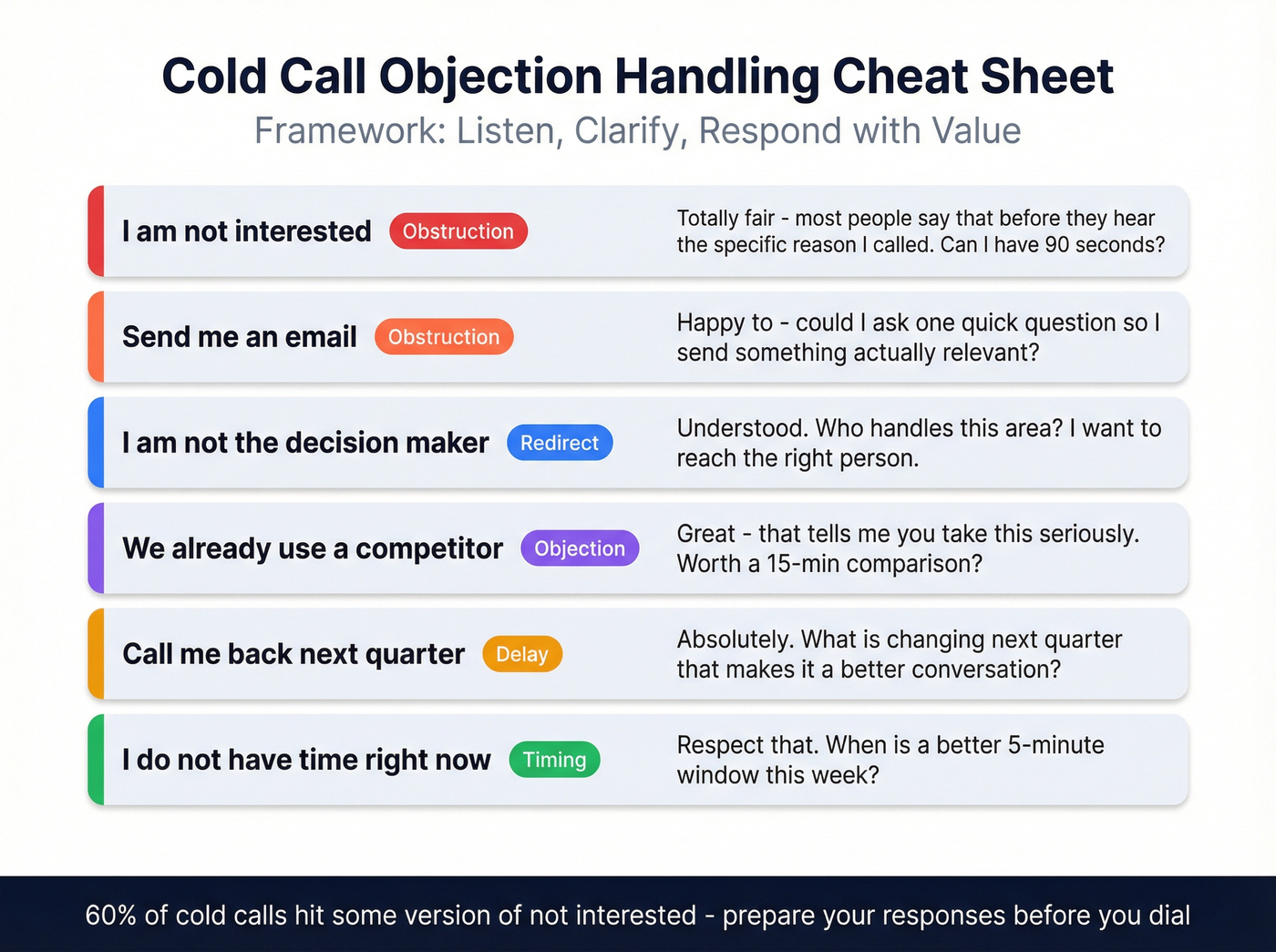
"I don't have time" is an obstruction. "We just signed a 3-year contract with your competitor" is an objection. Your response should differ.
The framework: Listen, Clarify, Respond with value. Don't interrupt. Don't argue. Acknowledge, then redirect. About 60% of cold calls hit some version of "not interested" - it's the default obstruction, not a real objection. Building objection handling into your call script ahead of time keeps you from freezing in the moment.
Here are the six you'll hear most:
"I'm not interested." "Totally fair - most people say that before they hear the specific reason I called. If I could show you how to [specific benefit], would you give me 90 seconds?"
"Send me an email." "Happy to. Before I do - could I ask one quick question so I send you something actually relevant instead of a generic pitch?"
"I'm not the decision maker." "Understood. Who handles [area] decisions? I want to make sure I'm reaching the right person."
"We already use [competitor]." "Great - that tells me you take [problem area] seriously. Most teams using [competitor] are curious about [specific differentiator]. Worth a 15-minute comparison?"
"Call me back next quarter." "Absolutely. Before I set that reminder - what's changing next quarter that would make this a better conversation?"
"I don't have time right now." "Respect that. When's a better 5-minute window this week?"
Mistakes That Kill Your Numbers
Across SDR teams we've coached and worked alongside, the same patterns keep showing up on underperforming teams:
Giving up after one attempt. 93% of conversations happen by the 3rd call, and 98% by the 5th. Track every dial as data, not as a rejection. (If you're building a repeatable system, use a cold call checklist so reps don’t skip steps.)
Pitching in the first 30 seconds. Open with context and a question, not a feature dump. Earn the right to pitch.
Reading the script word-for-word. Use your script as a framework, not a teleprompter. Prospects can hear when you're reading - and they check out immediately.
Mistaking politeness for interest. "That sounds interesting" isn't a buying signal. Qualify with "What specifically stood out?" or "Are you actively exploring this?"
Never reviewing recorded calls. If your dialer records calls (and it should), review at least 3 per week with your manager or a peer. The fastest path to better numbers is hearing what you actually sound like versus what you think you sound like. A lightweight cold call coaching cadence makes this stick.
Talking more than listening. If you're speaking more than 40% of the call, you're pitching, not selling. Ask open-ended questions and mirror their language back.
The Data Problem Nobody Talks About
Here's the thing: most "cold calling tips" content is useless because it ignores the biggest variable. Your scripts don't matter if your numbers are wrong.
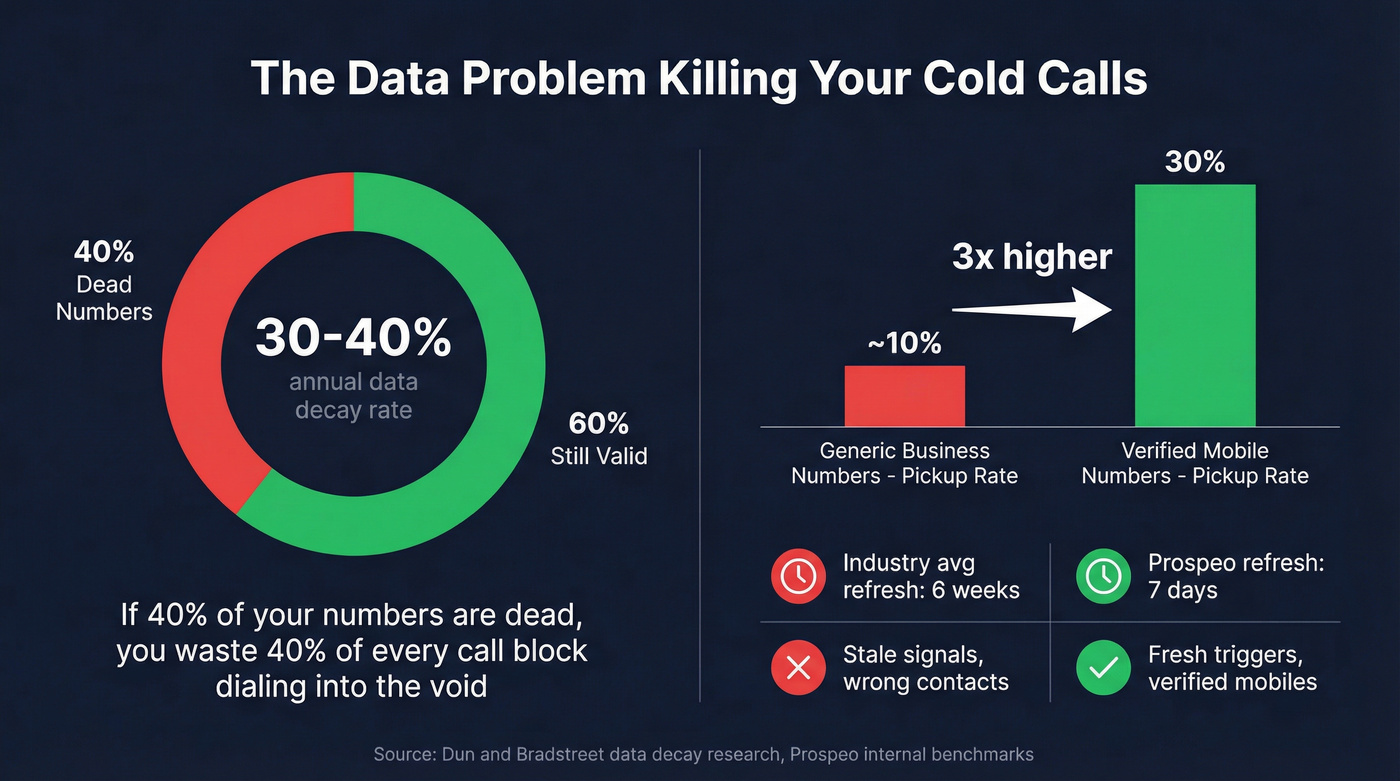
B2B contact data decays at 30-40% annually. People change jobs, companies switch phone systems, direct lines get reassigned. If 40% of your numbers are dead, you're wasting 40% of your call block dialing into the void. That's not a script problem or a mindset problem - it's a data problem. Even the best opener in the world won't help if nobody picks up. (For the deeper breakdown and KPIs, see contact data decay.)
The difference between calling generic business numbers and calling verified mobiles is massive. Prospeo's 125M+ verified mobile numbers deliver a 30% pickup rate on a 7-day refresh cycle, compared to the 6-week industry average. At 10 credits per mobile number, the cost is a fraction of the hours your SDRs burn calling dead lines. Meritt tripled their connect rate to 20-25% after switching, and GreyScout saw pipeline jump 140% while cutting rep ramp time in half.
Trigger-based openers only work when your data is fresh. Prospeo refreshes every 7 days - not 6 weeks - so your job change, funding, and hiring signals are still relevant when you pick up the phone.
Dial with data that's days old, not months. Build your list free.
Tools for B2B Cold Calling
You need three categories covered: data, dialer, and CRM. Here's what's worth your time. If you're rebuilding end-to-end, start with a modern B2B sales stack blueprint.
| Category | Tool | Starting Price | Best For |
|---|---|---|---|
| Data | Prospeo | Free tier; ~$0.01/email | Verified mobiles + emails |
| Dialer | Orum | ~$100-200+/user/mo | Parallel dialing at scale |
| Dialer | CloudTalk | $25/user/mo | Mid-market teams |
| Dialer | RingCentral | $20/user/mo | Budget-friendly option |
| CRM | HubSpot | Free tier; paid from $20/mo | SMB and mid-market |
| CRM | Salesforce | ~$25-300/user/mo | Enterprise |
Orum is the go-to parallel dialer for teams doing serious volume. It dials multiple numbers simultaneously and connects reps only when a human picks up, with voicemail drop to save time on unanswered calls. Enterprise pricing runs around $100-200+/user/month, but the productivity gain is real if you're making 100+ dials daily. Skip it if your team is under 5 reps - the ROI doesn't pencil out at that scale.
CloudTalk hits the sweet spot for most teams. Plans start at $25/user/month with call recording, CRM integrations, voicemail drop, and local presence dialing. The Expert tier at $50/month adds predictive dialing.
RingCentral and the CRMs are table stakes - pick whatever your team already uses. Don't overthink the CRM choice; overthink the data feeding it. If you’re seeing duplicates and stale fields, prioritize CRM hygiene before you add more tools.
Stay Legal
B2B cold calling is legal, but there are lines you can't cross. Run through this checklist before your first dial block:
- Calling hours: 8 AM - 9 PM in the recipient's local time zone.
- Caller ID: Must be accurate. Spoofing is prohibited under federal law.
- National DNC registry: Scrub your list against it before campaigns.
- Internal DNC list: Maintain one. Process opt-outs immediately.
- Auto-dialers to cell phones: Require prior express written consent under TCPA. Live agent calls to business lines are less restricted, but mobile numbers used for work are treated as consumer lines.
- Call recording: Some states require two-party consent. Know which ones your prospects are in.
- Penalties: $500-$1,500 per TCPA violation. Up to $43,792 per DNC infraction. These aren't theoretical - they're enforced.
Multi-Channel Follow-Up
A b2b cold call works better as part of a sequence, not as a standalone event. The most effective cadence pairs phone with email and social touches across 5-8 touchpoints. The 93%-by-3rd-attempt stat applies to calls specifically, but email and social extend your window for prospects who don't pick up.
A proven sequence: call on Day 1, follow up with a personalized email on Day 2 referencing the voicemail you left, add a social touch on Day 3, then call again on Day 5. Repeat the cycle. Most prospects need multiple exposures across channels before they engage - the consensus on r/sales is that reps who stick to phone-only are leaving meetings on the table. (If you want templates you can paste into your sequence, use these outreach email templates.)
One critical detail: verify your email list before launching follow-up sequences. A bounced email after a cold call doesn't just waste a touch - it damages your sender reputation for every future campaign. Use an email ID validator to keep bounce rates down.
FAQ
Is B2B cold calling legal?
Yes - live B2B cold calls to business lines are legal in the US without prior consent. You must comply with TCPA rules: call only during permitted hours (8 AM-9 PM local), display accurate caller ID, and scrub against the National DNC registry. Auto-dialers to cell phones require prior express written consent. Penalties reach $43,792 per DNC violation.
What's a good connect rate?
Average connect rates run in the single digits for many outbound teams. Top teams using verified mobile numbers hit 15-25%. The biggest variable isn't your script - it's data quality. Meritt reported connect rates of 20-25% after switching to verified mobiles, compared to single digits when calling switchboards or outdated direct lines.
How many cold calls should an SDR make per day?
Most SDR teams target 50+ dials per day and average about 4.4 quality conversations. Focus on conversation quality over dial volume - 50 calls to verified mobiles outperform 100 calls to stale numbers every time. Track conversations and meetings booked, not raw dials.
Do I need a different script for B2B versus B2C?
Yes. A B2B call script focuses on business outcomes - revenue impact, efficiency gains, competitive advantage - rather than personal benefits. B2B calls also tend to involve multiple stakeholders, so your script should include questions that uncover the decision-making process and identify other people involved in the buying decision.
How do I build a call script from scratch?
Start with the 3-minute structure outlined above: hook, problem/value, discovery, and CTA. Write out your opening line, two to three objection responses, and a closing ask. Then practice it aloud until it sounds conversational, not rehearsed. The best scripts evolve - review your recorded calls weekly and update the language based on what actually gets prospects talking.