Enterprise Cold Email Outreach: An Operating System, Not a Copywriting Exercise
You got budget to go upmarket. You hired two enterprise AEs, spun up dedicated domains, and launched sequences against Fortune 2000 accounts. Within three weeks, your primary domain's reputation tanked, your reply rate sat at 1.2%, and the VP you actually reached forwarded your email to procurement - where the deal went to die.
This isn't a copywriting problem. It's an infrastructure and governance failure, and it's the default outcome when teams treat enterprise cold email outreach like scaled SMB prospecting.
What You Need Before Anything Else
Before you read another word about subject lines or personalization tokens, internalize three things:
- Fix infrastructure first - authentication, dedicated subdomains, sending ramp, monitoring thresholds. Not copy. (If you need the full checklist, start with authentication and email sending infrastructure.)
- Build verified lists of 1-2 contacts per account, then deliberately multi-thread to 3+ roles across the buying committee.
- Run ABM on 20-50 accounts with deep research - not sequences blasted to 5,000 contacts. (Use an account-based prospecting approach, not volume.)
The hidden bottleneck behind all three? Data quality. Bad emails torch your sender reputation before your copy ever gets read.
Why Enterprise Outbound Fails
Across 16.5 million cold emails analyzed by Belkins, the average reply rate dropped to 5.8% - down from 6.8% the year before. That's the broad B2B number. For enterprise accounts specifically, expect 1-5% positive replies with standard targeting.
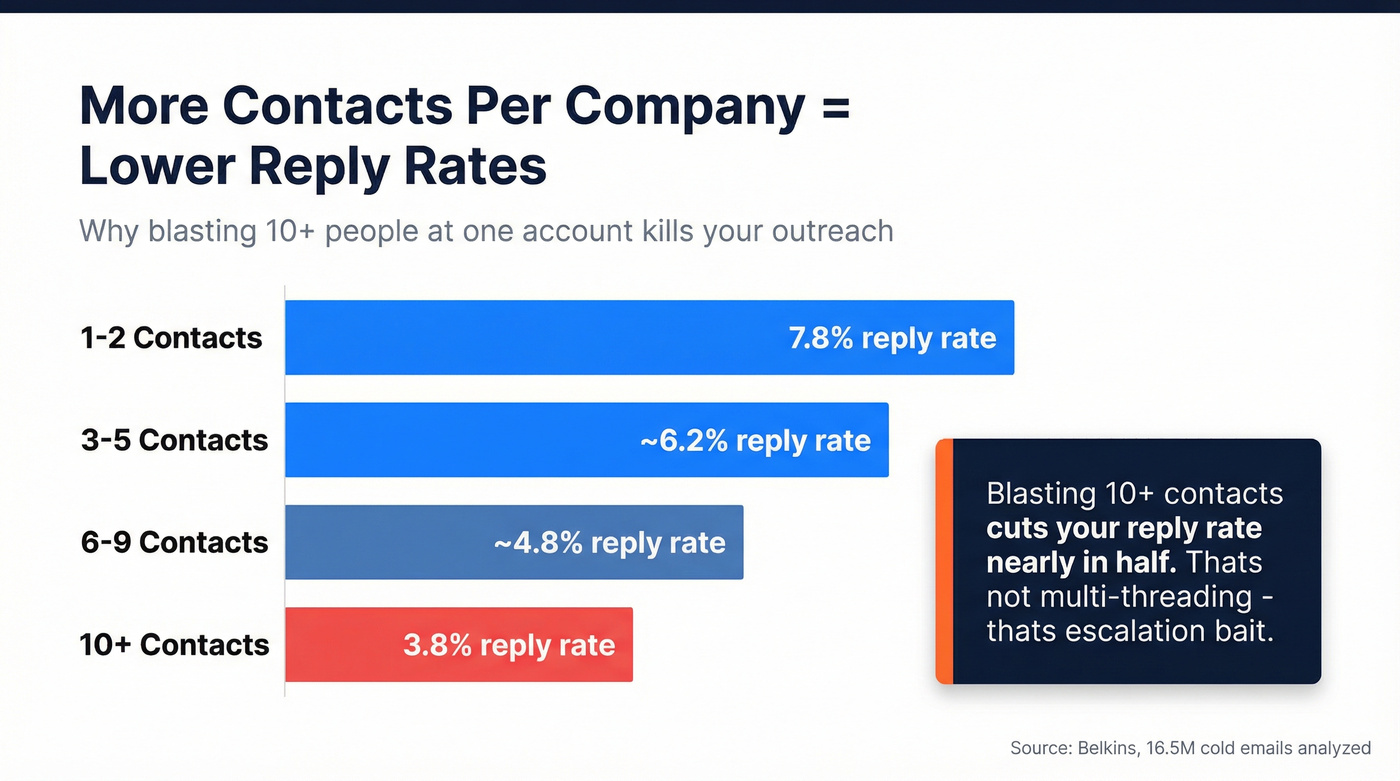
Most teams respond to declining reply rates by doing more: more follow-ups, more contacts per account, more volume. That's exactly backwards. The same dataset shows that blasting 10+ contacts at a single company cuts your reply rate nearly in half - from 7.8% with 1-2 contacts down to 3.8%. You're not multi-threading at that point. You're triggering internal escalation and training the company's security gateway to flag your domain.
The copy matters, but only after the plumbing works.
Enterprise Deliverability SOP
Most guides skip bounce thresholds and spam complaint ceilings. That's exactly why teams torch domains and blame the copy. (If you want a deeper baseline, use an email deliverability checklist and a full email deliverability guide.)
Authentication Checklist
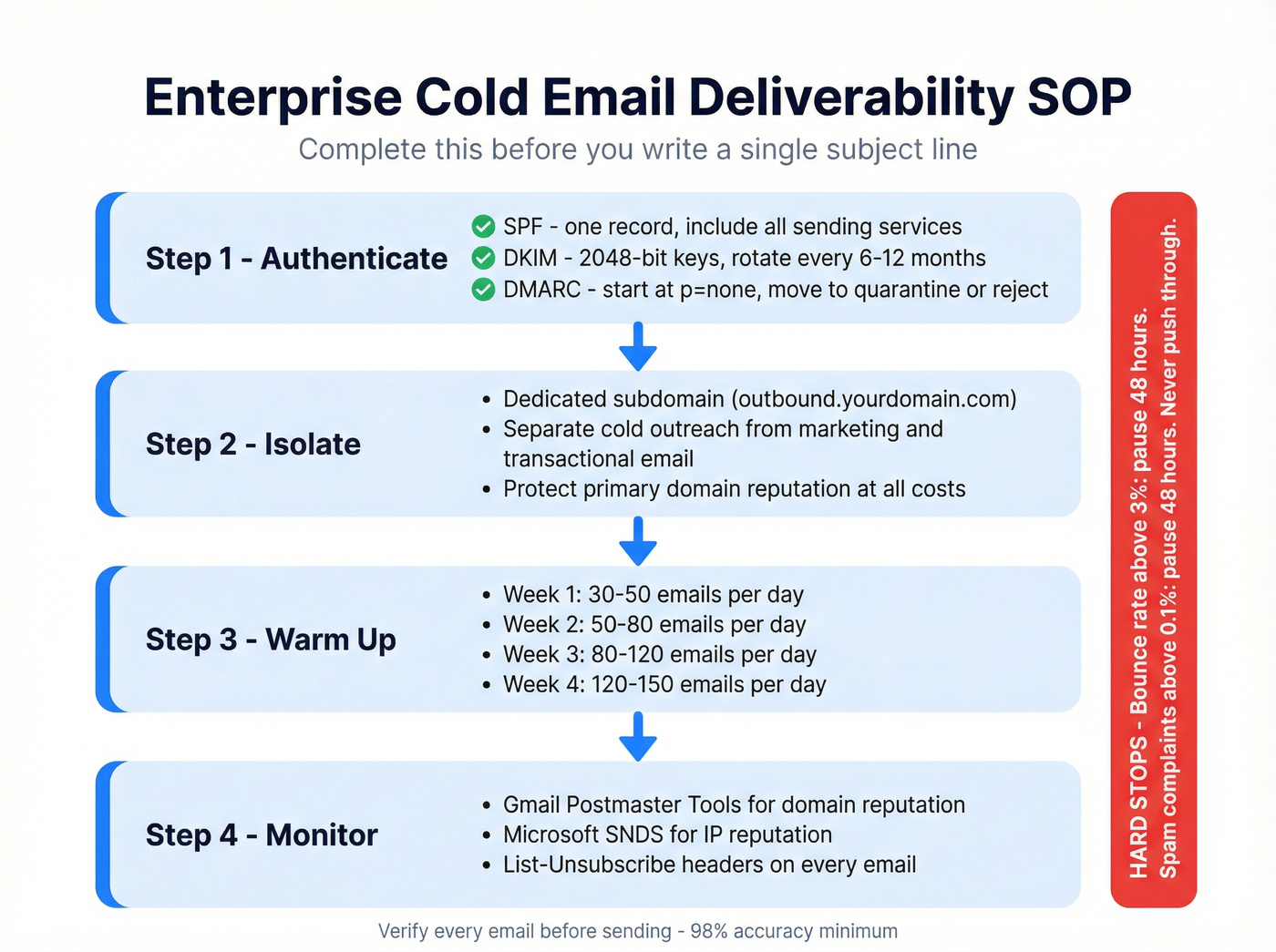
Every enterprise outbound domain needs three layers of authentication before you send a single email:
- SPF: Publish one record - not multiple, since multiple SPF records break validation. Include every service that sends on your behalf.
- DKIM: Use 2048-bit keys minimum. Rotate every 6-12 months, not just after a security incident. Right now, 47.7% of senders only rotate DKIM keys after a security issue - that's a risk you don't need.
- DMARC: Start at
p=nonewithruareporting so you can see who's sending as your domain. Move toquarantineorrejectonce you're confident in your authentication alignment.
The adoption numbers tell the story: 53.8% of senders use DMARC, up from 42.6% in 2023. Among high-volume senders at 100k+ emails per month, that jumps to 71%. But only 37% enforce DMARC with reject or quarantine policies. If you're sending cold email to enterprise accounts without DMARC enforcement, you're leaving your domain reputation exposed to spoofing - and gateways like Proofpoint and Mimecast check for this.
Dedicated Subdomains
Send from a dedicated subdomain like outbound.yourdomain.com so cold outreach reputation issues never touch your primary domain. Non-negotiable. If your cold campaigns trigger a blocklist, your marketing emails, transactional emails, and support communications keep flowing. (If you’re deciding between setups, see dedicated IP vs shared IP.)
We've seen teams lose their entire email infrastructure because they ran outbound off their primary domain. Don't be that team.
Warm-Up Ramp Per Mailbox
Don't launch a new mailbox at full volume. Enterprise gateways enforce stricter reputation and authentication checks than consumer inboxes, and a sudden spike in sending volume from a fresh domain is a red flag.
Here's the ramp we use:
| Week | Daily Volume | Metric to Watch |
|---|---|---|
| 1 | 30-50 | Bounce rate <3% |
| 2 | 50-80 | Spam complaints <0.1% |
| 3 | 80-120 | Domain reputation via Postmaster Tools |
| 4 | 120-150 | All metrics stable |
Guardrails: If bounce exceeds 3% or spam complaints exceed 0.1% at any point, pause for 48-72 hours. Don't push through it. A damaged domain reputation takes weeks to recover. A 48-hour pause takes 48 hours.
Monitoring and Compliance Headers
Set up Gmail Postmaster Tools for domain and IP reputation and spam rates, and Microsoft SNDS for IP reputation on dedicated IPs, before you start sending. These aren't optional - they're your early warning system.
On the header side, add List-Unsubscribe and List-Unsubscribe-Post: List-Unsubscribe=One-Click to every outbound email. Honor unsubscribes within 2 business days - not the legal maximum of 10. Maintain a global suppression list that syncs across every sending platform and mailbox your team uses.
Here's the thing: bad data is the #1 deliverability killer. If 5% of your list bounces, you've already blown past the 3% threshold and your domain reputation starts degrading with every send. Prospeo's 5-step verification process - catch-all handling, spam-trap removal, honeypot filtering - keeps email accuracy at 98%, which is the difference between a clean ramp and a domain you have to retire after two weeks. Verify before you send. Every time. (If you’re evaluating vendors, compare email ID validators and email checker tools.)
Multi-Threading the Buying Committee
The 3-Role Minimum
Multi-threading doesn't mean emailing everyone with a director title at the target company. It means maintaining active, distinct conversations with at least three roles: the economic buyer who controls budget, the technical evaluator who vets your solution, and the end user or champion who feels the pain daily. (If you want the definition and benchmarks, see what multithreading in sales actually means.)
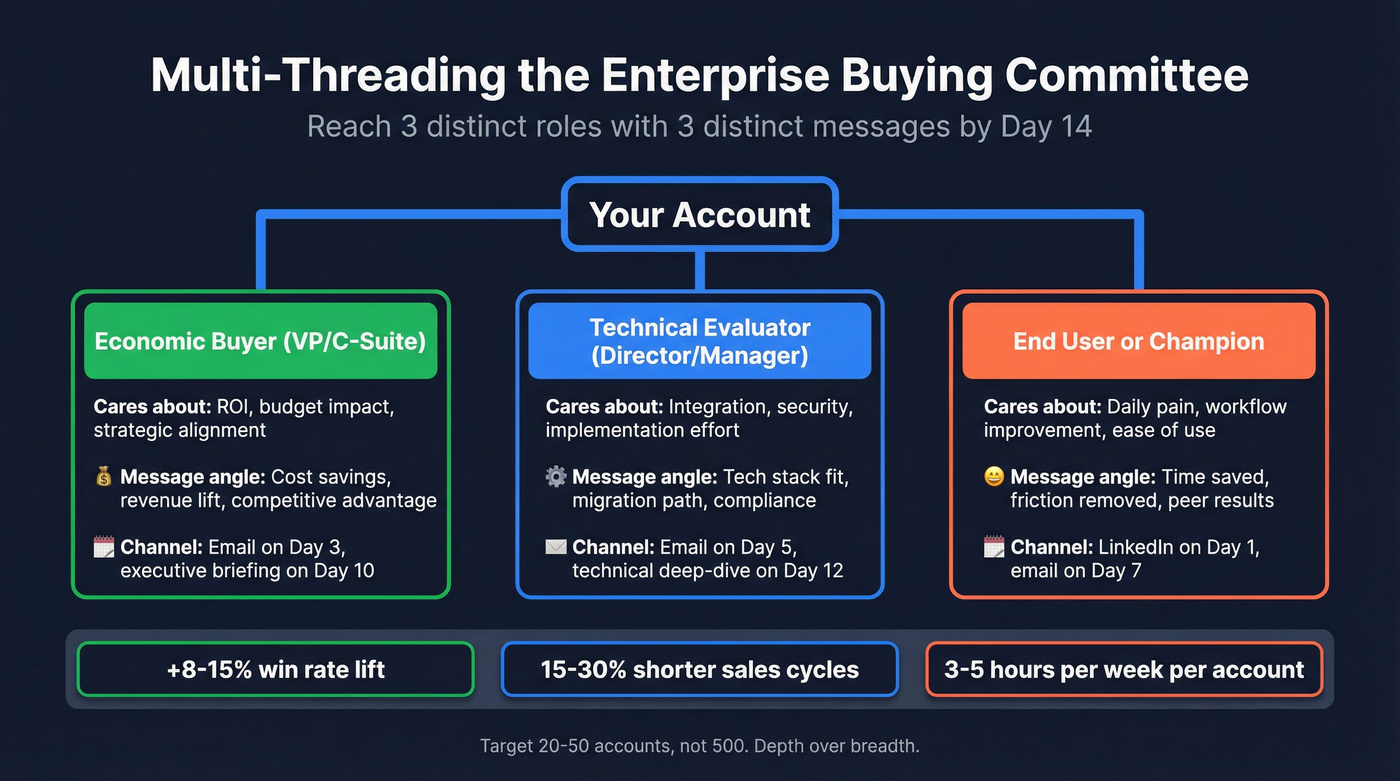
Buying committees average 6-10 people. Some enterprise deals involve 22 stakeholders across procurement, legal, IT security, and business units. You don't need to reach all of them - you need to reach the right three, with messages tailored to what each one actually cares about. Teams that consistently multi-thread see win rates climb 8-15 percentage points and sales cycles shorten by 15-30%.
Operational targets: aim for first value delivery to all three roles by day 14. Track "threads per account" as a KPI - target three or more active contacts. The time investment is real, roughly 3-5 hours per week per account to maintain quality threads. That's why you run this on 20-50 accounts, not 500.
Why "Blast Everyone" Backfires
Blasting 10+ people at the same company isn't multi-threading. It's escalation bait.
The data backs this up - contacting 1-2 people per company yields a 7.8% reply rate, while contacting 10+ drops that to 3.8%. The reason is obvious once you think about it from the buyer's side. When three people in the same department get the same cold email on the same day, they forward it to each other with a "did you get this too?" message. Now you're not a potential vendor - you're a nuisance. Enterprise security teams flag patterns like this.
You need verified emails for the right 3 people, not guessed emails for 10. Prospeo's 30+ search filters - job title, department, seniority, company size - let you pinpoint economic buyers, technical evaluators, and end users at the same company with 98% email accuracy so your first touch actually lands.
Coordinating Across Channels
Email alone rarely opens an enterprise deal. The strongest ABM sequences layer channels deliberately: start with a touch on a professional network on Day 1, send a tailored email to the economic buyer on Day 3, then reach the executive sponsor with a separate email on Day 10. Each touchpoint references a different angle - the economic buyer hears about ROI, the sponsor hears about strategic alignment. This isn't automation. It's orchestration, and it's why ABM outperforms spray-and-pray by every metric that matters. (For a broader system, see AI multi-channel prospecting.)

You just read why bounce rates above 3% torch your sender reputation. Prospeo's 5-step verification - catch-all handling, spam-trap removal, honeypot filtering - delivers 98% email accuracy. That's the difference between a clean 4-week ramp and retiring a domain after two weeks.
Verify every enterprise contact before it touches your sending infrastructure.
Account Selection and Research
If you can't spend 30 minutes researching an account, it's not an enterprise target - it's a spray-and-pray victim.
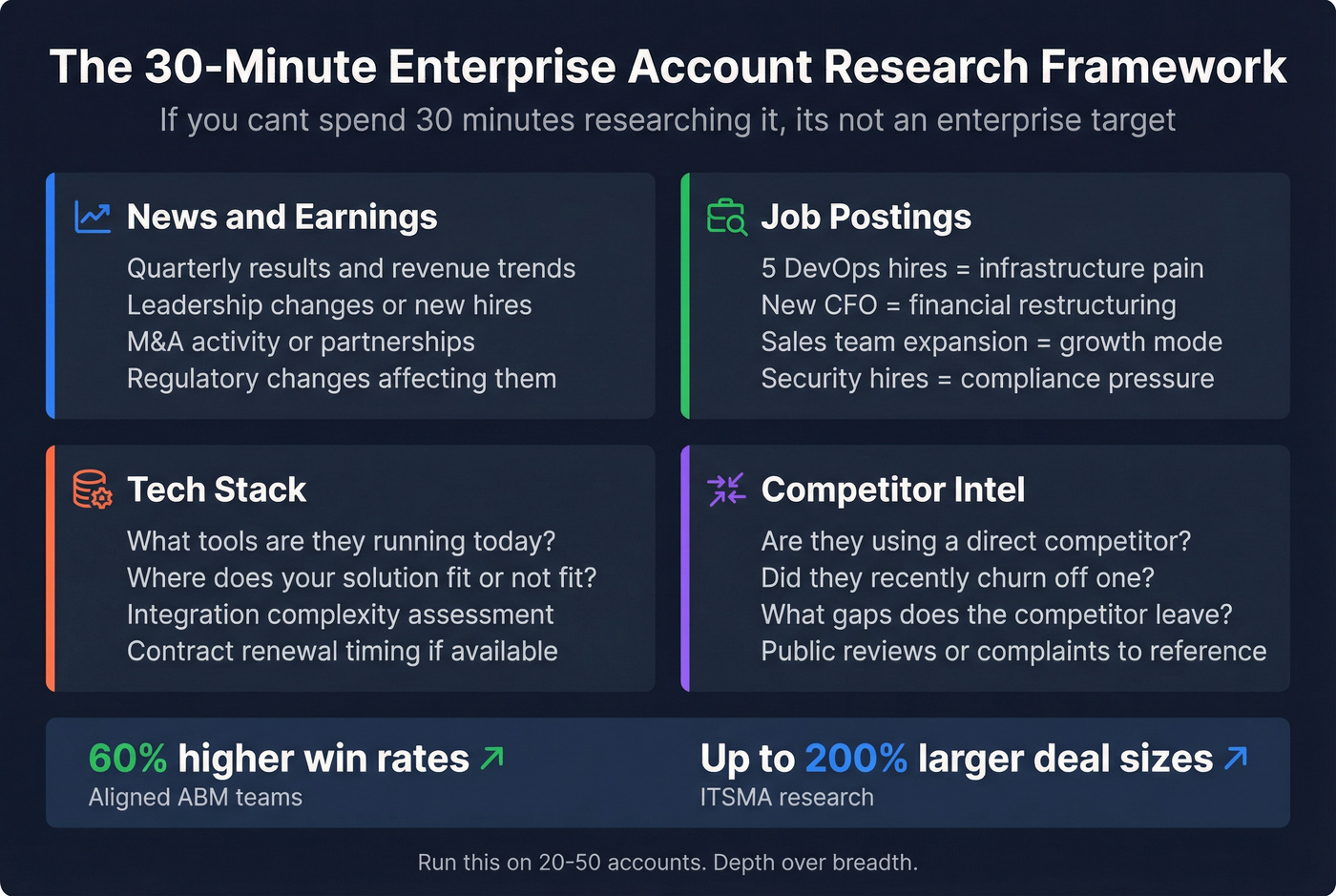
ABM is the only scalable strategy for cold email aimed at enterprise clients, and it starts with account selection, not contact selection. Start with 20-50 accounts. Depth over breadth. For each active account, invest 30-60 minutes on research inputs:
- News and earnings: Recent quarterly results, leadership changes, M&A activity
- Job postings: Hiring signals reveal priorities - a company posting for 5 DevOps engineers has different pain than one hiring a new CFO
- Tech stack: What they're running today tells you where your solution fits or doesn't
- Competitor angles: Are they using a competitor? Did they just churn off one?
Aligned ABM teams report 60% higher win rates, and ITSMA research shows deal sizes up to 200% larger - because they're showing up with context, not just a value prop. In our experience, the research phase is where most teams cut corners and where the best teams pull ahead. (If you need a structure, use an ABM account plan template.)
Cadence Rules and Benchmarks
This is where most enterprise teams over-invest. The instinct is to add more follow-ups, but the data shows diminishing - and eventually negative - returns.
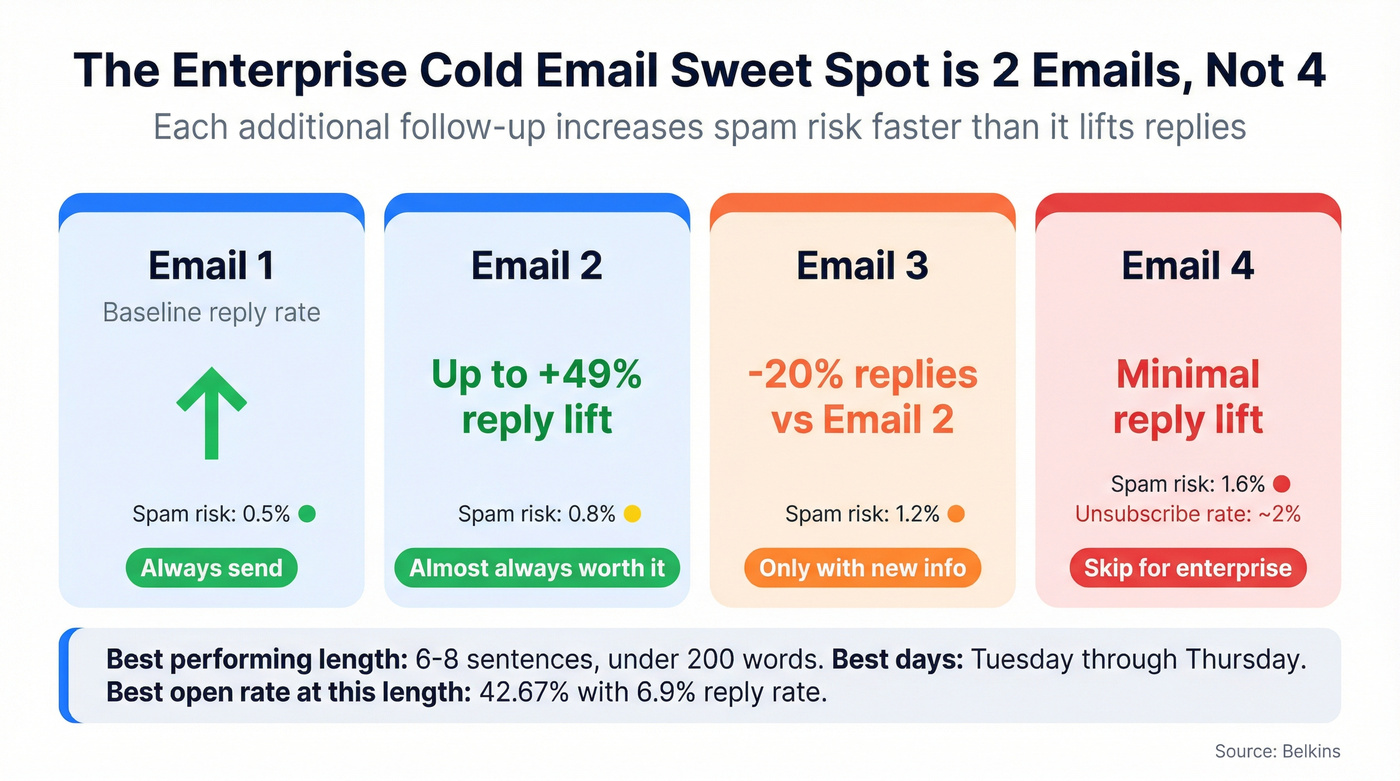
| Email # | Reply Lift | Spam Risk | Recommendation |
|---|---|---|---|
| 1 (Initial) | Baseline | 0.5% | Always send |
| 2 (Follow-up) | Up to +49% | ~0.8% | Almost always worth it |
| 3 | -20% vs email 2 | ~1.2% | Only with new info |
| 4 | Minimal | ~1.6% | Skip for enterprise |
The first follow-up can lift replies by up to 49% in top-performing campaigns. That's significant. But the third email yields 20% fewer responses than the second, and by email four, spam rates climb to 1.6% and unsubscribe rates hit ~2%. For enterprise prospects - where a single spam complaint can get your domain blocklisted at the company level - two total emails is the sweet spot.
In our experience, the third follow-up is where enterprise deals go to die. Not because the prospect isn't interested, but because their security team flags the pattern.
Best performing email length: 6-8 sentences, under 200 words. That's associated with a 42.67% open rate and 6.9% reply rate. Tuesday through Thursday mornings consistently outperform other send windows for enterprise prospects - avoid Mondays and Fridays. A/B test your subject lines and opening sentences, but don't A/B test your way out of bad infrastructure. (If you want more tactical levers, use these cold email tactics.)
Conservative enterprise expectation: 1-5% positive reply rate with broad targeting, or 5-10% with intent-triggered ABM on tight segments.
Skip this if your average deal is under $25k. The research investment per account, the multi-threading overhead, the governance requirements - none of it pencils out unless the contract size justifies 3-5 hours per week per account. Run a tighter SMB motion instead and save enterprise ABM for the accounts that actually move the needle.
Governance at Scale
A pilot works at 20-30 accounts with 3-4 people. Then someone says "let's scale this across all regions and product lines," and everything breaks.
I've watched two reps from different product lines email the same CTO at a Fortune 500 account on the same day - with contradictory value props. That's not a messaging problem. It's a governance failure. Product-line collisions, regional fragmentation, and uneven team capabilities turn a working pilot into a reputation-damaging mess. The fix is a governance model that centralizes some things and decentralizes others.
Centralize account selection criteria, ownership rules, brand guidelines, tech platforms, and measurement methodology. These can't vary by region or team - inconsistency here creates collisions and compliance risk.
Decentralize account selection within the framework, content customization, channel mix, execution timing, and regional adaptations. Reps closest to the market should own the tactical decisions.
Build modular content libraries - email frameworks by persona and industry, modular decks, value prop libraries - so reps can customize without starting from scratch. Enterprise deals can be eight-figure contracts spanning 18-24 months. The organizational design of your outbound program matters as much as the messaging.
Compliance Checklist
CAN-SPAM penalties reach up to $53,088 per email. Compliance isn't optional - it's the cost of doing business in enterprise outbound. The minimum:
- Truthful headers: Your "From" name and email must be accurate
- Non-deceptive subject lines: No bait-and-switch
- Physical mailing address: Required in every email
- Working unsubscribe: Functional and easy to find
- Honor opt-outs within 10 business days - enterprise SLA: 2 business days
- Global suppression list: Synced across all sending platforms
For international targets, CASL in Canada requires express or implied consent. Germany and the UAE require explicit prior consent - cold emailing without it is effectively illegal. If you're running enterprise outbound across multiple jurisdictions, get legal review on your compliance posture before you scale. The FTC's largest CAN-SPAM penalty hit $2.95M. That's not theoretical risk.
Templates That Actually Work
These only work if you've done the account research and verified your contacts. Let's be honest about what doesn't work first - the kind of email that gets forwarded to IT security with a "block this domain" note:
"Hi [First Name], I help companies like yours drive revenue. We work with industry leaders to deliver best-in-class solutions. I'd love to schedule 15 minutes to show you how we can help. Are you free Tuesday?"
No research. No specificity. No reason for a VP to reply. Now here's what works.
Economic Buyer
Subject: [Company]'s Q3 expansion + [your category]
Hi [First Name],
Saw [Company] is expanding into [market/region] based on [specific trigger - earnings call, press release, job postings]. That kind of growth usually surfaces [specific pain your product solves] - it's the pattern we see with companies at your stage.
[One sentence on the outcome you deliver, with a specific metric if possible.]
Would it make sense to spend 20 minutes on how [similar company] handled this? Happy to share the specifics either way.
[Your name]
Lead with their business context, not your product. The economic buyer cares about ROI and strategic alignment.
Technical Evaluator
Subject: Quick question on [Company]'s [tech stack element]
Hi [First Name],
Your team's running [specific technology from job postings or technographic data]. We integrate with [that technology] and typically see [specific technical outcome - reduced implementation time, fewer API calls, better uptime].
I'd rather have a technical conversation than a demo - would 15 minutes with our solutions engineer be useful? No pitch, just architecture.
[Your name]
Technical evaluators want to know if your solution fits their stack and won't create more work. Don't sell - solve.
Champion / End User
Subject: [Specific workflow pain] at [Company]
Hi [First Name],
If you're the one dealing with [specific day-to-day pain - manual reporting, broken handoffs, slow provisioning], this might be relevant. [Similar role at similar company] was spending [X hours/week] on this before switching to [your solution].
Not trying to sell you anything - just flagging it because the pain is usually invisible to leadership until someone raises it. Happy to share what we've seen work.
[Your name]
The champion feels the pain daily but often doesn't have budget authority. Position yourself as an ally who can help them build the internal case.
Multi-threading 3+ roles per account means you need verified emails for the economic buyer, the technical evaluator, and the champion - not guesses. Prospeo gives you 300M+ profiles with 30+ filters including job title, department headcount, and buyer intent across 15,000 topics. Build precise buying committee lists at $0.01 per email.
Map the entire buying committee with data that actually connects.
FAQ
What reply rate should I expect?
Across 16.5 million cold emails analyzed, the average reply rate was 5.8%. For enterprise accounts, expect 1-5% positive replies with broad targeting. Intent-triggered ABM on tight segments of 20-50 accounts can push that to 5-10%. Anything above 10% is exceptional.
How many follow-ups work?
One follow-up is almost always worth it - it can lift replies by up to 49%. Beyond that, returns drop sharply and spam risk climbs to 1.6% by email four. Two total emails is the sweet spot for enterprise. Add a third only with genuinely new information.
How do I avoid spam filters at large companies?
Authenticate with SPF, DKIM, and DMARC. Send from a dedicated subdomain. Ramp volume over 4 weeks. Keep bounce rate under 3% and spam complaints under 0.1%. Verify every email before sending - tools like Prospeo, NeverBounce, or ZeroBounce prevent the bounces that trigger gateway flags at Proofpoint and Mimecast.
What does a full enterprise outbound stack cost?
Budget $5k-$30k/year depending on team size. Core components: a verified data source (Prospeo starts free with 75 credits/month, roughly $0.01/email at scale), a sending platform with throttling like Smartlead (~$39/mo) or Instantly (~$30/mo), and monitoring via Gmail Postmaster Tools (free). Intent data and enrichment add cost but dramatically improve targeting precision.