Sales Intelligence vs CRM: What to Buy First (2026)
It's 9:14 AM. Your SDR has spent 45 minutes researching a single account - pulling up the company blog, scanning press releases, guessing an email format. She sends the email. It bounces. That's not a productivity problem; it's a tool-stack problem. Reps spend roughly 28-30% of their time actually selling. The rest disappears into research, data entry, and chasing contacts that don't exist anymore.
Most of this waste traces back to buying the wrong tool first.
The Quick Answer
- Your team prospects outbound and your CRM contacts are stale? You need sales intelligence first.
- You already have good leads but lose track of deals? You need a CRM first.
The sales intelligence market is hitting $4.99B in 2026, growing at 12.89% CAGR through 2031. This isn't a niche category anymore - it's table stakes for outbound teams. Pay-as-you-go models are the fastest-growing segment at 18.51% CAGR, which tells you exactly where the market is heading.
What Is Sales Intelligence?
Sales intelligence is everything that happens before a contact enters your pipeline. It's external data - pulled from the web, intent signals, technographic sources, and verified databases - designed to help you find the right people and reach them with accurate information.
Think of it in three buckets:
Data enrichment and contact intelligence covers the basics: verified emails, mobile numbers, firmographic data, org charts. This is the "who to contact" layer. Tools like Prospeo, ZoomInfo, and Apollo live here.
Intent and warm-signal intelligence tells you who's actively researching solutions like yours. Bombora signals, G2 buyer intent, website visitor tracking - this is the "who's showing interest" layer. 6sense and Bombora are the big names.
Conversation intelligence analyzes what buyers actually say on calls and in meetings. Gong and Chorus own this space.
Here's the thing most people miss: B2B contact data decays roughly 30% annually. People change jobs, companies rebrand, phone numbers rotate. Without a sales intelligence layer refreshing that data, your CRM becomes a graveyard of outdated records within a year.
What Is a CRM?
A CRM is your internal system of record. It tracks what's already happening - deal stages, rep activities, customer interactions, revenue forecasts. Salesforce, HubSpot, Pipedrive. You know the category.
CRMs handle pipeline tracking and deal management exceptionally well. They're the backbone of reporting, forecasting, and territory management. What they don't do is find new prospects, verify that a contact's email still works, or tell you which accounts are in-market right now. A CRM records history. It doesn't create opportunity.
That distinction matters because 70% of customers expect reps to know their purchase and issue history when they engage. A CRM delivers that context - but it can't help you reach those customers in the first place if the data feeding it is garbage.
Side-by-Side Comparison
| Dimension | Sales Intelligence | CRM |
|---|---|---|
| Purpose | Find & qualify prospects | Manage deals & relationships |
| Data source | External (web, intent, tech) | Internal (rep activity, stages) |
| Funnel stage | Top-of-funnel / pre-pipeline | Mid-to-bottom funnel |
| AI use cases | Scoring, intent, enrichment | Forecasting, logging, next-action |
| Cost range | Free-$40k+/year | Free-$350/user/month |
| Example tools | Prospeo, ZoomInfo, Apollo | Salesforce, HubSpot, Pipedrive |
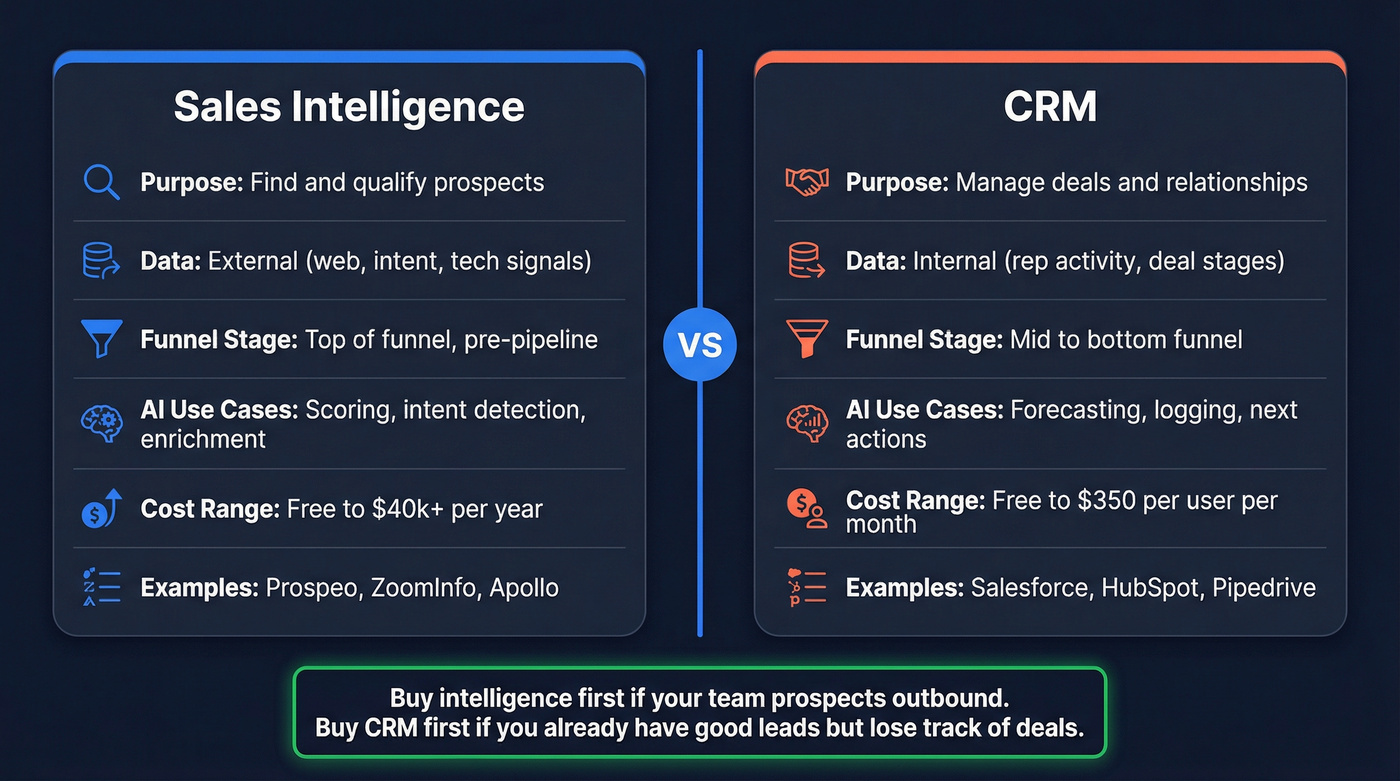
If you're choosing one first, intelligence wins. You can't manage relationships with contacts you can't reach.
The average organization uses close to 1,000 applications, but only 28% are integrated. That gap between "we have the tools" and "the tools actually work together" is where pipeline goes to die.
Where Revenue Intelligence Fits
Revenue intelligence is the third category people conflate with the first two. Gong, Clari, People.ai - these platforms sit on top of your CRM and intelligence stack, not instead of either.
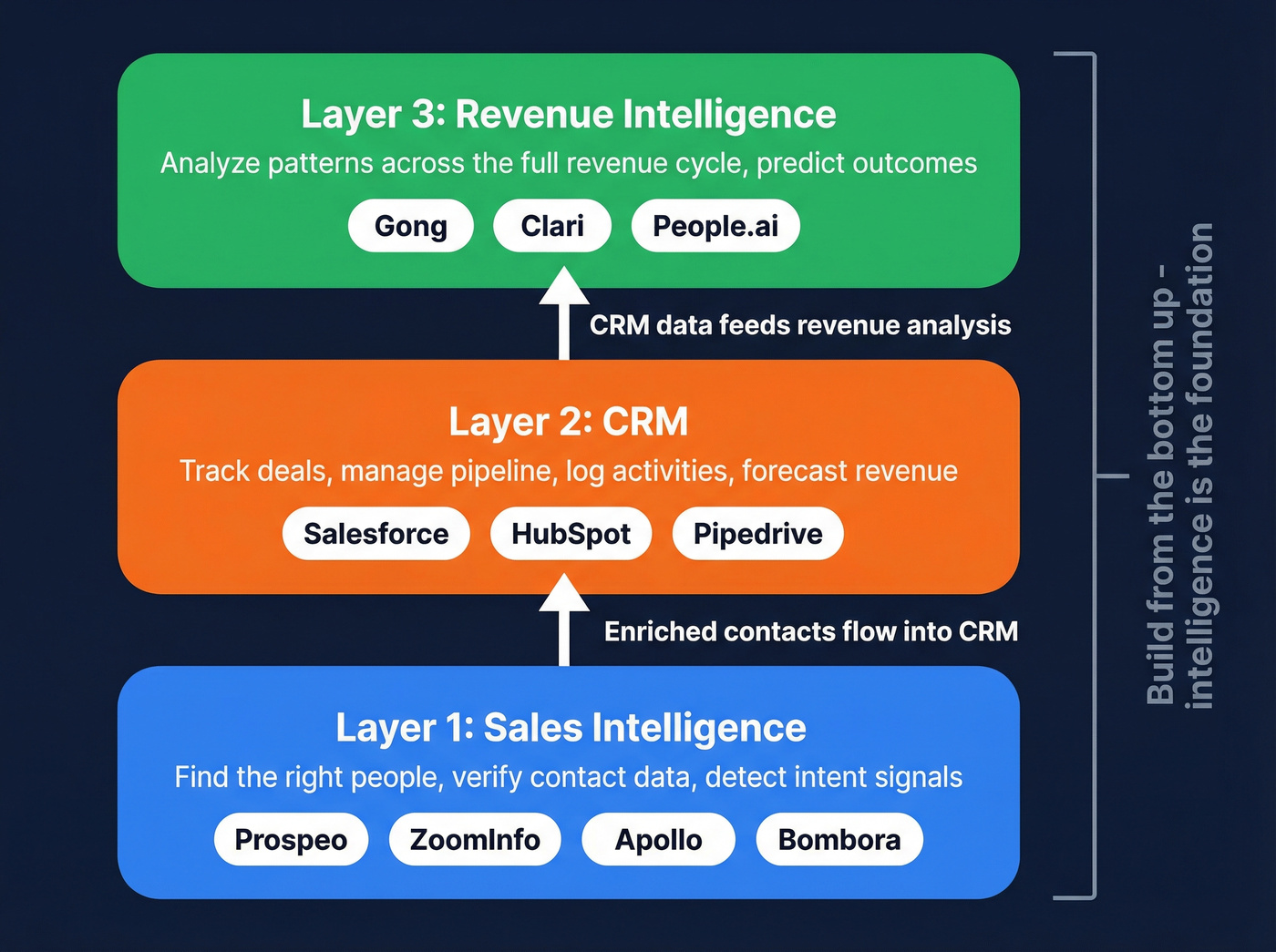
Sales intelligence tells you who to talk to. CRM tracks the conversation. Revenue intelligence analyzes patterns across the entire revenue cycle - sales, marketing, customer success, support - and turns signals into forecasts and next-best-action recommendations.
Conversation intelligence users close deals 11 days faster on average with a 10 percentage point win-rate improvement on deals over $50k. But you can't layer revenue intelligence on top of a broken foundation. Get your data and CRM right first.

Your CRM can't manage deals with contacts that bounce. Prospeo enriches every record with 50+ verified data points - 98% email accuracy, 125M+ verified mobiles, refreshed every 7 days instead of the 6-week industry average. That's the intelligence layer your pipeline is missing.
Stop filling your CRM with dead data. Start with intelligence that actually connects.
Which Do You Need First?
The "you need both" answer is lazy. The real question is which one you need first, and 45% of sales professionals struggle to make exactly this call.
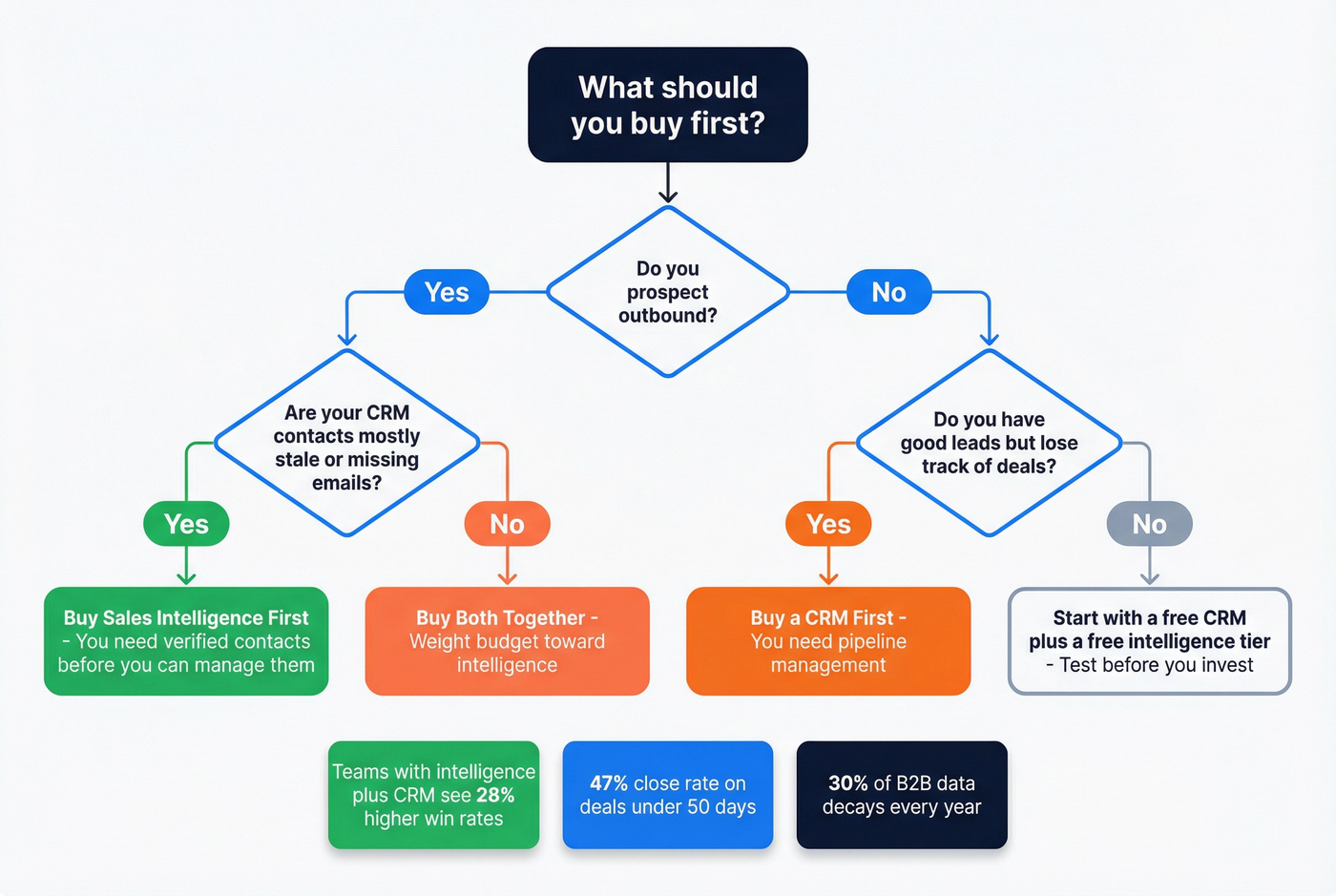
Let's be honest: if your average deal size is under $10k, you probably don't need a $30k CRM implementation. You need accurate contacts and a spreadsheet. Intelligence first, CRM second - always.
The data backs this up. Teams that combine the right intelligence tools with their CRM see 28% higher win rates and 26% larger deal sizes. Deals that close in under 50 days convert at 47%, compared to just 20% for deals dragging past that mark. Speed depends on reaching the right person with the right data - that's intelligence, not CRM.
Here's how we'd break it down by team size:
Solo founder or fewer than 5 reps, under $500/month budget: Sales intelligence first. Use a free tier for verified contacts and track deals in a spreadsheet or HubSpot's free CRM. You can manage a pipeline in a spreadsheet for three months. You can't prospect with bad data for three months.
5-20 reps, $500-$2k/month: Both, but weighted toward intelligence. A strong enrichment tool for data accuracy, Apollo for sequencing, HubSpot or Pipedrive for deal management.
20+ reps, $2k+/month: Full stack. ZoomInfo or Cognism for scale, Salesforce for CRM, Gong for conversation intelligence. Layer in a dedicated email verification tool - even enterprise databases have accuracy gaps.
We've seen teams buy a $30k CRM implementation before they had a reliable way to fill it with contacts. That's like building a warehouse before you have suppliers.
How Intelligence Data Feeds Your CRM
Open your CRM on a Monday morning. You've got 2,400 contacts. Roughly 30% have no email. Another 15% changed jobs in the last quarter. Your "database" is actually a collection of decaying records that gets worse every week.
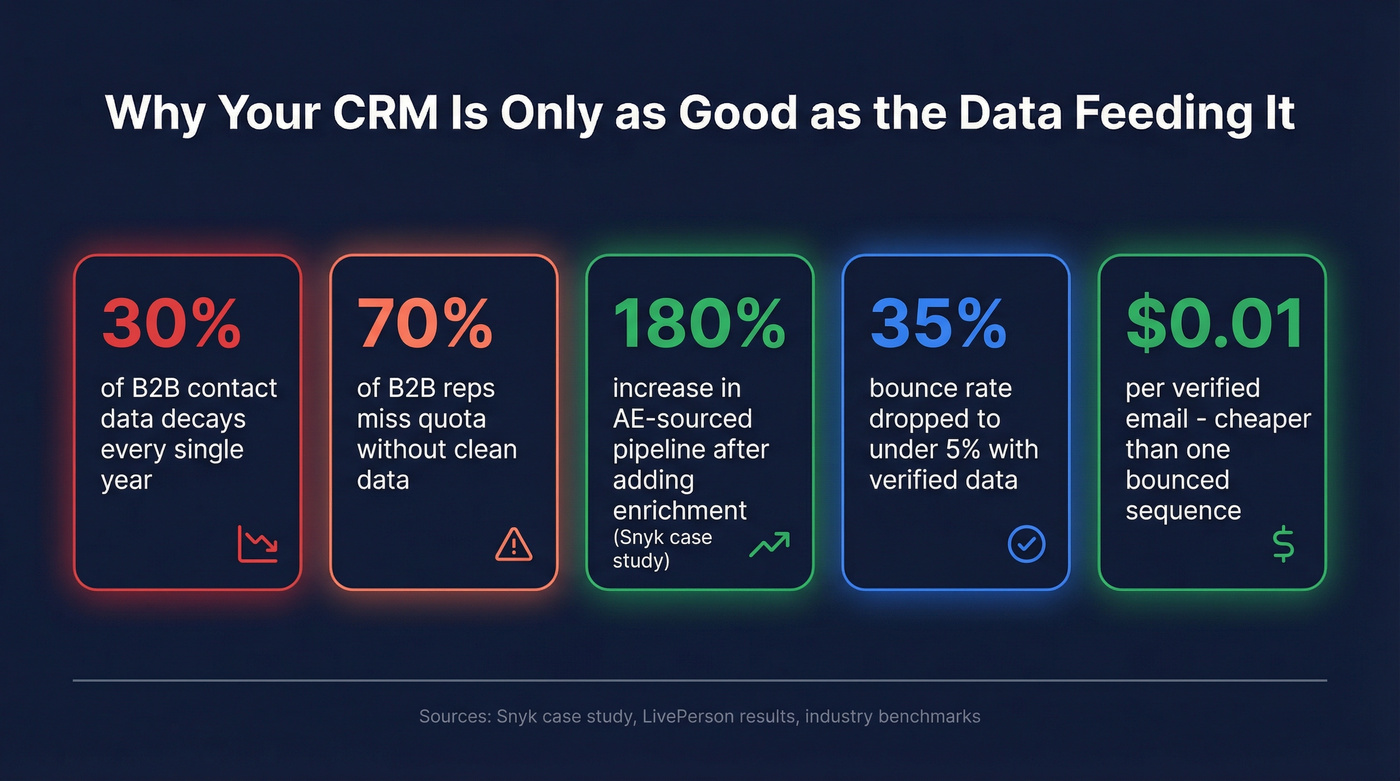
This is the enrichment problem, and it's the bridge between sales intelligence and CRM. Without it, 70% of B2B reps miss quota.
An enrichment layer earns its keep here. Prospeo pushes 50+ verified data points per contact into Salesforce or HubSpot - verified emails at 98% accuracy, verified mobile numbers with a 30% pickup rate, firmographic and technographic fields. Everything refreshes on a 7-day cycle, so your CRM records don't decay the way they do with tools that refresh every 6 weeks or so.
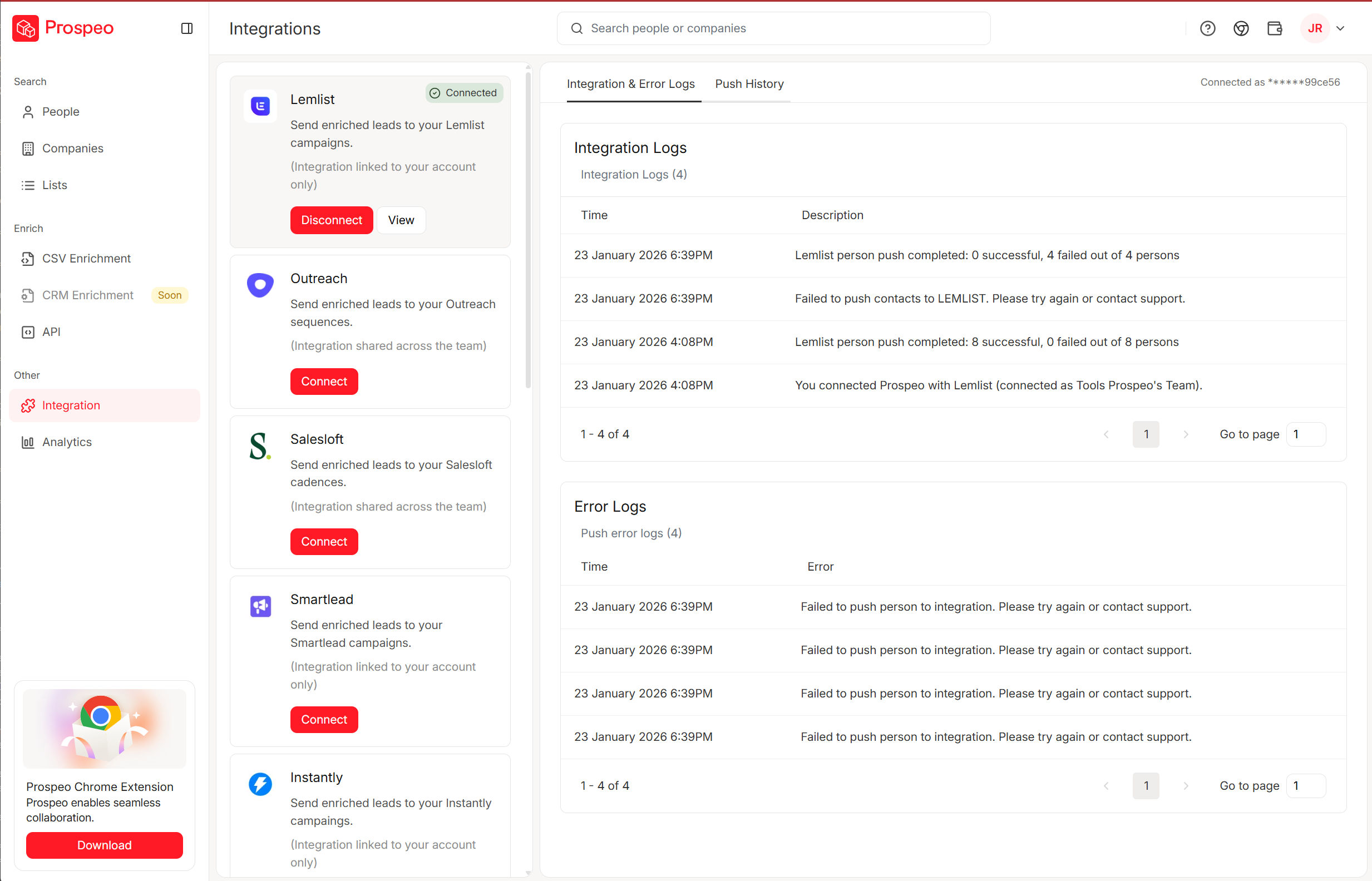
The proof is in the results. Snyk had 50 AEs prospecting 4-6 hours per week with bounce rates running 35-40%. Within weeks of connecting an enrichment layer to their CRM, bounces dropped under 5%, AE-sourced pipeline jumped 180%, and the team generated 200+ new opportunities per month. That's not a marginal improvement - that's a fundamentally different pipeline.
LivePerson cut per-prospect research time from 20 minutes to 2 minutes and saw a 35% engagement lift after layering intelligence into their workflow. At roughly $0.01 per verified email, the math is hard to argue with. A single bounced email sequence costs more in domain reputation damage than a month of enrichment credits.
B2B contact data decays 30% per year. Prospeo's 7-day refresh cycle and 5-step verification keep your CRM from becoming a graveyard - at $0.01 per email. Teams using Prospeo book 26% more meetings than ZoomInfo users and 35% more than Apollo.
Feed your CRM verified data, not educated guesses.
Sales Intelligence Tools Worth Knowing
ZoomInfo
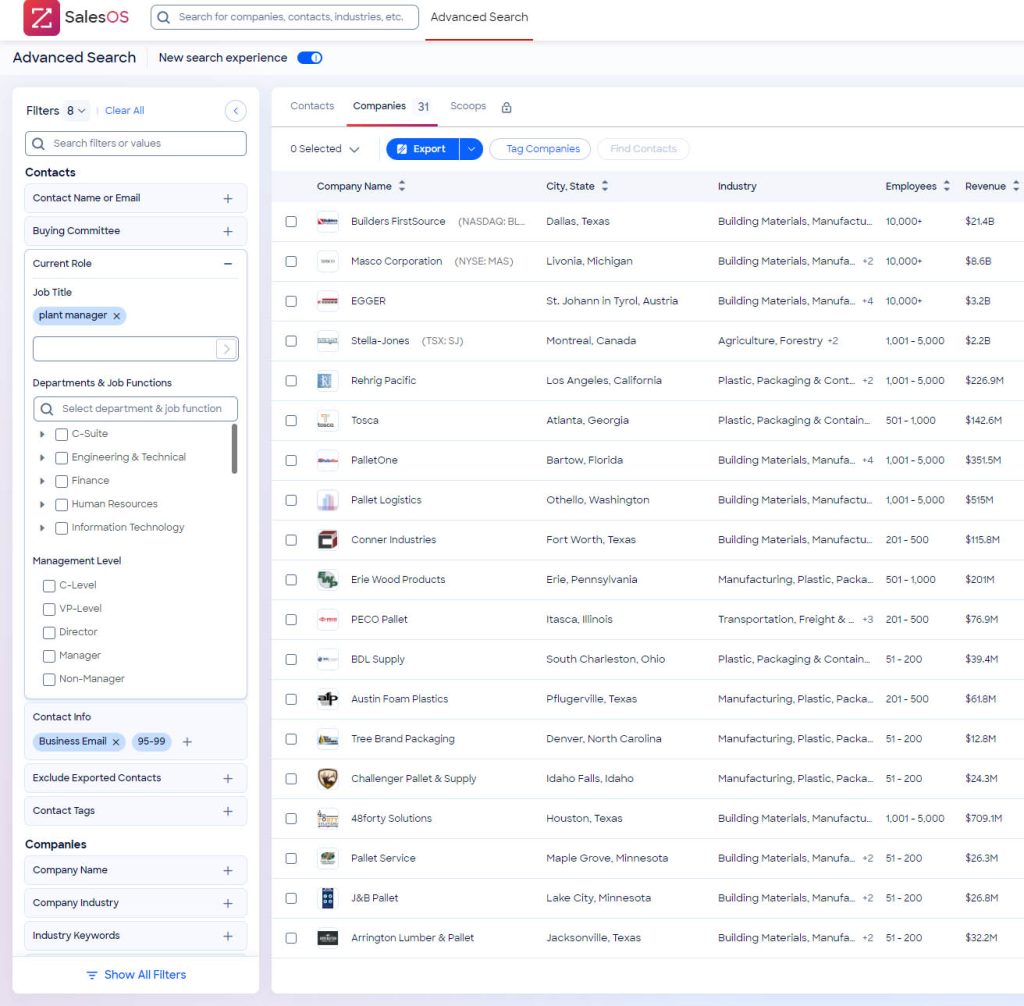
ZoomInfo is the 800-pound gorilla - 100M company profiles, 500M contacts, 1B buying signals processed monthly. The platform is genuinely powerful if you have the ops team to configure it and the budget to sustain it. A common question buyers ask is whether ZoomInfo is a CRM. It isn't. ZoomInfo is a sales intelligence platform that feeds data into your CRM, not a system of record for managing deals and pipeline stages.
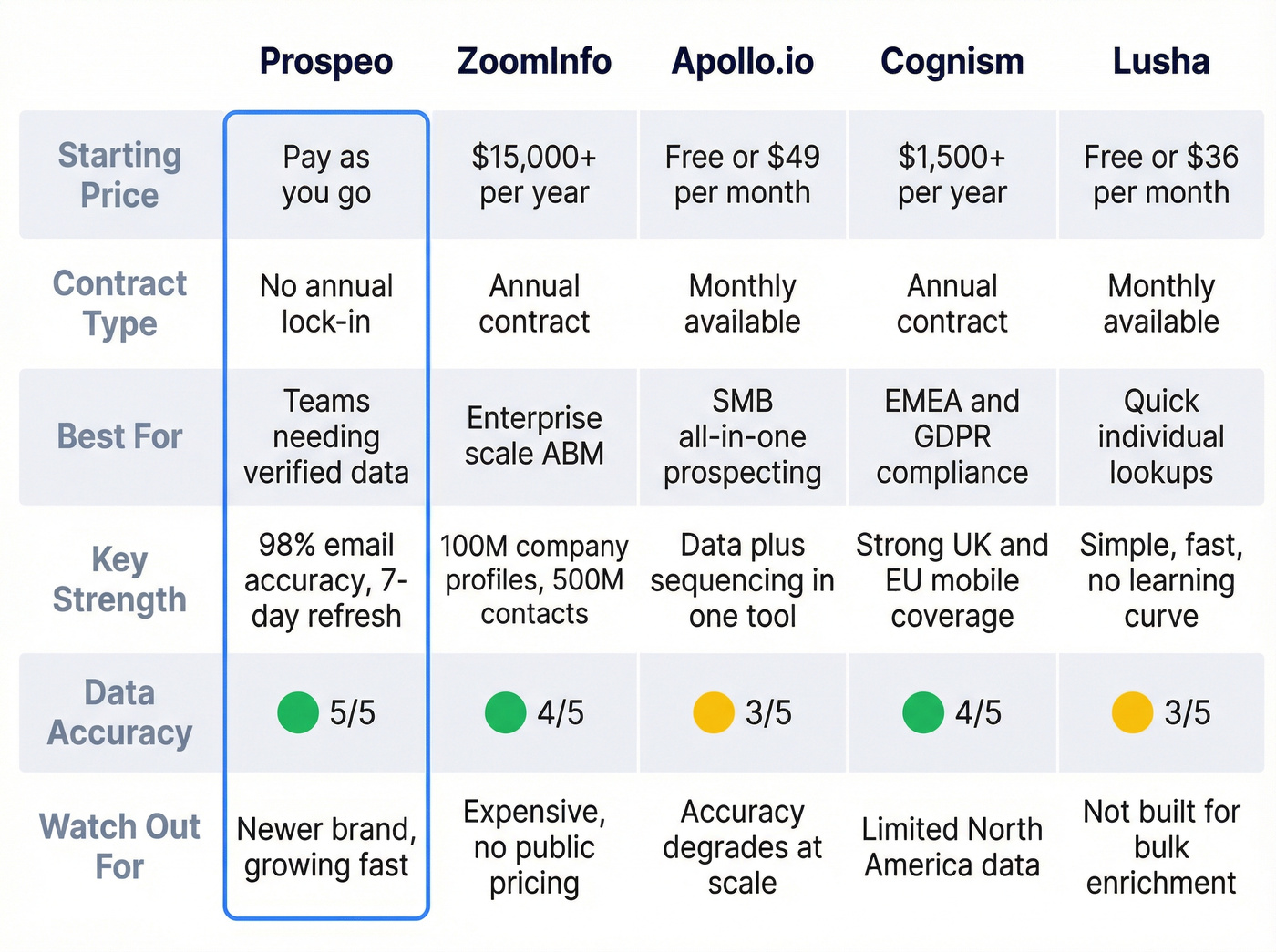
The fact that ZoomInfo still won't publish pricing tells you everything about their sales process. Expect $15,000-$40,000+ per year depending on seats, modules, and add-ons. For a 10-seat team that just needs verified contacts and mobile numbers, that's wildly overpriced. For a 200-person sales org running multi-channel ABM, it might be worth it.
Apollo.io
Imagine you're a 5-person SDR team that just got budget approval. You need contacts and a way to email them - today, not after a 6-week implementation. That's Apollo. Contact data plus email sequencing in a single platform, free tier included, paid plans from $49/month. G2 rating of 4.8/5, which is genuinely impressive for this category. The tradeoff: data accuracy can degrade as you scale. Great for getting moving fast, less great when deliverability starts mattering at volume.
Cognism
If your territory is the UK, Germany, or France, look at Cognism early. It's GDPR-focused, with strong EMEA mobile coverage. Custom pricing - typically $1,500-$25,000/year depending on team size and package. Skip this if your entire market is North America.
Lusha
Simple, fast, no learning curve. Free tier, paid from $36/month. Good for individual reps who need quick lookups. For teams that need bulk enrichment and deep CRM workflows at scale, you'll usually want a more dedicated platform.
Pricing at a Glance:
| Tool | Starting Price | Contract | Best For |
|---|---|---|---|
| Apollo.io | Free / $49/mo | Monthly available | SMB all-in-one |
| Lusha | Free / $36/mo | Monthly available | Quick lookups |
| Cognism | ~$1,500/year | Annual | EMEA / GDPR compliance |
| ZoomInfo | ~$15,000/year | Annual | Enterprise scale |
CRM Platforms That Pair Well
This isn't a CRM comparison article, but the integration matters. Three pairings we see work well:
Salesforce ($25-$350/user/month) remains the default for mid-market and enterprise. Every serious SI tool integrates with it. The ecosystem is unmatched, but so is the implementation complexity.
HubSpot offers a genuinely useful free CRM, with Sales Hub starting at $20/seat/month billed annually. For teams under 20 reps, it's the path of least resistance. Most enrichment tools integrate natively, pushing enriched contacts directly into your records.
Pipedrive and monday CRM serve smaller teams that want visual pipeline management without the Salesforce overhead. monday CRM starts at $12/seat/month. Both connect to SI tools via Zapier or Make if native integrations aren't available.
How to Integrate the Two
Real talk: most integration projects fail because teams over-engineer them. There are four levels worth understanding, and you should start at the simplest one that solves your problem.
UI/layout customization means embedding SI data into your CRM views so reps see enriched fields without switching tabs. Field-level integration maps specific data points - verified email, mobile number, intent score - to CRM fields. Workflow automation triggers enrichment when a new lead enters the system or a contact's data goes stale. Code-level integration uses APIs for custom logic: Salesforce Apex triggers, webhook-based enrichment flows.
Red flags that signal you need better integration: low CRM adoption because reps don't trust the data, duplicate records everywhere, missing fields that make reporting useless, and disconnected workflows where reps copy-paste between tools.
Start simple. Native Salesforce and HubSpot integrations handle field-level mapping and automated enrichment out of the box. Build custom API workflows only after you've validated the data flow with native connectors. In our experience, teams spend months building custom integrations that a native connector would've handled in an afternoon.
If you're seeing duplicates and missing fields, start with CRM hygiene before you add more tools.
FAQ
Is sales intelligence part of a CRM?
No. Sales intelligence provides external data - verified contacts, intent signals, and technographics - while a CRM manages internal data like deals, activities, and relationships. They're complementary systems, not subsets of each other.
Is ZoomInfo a CRM?
No. ZoomInfo is a sales intelligence platform that provides contact data, company profiles, and intent signals. You export or sync that data into a CRM like Salesforce or HubSpot. You still need a separate CRM to manage pipeline, track deal stages, and log rep activities.
How much does sales intelligence cost?
Most SMB teams spend $50-$500/month on intelligence tools. Credit-based platforms start at roughly $0.01 per verified email with free tiers available. Enterprise platforms like ZoomInfo run $15k-$40k+ annually with mandatory annual contracts.
Can I use sales intelligence without a CRM?
Yes. Many teams start with an intelligence tool and a spreadsheet. Verified contact data is valuable on its own for prospecting. Add a paid CRM when deal tracking becomes the bottleneck - not before.
How often should I refresh CRM data?
B2B contact data decays roughly 30% per year, so quarterly refreshes are the bare minimum. The best enrichment tools refresh on a weekly cycle, keeping records current automatically. The longer you wait, the more pipeline you lose to bounced emails and wrong numbers.