Lead Nurturing Emails: The Data-Backed Guide to Sequences That Actually Convert
You downloaded 500 leads from a webinar last month. You sent a "thanks for attending" email and... nothing. Maybe a follow-up a week later. Then silence. Those leads are sitting in your CRM right now, decaying. As one SaaS marketer put it on Reddit, "most nurturing workflows are just a graveyard for leads who are cold/didn't convert easily."
That's not a tools problem or a timing problem. It's a sequence problem.
The average cost per lead across all industries is $198.44. You're spending real money to get people into your funnel, then letting them rot with generic drip emails - or worse, no emails at all. Only 20% of leads convert into customers, and 50% of qualified leads aren't ready to buy when they first raise their hand. But here's the number that should change how you think about this: 63% of leads convert within 3 months when they receive regular nurturing. The gap between "lead acquired" and "lead converted" isn't a mystery - it's a sequence you haven't built yet.
What You Need (Quick Version)
If you're skimming, here's the cheat sheet:

- 5-8 emails, not a 12-email marathon. Diminishing returns hit hard after the first few touches. Build a tight, value-dense sequence first, then expand.
- 2x per week. Counterintuitively, this produces the lowest unsubscribe rate (0.33%) - lower than weekly or monthly sends. More on the data below.
- Lead with value in every nurturing email. Save the pitch for email 5+. Nurture sequences generate 4-10x higher response rates than standalone blasts, but only when they're actually useful.
- Verify your list before you send anything. Bounces destroy deliverability for the entire sequence. One bad send can tank your sender reputation for weeks. (If you need a process, start with an email verification list SOP.)
- Use the benchmarks below to know if your numbers are good or broken. A 35%+ open rate on nurture emails is healthy. Below 25% on early emails means something's wrong with your data or your subject lines.
Why Nurture Sequences Outperform One-Off Blasts
A single email blast is a coin flip. You're betting that the recipient is in the right headspace, at the right moment, with the right problem - all from one touch. Nurture sequences stack the odds by showing up repeatedly with relevant content until the timing aligns. And 97% of people ignore cold calls now, which means email isn't just one channel among many - it's the primary way B2B buyers want to hear from you.
The numbers aren't subtle. Nurture emails pull 4-10x higher response rates compared to standalone blasts. Companies that excel at nurturing generate 50% more sales-ready leads at 33% lower cost. Nurtured leads don't just convert more - they spend 47% more on average.
Welcome emails alone hit ~80% open rates. Abandoned cart emails exceed 40%. Even re-engagement emails - sent to people who've gone cold - average 36% open rates. Compare that to the typical blast campaign struggling to crack 25%.
Businesses using marketing automation for nurturing report a 451% increase in qualified leads. That's not a typo. Automation lets you send the right message at the right time without manually babysitting every lead.
Nurture Emails vs. Email Blasts
| Metric | Nurture Emails | Email Blasts |
|---|---|---|
| Response rate | 4-10x higher | 1x (baseline) |
| Sales-ready leads | +50% more | Standard pipeline output |
| Cost per lead | 33% lower | Full cost (baseline) |
| Avg. purchase size | 47% larger | 1x (baseline) |
| Welcome open rate | ~80% | 20-30% typical |
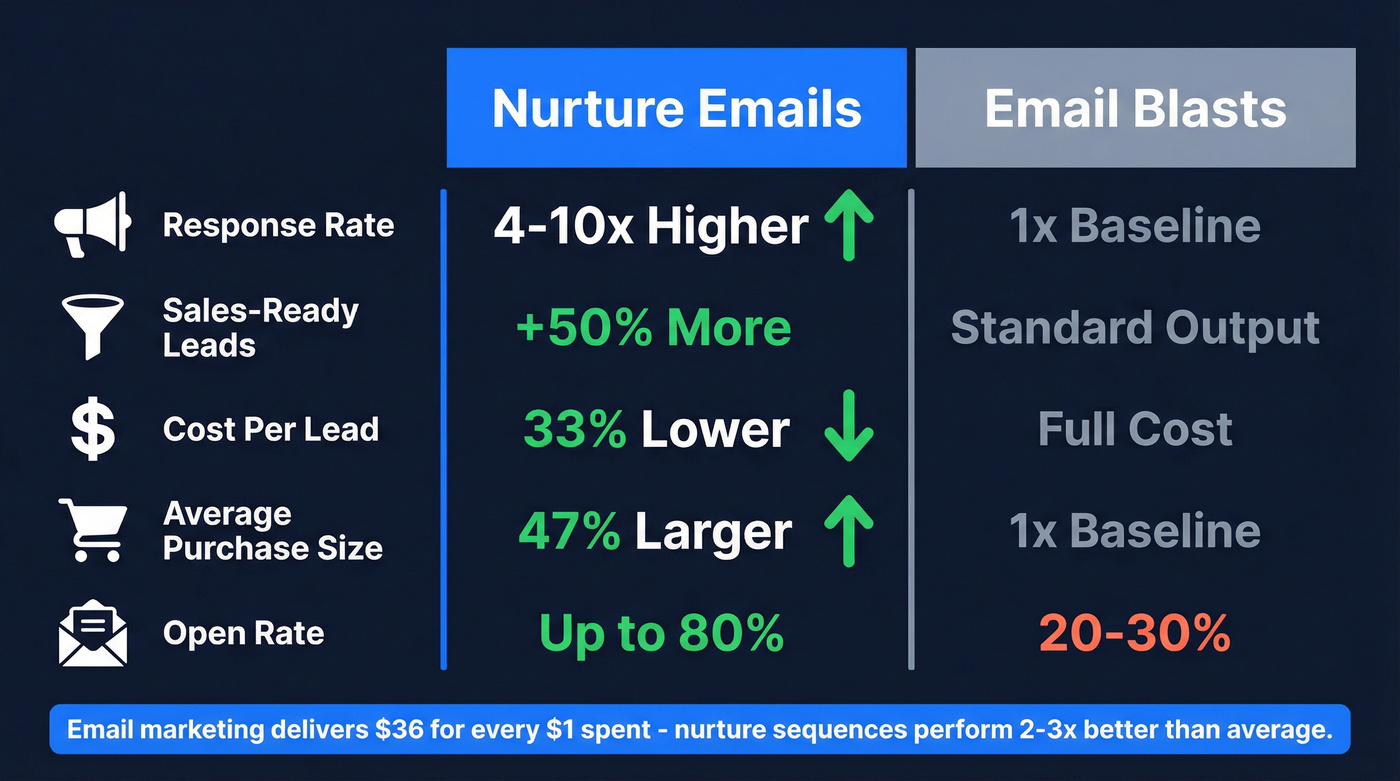
The ROI math is simple. Email marketing delivers $36 for every $1 spent. But that average includes all the terrible campaigns dragging it down. A well-built nurture sequence performs 2-3x better than the mean.
Complete Nurture Sequences You Can Steal
These aren't theoretical frameworks. They're full sequences with subject lines, timing, and performance benchmarks. Adapt them to your product, but don't overthink it - the structures work.
Hot take: if you're only going to build one sequence, build the SaaS Educational Sequence below. Despite the name, it works for any B2B company - the structure is universal. I've seen it adapted for agencies, consulting firms, and even manufacturing companies. Start here, measure, then build the others.
SaaS Educational Sequence (8 Emails, 30 Days)
This sequence targets leads who downloaded an industry report or gated content. The goal: move them from problem-aware to product-aware over 30 days.

Email 1 - Day 0
Subject: "Your report + what most companies miss" Deliver the asset immediately, then add a bonus insight that isn't in the report. This is where you prove you're worth reading. Benchmark: 52% open rate, 12% CTR
Email 2 - Day 4
Subject: "The [metric] mistake costing you revenue" Agitate a specific problem your product solves. Don't mention your product yet. Benchmark: 41% open rate, 8% CTR
Email 3 - Day 8
Subject: "How [Company X] fixed their [problem]" Case study time. This comes after trust is built - not in email 1. Mid-sequence case studies convert better because the reader already cares about the problem. Benchmark: 38% open rate, 9% CTR
Email 4 - Day 12
Subject: "3 things [role] teams get wrong about [topic]" Educational content that positions your perspective. Still no hard pitch. Benchmark: 35% open rate, 7% CTR
Email 5 - Day 16
Subject: "The framework behind [Company X]'s results" Bridge from the case study to a reusable framework. This is where you can start connecting dots to your product. Benchmark: 33% open rate, 6% CTR
Email 6 - Day 20
Subject: "See it in action (2-min video)" Product demo or walkthrough. By now, the reader understands the problem and has seen proof. They're ready to see the solution. Benchmark: 31% open rate, 5% CTR
Email 7 - Day 25
Subject: "Quick question about [their challenge]" Personal-feeling email. Ask a question. Invite a reply. This breaks the broadcast pattern and often generates the most responses. Benchmark: 30% open rate, 5% CTR
Email 8 - Day 30
Subject: "Last thought on [topic] (+ an offer)" Soft close with a time-limited offer or consultation. Don't be aggressive - you've earned attention, not a hard sell. Benchmark: 28% open rate, 4% CTR
The natural decline from 52% to 28% is healthy. That's not failure - it's the sequence doing its job of filtering engaged leads from casual downloaders.
Lead Magnet Nurture Sequence (4 Emails, 7 Days)
Shorter, faster, designed for leads who grabbed a specific resource. The biggest mistake here is the "download and forget" problem - someone grabs your ebook and never opens it. Here's the fix:
| Day | Subject Line | Strategy | |
|---|---|---|---|
| 1 | 0 | "Download your [resource name]" | Deliver the asset. One sentence about what they'll get. That's it. |
| 2 | 2 | "Make [resource] work for you" | Pick one specific step from the resource and tell them to try it today. This prevents the download-and-forget cycle. |
| 3 | 4 | "What to do next" | Push toward the highest-value section - ideally the one that connects to your product. "If you only read one chapter, make it Chapter 4." |
| 4 | 7 | "More resources on [topic]" | Curate 2-3 additional resources (blog posts, videos, tools) with a soft CTA to book a call or start a trial. |
One Reddit practitioner shared a similar 6-day structure: re-intro, framework, exclusive content, case study with soft CTA, common mistakes, hard pitch with urgency. The pattern works because it front-loads value and saves the ask for the end.
Re-Engagement Sequence (3-4 Emails, 2 Weeks)
For leads who've gone dark.

These people were interested once - they downloaded something, attended a webinar, maybe even replied to an email. Then they disappeared. As one practitioner on Reddit put it, "collecting leads and then never following up is a common rookie mistake." This sequence fixes that.
Start with a friendly check-in on Day 0 - no guilt trip, just reference their last interaction: "You grabbed our [resource] back in [month]. Wanted to share something new." Use a subject line like "Still thinking about [topic]?"
Four days later, send exclusive content they haven't seen. A new case study, a fresh data point, an industry report. The subject line "This might change your mind about [topic]" works because it creates curiosity without being clickbait. Give them a genuine reason to re-engage.
By Day 10, make your final push with a concrete offer - a discount, a free consultation, an extended trial. Subject: "Last chance: [specific offer]." Make it clear this is the last email in the sequence.
The optional Day 14 email is the breakup: "We don't want to clog your inbox. If you're still interested, click here. Otherwise, we'll remove you." This email consistently pulls 36% open rates because loss aversion is powerful. The escalating approach - friendly, value, urgency, breakup - mirrors what works in re-engagement across every channel.

You just designed the perfect nurture sequence. Now imagine 35% of those emails bouncing because your contact data is stale. Prospeo's 7-day data refresh and 98% email accuracy mean your 8-email sequence actually reaches inboxes - not spam folders.
Stop nurturing bounced emails. Start with verified data.
The "Hard Thing" Nurture Email Template
If you write one nurture email this quarter, use this framework.

The "Hard Thing" template comes from Joanna Wiebe at Copyhackers. She originally wrote it for GitPrime (which later sold to Pluralsight), and it's the single most effective B2B nurture email structure I've encountered.
Subject line formula: "The hard thing about [hard thing]"
Example: "The hard thing about engineering velocity"
Before you write it, you need four things:
- A specific feature or product to sell
- The value proposition for that feature
- The problem it solves
- The failed solutions your prospect has already tried
The email structure:
Open with the hard thing. Name the problem directly. "The hard thing about scaling outbound isn't finding leads. It's finding leads that don't bounce."
Agitate with failed solutions. "You've tried buying lists. You've tried scraping. You've tried that tool your VP of Sales swore by. And you're still getting 15% bounce rates."
Introduce the solution concept. Don't pitch your product yet - introduce the idea. "What if you could verify every email before it ever hit a sequence?" (More on list hygiene in our guide to data quality.)
Bridge to your product. Now connect the concept to what you sell. Keep it brief.
CTA. One clear action. Not three. One.
Here's what a complete "Hard Thing" email looks like in practice:
Subject: The hard thing about outbound deliverability
The hard thing about scaling outbound isn't writing good emails. It's making sure they arrive.
You've cleaned your list manually. You've used a free verification tool. You've even cut your send volume in half, hoping that would fix your bounce rate. It didn't.
The problem isn't your copy or your cadence - it's that 15% of your list went stale in the last 30 days. What if every address was re-verified weekly, automatically, before it ever entered a sequence?
That's what [Product] does. One integration, zero bounces, and your sender reputation stays intact.
Want to see it on your list? [Book 15 minutes here.]
This template works because it moves the reader from problem-aware to product-aware in a single email. Most nurture emails try to do one thing - educate, or pitch, or share a case study. The Hard Thing template does all three in a natural progression. It's longer than typical SaaS emails, and that's the point. The reader stays because you're describing their exact frustration.
How Often Should You Send Nurture Emails?
The Frequency Data That Contradicts Everything You've Heard
Everything you've been told about email frequency is wrong.
In our experience, teams that drop to monthly sends lose more subscribers than teams sending twice a week - and the data confirms it. The conventional wisdom says "don't email too often or people will unsubscribe." The data says the opposite. Here's what a benchmark analysis of MailerLite data found:
| Frequency | Open Rate | Click Rate | Unsub Rate |
|---|---|---|---|
| < 1/month | 35.11% | 3.74% | 0.87% |
| 1-3/month | 33.48% | 4.32% | 0.54% |
| Weekly | 33.22% | 4.87% | 0.38% |
| 2x/week | 32.98% | 5.31% | 0.33% |
| Daily | 30.04% | 4.97% | 0.36% |
Read that unsubscribe column again. Sending 2x per week produces the lowest unsubscribe rate at 0.33%. Sending less than once a month? The highest at 0.87%. People unsubscribe from lists they've forgotten about, not lists they hear from regularly.
The click rate tells the same story. 2x/week wins at 5.31% - nearly 50% higher than the less-than-monthly crowd.
A caveat: a Belkins study of 16.5 million cold emails found the highest reply rate (8.4%) comes from the first email, with diminishing returns after each follow-up. But that's cold outreach data - your recipients didn't opt in. For nurture sequences where the lead raised their hand, the 2x/week cadence holds. (If you're building outbound too, use a real follow up email sequence strategy instead of guessing.)
Belkins also found that combining email with a profile visit on professional networks hits an 11.87% reply rate - higher than any email-only sequence. If your nurture sequence includes an outbound component, layering in social touches between emails can meaningfully boost response rates. (Related: social selling as a system, not a tactic.)
The takeaway: front-load your best content in the first 2-3 emails, maintain a 2x/week cadence, and don't ghost your list. Consistency beats restraint.
Cadence by Lifecycle Stage
Not every lead needs the same frequency. Match your nurturing cadence to where they are:
| Lifecycle Stage | Cadence | Content Type |
|---|---|---|
| Awareness | Every 2-3 days | Educational, problem-focused |
| Consideration | Weekly | Comparisons, case studies |
| Decision | 2-3x/week | Demos, trials, ROI proof |
| Retention | Monthly/quarterly | Updates, upsells, tips |
88% of users check their inbox multiple times daily. You're not interrupting them - you're meeting them where they already are. The key is matching content intensity to intent level. A lead who just downloaded a whitepaper needs education every couple of days. A customer who's been with you for two years needs a monthly check-in, not a daily drip.
Segmentation That Actually Moves the Needle
Stop thinking personalization means "Hi {first_name}."
I've watched teams obsess over first-name merge tags while ignoring behavioral signals that actually move revenue. First-name personalization sometimes negatively impacts email performance at this point. Everyone knows it's a merge tag. It's not personal - it's a parlor trick.
Segmented campaigns generate up to 760% more revenue than non-segmented ones. But the segmentation that matters isn't demographic. It's behavioral and firmographic. And 24% of email marketers now cite segmentation as a key innovation area - because the gap between "segmented" and "not segmented" is enormous. (If you want the mechanics, see how to segment your email list.)
Tier 1: Behavioral segmentation (highest impact)
- Pages visited (pricing page 3x this week = hot lead)
- Content downloaded (whitepaper vs. case study signals different intent)
- Email engagement (opened last 5 emails vs. hasn't opened in 60 days)
- Product usage (for freemium - which features they've activated)
Tier 2: Engagement-level segmentation
- Active subscribers get exclusive offers and early access
- Passive subscribers get re-engagement sequences
- Dead leads get the breakup email
Tier 3: Firmographic segmentation
- Industry (a manufacturing lead gets manufacturing case studies)
- Company size (enterprise vs. SMB messaging)
- Role (VP of Sales cares about pipeline; RevOps cares about data quality)
80% of buyers say the experience a company provides is as important as its products. The bar isn't "Hi Sarah" anymore. It's "here's a case study from a company your size, in your industry, solving the problem you were researching on our site last Tuesday." Effective nurturing leads with that level of relevance - not generic content blasted to your entire database.
Setting Up Your Nurture Automation
Platform Recommendations
Skip the fancy visual email builders for nurture sequences. Plain text emails with one link consistently outperform designed HTML emails in B2B nurture - they feel personal, not promotional. That said, you still need a platform that handles conditional logic well.
For mid-market teams, HubSpot's workflow builder handles conditional branching and lead scoring natively - it's the most intuitive for complex multi-sequence setups. SMBs get better value from ActiveCampaign, which also posts the highest deliverability rate in the industry at 94.2%. E-commerce teams should look at Drip for its cart abandonment and purchase-behavior triggers that plug directly into your store data.
Triggers, Branches, and Adaptive Delays
The difference between a drip campaign and a real nurture sequence is conditional logic. Drip campaigns are dumb pipes - Day 1, Day 3, Day 7, regardless of what the lead does. Nurture sequences respond. (If you want more examples, see conditional sequences.)
Trigger types that should launch a sequence:
- Form submissions (lead magnet download, webinar registration)
- Page visits (pricing page, comparison pages, case studies)
- Email clicks (clicked a CTA but didn't convert)
Conditional logic example: A lead visits your pricing page three times in a week. Don't send them email 4 of your educational sequence - skip them straight to a demo offer. They're past the education phase.
Adaptive delays matter. After a whitepaper download, a 3-day delay gives the lead time to actually read it before you follow up. But if that lead takes another action during the waiting period - say, they visit your pricing page - the workflow should respond immediately. Static delays ignore buying signals. Adaptive delays catch them.
The 451% increase in qualified leads from automation isn't magic. It's the compound effect of sending the right message at the right time, thousands of times, without a human manually triaging every lead.
Lead Scoring and Sales Handoff
Your nurture sequence should have an ejection seat. When a lead is ready, get them to sales fast.
- Score threshold: Leads hitting 80+ on a 100-point scale get handed to sales immediately (here’s a deeper framework on lead scoring systems.)
- Buying signals that override the score: Pricing page visits, demo requests, "talk to sales" clicks - these trigger instant handoff regardless of score
- Keep sales informed: Share what nurture content the lead received. Nothing kills a deal faster than a rep asking questions the lead already answered in an email reply
The Data Quality Prerequisite
Here's the thing nobody talks about in nurture email guides: none of this matters if your emails bounce.
A bounce rate above 2% damages your sender reputation. A damaged sender reputation means your brilliant nurture sequence lands in spam - for everyone on your list, not just the bad addresses. The deliverability benchmark you need to hit is 94%+.
Before you activate any sequence, run your list through a verification tool. Tools like Prospeo catch invalid addresses, spam traps, and honeypots before they wreck your domain - and a 7-day data refresh cycle means your list doesn't decay between sends. A brilliant nurture email that bounces is just wasted copy. (If you’re troubleshooting bounces, start with 550 Recipient Rejected.)
Mistakes Killing Your Nurture Campaigns
You spent $198 acquiring that lead. Then you sent three generic emails and gave up. Here are the seven mistakes I see killing nurture campaigns over and over - and I'm genuinely frustrated by how preventable they all are.
1. Giving up too early. 40.4% of B2B buyers take 6-12 months to reach a purchase decision. Another 15.4% take over a year. A lead needs up to 10 nurturing emails before converting. If your sequence is 3 emails over 2 weeks, you're abandoning leads right when they're starting to warm up. Fix: Build sequences that span months, not days. Use the 8-email SaaS sequence above as your minimum, then add a monthly check-in cadence for leads that complete it without converting.
2. Generic messaging that ignores the buyer's context. "Hi {first_name}, check out our latest blog post" isn't nurturing - it's noise. Fix: Segment by behavior, industry, and engagement level. A VP of Engineering and a CMO shouldn't get the same email. Build at least 2-3 variants of your core sequence for different personas.
3. CTA overload. Every email should have one clear CTA. Not three buttons, two links, and a P.S. with another offer. Multiple CTAs create decision paralysis and make your emails look like spam. Fix: One email, one action. If you can't decide which CTA to use, that's a sign the email is trying to do too much. Split it into two emails.
4. Pitching too early. 50% of qualified leads aren't ready to buy. If your second email is a demo request, you're pushing people away. Case studies work best mid-sequence (email 3-4), and product demos belong at email 6+. Fix: Earn the right to pitch. Front-load value for the first 4-5 emails, then introduce your product as the natural solution to the problem you've been educating them about.
5. Ignoring post-sale nurturing. The relationship doesn't end at the signature. Post-sale nurture drives renewals, upsells, and referrals. Acquiring a new customer costs 5-7x more than retaining an existing one. Yet most teams shut off nurture the moment a deal closes. Fix: Build a 90-day post-sale onboarding sequence, then transition to a monthly value-add cadence.
6. Not testing anything. As one Reddit commenter noted, "open and click rates keep sliding" - and most teams have no idea why because they're not running tests. Fix: Run A/B tests on subject lines for every sequence. Even a 5% open rate improvement compounds across thousands of leads over months. (Use this A/B testing lead generation campaigns framework to keep tests clean.)
7. Sales and marketing misalignment. When marketing enrolls a lead in a nurture sequence and sales starts cold-calling them simultaneously, the experience is jarring. Fix: Align on enrollment criteria, lead status definitions, and handoff triggers. Use your CRM to prevent overlapping outreach. A shared Slack channel for "leads in active nurture" takes five minutes to set up and prevents most conflicts.
2026 Benchmarks - What "Good" Actually Looks Like
Stop comparing your lead nurturing emails to "industry averages" without context. Here's what the data actually says.
Open and Click Rates by Industry
| Industry | Open Rate | Click Rate |
|---|---|---|
| Media/Publishing | 43.16% | 7.32% |
| Healthcare | 41.48% | 6.45% |
| Consulting/Agency | 39.08% | 7.05% |
| Software/SaaS | 36.20% | 6.67% |
| E-Commerce/Retail | 35.66% | 5.07% |
| Overall Average | 39.26% | 6.21% |
Benchmarks by Email Journey Type
| Journey Type | Open Rate | Key Insight |
|---|---|---|
| Welcome emails | ~80% | 3-email series = 90% more orders |
| Abandoned cart | >40% | Can reach 49% |
| Upsell/cross-sell | 61.7% | Best post-purchase |
| Re-engagement | ~36% | Breakup emails win |
| Trial activation | 20-40% | Varies by product complexity |
If your nurture sequence open rate is above 35%, you're in healthy territory. Below 25% on early emails signals a data quality or subject line problem - probably both. (For subject ideas, borrow from these reminder email subject lines patterns.)
Overall email marketing conversion rates run 2.8% for B2C and 2.4% for B2B. That means for every 1,000 nurtured leads, you should expect 24-28 conversions. If you're below that, revisit your segmentation and sequence structure before blaming the channel.
Real talk: email marketing still delivers $36 for every $1 spent. No other channel comes close at scale. Lead nurturing emails are how you capture the full value of that ROI instead of leaving it on the table.
Nurtured leads spend 47% more - but only if your emails land. Companies using Prospeo cut bounce rates from 35%+ to under 4%. At $0.01 per verified email, clean data costs less than a single wasted lead at $198.
Every bounced nurture email is $198 in lead cost down the drain.
FAQ
How many emails should a lead nurturing sequence have?
Five to eight emails works best for most B2B sequences. Data shows a lead needs up to 10 touches before converting, but diminishing returns hit after the first few. Start with 5-8, measure performance, then extend if engagement holds.
What's the difference between a drip campaign and a nurture sequence?
Drip campaigns are time-based - Day 1, Day 3, Day 7 - regardless of recipient behavior. Nurture sequences respond to actions like page visits, content downloads, and email clicks. The best sequences combine time-based defaults with behavioral triggers that adapt the path in real time.
How often should I send nurture emails?
Twice per week produces the lowest unsubscribe rate at 0.33% - lower than weekly or monthly sends. Match cadence to lifecycle stage: every 2-3 days during awareness, weekly during consideration, and monthly for retention. Consistency matters more than restraint.
What open rate should I expect from a nurture sequence?
Welcome emails can hit ~80%. Mid-sequence emails typically range from 30-50% early on, declining to 25-30% by email 5+. The overall industry average is 39.26%. If your early emails fall below 25%, audit your data quality and subject lines first.
How do I keep my nurture emails out of spam?
Verify every email address before launching your sequence, keep bounce rates under 2%, and maintain consistent sending frequency. A 5-step verification process that removes invalid addresses, spam traps, and honeypots - paired with weekly data refresh - keeps your list clean between sends and your sender reputation intact.