How to Build an MQL Follow-Up Process That Actually Converts
You spent $50,000 on a webinar. Marketing delivered 150 MQLs. Your SDRs cherry-picked the 10 that looked easiest, and the other 140 rotted in a spreadsheet until someone quietly archived them. That's not a lead quality problem - it's a follow-up process problem.
80% of sales require 5-12 follow-up attempts, but 92% of reps quit after 4. Responding within 5 minutes makes you 100x more likely to connect. The gap between those numbers is where pipeline goes to die.
What You Need (Quick Version)
An effective MQL follow-up process has three non-negotiable components:
- A lead scoring model that separates high-intent from low-intent MQLs - with negative signals and score decay, not just additive points
- A multi-channel cadence that persists beyond the 4th touch - 12 touches over 14 days, minimum
- A marketing-sales SLA that enforces accountability - response times, minimum attempts, recycle rules, and reason codes
Everything below is the full playbook.
Define MQL Criteria with a Scoring Model
Most teams score leads by adding points for good behavior and calling it a day. That's vanity math. A scoring model without negative signals and score decay will flood your SDRs with leads that look qualified on paper but waste everyone's time.
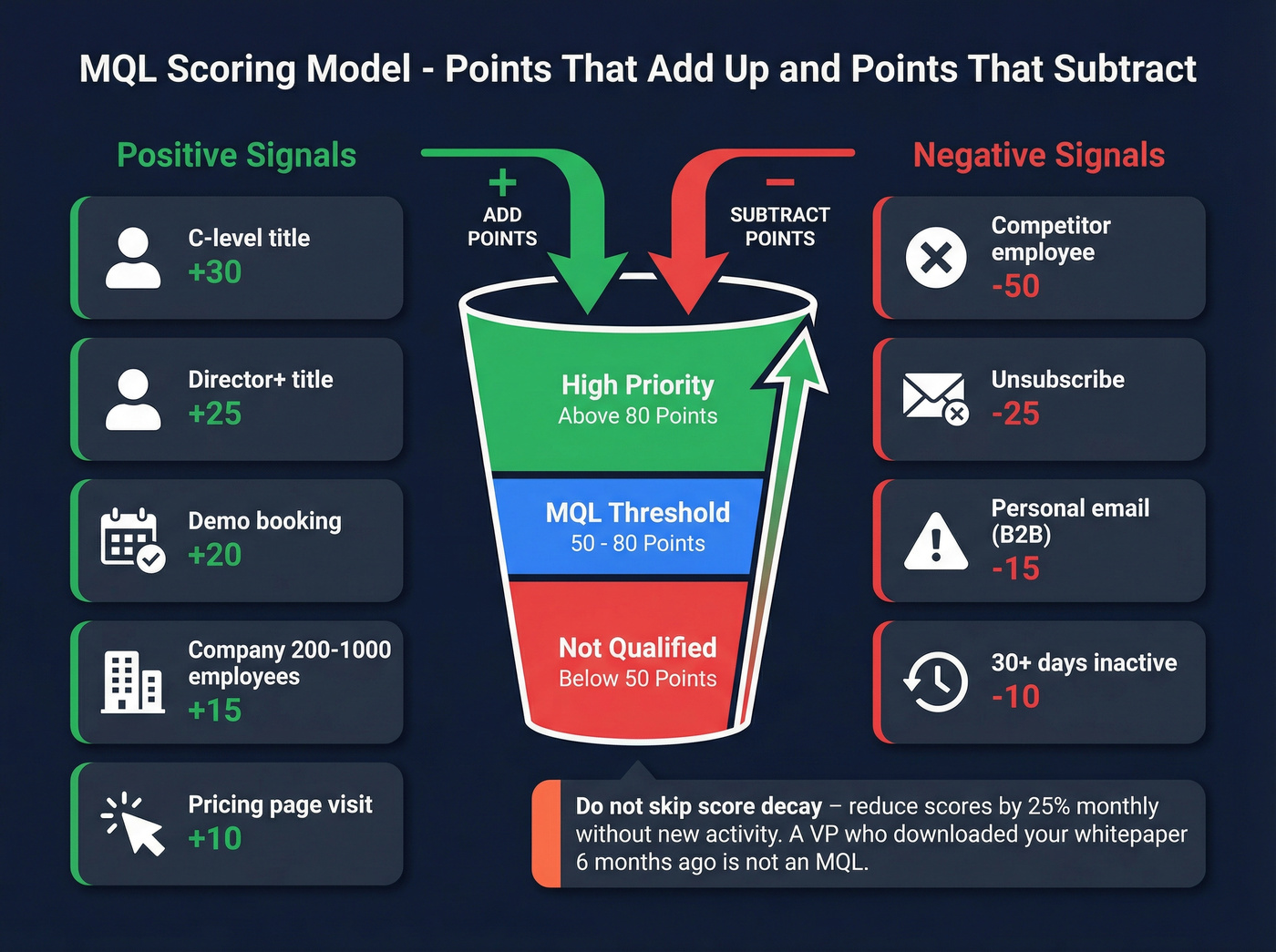
Here's a sample scoring matrix that actually works:
| Signal | Points |
|---|---|
| Director+ title | +25 |
| Demo booking | +20 |
| Pricing page visit | +10 |
| Company 200-1,000 employees | +15 |
| C-level title | +30 |
| 30+ days inactive | -10 |
| Personal email (B2B context) | -15 |
| Competitor employee | -50 |
| Unsubscribe | -25 |
Set your MQL threshold at 50-80 points, or roughly the top 20% of leads by score. Start with 5-7 core criteria that drive most conversions, then refine quarterly.
The rule most teams skip: score decay. Reduce scores by 25% monthly without new activity. A VP who downloaded your whitepaper six months ago and hasn't visited since isn't an MQL - they're a cold contact wearing an MQL label.
Categorize MQLs by Intent Level
Most follow-up workflows fail because they treat every lead the same. A demo request and a blog PDF download are fundamentally different signals, and they deserve different response speeds, channels, and goals.
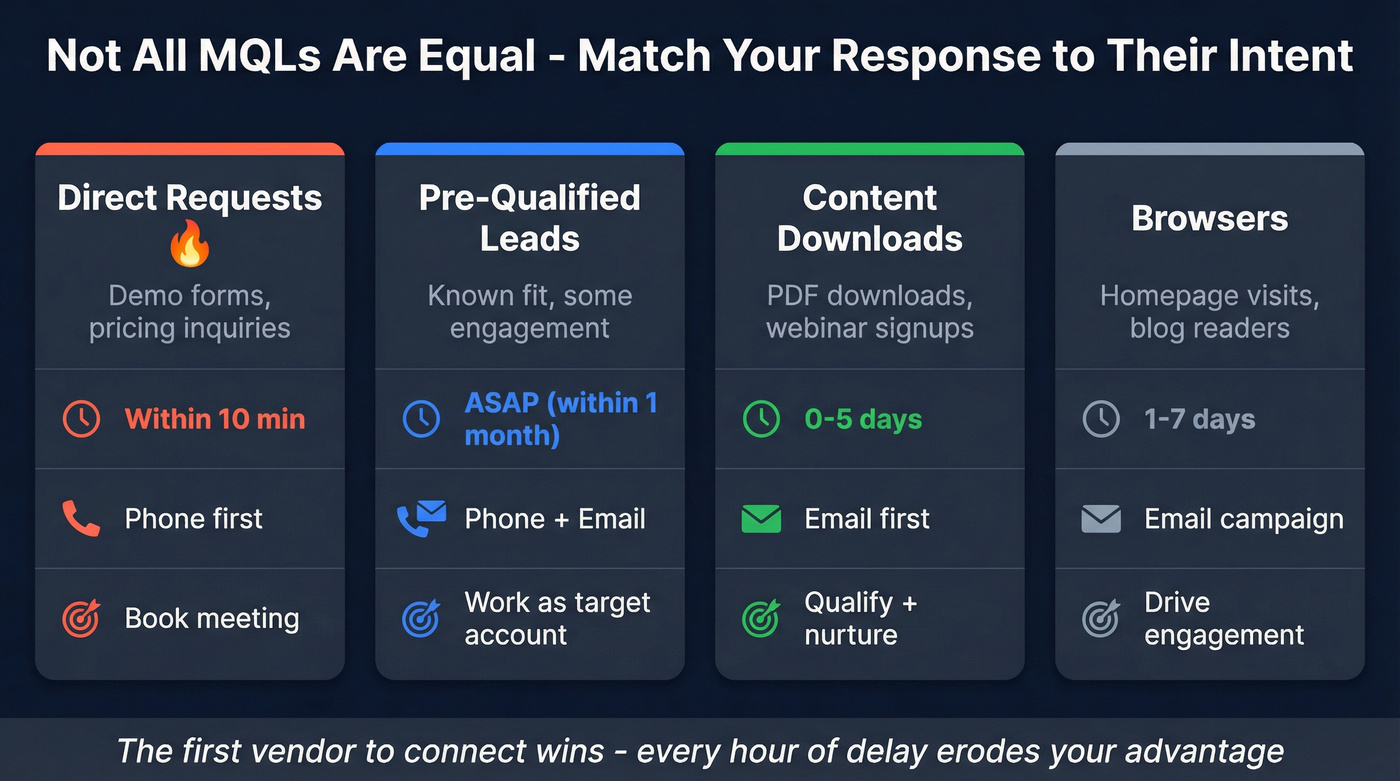
OpenView's framework breaks MQLs into four categories:
| MQL Type | Response Time | Primary Channel | Follow-Up Goal |
|---|---|---|---|
| Direct Requests | Within 10 min | Phone first | Book meeting |
| Pre-Qualified Leads | ASAP (work within a month) | Phone + email | Work as target account |
| Content Downloads | 0-5 days | Email first | Qualify + nurture |
| Browsers | 1-7 days | Email campaign | Drive engagement |
Direct Requests - demo forms, pricing inquiries, assessment requests - get phone calls within 10 minutes. Not an hour. Not "end of day." Ten minutes. The first vendor to connect has a massive advantage, and every hour of delay erodes it.
Content Downloads are trickier. The person who downloaded your PDF often isn't the decision-maker. Your goal isn't to pitch - it's to map the account and find the economic buyer.
Browsers get email nurture campaigns with strong CTAs. Don't waste phone time on someone who visited your homepage once.
Build Your Follow-Up Cadence
Here's a 12-touch cadence over 14 days. It's aggressive, and that's the point - multi-touch follow-up strategies achieve 28% higher MQL-to-SQL rates than single-channel approaches.
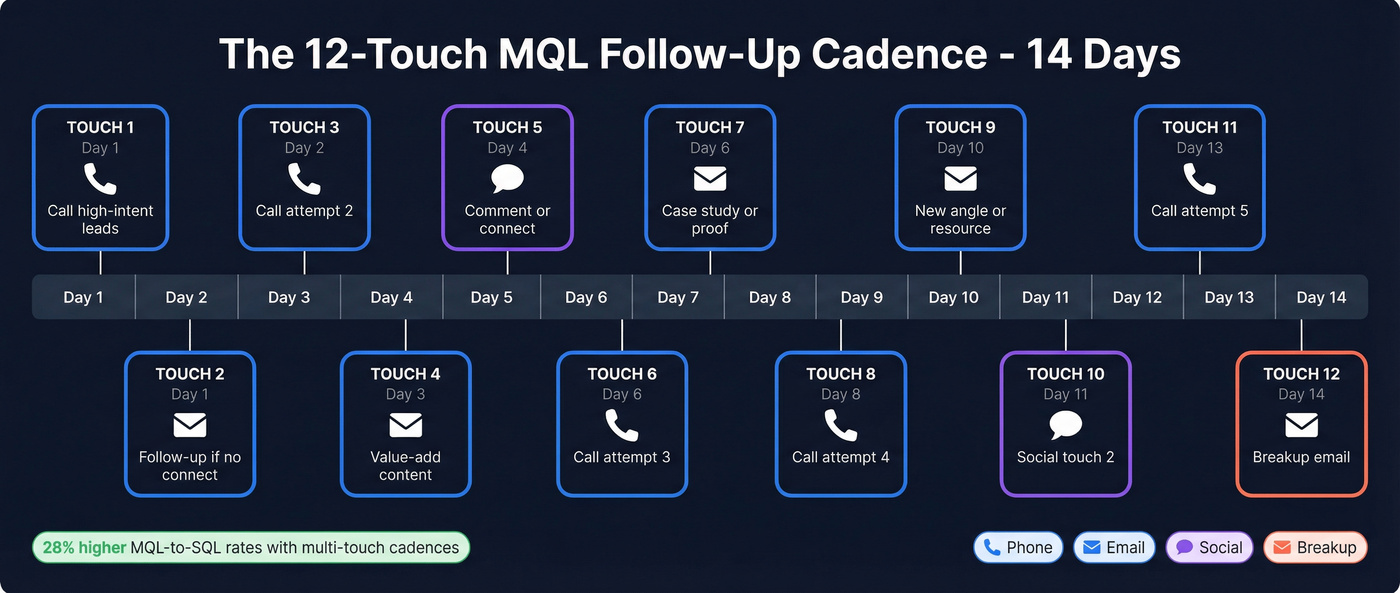
- Day 1 - Phone call (high-intent) or email (content download)
- Day 1 - Follow-up email if no phone connect
- Day 2 - Phone call attempt #2
- Day 3 - Email with value-add content
- Day 4 - Social touch (comment or connect request)
- Day 6 - Phone call attempt #3
- Day 7 - Email with case study or social proof
- Day 8 - Phone call attempt #4
- Day 10 - Email with new angle or resource
- Day 11 - Social touch #2
- Day 13 - Phone call attempt #5
- Day 14 - Breakup email
The spacing matters. Optimal time between follow-up calls is 3-5 days, with phone attempts clustered earlier when intent is freshest. It takes an average of 8 call attempts to reach a prospect - 6+ calls can boost contact rates by 70%. Average B2B email open rates sit around 22%, so volume matters. One email won't cut it.
Why layer in phone at all? Because 77% of B2B buyers prefer email as their primary contact method, but preference doesn't equal conversion. Phone connects on high-intent MQLs close faster. Email scales the rest.
Here's the thing: if your average deal size is under $10K, you can probably skip the phone touches entirely and run a tighter 8-touch email + social cadence. Phone outreach only pays for itself when the contract value justifies the SDR time.
One critical prerequisite - this cadence assumes verified contact data. If you're working off raw CRM exports with stale emails and switchboard numbers, you'll burn through the sequence hitting dead ends. Enrich and verify first. Run your MQL list through a tool like Prospeo before reps start dialing, and you'll eliminate bounces before they tank your email deliverability.
CRM implementation note: In HubSpot, set up workflow triggers for MQL threshold hits. In Salesforce, use lead assignment rules with time-based escalation. The specific tool matters less than the logic - auto-route, auto-escalate, auto-reassign.

A 12-touch cadence means nothing if 30% of your emails bounce. Prospeo enriches your MQL lists with 98% verified emails and 125M+ direct dials - refreshed every 7 days, not every quarter. Stop blaming lead quality when the real problem is stale data.
Enrich your MQL list before your SDRs burn a single touch.
Verify Contact Data Before Outreach
Your AE just told you the phone number bounced, the email came back undeliverable, and the "MQL" is actually an intern who downloaded a PDF. Sound familiar?
Bad contact data is the silent killer of lead follow-up. No one on your team will say "we didn't follow up because the data was wrong" - they'll just say the leads were bad. You'll blame marketing. Marketing will blame sales. The real culprit is sitting in your CRM: outdated emails, generic phone numbers, and contacts who changed jobs three months ago.
We've seen this play out dozens of times. A team runs a solid cadence, hits all their SLA targets, and still converts at half the industry benchmark. They assume the leads are garbage. Then they run the same list through a verification tool and discover 30% of the emails were invalid and another 15% were catch-all domains that never delivered. The leads weren't bad - the data was.
Prospeo handles this with CSV and CRM enrichment that returns 50+ data points per contact at 98% email accuracy, plus 125M+ verified mobile numbers with a 30% pickup rate. The 7-day data refresh cycle means you aren't working off stale records from last quarter.
Your SLA says respond in 10 minutes. But your reps are spending that time hunting for valid emails and direct dials. Prospeo's CRM enrichment returns 50+ data points per contact at a 92% match rate - so reps spend those 10 minutes selling, not searching.
Give your SDRs verified contact data the moment an MQL fires.
Nail the MQL Handoff to Sales
The SLA is the single most underbuilt piece of most B2B GTM operations. Only 22% of companies feel marketing and sales are tightly aligned. The ones that do grow ~20% per year. The math isn't subtle.
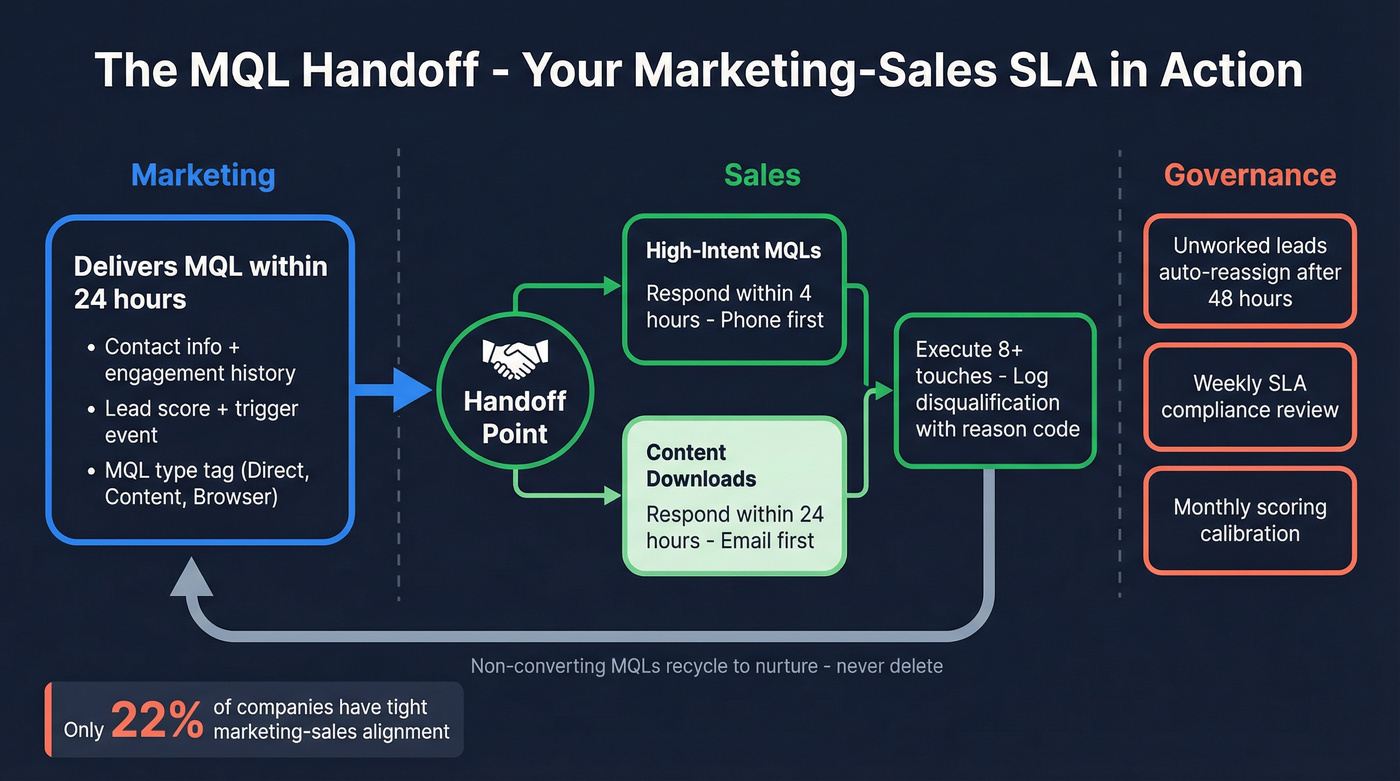
Let's be honest - the frustration on both sides is real. Marketing says leads are qualified, sales says they're garbage, and nobody has the data to prove who's right. We've sat in those finger-pointing meetings. A well-documented handoff fixes it by defining exactly what information travels with each lead and who owns the next action.
Adapt this SLA template today:
Marketing commits to handing off MQLs within 24 hours of qualification, including required data - contact info, engagement history, lead score, and trigger event - and tagging each MQL by type (Direct Request, Content Download, etc.).
Sales commits to:
- Respond to high-intent MQLs within 4 hours
- Respond to content downloads within 24 hours
- Execute minimum 8 follow-up touches per MQL
- Log disqualification with a reason code (wrong ICP, bad timing, no budget, competitor)
- Recycle non-converting MQLs back to marketing nurture - never delete
Governance:
- Unworked leads auto-reassign after 48 hours
- Weekly SLA compliance review (% of MQLs worked within SLA, average touches per lead)
- Monthly scoring model calibration based on disqualification reasons
Without the governance layer, the SLA is just a document nobody reads. Auto-reassignment is what gives it teeth.
Measure, Recycle, and Optimize
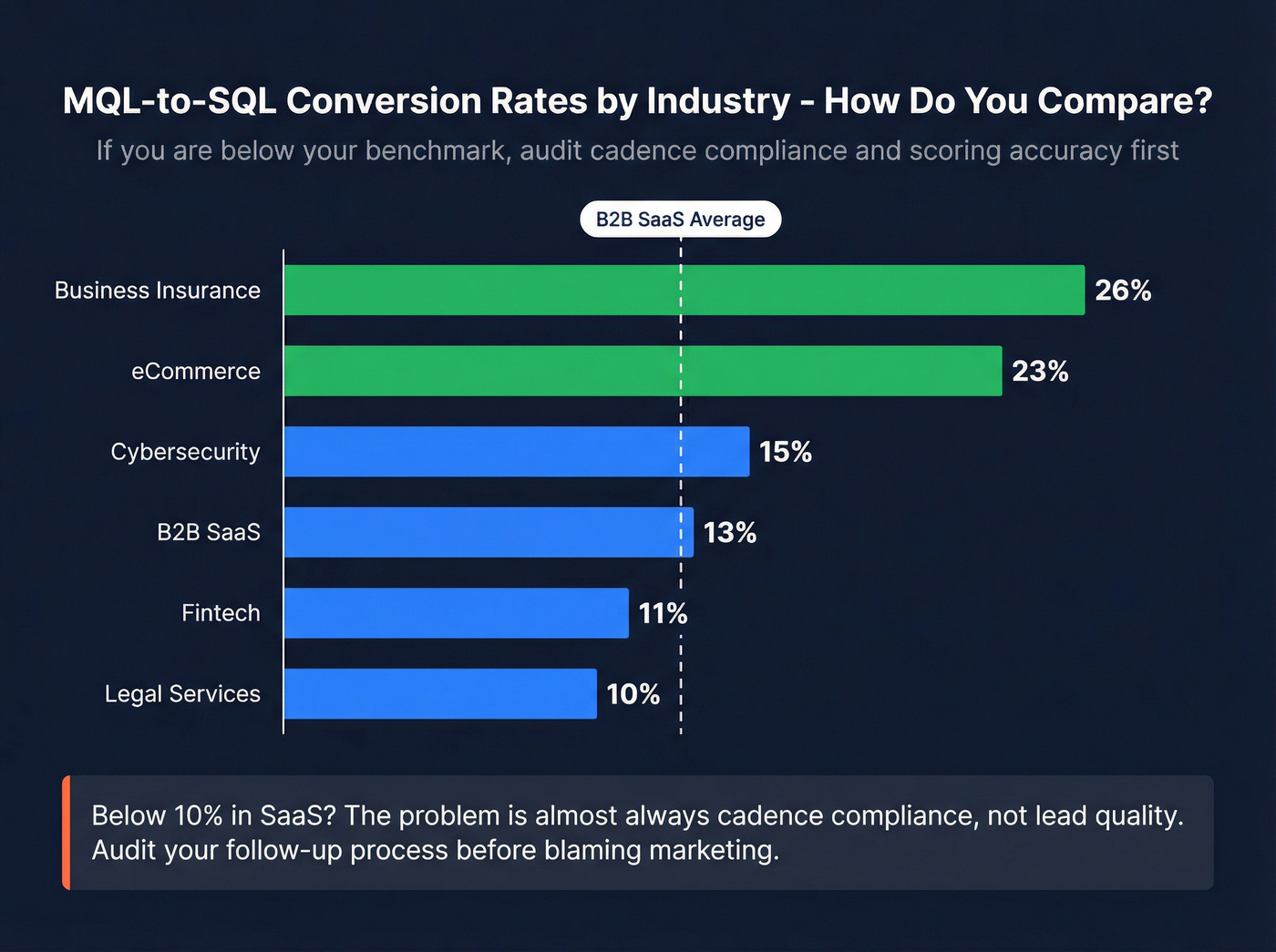
You need benchmarks to know if your process is working. MQL-to-SQL conversion rates by industry for calibration:
| Industry | MQL-to-SQL Rate |
|---|---|
| B2B SaaS | 13% |
| Cybersecurity | 15% |
| Fintech | 11% |
| Legal Services | 10% |
| Business Insurance | 26% |
| eCommerce | 23% |
If you're significantly below your industry benchmark, audit two things before blaming lead quality: follow-up cadence compliance and lead scoring accuracy. The problem is almost always one of those two.
The feedback loop is what separates good teams from great ones. Sales must log disqualification reasons. Marketing uses those reasons to refine scoring criteria and targeting. If 40% of disqualified MQLs are tagged "wrong ICP," that's a targeting signal for marketing to adjust ad audiences or content topics. If "bad timing" dominates, your lead nurturing sequences need work, not your targeting.
Revisit your qualification criteria quarterly based on these disqualification patterns. This keeps your scoring model honest and prevents MQL inflation. Leads that don't convert re-enter nurture with adjusted scores - they're recycled, never deleted. Today's "not ready" is next quarter's closed-won if you keep the relationship warm.
Skip this step if you're converting above benchmark. But if you're below 10% MQL-to-SQL in SaaS, the consensus on r/sales is almost always the same: it's cadence compliance, not lead quality.
MQL Follow-Up Email Templates
Templates are starting points, not scripts. Personalize every one to the trigger event.
Demo Request Follow-Up
Subject: Your [Product] demo - quick next step
Hi [First Name], saw your demo request come through. I just tried calling - wanted to connect while [specific pain point from the form] is top of mind. Would [Day] at [Time] work for a 15-minute walkthrough?
Content Download Follow-Up
Subject: Two resources deeper than [Asset Title]
Hi [First Name], thanks for grabbing [Asset Title]. If you're exploring [topic], these two go further: [Link 1] and [Link 2]. Worth a quick chat about how [your company] handles this for teams like yours?
Webinar Attendee Follow-Up
Subject: Re: [Webinar Title] - one thing we didn't cover
Hi [First Name], glad you joined [Webinar Title]. One thing we ran out of time for: [relevant extension of the topic]. Worth a 15-minute conversation? I can share what we're seeing with similar teams.
Re-Engagement (No Response)
Subject: Should I close this out?
Hi [First Name], I've reached out a few times - totally understand if the timing's off. Hit reply with: (1) chat next quarter, (2) went another direction, or (3) stop reaching out. No hard feelings either way.
That last "one-stroke reply" format works because it reduces friction. The prospect doesn't need to compose a response - they just type a number. We've seen reply rates double with this approach compared to open-ended "just checking in" emails.
FAQ
How fast should you follow up with an MQL?
High-intent MQLs deserve a phone call within 5-10 minutes. Content downloads and webinar attendees should get an email within 24 hours. Every hour of delay costs conversions - speed-to-lead is the single highest-leverage variable in your entire follow-up sequence.
What's a good MQL-to-SQL conversion rate?
B2B SaaS averages 13%, cybersecurity 15%, and business insurance 26%. If you're below your industry benchmark, audit cadence compliance and your scoring model before blaming lead quality - those two factors explain most underperformance.
How do you keep MQL contact data accurate?
Run your list through a verification tool before reps start calling. With 98% email accuracy and a 7-day data refresh cycle, you eliminate bounces and stale records that would otherwise tank your cadence before it gets started.
What should the MQL handoff to sales include?
Every handoff should include verified contact info, the lead score with contributing signals, engagement history (pages visited, content downloaded, emails opened), and the trigger event that pushed the lead past the MQL threshold. Without this context, reps waste their first touch asking questions marketing already answered.