The Lead Nurturing Strategy Most Teams Get Wrong - And How to Fix It
79% of marketing leads never convert into sales. Not because the leads are bad - because the nurture system behind them is broken. Most B2B teams build a drip sequence, set it to autopilot, and wonder why pipeline stays flat. Meanwhile, 96% of visitors aren't ready to buy when they first touch your brand, and the nurture system meant to warm them up fails in three predictable ways.
Here's the thing: companies that get nurturing right generate 50% more sales-ready leads at 33% lower cost. That's not a marginal improvement. It's the difference between a pipeline that compounds and one that flatlines.
Three Reasons Your Nurture Program Fails
Bad Data Feeding Bad Sequences
If a third of your emails bounce, your sender reputation tanks before your nurture sequences get a chance. We've seen teams launch beautifully written 8-email campaigns only to discover their list was 30% invalid. By email three, even valid addresses land in spam. Verification before any sequence launch isn't optional - it's the foundation everything else sits on. (If you need a quick shortlist, start with an email ID validator.)

No Scoring Model
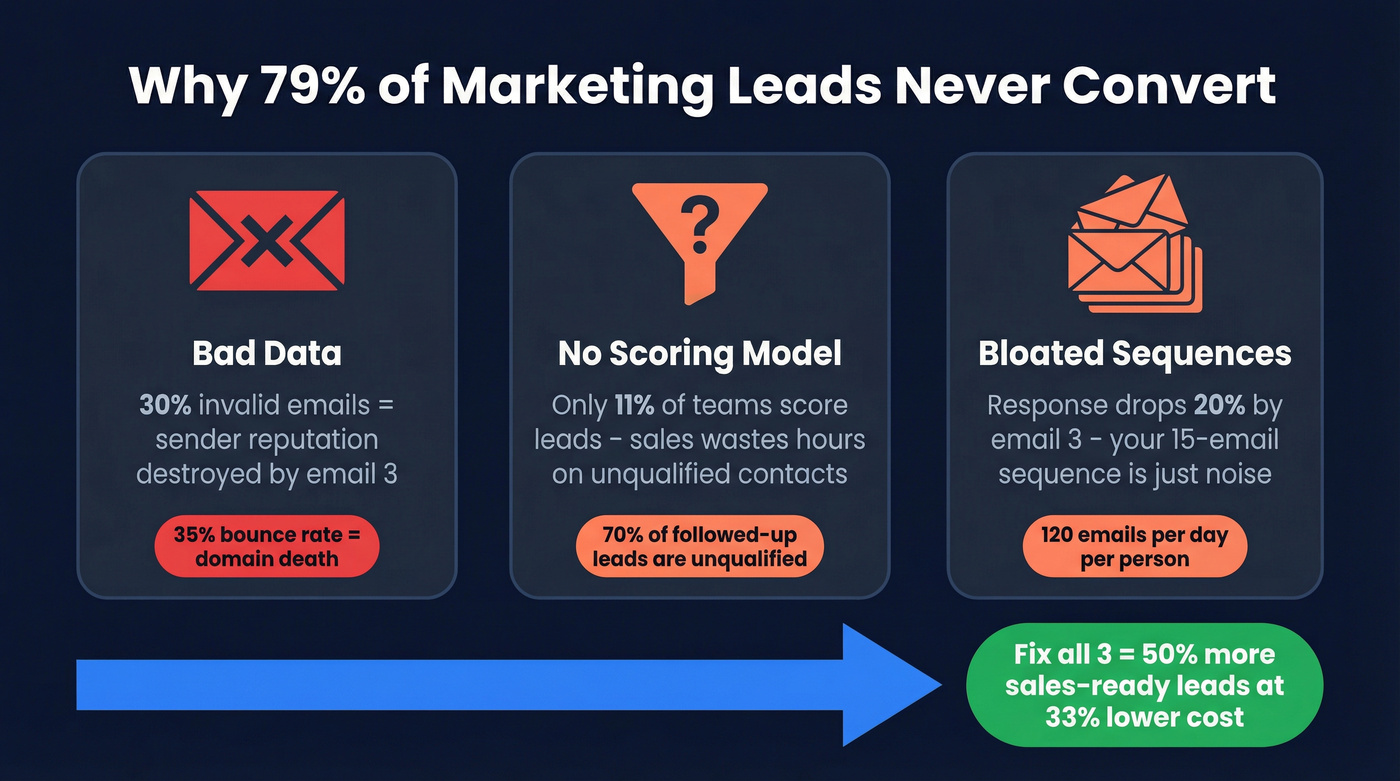
Only 11% of marketing automation users actually score their leads. The rest treat every download, every webinar registration, and every pricing page visit the same. Sales gets a firehose of "leads" with no signal about who's ready to talk.
Of the 20% of leads sales actually follows up on, 70% aren't qualified. That's your team burning hours on people who were never going to buy - because nobody built a filter. Without scoring baked into your nurture workflow, your pipeline stays full of noise. (If you want a deeper build guide, use this lead scoring system.)
Bloated Sequences
The instinct is to build a 15-email monster sequence. But response rates drop 20% by the third follow-up. The average person receives roughly 120 emails per day. Your 12-email nurture isn't persistent - it's noise.
Nurture Sequences That Work (With Templates)
SaaS Educational Sequence (30 Days)
This is the workhorse for most B2B SaaS teams. Eight emails over 30 days, front-loaded with value, case study at Day 20, soft CTA at Day 30. (For more examples, see these lead nurturing emails.)
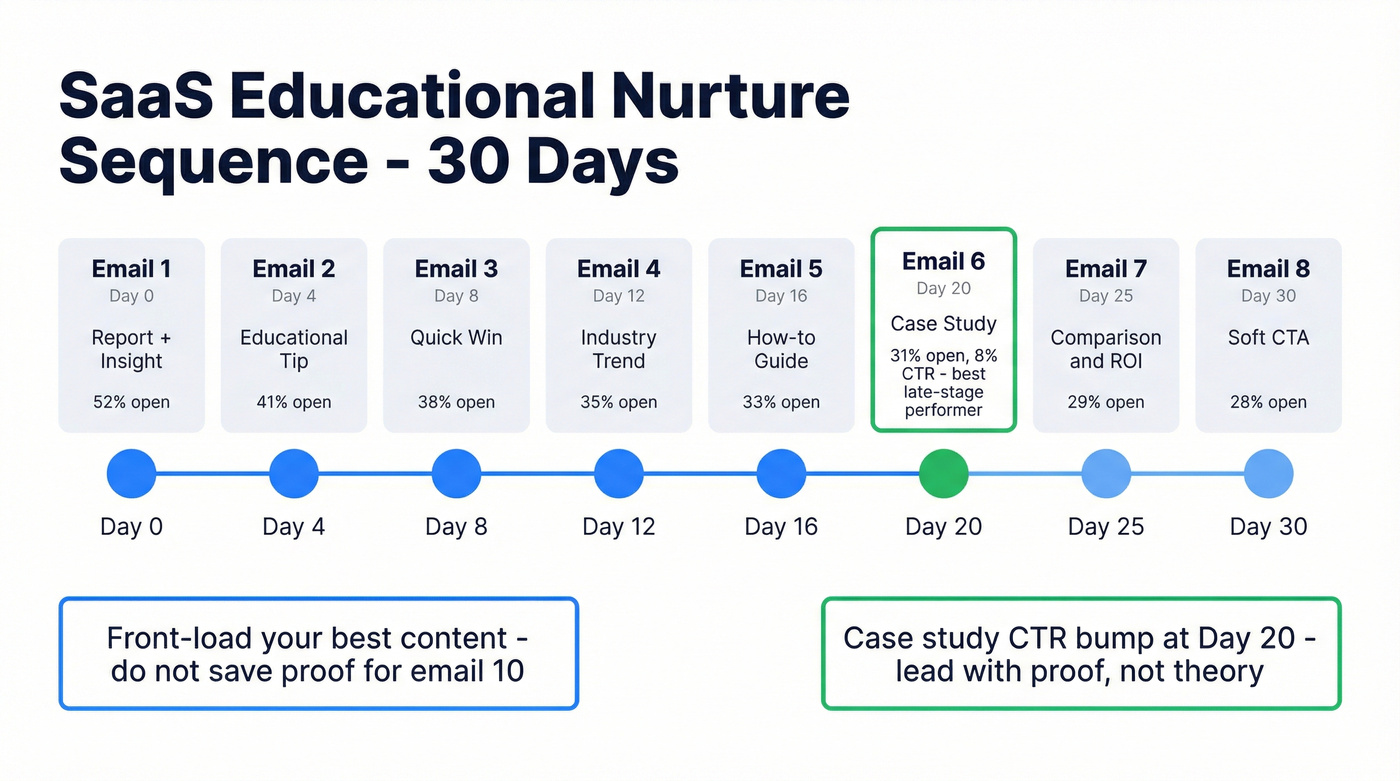
| Day | Focus | Open Rate | CTR | |
|---|---|---|---|---|
| 1 | 0 | Report + insight | 52% | 12% |
| 2 | 4 | Educational tip | 41% | 8% |
| 3 | 8 | Quick win | 38% | 7% |
| 4 | 12 | Industry trend | 35% | 6% |
| 5 | 16 | How-to guide | 33% | 7% |
| 6 | 20 | Case study | 31% | 8% |
| 7 | 25 | Comparison/ROI | 29% | 5% |
| 8 | 30 | Soft CTA | 28% | 4% |
Opens taper from ~52% to ~28%, and CTR follows. That's normal. The key is front-loading your best content - don't save the case study for email 10 when half your list has tuned out. Notice the CTR bump at email 6: case studies outperform generic educational content even late in the sequence. Lead with proof, not theory.
B2B Consultation Sequence (60 Days)
For enterprise deals with longer cycles, stretch to 10 emails over 60 days. Start with diagnostic questions, move through benchmarks and an ROI guide, then offer a personal meeting. This only makes sense when your average conversion cycle runs around 64.5 days and deal sizes justify the longer runway.
The flow: diagnostic questions (Days 1-7) → industry benchmarks (Days 10-20) → mistakes to avoid (Days 25-30) → case study + ROI guide (Days 35-45) → objection handling (Day 50) → personal meeting offer (Day 60).
Cadence Rules That Actually Matter
Following up within one day actually decreases response rates by 11%. Wait three days and replies jump 31%. That first follow-up is critical - 220% more leads answer after the initial follow-up compared to the original email alone. (If you want a ready-made structure, use a sales cadence example.)
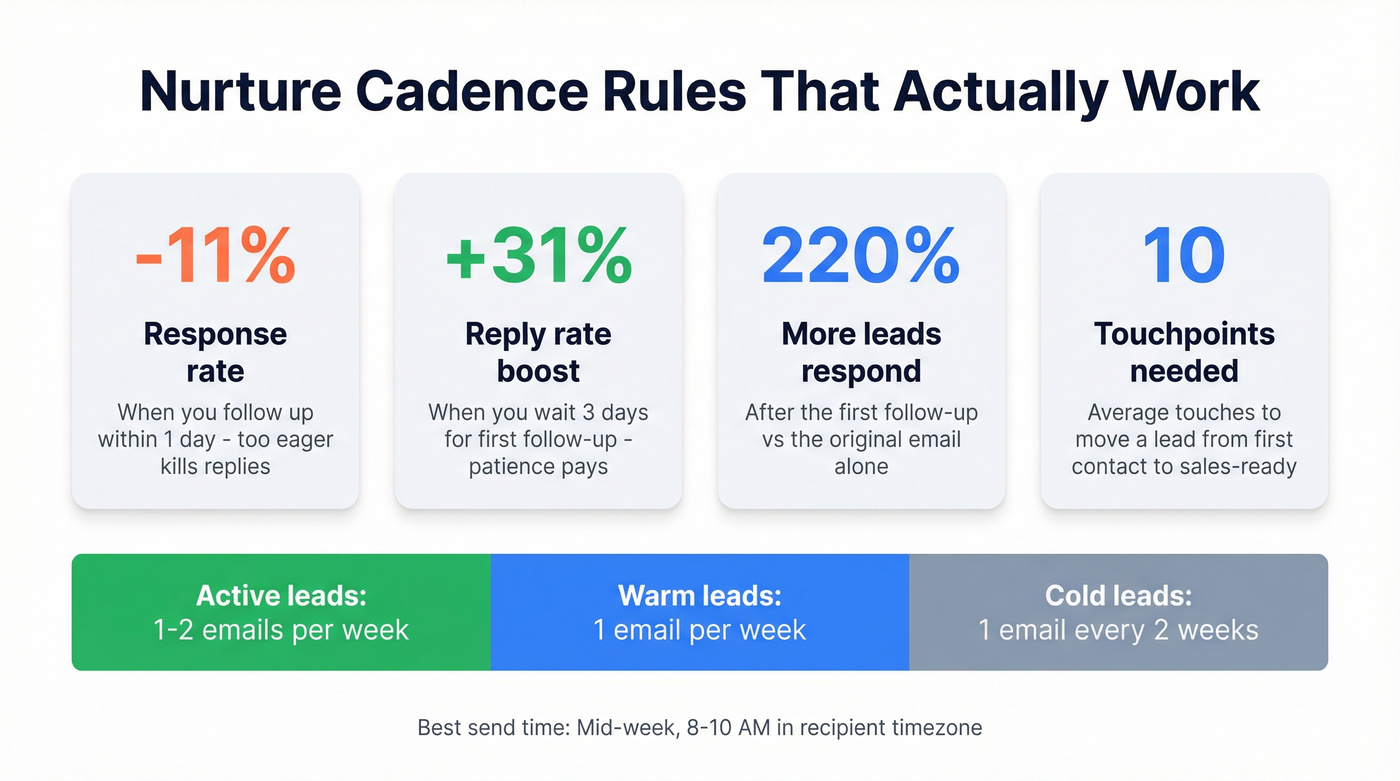
Active leads get 1-2 emails per week. Colder leads get one every two weeks. Mid-week sends between 8-10 AM in the recipient's timezone consistently outperform.
Plan for roughly 10 marketing touchpoints to move a lead from first contact to sales-ready. If someone goes quiet for 30-60 days, trigger a re-engagement sequence - don't let them rot in your CRM. The most common pattern we hear about in automation communities like r/sales and r/marketing: the nurture sequence was built once, never updated, and runs the same content to a VP of Engineering and a marketing intern. Segment or lose.
Beyond Email: Multi-Channel Nurture
Email carries the weight, but the best-performing nurture programs layer in other channels. Social retargeting ads that mirror your email content, personalized website experiences for returning visitors, and even direct mail for high-value enterprise prospects all increase touchpoint diversity. You don't need all of these on day one - but if your entire nurture plan lives in one inbox, you're leaving pipeline on the table. (If you're building this out, align it to a B2B omnichannel marketing plan.)
A Lead Scoring Model You Can Use Today
Companies using lead scoring report a 77% boost in ROI. Yet almost nobody does it. Here's a model you can implement this afternoon. (You can also add negative lead scoring to keep junk out of MQLs.)
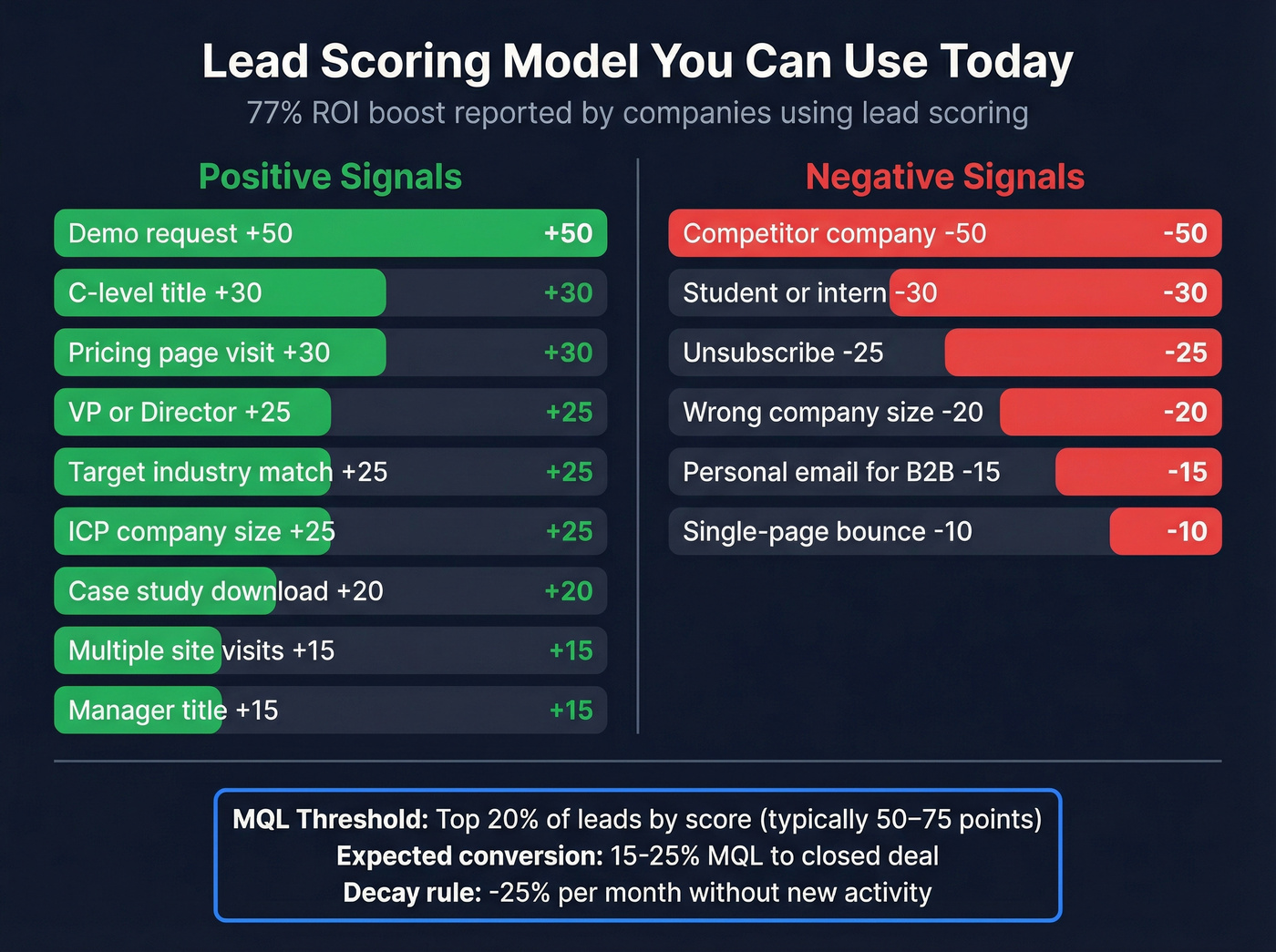
| Signal | Points |
|---|---|
| C-level title | +30 |
| VP/Director | +25 |
| Manager | +15 |
| Target industry match | +25 |
| ICP company size | +25 |
| Demo request | +50 |
| Pricing page visit | +30 |
| Case study download | +20 |
| Multiple site visits | +15 |
| Competitor company | -50 |
| Student/intern | -30 |
| Unsubscribe | -25 |
| Wrong company size | -20 |
| Personal email (B2B) | -15 |
| Single-page bounce | -10 |
Set your MQL threshold to capture the top 20% of leads by score - typically 50-75 points on a 100-point scale. Expect 15-25% conversion from MQL to closed deal. Decay scores by 25% per month without new activity, because a pricing page visit from six months ago doesn't mean what it meant then.
Start with 5-7 core criteria. Don't over-engineer it. Salesforce reported a 28% increase in SQL conversion rates after refining their scoring model quarterly through sales-marketing collaboration. The model doesn't need to be perfect on day one - it needs to exist.
Use progressive profiling to sharpen scores over time. Ask for 1-2 new data points per interaction instead of re-gating everything. Ungated thought leadership → gated case study → ungated demo. Each touchpoint fills in the picture without creating friction that kills conversion.

Your lead scoring model is useless if half your contacts bounce. Prospeo delivers 143M+ verified emails at 98% accuracy on a 7-day refresh cycle - so every lead in your nurture sequence actually reaches a real inbox.
Stop nurturing dead emails. Start with data that connects.
Fix Your Data Before You Launch Anything
A 35% bounce rate doesn't just waste emails - it craters your domain reputation. By email three in your nurture sequence, even valid addresses start landing in spam. This is the silent killer of nurture programs, and it's the one most teams ignore because they trust their data provider. No amount of clever copywriting compensates for rotten contact data. (If you're cleaning lists, follow a CRM verify workflow.)
Prospeo handles this at the source: 143M+ verified emails at 98% accuracy, refreshed on a 7-day cycle versus the 6-week industry average. Meritt dropped their bounce rate from 35% to under 4% after switching, and their pipeline tripled from $100K to $300K per week. The free tier gives you 75 verified emails per month plus 100 Chrome extension credits - enough to test the quality before committing.
Your nurturing system is only as good as the data feeding it. A perfectly crafted 8-email sequence means nothing if a third of those emails never arrive.
AI-Powered Nurturing in 2026
71% of organizations now use generative AI in marketing and sales. For nurture specifically, 41% use AI for lead magnet follow-ups and 32% build behavior-based sequences with it. This isn't experimental anymore - it's the baseline for competitive teams. (If you're implementing it, start with AI drip campaigns.)
Three AI functions that actually move the needle: predictive scoring that identifies which leads are most likely to convert, dynamic content personalization that tailors email body and CTAs per segment, and trigger-based journeys where a pricing page visit fires a personalized comparison email within hours. HubSpot's demand gen team reported 82% higher conversion rates, 30% better open rates, and 50% improved click-through rates after implementing AI-driven personalization.
Let's be honest: if your deals average under $10K, you probably don't need a $3,000/month Marketo instance with AI scoring. A well-built 8-email sequence in ActiveCampaign with clean data will outperform a bloated enterprise stack running on garbage contacts every single time. Complexity isn't a strategy.
Tools Worth Paying For
| Category | Tool | Starting Price | Best For |
|---|---|---|---|
| Data Quality | Prospeo | Free (75/mo); ~$0.01/lead | Verified emails + mobiles |
| CRM | HubSpot | Free; Marketing from $20/mo | Teams under 50 |
| CRM | monday CRM | $12/seat/mo (Standard) | Budget teams; min 3 seats |
| CRM | Salesforce | From $25/user/mo | Enterprise scale |
| Automation | ActiveCampaign | From $29/mo | Email + nurture workflows |
| Automation | Marketo | ~$1,000-3,000/mo | Enterprise marketing ops |
| Outreach | Instantly | From $30/mo | Cold email + nurture |
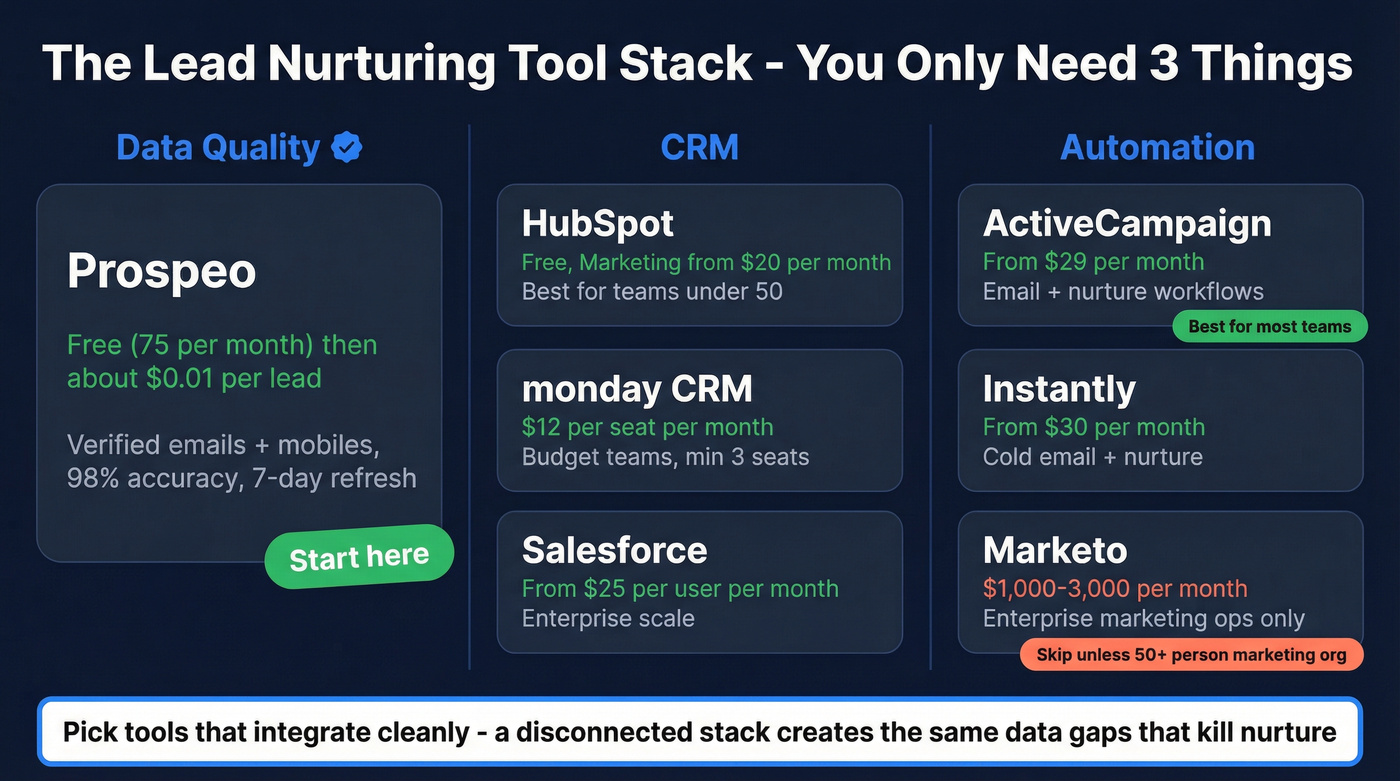
You need three things: a CRM, an automation platform, and a data provider that doesn't feed you garbage contacts. That's it. Everything else is optimization. Pick tools that integrate cleanly - a disconnected stack creates the same data gaps that kill your nurture plan in the first place. (If you're rationalizing spend, use a B2B sales stack blueprint.)
Skip Marketo unless you're running a 50+ person marketing org with complex multi-product nurture flows. For most teams, ActiveCampaign or HubSpot's marketing hub covers 90% of what you need at a fraction of the cost.
Five Mistakes That Kill Pipeline
Skipping data verification. A 35% bounce rate is domain death. Verify before you send. Always. SEO leads close at 14.6% versus 1.7% for outbound - if you're investing in inbound content to generate those high-quality leads, letting them bounce is burning money twice.
Building 12+ email sequences. Response drops 20% by the third follow-up. Eight emails over 30 days is the sweet spot for most teams. Front-load value, not volume.
Scoring leads on vibes. "They seemed interested" isn't a scoring model. Use the point system above. It takes an hour to set up and transforms pipeline quality. 80% of marketing automation users report increased leads after implementing proper scoring. The math is obvious.
Treating all leads the same. A VP who downloaded a case study and a student who grabbed a free template are not the same lead. Segment by role, stage, and industry. 96% of marketers report that personalized experiences increase sales - generic nurture is a losing bet. (If you need a framework, start with behavioral segmentation.)
Never re-engaging dormant leads. 80% of prospects that don't qualify today will buy from someone within 24 months. Set a 30-60 day re-engagement trigger. And don't stop at the sale - post-purchase nurture drives expansion revenue and referrals that most teams leave on the table entirely.
Meritt cut their bounce rate from 35% to under 4% and tripled pipeline to $300K/week. The fix wasn't better copy or longer sequences - it was replacing bad data with 98% accurate contacts at $0.01 per email.
Fix the data layer your entire nurture strategy depends on.
FAQ
How long does lead nurturing take to show results?
Most B2B leads take roughly 64.5 days to convert, so plan for 2-3 months before measuring pipeline impact. Nurtured leads move through the cycle 23% faster than non-nurtured ones. Track MQL-to-SQL conversion weekly to spot early momentum.
How many emails should a nurture sequence have?
Eight emails over 30 days is the sweet spot for most B2B sequences. Response rates drop 20% by the third follow-up, so front-load your best content - case studies and ROI proof - early. Stretch to 10 emails over 60 days only for enterprise deals exceeding $50K ACV.
What's the most overlooked part of lead nurturing?
Data quality. If a third of your emails bounce, your sender reputation tanks and every subsequent email lands in spam - even for valid addresses. We've watched teams spend weeks perfecting email copy while ignoring a list that's 30% invalid. Verify first, write second.