

B2B Omnichannel Marketing: The 2026 Strategy Guide
You ran a webinar campaign last quarter. Solid attendance, decent content, real pipeline potential. Then your SDRs started the follow-up sequence - 22% of the emails bounced, half the phone numbers were disconnected, and the social touches went to people who'd already talked to a different rep about a different product. Three channels, zero coordination, pipeline evaporated.
That's the core challenge of B2B omnichannel marketing. Buyers now use an average of 10 interaction channels during their buying journey, up from 5 in 2016. The channels aren't the hard part. Making them work together is.
The Short Version
- Clean your data first. No amount of channel orchestration fixes bounced emails and disconnected phones.
- Pick 4-5 channels your ICP actually uses. Omnichannel doesn't mean omnipresent.
- Choose an attribution model and commit for 90 days. Imperfect measurement beats no measurement.
- Align sales and marketing on one shared sequence, not parallel campaigns that confuse buyers.
What Is B2B Omnichannel Marketing?
Your buyer picks the channel. The context follows them - across email, phone, social, web, events, and self-serve portals - as one coordinated experience.
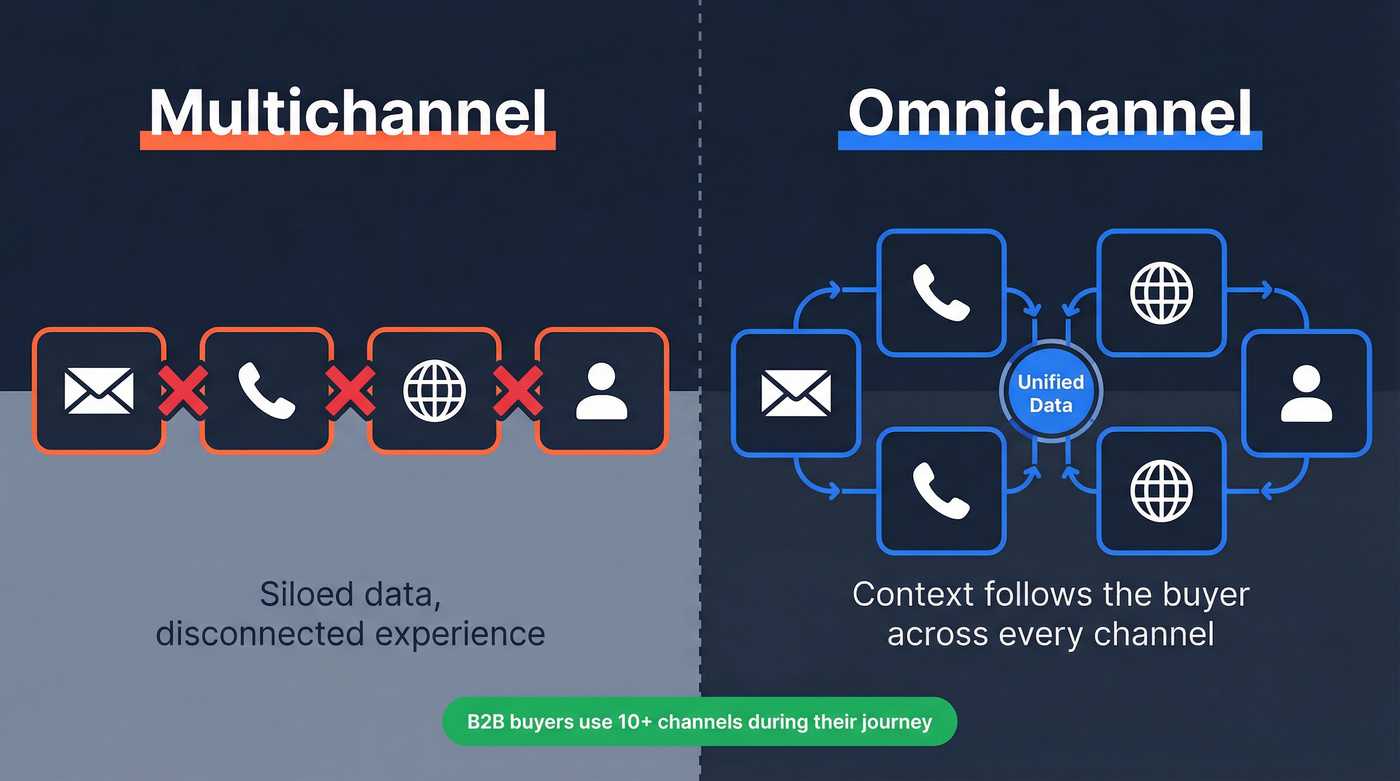
The distinction from multichannel matters more than most teams realize:
| Multichannel | Omnichannel | |
|---|---|---|
| Structure | Channels run in parallel | Channels orchestrated as one |
| Data | Siloed per channel | Unified across touchpoints |
| Buyer experience | Restarts at each channel | Continuous, context-aware |
| Measurement | Per-channel metrics | Cross-channel attribution |
McKinsey's "rule of thirds" captures why this matters: at any stage of the buying journey, roughly one-third of B2B buyers prefer in-person interaction, one-third prefer remote, and one-third prefer digital self-serve. That split holds across geographies, industries, and company sizes. Your buyers aren't choosing one channel. They're switching between all of them, sometimes in the same afternoon.
Why Cross-Channel Coordination Matters Now
The shift already happened.
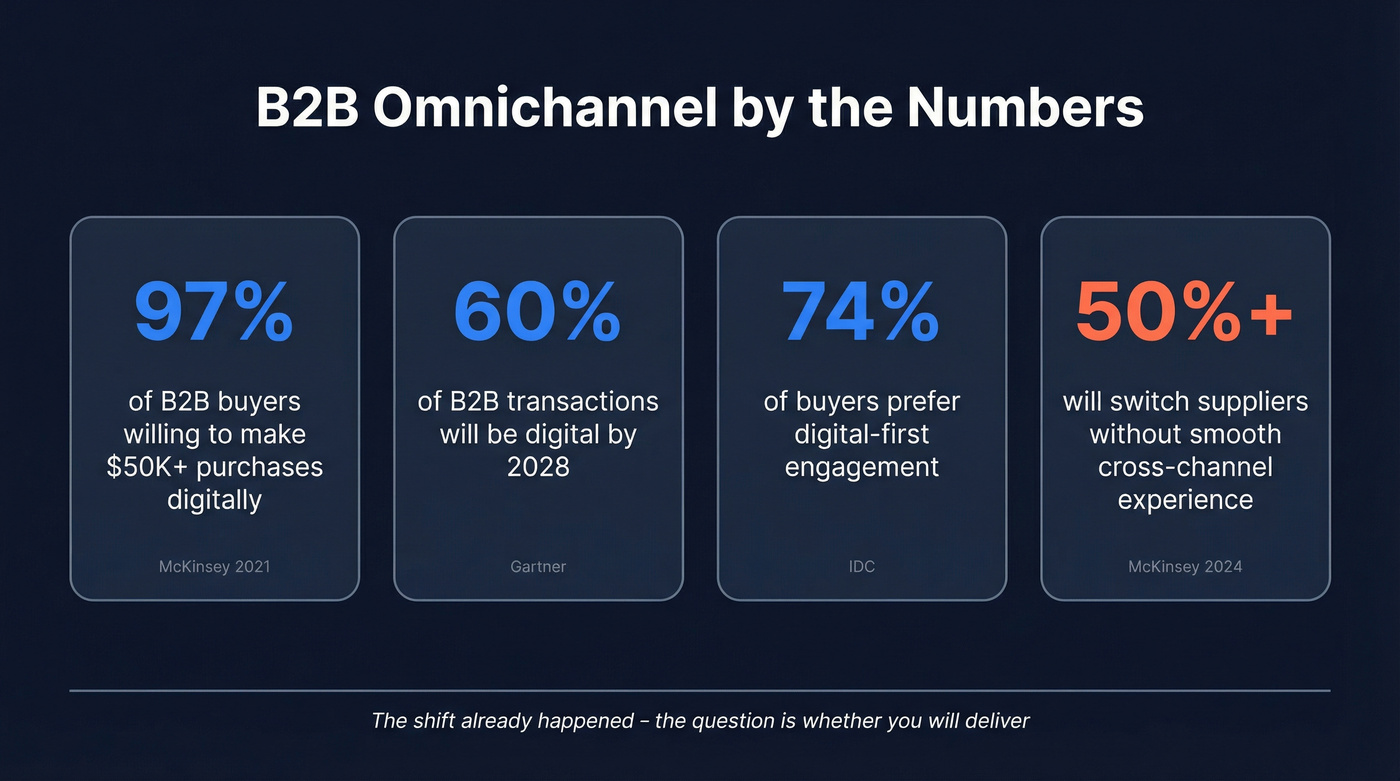
A 2024 survey of nearly 4,000 B2B decision makers across 13 countries found that more than half want a true omnichannel experience - and they'll switch suppliers without a smooth cross-channel journey. E-commerce is now the top B2B revenue channel, generating more than one-third of total revenue, while in-person revenue dropped 5 percentage points year-over-year.
By 2021, 97% of B2B buyers were willing to make digital self-serve purchases exceeding $50,000. Over 70% preferred remote interactions. Only about 25% wanted to go back to in-person sales. Gartner projects 60% of B2B transactions will be completed through digital commerce by 2028, and IDC puts it bluntly: 74% of buyers prefer digital-first engagement.
Here's the thing: if you're still debating whether to invest in coordinated cross-channel programs, you're not early. You're late. The question isn't whether your buyers want seamless experiences. It's whether you'll deliver them, or be the vendor they switch away from.
Omnichannel Mistakes That Kill Programs
We've seen the same five mistakes sink programs repeatedly.
Running channels as silos. Marketing runs email nurture. Sales works the phones. Social sits with a different team entirely. The buyer gets three disconnected experiences from the same company, and the consensus on r/sales echoes this constantly: "We have the tools, we just can't get them to talk to each other." That's a data and process problem, not a technology problem.
Over-automating without personalization. Personalized interactions lift engagement by 30% compared to generic touchpoints. Automation that doesn't personalize is just spam at scale.
Separating marketing intelligence from sales. If your SDRs can't see which accounts are surging on intent signals or which contacts engaged with last week's webinar, you're leaving pipeline on the table. Full stop.
Using static nurture sequences. A 12-email drip that ignores what the buyer did yesterday is worse than no nurture at all. Your cadence needs to adapt to real-time behavior - page visits, content downloads, pricing page views.
Ignoring data quality. The silent killer. 37% of marketers cite data quality as their top challenge in developing a multichannel strategy, and only 23% rate their strategy as "very successful." Those numbers aren't a coincidence. Verify emails and phone numbers before they enter your CRM. Prospeo catches bounces, spam traps, and disconnected numbers with 98% email accuracy and a 7-day data refresh cycle, but whatever tool you use, the principle is the same: garbage data in, garbage campaigns out.

You just read it: 37% of marketers say data quality is their top multichannel challenge, and 22% bounce rates kill pipeline before your omnichannel strategy even starts. Prospeo's 7-day data refresh, 98% email accuracy, and 125M+ verified mobiles mean every channel in your sequence actually reaches a real person.
Fix the data layer and your omnichannel strategy actually works.
How to Build a B2B Omnichannel Strategy
A contrarian note before we start: pick 4-5 channels, not 15. Your buyers use 10 channels, but your job is to be excellent in the ones that matter to your segment, not mediocre everywhere.
Define Your ICP and Buyer Journey
Map your ideal customer profile down to the role level, then document how those buyers actually move from problem-aware to purchase-ready. Don't guess - interview recent closed-won customers about their buying process. We've found that even five interviews reveal patterns your CRM data alone won't show you, like which channels buyers trust at different stages and which ones they actively ignore.
Audit and Clean Your Data
Every omnichannel strategy runs on contact and account data. If your CRM is full of stale emails, disconnected phones, and duplicate records, nothing downstream works. Run a full data audit before you build a single sequence. Skip this step if you enjoy watching 22% of your outbound bounce.
Align Sales and Marketing
One coordinated sequence per segment, not parallel campaigns. Sales and marketing should agree on who gets touched, through which channels, in what order, and with what messaging. If your SDRs are running a phone cadence that contradicts your marketing email sequence, the buyer notices - and they don't think "oh, two different teams." They think "this company is disorganized." (Revenue Operations Alignment is usually the fastest fix.)
Map Channels to Journey Stages
| Stage | Channels | Purpose |
|---|---|---|
| TOFU | Content syndication, social, paid media | Awareness and education |
| MOFU | Email nurture, webinars, retargeting | Consideration and evaluation |
| BOFU | Direct outreach, demos, proposals | Decision and close |
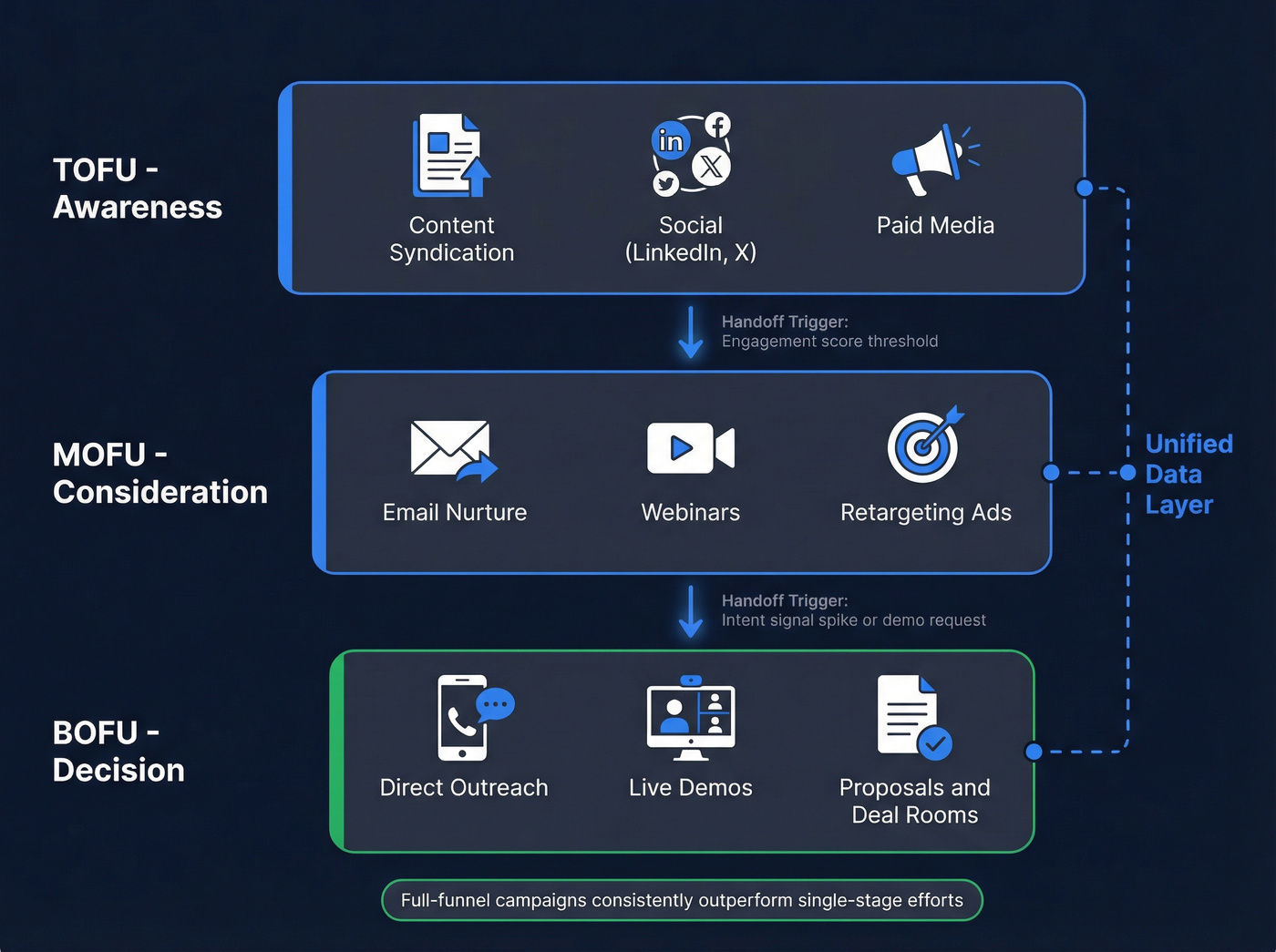
Build handoff triggers between stages so leads don't stall in the middle. Full-funnel campaigns that span all three stages consistently outperform single-stage efforts because they maintain context as the buyer progresses.
Build Outbound Sequences
Follow-ups drive 50-70% of total responses - the first touch is just the opening.
A strong outbound sequence runs 7-10 touchpoints across email, social, and phone over 2-3 weeks. Coordinate timing so each channel reinforces the others rather than repeating the same message. For teams that need a starting framework: email on day 1, social connection on day 2, phone on day 4, then alternate from there based on engagement signals. (If you want templates, start with a sales cadence you can copy/paste.)
Layer Intent Data
Not every account deserves the same effort. Intent data tells you which accounts are actively researching your category right now. Use it to prioritize sequences, personalize messaging, and time outreach to the moment of highest receptivity. Prospeo tracks 15,000 intent topics via Bombora, letting you layer buyer intent with job role and company growth signals to focus your omnichannel spend where it actually converts. If you need a starting point, build around intent signals and a simple scoring rubric.
Choose an Attribution Model
Pick a model (more below), implement it, and commit for 90 days before changing anything. The worst attribution model is the one you never implement.
The Omnichannel Tech Stack
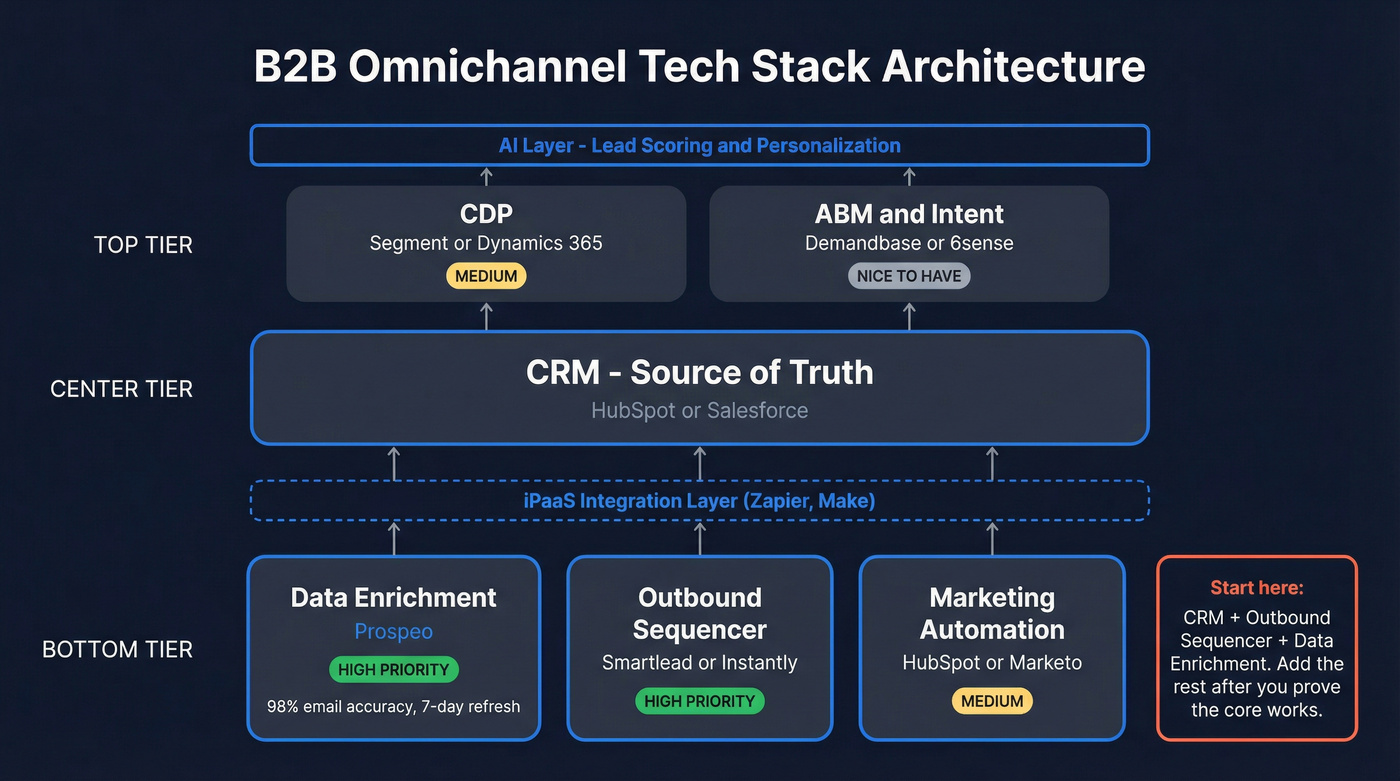
We've tested stacks with 12+ tools and stacks with 4. The smaller stack wins every time.
| Category | Priority | Example Tools | Price Range |
|---|---|---|---|
| CRM | High | HubSpot, Salesforce | Free-$300+/user/mo |
| Data Enrichment | High | Prospeo | ~$0.01/email, free tier |
| Outbound Sequencer | High | Smartlead, Instantly | $30-100/mo |
| Marketing Automation | Medium | HubSpot, Marketo | $800-3,500/mo |
| CDP | Medium | Segment, Dynamics 365 CI | $1K-10K+/mo |
| iPaaS | Medium | Zapier, Make | Free-$500+/mo |
| ABM/Intent | Nice-to-have | Demandbase, 6sense | $30-100K+/yr |
Start with CRM + outbound sequencer + data enrichment. Add CDP and ABM only after you've proven the core stack works.
The architecture pattern that works, per Wipfli's framework: CRM as the central source of truth, connected to your CPQ/deal rooms, CDP, and outbound tools through an iPaaS integration layer. AI sits on top for lead scoring and personalization.

Let's be honest: most teams overspend on ABM platforms and underspend on data quality. A $30-100K/year intent platform is worthless if 22% of your outbound emails bounce. Data enrichment is the cheapest layer in your stack and the one most teams skip, which is exactly why their cross-channel campaigns break down before they produce results. If you want to quantify the problem, start with B2B contact data decay benchmarks.
Attribution Models for Omnichannel
Attribution is where most programs stall. Teams debate models for months instead of picking one and learning from it.
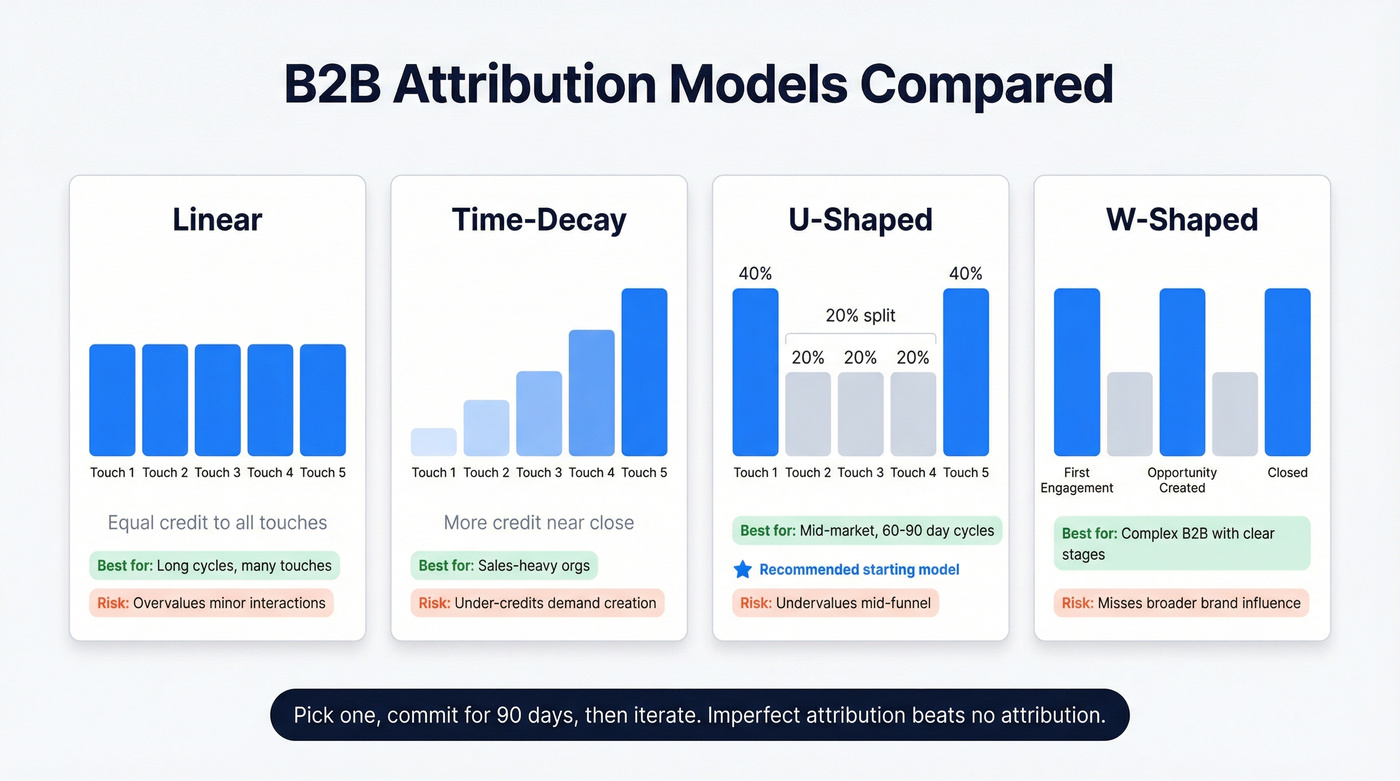
| Model | How It Works | Best For | Limitation |
|---|---|---|---|
| Linear | Equal credit to all touches | Long cycles, many touches | Overvalues minor interactions |
| Time-Decay | More credit near conversion | Sales-heavy orgs | Under-credits demand creation |
| U-Shaped | 40/40/20: first + last heavy | Mid-market, 60-90 day cycles | Undervalues mid-funnel nurture |
| W-Shaped | Weights 3 key milestones | Complex B2B with clear stages | Misses broader brand influence |
HockeyStack's framework defines four milestone touchpoints that map cleanly to B2B: First Engagement, Last Marketing Interaction, Opportunity Created, and Opportunity Closed.
In our experience, U-shaped attribution gives mid-market teams the clearest signal. It properly weights the channels that create awareness and the ones that close deals, without overcomplicating things. Run it for 90 days, then iterate. Imperfect attribution beats no attribution every single time. (If you want the plumbing right, set up CRM lead source tracking before you touch dashboards.)
GenAI and What's Coming
GenAI is already reshaping omnichannel execution. 19% of B2B sales forces are implementing GenAI use cases and 23% are experimenting. Teams blending personalization with GenAI are 1.7x more likely to increase market share.
The forward-looking projections are striking. Gartner predicts 20% of B2B sales organizations will use digital twins of customers by 2027 - AI models that simulate how specific accounts will respond to different channel strategies. By 2028, 15 billion connected products will act as autonomous buyers, purchasing services and supplies without human intervention.
More than one-third of CMOs say creating a unified omnichannel journey will shape their strategy in the next 12-18 months. The infrastructure you build now - clean data, coordinated channels, working attribution - becomes the foundation GenAI tools optimize on top of. Skip the foundation, and the AI layer has nothing useful to work with. If you're operationalizing this, start with AI in sales cadences rather than random one-off prompts.
Omnichannel coordination falls apart when sales and marketing work from different data. Prospeo unifies your contact intelligence - 300M+ profiles, intent data across 15,000 topics, and 50+ enrichment data points per contact - so every channel shares the same verified, current buyer context.
One source of truth for every channel in your stack.
FAQ
What's the difference between omnichannel and multichannel in B2B?
Multichannel means you're present on multiple channels independently, but each operates in its own silo. Omnichannel means those channels are coordinated so the buyer gets a consistent, context-aware experience regardless of where they engage. A buyer who downloads a whitepaper should trigger a different phone script than one who visited your pricing page.
How many channels should a B2B omnichannel strategy include?
Four to five channels where your ICP actually engages - not every channel that exists. Spreading thin across 10+ channels with inconsistent messaging is worse than owning five with tight orchestration. Start with email, phone, one social platform, and your website, then expand based on engagement data.
What's the first step to building an omnichannel program?
Clean your data. With 37% of marketers citing data quality as their top multichannel challenge, no amount of channel orchestration compensates for bounced emails. Verify your database before building sequences - it's the single highest-ROI hour you'll spend on the entire program.
How do you measure omnichannel campaign performance?
Start with U-shaped attribution (40% credit to first touch, 40% to last, 20% distributed across the middle) and commit for 90 days before switching models. Track cross-channel metrics - not just per-channel vanity numbers - to understand which combination of touchpoints actually drives pipeline.