

The Best Email ID Finder Tools in 2026
Every tool on the market claims 92-99% email accuracy. Here's what actually happens: an SDR uploads 500 prospects on Monday morning, launches a sequence by noon, and wakes up Tuesday to a 40% bounce rate and a domain reputation in freefall. The right email ID finder prevents that nightmare entirely.
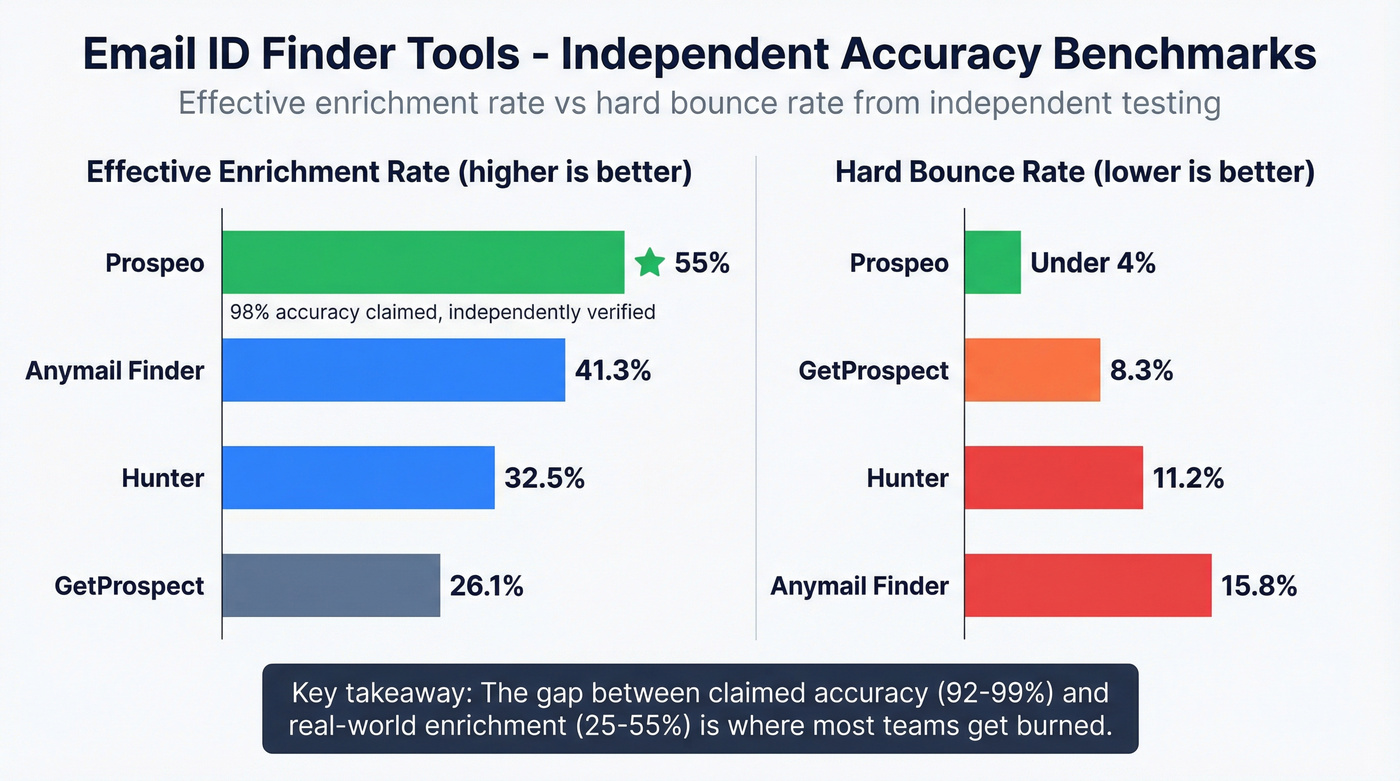
Independent benchmarks tell a different story than vendor marketing - effective enrichment rates land between 25% and 55% depending on the tool, the data freshness, and how they handle catch-all domains. That gap between "claimed accuracy" and "emails that actually land" is where most teams get burned.
We've tested these tools against real prospect lists and stacked them against independent benchmarks. Here's what's actually worth your money.
Our Top Picks (TL;DR)
| Pick | Tool | One-Line Verdict |
|---|---|---|
| Best accuracy | Prospeo | 98% accuracy, 7-day refresh, free tier |
| Largest ecosystem | Hunter | Big brand, 32.5% enrichment rate |
| Best all-in-one | Snov.io | Find + sequence + warm-up in one |
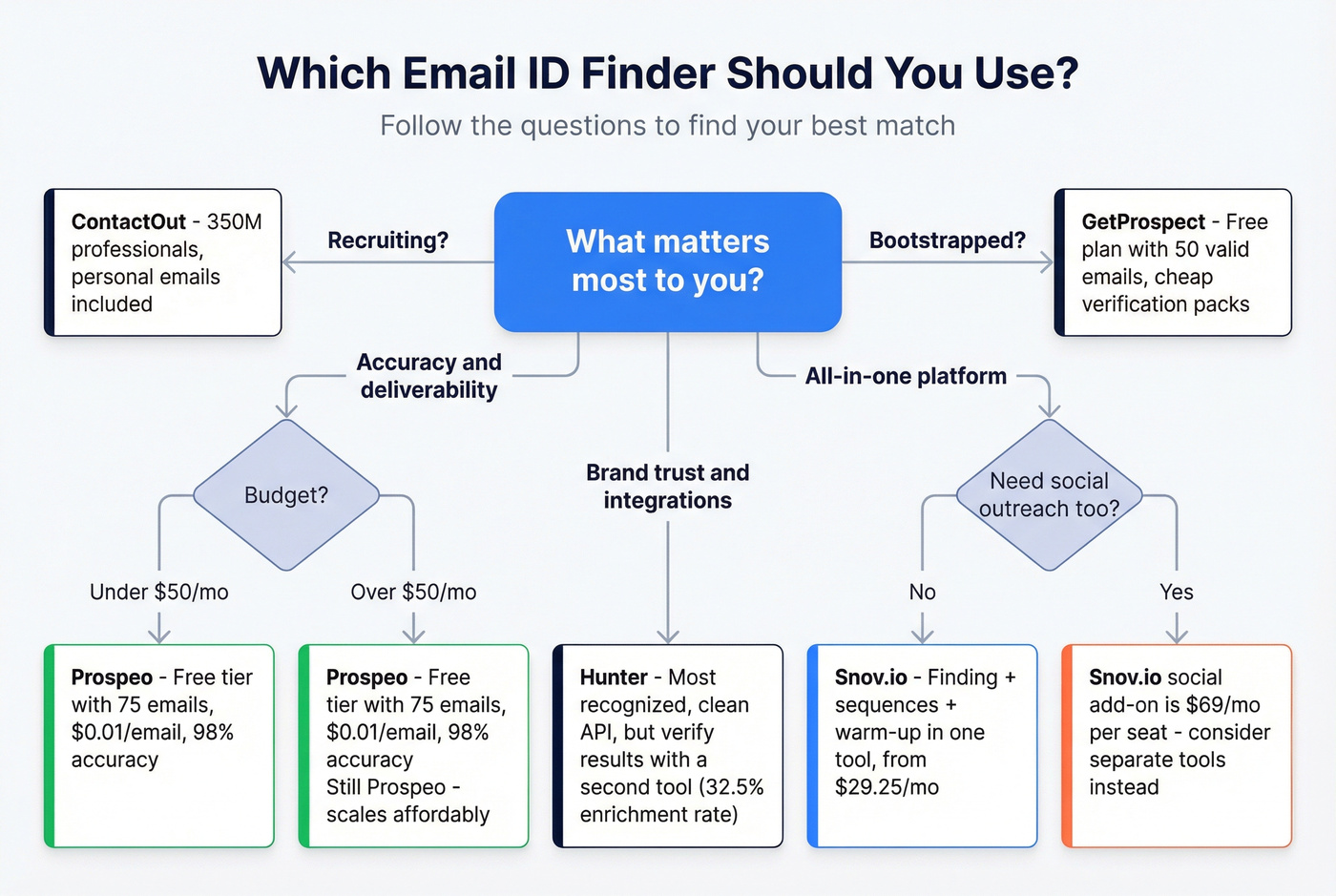
Prospeo wins on data quality and cost-per-valid-email. Hunter wins on brand trust and ecosystem integrations. Snov.io wins if you want finding, sequencing, and warm-up under one roof. The rest of this article explains why - and covers six more tools worth knowing about.
How Email Finders Actually Work
Most people think email finders just "look up" an address. The reality involves three distinct technical steps, and understanding them explains why accuracy varies so wildly between tools.
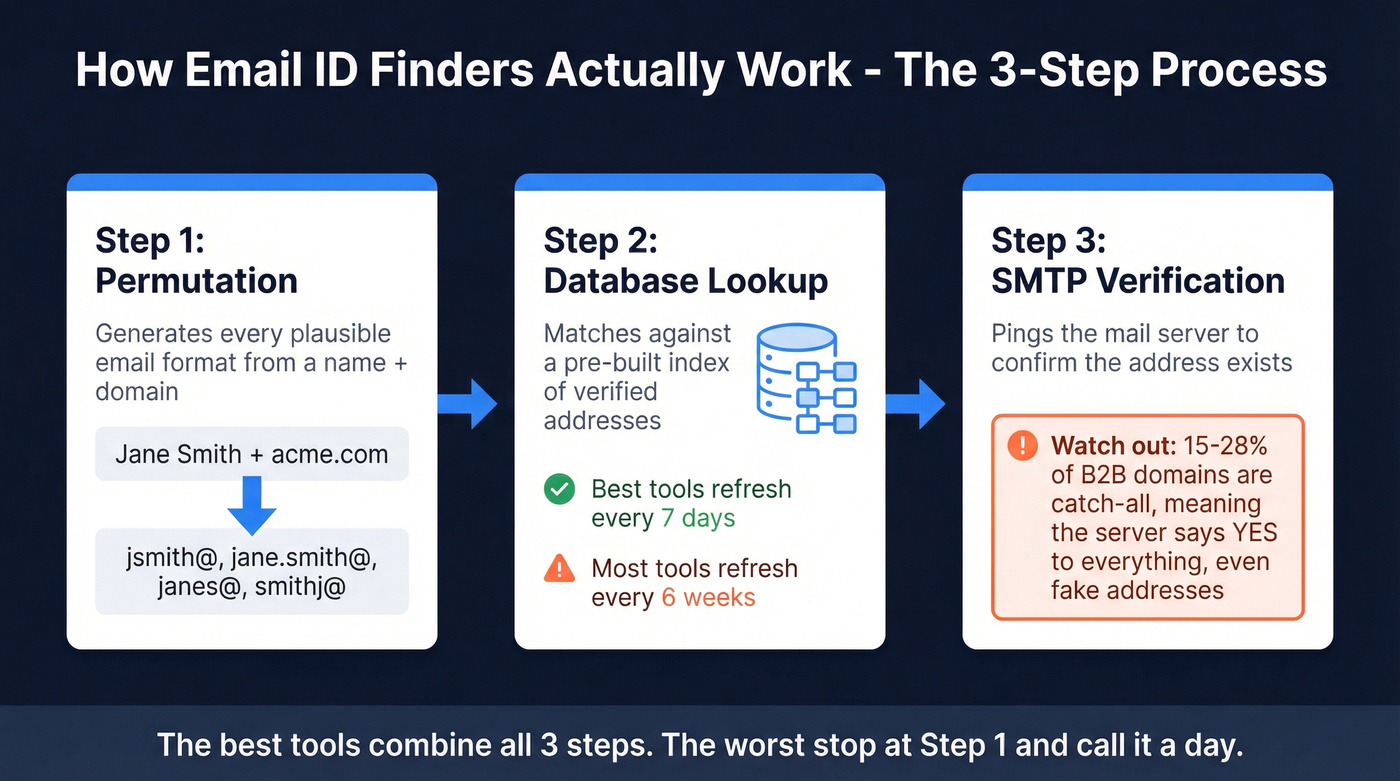
Step one: permutation. The tool takes a name (say, "Jane Smith") and a domain ("acme.com") and generates every plausible email format - jsmith@, jane.smith@, janes@, smithj@, and dozens more. An analysis of over 5 million companies found that startups with 1-10 employees use firstname@ 71% of the time, while enterprises with 10,001+ employees default to first.last@ 56% of the time. The crossover happens around 51-200 employees, where flast@ dominates at 42%.
Step two: database lookup. Better tools skip the guessing entirely and match against a pre-built database of verified addresses. Think of this step as using an email ID search engine - the tool queries a massive index of professional contacts rather than generating blind guesses. It's faster and more reliable, but only as good as the database's freshness. Most providers refresh around every 6 weeks. The best tools refresh every 7 days, and that's a meaningful difference when people change jobs frequently.
Step three: SMTP verification. The tool pings the recipient's mail server to confirm the address exists and accepts mail. This is where catch-all domains create chaos - between 15% and 28% of B2B domains are catch-all, meaning the server accepts everything, valid or not. Tools that can't handle catch-all verification will show a "valid" result for addresses that don't actually exist.
The best tools combine all three steps. The worst ones stop at permutation and call it a day.
Top 9 Email ID Finder Tools Compared
Prospeo - Best for Accuracy and Freshness
Prospeo's database covers 300M+ professional profiles with 143M+ verified emails, all running on a proprietary 5-step verification process. That process includes catch-all domain handling, spam-trap removal, and honeypot filtering - the three things that trip up most competitors.
If you want the full workflow, see our guide on how to use an email finder tool.
Use this if: You care about deliverability above everything else. The 98% email accuracy rate is backed by verification infrastructure built in-house rather than licensed from third-party providers. The 7-day data refresh cycle means you're not emailing people who changed jobs six weeks ago. Meritt saw their bounce rate drop from 35% to under 4% after switching, and their pipeline tripled from $100K to $300K per week.
Pricing: ~$0.01 per email. Free tier gives you 75 verified emails per month. No contracts, no sales calls required. The Chrome extension (40,000+ users) lets you find contact data from any website or CRM in one click.

Pairs with: Smartlead, Instantly, Lemlist, and Outreach for the sending side. Prospeo focuses on data accuracy; pick your favorite sequencer for delivery. If you're building a full stack, start with our roundup of cold email marketing tools.
Hunter - Most Recognized Brand
Hunter is the tool most people try first, and there's a reason - it's been around forever, the UX is clean, and the unified credit system is straightforward. One credit gets you one email found. Verifying an existing address costs half a credit. If nothing's found, you don't pay.

Use this if: You want a well-documented API, a brand your team already knows, and you're doing moderate-volume lookups. Hunter's pricing starts at $0 for 50 credits/month, then $49/mo for 2,000 credits on Starter ($34/mo billed annually), $149/mo for Growth, and $299/mo for Scale.
Skip this if: Accuracy is your top priority. In Dropcontact's 20,000-contact benchmark, Hunter landed at 32.5% effective enrichment with an 11.2% hard bounce rate. A separate Tomba benchmark showed Hunter finding valid emails for only 35.5% of domain searches. That's a lot of wasted credits if you're running high-volume campaigns.
Here's the thing: Hunter's brand recognition is an asset for getting buy-in from your team, but the numbers suggest you should verify Hunter results through a second tool before sending.
Snov.io - Best All-in-One Platform
Snov.io bundles email finding, verification, email sequences, and inbox warm-up into a single platform. For teams that don't want to stitch together three separate tools, that's genuinely appealing. If warm-up is a priority, compare options in our guide to automated email warmup.
Use this if: You're a small team that wants prospecting and outreach in one place. Starter runs $29.25/mo billed annually with 1,000 credits and 3 inbox warm-ups. Pro bumps to $74.25/mo with 5,000 credits and unlimited warm-ups.
Skip this if: You need automation beyond email. Snov.io's social outreach add-on costs $69/mo per seat - a hidden cost that can double your bill fast. And if you're already running Instantly or Smartlead for sequences, paying for Snov.io's built-in sequencer is redundant.
The credit math matters: each prospect found and each verification costs 1 credit. At 1,000 credits on Starter, you're looking at roughly 500 found-and-verified contacts per month if you're doing both steps.
Anymail Finder - Best Pay-Per-Valid Model
I watched a team burn through $400 in credits on another tool before realizing half the "found" emails were undeliverable. Anymail Finder's model exists to prevent exactly that - you only pay for emails that come back valid.
Use this if: You want zero risk on bad data. Starter is $9/mo billed annually with 600 credits per year. Standard jumps to $32/mo for 12K credits. Unused credits roll over up to 2x your plan limit, which is generous. A single company-name or domain search costs 1 credit and can return up to 20 valid emails - strong value for company-level prospecting. They even offer refunds if you can prove a bounce rate above 3% on a meaningful sample.
Skip this if: You need high volume at high accuracy. Independent testing showed Anymail Finder at 41.3% effective enrichment - solid - but with a 15.8% hard bounce rate, the highest among the top tools tested. The pay-per-valid model protects your wallet, but it doesn't protect your domain reputation if their "valid" emails still bounce at that rate.
GetProspect - Best Budget Option
Use this if: You're bootstrapped and need verified emails without a big monthly commitment. The free plan gives you 50 valid emails and 100 verifications - enough to test properly. Starter at $49/mo includes 1,000 valid emails. GetProspect only charges for verified contacts, unused credits roll over, and their verification credit packs are cheap: 10K verifications for $29, scaling down to ~$0.00025/verification at the 10M tier. For a deeper breakdown, see GetProspect pricing.
Skip this if: You're running high-volume outbound. Independent testing showed 26.1% effective enrichment and 8.3% hard bounce. Serviceable for small batches, but you'll want a better primary tool if you're sending thousands of emails per week.
ContactOut - Best for Recruiters
ContactOut positions itself squarely at recruiters, with a database covering 350M professionals and 200M work emails. The triple-verified process and hourly data updates are strong differentiators.
Use this if: You're in talent acquisition and need personal emails alongside work addresses. Their 150M personal email database is something most sales-focused tools don't offer. ContactOut also doubles as a contact information finder for recruiters who need phone numbers and social profiles alongside addresses. If you're hiring-focused, compare more options in email finder tools for recruiters.
Skip this if: You want transparent pricing. ContactOut doesn't publish self-serve pricing on its site. A widely cited breakdown puts the Email plan at ~$49/mo billed annually with a fair-use cap of 2,000 emails/month, and the Email + Phone plan at ~$99/mo capped at 2,000 emails plus 1,000 phone numbers.
Skrapp.io - Mid-Tier Alternative
Use this if: You need a simple Chrome extension for one-off lookups and light prospecting. Free tier available, paid plans from ~$49/mo. Decent for small teams doing manual prospecting who don't need bulk capabilities.
Skip this if: You're scaling outbound. Limited independent benchmark data makes it hard to evaluate for high-volume use cases. It's a reasonable option for teams doing under 500 lookups per month, but not one we'd bet a pipeline on.
Mailmeteor - Best for One-Off Lookups
Mailmeteor's free email finder requires no signup and handles single lookups with real-time processing - queries aren't stored or shared. Useful for checking one address before a cold call, but it's not built for prospecting at any scale.
EXPERTE.com - Free No-Signup Option
EXPERTE.com runs basic permutation plus SMTP checks for free, no account required. There's no database behind it and no bulk capability - think of it as a quick sanity check, not a prospecting tool.

You just read that most email finders stop at permutation. Prospeo runs a 5-step verification process - catch-all handling, spam-trap removal, honeypot filtering - on 143M+ emails refreshed every 7 days. That's why teams like Meritt cut bounce rates from 35% to under 4%.
Stop guessing email IDs. Start sending to verified ones at $0.01 each.
Pricing Comparison
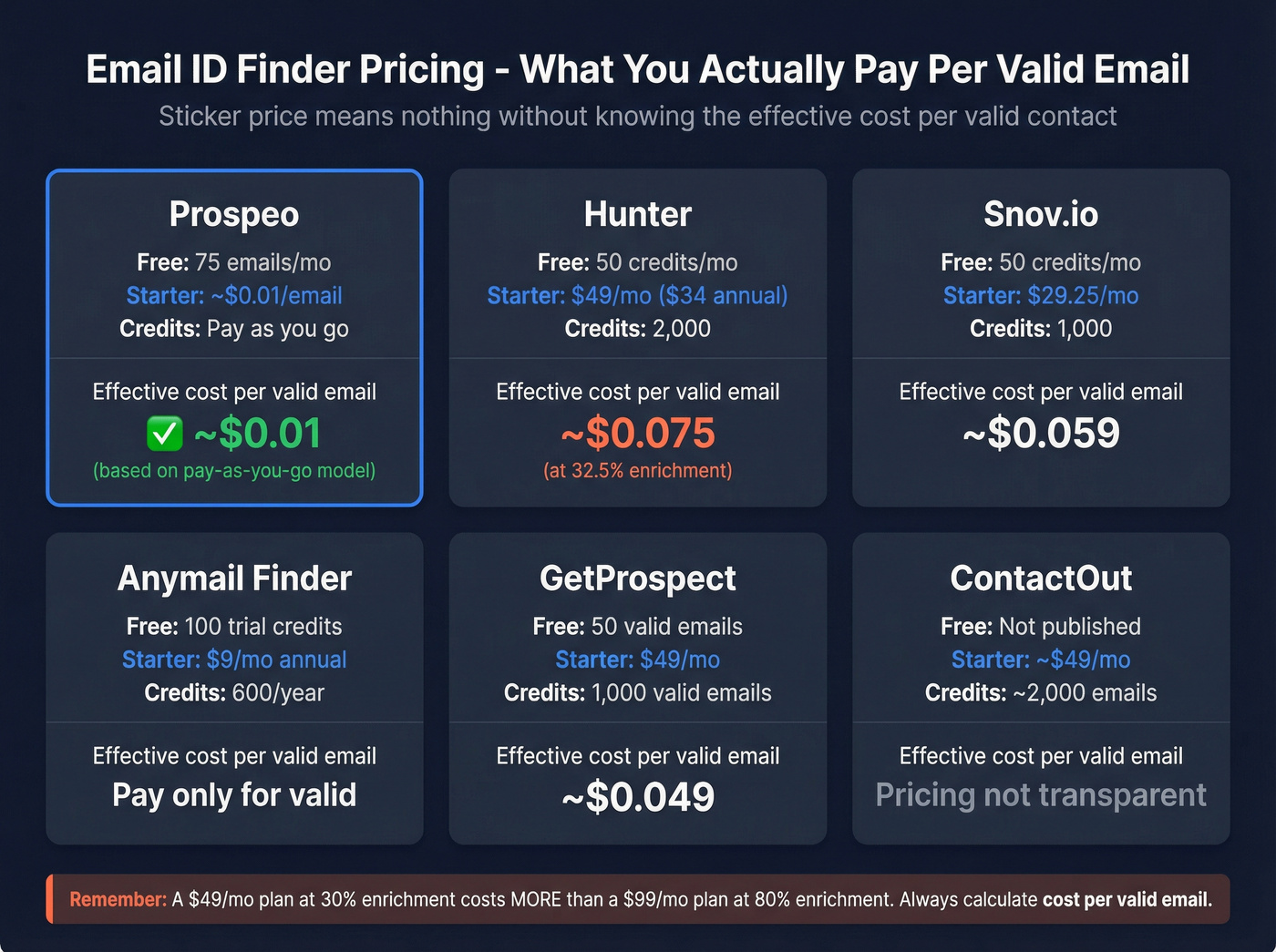
The sticker price of an email finder tool is almost meaningless without knowing the effective cost per valid email. A $49/mo plan that finds valid emails 30% of the time is more expensive than a $99/mo plan that hits 80%. The most common complaint across B2B prospecting communities - and a recurring theme on r/sales - is exactly this: paying full credit price for emails that bounce.
If you're deciding between finding vs verifying, this companion guide on email ID validators helps.
Plan Pricing Overview
| Tool | Free Tier | Starter Price | Credits Included |
|---|---|---|---|
| Hunter | 50 credits/mo | $49/mo ($34 annual) | 2,000 credits |
| Snov.io | 50 credits/mo | $29.25/mo | 1,000 credits |
| Anymail Finder | 100 trial credits | $9/mo (annual) | 600/year |
| GetProspect | 50 valid emails | $49/mo | 1,000 valid emails |
| ContactOut | 5 emails/day | ~$49/mo (annual) | ~2,000/mo cap |
| Skrapp.io | Yes | ~$49/mo | Varies |
| Mailmeteor | Free | N/A | Single lookups |
| EXPERTE.com | Free | N/A | Single lookups |
Cost Per Valid Email (Using Benchmark Data)
| Tool | Effective Rate | Cost/Valid Email | Model |
|---|---|---|---|
| Prospeo | 98% accuracy | ~$0.01 | Pay-per-valid |
| Anymail Finder | 41.3% enrichment | ~$0.032 | Pay-per-valid |
| GetProspect | 26.1% enrichment | ~$0.049 | Pay-per-verified |
| Snov.io | ~35% est. | ~$0.059 | Credit-based |
| Hunter | 32.5% enrichment | ~$0.075 | Credit-based |
The billing model matters as much as the price. Pay-per-valid tools don't charge you for failed lookups. Credit-based tools burn a credit whether the email is valid or not. Over thousands of lookups, that difference compounds fast.
Accuracy Benchmarks
Let's look at what independent testing actually shows - keeping in mind that both major benchmarks were run by vendors with skin in the game.
The Dropcontact benchmark tested 20,000 contacts across 15 tools. The Tomba benchmark ran 5,000 identical searches across 9 tools in February 2026.
| Tool | Effective Enrichment | Hard Bounce | Source |
|---|---|---|---|
| Dropcontact | 54.9% | 0.9% | 20K-contact test |
| Anymail Finder | 41.3% | 15.8% | 20K-contact test |
| Hunter | 32.5% | 11.2% | 20K-contact test |
| GetProspect | 26.1% | 8.3% | 20K-contact test |
| Tomba (domain) | 81.0% | N/A | 5K-search test |
| Anymail Finder (domain) | 76.7% | N/A | 5K-search test |
| Hunter (domain) | 35.5% | N/A | 5K-search test |

One insight the Tomba benchmark reveals that most comparisons miss: tool accuracy collapses when you only have a company name without a domain. Hunter actually performed slightly better in company-name-only searches (39.8%) than domain searches (35.5%), but most tools saw sharp drops. If your prospect list is light on domains, expect worse results across the board.
What's consistent across both benchmarks: Hunter underperforms its brand reputation on raw accuracy, and Anymail Finder finds a lot of emails but lets too many bad ones through.
If your average deal size is under five figures, you probably don't need the most expensive tool on the market. But you absolutely need the most accurate one. A single bounced email to a key prospect costs more than a month of any tool on this list - not in dollars, but in domain reputation and lost opportunity. If you're troubleshooting bounces, start with our guide to hard bounces.
The industry needs more independent, non-vendor benchmarks. Until then, run your own test. Take 200 contacts, split them across two or three tools, send through a verification service, and compare bounce rates. It takes an afternoon and saves you months of bad data.
Independent benchmarks show most email ID finders deliver 25-55% enrichment rates. Prospeo's proprietary infrastructure - no third-party email providers - hits 98% accuracy across 300M+ profiles. No contracts, no sales calls. 75 free emails to prove it.
Test 75 emails free and see your actual bounce rate drop.
How to Choose the Right Tool
The "best" email ID finder depends entirely on your workflow and volume. Here's a decision framework:
Solo founder or small team (under 500 lookups/month): Start with a free tier - GetProspect's 50 valid emails or a pay-per-valid model - and test accuracy on your actual ICP before spending anything. If you're building lists from scratch, use these list building tools to speed up the workflow.
SDR team doing high-volume outbound (1,000+ emails/week): Prioritize accuracy and cost-per-valid-email. Hunter wins if your team already lives in its ecosystem and you value the API documentation, but verify results through a second tool. If you're scaling safely, follow cold email volume best practices.
All-in-one outreach platform: Snov.io, if you want finding + sequencing + warm-up without integrating three tools. Budget the add-on costs carefully.
Budget-conscious teams: Anymail Finder's model means you never pay for bad data. Just verify independently before sending, given the benchmark bounce rates.
Recruiting: ContactOut is purpose-built for talent acquisition with personal email coverage most sales tools lack.
One pattern we see repeatedly: the best results come from a waterfall strategy. Use your primary email ID finder for the first pass, then run unfound contacts through a second tool. Two tools at 50% coverage each can get you to 75%+ combined - better than any single tool alone. The consensus on r/sales and r/coldemail backs this up: nobody trusts a single data source anymore, and the teams with the best deliverability are stacking two or three providers in sequence. If you're formalizing this approach, see our guide to waterfall alternatives.
Staying Compliant (GDPR & CAN-SPAM)
Using an email lookup tool doesn't exempt you from compliance. CAN-SPAM penalties run up to $50,120 per offending email. GDPR fines have totaled roughly EUR 5.88B across 2,245 enforcement actions.
Before choosing a tool, check for these compliance signals: a Data Processing Addendum available without negotiation, a clear data retention policy, disclosed hosting locations with Standard Contractual Clauses where data crosses borders, a published subprocessor list, deletion timelines under 48 working hours, and opt-out/suppression list support that honors your lists automatically. For a practical outbound view, use our GDPR for Sales and Marketing playbook.
On the technical side, make sure your sending infrastructure has SPF, DKIM, and DMARC configured before you send a single cold email. Google and Yahoo's bulk sender requirements make this non-negotiable. Always include a one-click unsubscribe. Use this SPF, DKIM, DMARC guide to get it right.
FAQ
What is an email ID finder?
An email ID finder discovers professional email addresses using a person's name and company domain. It works by testing email format permutations against mail servers or searching pre-verified databases to return a deliverable address. The best tools combine both approaches with real-time SMTP verification.
How do you find someone's email ID?
Enter the person's full name and their company domain into a finder tool like Prospeo, Hunter, or Snov.io - it generates likely address formats, checks them against its database, and verifies deliverability via SMTP. If you only have a company name, use a domain search first to identify the email pattern, then narrow down to your target contact.
Are email finder tools legal?
Yes, when used responsibly. B2B email finders pull publicly available professional data. You must comply with GDPR (EU) and CAN-SPAM (US) - include opt-out links, honor suppression lists, and have a lawful basis for outreach. Always check your target country's specific regulations.
How accurate are email finder tools really?
Vendor claims range from 92-99%, but independent benchmarks show effective enrichment rates of 25-55%. The gap comes from catch-all domains, stale data, and how each vendor defines "accuracy." Always verify results before sending - your domain reputation depends on it.
What's a good free email ID finder?
Prospeo gives 75 free verified emails per month with full verification included. Hunter offers 50 free credits, and GetProspect provides 50 free valid emails. Mailmeteor and EXPERTE.com let you search without creating an account - useful for one-off lookups but not for prospecting at scale.