

New Hire Buying Signals: The 90-Day Playbook
Your champion just left. They updated their profile on Monday, started at a new company by Wednesday, and by Friday three of your competitors have already emailed them. That's the new hire buying signal in action - and if you're not tracking it, you're leaving pipeline on the table.
Leadership changes produce 14% outbound response rates vs 1.2% for standard cold calls. Greenly built 48% of its pipeline by acting on job changes and new hires. These aren't marginal gains. They're the difference between a pipeline that grows and one that flatlines.
Most buying signal guides lump new hires in with 15 other triggers. That's a mistake. New hires are one of the highest-converting signal types, and they need a different playbook entirely.
What You Actually Need
70% of new executives make a technology purchase within their first 100 days. To capture that window, you need three things:
- Signal detection - a way to know when a decision-maker joins a target account
- Verified contact data - because new hires are the hardest segment for email accuracy
- A 48-hour response window - the vendor that gets ranked first late in selection wins roughly 80% of the time
The 90-Day Window
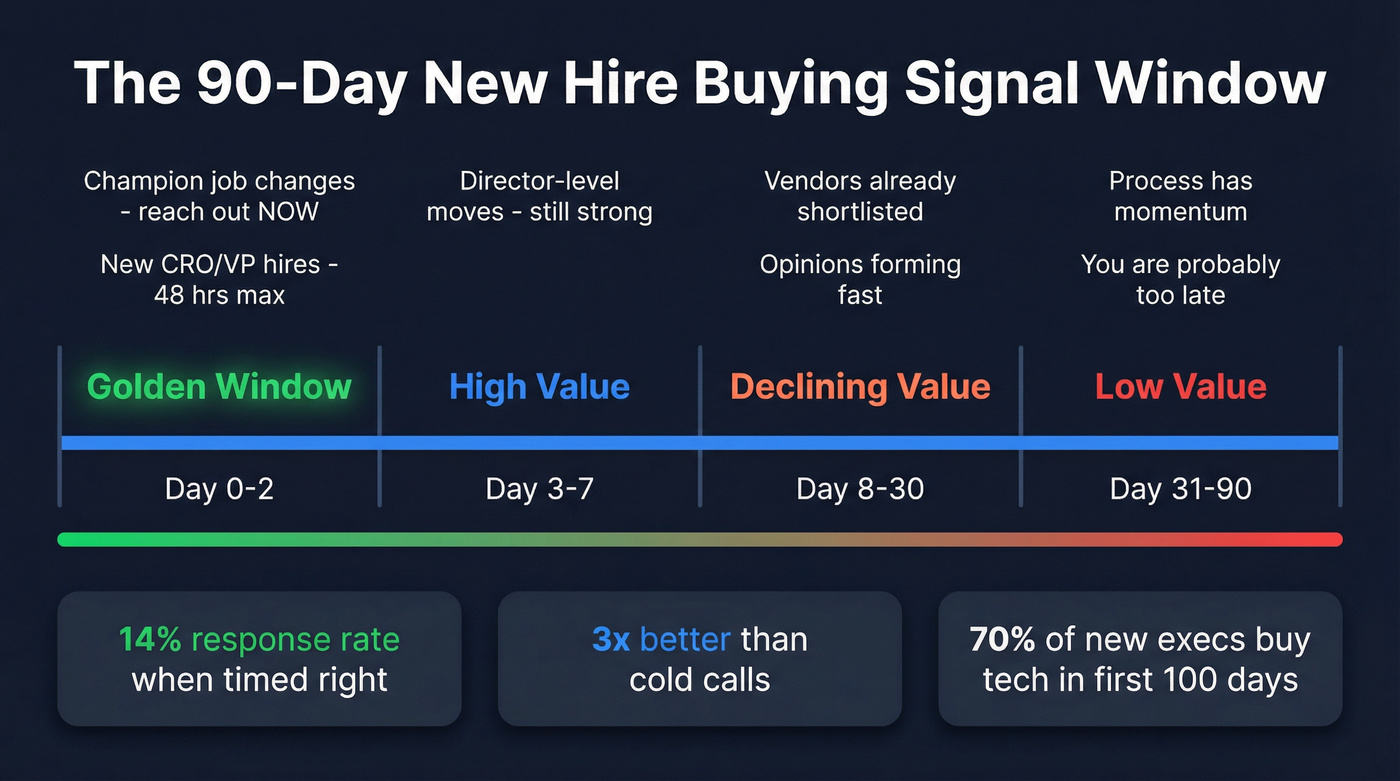
Calls tied to personnel moves outperform generic cold calls 3-to-1. But not every new hire trigger is worth the same effort.
| Signal Type | Impact | Why | Action |
|---|---|---|---|
| Champion job change | Very high | Already trusts your product | Reach out within 24 hrs |
| New CRO / VP Sales / VP RevOps | High | Mandate to evaluate tools | Reach out within 48 hrs |
| New director in target dept | Medium | Influences vendor decisions | Reach out within 1 week |
| Hiring surge in target dept | Medium-low | Indicates growth/budget | Monitor + sequence |
The 24-48 hour rule isn't arbitrary. New leaders are setting direction, meeting vendors, and forming opinions in their first couple of weeks. A new executive hire signal loses most of its value after the first month - by then, you're walking into a process that already has momentum and a shortlist that doesn't include you.
The Data Problem Nobody Mentions
Let's be honest about where signal campaigns actually break down. Your SDR found a new CRO at a target account. Perfect signal. The email bounced.
New hires have the worst contact data quality of any segment in your database. They've just changed companies, which means their old email is dead and their new one hasn't propagated through most data providers yet. Most major providers refresh on roughly a 6-week cycle. A new VP of Sales who started two weeks ago? Most databases still show their previous employer's email.
This is where the signal-to-pipeline chain snaps. You detect the right person at the right time, and then you can't reach them. We've watched teams burn through entire signal lists with 30%+ bounce rates because the contact data was stale - and that kind of bounce rate doesn't just waste effort, it tanks your domain reputation.
Prospeo's 7-day data refresh cycle closes that gap. Its database covers 300M+ professional profiles with 143M+ verified emails at 98% accuracy. The job change filter is built into 30+ search filters, so you find new hires at target accounts and pull verified contact data in the same workflow.

Most data providers still show a new hire's old email weeks after they've moved. Prospeo refreshes every 7 days - not 6 weeks - so you reach the new VP of Sales at their actual company. 98% email accuracy, job change filters built in, $0.01 per email.
Stop bouncing emails on your best buying signals.
The budget stack works: Prospeo for signal detection and verified contacts, Smartlead or Instantly for sequencing. Under $200/month total. 300M+ profiles, 30+ filters including job changes, and 143M+ verified emails refreshed weekly.
Build your new hire signal pipeline for less than one UserGems invoice.
Tools for Signal Tracking
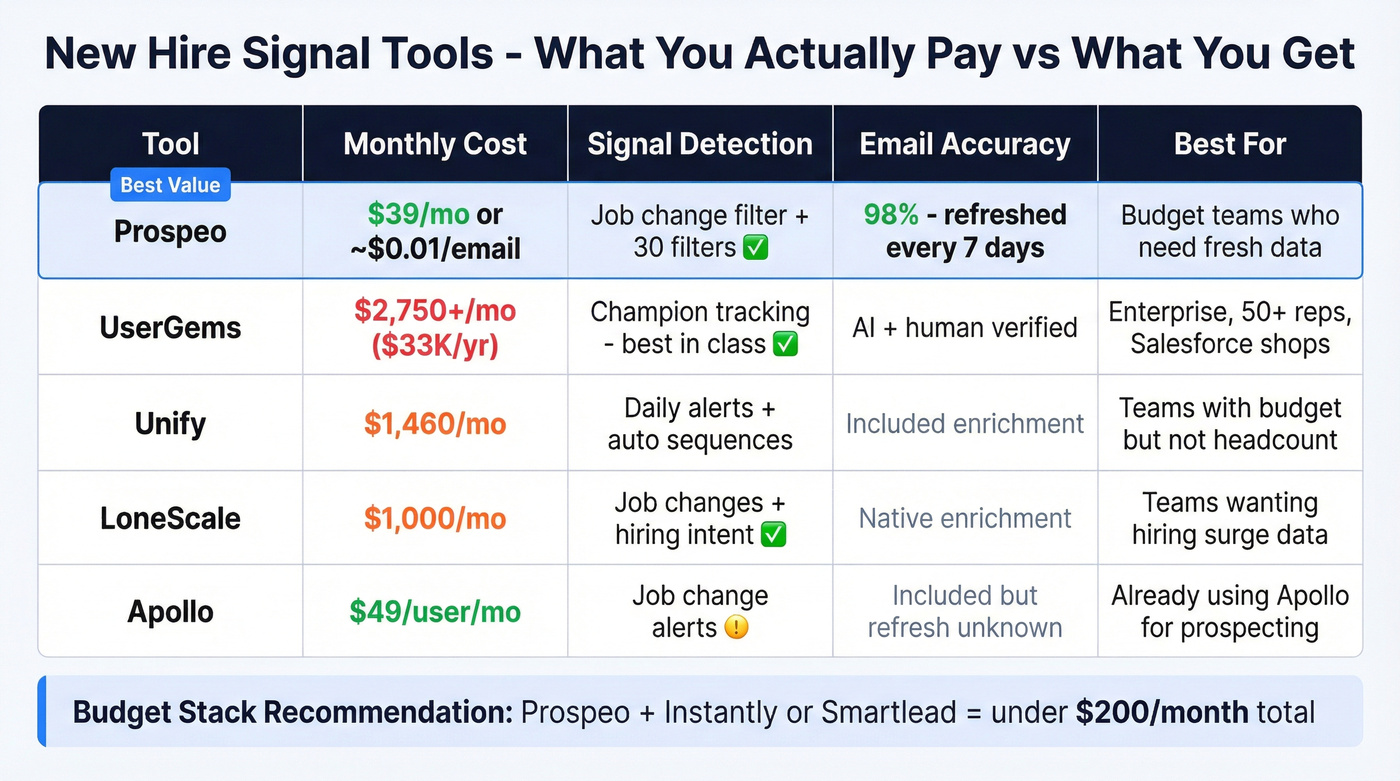
You don't need a $33K signal platform. We've tested most of these, and here's what actually matters at each price point.
| Tool | Starting Price | New Hire Detection | Contact Verification | Data Refresh |
|---|---|---|---|---|
| Prospeo | ~$0.01/email (free tier) | Job change filter | 98% email accuracy | 7 days |
| UserGems | $33,000/yr + $3K setup | Champion tracking | AI + human verified | Not public |
| Unify | $1,460/mo | Daily new hire alerts | Included enrichment | Daily |
| LoneScale | $1,000/mo | Job changes + hiring intent | Native enrichment | Daily |
| Apollo.io | $49/user/mo | Job change alerts | Included | Not public |
UserGems: Enterprise Only
One sales leader on a review site put it bluntly: leads from UserGems "aren't always in industries or job roles that make outreach valid." That tracks with what we've seen. UserGems is the category leader for champion tracking - knowing when your existing customers change jobs - and it's excellent at that specific thing. But at $33K/year minimum with a $3K implementation fee, it's enterprise-only. There's no execution layer: no sequencing, no dialer. You're paying for signal detection and still need a separate stack to act on it.
It's also heavily Salesforce-dependent. If you have 50+ reps running Salesforce and a six-figure outbound budget, UserGems earns its price. Skip it if you're a team of five.
Unify: Best Automated Option
If your team wants daily new hire alerts that automatically trigger personalized sequences, Unify is the play. At $1,460/mo it's not cheap, but it removes the manual work between signal detection and outreach - think of it as the tool for teams that have budget but not headcount. It handles new hires and promotions signals in a single workflow, so you're catching external moves and internal ones too.
LoneScale, Apollo, and Clay
LoneScale adds job post analysis to standard job change detection at $1,000/mo, useful if you want to know not just who joined but what roles a company is hiring for. Apollo offers job change alerts at $49/user/mo. Don't buy Apollo just for signals, but if you're already using it for prospecting, the alerts are a solid bonus. Clay at $149/mo is a workflow automation layer for chaining signal sources together, not a signal source itself.
The real differentiator across all of these isn't CRM compatibility. It's whether the contact data is fresh enough to actually reach the new hire before they've already picked a vendor.
The budget stack we recommend: Prospeo for detection and verified contact data, plus Instantly or Smartlead for sequencing. Total cost under $200/month. You won't get the automated champion tracking of UserGems, but you'll get verified emails that actually land - which matters more than a signal you can't act on.
Outreach Templates That Work
Personalized subject lines boost open rates by 26%. For new hire outreach, the structure is simple: timely hook, role-specific pain, similar-company proof, low-friction CTA. If you want more variations, pull from these outreach email templates and adapt the first line to the trigger.
Template: New Executive at Target Account
Subject: Congrats on the [Title] role at [Company]
Hi [First Name],
Congrats on joining [Company] as [Title]. New [titles] usually review their current [category] stack in the first few months - we've helped [similar company] cut [specific metric] by [X%] in a similar transition.
Worth 15 minutes to see if there's a fit?
Template: Champion Job Change
Subject: [First Name], saw you moved to [Company]
Hi [First Name],
Great to see you landed at [Company]. At [Previous Company], you saw how [your product] helped with [specific outcome]. Happy to help you replicate that - different context, but the same playbook tends to work.
Want me to put together a quick overview for your new team?
Keep emails to 4-5 sentences. Sequences of 4-7 emails outperform shorter ones, and follow-ups can lift reply rates by 50%. Don't stop at one touch - use a consistent sales cadence and track replies by trigger.
Mistakes That Kill Signal Campaigns
Treating every new hire as a signal. A new marketing coordinator isn't a buying signal. Filter by ICP - title, seniority, department, company size. If you're blasting every new hire at every account, you're just doing cold outreach with a "congrats" line stapled on. This is where account qualification and ABM account prioritization keep your list tight.
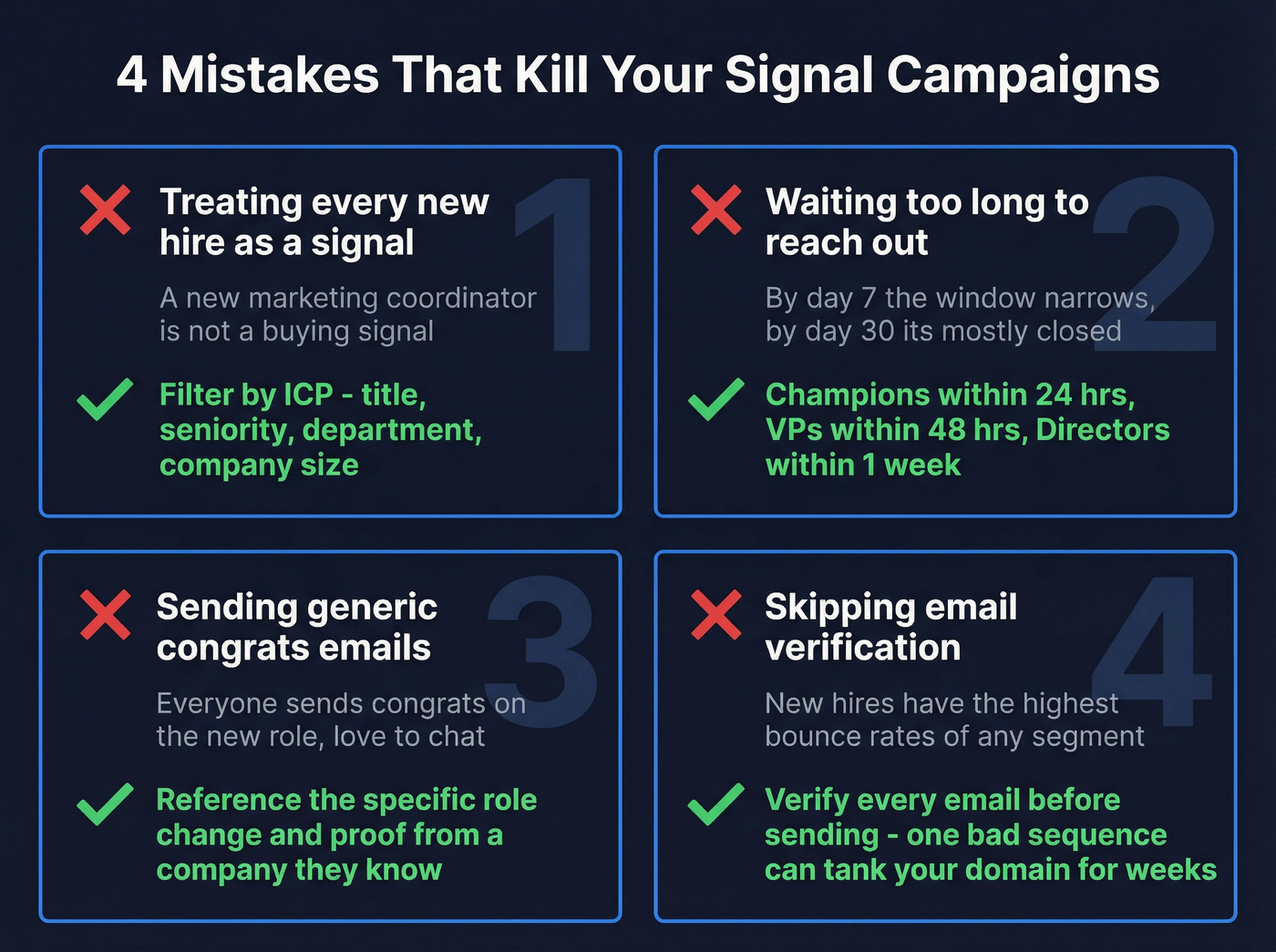
Waiting too long. In our experience, this is the biggest killer. By day 7, the window is narrowing. By day 30, most new execs have already met with two or three vendors and formed opinions that are hard to dislodge. If you need an ops view on timing and routing, use this buying signals follow up framework.
Generic outreach. "Congrats on the new role! We'd love to chat" is lazy and everyone sends it. Reference the specific role change and proof from a company they'd recognize. If you’re scaling personalization, borrow patterns from personalized outbound email.
Skipping email verification. New hires have the highest bounce rates of any segment. One bad sequence can tank your sender reputation for weeks, and recovering domain health is a slow, painful process that costs you far more than the verification would have. Use an email checker tool or a dedicated email ID validator before you send.
FAQ
What is a new hire buying signal?
It's a trigger event where a decision-maker joins a company in a role that gives them authority and budget to evaluate tools - creating a 90-day window where they're 3x more likely to take a sales call. It's among the most reliable signal types because it combines urgency with purchasing authority.
How quickly should you act on a job change signal?
Within 24-48 hours for champion job changes and new C-level or VP hires. Within one week for director-level moves. Calls tied to personnel changes outperform cold calls 3-to-1, but only when you're early. By day 30, most new leaders have already shortlisted vendors.
What tools track new hire buying signals on a budget?
Dedicated platforms like UserGems ($33K/yr) and Unify ($1,460/mo) automate detection and sequencing. For teams spending under $25K annually on outbound, Prospeo's job change filter with 98%-accurate verified emails paired with a sequencer like Instantly delivers comparable detection at under $200/month - with a free tier to test before committing.