

Outreach Email Templates That Actually Get Replies in 2026
You sent 300 emails last week. You got two auto-replies and a "please remove me." The outreach email template wasn't the problem - or at least, it wasn't the whole problem.
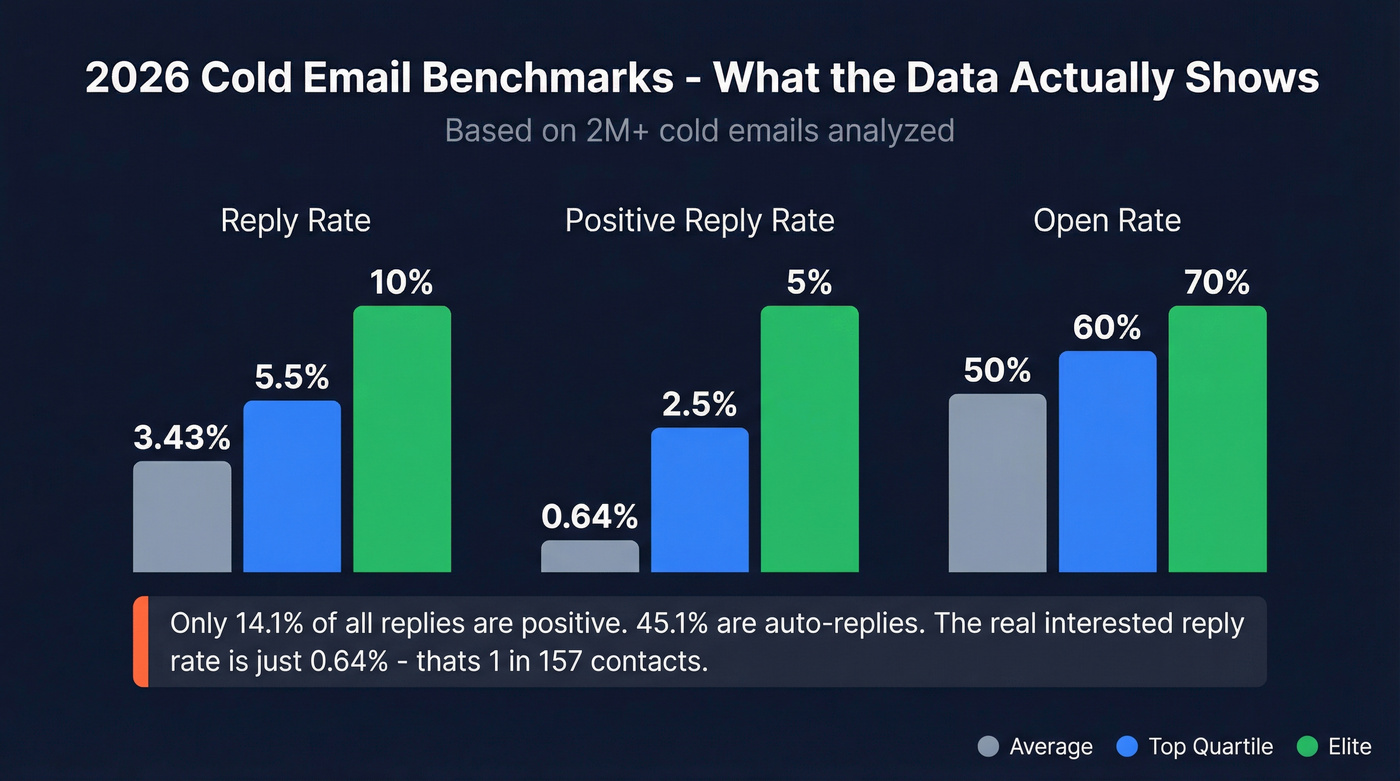
Instantly's 2026 benchmark report puts the average reply rate across cold email campaigns at 3.43%, with top quartile performance around 5.5% and elite teams exceeding 10%. But strip out auto-replies and "not interested" responses, and the real interested reply rate across 2M+ cold emails drops to 0.64%. That's 1 in 157 contacts who actually want to talk to you.
The real lever isn't "finding the perfect template." It's targeting, deliverability, and sequencing discipline - then using templates as the repeatable wrapper. McKinsey found that systematic sales engagement processes drive 10-20% pipeline improvements, which is exactly what we're building here. Not just templates. The full system.
What You Need (Quick Version)
- Target directors and C-suite, not individual contributors - directors reply 66% more often
- Set up SPF, DKIM, and DMARC on a dedicated outreach domain before you send a single email
- Use informal tone - it drives a 78% higher positive reply rate than formal language
- One CTA per email - "Want to see it in action?" converts at 30.05% positive rate, crushing every other option
- Verify your list first - invalid addresses tank your sender reputation before your templates get a chance to work
2026 Cold Email Benchmarks
Counting auto-replies as "engagement" makes your numbers look better than they are. Here's what the data actually shows.
| Metric | Average | Top Quartile | Elite |
|---|---|---|---|
| Reply rate | 3.43% | 5.5%+ | 10%+ |
| Positive reply rate | 0.64% | 2-3% | 5%+ |
| Open rate | 45-55% | 60%+ | 70%+ |
Of all replies in the 2M+ email dataset, only 14.1% were positive. A full 45.1% were auto-replies. Another 29.9% were flat-out negative. When you strip away the noise, the real interested reply rate lands at roughly 0.64%.
Between 58% and 79% of all replies come from the first email, depending on the dataset. Your opener carries most of the weight. Follow-ups matter, but they're capturing the remainder - not saving a bad first touch.
Who You Email Matters Most
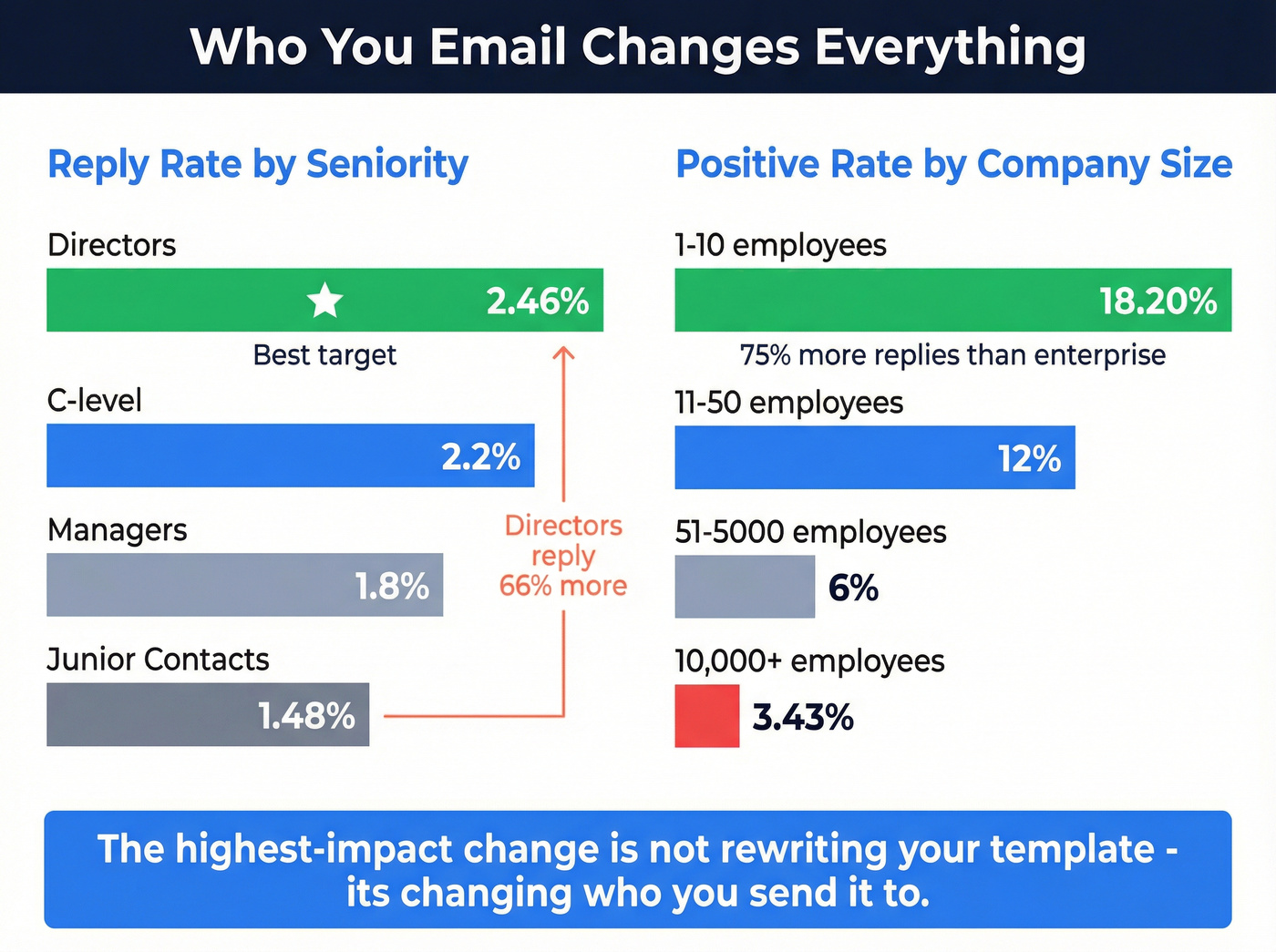
This is the highest-impact change you can make, and almost no template article talks about it. The consensus on r/sales is the same: the template is the last thing to optimize. Changing who you email moves the needle more than rewriting your copy for the tenth time.
| Seniority | Reply Rate | Positive Rate |
|---|---|---|
| Directors | 2.46% | 14%+ |
| C-level | 2.2% | 14.16% |
| Managers | 1.8% | 4.3% |
| Junior contacts | 1.48% | 5-6% |
C-level contacts convert at 3.3x the rate of managers. Directors reply 66% more than junior contacts. Company size matters just as much - 1-10 employee companies reply 75% more than 5,000+ employee orgs, with an 18.20% positive rate vs 3.43% for 10,000+ employee organizations. Department matters too: Customer Success teams respond at 2.79% vs Engineering at 0.98%.
We've found that the targeting step is where most teams cut corners, and it's the exact place where cutting corners costs you the most. Prospeo's 30+ search filters let you build lists by seniority, department, company size, buyer intent, and headcount growth - so you're reaching directors at growth-stage companies, not blasting individual contributors at Fortune 500s. That targeting work happens before you ever open a template. (If you want a tighter process, start with choosing targets for cold outreach.)

Deliverability Checklist
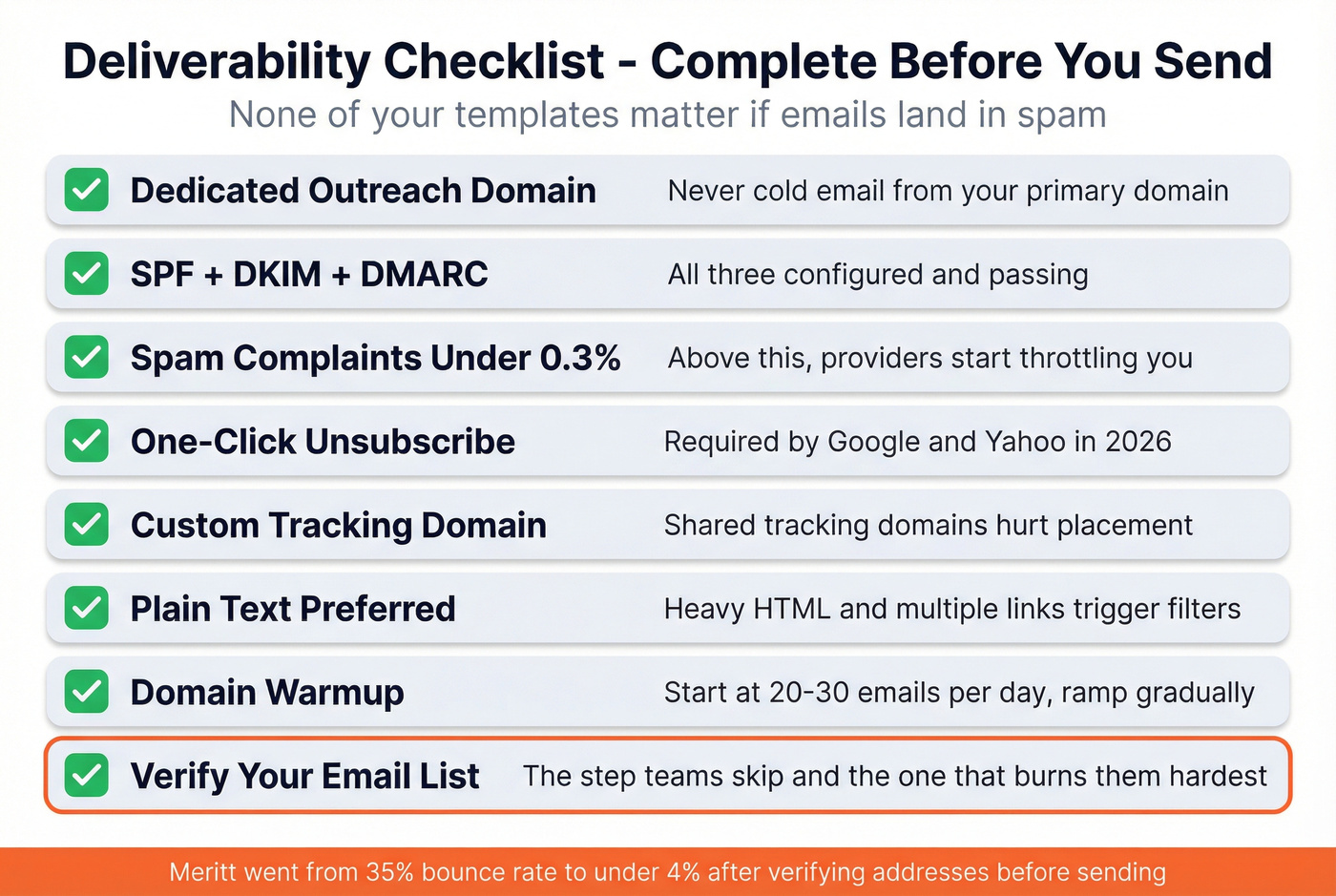
None of your templates matter if emails land in spam. Deliverability - inbox placement, not just ISP acceptance - is the gate everything else passes through. If you need the full playbook, use this email deliverability checklist.
- Dedicated outreach domain - never cold-email from your primary domain. Buy a lookalike and warm it up for 2-3 weeks.
- SPF, DKIM, DMARC - all three, configured and passing. Non-negotiable in 2026.
- Spam complaint rate under 0.3% - above this, inbox providers start throttling you.
- One-click unsubscribe - required by Google and Yahoo sender rules.
- Custom tracking domain - shared tracking domains hurt deliverability. (More on this in does open tracking hurt cold email.)
- Plain text preferred - heavy HTML and multiple links trigger spam filters. Keep links to a minimum.
- Domain warmup - start with 20-30 emails/day and ramp gradually. Use a proven automated email warmup workflow.
- List verification - the step teams skip, and the one that burns them hardest. Use an email checker tool before every send.
Meritt went from a 35% bounce rate to under 4% after verifying addresses with Prospeo before sending. That's the difference between a domain that builds reputation and one that gets blacklisted inside a week. (If you're troubleshooting bounces, start with hard bounce.)

The data proves it: directors reply 66% more than junior contacts. Prospeo's 30+ search filters let you target by seniority, department, company size, and buyer intent - so every outreach email lands with the right person.
Build laser-targeted lists in minutes, not hours.
Subject Lines That Get Opened
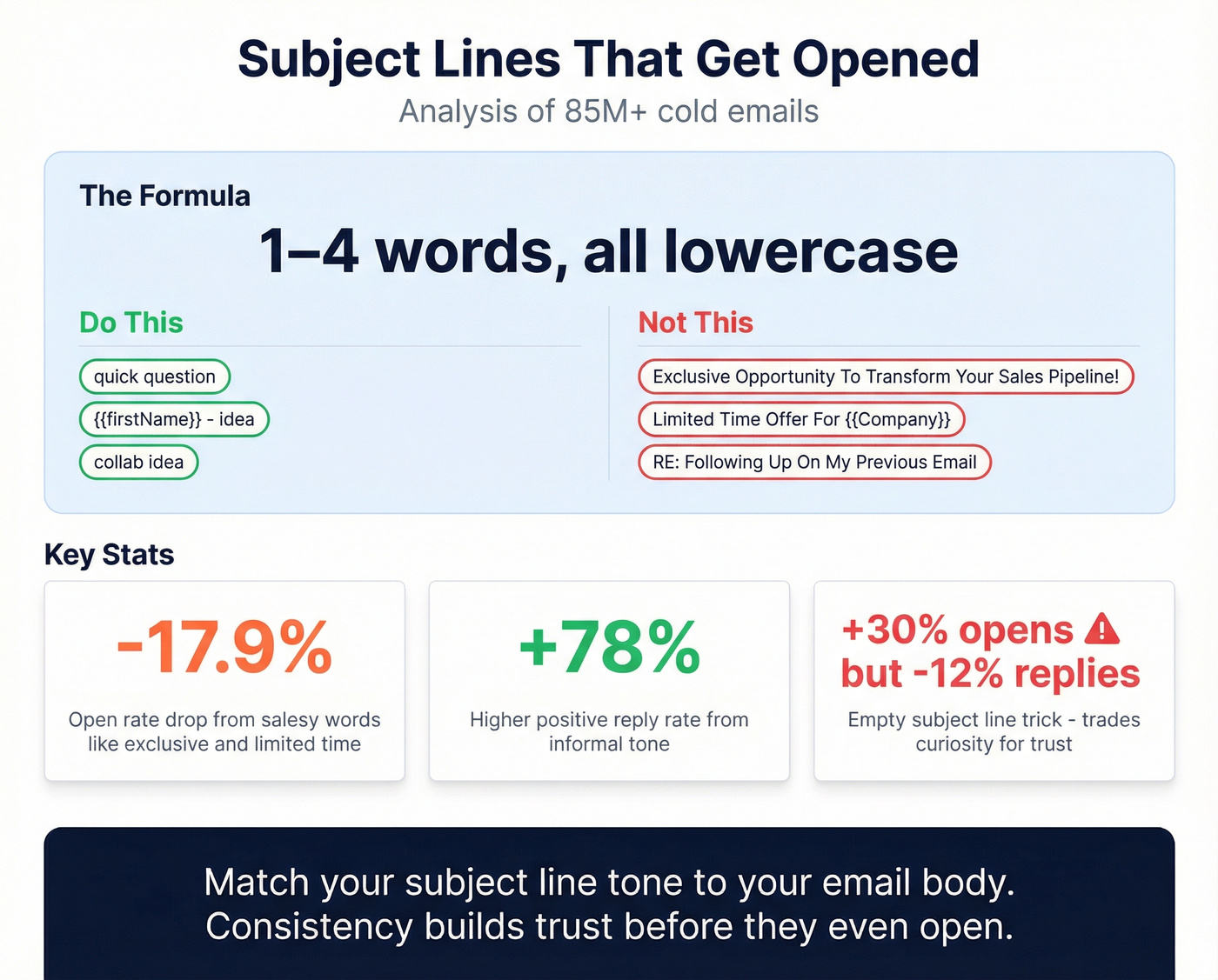
1-4 words, all lowercase. Analysis of 85M+ cold emails shows short subject lines dominate. Lowercase outperforms title case consistently.
- ✅
quick question - ✅
{{firstName}} - idea - ❌
Exclusive Opportunity To Transform Your Sales Pipeline!
Kill the salesy language. Words like "exclusive," "limited time," and "opportunity" reduce open rates by up to 17.9%. Write like you're emailing a colleague, not pitching a timeshare. (For a bigger blacklist, see words to avoid in email subject lines.)
Don't try the empty subject line trick. It boosts opens by 30% but drops reply rates by 12%. That's a gimmick that trades curiosity for trust. Skip it.
Match tone to body. If your email is casual and direct, a formal subject line creates a jarring disconnect. Consistency builds trust before they even open.
Meritt cut their bounce rate from 35% to under 4% and tripled pipeline to $300K/week. The difference? Verified emails before every send. Prospeo's 5-step verification delivers 98% accuracy at $0.01 per email - so your outreach templates actually reach inboxes.
Stop burning domains with bad data. Verify first, send second.
10 Outreach Email Templates That Work
You don't need 24 templates. You need 3 great ones - a first touch, a follow-up, and a break-up - plus the discipline to personalize each one. Before you send any of these, check your pronoun ratio: aim for roughly 1:2 on I/my vs you/your. The email should be about them. If you want more structure, use a modern sales email structure.
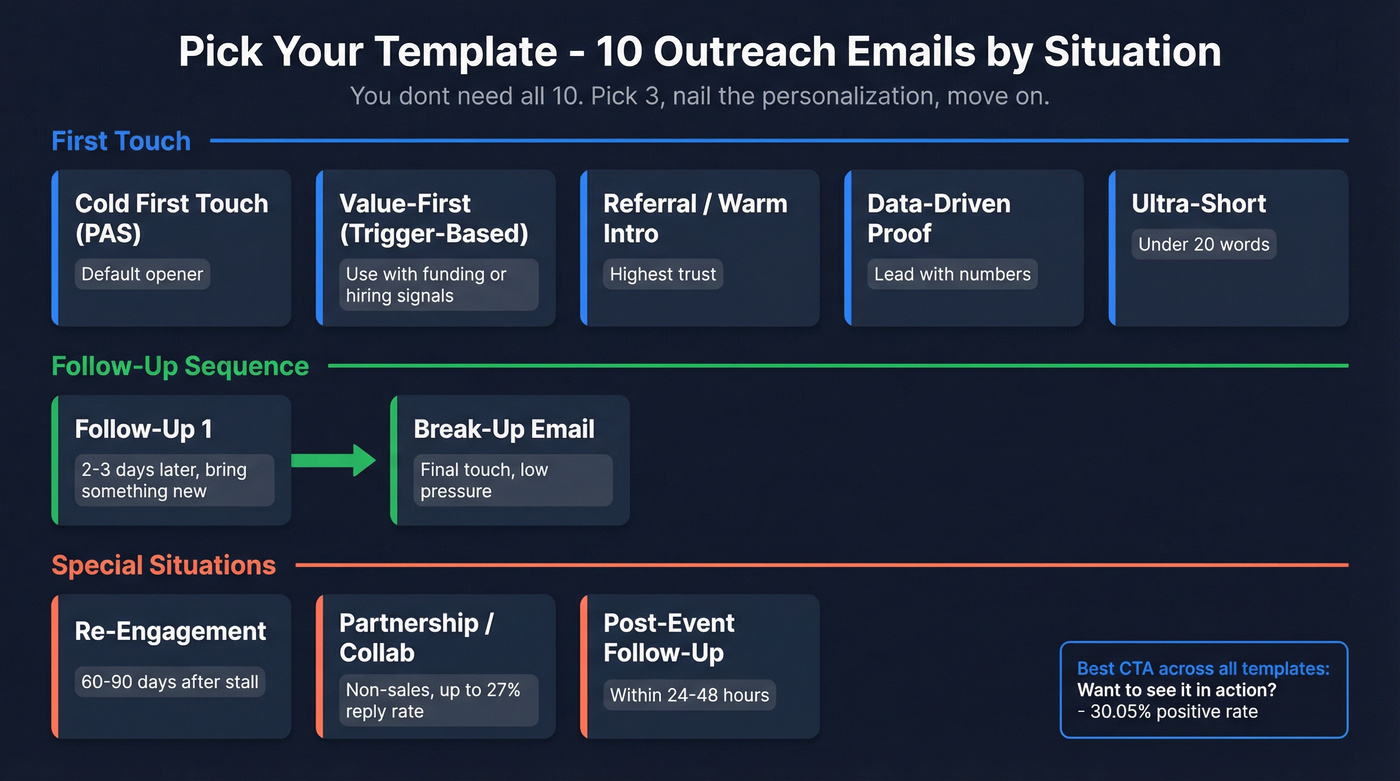
Here's the thing: if your average deal size is under five figures, you probably don't need a 10-template sequence. Pick three from this list, nail the personalization, and move on.
Cold First Touch (PAS Framework)
Subject: quick question
Hi {{firstName}},
{{Company}} is scaling fast - which usually means {{specific pain point}} starts breaking. We helped {{similar company}} cut {{metric}} by {{result}} in {{timeframe}}.
Want to see how it works?
Problem, agitate, solve in under 60 words. The single CTA keeps friction low. Informal tone drives 78% higher positive rates. Use this as your default first cold touch to a director or VP.
Value-First (Trigger-Based)
Use this when you have a clear trigger event - funding, hiring, product launch. The trigger is the whole email.
Subject: {{company}} + {{your company}}
Hi {{firstName}},
{{Specific observation about their business - a job posting, product launch, or funding round}}. That usually means {{implication}}.
We built {{product/feature}} specifically for that. {{One-sentence proof point with a number}}.
Want to see it in action?
"Want to see it in action?" converts at 30.05% positive rate - 3.5x better than softer alternatives.
Referral / Warm Intro
Subject: {{mutual connection}} suggested I reach out
Hi {{firstName}},
{{Mutual connection}} mentioned you're working on {{initiative}}. We helped their team {{specific result}}, and they thought it'd be relevant for you.
Worth a 15-minute call this week?
Social proof from a trusted name bypasses the "who is this person" filter. Don't fake this - a fabricated referral destroys trust permanently.
Data-Driven Proof
Subject: {{stat}} for {{company}}
Hi {{firstName}},
Teams like {{company}} typically {{problem statement}}. Our customers in {{industry}} are seeing {{specific metric improvement}} after {{timeframe}}.
Here's a 2-minute case study: {{link}}
Want to see it in action?
Leading with a number earns credibility before you pitch. The VP-Trust-CTA structure hits a 9.47% positive rate.
Follow-Up #1 (2-3 Days Later)
Subject: re: quick question
Hi {{firstName}},
Wanted to share something relevant - {{new insight, article, or data point related to their business}}.
{{One sentence connecting it to your solution}}.
Still open to a quick chat?
Follow-ups capture up to 42% of all replies - but only when they bring something new. "Just bumping this up" is the fastest way to get archived. (If you need more options, pull from these subject lines for follow-up emails.)
Break-Up Email
Subject: closing the loop
Hi {{firstName}},
I've reached out a couple of times - no worries if the timing's off. If {{pain point}} becomes a priority, I'm here.
Either way, I'll stop filling your inbox. Cheers.
Low pressure, high dignity. The "I'll stop" signal often triggers a response from people who were interested but busy. Use this as your final touch in a 4-7 step sequence.
Re-Engagement (Cold Lead Revival)
60-90 days after a stalled conversation, this works:
Subject: things changed
Hi {{firstName}},
We talked {{timeframe}} ago about {{topic}}. Since then, we've {{new feature, result, or milestone}}.
Worth revisiting?
Short, respectful of their time, and gives a concrete reason to re-engage.
Partnership / Collaboration
Subject: collab idea
Hi {{firstName}},
I've been following {{their content/product}} - {{genuine compliment with specifics}}. We have overlapping audiences, and I think {{specific collaboration idea}} works well for both of us.
Open to exploring it?
Non-sales outreach gets higher reply rates because there's no pitch to resist. Siege Media reports response rates as high as 27% on well-targeted collaboration-style outreach.
Post-Event Follow-Up
Send within 24-48 hours. Reference a specific moment from the event - it proves you're not mass-emailing the attendee list.
Subject: good meeting you at {{event}}
Hi {{firstName}},
Great chatting at {{event}} about {{specific topic you discussed}}. You mentioned {{their challenge}} - we've helped teams tackle that with {{brief solution}}.
Want to continue the conversation this week?
The Ultra-Short Template
Subject: hey
{{firstName}} - {{one sentence about their specific situation}}. We fix that. Interested?
Under 20 words. Ultra-short emails match the positive reply rates of longer ones at around 8.8%. When you're confident in your targeting, less really is more.
Writing Rules That Move the Needle
These aren't opinions - they're backed by data from 2M+ cold emails.
Informal tone, always. Informal emails hit a 10.36% positive rate vs 5.83% for formal. That's a 78% lift just from writing like a human.
Under 80 words. The best-performing campaigns keep emails under 80 words. Every word past that threshold costs you replies.
One CTA, low friction.
| CTA Phrase | Positive Rate |
|---|---|
| Want to see it in action? | 30.05% |
| Open to a quick chat? | 12% |
| Mind if I send more info? | 8.59% |
| Are you the right person? | 6% |
VP-Trust-CTA structure. Open with a value proposition, build credibility with proof, close with a single ask. This structure hits 9.47% positive - the highest of any format tested.
Write at an eighth-grade reading level. Short sentences. Common words. No jargon walls. If a VP can't scan it in 8 seconds, it's too complex.
Pronoun ratio matters. Aim for roughly 1:2 on I/my vs you/your. The email should be about them, not about you. Track reply sentiment too - positive, negative, and auto-reply rates tell you more than raw reply counts ever will.
Timing and Sequencing
The sweet spot for sequence length is 4-7 email touchpoints. Fewer than 4 quits too early. More than 7 hits diminishing returns. RAIN Group research shows meetings require 8 touches on average, which aligns with 4-7 emails plus phone and social touches across channels. (For more cadence examples, see sales cadence example.)
| Day | Reply Rate | Positive Rate |
|---|---|---|
| Monday | 1.96% | 8% |
| Tuesday | 1.8% | 9% |
| Wednesday | 1.9% | 9.5% |
| Thursday | 1.7% | 10.5% |
| Friday | 1.5% | 7% |
| Weekend | 1.2% | 6% |
Monday has the highest reply rate per email sent, while Wednesday drives the highest reply volume. Thursday produces the highest positive reply rate. A practical rhythm: launch new sequences Monday, send follow-ups Wednesday, triage auto-replies Friday.
For spacing, start tight - 1-2 days between your first and second touch - then expand to 3+ days for later steps. The best-performing sequences are multichannel: email 40-50%, phone 20-30%, social 15-25%, video 5-10%.
Common Mistakes That Kill Replies
Emailing the wrong seniority. Directors reply 66% more than junior contacts. If your list is full of individual contributors, no template will save you.
Skipping deliverability setup. No SPF/DKIM/DMARC, no custom tracking domain, no warmup - and then wondering why open rates are 12%. Fix the infrastructure first. Stack Optimize built from $0 to $1M ARR with client deliverability at 94%+ and zero domain flags across all clients. (If you're worried about reputation hits, read how to prevent email blacklisting.)
Multiple CTAs. Every additional ask dilutes the one that matters. One CTA. That's it.
Generic copy with zero personalization. A template is a starting point, not a finished product. If you can't point to one sentence that only applies to this prospect, you haven't personalized enough. We've seen teams A/B test subject lines for weeks while sending the exact same generic body copy to everyone - that's optimizing the wrong thing entirely. Use a real personalization in outbound sales checklist.
Heavy HTML and images. Plain text outperforms rich HTML in cold outreach. Save the designed emails for nurture campaigns.
Skipping list verification. This is the silent killer. You send 500 emails, 40 bounce, your domain reputation drops, and suddenly even your good emails land in spam. Run every address through verification before you send - bounce rates drop to under 3% consistently when you do.
Which Template Should You Use?
Not sure which fits your situation? Quick decision framework:
- First cold touch to a director or VP - PAS or Value-First template
- Warm lead from a mutual connection - Referral template
- Post-event or conference - Post-Event Follow-Up
- Stalled deal, 60-90 days cold - Re-Engagement template
- High-confidence targeting, smaller deals - Ultra-Short template
- Partnership or link-building - skip the sales templates entirely and use the Collaboration template
Let's be honest: the best outreach email template shares three traits with every other high-performing template. It's under 80 words. It leads with the prospect's situation. And it closes with a single low-friction CTA. Everything else is noise.
FAQ
What's a good reply rate for cold outreach in 2026?
The average cold email reply rate is 3.43%, with top performers exceeding 10%. The real "interested" reply rate is closer to 0.64% across 2M+ emails. Elite teams hit 5%+ through better targeting, verified data, and deliverability infrastructure - not templates alone.
How many follow-ups should I send?
Four to seven touchpoints is the sweet spot. Between 58% and 79% of replies come from the first email, but follow-ups capture the rest. Each one should add new value - a case study, a relevant insight, or a different angle. Never send "just checking in."
Should I use AI to write cold emails?
49% of B2B marketers already use generative AI for email creation. Lavender ($29/mo) is purpose-built for sales emails; ChatGPT ($20/mo) works but needs more editing. The key rule: always personalize the output. AI generates a solid draft, but human judgment on personalization and tone separates replies from silence.
How do I keep outreach emails out of spam?
Set up SPF, DKIM, and DMARC on a dedicated domain. Warm it for 2-3 weeks starting at 20-30 sends/day. Keep spam complaints below 0.3%, use a custom tracking domain, and verify every address before sending.
What's the best CTA for a cold email?
"Want to see it in action?" converts at 30.05% positive reply rate - 3.5x better than "Mind if I send more info?" at 8.59%. Specific, low-friction, action-oriented CTAs win. One per email, always.
Templates help, but targeting the right seniority, nailing deliverability, verifying your list, and sequencing with discipline is what separates the 0.64% from the 5%+. Build the system first. Then your outreach email template does its job.