Personalization in Outbound Sales: A Relevance-First Framework
Your reps send 100 emails a day and book zero meetings. They open with "I saw your post about leadership" and close with a product pitch nobody asked for. The average rep needs 344 cold emails to land a single meeting - and the reason isn't volume. It's that most personalization in outbound sales is theater: surface-level name-drops dressed up as relevance.
The framework that actually works in 2026 flips the script entirely. Relevance beats personalization every time.
The Short Version
- Keep emails under 100 words, 3-4 sentences max. Pitching in a cold email [drops reply rates by up to 57%]. Shorter emails with no pitch consistently win.
- Replace "personal openers" with a trigger and pain hypothesis. "I saw you raised a Series B" isn't personalization. "Series B teams usually struggle to scale outbound without burning their domain - is that on your radar?" is relevance.
- Fix your data before you write a single word. A verified, accurate email list isn't a nice-to-have. It's the prerequisite for any outbound personalization effort (and a core part of email deliverability).
What the Data Says
An analysis of 28M+ cold outbound emails found that top performers book 8.1x more meetings than average reps, get 4.2x more replies, and have 2.1x higher open rates. The biggest differentiator isn't some magic personalization trick - it's what they don't do. They don't pitch. They don't write long emails. They don't stuff subject lines with buzzwords, which actually reduce opens by up to 17.9% (see words to avoid in email subject lines).
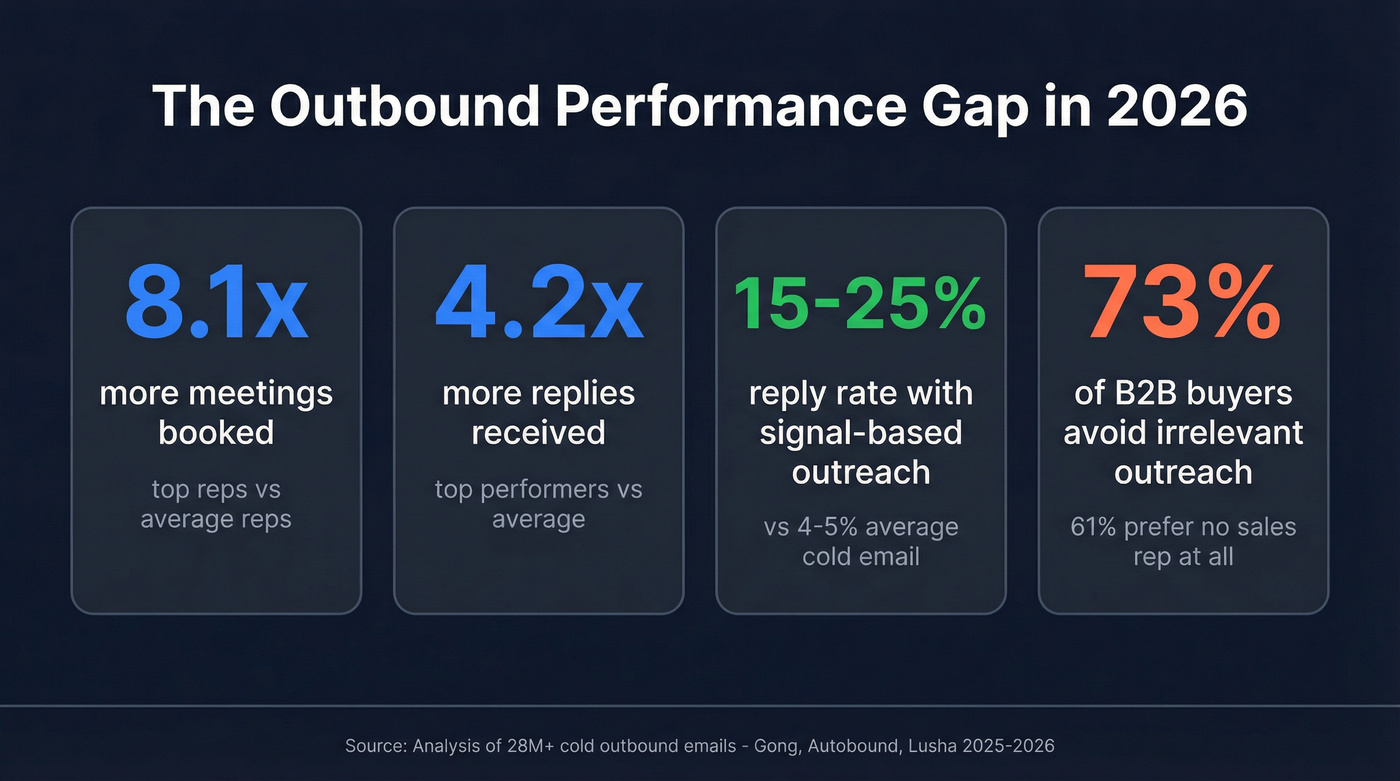
Average cold email reply rates have fallen to 4-5%, down from 8.5% in 2019. Signal-personalized outreach - emails triggered by real buying signals - hits 15-25% reply rates. That's a 3-5x gap between "I personalized the first line" and "I reached out because something changed."
On the buyer side, 73% of B2B buyers actively avoid irrelevant outreach, and 61% prefer buying without engaging a sales rep at all.
Relevance vs. Personalization
These two words get used interchangeably, and that's the root of the problem.
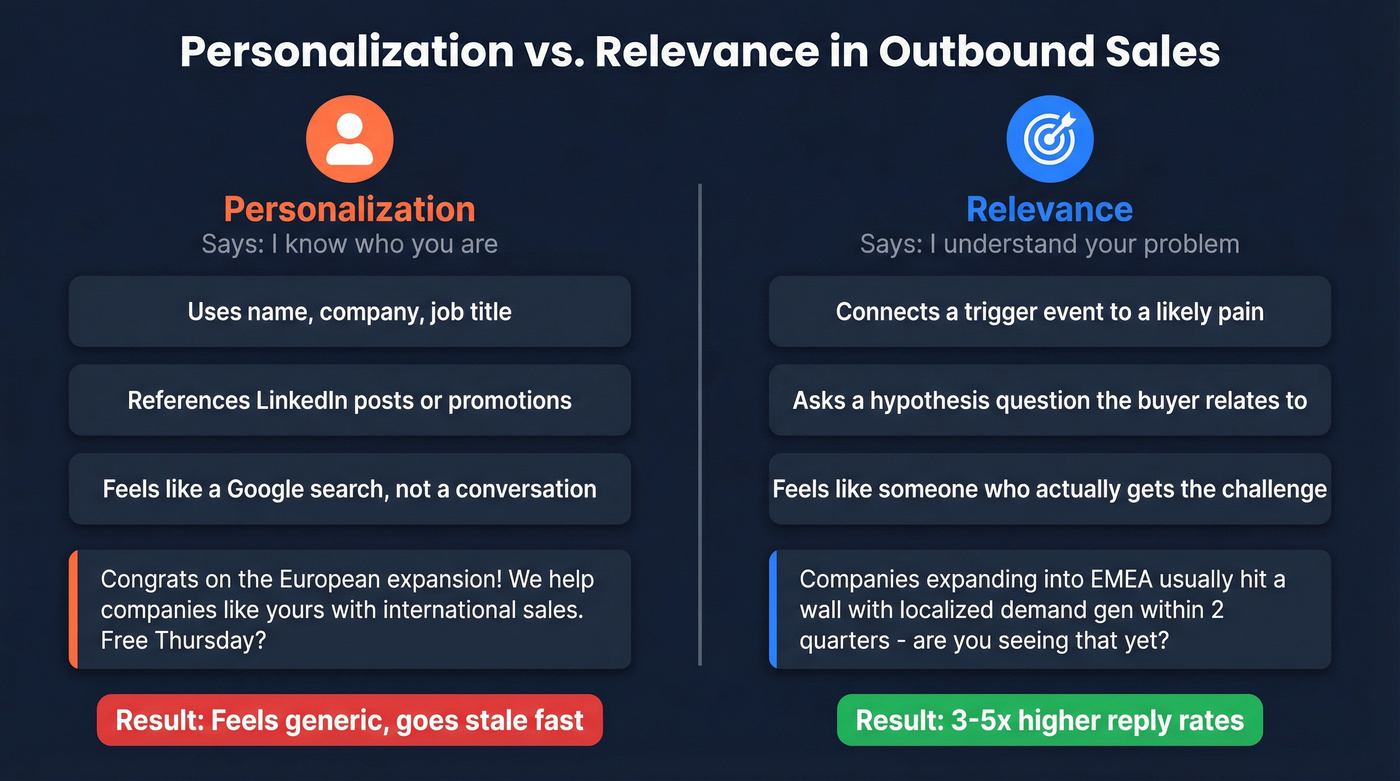
Here's the cleanest distinction we've found, borrowed from [Zenoll's framework]: personalization says "I know who you are." Relevance says "I understand your problem." Personalization is your name, your company, your recent promotion. Relevance is connecting an observable trigger to a likely pain and asking a question that makes the prospect think, "Yeah, that's actually what I'm dealing with." And 63% of buyers are more likely to engage when outreach speaks to their industry and role - not when it proves you can Google their name.
Let's make this concrete. A rep notices a company expanded to Europe. The personalized version says "Congrats on the European expansion!" The relevant version says "Companies expanding into EMEA usually hit a wall with localized demand gen within the first two quarters - are you seeing that yet?" Same trigger, completely different impact. Personalization theater feels creepy, goes stale fast, and doesn't connect to a real problem. Relevance sidesteps all three.

Trigger-based outreach only works when your data matches reality. Prospeo's 30+ search filters let you segment by buyer intent, job changes, headcount growth, and funding - all refreshed every 7 days, not the 6-week industry average. 98% email accuracy means your relevant message actually lands.
Stop writing relevant emails to outdated contacts.
The Relevance-First Playbook
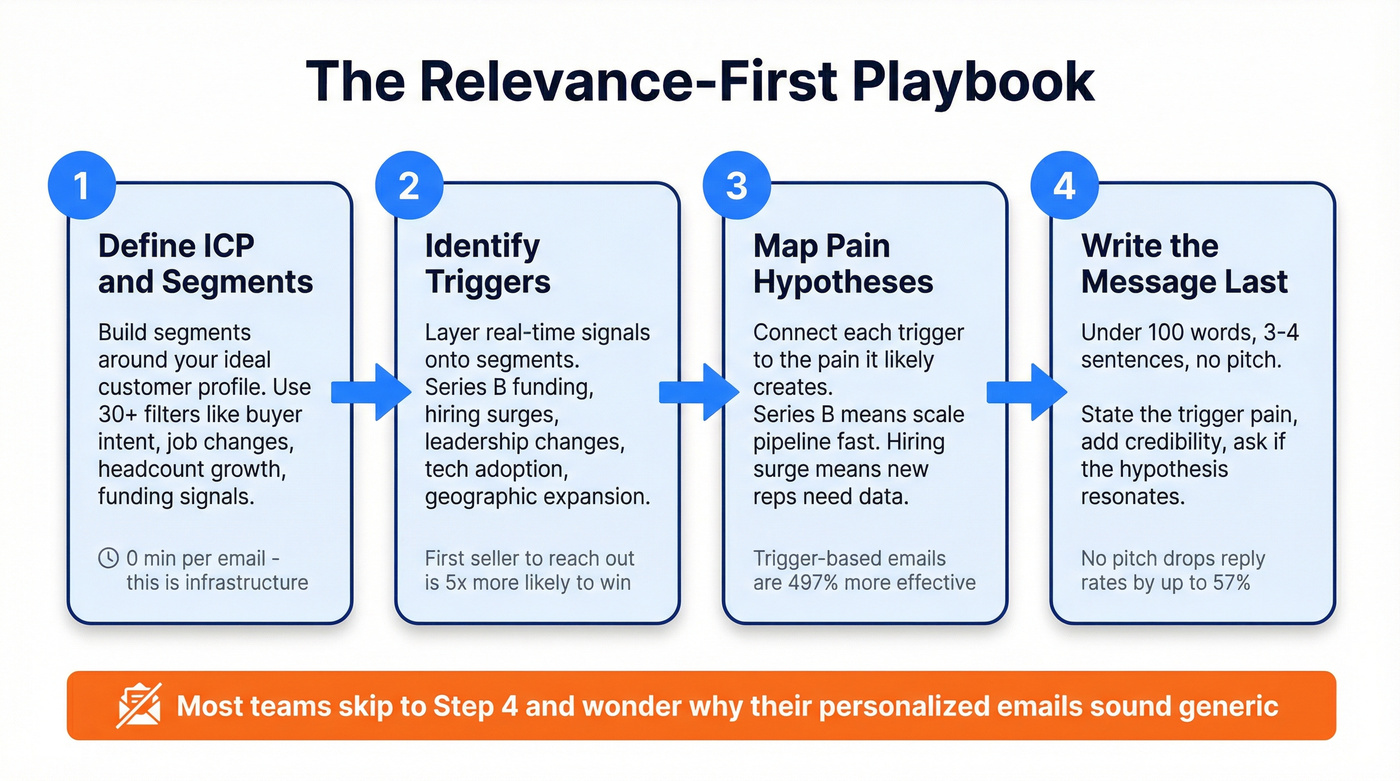
Most teams start with the email. They open a blank compose window and try to write something clever. That's backwards. The system that works starts two steps earlier (and maps cleanly to a modern outbound sales engine).
Start With Segments, Not Sentences
Before you write a word, you need to know who you're writing to and why now. Build segments around your ICP, then layer in triggers that signal a likely pain. The sequence is: ICP definition, segment creation, trigger identification, then message. Most teams skip straight from ICP to message and wonder why their "personalized" emails sound generic (compare with a personalized outbound email approach that stays signal-led).
Building those segments requires accurate, fresh contact data. Prospeo's 30+ search filters let you segment by buyer intent, technographics, job changes, headcount growth, and funding signals - all on a 7-day refresh cycle versus the 6-week industry average. You can't write a relevant email to someone who changed roles two months ago if your data still shows their old title (see B2B contact data decay).

Match Triggers to Pain Hypotheses
Once you've built your segments, map each trigger to the pain it likely creates. The first seller to reach out after a trigger event is 5x more likely to win the deal. That alone justifies the trigger-first approach. Trigger-based emails are 497% more effective than batch-and-blast - you're not guessing, you're hypothesizing based on something that actually happened (more on operationalizing this in how to track sales triggers).
| Trigger | Likely Pain | Hypothesis |
|---|---|---|
| Series B+ funding | Scale pipeline fast | "Scaling outbound post-raise?" |
| Hiring surge (SDRs) | New reps need data | "Ramping 5+ SDRs? Data gaps show fast." |
| Leadership change (CRO) | Auditing the stack | "New leaders find 30% of stack unused." |
| Tech adoption (competitor) | Evaluating alternatives | "Teams on [X] often hit [limitation]." |
| Headcount growth >20% | Ops can't keep up | "Growing fast breaks CRM data first." |
| Job change (persona) | Proving impact in 90 days | "Building pipeline from scratch?" |
| Intent spike | Researching solutions | "Your team's researching [topic]." |
| Geographic expansion | Compliance, localization | "EMEA means GDPR headaches in 60 days." |
Write the Message Last
Now you write - and you follow hard constraints: 100 words or fewer, 3-4 sentences, no pitch. The research and segmentation you've already done means the message practically writes itself (use a consistent sales email structure so reps don’t freestyle into fluff).
The structure that works: one sentence stating the trigger-based pain, one line of credibility, a question asking if the hypothesis resonates, and a soft CTA without pressure.
Bad: "Hi Sarah, I saw your company is expanding to Europe - congrats! We help companies like yours with international sales. I'd love to set up a 15-minute call to show you how our platform works. Are you free Thursday?"
Good:
Subject: EMEA pipeline
Companies expanding into Europe often see outbound performance dip fast - localized messaging and compliant data are the usual bottlenecks. We helped [similar company] solve this in 3 weeks. Is that something you're running into, or have you already figured it out?
That's about 50 words. No pitch, no "I saw your post," no buzzwords in the subject line. Just a hypothesis, a proof point, and a question (more examples in our outreach email template guide).
Personalization Tiers and Time Budgets
Not every prospect deserves 20 minutes of research. Match your investment to the account's value and signal strength.
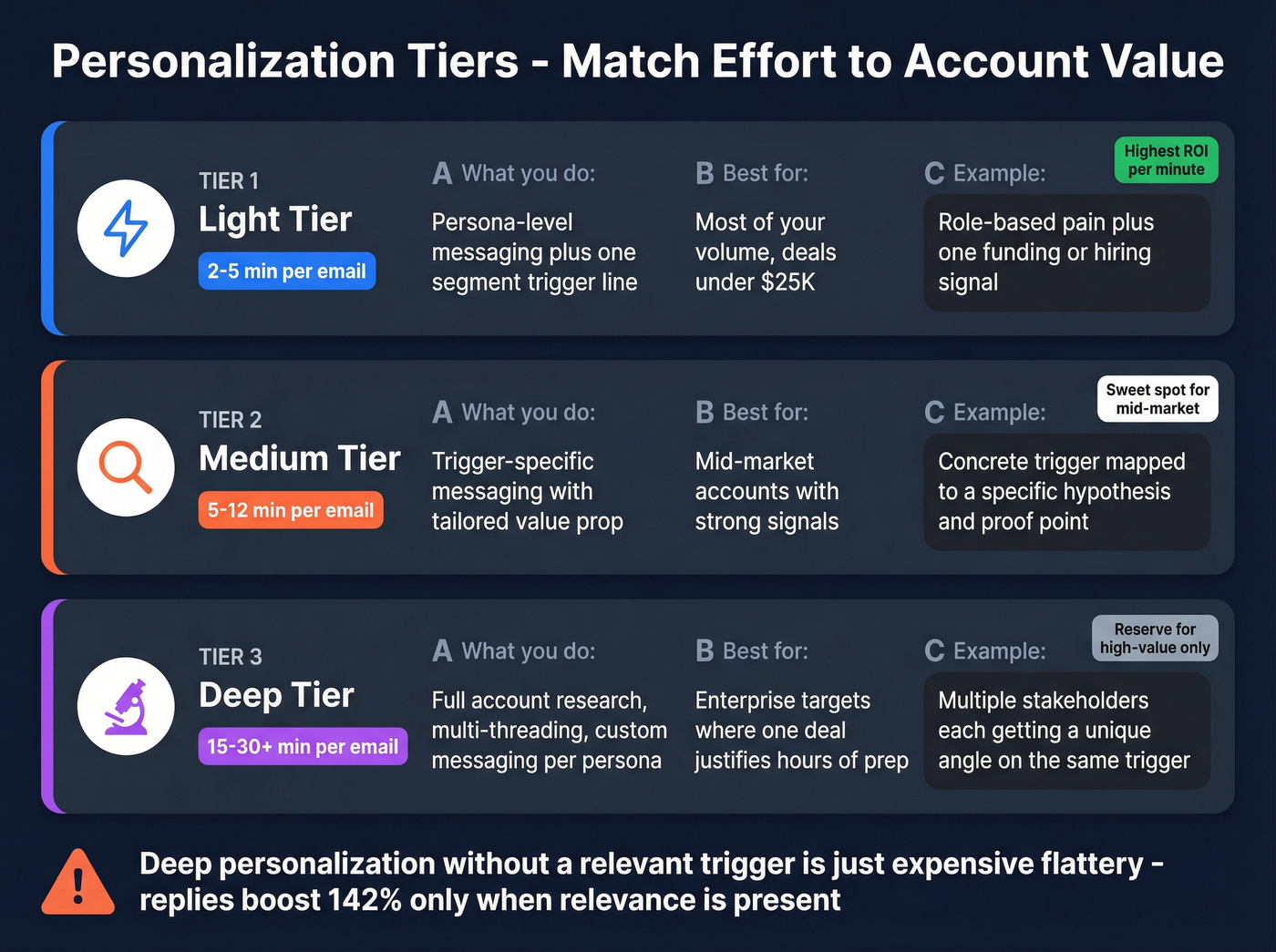
Light (2-5 min): Persona-level messaging plus one line tied to a segment trigger. This is where most of your volume should live - you're writing to the role, not the person.
Medium (5-12 min): Trigger-specific messaging with a tailored value prop. You've identified a concrete signal and you're building the hypothesis around it. The sweet spot for mid-market accounts.
Deep (15-30+ min): Full account research, multi-threading across stakeholders, custom messaging per persona. Reserve this for enterprise targets where a single deal justifies hours of prep.
Here's our honest take: if your average deal size is under $25k, you probably don't need deep personalization at all. A well-segmented light-tier email built around a real signal will outperform a deeply researched email that opens with "I loved your podcast appearance" and pivots to a generic pitch. Highly personalized messages boost replies up to 142% - but only when relevance is present. Deep personalization without a relevant trigger is just expensive flattery.
Why Great Messages Still Fail
You can nail the framework, write a perfect 50-word hypothesis email, and still get zero replies.
The reason is almost always upstream: your data is bad. Even the best outreach falls apart when emails never reach the inbox. You send 1,000 emails. 15% bounce because the addresses are stale. Your domain reputation drops. ISPs start routing you to spam. Within two weeks, your entire outbound motion is compromised - not because of your messaging, but because of your list. One Prospeo customer, Meritt, went from a 35% bounce rate to under 4%, and their pipeline tripled from $100K to $300K per week. That wasn't a messaging change. It was a data quality change (and it’s why teams invest in email verification for outreach).
And 80% of deals require five or more follow-ups, yet 44% of reps stop after one. Using 3+ channels yields 287% higher purchase rates - and multichannel works best when you have both a verified email and a direct dial so your reps can layer calls on top of email sequences without sourcing phone data from a separate vendor.

Measuring What Matters
If you're tracking open rates as your primary metric, stop. Apple Mail Privacy Protection inflates opens to the point of uselessness (use positive reply rate as your north star instead).
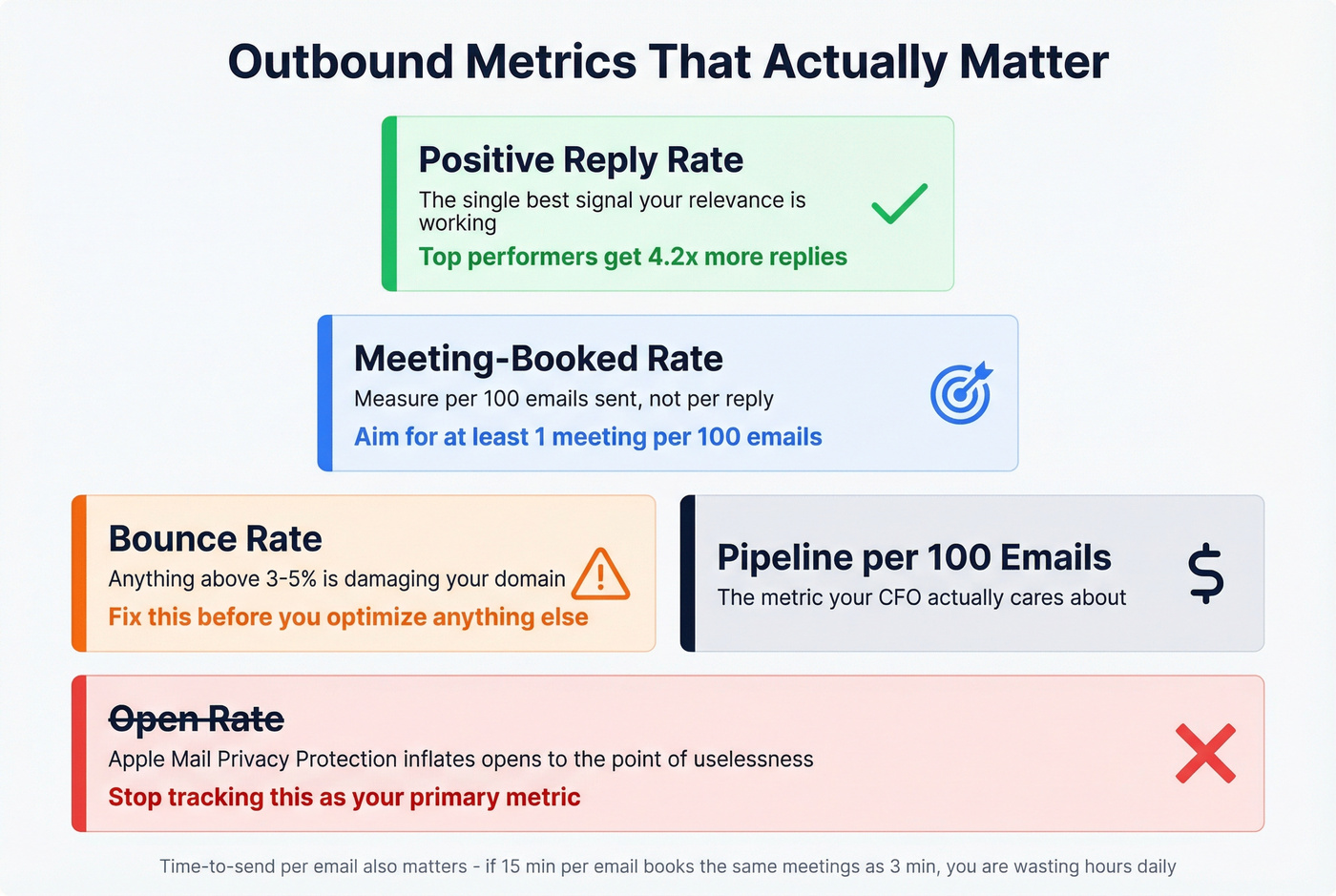
Positive reply rate is the single best signal that your relevance is working. Top performers get 4.2x more replies than average reps - track this, not opens. Meeting-booked rate is the ultimate conversion metric: measure per 100 emails sent, not per reply. As a rule of thumb, aim for at least 1 meeting per 100 emails. If you're below that, your targeting or messaging needs work.
Beyond those two, watch your bounce rate - anything above 3-5% is damaging your domain, and you should fix it before you optimize anything else. Pipeline per 100 emails is the metric your CFO actually cares about. Time-to-send per email also matters: if your "personalized" approach takes 15 minutes per email and books the same meetings as a 3-minute segmented approach, you're wasting hours every single day that could go toward closing deals or building new segments. The goal isn't perfection per email. It's maximum relevance per minute spent.
The reps booking 8x more meetings aren't better writers - they have better signals. Prospeo tracks 15,000 intent topics via Bombora, surfaces job changes in real time, and verifies every email through a 5-step process. Your pain hypotheses hit harder when the data behind them is 7 days fresh, not 6 weeks stale.
Relevance without accurate data is just a guess.
FAQ
Does personalization actually increase reply rates?
Yes, but only when tied to relevance. Highly personalized messages boost replies up to 142% - when the personalization connects to a real pain point. Generic "I saw your post" openers don't move the needle. The lift comes from demonstrating you understand the prospect's situation, not from proving you can Google their name.
How long should a personalized cold email be?
A hundred words or fewer, 3-4 sentences. Every extra sentence dilutes your hypothesis and increases the chance you start pitching, which drops reply rates by up to 57%.
What's the fastest way to personalize at scale?
Build campaigns around trigger events - funding rounds, hiring surges, leadership changes - rather than researching individuals one by one. Segment first, write last. When you can filter by intent signals and job changes upfront, a well-segmented trigger campaign at 3 minutes per email outperforms deep 1:1 research at 20 minutes per email.
Is AI personalization worth using in 2026?
81% of sales teams are experimenting with AI, and the AI SDR market is projected to hit $15B by 2030. The risk isn't AI itself - it's using AI to generate generic mass emails faster. Use AI for research synthesis and draft generation, but keep a human reviewing the hypothesis. AI that removes human judgment produces volume, not relevance.