

B2B Data for Fintech: What to Buy, Who to Buy It From, and What to Pay
Your Series A fintech just closed. You've hired three SDRs, the board wants pipeline yesterday, and someone handed you a spreadsheet of "leads" that's 40% bounced emails and disconnected numbers. Meanwhile, your competitors are hiring SDRs too - and the ones with clean data are booking meetings while yours are leaving voicemails into the void.
Data for fintech GTM teams isn't the same as data for a mid-market SaaS company. Compliance stakes are higher, org charts shift faster after funding rounds, and your buyers sit inside regulated institutions that'll blacklist your domain if you bounce emails off their servers. We've watched fintech teams blow $30K on the wrong data vendor and spend six months recovering their sender reputation. Here's how to avoid that.
What You Need (Quick Version)
If you don't want to read the full guide, here's the stack:
- Apollo.io - Free plan with unlimited email credits. Solid for sequencing and broad database access when you're bootstrapping outbound.
- Cognism - Phone-verified mobiles scrubbed against 13 DNC lists. The pick if you're selling into EMEA financial institutions.
Three tools. You don't need seven.
The Fintech Data Taxonomy
"B2B data" covers at least five distinct categories, and fintech teams typically need more of them than a standard SaaS company.
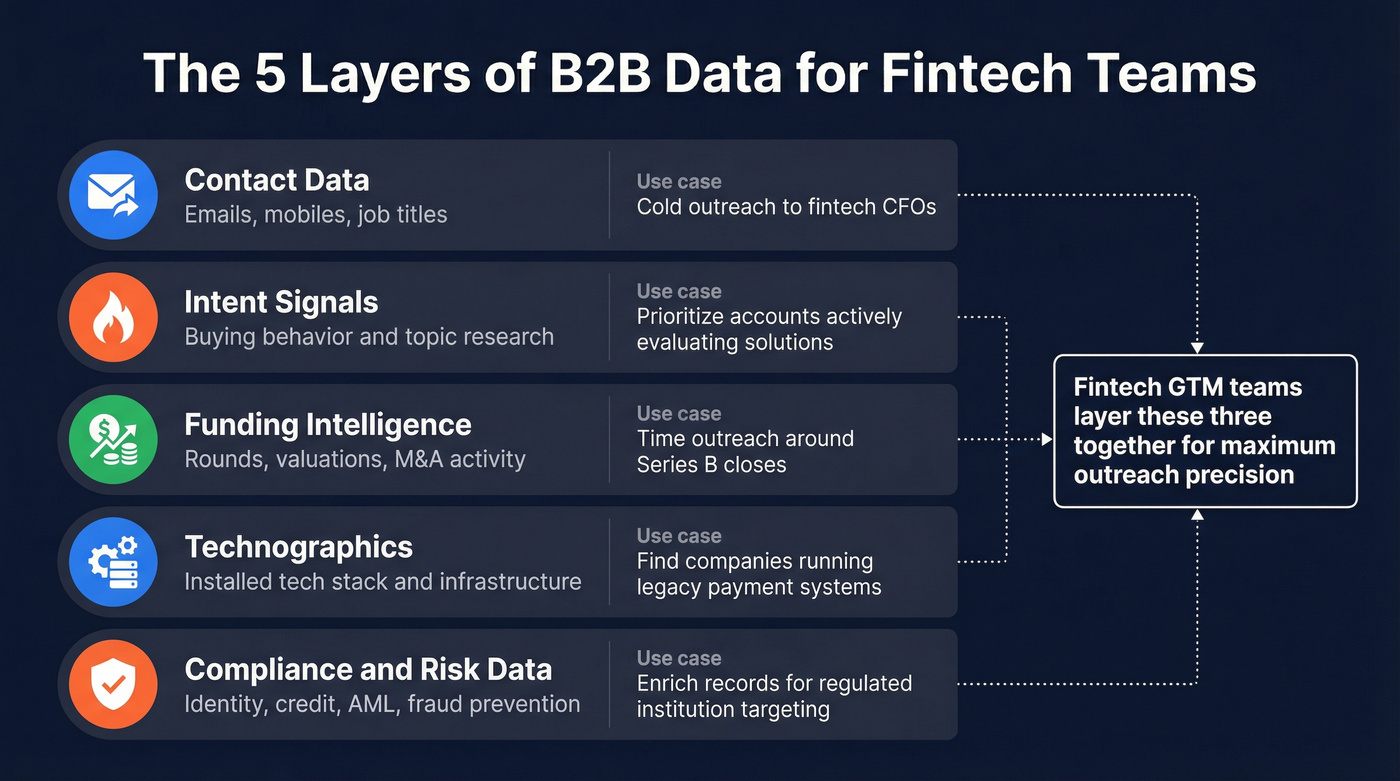
| Data Category | What It Covers | Example Providers |
|---|---|---|
| Contact data | Emails, mobiles, titles | Prospeo, Apollo, Cognism |
| Intent signals | Buying behavior topics | Bombora, 6sense, Demandbase |
| Funding intelligence | Rounds, valuations, M&A | Crunchbase |
| Technographics | Tech stack installed | BuiltWith, Wappalyzer |
| Compliance/risk data | Identity, credit, AML, fraud prevention | Experian, Plaid |
Most "B2B data provider" articles only talk about the first row. But fintech GTM teams layer funding intelligence on top of contact data to time outreach around Series B closes, and they use technographics to identify companies running legacy payment infrastructure ripe for replacement. The fintech sector is growing at a 23.58% CAGR through 2028, which makes that timing even more critical.
Why Fintech Teams Need Different Data
Compliance pressure alone separates fintech from every other vertical. GDPR penalties run up to EUR 20 million or 4% of annual global turnover. Picture your SDR cold-calling a DNC-listed compliance officer at a regulated bank - that's not just an awkward conversation, it's a potential regulatory incident for your prospect. They won't forget it.
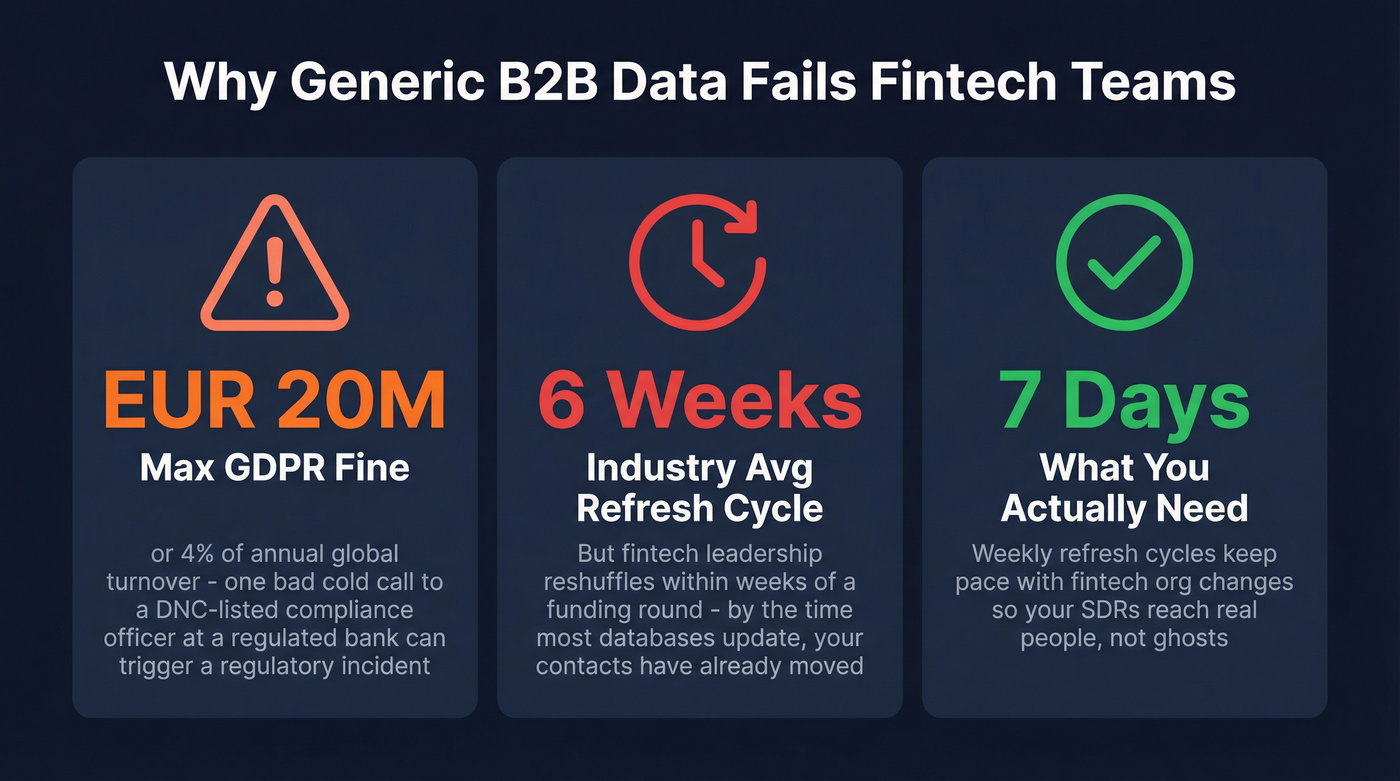
Then there's data decay. After a funding round, fintech companies reshuffle leadership within weeks. Data that's six weeks old - the industry-average refresh cycle - is already stale. You need providers that refresh weekly, not monthly.
Finally, you need filters that don't exist in generic databases: funding stage, regulatory status, technology stack, headcount growth. These are the difference between targeting a payments company that just raised $50M and one that's in a hiring freeze. In our experience, fintech sales teams that prioritize data accuracy over raw database size close more deals per rep. Every time.

Fintech orgs reshuffle leadership weeks after funding rounds - the 6-week industry refresh cycle means you're emailing ghosts. Prospeo refreshes all 300M+ profiles every 7 days, with 30+ filters for funding stage, technographics, and headcount growth. At $0.01/email with 98% accuracy, your SDRs stop burning domain reputation and start booking meetings.
Stop bouncing emails off regulated bank servers. Start with 75 free verified contacts.
Best Fintech Data Providers in 2026
Prospeo
Use this if: You need the highest email accuracy in the market without signing an annual contract. Prospeo's 300M+ profiles, 143M+ verified emails, and 125M+ verified mobiles run on a 7-day refresh cycle - meaning the data your SDRs pull on Monday is current, not a month-old snapshot. The 30+ search filters include funding stage, technographics, and headcount growth: exactly the signals fintech teams need to prioritize accounts.
The Snyk case study tells the story well. Their 50-person AE team saw bounce rates drop from 35-40% to under 5%, and AE-sourced pipeline jumped 180% with 200+ new opportunities per month. That's what happens when you stop burning domain reputation on bad emails. Pricing runs about $0.01/email with a free tier of 75 emails and 100 Chrome extension credits per month, zero contracts.

Skip this if: You need a built-in sequencer. Pair with Instantly, Lemlist, or Smartlead for outbound execution - native integrations connect in minutes.
Apollo.io
Use this if: You're pre-revenue or early-stage and need a free plan that actually works. Apollo's free plan includes unlimited email credits, 5 mobile credits per month, and basic sequencing. The 4.7/5 G2 rating across 9,400+ reviews reflects genuine ease of use. Paid plans start at $49/mo and scale to $119/mo for Organization tier at minimum 3 seats.
The catch: "Inaccurate Data" is the #2 complaint theme on G2 with 538 mentions. For fintech teams where bounced emails to regulated institutions carry real consequences, that's a meaningful risk. Credits also don't roll over - use them or lose them each billing cycle.
Skip this if: Email accuracy is your top priority. Apollo's email accuracy trails behind dedicated verification-first providers, and that gap matters when you're targeting compliance officers and CFOs at regulated institutions.
Cognism
Cognism earns its price tag in one specific scenario: selling into European financial institutions. The Mollie case study showed data that was "30% better" than competitors, with SDRs saving 10-15 minutes per account and connecting 2x more often. Diamond Data offers phone-verified mobile numbers scrubbed against 13 DNC lists - critical when your prospects work at banks with strict telecommunications compliance.
The cost is real though. Expect around $16,500/year for a single Platinum user and $25,000+ for Diamond, plus $3-8K implementation fees. Annual contracts only. Community discussions on r/sales mention auto-renewal clauses that lock teams into roughly EUR 20K/12-month commitments, so read the fine print carefully before you sign anything.
Skip this if you're a US-only team or pre-Series B.
ZoomInfo
Built for 50+ rep organizations with budget for a full-stack GTM platform. Estimated $15K-$40K+/year depending on seats and modules. Here's the thing: ZoomInfo is still the deepest US database, but most fintech startups don't need - and won't use - half of what they're paying for. A 10-seat contract with intent data can run $30-40K/year. That's real money for a Series A company still finding product-market fit.
Lead411
Lead411 takes a different approach: trigger-based outreach over database size. Their 100M+ verified contacts update daily, with real-time triggers for funding events, leadership changes, and tech adoption signals. GDPR and CCPA compliant. Estimated $75-$200/user/month. Best for fintech teams timing outreach around specific events rather than blasting static lists.
Lusha and UpLead
Lusha offers a free tier with 40 credits/month and an 800K+ contributor community - useful for quick one-off lookups, but data inaccuracy complaints across 40+ G2 reviews make it risky for bulk fintech prospecting. UpLead runs about $99-$400/month with straightforward credit-based pricing best suited for small teams wanting simplicity over fintech-specific depth. Neither is a bad tool. Neither is built for fintech's specific demands.
Pricing Comparison
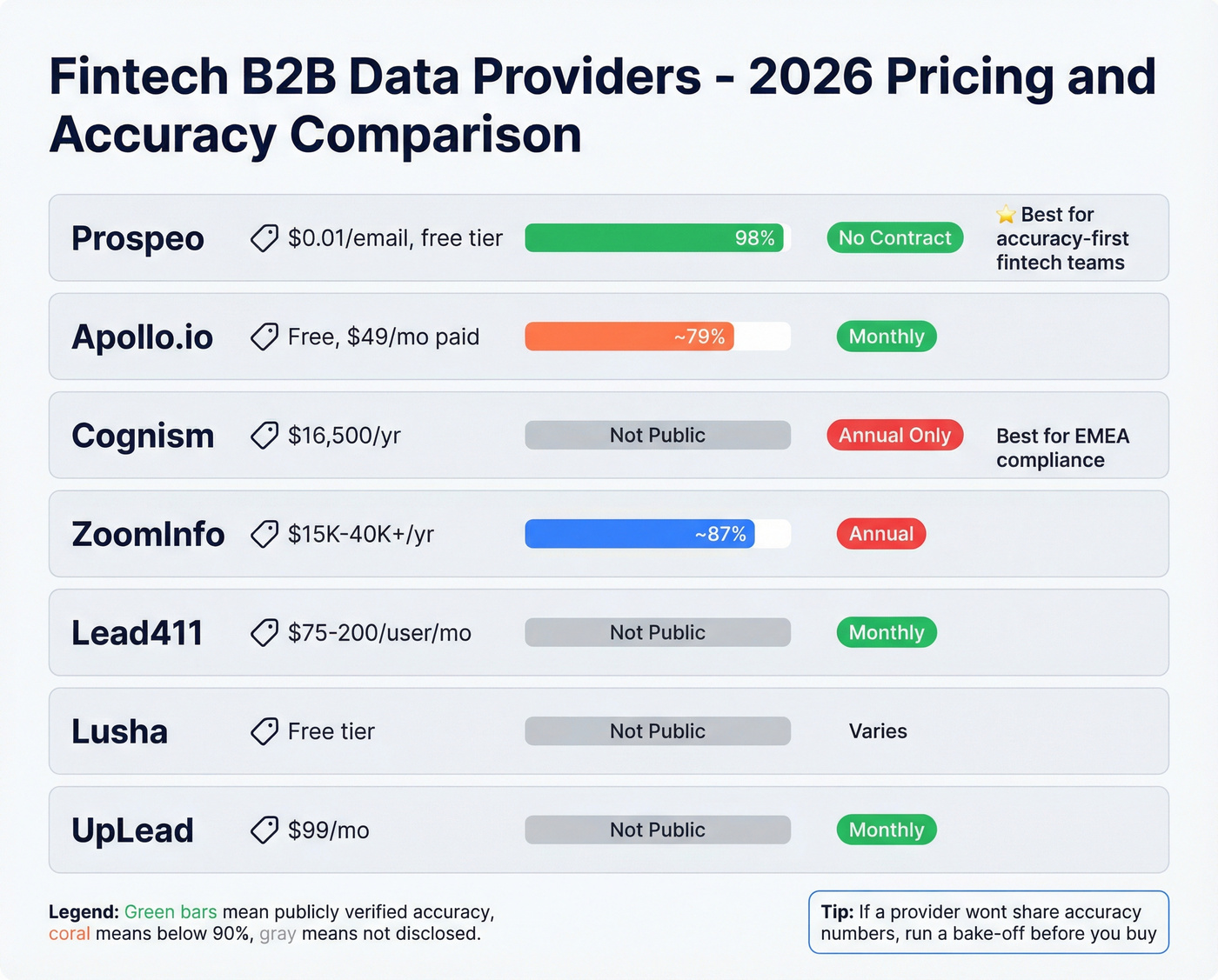
| Provider | Starting Price | Contract | Email Accuracy | Data Refresh | Best For |
|---|---|---|---|---|---|
| Prospeo | ~$0.01/email; free tier | None | 98% | 7 days | Accuracy-first teams |
| Apollo | Free; $49/mo paid | Monthly | ~79% | Not public | Budget prospecting |
| Cognism | ~$16,500/yr | Annual | Not public | Not public | EMEA compliance |
| ZoomInfo | ~$15K/yr | Annual | ~87% | Not public | Enterprise full-stack |
| Lead411 | ~$75/user/mo | Monthly | Not public | Daily updates | Trigger outreach |
| Lusha | Free tier available | Varies | Not public | Not public | Quick lookups |
| UpLead | ~$99/mo | Monthly | Not public | Not public | Simple self-serve |
How Fintech B2B Data Gets Collected
Three methods power every B2B database: web scraping, contributor networks, and data partnerships. Apollo's 2M+ data contributors and Lusha's 800K+ community feed their databases through opt-in sharing, where users trade their contacts for access. Web scraping of publicly available data gained important legal precedent through the hiQ Labs v. LinkedIn case, though the legal picture continues to evolve across jurisdictions.
Fintech compliance teams should ask every vendor one question: where does your data come from? Providers that rely on proprietary infrastructure rather than third-party email providers tend to give you a cleaner audit trail when your legal team reviews vendor DPAs. That distinction matters more than most buyers realize.
Compliance Checklist for Fintech Buyers
Before signing any contract, confirm these six things:
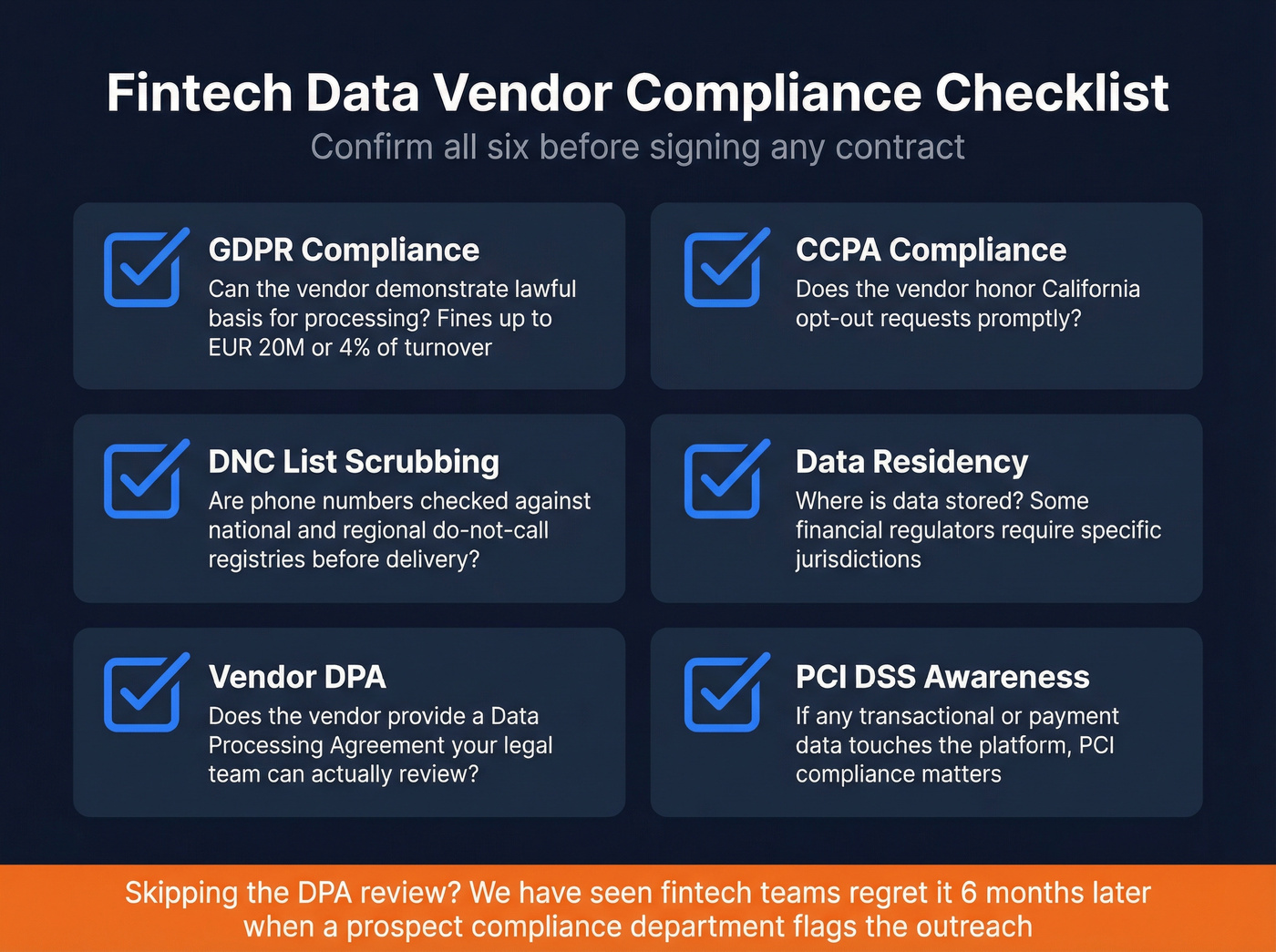
- GDPR compliance - Can the vendor demonstrate lawful basis for processing? Penalties reach EUR 20M or 4% of turnover.
- CCPA compliance - Does the vendor honor California opt-out requests?
- DNC list scrubbing - Are phone numbers checked against national and regional do-not-call registries before delivery?
- Data residency - Where is the data stored? Some financial regulators require specific jurisdictions.
- Vendor DPA - Does the vendor provide a Data Processing Agreement your legal team can review?
- PCI DSS awareness - If any transactional or payment data touches the platform, PCI compliance matters.
We've seen fintech teams skip the DPA review and regret it six months later when a prospect's compliance department flags the outreach. Don't be that team.
How to Run a Data Bake-Off
Look, every provider will tell you their data is "verified." The only way to know is to test it yourself.
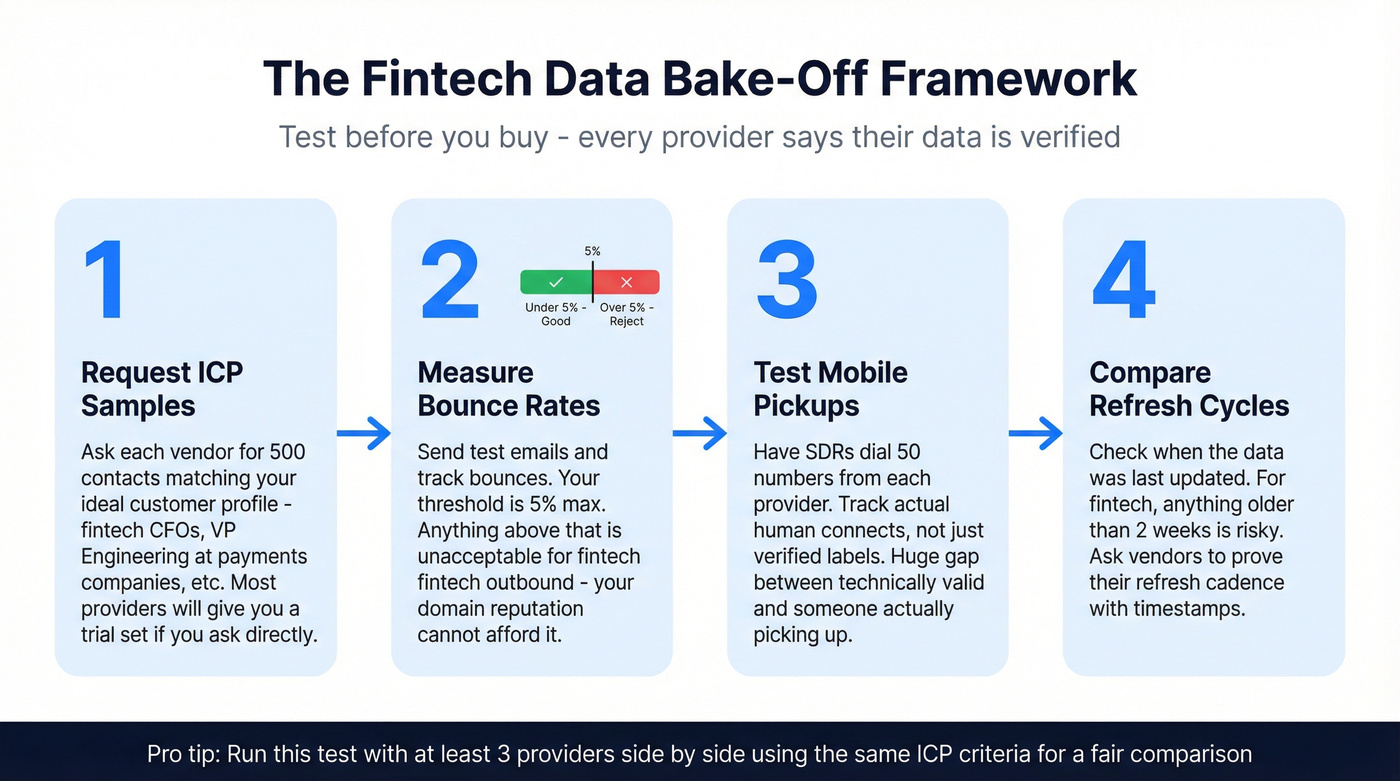
Step 1: Request sample data for your ICP. Ask each vendor for 500 contacts matching your ideal customer profile - fintech CFOs, VP Engineering at payments companies, whatever your target is. Most providers will give you a trial or sample set if you ask directly.
Step 2: Measure bounce rates against a 5% threshold. Anything above 5% is unacceptable for fintech outbound. Your domain reputation can't afford it, and neither can your relationship with prospects at regulated institutions that monitor inbound email quality closely.
Step 3: Test mobile pickup rates. Have your SDRs actually dial 50 numbers from each provider. Track connects, not just "verified" labels. There's a massive gap between a number that's technically valid and one where a human picks up.
Step 4: Compare refresh cycles. Ask when each record was last updated. If the answer is "we refresh monthly," that's already stale in fintech.
Let's be honest - this takes a week of work. But it'll save you from a $20K mistake and months of domain reputation recovery.
Snyk's 50 AEs dropped bounce rates from 35-40% to under 5% and generated 200+ new opportunities per month with Prospeo. For fintech teams targeting compliance officers and CFOs at financial institutions, that accuracy gap is the difference between pipeline and a blacklisted domain. No annual contracts, no sales calls required.
Your competitors already switched. 15,000+ companies use Prospeo to reach real buyers.
FAQ
Is ZoomInfo worth it for a fintech startup?
Not unless you have 20+ reps and $15K+ in annual budget to spare. For teams under that threshold, self-serve tools with verified data and no annual contracts deliver better ROI per dollar spent. ZoomInfo is built for Fortune 500 sales orgs, not Series B payments companies still finding product-market fit.
What's the most accurate fintech B2B data provider in 2026?
Prospeo leads with 98% verified email accuracy on a 7-day refresh cycle. ZoomInfo sits around 87%, Apollo around 79%. Accuracy matters disproportionately in fintech because bounced emails to regulated institutions damage domain reputation and deliverability faster than in other verticals.
Do fintech sales teams need intent data?
Yes - if you're targeting companies actively evaluating solutions in your category. Bombora-powered intent data tracks 15,000+ topics so you can prioritize accounts showing buying signals. Intent-informed outreach typically converts 2-3x better than cold lists, making the investment worthwhile once you've nailed your ICP.