Prospect Data Accuracy: How Fast It Decays, What It Costs, and How to Fix It
You exported 5,000 contacts last quarter. By now, roughly 1,125 of them have at least one field that's wrong - a dead email, a changed job title, a phone number that rings into someone else's voicemail. A study of 1,000 business cards found that 70.8% had one or more changes within 12 months. That's not a data quality problem. It's a prospect data accuracy problem, and most teams don't realize it until a campaign bounces at 10%+.
You don't need a cleaner CRM. You need a system that stops bad data from entering in the first place, then maintains what's already there on a disciplined cadence.
The Quick Version
Your database loses ~2.1% per month of its contacts every month. That's 22.5% per year gone stale, and in high-turnover industries like tech, it's worse. The fix isn't periodic CRM cleanups - it's real-time verification at the point of entry plus a scheduled maintenance cadence. Measure your current bounce rate against these benchmarks, then implement the playbook below.
| Rating | Bounce Rate |
|---|---|
| Excellent | Under 2% |
| Good | 2-5% |
| Acceptable | 5-10% |
| Poor | Above 10% |
If you're above 5%, your data provider or verification process is failing. Above 10%, stop sending. You're burning your domain.
The Real Cost of Poor Data Quality
Gartner pegs the average cost of poor data quality at $12.9 million per year for large organizations. Inaccurate contact data costs companies an estimated 15% in lost revenue. Scale that down to a 10-person sales team at a mid-market company and you're still looking at $50K-$100K annually in wasted effort, missed pipeline, and remediation.

Sales reps lose roughly 500 hours per year validating and correcting contact information - nearly a quarter of their selling time spent on data janitorial work. Every bounced email chips away at your sender reputation. Every wrong phone number wastes a dial and erodes rep confidence in the tools you're paying for.
The hidden costs go beyond revenue. Send enough emails to dead addresses and your deliverability tanks across the board - not just for the bad contacts, but for the good ones too. We've seen teams with 10%+ bounce rates get throttled by inbox providers within weeks, and rebuilding that reputation takes months. Stale data also creates compliance risk: outdated records mean you can end up contacting the wrong people at the wrong companies, failing basic data-minimization and accuracy expectations under GDPR and similar frameworks.
How Fast Does Data Decay?
The commonly cited benchmark is ~2.1% per month, or roughly 22.5% per year. But that's an average. The real decay rate depends on which fields you're tracking and which industries you're selling into.
Field-by-Field Decay Rates
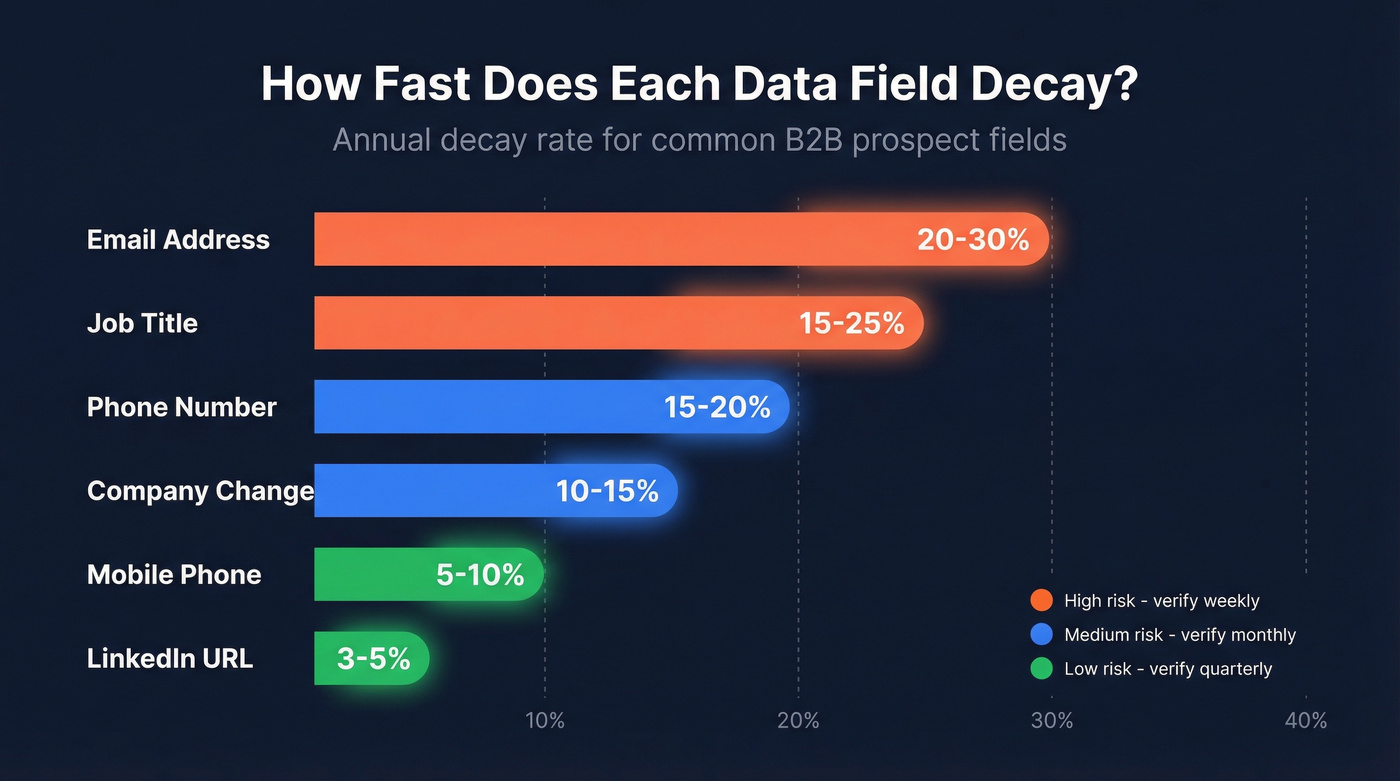
Not all fields rot at the same speed. The table below shows two measures: the "Study" column reflects the percentage of tracked individuals who experienced a change in that 1,000 business card study, while the "Annual Decay Range" estimates the percentage of a typical B2B database affected annually, drawn from Cleanlist's 2026 analysis.
| Field | 12-Month Change (Study) | Annual Decay Range |
|---|---|---|
| Job title | 65.8% | 15-25% |
| Phone number | 42.9% | 15-20% |
| Address | 41.9% | - |
| Email address | 37.3% | 20-30% |
| Company change | 29.6% | 10-15% |
| Mobile phone | - | 5-10% |
| LinkedIn URL | - | 3-5% |
The gap between columns tells you something important: individual change rates are always higher than database-wide decay rates because not every change invalidates the record. But the directional ranking holds. Job titles churn fastest. Mobile numbers are surprisingly stable. Tagging each field with a confidence level, last-verified date, and source makes it far easier to prioritize which records need re-verification first.
Decay Rates by Industry
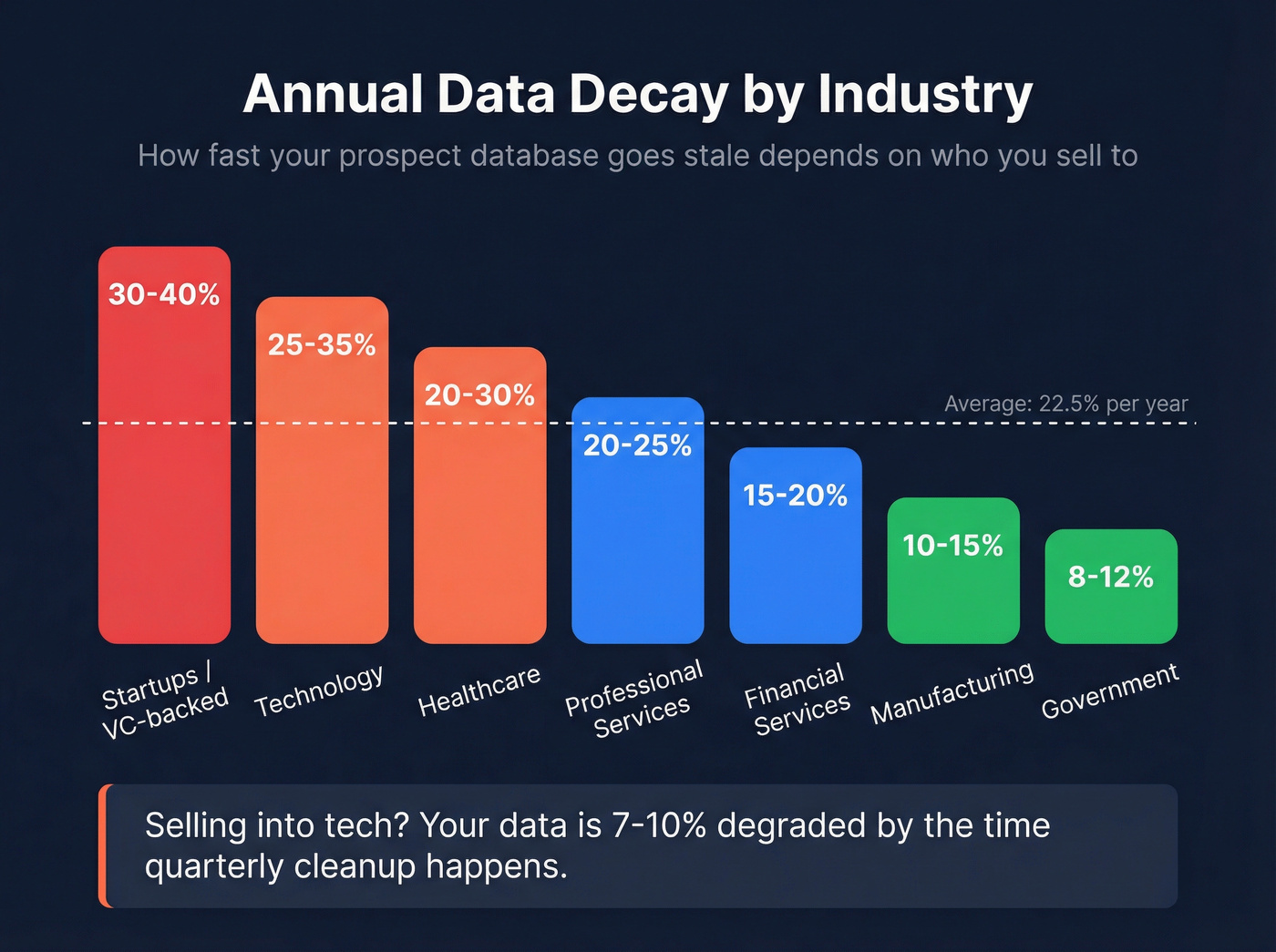
If you're selling into tech startups, your data is rotting nearly three times faster than if you're targeting government agencies.
| Industry | Annual Decay |
|---|---|
| Startups / VC-backed | 30-40% |
| Technology | 25-35% |
| Healthcare | 20-30% |
| Professional services | 20-25% |
| Financial services | 15-20% |
| Manufacturing | 10-15% |
| Government | 8-12% |
Running outbound into tech or startups and only cleaning your database quarterly? You're working with data that's already 7-10% degraded by the time you touch it. Quarterly cleanups for high-decay industries are like changing your oil once a year.

You just read how quarterly cleanups can't keep up with 25-35% annual decay in tech. Prospeo refreshes its 300M+ profiles every 7 days - not every 6 weeks like most providers. With 98% email accuracy and 5-step verification that catches spam traps and honeypots before they torch your domain, your data stays accurate between campaigns, not just on launch day.
Stop exporting stale lists. Start with data that's verified this week.
Phone Data - The Blind Spot
Email accuracy gets all the attention. Phone data is where campaigns quietly die.
A benchmark test of 307 verified contacts-accuracy-coverage-real-results) across multiple providers found accuracy ranging from 63% to 91% and coverage ranging from 26% to 92%. The provider you pick can literally double your connect rate - or halve it.
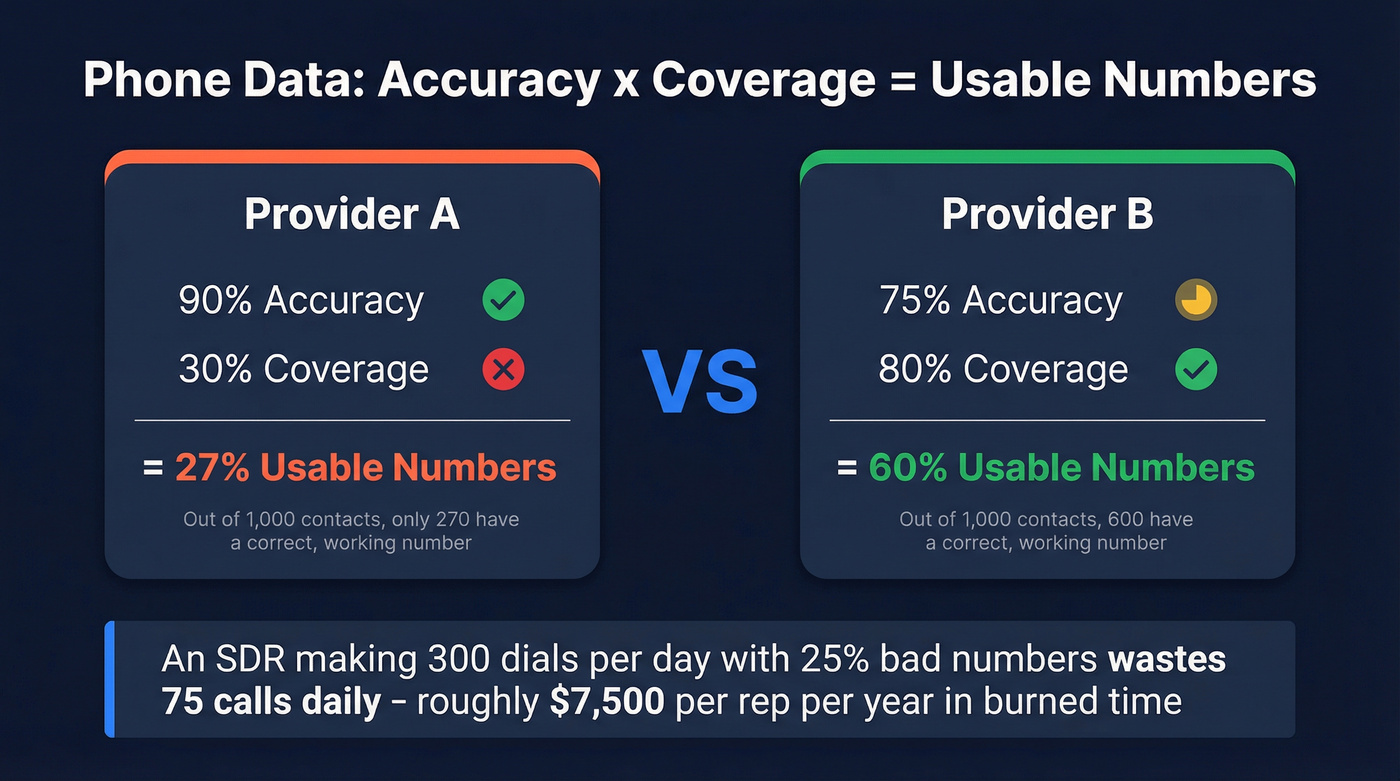
The metric that matters is accuracy x coverage. A provider with 90% accuracy but 30% coverage only gives you usable numbers for 27% of your list. A provider with 75% accuracy and 80% coverage gets you to 60%. Always multiply the two. In our testing, the gap between providers was even wider than these benchmarks suggest, which is part of why we built Prospeo's mobile finder around 125M+ verified numbers with a 30% pickup rate - the math only works when both sides of the equation are strong.
Here's the thing about bad phone data: if 25% of your numbers are wrong and an SDR makes 300 dials per day, that's 75 wasted calls daily - roughly $7,500 per rep per year in burned dial time and software minutes. Teams blame the script when the numbers are the problem.
If your average deal size is under $15K, you probably don't need enterprise-level data infrastructure. But you absolutely need accurate phone numbers. A $39/month tool with strong phone accuracy will outperform a $15,000/year platform with weak phone accuracy every single time. Spend on accuracy, not brand names.
How Bad Is Your CRM Right Now?
Before you fix anything, audit what you have. Salesforce's own data shows 90% of contacts in the average org include incomplete data. Roughly 20% of most databases are functionally useless - records with no valid email, no working phone, or outdated company information.
Run this quick self-audit:
- Bounce rate - Pull your last 3 outbound campaigns. Where do you land on the scale above?
- Duplicate rate - Under 5% is excellent. Above 20% means your intake process has no dedup logic and your reporting is unreliable.
- Completeness - What percentage of contacts have both a verified email and a direct phone number? Under 50% means you're leaving pipeline on the table.
When was the last time your full database was re-verified? If the answer is "never" or "I don't know," assume at least a quarter of it is stale.
The Data Maintenance Playbook
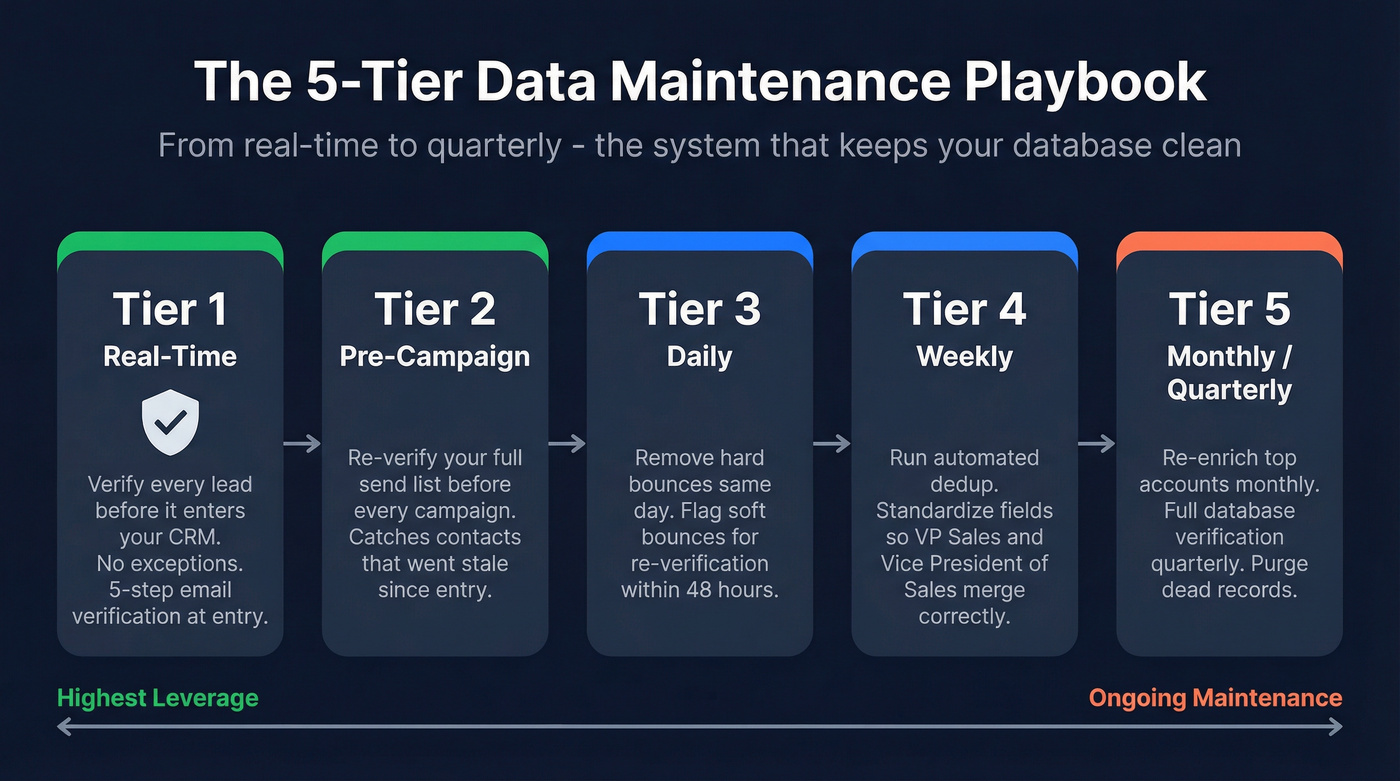
Cleaning your database once is a project. Keeping it clean is a system. Here's the five-tier cadence we recommend after working through this with dozens of outbound teams.
Tier 1: Real-Time - Verify at Entry
Every new lead gets verified before it touches your CRM. No exceptions. This is the single highest-leverage action in the entire playbook.
Catch-all domain handling and spam traps and honeypots filtering are non-negotiable verification steps. Prospeo's email finder runs a 5-step verification process at 98% email accuracy, drawing from 143M+ verified emails across 300M+ professional profiles. At ~$0.01 per email, there's no reason to let an unverified contact into your system.
Tier 2: Pre-Campaign - Verify the Send List
Even if contacts were verified at entry, re-verify your campaign list before every send. Data decays between the moment a contact enters your CRM and the moment you email them. A quick bulk verification pass catches the contacts that went stale in the gap. This single step is the difference between a 2% bounce rate and a 6% one.
Tier 3: Daily - Process Bounces
Remove hard bounces the same day they occur. Flag soft bounces for re-verification within 48 hours. A hard-bounced email is dead - keeping it in your system drags down your sender reputation with every campaign.
Tier 4: Weekly - Deduplicate
Run automated dedup every week. Standardize fields so your dedup logic catches matches - "VP Sales" and "Vice President of Sales" at the same company are the same person, and your system needs to know that.
Tier 5: Monthly and Quarterly - Refresh and Purge
Re-enrich your top accounts monthly. Check for job changes, company changes, and new decision-makers. The contacts that matter most are the ones most likely to have moved. Then run your entire database through verification quarterly. Purge records with no valid contact method remaining. For high-decay industries like tech and startups, do the full sweep monthly instead.
How to Evaluate a Data Provider
Every provider claims 95%+ accuracy. Run a real campaign and watch that number drop to around 50%.
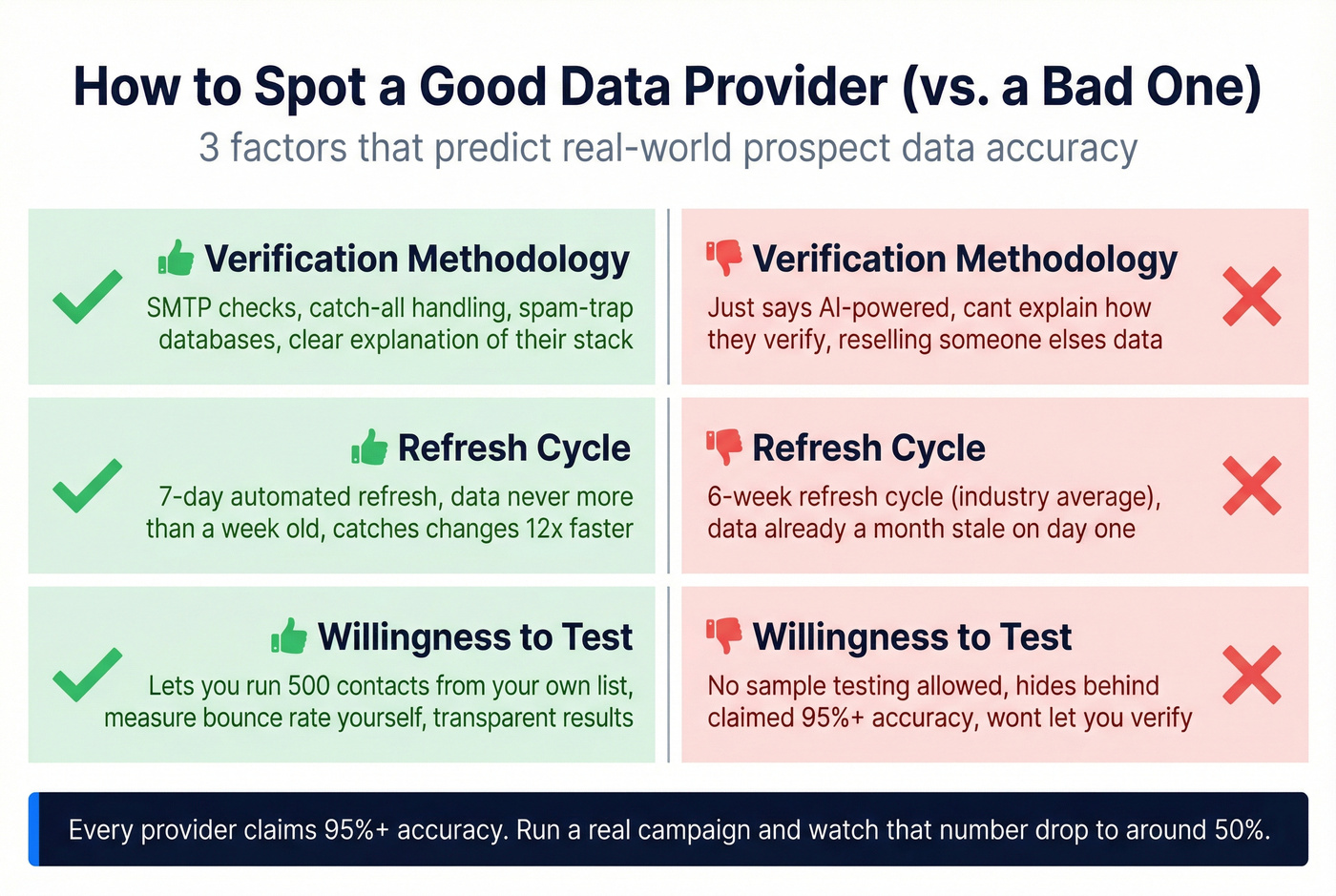
We've evaluated dozens of providers, and three factors predict real-world prospect data accuracy better than anything on a marketing page.
Verification methodology. Ask specifically how they verify. "AI-powered" is marketing fluff. You want to hear about SMTP checks, catch-all handling, spam-trap databases, and refresh cadences. If they can't explain their verification stack in plain terms, they're reselling someone else's data.
Refresh cycle. This is the single most underrated buying criterion. A 7-day refresh cycle means your data is never more than a week old. A 6-week cycle - the industry average - means you're working with data that's already over a month stale on day one. Some providers use human re-verification every 90 days. That's better than nothing, but a 7-day automated refresh catches changes 12x faster.
Test before you buy. Any provider that won't let you run a sample against your own list is hiding something. Export 500 contacts, run them through the provider, and measure bounce rate yourself. You can test this in an afternoon with a real list and a real campaign.
One strategy gaining traction - especially in Reddit threads on r/sales and r/coldemail - is waterfall enrichment: querying multiple data sources in sequence and cross-referencing results. Instead of trusting a single provider's accuracy claims, you layer 2-3 sources and keep only the records that match across providers. It's more work to set up, but it dramatically reduces false positives.
Red flags to watch for: Annual contracts with no trial period. "Talk to sales" as the only pricing path. Accuracy claims with no methodology explanation.
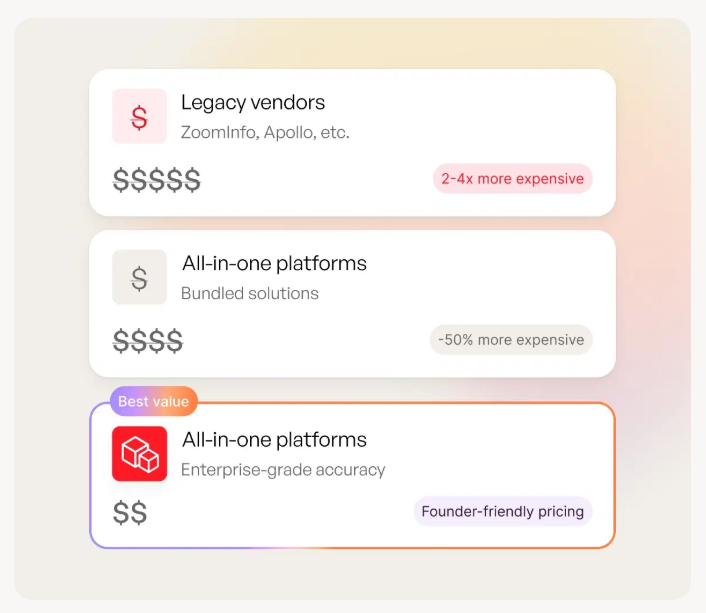
For pricing context, ZoomInfo starts at ~$15,000/year for a Professional plan with 5,000 credits. Mid-tier tools like Skrapp start at $37/month for 1,000 credits. Prospeo runs at ~$0.01 per email with a 7-day refresh cycle, 98% accuracy, and a free tier to test with - 75 emails per month, no contract required. That's the range, and refresh cycle matters more than price.
Bad phone data burns 75 dials a day per rep. Prospeo's 125M+ verified mobile numbers deliver a 30% pickup rate - while the industry benchmarks above show most providers sit at 11-12.5%. Accurate emails at $0.01 each, verified mobiles that actually connect, and zero annual contracts.
Multiply accuracy by coverage and finally win the math.
FAQ
How often should I re-verify my database?
Re-verify high-value accounts monthly and your full database quarterly. For tech and startup verticals where annual decay hits 25-35%, run monthly full sweeps. The highest-leverage habit is verifying every new lead at entry - before it touches your CRM.
What's a good email bounce rate for outbound?
Under 2% is excellent and signals strong verification hygiene. Between 2-5% is acceptable for most teams. Above 5%, your verification process is failing. Above 10%, stop sending immediately - you're actively damaging your domain reputation and deliverability across all your campaigns, not just the ones with bad addresses.
Can one provider deliver accurate emails and phone numbers?
Few providers excel at both channels. Most nail email or phone, not both. If your current provider only handles email well, pair it with a dedicated mobile data source rather than accepting bad numbers. The math on wasted dials adds up fast - 75 wrong calls a day at 300 dials isn't a rounding error, it's a quarter of your team's capacity gone.