Org Chart Mapping: Process, Tools, and How to Use It in 2026
Most org charts die the week after they're created. Someone builds a beautiful hierarchy in Lucidchart, shares it in Slack, and within a month it's wrong - new hires missing, a reorg nobody updated, dotted-line relationships that never made it onto the diagram.
The problem isn't the tool. It's that teams treat org chart mapping as a one-time project instead of an ongoing discipline. Here's the thing: a stale chart doesn't just sit there being useless - it actively misleads people about who owns what, who reports to whom, and where real decision-making power lives.
What Is Org Chart Mapping?
It goes beyond drawing boxes and lines. Org chart mapping is the process of visually representing an organization's structure, hierarchy, relationships, and processes - covering far more ground than a traditional chart on the break room wall.
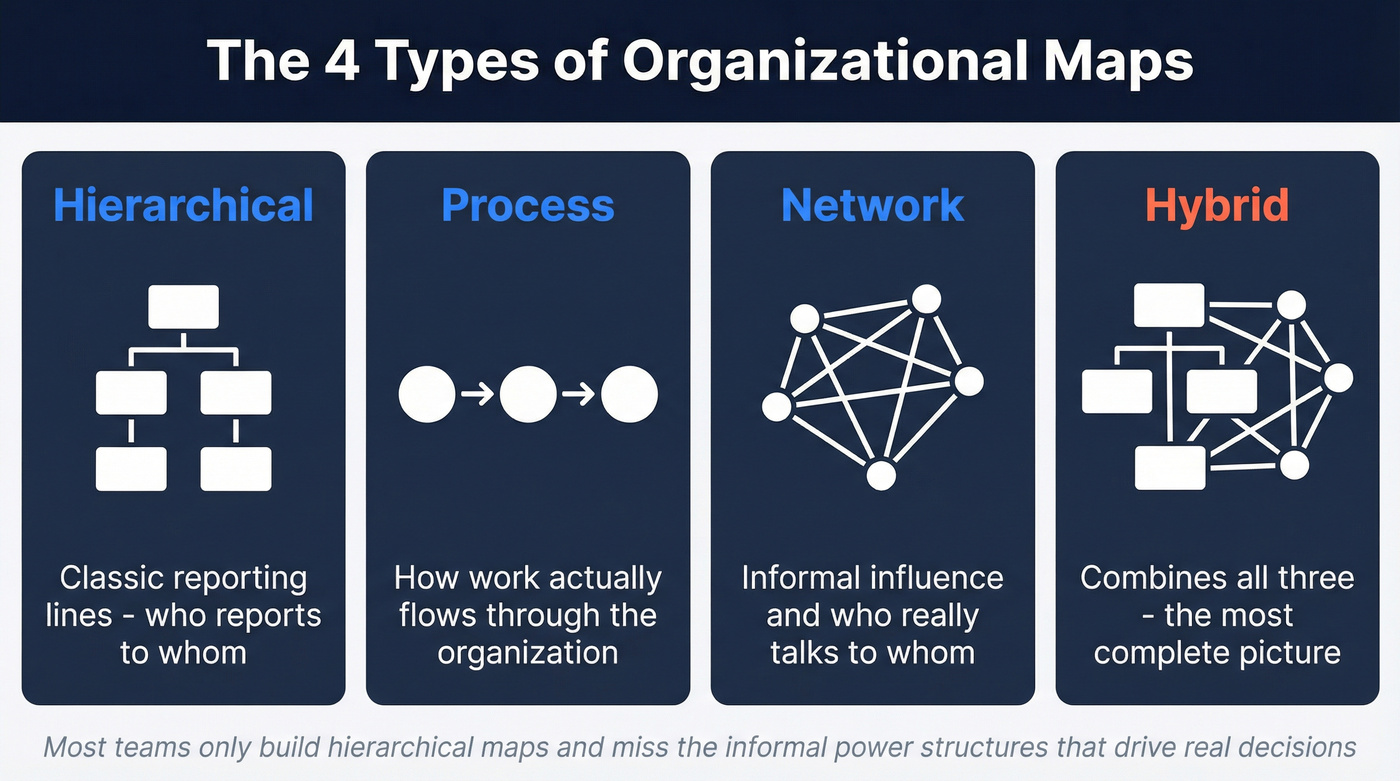
Ardoq's framework breaks organizational maps into four types: hierarchical maps showing classic reporting lines, process maps tracking how work flows, network maps revealing who influences whom through informal relationships, and hybrid maps combining elements. Most teams default to hierarchical charts and miss the informal power structures that actually drive decisions. A VP of Engineering who technically reports to the CTO might functionally run product decisions - a hierarchy chart won't show you that.
What You Need (Quick Version)
Three things to get right before you open any tool:
- Start with the work, not the boxes. Define activities and roles before drawing reporting lines.
- Under 100 people? Lucidchart or Canva. Over 100? Connect to your HRIS with OrgChart or ChartHop so the chart updates itself.
How to Map an Organization
Here's where most teams go wrong: they fire up a diagramming tool and start dragging boxes around before they've figured out what work needs to happen.
Start With the Work
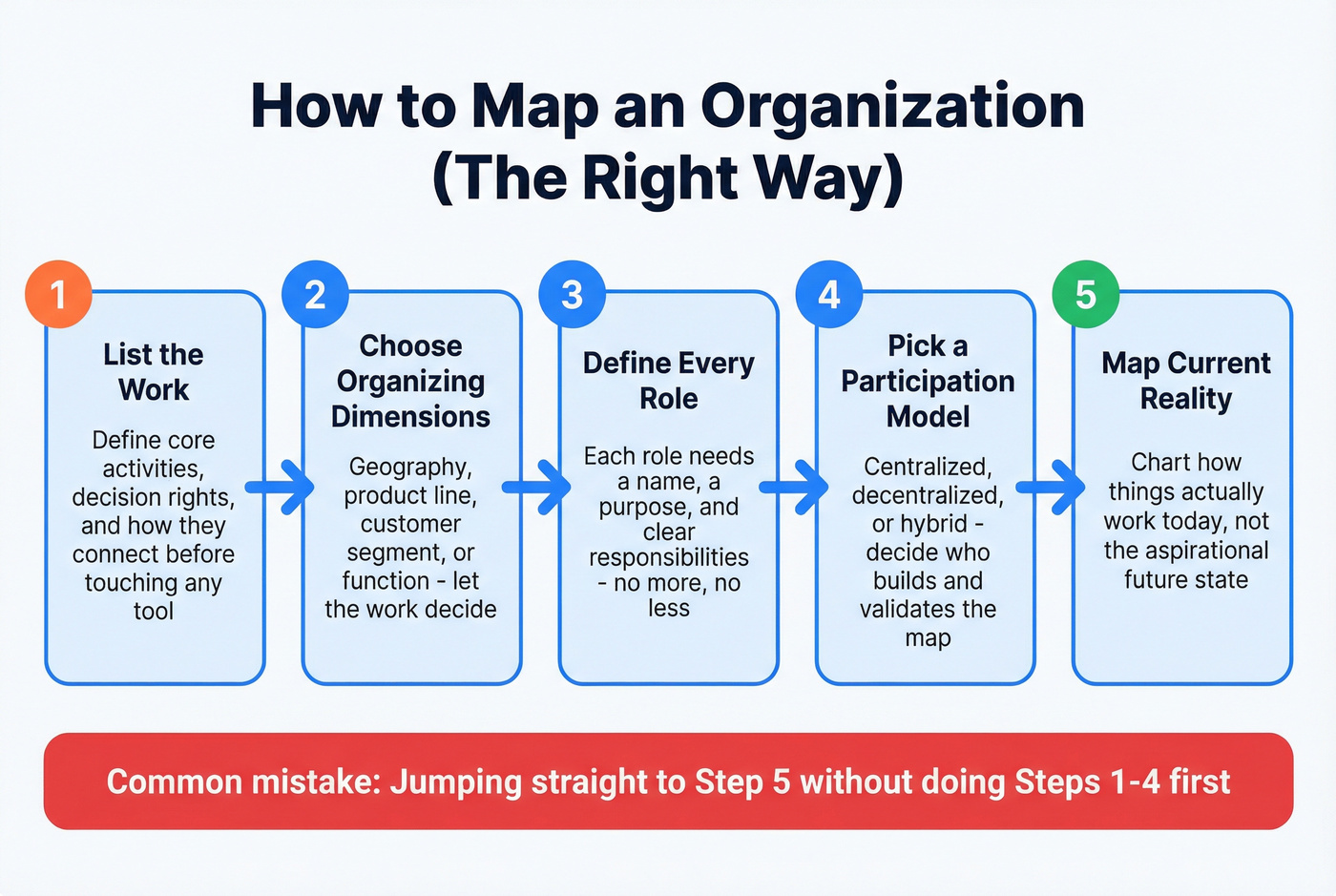
ThinkOrg calls this out as the single most common mistake in organizational design - jumping straight to the chart before articulating the key activities the organization needs to execute. List the work that matters first: core activities, decision rights, and how those activities connect. Only then decide how to group people.
The organizing dimensions you choose - geography, product line, customer segment, function - should follow from the work, not the other way around.
Define Roles Properly
Every role on your map needs three things: a name, a purpose, and a set of responsibilities. Peerdom, drawing on insights from 300+ organizations that published their first interactive org chart, recommends documenting the minimum detail needed for mutual understanding. Too little specification creates confusion. Too much makes the chart impossible to maintain.
Choose a Participation Model
Who builds the map? Peerdom observed two dominant models across those organizations: centralized, where a single cartographer defines roles and assigns people, and decentralized, where everyone defines their own roles. In our experience, the hybrid approach works best - a small team drafts the initial map, then department leads validate and refine.
One critical principle: map your current reality, not the idealized future state. An aspirational chart that doesn't reflect how work gets done today is worse than no chart at all.

An org chart without contact data is just a diagram. Upload your mapped stakeholders to Prospeo and get back 98% accurate emails and verified mobile numbers - refreshed every 7 days so your data stays as current as your chart.
Turn mapped decision-makers into reachable prospects in seconds.
Keeping Your Chart Alive
The moment your organizational chart stops reflecting reality, it starts doing harm.
The most common frustration we hear from teams is simple: the chart's already outdated by the time it's distributed. Salesforce frames this as the "living chart" concept - your org chart should be a dynamic tool connected to real data, not a static PDF. OrgChart connects to 50+ HRIS platforms including Workday, ADP, BambooHR, and SAP, with cadence controls for syncing updates. Many teams choose daily.
If you're under 50 people and can't justify an HRIS-connected tool, set a calendar reminder to review monthly at minimum. A stale chart does more damage than no chart.
Using Org Charts for Sales Prospecting
This is where the discipline shifts from an HR exercise to a revenue tool. When you're selling into enterprise accounts, knowing the buying committee structure is the difference between multi-threading into power and pitching the wrong person for six months.
Use this if: You're running account-based sales into companies with 5+ stakeholders. Tools like OrgChartHub build org charts directly on HubSpot account records, letting reps map buying roles, relationship strength, and placeholder contacts for stakeholders they haven't reached yet. This is especially useful if you're building an account-based prospecting motion.
Skip this if: You're selling transactional deals with a single decision-maker. A mapped hierarchy adds overhead you don't need.
Here's the gap most sales teams hit: you've mapped the buying committee, you know the VP of Ops is the economic buyer - but you don't have their direct email or mobile number. That's where contact enrichment comes in. We've found that pairing mapped org charts with Prospeo's enrichment - 143M+ verified emails, 125M+ verified mobiles, refreshed every 7 days - closes that gap fast. Upload a CSV of your mapped stakeholders, get back verified contacts at 98% email accuracy, and push them into your sequencer via native HubSpot or Salesforce integrations. If you're pressure-testing vendors, start with prospect data accuracy and a clear CRM hygiene process.
Many teams start by using domain-based extraction to pull a target company's hierarchy from publicly available data, then layer in enrichment to fill the gaps. This approach lets you build a complete picture of the buying committee before your first outreach. The consensus on r/sales is that multi-threading is non-negotiable for enterprise deals - and you can't multi-thread if you can only reach one person on the chart. If you want the playbook behind that, see what is multithreading in sales.
Multi-threading into enterprise accounts means reaching every stakeholder on your mapped buying committee - not just the one who replied. Prospeo covers 300M+ profiles with 143M+ verified emails and 125M+ direct dials at $0.01/email. No contracts, no sales calls.
Stop mapping committees you can't actually contact.
Best Tools for Org Chart Mapping
Tools fall into five buckets: visual diagramming (Lucidchart, SmartDraw, Canva), HR-driven automation (OrgChart, Pingboard), collaboration platforms (Miro, Confluence), workforce planning (ChartHop), and sales-focused mapping (OrgChartHub). Your pick depends on whether you're mapping your own company or someone else's. If you're evaluating adjacent tooling, compare options in our guide to sales prospecting platforms and lead generation software.
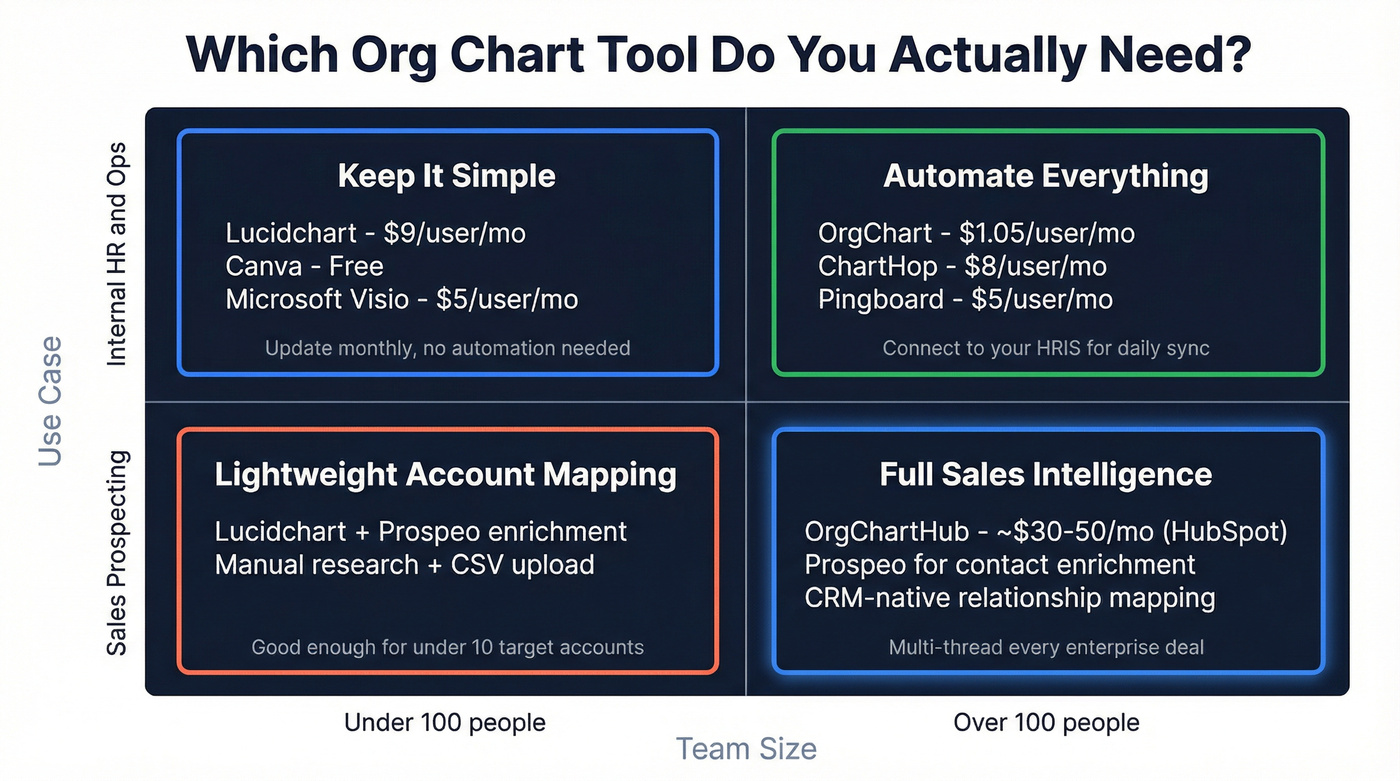
Let's be honest: most teams under 200 people don't need a dedicated org chart tool. A Lucidchart diagram updated monthly beats a $5,000/year platform nobody logs into. Save the budget for when manual updates start eating real hours.
| Tool | Starting Price | Best For | Gartner Rating |
|---|---|---|---|
| Lucidchart | $9/user/mo | Visual diagramming | 4.4/5 |
| OrgChart | $1.05/user/mo | Auto-updating HR charts | 4.5/5 |
| Microsoft Visio | $5/user/mo | Microsoft ecosystem | - |
| SmartDraw | $7.95/user/mo | Data-driven charts | - |
| ChartHop | $8/user/mo | Workforce planning | 4.5/5 |
| Sift | $1.50/user/mo | People search + org | 4.3/5 |
| Pingboard | $5/user/mo | Dynamic HR charts | 4.0/5 |
| Canva | Free | Quick templates | - |
| OrgChartHub | ~$30-50/mo | Sales mapping (HubSpot) | - |
For internal HR use, OrgChart at $1.05/user/mo is hard to beat - especially with 50+ HRIS integrations handling updates automatically. If you're already in the Microsoft ecosystem, Visio handles basic charting at $5/user/mo, but it won't auto-sync with your HRIS the way OrgChart does.
Lucidchart wins when you need presentation-ready visuals or ad hoc diagramming. For sales teams on HubSpot, OrgChartHub is purpose-built for account-level relationship mapping with buying roles baked in. Confluence works if your team already lives in Atlassian - it won't replace a dedicated platform, but it keeps charts accessible alongside the rest of your internal documentation.
Common Mistakes
Three patterns we see repeatedly:
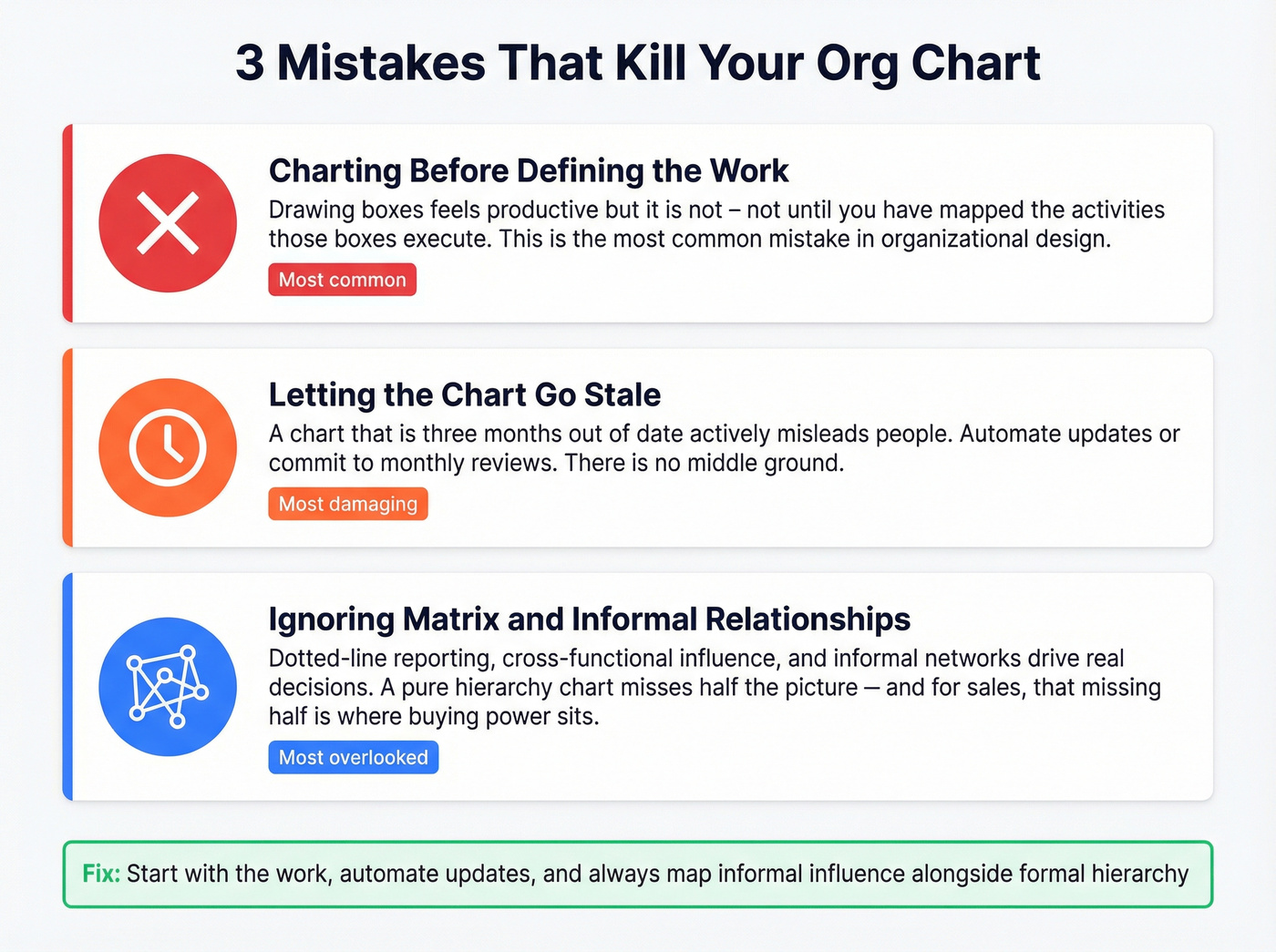
Charting before defining the work. Drawing boxes feels productive. It isn't - not until you've mapped the activities those boxes are supposed to execute. This is the mistake ThinkOrg flags as the most common in organizational design, and it's the one we've watched teams repeat the most.
Letting the chart go stale. A chart that's three months out of date actively misleads people. Automate updates or commit to a monthly review cadence. There's no middle ground here. This is also why teams get burned by B2B contact data decay when they try to operationalize org maps for outbound.
Ignoring matrix and informal relationships. Dotted-line reporting, cross-functional influence, and informal networks drive real decisions. A pure hierarchy chart misses half the picture - and if you're using it for sales prospecting, that missing half is often where the actual buying power sits.
FAQ
What's the difference between an org chart and an org map?
An org chart shows reporting hierarchy - who reports to whom. An org map is broader, capturing processes, informal networks, and cross-functional relationships alongside formal structure. Most sales teams need the map; most HR teams default to the chart.
How often should you update an org chart?
Connect to your HRIS for daily auto-sync if you have 100+ employees. For manual updates, review monthly at minimum - quarterly reviews leave too many gaps for the chart to be trustworthy.
How do I map a target account's org chart for sales?
Combine professional-profile research with domain-based hierarchy extraction tools. Once you have the structure, enrich contacts with a platform like Prospeo to add verified emails and direct dials - 83% of leads come back with contact data, so most mapped stakeholders become immediately reachable.
How do org charts fit into account-based selling?
Embedding org charts into your sales process helps reps identify champions, blockers, and economic buyers early. Teams that map accounts upfront can multi-thread from the first meeting, shortening deal cycles and reducing single-thread risk. I've seen reps cut their average deal cycle by weeks just by knowing the full committee before the first call.