The Best Prospecting Tools for SDRs - Ranked by What Actually Matters
It's Monday morning. You've got 200 accounts to prospect this week, a sequence that needs to launch by Wednesday, and half the contacts in your CRM bounced last time you ran a campaign. The problem isn't your messaging - it's your data.
Roughly 30% of workers change jobs annually, which means a contact list that was clean in January is already rotting by April. It takes 8-12 touches to get a meaningful response from a prospect, and every bounce eats into your domain reputation before you even get to touch three. McKinsey found that companies adopting advanced sales tech grow revenue 2-3x faster - but only when the underlying data is clean. You don't need 15 tools. You need three or four good ones working together.
Our Picks (TL;DR)
| Pick | Tool | Why |
|---|---|---|
| Best verified data accuracy | Prospeo | 98% email accuracy, 125M+ verified mobiles, 7-day refresh. Free tier available. |
| Best all-in-one starting point | Apollo.io | Free tier with database + sequencing. Unbeatable for getting started fast. |
| Best cold email infrastructure | Instantly | Unlimited sending accounts, warmup built in, starts at $30/mo. |
These three together land around $200/mo on paid plans and cover data, sequencing, and deliverability - a complete outbound stack for a fraction of a typical ZoomInfo contract.
How to Evaluate SDR Tools
Five things matter more than everything else.
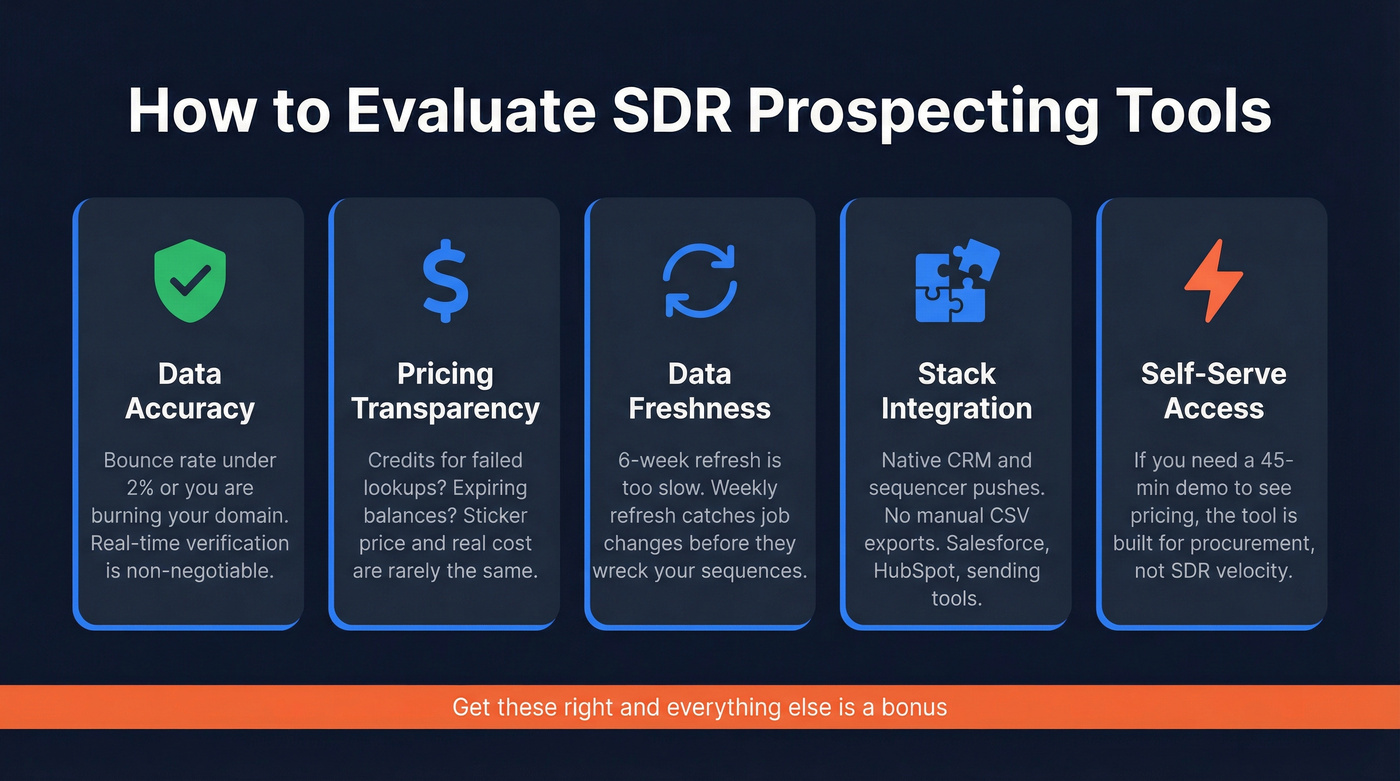
Data accuracy and verification method. A healthy bounce rate is under 2%. Above 5%, you're actively damaging your sending domain. Ask every vendor how they verify - real-time verification, catch-all handling, and spam-trap removal are non-negotiable. If they can't explain their verification process, the data isn't verified. (If you want to go deeper, start with B2B contact data decay and prospect data accuracy.)
Pricing transparency and credit mechanics. Some tools charge credits for failed lookups. Others expire unused credits every billing cycle. The sticker price and the real cost are often very different numbers, and we've seen teams blow through budgets mid-quarter because they didn't read the fine print on credit rollover policies.
Data freshness. The industry average refresh cycle is roughly six weeks. That's too slow when 30% of your contacts are changing roles every year. Weekly refresh should be the standard for teams that care about deliverability.
Integration with your existing stack. Your data tool needs to push contacts into your sequencer and CRM without manual CSV exports. Native integrations with Salesforce and HubSpot - plus direct pushes into your sending tools - are worth prioritizing over flashy features you'll never use.
Self-serve access vs. sales-call gates. If you need to sit through a 45-minute demo to see pricing, that tool is built for enterprise procurement, not SDR velocity.
Master Comparison Table
| Tool | Category | Starting Price | Best For | Key Strength |
|---|---|---|---|---|
| Apollo.io | All-in-One | Free tier | Getting started fast | Database + sequencing in one |
| ZoomInfo | Data & Enrichment | ~$15,000-$40,000/yr | Enterprise 20+ reps | Deep intent + integrations |
| Clay | Enrichment/Waterfall | Free (1,200 credits/yr) | Ops-heavy workflows | 50+ provider waterfall |
| Cognism | Data & Enrichment | ~$22,500/yr (5 users) | EMEA + verified mobiles | Strongest European data |
| Instantly | Cold Email | $30/mo | Sending infrastructure | Unlimited warmup accounts |
| Lusha | Data & Enrichment | Free (40 credits/mo) | Quick lookups | Fast Chrome extension |
| Outreach | Sales Engagement | ~$100-$150/user/mo | Multichannel orchestration | Enterprise reporting |
| Salesloft | Sales Engagement | ~$100-$150/user/mo | Enterprise sequences | Conversation intelligence |
| Smartlead | Cold Email | $39/mo | Multi-account sending | Agency-scale inbox mgmt |
| Hunter.io | Verification | Free (50 credits/mo) | Lightweight email finding | Simple verification |
| Reply.io | Multichannel | $99/user/mo | Email + calls + social | All-in-one multichannel |
| Orum | Calling | ~$200-$400/user/mo | Parallel dialing | More live connects per hour |
| Aircall | Calling | ~$30/user/mo | Cloud phone + CRM | Reliable, affordable calls |
| UpLead | Data & Enrichment | $99/mo | Mid-market alternative | 95% accuracy guarantee |
| Snov.io | Email + Drips | $39/mo | Bootstrapped teams | Prospecting + sequences |
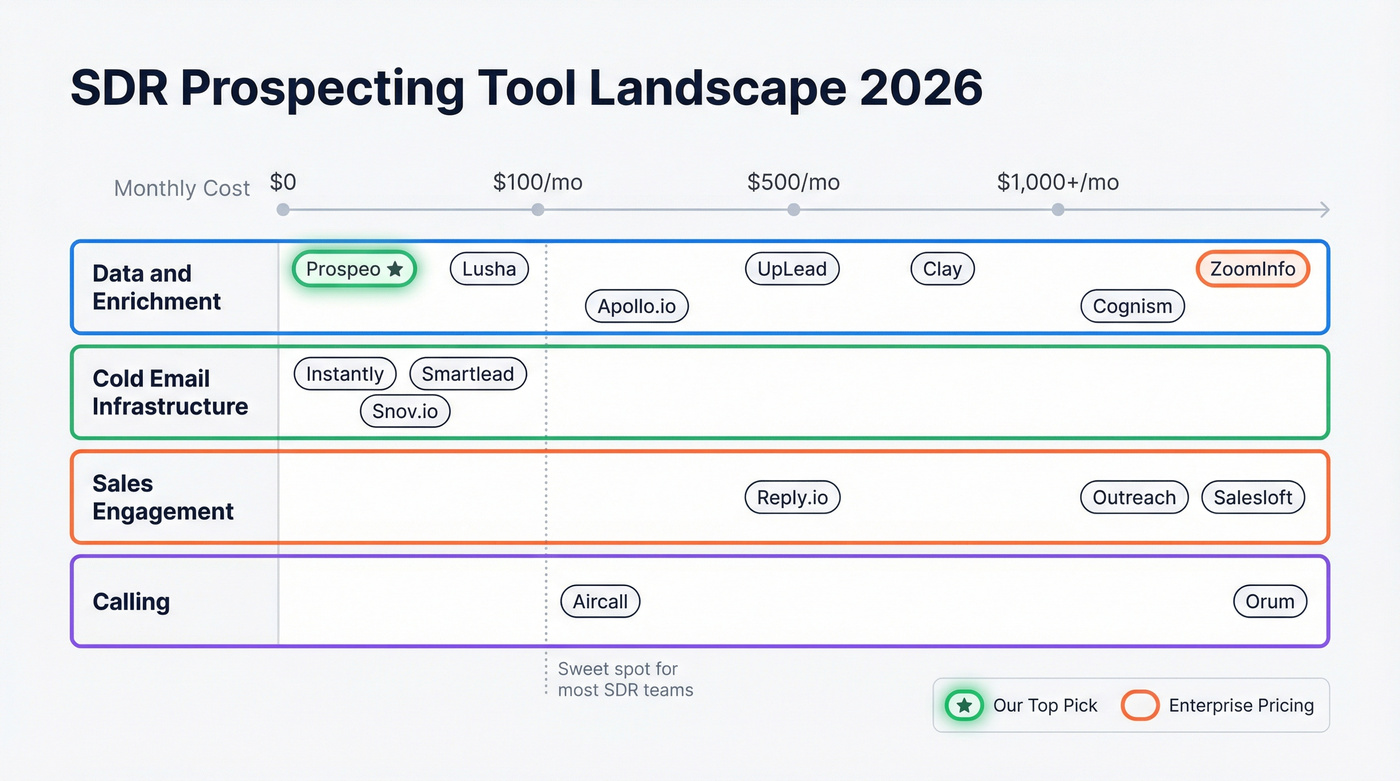

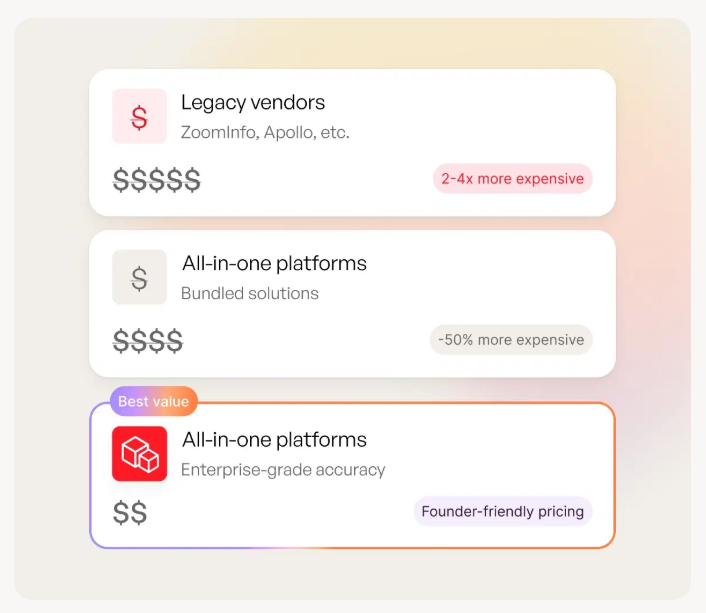
Every bounced email burns your domain reputation and wastes a touch. Prospeo's 98% email accuracy and 7-day data refresh keep your sequences hitting real inboxes - not dead ends. At $0.01 per lead, one SDR's entire monthly prospecting costs less than a single ZoomInfo seat.
Fix your data before you touch anything else in your stack.
Best Sales Prospecting Tools for SDRs
Data & Enrichment
Prospeo
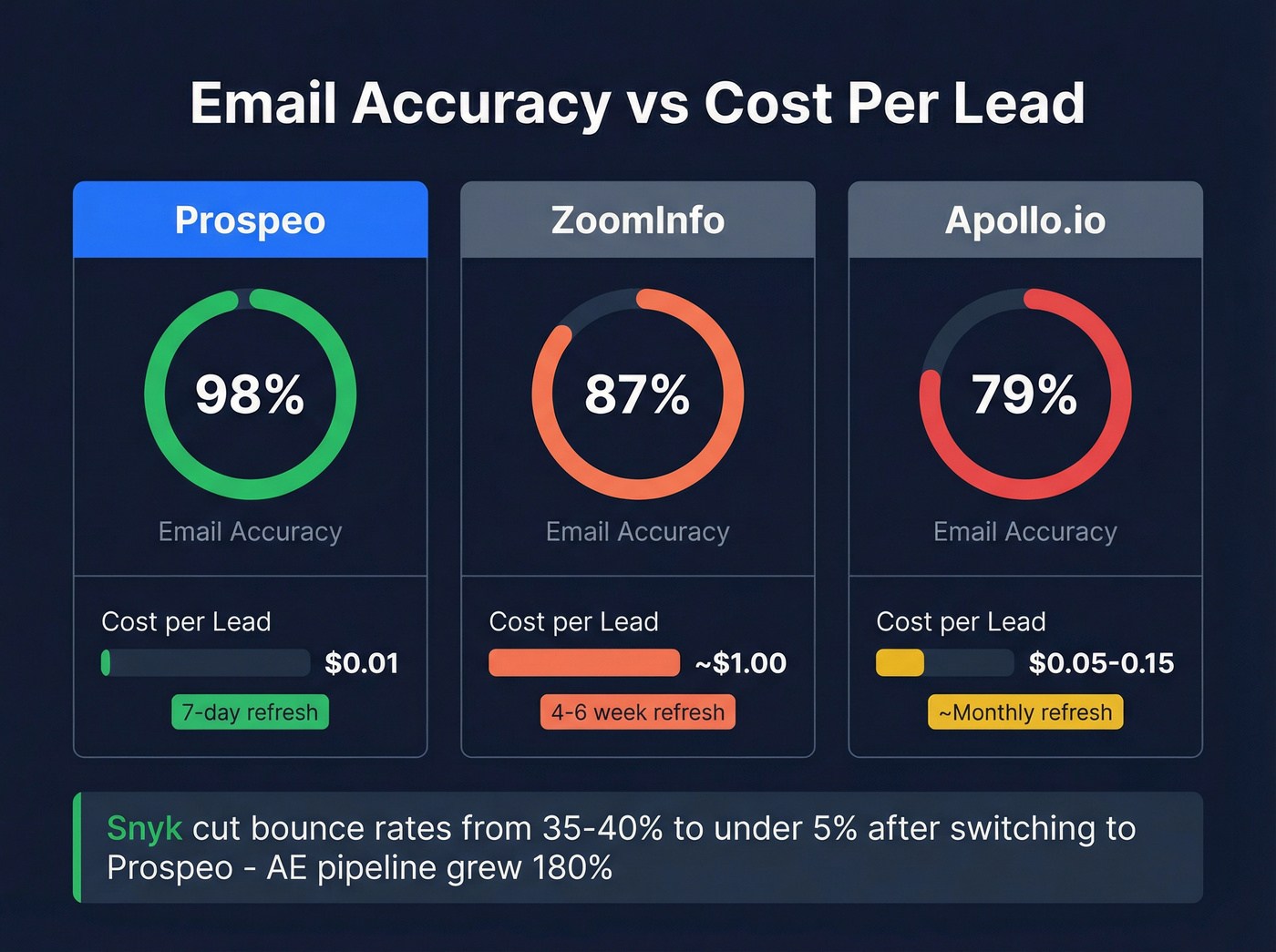
Prospeo's database covers 300M+ professional profiles, 143M+ verified emails, and 125M+ verified mobile numbers - all refreshed on a 7-day cycle. That refresh cadence is the real differentiator. While most providers update every four to six weeks, Prospeo catches job changes, role shifts, and company moves before they wreck your sequences.

The accuracy numbers tell the story: 98% verified email accuracy versus 87% from ZoomInfo and 79% from Apollo. At roughly $0.01 per lead compared to ZoomInfo's ~$1 per lead, the economics aren't even close. Snyk's 50-person AE team cut bounce rates from 35-40% to under 5% after switching, and their AE-sourced pipeline jumped 180%. Stack Optimize built from $0 to $1M ARR using Prospeo data, maintaining 94%+ deliverability and sub-3% bounce rates across all clients.
Search filters go deep: buyer intent across 15,000 Bombora topics, technographics, job changes, headcount growth, funding rounds, and revenue ranges. The Chrome extension (40K+ users) pulls verified contacts from any website without leaving your browser. Native integrations push directly into Salesforce, HubSpot, Instantly, Smartlead, Lemlist, and Clay. (If you're building lists at scale, see list building tools and data enrichment for cold email.)
Pricing starts free - 75 verified emails and 100 Chrome extension credits per month. Paid plans run about $0.01 per email with no contracts and no sales calls required. If your bounce rate is above 5%, start here. Fix the data before you touch anything else.
Snyk's 50 AEs dropped bounce rates from 35-40% to under 5% and grew AE-sourced pipeline 180%. Stack Optimize hit $1M ARR with sub-3% bounces across every client. The difference wasn't their sequences - it was 300M+ profiles refreshed every 7 days with 125M+ verified mobiles.
Build your outbound stack on data that actually connects you to buyers.
Apollo.io
Apollo is the obvious starting point for most SDR teams, and for good reason. The free tier gives you database access and built-in sequencing - two tools in one, at zero cost. For a rep who just needs to start booking meetings, nothing gets you there faster.
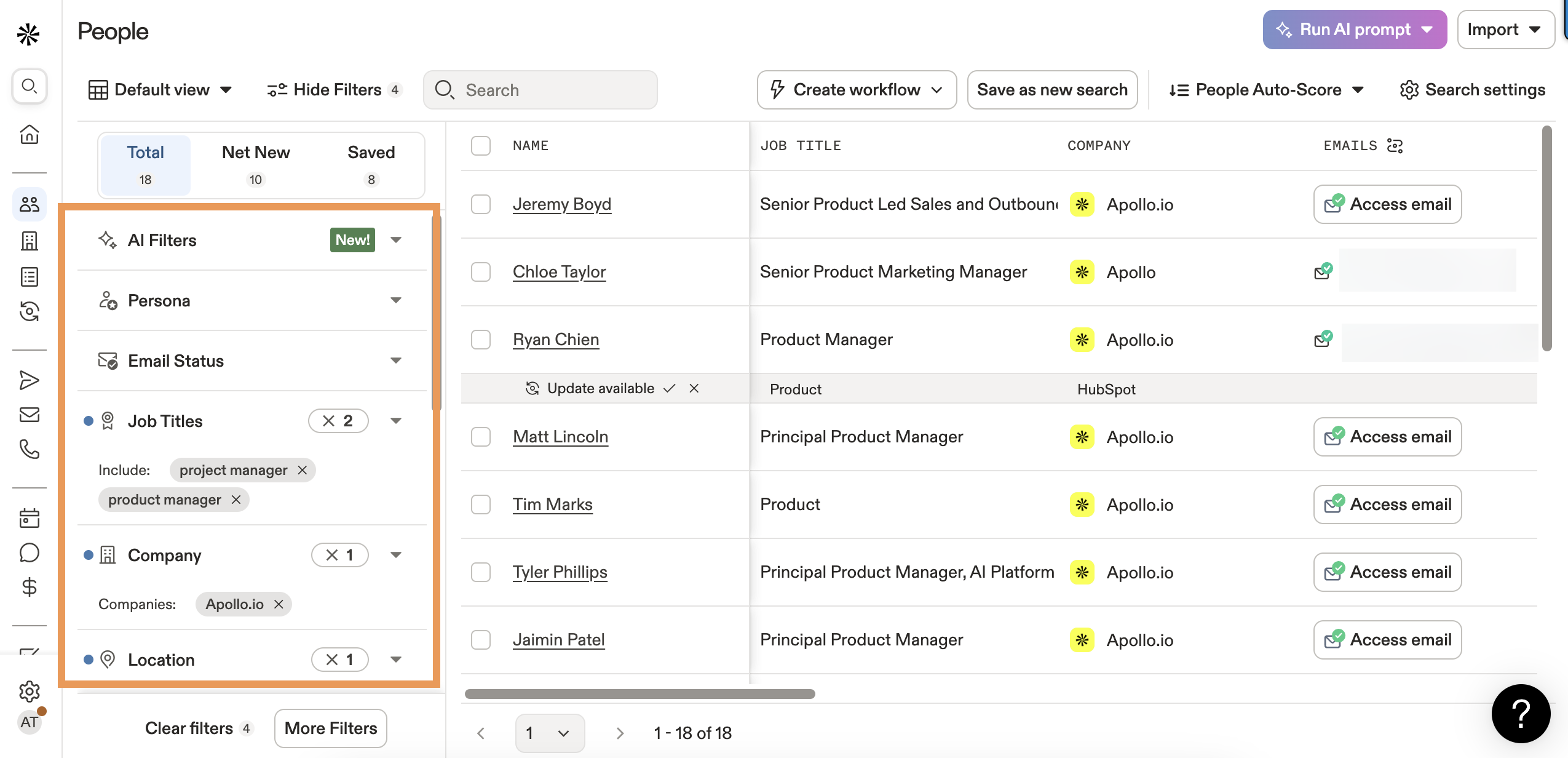
Paid plans run on a hybrid model: per-user monthly fee plus usage-based credits. Basic starts at $49/mo, Professional at $79/mo, and Organization at $119/mo with a minimum of three seats. Credits don't roll over - unused credits expire each billing cycle, and overages can sneak up mid-quarter.
Where Apollo wins over ZoomInfo: speed to value and price. Where ZoomInfo still wins: data depth for enterprise accounts and intent signal breadth. Where Apollo struggles: accuracy at scale. We've run Apollo lists through verification tools and found 10-20% of emails won't pass deliverability checks. That's fine for a 5-person team sending 50 emails a day. It's a problem at 500.
Use Apollo to get started. Pair it with a dedicated verification tool when volume matters (see email ID validators and email verification for outreach).
ZoomInfo
ZoomInfo is the incumbent for a reason - the database is massive, the intent data is mature, and the enterprise integrations are deep. If you're running a 50-rep sales floor with Salesforce, Outreach, and a dedicated RevOps team, ZoomInfo's workflow breadth is hard to match.
But the economics are brutal. A mid-market contract with intent data and mobile numbers runs $15,000-$40,000/year with annual commitment. The most common complaint on r/sales is price - specifically, paying for modules you don't use. A 10-seat contract with intent data can easily hit $40-60k/year.
Here's the thing: if your average deal size is under $15k, you almost certainly don't need ZoomInfo-level data. Self-serve tools deliver 90% of the prospecting value at 10% of the cost. Skip ZoomInfo unless you've genuinely outgrown the alternatives. (If you're comparing enterprise data options, see 6sense vs ZoomInfo.)
Clay
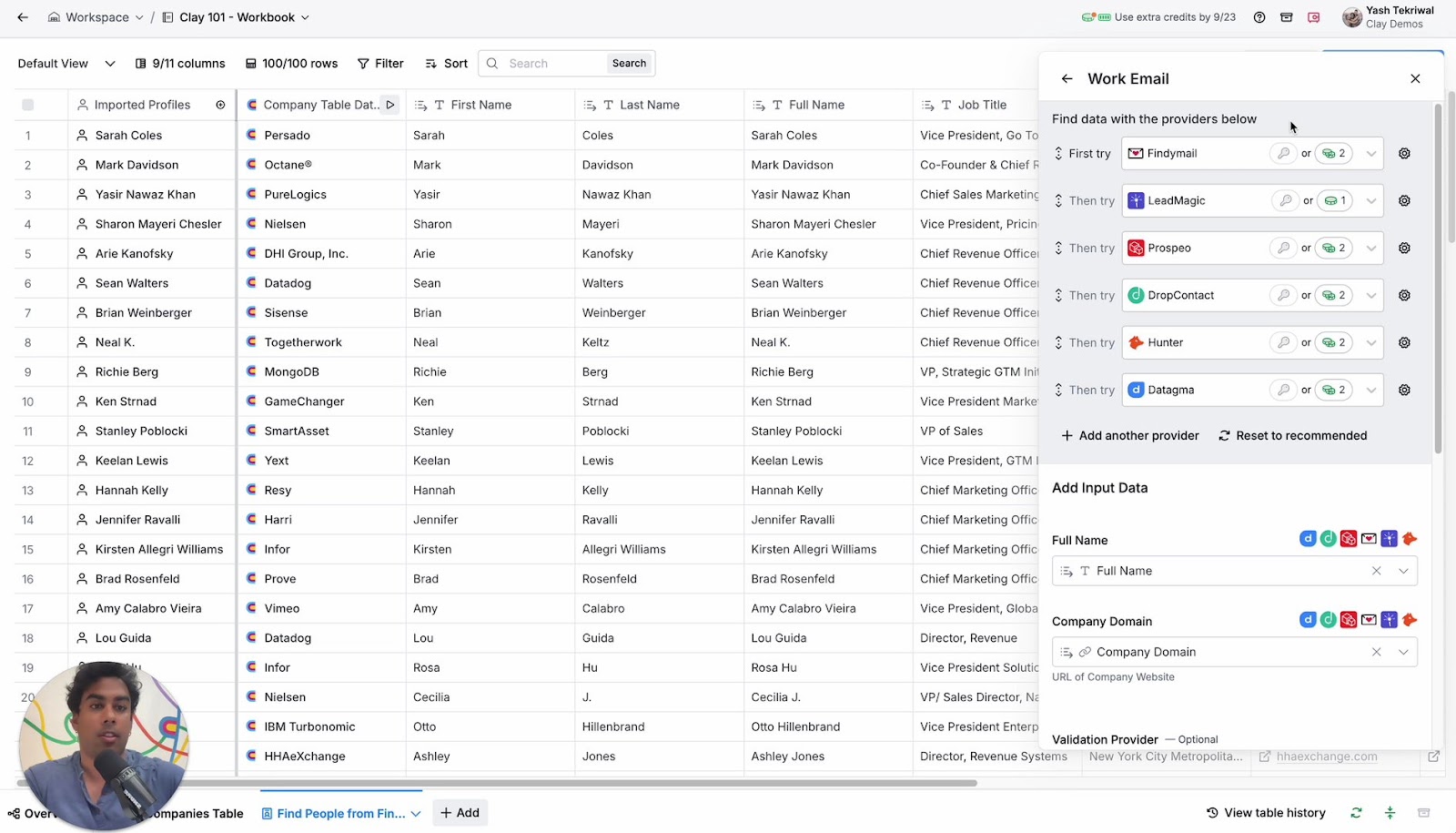
Clay takes a different approach - instead of maintaining its own database, it runs waterfall enrichment across a large set of data providers, pulling the best result from each. The concept is powerful. The reality is more nuanced.
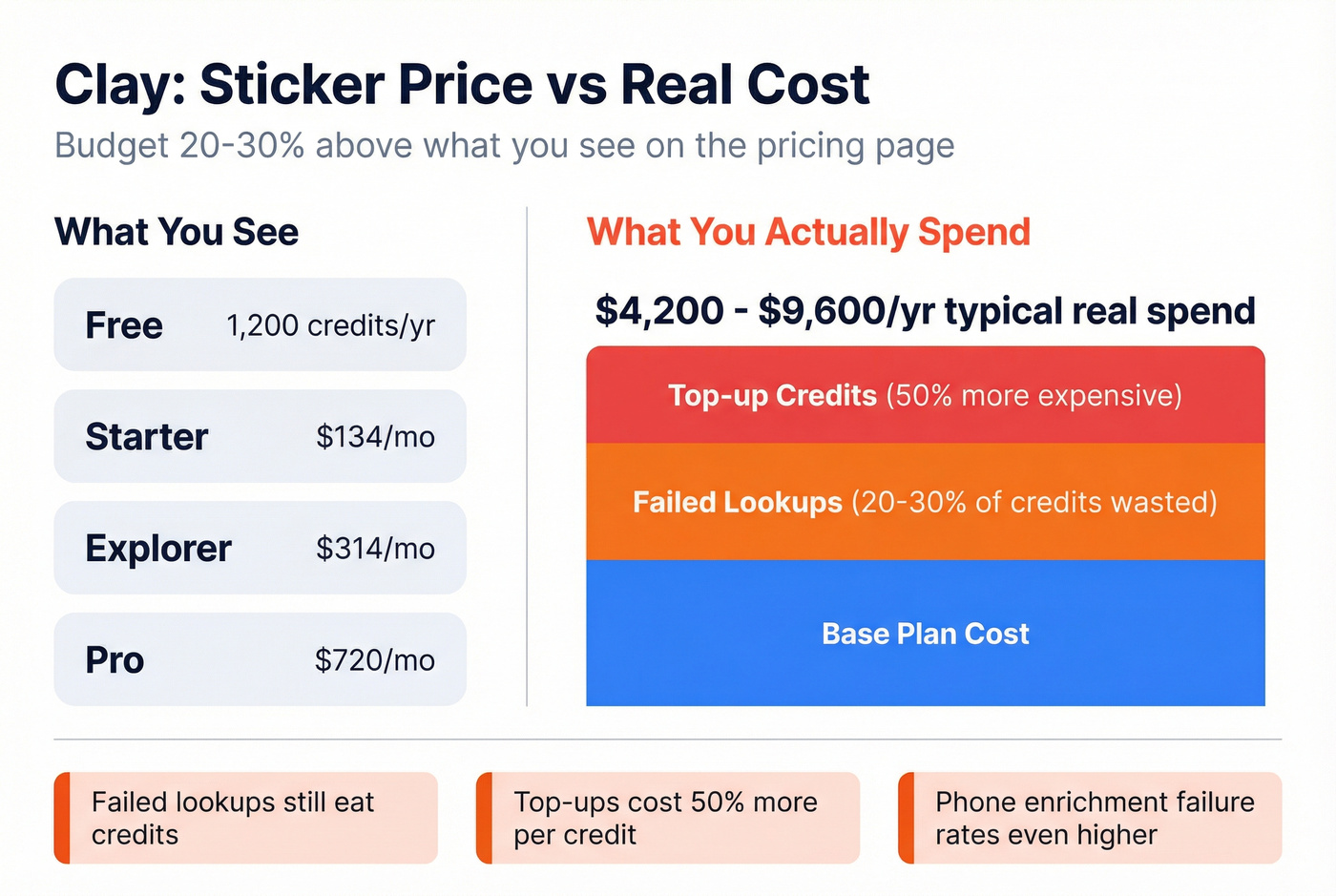
Free gets you 1,200 credits/year, Starter runs $134/mo, Explorer $314/mo, and Pro $720/mo. Those numbers look reasonable until you factor in hidden costs. Failed lookups still consume credits, and teams typically see 20-30% failure rates on email finding - even higher on phone enrichment. Top-up credits cost roughly 50% more than base-rate credits. Most teams spend $4,200-$9,600/year after top-ups and waste, so budget 20-30% above sticker price. (More detail: Clay pricing and waterfall alternatives.)
Clay makes sense for teams with a dedicated RevOps person who loves building workflows and needs to enrich data from multiple sources simultaneously. Skip it if you want simple search-and-export or you're watching credits carefully.
Cognism
Cognism is the strongest option for teams prospecting into EMEA markets. Their European data coverage - particularly verified mobile numbers - is genuinely better than what US-centric providers offer. Quote-based pricing starts around $22,500/year for a 5-user Grow plan and climbs to $37,500+ for Elevate. Watch for 10-15% renewal increases and fair-use caps around 2,000 records per user per month. If your ICP is primarily in North America, the premium over self-serve tools is hard to justify.
Lusha
Free tier gives you 40 credits per month, Pro runs $29.90/user/mo, and Premium hits $69.90/user/mo. Phone numbers cost 5 credits each, which adds up fast. Lusha works well for quick, one-off lookups when you need a number right now - but the credit economics make it expensive for bulk prospecting. Think of it as a spot-check tool, not a primary data source.
Outreach & Sequencing
Instantly
Instantly solved the cold email infrastructure problem that most SDR teams didn't even know they had. Unlimited sending accounts with built-in warmup means you can scale outbound volume without burning your primary domain.
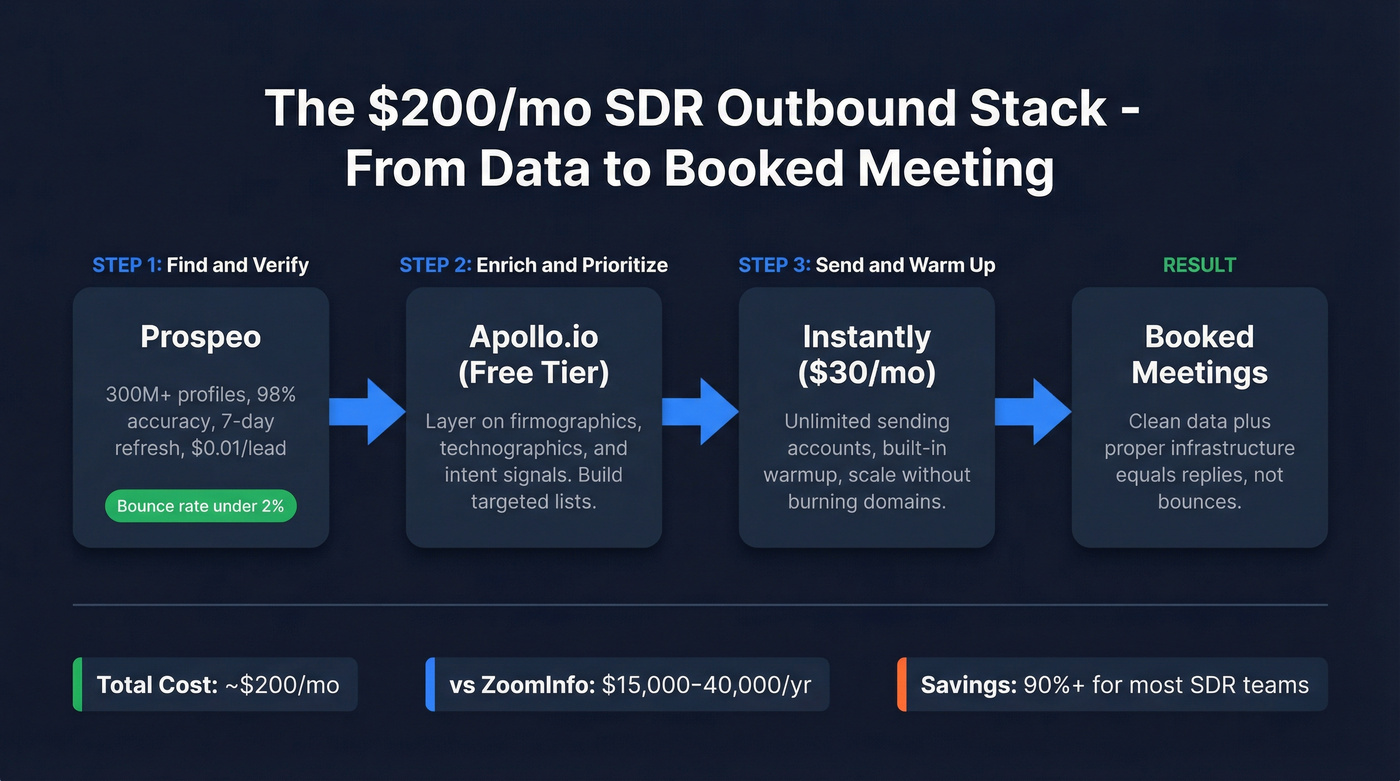
Plans start at $30/mo and scale into higher tiers as you add accounts and volume. The warmup feature alone is worth the price - it gradually builds sender reputation before you launch campaigns, which directly impacts inbox placement rates. In our experience, teams that skip warmup and blast from fresh domains see 40-60% of their emails land in spam. Instantly removes that risk almost entirely. (If you want the mechanics, read automated email warmup and the email deliverability checklist.)
Where Instantly wins over Outreach and Salesloft: price, simplicity, and cold email specialization. Where it doesn't compete: multichannel orchestration, call logging, and enterprise reporting. Instantly is a sending engine, not a sales engagement platform. Pair it with a data provider for the contacts and you've got a complete cold email stack for under $130/mo.
Outreach
Enterprise sales engagement at enterprise prices. Outreach handles multichannel sequences - email, calls, social touches, and tasks - with deep CRM integration and analytics that sales leaders use for forecasting. Pricing runs ~$100-$150/user/month with annual contracts. Best for teams of 20+ reps who need visibility into sequence performance across the org.
SalesLoft
Salesloft occupies nearly identical territory to Outreach - multichannel sequences, CRM integration, conversation intelligence, and deal management. Pricing is similar. The real differentiator is ecosystem: if your team already uses Salesloft, stay there. Switching between the two rarely justifies the migration cost. Both are overkill for teams under 15 reps.
Calling Tools
These two serve different calling philosophies. Orum (~$200-$400/user/month) is a parallel dialer - it dials multiple prospects simultaneously and connects you only when someone picks up, which can dramatically increase live conversations per hour. Worth every penny for high-volume cold calling teams where connect rate is the bottleneck. Aircall (~$30/user/month) provides reliable cloud phone infrastructure with solid CRM integrations. It's not a power dialer. It's for teams that make calls but don't live on the phone. If your reps make fewer than 50 calls a day, Aircall is plenty. (For the playbook side, see B2B cold calling guide.)
Lightweight Prospecting
Reply.io ($99/user/month) bundles email, calls, and social touches into one multichannel platform - a solid middle ground for teams that want everything in one place without Outreach-level complexity. Snov.io ($39/month) combines email finding with drip campaigns, making it a decent pick for bootstrapped teams that need basic prospecting and sequencing without paying for separate tools. Hunter.io offers a free tier with 50 credits/month and paid plans from $49/mo - lightweight email finding and verification that's been around forever, good for spot-checking but limited for bulk workflows. UpLead ($99/month) provides a 95% accuracy guarantee and a traditional search-and-export database, positioning it as a solid mid-market ZoomInfo alternative without the enterprise price tag.
Build Your Stack by Budget
Not every team needs the same tools. Here's what works at four budget levels.
~$200/mo - Complete Outbound Stack. Prospeo paid plan for verified data, Instantly ($30) for sending infrastructure, and Apollo Basic ($49) for sequencing and supplemental data. This covers prospecting, verification, and delivery for a solo SDR or small team - and it's the combination we recommend most often because the price-to-output ratio is absurd compared to what enterprise tools charge. (If you're mapping the whole stack, use this B2B sales stack blueprint.)
~$500/mo - Scaling Up. Add a higher Instantly tier and Clay Starter ($134) for waterfall enrichment workflows. Layer in Orum if cold calling is a core channel. This stack handles volume without sacrificing data quality.
$2,000+/mo - Enterprise. ZoomInfo or Cognism for database and intent, Outreach or Salesloft for multichannel orchestration, Orum for parallel dialing, and a dedicated intent data layer. This is the stack for 10+ rep teams with RevOps support.
Let's be honest: if you're spending less than $200/mo, the Prospeo-Apollo-Instantly combination is the stack. And if you're spending more than $2,000/mo and your bounce rate is still above 5%, fire your data provider before you add another tool.
SDR Benchmarks - What Good Looks Like
Bookmark these numbers. They're the difference between knowing your stack is working and guessing.
| Metric | Benchmark |
|---|---|
| Cold email response rate | 7-10% |
| Healthy bounce rate | <2% |
| Domain-damaging bounce rate | >5% |
| Replies after first follow-up | ~60% |
| Optimal sequence length | 4-7 emails over 14-21 days |
| Optimal email length | 50-125 words |
| Signal-based response rate | 18% vs 3.4% generic |
That last number deserves your attention. Signal-based selling - timing outreach around funding rounds, job changes, hiring surges, and tech adoption - produces 5x the response rate of generic cold outreach. In 2026, intent signals aren't a nice-to-have. They're the gap between a 3% reply rate and an 18% reply rate. (To operationalize it, see intent signals and signal-based outbound.)
The Rise of AI SDRs
AI SDR platforms are real, and the economics are compelling: $500-$2,000/month for an AI agent versus $75k-$100k/year for a human SDR.
But the tools only work as well as the data feeding them. Budget 40-60 hours of data preparation before launching - cleaning, enriching, and segmenting your contact lists. Start with 100-200 test accounts. Expect positive ROI in 3-6 months with clean data, or 6-9 months if you're building processes from scratch. Our team has watched companies throw money at AI SDR platforms only to automate the sending of emails to dead addresses and wrong job titles. That isn't automation - it's automated failure. Fix the data first. Always. (If you're evaluating the category, see AI SDR for SMB and enterprise.)
FAQ
How many prospecting tools does an SDR actually need?
Three to four: a data provider, a sequencing tool, and optionally a dialer and intent signal source. More than that creates tool sprawl without improving pipeline or reply rates.
What's a healthy bounce rate for cold email?
Under 2% is healthy. Above 5% is actively damaging your domain reputation and reducing inbox placement for every email you send. Fix your data source before optimizing copy.
Are free prospecting tools good enough to start?
Yes. Free tiers from Prospeo (75 verified emails/month) and Apollo (database + sequencing) give you a functional outbound stack at $0/month. These are legitimate tools, not watered-down demos - enough to book your first meetings and validate the outbound motion.
How often should I refresh prospect data?
Every 30-90 days at minimum. With 30% of workers changing jobs annually, data older than 90 days has significant decay. Tools with weekly refresh cycles handle this automatically so you don't have to think about it.
Is ZoomInfo worth the price for a small sales team?
Rarely. At $15,000-$40,000/year with annual contracts, ZoomInfo is built for 20+ rep teams running complex ABM workflows. For teams under 10 reps, self-serve prospecting tools cover 90% of the value at a fraction of the cost.