

Social Selling Best Practices (2026): A Complete Operating System
Attention's the scarce resource now, not leads. Buyers still buy, but they've learned to ignore "personalized" messages that read like templates.
This is the 2026 playbook we wish more teams ran: a weekly operating system you can execute without guessing. Listen, engage, convert, measure, iterate.
We've tested this loop across SDR, AE, and founder-led motions, and it holds up because it matches how trust actually gets built: show up in public, earn permission in private, then ask for a next step. Comment on a VP's CRM migration post on Tuesday, DM a teardown on Wednesday, email the checklist Thursday, book the call Friday.
What you need (quick version)
Checklist (print this, don't overthink it):
- Pick one primary channel + one support channel. Two channels max.
- Define your ICP in one sentence (role + trigger + why now).
- Tighten your profile for conversion: headline (who you help + outcome), About (POV + proof + CTA), Featured (1 proof asset + 1 strong post + 1 link).
- Build a daily "listen list": 25-50 target accounts + 50-100 target people.
- Engage before you DM. Your first DM shouldn't be your first interaction.
- Use a DM framework (HEART) and keep the first message meeting-free.
- Track the right KPIs: conversations -> meetings -> pipeline (SSI's a usage score, not revenue).
- Have a clean move off-platform step (email/mobile + verification) so warm interest turns into pipeline.
If you only do 3 things this week (simple social selling tips for sales teams):
- Leave 20 high-signal comments (specific, 2-4 sentences, add an insight).
- Send 30 connection requests using the HEART hook (context + relevance, not a pitch).
- Move 5 warm convos off-platform with a specific next step ("Want me to send the 2-page checklist?" / "Should I email you the teardown?").
What social selling is (and what it isn't)
Do this (social selling):
- Relationship-building first, offer second. You earn attention in public (comments, replies, helpful posts), then you earn permission in private (DMs).
- Use social as a signal engine. Job changes, new initiatives, tool migrations, hiring spikes, funding - those are your "why now" triggers. (More ideas in our guide to intent signals.)
- Treat it like account-based selling. You're not "posting for reach." You're building familiarity inside a narrow ICP.
Not that (what people call social selling but isn't):
- Pitch-first DMs. "Hey {firstName}, we help companies like yours..." is dead. It's not even bad - it's invisible. (If you want the definition + examples, see pitch slap.)
- Spray-and-pray connection requests. If you're connecting with everyone who breathes, your feed becomes useless and your targeting gets sloppy.
- Content as a vanity project. Posting daily doesn't matter if it doesn't start conversations with people who can buy.
Here's the contrarian rule that saves most teams: two channels max. One primary place where you show up daily, and one support channel where you repurpose and occasionally engage.
I've watched sellers try to "be everywhere" and end up with mediocre activity on five platforms and zero pipeline.
Two channels forces focus.
Benchmarks: what "good" looks like in 2026
Most social selling advice is vibes. Benchmarks fix that.
Belkins analyzed 20M+ outreach attempts run through Expandi across Jan 1-Dec 31, 2026. It's the cleanest calibration we've got for connection + DM performance at scale. The punchline: connection acceptance stays fairly stable, but replies are where you win or lose. (For more numbers, see our full roundup of social selling statistics.)
Connection requests
Connection acceptance rate is ~26.4% in the Belkins/Expandi dataset, and the weird part is this:
- Acceptance with a message: 26.42%
- Acceptance without a message: 26.37%
So no, adding a note doesn't magically get you accepted more.
But it does something more important: it changes what happens next.
Replies
Replies are where the money is.
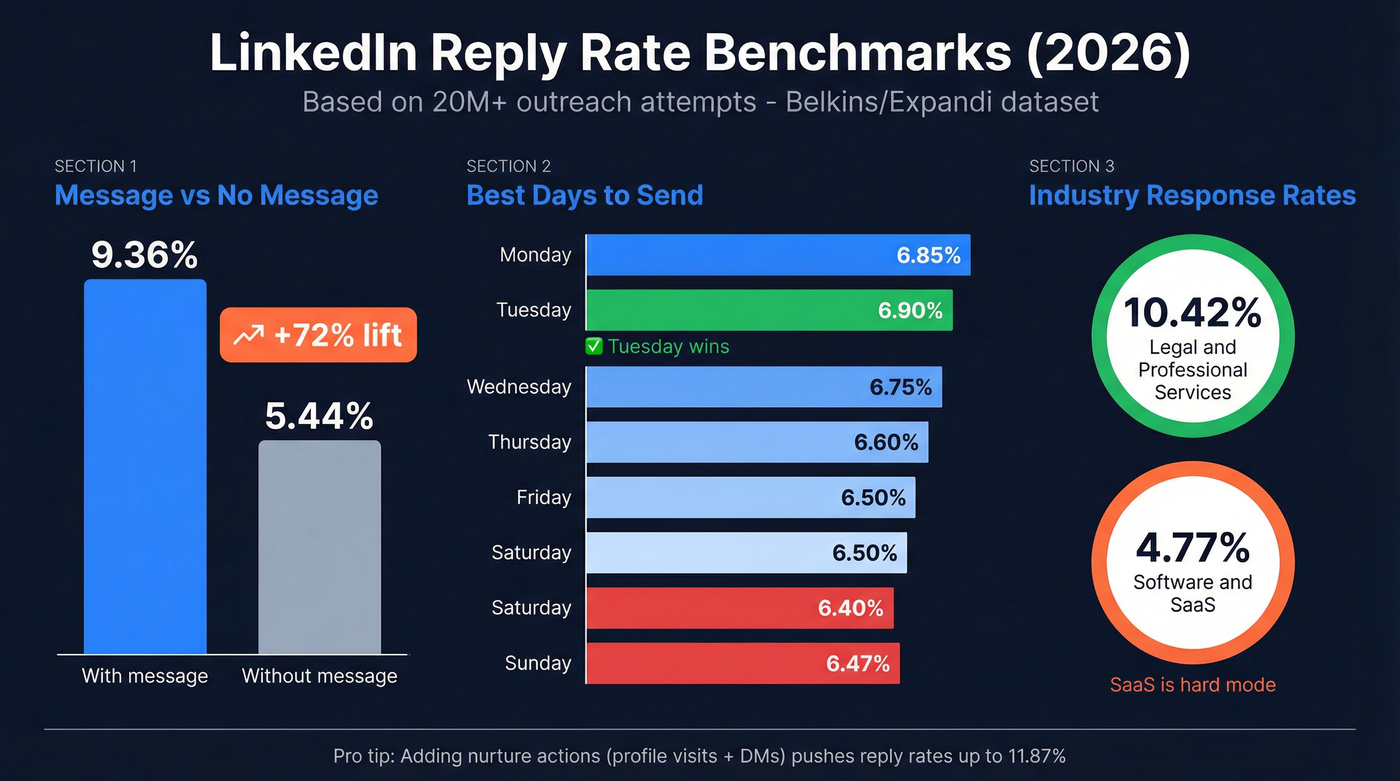
Belkins/Expandi shows:
- Reply rate with a message: 9.36%
- Reply rate without a message: 5.44%
That's a ~72.1% lift just by attaching a relevant message.
Timing matters too:
- Tuesday had the best reply rate: 6.90%
- Monday was close: 6.85%
- Weekends were lowest (Saturday 6.40%, Sunday 6.47%)
Industry matters more than people admit.
- Legal / professional services: 10.42% response rate
- Software / SaaS: 4.77% response rate
If you sell into SaaS, you're playing on hard mode. You need better targeting, better hooks, and better follow-up hygiene.
One more lever that's underrated: nurture actions. When you combine DMs with actions like profile visits, reply rate can reach up to 11.87%. That's not magic. It's familiarity.
Upper-band performance
Agency data from SalesBread shows what's possible when personalization's real and targeting's tight:
- 45% connection acceptance
- 19.98% reply rate
- 48.14% positive reply ratio (meeting requests or qualified inquiries)

That's the ceiling, not the average.
I've seen teams hit that upper band when they stop treating social like a lead list and start treating it like a sequence with public touchpoints, because the DM isn't the whole motion - it's one step in a longer pattern of visibility that makes your name feel familiar before you ever ask for time.
Benchmarks table (use this for goal-setting):
| Metric | Average (scale) | Strong | Elite |
|---|---|---|---|
| Conn. acceptance | ~26% | 35-45% | 45%+ |
| Reply rate | 5-9% | 10-15% | ~20% |
| Reply rate with nurture actions | 8-12% | 12-15% | 15%+ |
| Positive reply ratio | 20-35% | 35-45% | ~48% |
Social selling best practices (the system that actually moves deals)
Social selling works when it's a system, not a mood.
The time allocation that holds up in real teams is 10-15% of your week. For most sellers, that's 4-6 hours. Enough to be consistent, not enough to derail core pipeline work.
And here's my opinionated take: commenting beats posting for most sellers. Posting's great if you've got a clear POV and you can stay consistent. Commenting's the fastest path to being seen by the right people without fighting the algorithm from zero.
The phase-based checklist (Listen -> Engage -> Convert -> Measure)
Use this like a weekly runbook. Do the boxes, get the outcomes.
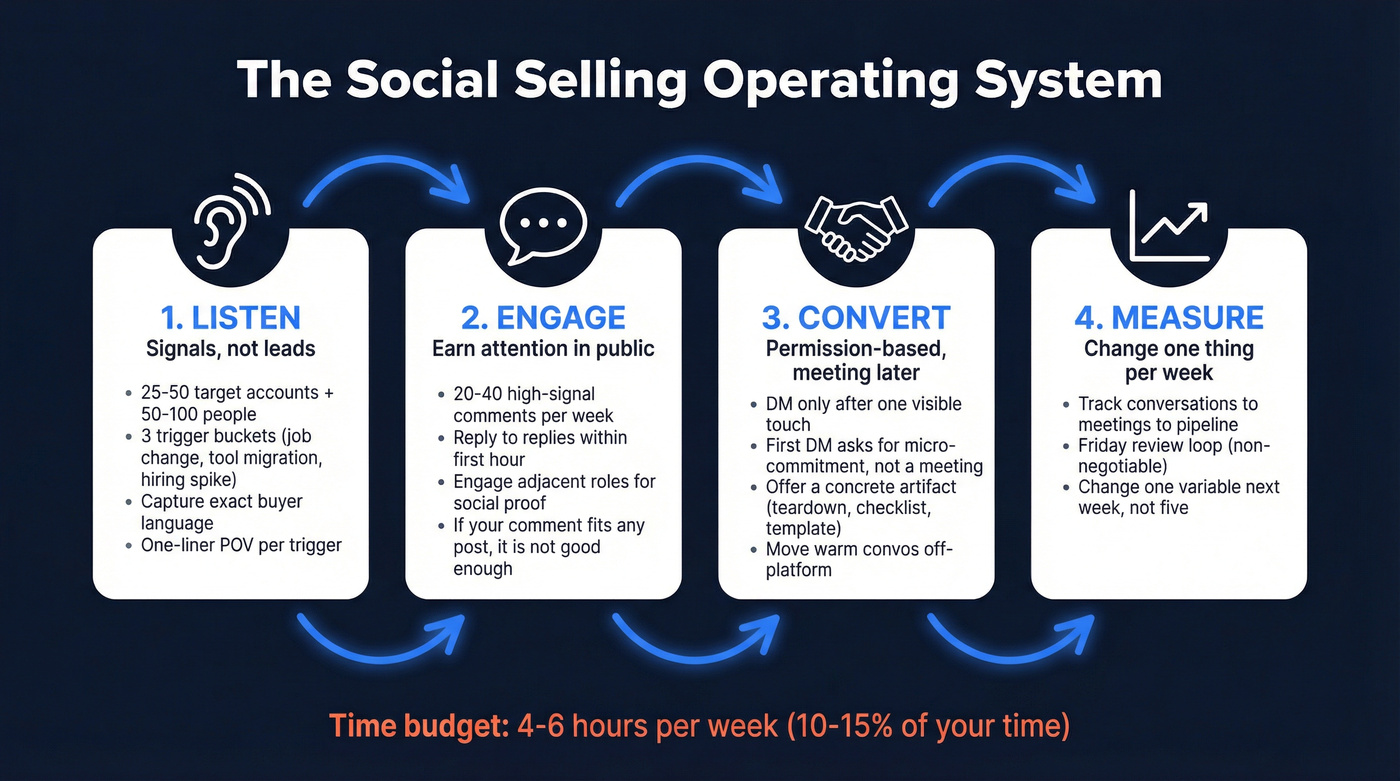
1) Listen (signals, not "leads")
- Build a listen list: 25-50 accounts + 50-100 people (champions + budget holders + likely blockers). (If you need a structure, start with an account list and tier it.)
- Define 3 trigger buckets you'll act on (example: job change, tool migration, hiring spike).
- Capture exact language buyers use (copy/paste phrases into a swipe file).
- Decide your one-liner POV for each trigger (what you believe + why it matters now).
Concrete example (trigger -> angle):
- Trigger: "Migrating CRM in Q1"
- Angle: "Most migrations fail because ops optimizes fields, not workflows. Fix workflows first, then fields."
2) Engage (earn attention in public)
- Leave 20-40 high-signal comments/week (2-4 sentences, specific, with an insight).
- Reply to replies within the first hour when you can (threads compound familiarity).
- Engage with adjacent roles (your buyer watches who you interact with; social proof is social).
Bad vs good comments (what I'd actually write):
| Situation | Bad (forgettable) | Good (gets replies) |
|---|---|---|
| Buyer posts "We're replatforming..." | "Great post - excited for you!" | "Replatforms usually break at handoffs. If you map the 3 highest-volume workflows first (lead -> meeting, meeting -> opp, opp -> closed), the rest gets easier. Are you mapping workflows or fields first?" |
| Buyer shares a metric | "Love the data!" | "That metric's the canary. If it's rising, the next thing to watch is X because it lags by ~2-3 weeks. Are you seeing that yet?" |
| Buyer asks for advice | "Happy to help!" | "Do you want the fast answer or the correct answer? Fast: do X. Correct: do X, then Y so it doesn't regress." |
A simple rule: if your comment could be pasted under any post, it's not a good comment.
3) Convert (permission-based, meeting-later)
- DM only after one visible touch (comment, reply, or shared context).
- First DM asks for a micro-commitment, not a meeting.
- Offer one concrete artifact: teardown, checklist, template, 5 bullets, loom, example. (If you want better asks, steal patterns from these sales CTA examples.)
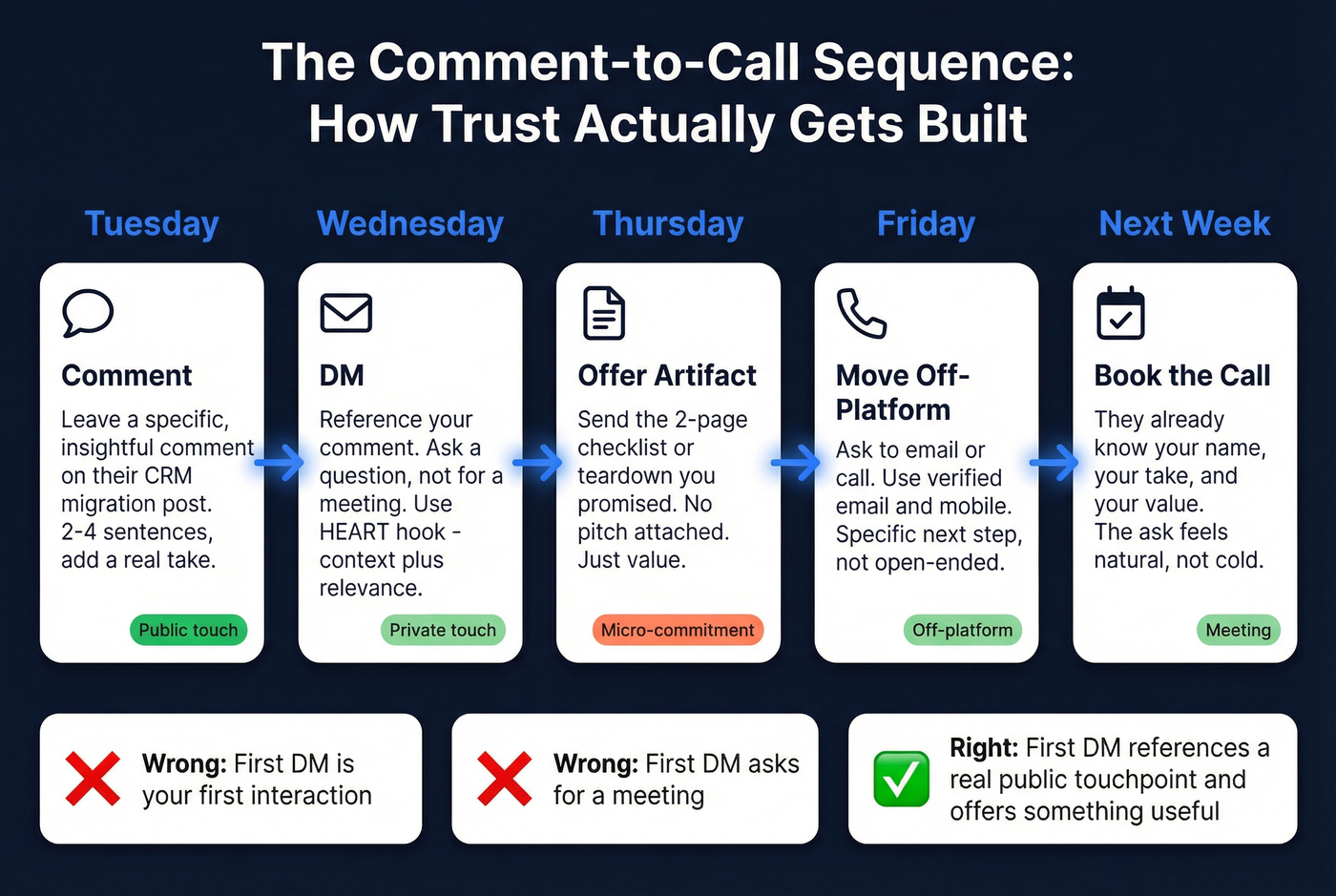
Micro-commitments that work:
- "Want the 2-page checklist?"
- "Should I send a quick teardown?"
- "Worth sharing how other teams handle this?"
Look, if your deal size is small (say, a few thousand a year), you don't need a "full social selling motion." You need a tight ICP, great comments, and a fast follow-up loop. Anything more turns into performance art.
4) Measure (and change one thing per week)
- Track the KPI ladder weekly: conversations -> meetings -> pipeline.
- Run a Friday review loop (non-negotiable). (If you want a template, use this pipeline review cadence.)
- Change one variable next week (hook, trigger, offer, follow-up timing)--not five.

Diagnostics: if X is low, do Y
- Low acceptance rate (<25%) -> tighten ICP + add credibility to profile (proof asset + specific headline).
- Acceptance's fine, replies are low (<8%) -> your hook's generic; anchor every DM to a trigger + a specific question.
- Replies happen, meetings don't -> your micro-commitment offer's weak; swap "chat?" for "want the teardown/checklist?"
- Meetings happen, opps don't -> qualify harder + multi-thread the buying group (add finance/ops/security early). (Use a real ABM multi-threading approach.)
- Opps happen, pipeline attribution looks weak -> fix self-reported attribution + CRM social-touch fields (don't buy tooling first).

You just built familiarity with 20 comments and 30 connection requests. Now 5 warm conversations need to move off-platform. That's where most sellers fumble - bad emails kill momentum. Prospeo gives you 98% accurate emails and verified mobile numbers so your Tuesday comment turns into a Friday call.
Don't let warm DMs die in a bounce folder.
Distribution mechanics: how to get seen (without engagement bait)
You don't need to worship the algorithm, but you do need to respect it. The cleanest mental model is: quality filter -> test -> ranking. Your post gets classified, shown to a small group, then expanded if it performs.
Rules of thumb that hold up:
- Dwell time matters. Write posts that are easy to read and worth finishing.
- The first 60 minutes is the golden hour. Reply to every real comment quickly. You're training the system that the post's a conversation, not a broadcast.
- Meaningful comments beat reactions. Comments longer than ~10 words carry more weight than "Great post!"
- Use 3-5 hashtags. More looks spammy.
- Wait 12 hours between posts. Posting too frequently cannibalizes reach and trips spam signals.
Anti-patterns that get you quietly throttled (social selling mistakes to avoid):
- "Comment YES and I'll send it"
- "Tag a friend"
- Tagging unrelated people
- Generic, AI-sounding comments that add nothing (common failure mode in AI cold email personalization mistakes, too)
"Do this instead" rewrites (common bad posts -> posts that start deals)
These are the edits I'd make if you handed me your draft.
Rewrite #1: The humblebrag
- Bad: "Thrilled to announce we're launching X. Big things coming!"
- Better: "We launched X because we kept seeing the same failure: {{specific problem}}. Here's the 3-step fix we now use internally (and the one step everyone skips)."
Rewrite #2: The vague lesson
- Bad: "Consistency is key in sales. Keep showing up."
- Better: "If you only have 30 minutes/day, spend it like this: 10 minutes listening for triggers, 15 minutes commenting on 3 posts, 5 minutes DMing one warm thread. That's enough to create pipeline."
Rewrite #3: The feature dump
- Bad: "Our platform does A, B, C, D..."
- Better: "If you're trying to solve {{job-to-be-done}}, stop evaluating tools by feature count. Evaluate by: time-to-value, data quality, and how fast your team can execute the workflow."
Personal opinion: most "low reach" problems are actually unclear audience problems. When your ICP recognizes themselves in the first two lines, distribution stops being the bottleneck.
DM best practices: HEART framework + templates
Most DMs fail for one reason: they're written like a brochure.
Use HEART:
- Hook: why you, why now (context trigger)
- Empathy: show you understand their world
- Authority: one proof point (tiny)
- Request: small ask (not a meeting)
- Thanks: close like a human
Two rules that keep you out of the spam bucket:
- Don't ask for a meeting in the first message.
- Don't pretend you know them. "Hope you're doing well" is filler.
A third rule that matters just as much: avoid pitch slap. If your first private message jumps from "nice to meet you" to "here's my product," you'll get ignored even when your targeting's right.
Bad vs good DM openers (steal the structure)
| Goal | Bad opener | Good opener |
|---|---|---|
| Start a convo | "Hey {{FirstName}}, we help companies like yours..." | "{{FirstName}} - saw {{trigger}}. When teams hit that moment, what breaks first for you: {{A}} or {{B}}?" |
| Offer value | "I'd love to show you a demo." | "Want a 5-bullet teardown of how teams avoid {{specific failure}} during {{trigger}}?" |
| Follow up | "Just bumping this." | "Quick follow-up: if you're still working on {{trigger}}, I can send the checklist. If not, I'll drop it." |
Template 1: New connection (no pitch)
Hey {{FirstName}} - saw your post on {{topic}}. Curious: when teams {{common situation}}, what's been the hardest part for you--{{option A}} or {{option B}}? (I'm asking because we see this a lot with {{ICP}}.) Thanks either way.
Template 2: Follow-up after engagement (best-performing pattern)
{{FirstName}} - appreciate you jumping into that thread on {{post topic}}. Quick thought: most teams try {{common approach}}, but the win usually comes from {{your insight}}. Want me to send a 5-bullet checklist we use to sanity-check this?
Template 3: Referral / intro ask (low friction)
Hey {{FirstName}} - quick one. Who on your team usually owns {{problem area}}? I've got a short teardown that might help, and I'd rather send it to the right person than spam three people. Thanks - happy to keep it lightweight.
Operator note: AI helps draft first messages, but it makes follow-ups worse when you let it generalize. Use AI for structure, then rewrite with one real trigger and one real question.
Mini walkthrough: from comment -> DM -> email -> meeting (with timestamps)
This is the exact flow I'd run if I were starting from scratch today.
Day 1 (Tue, 9:10am): comment (public)
Post: "We're migrating CRMs and I'm worried about reporting." Your comment (2-4 sentences):
"Reporting breaks when the workflow changes but the definitions don't. Before you migrate anything, lock the 10 metrics you'll defend in a board meeting and write the definitions in plain English. Are you standardizing definitions first, or migrating and 'fixing later'?"
Day 2 (Wed, 11:40am): DM (private, meeting-free)
"{{FirstName}} - your CRM migration note hit a nerve. The fastest way I've seen teams avoid reporting chaos is a 1-page 'metric contract' before they move data. Want me to send the template?"
Day 2 (Wed, 12:05pm): they reply "Sure"
You respond immediately:
"Perfect - where should I send it? Email works best so you can forward it internally."
Day 2 (Wed, 12:12pm): email (off-platform)
Subject: Metric contract template (CRM migration)
Body: 5 bullets + the template link + one question:
- "If you want, tell me which CRM you're moving from/to and I'll flag the 2 migration gotchas that usually hit RevOps."
Day 3 (Thu, 9:00am): meeting ask (only after value delivered)
"If you're open to it, I can do a 15-minute teardown of your migration plan against the template. No deck - just gaps and fixes. Want to do Fri morning or Mon?"
That's social selling: public signal -> private permission -> off-platform value -> meeting.
Your weekly social selling cadence (SDR, AE, founder)
If you don't schedule it, it doesn't happen.
Take the 10-15% weekly benchmark and turn it into blocks. The goal isn't "more time." It's consistent touchpoints with the right people.
Weekly cadence (example):
| Role | Mon | Tue | Wed | Thu | Fri |
|---|---|---|---|---|---|
| SDR | 30m listen + 30m comment | 30m connect + 30m DM | 30m nurture + 30m DM | 30m comment + 30m follow-up | 30m review + 30m list |
| AE | 30m listen + 30m comment | 30m DM warm leads | 30m post or thread | 30m DM + intros | 30m pipeline review |
| Founder | 30m comment | 30m post | 30m DM warm | 30m community | 30m review loop |
Quotas that keep it real (per week):
- Comments: 20-40 (high-signal only)
- Connection requests: 30-60 (tight ICP)
- Warm DMs: 15-30
- Follow-ups: 10-20
- Off-platform moves: 5-10
Friday review loop (non-negotiable):
- conversations started
- conversations progressed (2+ messages)
- meetings booked
- opportunities influenced / created
I've seen teams do "social selling" for months and still not know if it's working because they never built this Friday loop. Don't be that team.
Metrics that matter: SSI, KPI ladder, and attribution reality
SSI explained (and how to improve it fast)
LinkedIn's Social Selling Index (SSI) is a 1-100 score based on four pillars:
- Establish your professional brand
- Find the right people
- Engage with insights
- Build relationships
Each pillar is 25 points, equally weighted. SSI's free, updates daily, and you can view it through Sales Navigator.
The trap: SSI's a usage index, not pipeline. It rewards activity patterns that correlate with visibility, not revenue.
How to improve SSI quickly (only do this if it increases ICP conversations):
- Brand: tighten profile, add proof, post 1x/week
- Find: use advanced filters, build saved lists, do targeted searches weekly
- Engage: comment daily, reply fast in the first hour, join relevant threads
- Relationships: consistent DMs + follow-ups, not one-and-done outreach
KPI ladder (activity -> conversations -> meetings -> pipeline)
SSI's fine as a health signal. Your KPI ladder runs the business.
Use these targets (Claap's benchmarks are a solid spine):
- Cold outreach -> meeting: 2-3%
- Warm outreach -> meeting: 15-20%
- Meeting -> opportunity: 25-40%
- Pipeline coverage: 3x minimum (4-5x if win rate's low)
Mini-dashboard you can actually run:
| KPI | Target | Weekly check |
|---|---|---|
| High-signal comments | 20-40 | Fri |
| New ICP connections | 30-60 | Fri |
| Warm DM reply rate | 10-20% | Fri |
| Warm -> meeting | 15-20% | Fri |
| Meeting -> opp | 25-40% | Monthly |
Attribution reality (dark social + buying groups)
Attribution's messy because social's messy.
RevSure's attribution survey shows nearly 90% of teams still use single-touch or basic multi-touch attribution, 86%+ struggle with buying-group linkage, and nearly 90% deal with siloed systems. That's why social influence disappears.
What to do anyway (in order):
- Self-reported attribution on inbound ("How'd you hear about us?" with a "social" option + free text).
- CRM fields for "first social touch date" and "most recent social touch date."
- Link hygiene (UTMs on anything you share repeatedly).
- Buying group mapping (at least champion + economic buyer + blocker). (If you need the model, start with B2B decision making.)
Firm stance: don't buy an attribution tool to "prove" social. Fix self-reported attribution and CRM hygiene first. Tooling comes last.
Move off-platform the right way (and make people contactable)
Sales Navigator isn't a contact database. It's a targeting and workflow layer.
Once someone engages - comments back, replies in DMs, views your profile - you need a clean way to follow up outside the platform without wrecking deliverability. This is where a lot of teams get sloppy, then blame "social" when the real problem is bounces, bad data, and slow follow-up.
Step-by-step workflow (what actually works):
- Create an "engaged audience" list (people who replied, commented, or accepted + interacted).
- Tag them by trigger (job change, initiative, tool stack, hiring, pain).
- Pull verified email + mobile for that follow-up list from web sources (company sites, public pages, and other online signals). (If you need options, see our guide to email lookup.)
- Verify before you sequence so you don't spike bounces and burn domains. (Use this email verification list SOP.)
- Run a short warm sequence (2-4 touches) that references the social context, then offers a micro-commitment.
This is the "contactability moment," and it's where most teams leak pipeline.
Field note (what changes when contact data's actually accurate): when teams stop blasting unverified addresses, bounce rate drops fast - and once bounce drops, inbox placement and reply rates stop fighting you. That's the unsexy lever that makes social follow-up pay off.
If you want a clean "grab contact -> verify -> export" workflow, tools like Prospeo fit this step well because they're built for accuracy and speed: 98% email accuracy, a 7-day refresh, and an 83% enrichment match rate so your warm list doesn't turn into a spreadsheet of blanks.
Speed-to-lead for warm social intent (this is where deals get won)
Warm social intent has a half-life. When someone replies in DMs, you're in a tiny window where they're actually thinking about the problem.
Claap's research is blunt:
- Responding to a lead in under 5 minutes can improve conversion by 8x to 21x.
- 35-50% of deals go to the first responder.
So set an SLA:
- DM reply SLA: 15 minutes during business hours (faster's better).
- Off-platform send SLA (template/teardown): same day, ideally within 2 hours.
- Meeting ask: only after you deliver the artifact.
If you want one unfair advantage in 2026, it's this: be the fastest competent responder. Not the loudest poster. (Related: the core speed to lead metrics to track.)
Compliance & governance (skip this and you'll regret it)
If you're in financial services, insurance, healthcare, or anything regulated-adjacent, social selling without governance is a slow-motion incident.
Real talk: this is the part everyone hates, so they ignore it, and then one day legal shows up and the whole channel gets shut down.
Risk checklist (minimum viable governance):
- Record retention: FINRA requires firms to retain business-related social communications for at least 3 years, based on content ("business as such"), not device or platform.
- Supervision: a registered principal needs to review/approve social media sites used for business, and firms must supervise business-related content.
- Static vs interactive: static content often needs pre-approval; interactive communications can be post-reviewed if supervised like correspondence.
- Third-party content risk: if you "adopt" or become "entangled" with third-party content, advertising rules can apply.
- Default retention reality: when unspecified, many records default to at least 6 years retention under FINRA books-and-records guidance.
- Promissory language: FINRA flags false/misleading or promissory/exaggerated statements - train sellers on that, not just "be careful."
SEC Rule 17a-4 modernization matters here too:
- amended Oct 12, 2022
- effective Jan 3, 2023
- compliance date May 3, 2023
That's not trivia. It's why your archiving and supervision process can't be "screenshots in a folder."
Mini case study (why this gets expensive fast): M1 Finance's influencer program ran ~1,700 influencers, paid >$2.75M, and drove >39,400 new accounts. FINRA found supervision and recordkeeping failures around influencer communications, resulting in an $850,000 fine and a mandated review/retention workflow.
Practical governance moves that don't kill velocity:
- Write a one-page "what's allowed" playbook for sellers (examples included)
- Pre-approve static templates and profile language
- Use an archiving/retention system for business comms
- Train sellers on "fair and balanced" language and "no promissory claims"
- Audit quarterly: random sample of posts + DMs + approvals
I've seen teams ignore this until legal gets involved, and then social selling gets banned internally. A lightweight governance layer keeps the channel alive.
Tool stack by maturity stage (with realistic pricing)
Tools don't fix bad messaging. But the right stack reduces burnout and makes the system measurable.
Here's a practical maturity map with real pricing signals.
| Stage | Category | Examples | Price range |
|---|---|---|---|
| Starter | Social media management/scheduling | Sprout Social | $249-$499/mo |
| Starter | Prospecting | Sales Navigator | Paid per-seat; varies by tier (Core/Advanced/Advanced Plus) |
| Growing | Listening/analytics | Sprout Social | $249-$499/mo |
| Growing | Employee advocacy | GaggleAMP | ~$417/50 users/mo |
| Growing | Employee advocacy | Ambassify | from ~$928/mo |
| Growing | Employee advocacy | Vulse | from ~$23/user/mo |
| Scale | B2B social suite | Oktopost | ~$10k-$30k/yr |
| Any | Data/enrichment layer | Prospeo | ~$0.01/email; 10 credits/mobile |
When to buy what (and the stage mistake to avoid)
Starter (1-3 sellers):
- Buy: Sales Navigator + a scheduling tool if you're posting consistently.
- Skip this if you're not posting weekly: scheduling software. Use drafts and a calendar first.
Growing (team motion):
- Buy: listening/analytics if you're running campaigns and need consistency; employee advocacy if you've got 10+ people who can amplify.
- Avoid: forcing everyone to post daily. Most teams win with comments + selective posting.
Scale (multi-team, compliance, reporting):
- Buy: a B2B social suite when you need governance, workflows, and reporting across regions/business units.
- Avoid: measuring success by reach. At scale, you care about conversations, meetings, and influenced pipeline.
Job changes, tool migrations, hiring spikes - you're already tracking these triggers in your listen list. Prospeo layers intent data across 15,000 topics with verified contact data refreshed every 7 days, so your social signals connect to real emails and direct dials, not stale records.
Turn social selling triggers into booked meetings for $0.01 per email.
FAQ
How long does social selling take to show pipeline impact?
Expect signals in 2-4 weeks and real pipeline impact in 6-12 weeks when you run a weekly cadence and keep a Friday review loop. The compounding effect comes from repeated visibility inside a narrow buying group, not one viral post. If nothing changes after 30 days, fix ICP targeting or your micro-offer.
Is SSI a good KPI for sales performance?
SSI's a useful 1-100 activity score, but it's not a revenue KPI because it measures platform behaviors, not pipeline outcomes. Manage performance with a KPI ladder: 10-20% warm reply rate, 15-20% warm-to-meeting, and 25-40% meeting-to-opportunity. If SSI rises but meetings don't, your hooks or offers are weak.
How do I turn social engagement into outreach without hurting deliverability?
Move fast and verify contact data: reply within 15 minutes, deliver the promised artifact the same day, then ask for a meeting after value's delivered. Before any sequence, verify emails to keep bounce rates low (aim under 5%) so inbox placement doesn't collapse.
Summary: the 2026 operating system
The social selling best practices that win in 2026 aren't "post more" or "DM harder." They're a repeatable loop: listen for triggers, earn attention in public, ask for micro-commitments in private, move warm intent off-platform with verified contact data, and review weekly so you change one variable at a time.
Run the system for 6-12 weeks and the compounding familiarity turns into meetings, and then pipeline.