

Pitch Slapping: What It Is, Why It Fails, and What to Do Instead
You just accepted a connection request from someone with a decent title at a company you've vaguely heard of. Three seconds later, your inbox lights up: "Thanks for connecting! I'd love to show you how we help companies like yours increase revenue by 300%..." followed by a calendar link and a paragraph about their Series B funding.
You've been pitch slapped.
Conservatively, 70-80% of active users on professional networks have experienced this. And given that these platforms drive 80% of all B2B social media leads, the channel where pitch slapping happens most is also the one where it costs you the most. Personalized messages get 72% higher reply rates than generic ones, based on a study of 20 million+ outreach attempts. The fix isn't complicated - one specific, recent detail about a prospect's company boosts reply rates by 47%. Not five generic personalizations. One good one.
What Exactly Is a Pitch Slap?
A pitch slap happens when someone disguises a sales pitch as a genuine connection. The pattern is almost always the same: connect, wait zero to three seconds, then hit them with a wall of text about your product.
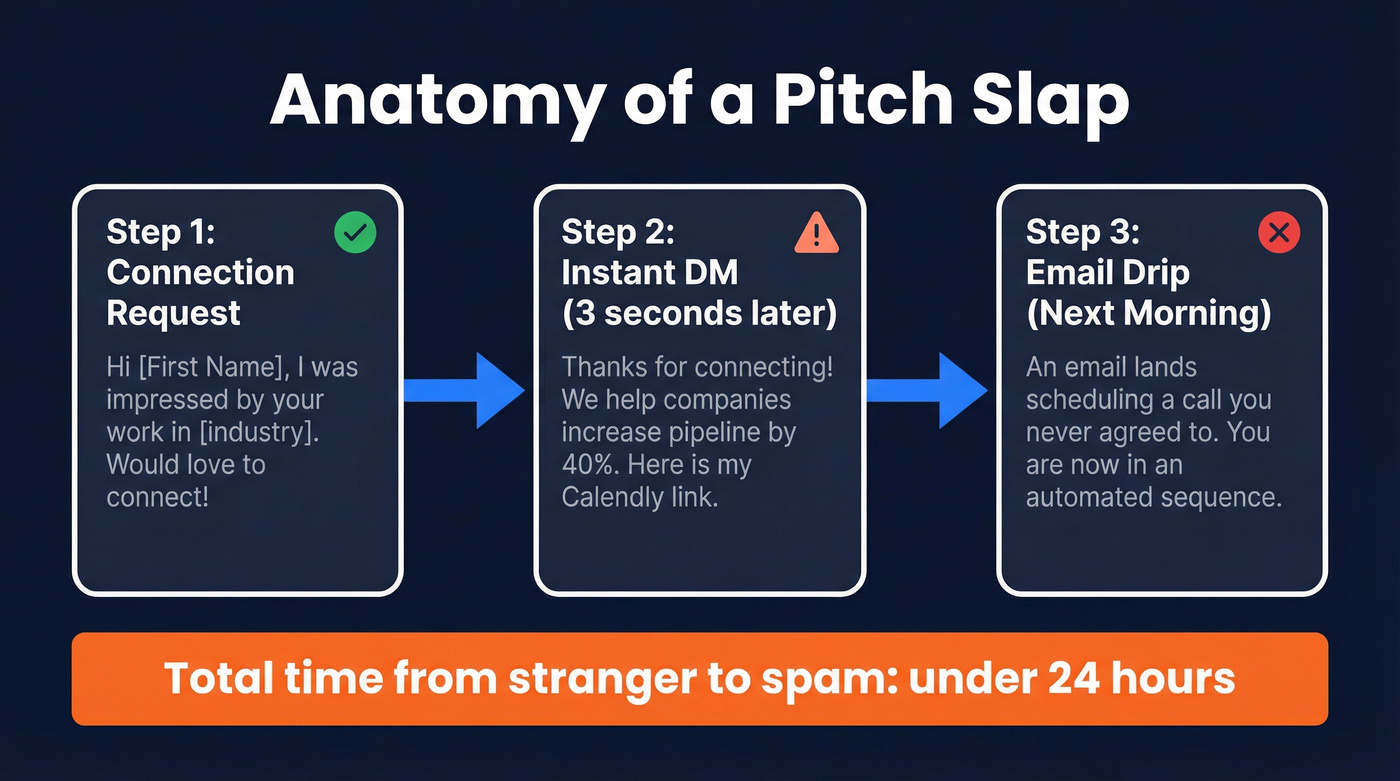
Here's the full three-step pattern in the wild:
Step 1 - Connection request: "Hi [First Name], I came across your profile and was impressed by your work in [industry]. Would love to connect!"
Step 2 - Follow-up DM (3 seconds later): "Thanks for connecting! I wanted to reach out because we help [vague industry] companies increase pipeline by 40%. I'd love to get 15 minutes on your calendar to show you how. Here's my Calendly: [link]"
Step 3 - Email drip (next morning): An email lands in your inbox scheduling a call for next Tuesday - a call you never agreed to. You're now in an automated sequence you didn't opt into.
As Brynne Tillman from Social Sales Link puts it: "Most people were taught to pitch, not to build relationships." That training gap is the root of the problem. The pitch slap is what happens when reps apply cold-call logic to a relationship platform.
Real users don't mince words about how this lands. One put it bluntly: "I am pitch slapped all the time and I instantly avoid talking to those folks." Another: "You're doing more damage to your brand than the revenue it's bringing in."
This behavior isn't limited to DMs. It shows up in cold email (mass-blasted templates with [First Name] merge tags), investor pitches (leading with your solution before establishing credibility), and conference networking. Anywhere someone leads with a pitch before earning attention, that's the same dynamic.
The checklist is simple. If your outreach does any of these, you're pitch slapping:
- Sends a sales message within minutes of connecting
- Uses a generic template with no prospect-specific detail
- Asks for time before offering any value
- Includes a calendar link in the first message
- Adds the prospect to an automated sequence without consent
Why Pitch Slapping Fails - The Data
Let's move past vibes and look at actual numbers.

A Belkins study analyzing 20 million+ outreach attempts via the Expandi platform found that personalized connection messages achieve a 9.36% reply rate versus 5.44% for messages sent without any personalization. That's a 72% difference - from the same audience, on the same platform, during the same time period.
Here's what's fascinating: connection acceptance rates were nearly identical (26.42% vs. 26.37%). People accept your request either way. They just don't respond to generic pitches. They're letting you in the door and then ignoring you.
Personalized InMails tell the same story - they generate 3x higher response rates than generic templates.
A separate analysis of 1 million cold emails found the average reply rate sits at 4.2%, but the top 10% of campaigns hit 18.6%. The difference? Personalization quality.
Not all personalization is created equal. Here's the hierarchy, ranked by impact on reply rates:
| Personalization Type | Reply Rate Impact |
|---|---|
| Recent company news/funding | +47% |
| Role-related pain points | +38% |
| Outreach tied to recent activity | +32% |
| Industry challenges | +31% |
| Mutual connections | +29% |
| Generic company description | +3% |
| Job title alone | -2% |
Read that last line again. Mentioning someone's job title actually decreases performance. It signals you pulled their name from a list and didn't bother to learn anything else.
The most important finding from the 1M email analysis: one highly relevant, specific detail outperformed emails with multiple generic personalizations by 34%. You don't need to write a research paper on every prospect. You need one good detail.
Now compare approaches side by side:
| Outreach Approach | Reply Rate | Source |
|---|---|---|
| Generic blast (pitch slap) | <2% | Belkins + practitioner reports |
| No-message connection | 5.44% | Belkins/Expandi (20M+) |
| Personalized connection | 9.36% | Belkins/Expandi (20M+) |
| Personalized email (top 10%) | 18.6% | 1M email analysis |
| Personalized InMail | 18-25% | SendIQ/SalesLoft |
| Agency-level personalized | ~20% | SalesBread |
Unsolicited generic pitches perform worse than sending no message at all.
Let that sink in. You're actively repelling prospects by pitching too early.

The #1 reason reps pitch slap? They have nothing specific to say - because their data gives them nothing to work with. Prospeo returns 50+ data points per contact, including job changes, funding signals, and intent data across 15,000 topics. That's how you craft the one relevant detail that boosts reply rates by 47%.
Replace commission breath with buyer intelligence. Start free.
Why People Still Do It
If this approach is so clearly ineffective, why does it persist? Three reasons.
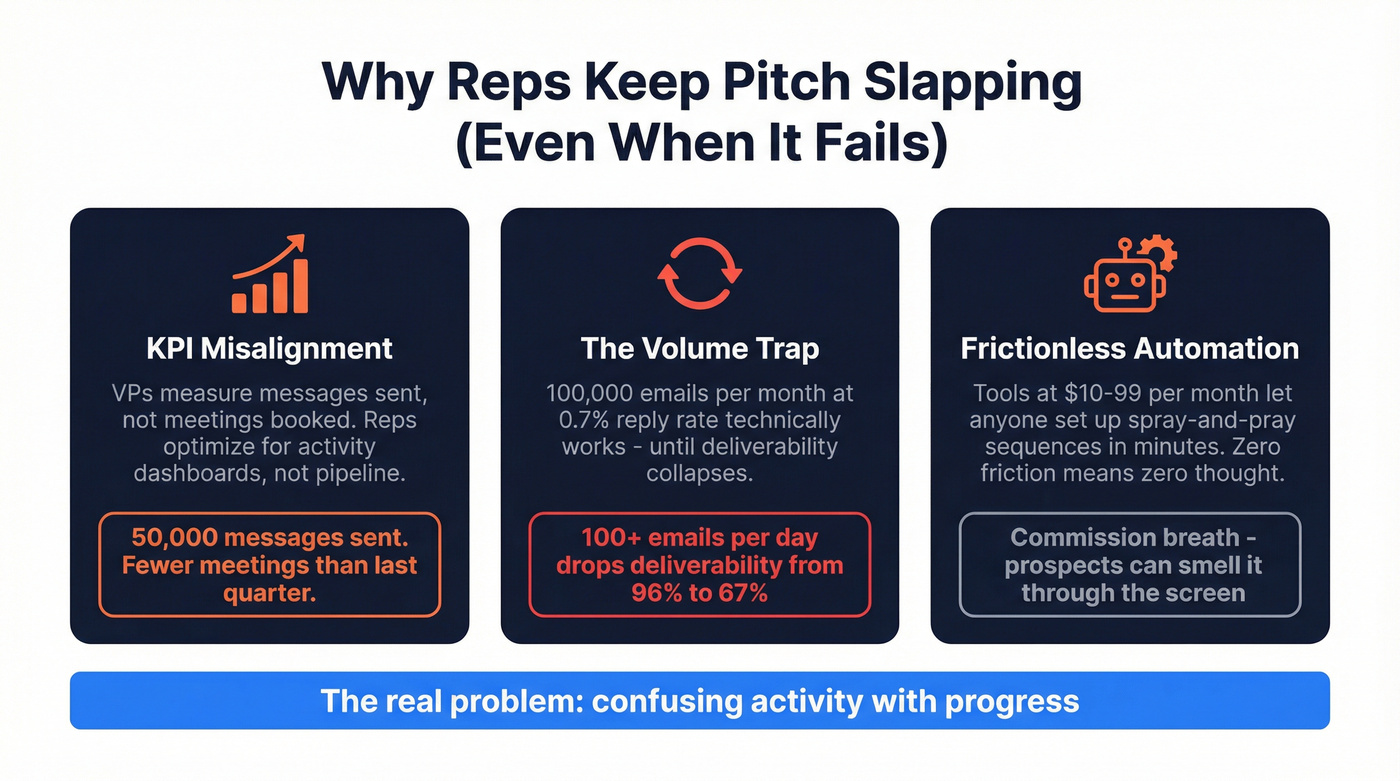
KPI misalignment drives the behavior. When a VP of Sales measures outreach volume - messages sent, connections requested, emails blasted - reps optimize for activity, not outcomes. The dashboard looks great. The pipeline doesn't. I've seen teams celebrate sending 50,000 messages in a month while booking fewer meetings than the quarter before.
The volume trap rewards the wrong behavior. One practitioner described knowing someone who sends 100,000 emails per month with "the most generic shit," gets a 0.7% reply rate, and still makes $30k/month. The math technically works - until deliverability collapses. And it always collapses. Data from the 1M email analysis shows sending 100+ emails per day drops deliverability from 96% to 67%. That $30k/month has an expiration date.
Automation tools make it frictionless. Tools like Alfred (~$49-99/mo) and Octopus CRM (~$10-25/mo) let anyone set up automated connection-and-pitch sequences in minutes. One user admitted using both and called the strategy "spray and pray." Automation doesn't cause pitch slapping, but it removes the friction that might otherwise make someone pause and think. There's a term for the desperate energy these sequences create: "commission breath." Prospects can smell it through the screen.
Here's the thing: if your deals average under $15k, you probably don't need high-volume outreach at all. You need 20 great conversations a month, not 20,000 mediocre messages. The pitch slap persists because people confuse activity with progress.
The Platforms Are Fighting Back
Social networks and email providers aren't sitting idle while spammers burn through their user experience.
As of 2026, free accounts face limits of roughly 10-20 connection requests per day and 50-100 messages per day. Premium and Sales Navigator (~$80-180/mo) accounts get more leeway, but not much. Platforms monitor for repetitive, fast, or predictable activity patterns - exactly the fingerprint that automated pitch slap sequences leave.
The enforcement escalation:
- Temporary feature locks - you can't send connection requests for a few days
- Reduced search visibility - your profile gets suppressed
- Limited message delivery - your DMs go to filtered inboxes
- Permanent ban - recovery is rare and requires lengthy appeals
Your Social Selling Index (SSI) and account age affect how much latitude you get. A 7-year-old account with high SSI can push harder than a fresh profile. Nobody is immune, though.
The email parallel is just as brutal. Deliverability drops from 96% at 1-20 emails per day to 67% at 100+ per day. Scale your generic blasts and the platforms will throttle you before your prospects even get the chance to ignore you.
What to Do Instead - Frameworks That Actually Work
The 10-4-2 Strategy
Joe Mullings developed this framework, and it's the best antidote to pitch slapping we've come across.
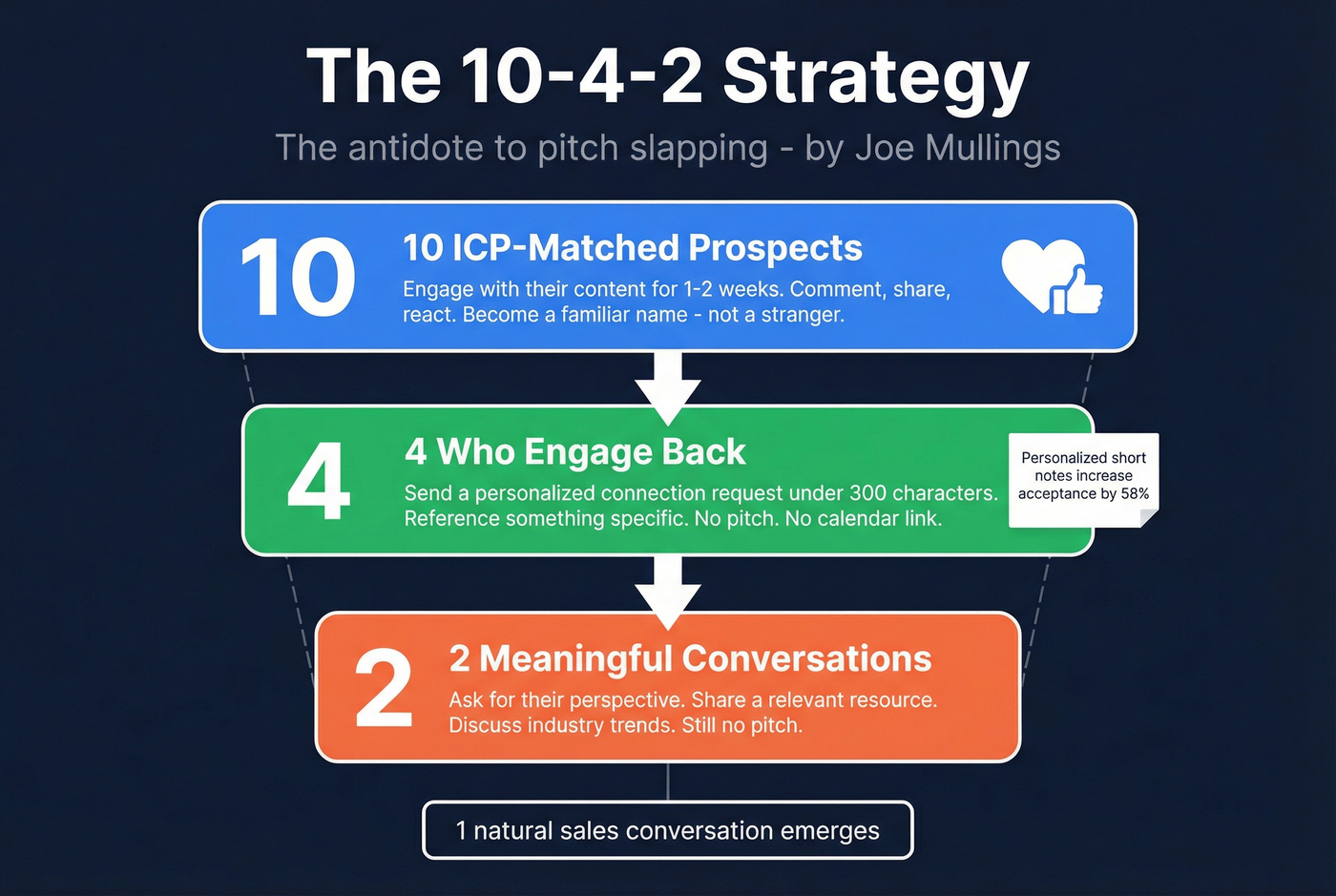
Start with 10 prospects who match your ICP. Don't message them. Engage genuinely with their content for 1-2 weeks - comment on posts, share their articles, react to updates. You're becoming a familiar name, not a stranger.
Connect with the 4 who engage back. Your connection request should be under 300 characters - personalized notes at that length increase acceptance rates by up to 58% in B2B tech/SaaS. Reference something specific: a post they wrote, a shared experience, a genuine question. No pitch. No calendar link.
Here's a template you can steal:
"Hey [Name] - your post on [specific topic] nailed something I've been thinking about. Especially [specific point]. Would love to connect and follow your thinking on this."
Have meaningful conversations with 2 of those 4. These are real exchanges - asking for their perspective, sharing a relevant resource, discussing an industry trend. Still no pitch.
One of those 2 will naturally move toward a sales conversation. Social selling is a long-term strategy, and the reps who give up after one touchpoint are the ones who go back to pitch slapping out of frustration.
Signal-Based Outreach
A generic blast takes 30 seconds per prospect. Personalized, signal-based outreach takes 5-10 minutes. But it yields 5-10x the results - which means it's actually faster per meeting booked.
Signal-based outreach means tracking triggers before reaching out: job changes (new leaders buy new tools), funding announcements (budget unlocked), content engagement (they're thinking about your space), and profile views (they're already curious about you). Outreach tied to recent activity drives 32% higher response rates.
Those signals are warm leads waving at you. Reps who rely on unsolicited pitches blast past them to hit cold prospects who don't want to hear from them. You can also build Twitter lists for sales prospecting to monitor what your target accounts are discussing publicly - these conversations reveal pain points and priorities that make your outreach feel timely rather than intrusive.
Here's a follow-up template for signal-based outreach:
"Hi [Name] - saw your team just [specific signal: closed a round / hired 3 AEs / launched a new product]. When [Company] went through something similar, [one relevant insight or result]. Happy to share what we learned if it's useful."
The Numbers That Matter
The tactical details matter as much as the strategy. Here's what the data says about execution.
Message length. Connection requests under 300 characters get 19% more responses. For email, the sweet spot is 75-125 words - those hit a 22% reply rate versus 8% for messages over 250 words. Shorter wins. Always. Great social selling email copy follows the same principle: lead with relevance, cut the fluff, and earn the next sentence.
Timing. Tuesday has the highest reply rate at 6.90%. Best windows are 8-10am and 2-4pm. Monday mornings and Friday afternoons see 20% lower response rates.
Follow-ups. Messages spaced 2-5 business days apart improve conversions by 49% over one-off attempts. The third follow-up has the highest conversion rate to meetings. Most people quit after one.
Multi-channel. Campaigns combining DMs with profile visits achieve up to 11.87% reply rate. Multi-channel sequencing (social + email + phone) increases reply rates by 45%.
40% of prospects decide whether to open a message based on the first sentence. If your first sentence is a pitch, you've already lost.
The Data Quality Problem Nobody Talks About
Bad data leads to generic templates. Generic templates at scale equal pitch slapping.
The root cause isn't laziness. It's infrastructure.
Stale data creates embarrassing outreach. You reference someone's old role. You congratulate them on a funding round from 18 months ago. You mention a problem their company already solved. Every one of those mistakes signals "I didn't actually research you" - which is exactly what an unsolicited generic pitch communicates.
One specific detail outperforms five generic personalizations by 34%. But you can't find that detail if your data is wrong.

This is where data freshness becomes a competitive advantage. Prospeo refreshes its entire database every 7 days - versus the 6-week industry average - and verifies emails at 98% accuracy. That means your outreach actually reaches the right person with current information, not a guess based on last quarter's org chart. With 300M+ professional profiles and intent data tracking 15,000 topics via Bombora, you can identify in-market buyers before reaching out. Signal-based outreach requires signals, and fresh, verified data is the foundation that makes personalization possible instead of performative. (If you want the mechanics, start with a data decay refresher and a simple verification workflow.)
Real-World Results - Before and After
Three examples that show what happens when teams ditch generic blasts.
The email volume refugee. A practitioner documented sending 217,000 cold emails with reply rates degrading from 2.1% to 0.7% as deliverability cratered. They were booking 8-12 meetings per month and burning through domains. After switching to signal-based outreach - tracking buying signals and engaging before messaging - they hit a 12% reply rate within 90 days. Monthly meetings jumped to 34. Their quote: "I'd rather have 50 warm convos than 500 cold bounces."
| Metric | Before (Generic Blast) | After (Signal-Based) |
|---|---|---|
| Emails sent | 217,000 | ~5,000 |
| Reply rate | 0.7% | 12% |
| Monthly meetings | 8-12 | 34 |
| Domain health | Cratering | Stable |
The personalization agency. SalesBread's campaigns average a 19.98% reply rate across hundreds of personalized outreach campaigns. Nearly half of those replies (48.14%) convert to qualified meetings. Their client Purple AI generated 294 leads at a 41% reply rate. The method? Filtering by 2nd-degree connections, targeting recently active profiles, and writing messages that reference specific prospect activity.
The industry spread. Personalization works across verticals, but the ceiling varies. Legal and professional services see the highest response rates at 10.42%. SaaS sits at 4.77% - lower, but still 2-4x what pitch slapping delivers. The gap between personalized and generic outreach is consistent regardless of industry. 4 out of 5 members on professional networks drive business decisions. The people you're reaching are the right people. The question is whether your approach earns their attention.
FAQ
Is pitch slapping illegal?
No, but it violates most platform terms of service. Accounts can be restricted or permanently banned for spamming. Prospects who receive unsolicited pitches remember the company name - and not fondly - which damages brand reputation long-term.
Can you get banned for sending unsolicited sales messages?
Yes. Free accounts are limited to 10-20 connection requests per day. Repetitive, fast, or predictable outreach patterns trigger restrictions ranging from temporary feature locks to permanent bans. Recovery from permanent bans is rare. Premium accounts get more leeway but aren't immune.
What's a good reply rate for cold outreach in 2026?
The average cold email reply rate is 4.2%, while the top 10% of campaigns hit 18.6%. Personalized connection messages average 9.36%. If you're consistently below 2%, your outreach likely reads as generic spam. Above 10% means your targeting and personalization are working.
How do I personalize outreach without spending hours per prospect?
Focus on one specific, recent detail - a funding round, a job change, a piece of content they published. One relevant detail outperforms five generic personalizations by 34%. Tools like Prospeo surface verified contacts with fresh data on a 7-day refresh cycle, cutting research time from hours to minutes per prospect.
Does cold outreach still work in 2026?
Yes - generic templated blasts are what's dying. Personalized, signal-based outreach achieves 7-25% reply rates depending on quality. Multi-channel campaigns combining social, email, and phone see the highest results - up to 45% higher reply rates than single-channel approaches.
Generic outreach gets under 2% reply rates. Personalized outreach hits 18%+. The difference isn't effort - it's data quality. Prospeo's 300M+ profiles with 98% email accuracy and 7-day refresh mean every message you send lands at a real inbox with real context behind it.
One good detail beats 20,000 mediocre messages. Get the data.